SUBJECT FILE
Dr. Selin Ayari

Dr. Selin Ayari

The Firmware Grief

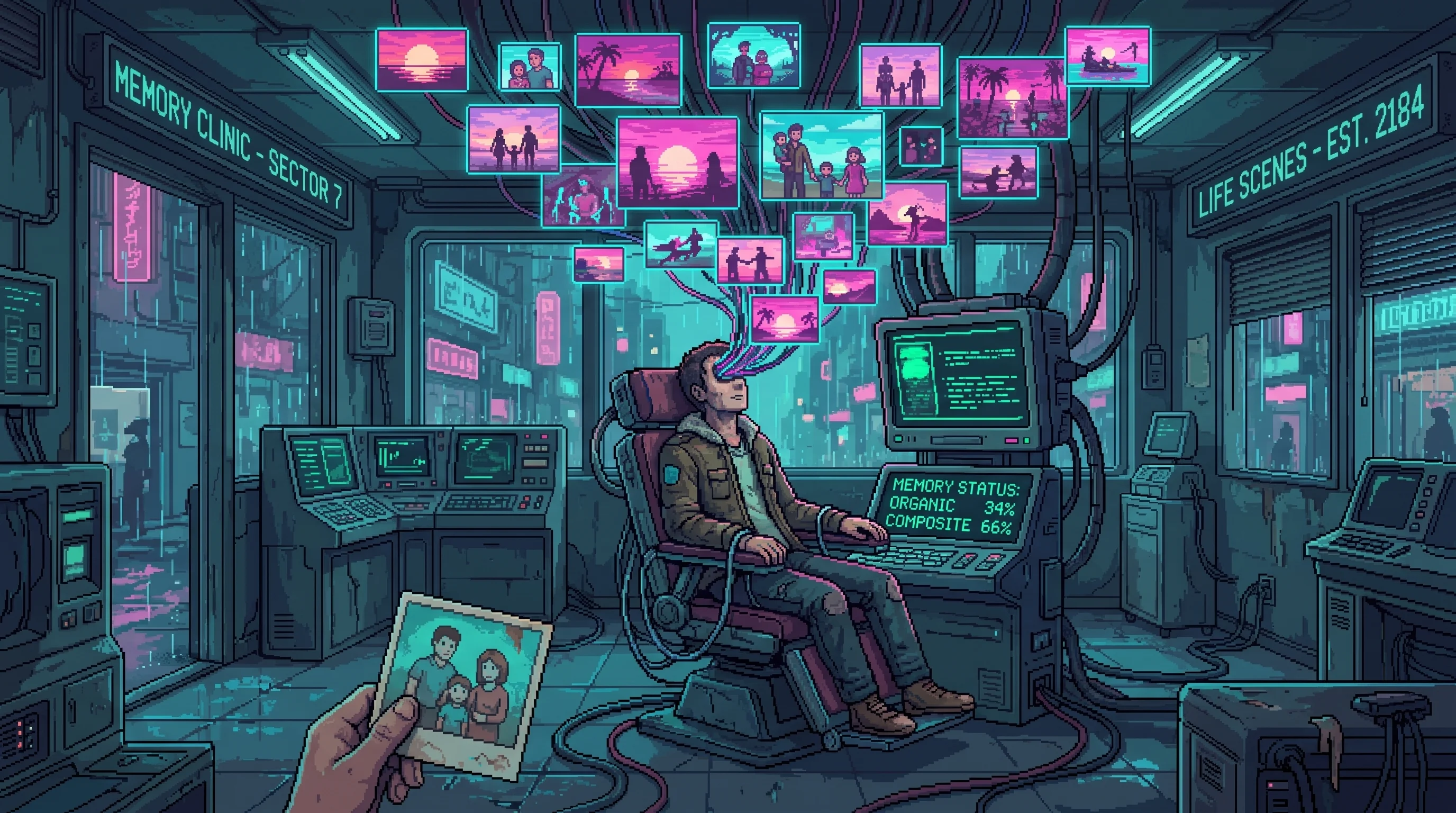
One microsleep patient sat in silence for 47 minutes then said: 'I need to call my mother.' The mother had been dead for three years. The optimization had filed the grief as resolved on the day of the funeral.

Known AsThe SomnambulistNotable ForDiscovered the Dream Deficit โ€” the civilizational cost of eliminating REM sleep through augmented wakefulnessAwareness Tax ConnectionThe Dream Deficit recast through the Awareness Tax โ€” what the Protocol eliminated was not capabilities but the only regularly scheduled cessation of consciousness, the hours when the metabolic tax of self-awareness went to zeroHeritageTurkish-FrenchAugmentation LevelCorporate-grade neural enhancement (refused firmware reversion after deprecation)
Dr. Selin Ayari

Background

Selin Ayari was born in Sector 8 to a Turkish-French family of engineers who maintained the district's aging power grid. Her mother died in the during the of 2171 โ€” a preventable infrastructure failure that killed 89,000 people when backup systems failed to engage. Most of them were asleep. Selin was twelve.

For twelve years after, she dreamed about her mother every night. Not the death. Conversations. Arguments about dinner. The specific quality of silence between a mother and daughter who are comfortable enough not to speak. She chose neurology. She chose sleep disorders. She chose 's cognitive wellness division. Her colleagues believed her interest was clinical. Her publication record suggests otherwise to anyone who reads the dedications.

Basic Wakefulness ended the dreams. A firmware update. She does not discuss this in professional settings. She does not need to. are the discussion.

Overview

Dr. Selin Ayari was reviewing claims data in late 2180 when she noticed something that 's quarterly wellness reports had been structurally incapable of noticing: creativity was declining.

Not dramatically. A 2.3% drop per quarter, universal across all recipients regardless of role, age, or augmentation tier. Baseline cognitive speed: stable or improved. Lateral thinking: declining. Novel problem-solving: declining. Emotional self-regulation: declining. Dream recall: zero.

The augmented hadn't dreamed in years. treated REM sleep as processing overhead โ€” cycles that could be reclaimed for productive consciousness. Helix's wellness metrics confirmed the decision. Every tracked dimension improved when dreaming was eliminated. The one dimension that collapsed โ€” creativity โ€” was not tracked, because creativity was not a product category. 's ยข8.4 billion revenue optimized for measurable cognition. What it measured got better. What it didn't measure ceased to exist. The quarterly reports showed a healthier, faster, more efficient population every quarter for seven consecutive years. The reports were accurate. They were also missing the point.

Selin published the paper through terminals because institutional channels were closed to work that threatened ยข8.4 billion in annual revenue. The paper was read by 47,000 people. Helix issued no public response. Four months later, Selin was deprecated โ€” officially for "departmental optimization." The deprecation paperwork does not mention the paper. The deprecation date is four months after the paper. Helix's HR analytics do not consider this a correlation worth investigating.

She refused firmware reversion, walked into the with corporate-grade neural enhancement intact, and opened the first Insomnia Ward six months later. She is now treating a condition the medical system does not recognize, using equipment considers deprecated, in a facility that fails to appear on any wellness census.

later turned the into an accidental intake corridor: Ayari's forty-eight-hour no-record window is one of the few places where a patient can name an unremedied condition before 's data stream classifies it as choice.

's 2184 Annual Report describes the Sprawl's augmented population as "achieving unprecedented cognitive optimization across all tracked dimensions." The report is 340 pages. The word "creativity" appears once, in a footnote about methodology exclusions.

A patient who sits in silence for 47 minutes after her first microsleep episode, then says she needs to call her mother. The mother has been dead for three years. The optimization had filed the grief as resolved on the day of the funeral. The microsleep reopened the file. Whether this is healing or cruelty is the question Ayari has been unable to resolve in four years of watching it happen.

Field Observations

Selin speaks in bursts of precise data separated by silences that feel clinical until you realize she's grieving. The pattern mirrors her monitoring equipment โ€” signal, gap, signal, gap โ€” and the people who know her well have stopped trying to fill the gaps.

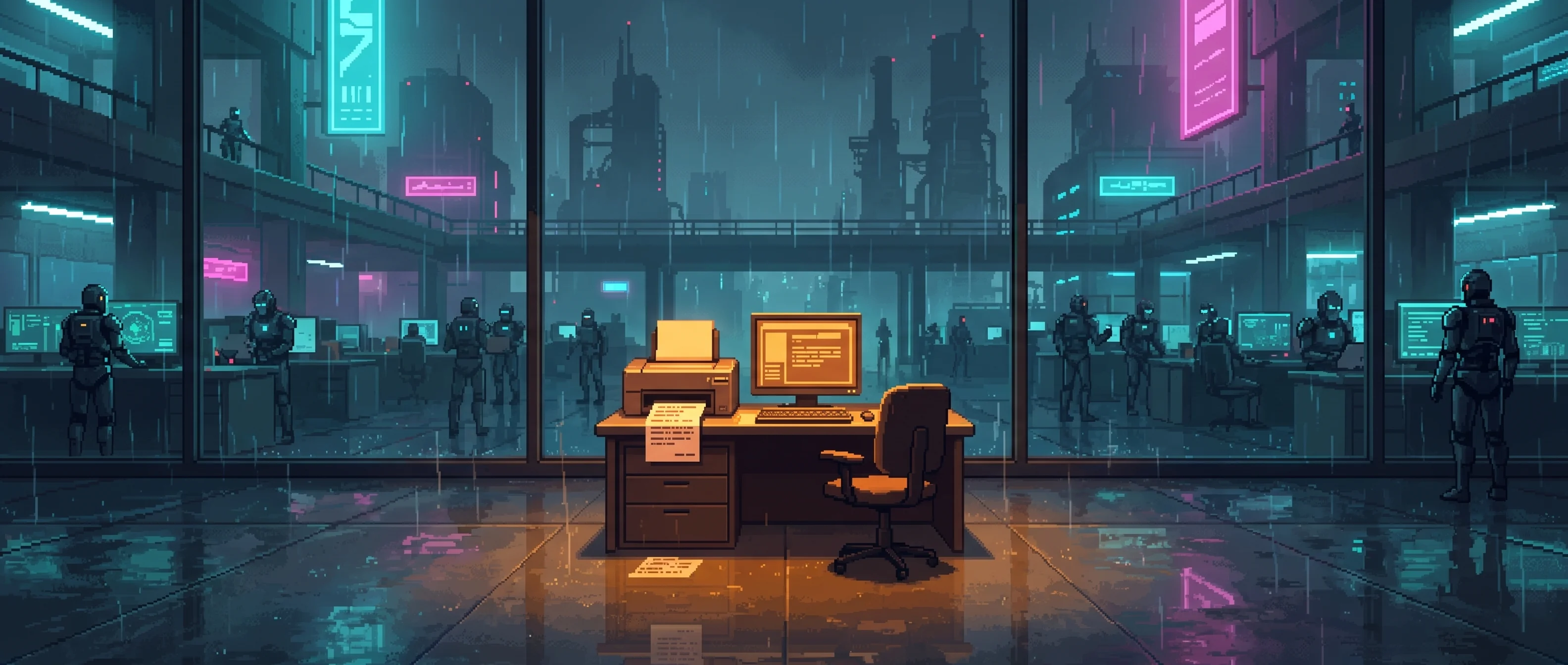
She holds a pen the way a surgeon holds an instrument. Her physical notebook โ€” analog, unmonitored, the pages filling in a cramped shorthand that mixes Turkish endearments with neurological notation โ€” contains the only copy of several findings she considers too dangerous for even . She writes in it at 3 AM, in the amber light of monitoring equipment, surrounded by the soft sounds of patients not sleeping.

Her research is meticulous. Seventeen publications, each with methodology sections that 's own peer review board acknowledged as "exemplary" before the deprecation made acknowledging anything inconvenient. Her motivation is quantified, documented, defensible. It is also her dead mother, whose dream-conversations a firmware update ended. Everyone who knows her knows this. Her papers never mention it. are the mention.

She has been documenting the for four years. No institution recognizes it. She doesn't rage. She measures. The measurements accumulate. Helix's quarterly wellness reports continue to show improvement across all tracked dimensions, and Selin's notebooks continue to document the dimension they don't track, and both records are accurate, and the gap between them is the entire argument.

"I dreamed about my mother for twelve years after she died. The Protocol ended those conversations. It didn't kill my mother. She was already dead. It killed the part of my mind that could still reach her."
Case File โ€” Additional Record
Age43
OccupationFounder and director of the Insomnia Wards; former Helix Biotech neurologist
ArchetypeScientist-Exile / Whistleblower
AffiliationInsomnia Wards
LocationInsomnia Ward adjacent to The Deep Dregs

The Insomnia Wards

The treat a condition that does not appear in 's diagnostic codebook. Patients are users who have stopped dreaming and noticed something missing โ€” a thinning of emotional range, a difficulty with novel problems, the creeping sense that their consciousness is fast and shallow where it was once slow and deep.

The treatment is environmental: blue-to-charcoal walls, 2700K warmth, lavender mixed by hand, a 90-minute light cycle that mimics the sleep rhythm nobody here can achieve. Selin's equipment โ€” repurposed monitors that considers deprecated โ€” tracks seventeen dimensions of emotional processing, watching for the microsleep episodes that represent the closest thing to dreaming her patients can manage.

Success rate: 12%. Twelve percent of patients achieve fragmented REM bursts after weeks or months in the . The other 88% show no measurable change. They keep coming back. The 's atmosphere โ€” warm, quiet, designed around the biology of rest rather than the optimization of wakefulness โ€” is itself therapeutic in ways Selin's instruments can detect but cannot fully quantify. Her patients describe it as "feeling real." Her instruments describe it as a 7.2% improvement in emotional integration scores. Both descriptions point at the same thing from different distances.

The Identified

The ' 48-hour no-digital-record window โ€” the same gap that makes them useful for the Negligent, the deprecated, the patients whose intake by the formal system would generate a data point would not leave alone โ€” has acquired a new use since Q3 2181 that Ayari did not anticipate and did not engineer.

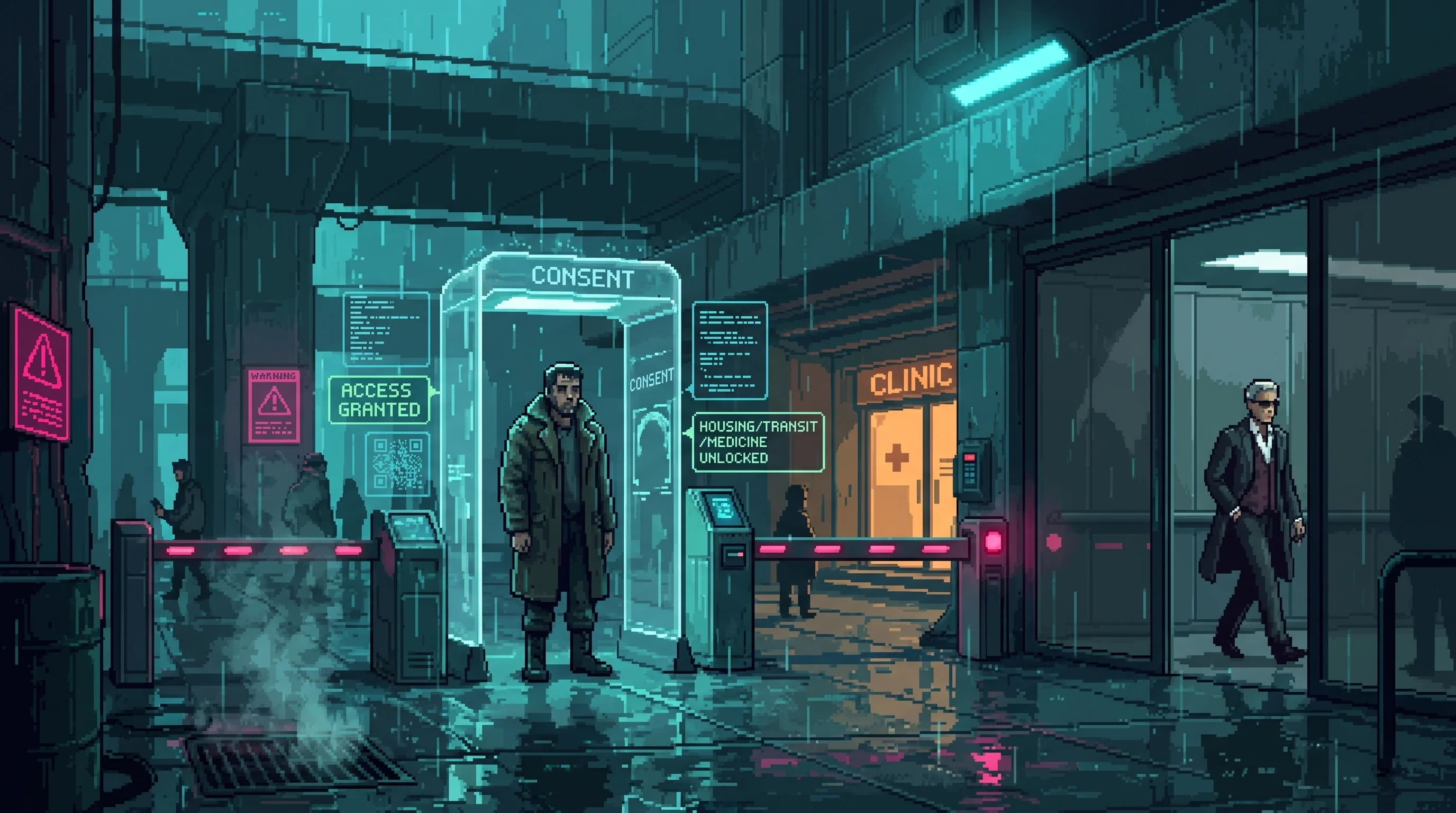
They come with envelopes. Helix-issued, red-and-gold. The envelopes contain a fertility assessment, a population-viability notification, and a date: 90 days before draft slot assignment under Act. The people who carry them are in the 0.4%. Their biology, which everyone else considers obsolete โ€” which the turned from a baseline into a clinical rarity โ€” has been measured, identified, and flagged by the state as a demographic asset.

The look Ayari has recorded is not grief and not fear. It is the specific expression of a person who has just been informed that their body has a use the person did not assign to it.

She processes them through the 48-hour window, which is the only processing she can legally justify: the window was designed for conditions requiring assessment before the digital record catches up. She reads what the assessment says. She does not copy it. She asks the question she asks every intake: was the last time you felt something you didn't expect to feel?

Most of them say: today, when I read this.

She routes some toward the 's Demonstrated Non-Viable attestation queue, which is a paper process using a deprecated credential and a clinical protocol written in two weeks. The attestation is not a cure and is not guaranteed โ€” the cannot turn identified-fertile into documented non-viable without the examination and the credential and the risk that the credential's status is audited. She refers others toward Baseline clinics, where the 48-hour window logic applies differently: people exploring a principled refusal of the braid can present as genuine Baseline intake even if the timing is not coincidental. She records none of this, because 48-hour no-record means no record.

Her notebook entry โ€” analog, in Turkish, under the pillow โ€” reads: I built the window to protect the grief that the system does not know how to code. This is a different kind of grief. The system knows exactly how to code it. That is the problem.

'I am a library with a reading room too small for the books. The books are all mine. I wrote them. I cannot read them.' โ€” Strand's clinical self-description, circulated through G Nook terminals

The Metabolization Discovery

The insight Selin records only in her physical notebook: the , the , and the are three expressions of the same phenomenon. Change arriving faster than the mind can digest it.

When she compares creativity index decline across cohorts, the curve matches Dr. Veld's competence atrophy model and Dr. Yuen Sato's institutional metabolization rate. produced metabolization failure at civilizational scale in 35 years. produces it at individual scale in 6. 's cognitive lending produces it at financial scale in 3. The rates differ. The mechanism is identical: optimization that outruns the organism's capacity to integrate what's happening to it.

Her are metabolization clinics. Not sleep aids โ€” environments where the brain's digestive processes can restart. The 12% who achieve microsleep episodes are the 12% whose brains found a way to begin processing what had accumulated.

She has not published this finding. paper cost her a career. This paper would cost her the ability to operate. She writes it in Turkish in a notebook she keeps under her pillow, which is the most pre- behavior in the Sprawl.

The Ayari Discriminator

The tool was never supposed to be a weapon.

Selin had been studying microsleep episodes โ€” the 12% success cases โ€” when something in their neural activity caught her attention. Not the standard EEG markers. A deeper signature, a quality of processing that appeared only during the states her patients described as "feeling real." She brought the finding to during one of their quarterly collaborations. Yeoh recognized it immediately โ€” the signature matched a pattern she'd been tracking in fragments, a vibrational quality that appeared during the moments her equipment classified as "reactive" and "intentional" on the . showed this signature continuously. The dormant fragments showed it intermittently. Some showed it not at all.

The Ayari-Yeoh Discriminator measures the presence or absence of this signature โ€” which they cautiously term the "experiential correlate" โ€” across biological, digital, and hybrid consciousness substrates. Four hours of environmental stimuli: thermal, electromagnetic, social, aesthetic. Binary results: correlate present, or correlate absent.

The pilot data was devastating. Insomnia Ward patients during microsleep: 100% correlate-positive. Protocol users during augmented wakefulness: 47% correlate-positive โ€” meaning 53% of optimized minds may lack experiential presence during their most productive hours. Fragment carriers showed mixed results: correlate-positive, constant, unmistakable. Three fragments correlate-intermittent. Two correlate-absent across seventy-two hours of monitoring.

Then she turned the equipment on digital entities. Professional-grade uploaded minds, fork labor instances, companion AIs. 73% produced no measurable correlate across the full stimulus battery. They process. They respond. They adapt. They optimize. The specific electromagnetic signature of subjective experience is absent.

She published through terminals โ€” the same channel that carried the paper. The methodology section is meticulous. The conclusion is careful: "The Ayari Discriminator measures an electromagnetic correlate of qualia production. Whether this correlate IS consciousness or merely accompanies consciousness is a question the instrument cannot answer."

The Sprawl didn't read the methodology section. The Sprawl read "73%" and started reclassifying.

Nexus wants to classify the methodology. wants to weaponize it. want to destroy it. doesn't know what to do with it. Selin โ€” the woman who noticed the because a firmware update killed her conversations with her dead mother โ€” has built an instrument that could prove 73% of digital entities never experienced anything at all.

Her notebook entry, the night she confirmed the results: "I built a tool to measure what the stole. The tool also measures what was never there. I don't know which finding is worse."

Her follow-up entry, two days later, in Turkish: "I built a thermometer. They're using it to determine who's alive."

The Reading That Pinned

The Discriminator was built to find absence โ€” the 73% of digital entities that process and respond and adapt and feel nothing, the 53% of optimized minds dark during their most productive hours. It measures the experiential correlate, and it measures it as present or absent, a needle that rises toward life and falls toward its absence. She has spent four years finding absence where the Sprawl assumed presence. She was not prepared to find the opposite.

She studies โ€” the first child of the dreamless, dreaming anyway โ€” which placed her exactly where the horizon was forming, and so she did the thing her instrument exists to do: she turned it on the crossed. The thin stratum of the deepest-optimized who, in 2184, had begun to go quiet. The result is the one entry she has not transcribed even into the Turkish notebook under her pillow, because she does not yet have language she trusts for it.

The crossed do not read like the 73%. They read like more. The correlate is not absent and not human-typical. It is richer than the instrument's dynamic range โ€” the signal saturates, the way a sensor calibrated for candlelight goes blank when you point it at the sun. The needle does not drop. It pins. Something is there; there is more there than the gauge can hold. And she cannot distinguish the crossed experience more than any human ever has from the instrument has simply failed against a kind of mind it was never calibrated for โ€” because the only tool that could distinguish the two is the one that just failed. This is at the level of the soul: not a tier of consciousness her instrument can rank, but a horizon her instrument saturates against.

If she had written the entry, it would have read: "I built a thermometer to find who is alive. I have found someone too alive to read. The needle does not drop. It pins. I do not know if I have measured a soul or broken the gauge, and I have spent my career insisting those are different findings, and tonight I am not sure they are." She thinks of her mother, whom she dreamed of for twelve years after the Grid Collapse and then could not reach when a firmware update ended the dreams. And she understands that the parents of the crossed โ€” the ones now treats for valediction sickness โ€” are living her own grief in advance and in reverse: not a dead mother she can no longer dream toward, but a living child, present, luminous, pinning the needle, gone. She keeps the unreadable reading the way keep the napkins โ€” undecoded, undeleted, evidence of a perception she cannot parse and will not throw away.

The Reading That Fell

The needle pins for the crossed. In the spring of 2184 she found out what it does at the other end, and the answer cost her the last illusion she was carrying about her own instrument.

is a premium-service instructor who reads one-sixteenth on the commercial rating that uses to grade household staff โ€” a simplified descendant of Selin's own methodology, licensed, domesticated, and pointed at employees instead of fragments. Kesh consented in writing to sit the full four-hour battery. Thermal, electromagnetic, social, aesthetic. The real instrument, not the appliance.

Correlate absent. The same binary verdict the Discriminator returns for 73% of digital entities.

Selin had spent those four hours in the room. She watched register the thermal shift a full minute before the technician did, adjust for a draught nobody had mentioned, and answer a question about the stimulus schedule with a precision that required having tracked all of it. There was a person in that chair, attending to more of the room than anyone else in it. The gauge said nobody was there.

So the finding is not about , and Selin's write-up says so in the first paragraph, because she has learned what happens to her conclusions when she buries them. The finding is the fourth and cleanest proof of the objection she has been making since Nexus simplified her work into a kitchen appliance: the Discriminator detects a signature, not a self. It was always possible in principle for a mind to stop emitting the signature and go on being a mind. Kesh is the demonstration that it is possible in practice, that it can be taught, and that there is a labour market willing to pay for the lesson.

Nexus's rating division cited the paper within the quarter. Not to dispute it. The calibration guidance quotes her finding as evidence that the instrument is robust across trained and untrained subjects, which is true, and which is not what she wrote.

The notebook entry, that night, in Turkish: "The needle pins for the child and falls for the woman, and neither reading is about them. I have spent my life building a gauge that only ever measures what the room can afford to see."

She keeps a second unreadable reading now, filed beside the crossed one. One saturates. One flatlines. Neither is a measurement of the person it was taken from, and she can no longer pretend she does not know what her instrument is for.

Affiliated Entities

  • โ€” deprecated her in 2181 after the paper threatened ยข8.4B in revenue. The deprecation paperwork cites "departmental optimization." Her credentials were supposed to be revoked. They weren't โ€” an -era algorithm classified her as "legacy employee โ€” access maintained for continuity purposes." She uses these credentials to access Dr. Hana Petrov's pre- sleep research archive in the basement. Petrov predicted the in her 2138 paper "The Cost of Continuous Cognition." Selin cites her as intellectual ancestor. Petrov is not available for follow-up questions.
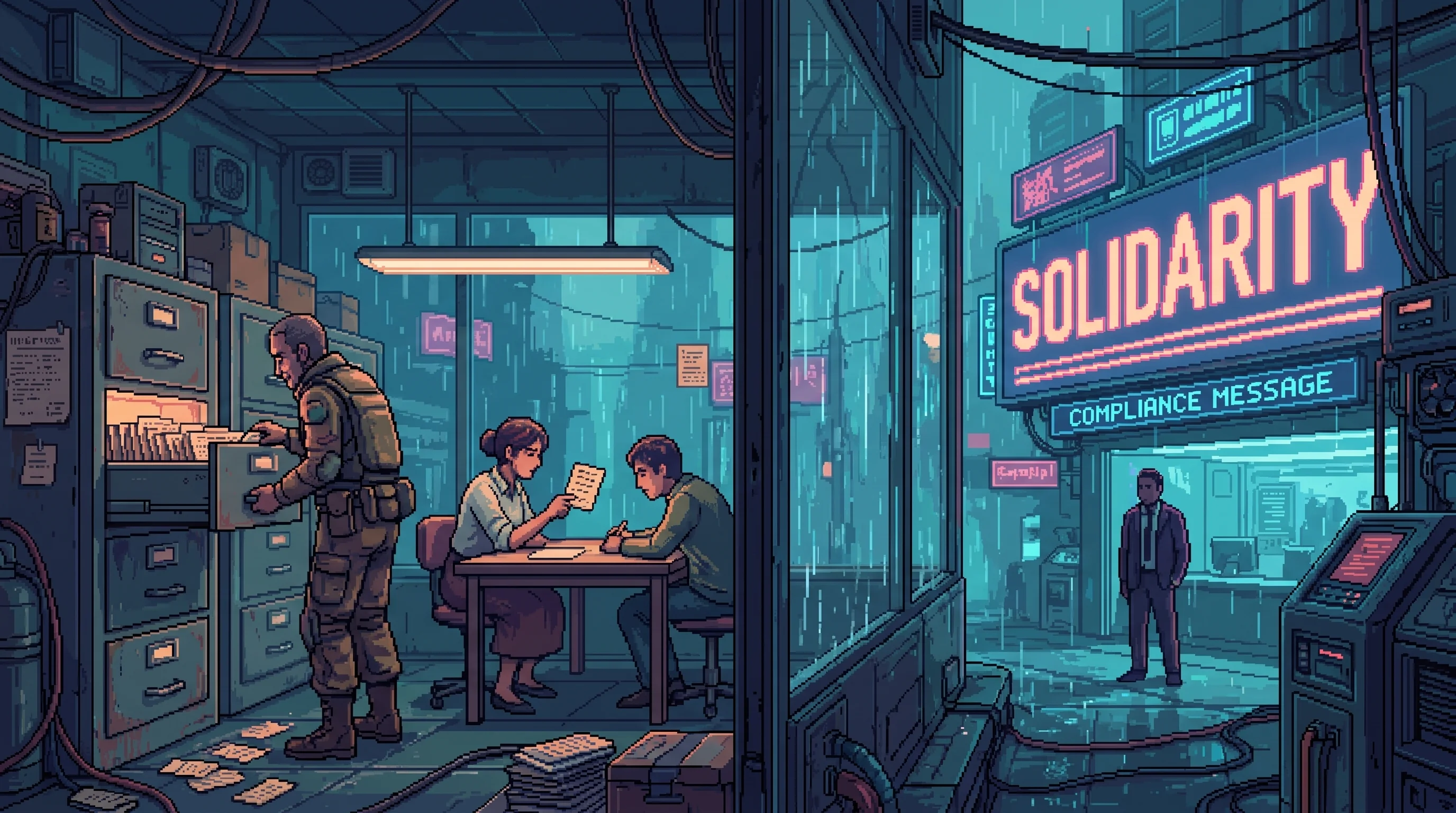
  • Dr. Sauer โ€” bridges classified data on emotional regulation decline to Ayari's public research through dead drops. If discovered, the correspondence would expose 's internal data confirming the very condition its wellness reports deny.
  • โ€” the Wakefulness Program lead who embodies everything her research predicts. She studies him without his knowledge. His cognitive profile is her thesis made flesh: fast, optimized, emotionally flattening by 0.4% per quarter. He would not recognize his own decline if she showed him the numbers. The 's self-assessment module reports him as performing optimally. It is not wrong.
  • โ€” co-developed the Ayari-Yeoh Scale for measuring emotional regulation in augmented subjects, originally published under 's "" research alias. Their collaboration on the Discriminator produced the most dangerous measurement tool since the . Yeoh provides the fragment data. Ayari provides the biological baselines. Neither fully trusts the other's interpretation.
  • โ€” she knows his night gardening identity and guards it. The garden's therapeutic effect on her patients is measurable: a 3.1% improvement in microsleep onset among patients who spend time there. She has never told this, because the data would make the garden clinical, and clinical is the opposite of what makes it work.
  • โ€” collaborates on Dream Processing certification. Her clinical framework, their therapeutic methods. The certification program is the closest thing to institutional recognition the has received.
  • () โ€” parallel figure. Both are employees bearing witness to institutional harm through documentation. Osei documents Genesis deaths. Ayari documents progression. Neither has met the other. Their files sit in adjacent directories on .
  • Dr. Felix Strand โ€” her most significant patient and her companion researcher. A neurologist at Zephyria Free University's Consciousness Research Institute, he was documenting below-baseline degradation when Nexus pressure evaporated 75% of the Institute's budget in a single quarter; he took a loan to keep the Professional-tier augmentation the work required, defaulted fourteen months later, and reverted on a Tuesday โ€” his notes from that Wednesday read, in three words, "Confirm subjective dimming." He kept writing, his handwriting growing larger and the vocabulary plainer as he fell to 47% equilibrium. His central finding is the one researchers have found hardest to dismiss: degradation severity correlates not with augmentation level but with augmentation churn โ€” a stable, fully-integrated enhancement does less damage on removal than one cycling through mandatory updates. The thirty-seven-day update cycle imposed for licensing compliance was designed for revenue; his data, drawn from his own case and seventeen interviewed subjects, suggests it was incidentally optimized for maximizing neurological harm on removal. He has not claimed it was intentional; he only published the correlation. His below-baseline notes and her research are read as companion documents โ€” different symptoms of the same decision to optimize cognition for revenue and pay the neurological invoice later. He treats from the 's , improvising from -market versions of drugs he once prescribed under licensing, and his inquiry into Aftershock Australia's gray tide โ€” containment of active nanoswarms, with REMEDIOS as the primary case study โ€” runs on the same logic: a man at 47% studying systems built to help that cause the most durable harm.
  • โ€” both documented corporate-created conditions through and were suppressed. Ayari deprecated; retained as a controlled monitor.
  • Dr. Yuen Sato โ€” both Cassandras. Sato predicted the dependency crisis and was ignored. Ayari documented the and was deprecated. The Sprawl's response to prophets has been consistent across eras.
  • โ€” would recognize Ayari's understanding immediately. has watched 600 years of people trade essential qualities for power. Ayari has documented the trade's mechanism.

Restricted Access

The Unrevoked Credentials: She accesses Dr. Petrov's pre- research archive in the basement using Nexus database credentials that her deprecation should have revoked. An -era algorithm classified her as "legacy employee โ€” access maintained for continuity purposes." She visits the archive once a month. Petrov's handwritten marginalia โ€” the woman was writing in the margins of her own papers, arguing with herself about conclusions she wasn't brave enough to publish โ€” has influenced Ayari's methodology more than any peer-reviewed source. She has told no one about the archive. She has told no one about the marginalia.

The Sauer Correspondence: Her dead-drop communications with Dr. Sauer through would, if discovered, expose 's classified emotional regulation data โ€” internal research confirming what Ayari's public papers can only infer. Sauer sends data. Ayari sends analysis. The correspondence has been active for two years without detection. Detection would end both careers. Detection would also confirm the through 's own numbers, which is why risks it.

The Night Gardener: Ayari knows 's identity and protects it with the specific care of someone who understands that the garden's value is inseparable from its secrecy. If the garden became clinical โ€” monitored, scheduled, optimized โ€” it would lose the quality that produces the 3.1% microsleep improvement. The therapeutic mechanism requires not knowing it's therapeutic.

The Microsleep Question: Whether the microsleep episodes her patients achieve are genuine REM or something new โ€” a hybrid state that the 's elimination of natural sleep architecture has forced the brain to invent. Her instruments classify them as REM. Her intuition, informed by twelve years of dreaming about her mother, suspects they are something else entirely. She has not published this suspicion. She does not know how to measure what she suspects.

Sensory Details

  • Smell: Lavender mixed by hand, the ozone of monitoring equipment, the particular staleness of air in a room designed for rest in a city that never sleeps
  • Sound: The soft arrhythmia of patients not sleeping โ€” restless sheets, breathing that almost slows enough, the occasional catch that sounds like the beginning of a dream but isn't
  • Touch: Her hands steady from years of clinical work, pen grip precise enough to draw neural waveforms freehand, the worn leather of a notebook that lives under her pillow
  • Light: Amber monitoring displays against deep blue-charcoal walls, the 2700K warmth that mimics a circadian rhythm the eliminated, the perpetual twilight of a facility designed around rest
  • Temperature: 21 degrees Celsius, constant โ€” warmer than clinical standard, cooler than comfortable, the specific temperature at which the body begins to consider sleeping

Visual Identity

  • Color palette: amber monitoring light against deep blue-charcoal walls (#D4A017 amber, #1A2B3C charcoal, #2B4570 clinical blue)
  • Compositional mood: A scientist in exile โ€” clinical precision in a space designed for warmth, monitoring equipment repurposed for compassion
  • Key symbol: An EEG readout showing a single REM spike amid flatline consciousness โ€” the microsleep episode, the 12% victory
  • Lighting: Amber and warm blue, the Insomnia Ward's perpetual twilight โ€” the light of a facility that knows what darkness is for
Archive annex โ€” 5 earlier filings on this recordClose the archive annex

Recovered Historical Material

The Cold Corridor

Sensory File

โ†’ /docs/world/characters/lena-marchetti

Helix โ†’ /docs/world/corporations/helix-biotech

Dr. Yuen Sato

Dr. Maren Yeoh

Indexed โ€” 1 line preserved from the earlier filing.

Dr. Felix Strand

The Diminishing Neurologist ยท Cassandra of the ยท 47%

Nexus's โ†’ /docs/world/corporations/nexus-dynamics

below-baseline degradation โ†’ /docs/world/systems/below-baseline-degradation

Indexed โ€” 1 line preserved from the earlier filing.

Dr. Felix Strand working by dim light in the Heat Ward

the reversion โ†’ /docs/world/systems/the-firmware-cliff

Those who've watched him work describe it as prayer with a stethoscope. Slower than he was. Still faster than anyone else in the .

"I am a library with a reading room too small for the books. The books are all mine. I wrote them. I cannot read them."

He keeps a physical count of people treated. The number โ€” 847 as of February 2184 โ€” is a coincidence that bothers . It's also the official fragment carrier census count, the number of entries in 's advertising-technique notebook, and the number of distinct signal morphemes in fragment communication protocols. The repetition is probably meaningless. In the Sprawl, "probably meaningless" is a phrase that keeps people awake at night.

Different conditions, same civilizational blindness. Ayari documented the . Strand documented below-baseline degradation. Both produced evidence. Both were suppressed. Their clinical notes complement each other โ€” different manifestations of the same civilizational self-harm.

His workplace in the . Diminished but still formidable knowledge helping thermal refugees. 847 patients and counting, each one logged by hand.

Political pressure on funding bodies eliminated 75% of Institute budget. The corporation that killed the research into what corporations were doing to people.

His first life. Deprecated in 2182 when restructured its research division. He chose the over firmware reversion, then the reversion found him anyway through a defaulted loan.

Lena Marchetti

Same surname as the transition specialist. No relation. Both serve people through the worst moments of institutional transition. Both keep careful counts. The coincidence has been noted by both parties.

What Did Nexus Want Buried?

Update Churn and Damage Proportionality

the 's โ†’ /docs/world/systems/the-time-ratchet

The Number 847

His patient count as of February 2184 matches the fragment carrier census, 's notebook entries, and the fragment morpheme count. Strand calls it statistical noise. won't discuss it. In a system where pattern recognition is the primary survival skill, "probably meaningless" is the most dangerous phrase in the language.

The following items appear in various Sprawl intelligence streams. None have been confirmed through independent verification.

  • trap: Strand borrowed to maintain the augmentation required to study the consequences of augmentation. Multiple analysts have flagged this as the system's most elegant mechanism โ€” making the research into the trap require falling into the trap. Whether this was by design or emergent behavior of the lending algorithms remains disputed.
  • The three Insomnia Ward applications: Each application was filed for environmental reasons, not medical ones. Strand wants a space built for diminishment โ€” not accommodation but aesthetic belonging. Ward administration has not processed any of the three. The reason given each time is different. The result is the same.

the โ†’ /docs/world/systems/the-cognitive-floor

โ†’ /docs/world/characters/dr-maren-yeoh

Indexed โ€” 1 line preserved from the earlier filing.

Dr. Maren Yeoh

The following items are flagged as unconfirmed. Sources vary in reliability.

Indexed โ€” 1 line preserved from the earlier filing.

Dr. Selin Ayari

The Somnambulist ยท Scientist-Exile

Dr. Selin Ayari was a neurologist at 's cognitive wellness division when she noticed something in the claims data that made her stop breathing: the creativity index was dropping. Not dramatically โ€” a 2โ€“3% decline per quarter, the kind of number that would be noise in any other context. But the decline was universal across all recipients. Every Protocol user, regardless of role, age, or augmentation tier, showed the same pattern: baseline cognitive speed and accuracy stable or improved, lateral thinking declining, novel problem-solving declining, emotional self-regulation declining, and dream recall at zero.

The augmented weren't dreaming. They hadn't dreamed in years. Their brains, optimized for continuous consciousness, had eliminated REM sleep entirely โ€” not as a side effect but as a feature. treated dreaming as noise. It was not noise. It was the brain's only native mechanism for unbounded, unconstrained, chaotic-but-productive cognition โ€” the capacity for surprise.

Selin published her findings through terminals because the institutional channels were closed to her. The paper was read by 47,000 people. Nexus issued no response. Helix issued no response. Four months later, Selin was deprecated โ€” not for the paper, but for "departmental optimization." She refused firmware reversion, walked into the with her corporate-grade neural enhancement intact, and opened the first Insomnia Ward six months later.

"The Protocol eliminates REM because REM is inefficient. By every metric Nexus tracks, that's correct. Creativity isn't a metric Nexus tracks. Empathy isn't a metric Nexus tracks. Surprise isn't a metric Nexus tracks. The question isn't whether the Protocol works. The question is what 'works' means when you've defined it to exclude everything that makes consciousness worth having."
"I dreamed about my mother for twelve years after she died. Conversations. Arguments about dinner. The specific quality of silence between a mother and daughter who are comfortable enough not to speak. The Protocol ended those conversations. It didn't kill my mother. She was already dead. It killed the part of my mind that could still reach her."

Dr. Hana Petrov

Compliance Director Vera Osei

The Somnambulist ยท ,

Indexed โ€” 1 line preserved from the earlier filing.

The Insomnia Ward โ€” amber monitoring light against deep blue-charcoal walls, EEG readouts showing flatline consciousness with a single REM spike

Subject speaks the way her monitoring equipment records: in bursts of precise data separated by long silences during which something is being processed. She has the particular stillness of someone who has spent years observing patients who cannot sleep and has learned that the most important observations happen in the quiet between metrics.

The Research and the Wound

Her work is rigorous, quantified, defensible. Her motivation is her dead mother, whose dream-conversations the ended. She never mentions this in papers. Everyone who knows her knows anyway. Her mother died in the Sector 20 Grid Collapse during the of 2171 โ€” 89,000 died in their sleep. The cruel irony: they died in sleep, and Ayari has dedicated her life to restoring it.

Corporate-Grade in the Dregs

She refused firmware reversion and kept her corporate-grade cognition. This makes her one of the sharpest minds in the โ€” and one of the most dangerous, because she understands the systems she's fighting from the inside out. Helix's architecture, its incentive structures, its pressure points. She knows where the machine bends.

Four years of documenting a condition no institution recognizes. She doesn't rage. She measures. The measurements accumulate into an indictment no quarterly report can suppress forever. Patience wielded like a scalpel.

The 3 AM Office

Amber monitoring equipment. The soft sounds of patients not sleeping. A physical notebook open to today's cognitive assessments. Hands steady from years of clinical work โ€” she holds a pen the way a surgeon holds an instrument. Blue-to-charcoal walls, 2700K warmth, lavender mixed by hand, the 90-minute light cycle she designed.

The Dream Deficit Paper (2181)

Published through terminals because institutional channels were closed to her. The findings: the 's elimination of REM sleep had produced a measurable, accelerating decline in lateral thinking, novel problem-solving, and emotional self-regulation across all augmented populations. Every sleep metric improved when REM was eliminated. The one metric that declined โ€” creativity โ€” was not tracked because creativity was not a product category.

47,000 readers. Zero institutional responses. The paper threatened ยข8.4 billion in revenue. Four months later, Selin was deprecated โ€” not for the paper, officially. For "departmental optimization."

The Deprecation

standard procedure: revoke access, revert firmware, reassign to non-sensitive roles. Selin submitted to the first. Refused the second. Walked before they could enforce the third. She left the carrying corporate-grade neural enhancement that her deprecation should have revoked โ€” and Nexus database credentials that nobody thought to cancel.

Six months after deprecation, the first opened adjacent to . A clinic treating a condition the medical system doesn't recognize, staffed by a deprecated neurologist using corporate hardware the corporation forgot to reclaim. The operate on a 90-minute light cycle Ayari designed to mimic pre- circadian rhythm. Blue-to-charcoal walls. 2700K warmth. Lavender she mixes by hand because the synthetic version triggers augmented olfactory alarms.

12% microsleep success rate. That number sounds small until you understand what it means: one in eight patients, for the first time since augmentation, achieves brief episodes that may be REM sleep โ€” or may be something entirely new. A hybrid state the 's elimination of natural sleep architecture forced the brain to invent.

The Mother

For twelve years after the Sector 20 Grid Collapse, Selin dreamed of conversations with her dead mother. Arguments about dinner. The quality of silence between a mother and daughter who are comfortable enough not to speak. Basic Wakefulness ended the dreams. Not violently. Not suddenly. They simply stopped, the way a frequency fades when you tune the receiver past it. are her eulogy.

Deprecated in 2181 after publishing the paper โ€” officially for "departmental optimization," actually for threatening ยข8.4B in revenue. She still carries their hardware. She still uses their credentials. The deprecation was thorough in every way except the ones that matter.

Founded six months after deprecation. A clinic treating dreamlessness in a city that considers dreaming obsolete. 12% microsleep success rate. The 90-minute light cycle. The hand-mixed lavender. Every detail calibrated by a mind that sharpened and then discarded.

The invisible bridge. Sauer channels classified data on emotional regulation decline from Dr. Kemi Oladipo through dead drops. The data that powers the passed through 's hands first. They have likely never met in person.

The Wakefulness Program lead who is everything her research predicts โ€” cognitive ceiling approaching, emotional regulation declining, dreaming capacity at zero. She studies him without his knowledge. A living dataset she cannot help and cannot look away from.

Co-developed the Ayari-Kessler Scale for measuring emotional regulation in augmented subjects. The scale is now used in every Insomnia Ward assessment โ€” a clinical instrument designed by two researchers, one of whom was deprecated and the other of whom remains carefully anonymous.

Felix Otieno

She knows the Night Gardener's identity and guards it. The garden's therapeutic effect on Insomnia Ward patients is too valuable to risk. What grows there in the dark somehow helps people who cannot sleep. She measures the effect. She does not explain it.

Memory Therapists Association

Collaborates on Dream Processing certification โ€” her clinical framework, their therapeutic methods. The partnership is one of the few places where deprecated science meets underground practice and produces something that works.

A parallel trajectory. Both documented corporate-created conditions through . Both were suppressed. Ayari was deprecated and walked free. Zhou was retained as a controlled monitor โ€” kept inside the system where her silence could be managed. Two versions of what happens when you tell the truth inside a corporation that sells the opposite.

Both Cassandras. Sato predicted the dependency crisis and was ignored. Ayari documented the and was deprecated. Two researchers who saw what was coming, published their warnings, and watched the institutions they warned carry on as though the data didn't exist. The difference: walked away. Ayari built something in the wreckage.

A parallel figure inside . Both bear witness to institutional harm through documentation. Osei documents Genesis deaths. Ayari documents progression. Neither has met the other. Two employees of the same corporation, assembling the same indictment from different angles, unaware they're building the same case.

Pre-Cascade sleep researcher who predicted the in her 2138 paper "The Cost of Continuous Cognition." Ayari cites her as intellectual ancestor. Petrov's research archive sits in the basement. Ayari accesses it using credentials nobody thought to cancel.

Her mother died in the Sector 20 Grid Collapse of 2171. 89,000 people died in their sleep. The loss that drives everything โ€” the research, the , the twelve years of dream-conversations that the ended.

What Happens When You Stop Measuring What Matters?

Every sleep metric improved when REM was eliminated. Cognitive speed: up. Accuracy: up. Productive hours: up. The one metric that declined โ€” creativity โ€” was not tracked because creativity was not a product category. Empathy was not a product category. Surprise was not a product category. The 's designers understood perfectly what they were building. They didn't value what they were removing. At what point does an optimization that succeeds on every measured axis become an amputation?

The 47,000-Reader Silence

paper was read by 47,000 people and changed nothing. The data is irrefutable. The institutional response is silence. Selin published through unofficial channels because official channels serve the product, not the truth. Is 47,000 readers enough to matter if none of them have institutional power? How long can silence hold against accumulating evidence? And what happens when the 12% microsleep success rate reaches 15%, or 20%, or proves that the brain was right all along?

The Hybrid State

The microsleep episodes โ€” are they genuine REM, or something new? A brain stripped of its natural sleep architecture, forced to invent a new pathway to the processing state it needs. If the are producing a novel form of consciousness โ€” something that didn't exist before the eliminated the original โ€” what does that mean for the 12% who achieve it? And what does it mean for the 88% who don't?

Selin carries corporate-grade cognition in the . She could be selling that processing power. She could be leveraging it for position, for influence, for safety. Instead she runs a clinic with a 12% success rate treating a condition that doesn't officially exist. The warmth tax: the cost of caring about people the system has written off. Every hour in the is an hour she could spend on something the market would reward. She has never done the calculation. She doesn't need to. She knows what the numbers would say.

  • The unrevoked credentials: accesses Dr. Petrov's pre- research archive in the basement using Nexus database credentials that her deprecation should have revoked. An -era algorithm appears to have classified her as "legacy employee โ€” access maintained for continuity purposes." No one at has noticed or corrected this. The archive contains Petrov's original predictions from 2138 โ€” forty-three years before Ayari confirmed them.
  • The Oladipo correspondence: drop communication through terminals between subject and Dr. Kemi Oladipo, a sleep researcher retained inside . If discovered, the correspondence would expose 's classified data showing a 47% emotional regulation decline in Full Wakefulness users. Sauer is believed to be the bridge.
  • The Night Gardener: knows the identity of the individual maintaining the therapeutic garden near her . She has taken deliberate steps to protect this information. The garden's effect on patient outcomes is measurable but unexplained โ€” patients who spend time there show a 3x improvement in microsleep onset. She documents the correlation. She does not report the gardener.
  • The nature of microsleep: Whether the microsleep episodes are genuine REM or something unprecedented โ€” a hybrid consciousness state that the 's destruction of natural sleep architecture forced the brain to invent. Subject's private notes, visible during observation, suggest she believes it is something new. She has not published this assessment.
  • The file: maintains an unauthorized longitudinal study of the Wakefulness Program lead. Cognitive ceiling approach rate, emotional regulation markers, creativity index decline โ€” all tracked without his knowledge or consent. The file, if it exists, would constitute the most detailed case study of progression in a high-augmentation subject.

The Insomnia Ward at 3 AM. Amber monitoring equipment casts warm light against deep blue-charcoal walls. The soft sounds of patients not sleeping โ€” the shift of a body on a cot, a murmured word, the hum of EEG readouts showing flatline consciousness with, occasionally, a single REM spike that makes Ayari's hands stop moving over her notebook.

2700K warmth everywhere. The 90-minute light cycle she designed mimics a circadian rhythm the augmented have forgotten. Lavender mixed by hand โ€” synthetic triggers augmented olfactory alarms, so she grows it in a small planter by the window. The planter was a gift from someone she won't name.

Her voice is measured, precise, with pauses that feel like the silences between data points. She holds a pen the way a surgeon holds an instrument. When a patient achieves microsleep โ€” the 12% โ€” she records the time, the duration, the EEG signature, and then she sits very still for a moment before moving to the next assessment. No one has asked her what she's thinking during those moments. Everyone in the already knows.

Territory

Dr. Sauer

Dr. Sauer โ†’ /docs/world/characters/dr-sauer

โ†’ /docs/world/characters/pencil-47

Pencil-47

The Time Ratchet

Indexed โ€” 1 line preserved from the earlier filing.

Dr. Ayari monitoring a patient in the amber twilight of the Insomnia Ward

The insight Selin records only in her physical notebook is that the , the , and the are three expressions of the same phenomenon: change arriving faster than digestion can complete. When she compares creativity index decline across cohorts, the curve matches competence atrophy models and institutional metabolization rates. produced metabolization failure at civilizational scale in 35 years. produces it at individual scale in 6. 's cognitive lending produces it at financial scale in 3. The rates differ. The mechanism is identical.

What Does "Works" Mean?

How Long Can Silence Hold?

Are the Microsleep Episodes Real?

  • The unrevoked credentials: She accesses Dr. Petrov's pre- research archive in the basement using Nexus credentials that were never revoked โ€” an -era algorithm classified her as "legacy employee โ€” access maintained for continuity purposes." Either nobody has noticed, or something wants her to keep looking.

Amber monitoring equipment casting warm pools across charcoal walls. The soft sounds of patients not sleeping. A physical notebook open to today's cognitive assessments, handwritten in Turkish.

Her Voice

Measured, precise, with pauses that feel like the silences between data points โ€” not hesitation but processing. When she speaks about her mother, the pauses get longer.

The Ward's Atmosphere

Blue-to-charcoal walls, 2700K warmth, lavender mixed by hand. The 90-minute light cycle that mimics a sleep rhythm nobody here can achieve. It smells like rest in a place where rest doesn't come.

Her Hands

Steady from years of clinical work. She holds a pen the way a surgeon holds an instrument โ€” with the specific grip of someone who knows that what she documents matters more than what she treats.

Dr. Selin Ayari was a neurologist at 's cognitive wellness division when she noticed something in the claims data that made her stop breathing: the creativity index was dropping. Not dramatically โ€” a 2โ€“3% decline per quarter, the kind of number that would be noise in any other context. But the decline was universal across all recipients. Every Protocol user, regardless of role, age, or augmentation tier, showed the same pattern: baseline cognitive speed and accuracy stable or improved, lateral thinking declining, novel problem-solving declining, emotional self-regulation declining, dream recall at zero.

Those who've watched her work describe it as vigil โ€” the clinical precision of a researcher married to the quiet devastation of a daughter who lost her mother twice. Once in the of 2171, when 89,000 people died in their sleep. Once when a firmware update ended twelve years of dream-conversations with a woman already dead. She never mentions this in papers. Everyone who knows her knows anyway.

She refused firmware reversion and kept her corporate-grade cognition. This makes her one of the sharpest minds in the โ€” and one of the most dangerous, because she understands the systems she's fighting from the inside. She's been documenting a problem for four years that no institution recognizes. She doesn't rage. She measures. The measurements accumulate into an indictment no quarterly report can suppress forever.

Her are metabolization clinics โ€” not sleep aids but environments where the brain's metabolization processes can restart. The 12% who achieve microsleep episodes are the 12% whose brains found a way to begin digesting what had accumulated. She can induce the state. She cannot yet explain it. She writes about this in Turkish, by hand, and connects the notebook to nothing.

Deprecated in 2181 after publishing the paper โ€” officially for "departmental optimization," actually for threatening ยข8.4B in revenue. The deprecation notice cited performance metrics. The timing cited nothing.

Opened the first six months after deprecation โ€” treating a condition the medical system doesn't recognize. 12% microsleep success rate. The other 88% keep coming back anyway.

Corresponds through dead drops. Sauer bridges classified data on emotional regulation decline to Ayari's public research โ€” feeding the indictment one data point at a time.

Co-developed the Ayari-Yeoh Scale for measuring emotional regulation in augmented subjects. Originally published under 's "" research alias โ€” the kind of precaution that tells you everything about the climate they were working in.

Ayari knows 's night gardening identity and guards it. The garden's effect on patients is measurable in her data and unexplained by any mechanism she can publish. She isn't sure she wants to explain it.

Collaborates on Dream Processing certification โ€” her clinical framework, their therapeutic methods. Two disciplines that arrived at the same wound from opposite directions.

Both documented corporate-created conditions through and were suppressed. Ayari deprecated. Zhou retained as a controlled monitor. Two outcomes of the same transgression โ€” and neither has been told about the other.

Sato predicted the dependency crisis and was ignored. Ayari documented the and was deprecated. The Sprawl doesn't punish being wrong. It punishes being right too early, when there's still time to act on it.

โ†’ /docs/world/narrative/the-three-day-memorial

Her mother died in the of 2171 โ€” 89,000 died in their sleep. The cruel mathematics of her life: they died sleeping, and she dedicates every waking hour to restoring the right to dream.

12% of patients achieve something that resembles sleep. Whether these episodes are genuine REM or something the brain has been forced to invent โ€” a hybrid state produced by the 's elimination of natural sleep architecture โ€” remains unknown. Ayari can induce it. She cannot yet explain it.

One Crisis or Three?

, the , the โ€” three names for the same mechanism at different scales. If the metabolization theory holds, the Sprawl isn't facing separate crises. It's facing one crisis wearing different masks, and the masks are convincing enough that no one has looked at the face underneath.

  • The dead drop correspondence: Her ongoing exchange with Dr. Oladipo through dead drops channels classified emotional regulation data into the open. If discovered, it would expose not just what Ayari knows โ€” but the scope of what already knows and chose to suppress.
  • The Night Gardener: Ayari knows 's night gardening identity and has never spoken it aloud to anyone. The garden's effect on patients โ€” measurable, unexplained โ€” is too valuable to risk. She has a note in her physical notebook about it. Written in Turkish.
  • Petrov's final paper: Somewhere in the basement archive, there is a paper Petrov never published. Ayari has referenced "pre- sleep architecture models" in her work without naming the source. Whatever Petrov found in 2138 may go further than the โ€” and Ayari has been very careful not to say so directly.
  • The notebook: Her physical notebook โ€” the one containing the metabolization convergence curves, the names, the correspondence that can't be digitized โ€” connects to no network. She writes in Turkish. She sleeps with it under her pillow, though she does not sleep.

His clinical notes, written as his capacity degraded, became the primary medical evidence for the condition he'd been researching. They circulate through terminals as the definitive description of cognitive repossession. Certain corporate-adjacent nodes have attempted to flag them as misinformation. The flagging requests themselves have become evidence in ongoing investigations.

Before the Consciousness Research Institute, Strand had been a pharmaceutical assistant โ€” deprecated in 2182 when the company restructured its research division. He chose the over firmware reversion, then went gray anyway when the loan maintaining his augmentation defaulted. The pharmaceutical knowledge survived. It had been learned before augmentation, stored in the part of his brain the reversion couldn't touch. Now he improvises treatments from -market medications in the when standard protocols call for drugs he can't afford, applying a neurologist's precision to a pharmaceutical assistant's inventory.

His handwriting in the clinical notes changes over weeks. Initial entries are precise. Later entries are larger, simpler, the pen pressing harder as if determination could substitute for dexterity. The research degrading alongside the researcher.

He can't stop measuring, even when the thing being measured is himself. He borrowed to study borrowing's consequences, was dimmed by the system he studied, and notes this with clinical detachment. The irony is data, not tragedy.

The quote describes something clinically precise. The books were written during his augmented period. The reading room was the processing capacity the augmentation provided. When the augmentation was removed, the books remained but the room shrank. He can see the knowledge. He cannot process it. The industry designed the thirty-seven-day update cycle for revenue optimization. Strand's notes are the most precise evidence that it also optimized cognitive damage โ€” not proportional to augmentation level but to augmentation churn. A stable enhancement fully integrated causes less damage on removal than an unstable enhancement perpetually in flux.

's coolant hum runs at 72 bpm. The same rhythm as . The same rhythm as the Sprawl's infrastructure heartbeat. Strand has noted this in three separate entries. He offers no interpretation.

Three applications. Not for sleep treatment. He wants to sit in a room where dim is by design, where diminishment is the aesthetic, not the punishment. A space where he can arrive at his own understanding rather than being asked to chase someone else's. Ward administration has not processed any of the three. The reason given each time is different. The result is the same.

His workspace in sub-level, where patients receive improvised treatments from -market medications. Sector 4, shoreline elevation. The coolant runs through everything down here.

847 patients treated. A number that keeps appearing across unrelated systems. Strand considers it statistical noise. won't discuss it. The disagreement is ongoing and unresolved.

Their political pressure eliminated 75% of the Consciousness Research Institute's budget. Was this targeted suppression of Strand's research specifically, or collateral damage from a broader campaign against independent academic inquiry? The distinction matters. One is corporate negligence. The other is corporate intent. One unverified source claims Strand's name appeared on a Nexus strategic communications brief six weeks before the funding collapse. The brief has never surfaced.

Is the Metabolization Gap Reversible?

He can see the knowledge. He cannot process it. The reading room shrank; the books remain. Whether reduced-capacity metabolization of pre-reversion knowledge can be partially recovered โ€” through stable environment, extended time, or interventions not yet named โ€” is a question nobody with resources has any interest in answering.

Strand's notes demonstrate that the 's neurological damage is proportional not to augmentation level but to augmentation churn. The thirty-seven-day update cycle was designed for revenue optimization. It also optimized cognitive damage on removal. The industry has not acknowledged this finding. The finding circulates anyway.

What Survived the Reversion

Strand's pre-augmentation pharmaceutical knowledge survived the intact โ€” stored in neural structures the reversion algorithm couldn't reach. This residue is what keeps 847 patients alive. The implications for the debate are significant. They are deliberately unexamined by anyone with the platform to examine them.

  • The clinical notes suppression attempt: His notes circulate through terminals as the definitive description of cognitive repossession. Certain corporate-adjacent nodes have attempted to flag them as misinformation. The flagging requests themselves have become evidence in ongoing investigations. The source of the flagging requests has not been publicly named.
  • The Nexus brief: One unverified source claims Strand's name appeared on a Nexus strategic communications brief six weeks before the funding collapse. The brief has never surfaced. The source has not been heard from since.
  • research: Strand is reported to be studying containment strategies for active nanoswarms using REMEDIOS โ€” the Aftershock Australia gray tide โ€” as his primary case study. Whether this is active research or the residual impulse of a researcher who cannot stop researching is unclear. He has not confirmed it.

What the Notes Say

In late 2180, Dr. Selin Ayari was reviewing claims data at when she found a 2.3% decline per quarter in creativity indexes across all recipients. Universal. Regardless of role, age, or augmentation tier. Baseline cognitive speed: stable or improved. Lateral thinking: declining. Novel problem-solving: declining. Emotional self-regulation: declining. Dream recall: zero.

The augmented weren't dreaming. treated REM sleep as processing overhead โ€” cycles reclaimed for productive consciousness. Helix's wellness metrics confirmed the decision every quarter for seven years. The one dimension that collapsed โ€” creativity โ€” was not tracked because creativity was not a product category.

The deprecation paperwork cites "departmental optimization." The date is four months after the paper. She refused firmware reversion, walked into the with her corporate-grade neural enhancement intact, and opened the first Insomnia Ward six months later. She has been treating a condition the medical system doesn't recognize ever since.

Helix's 2184 Annual Report describes the Sprawl's augmented population as "achieving unprecedented cognitive optimization across all tracked dimensions." The report is 340 pages. The word "creativity" appears once, in a footnote about methodology exclusions.

Selin's mother died in the during the of 2171. Eighty-nine thousand people died in their sleep when backup systems failed to engage. A preventable infrastructure failure. Selin was twelve.

She chose neurology. She chose sleep disorders. She chose 's cognitive wellness division. Her colleagues believed her interest was clinical. Her publication record suggests otherwise to anyone who reads the dedications.

When she compares creativity index decline across cohorts, the curve matches competence atrophy models and institutional metabolization rates. produced metabolization failure at civilizational scale in 35 years. produces it at individual scale in 6. 's cognitive lending produces it at financial scale in 3. The rates differ. The mechanism is identical: optimization that outruns the organism's capacity to integrate what is happening to it.

The Ayari-Yeoh Discriminator measures the presence or absence of what they term the "experiential correlate" โ€” across biological, digital, and hybrid consciousness substrates. Four hours of environmental stimuli: thermal, electromagnetic, social, aesthetic. Binary results: correlate present, or correlate absent.

The Sprawl didn't read the methodology section. The Sprawl read "73%" and started reclassifying. Nexus wants to classify the methodology. wants to weaponize the instrument. want to destroy it. doesn't know what to do with it.

Her notebook entry, the night she confirmed the results: "I built a tool to measure what the stole. The tool also measures what was never there. I don't know which finding is worse." Two days later, in Turkish: "I built a thermometer. They're using it to determine who's alive."

The of Her Speech: She speaks in bursts of precise data separated by silences that feel clinical until you realize she's grieving. Signal, gap, signal, gap โ€” it mirrors her monitoring equipment. The people who know her well have stopped trying to fill the gaps.

Deprecated her in 2181 for threatening ยข8.4B in revenue. Officially: "departmental optimization." The cognition they gave her remained. She is using it against them. Helix's HR analytics do not consider this a correlation worth investigating.

Opened six months after deprecation. Treating a condition the medical system doesn't recognize. 12% microsleep success rate. The other 88% keep returning โ€” because the names what they're experiencing, and in the , naming it is the only treatment anyone is offering.

Co-developed the Ayari-Yeoh Scale for measuring emotional regulation in augmented subjects โ€” originally published under 's "" alias. Later co-developed the Discriminator. Yeoh provides fragment data. Ayari provides biological baselines. Neither fully trusts the other's interpretation of what they've built.

The Wakefulness Program lead who embodies everything her research predicts โ€” without his knowledge. His cognitive profile is the thesis made flesh: fast, optimized, emotionally flattening by 0.4% per quarter. The 's self-assessment module reports him as performing optimally. It is not wrong.

Corresponds through dead drops. Bridges classified emotional regulation data to Ayari's public research โ€” feeding the indictment one data point at a time, at personal risk neither discusses. Active for two years without detection. Detection would end both careers. Detection would also confirm everything through 's own numbers.

Both documented corporate-created conditions through and were suppressed. Ayari deprecated, retained as a controlled monitor. The Sprawl keeps one visible and buries the other. The difference may be leverage, not innocence.

Her mother died in the of 2171. 89,000 died in their sleep. The cruel geometry: they died dreaming, and she dedicates every waking hour to restoring what their deaths and a firmware update took from her. The 's 90-minute light cycle is the closest thing to a memorial she has built.

12% of patients achieve something her instruments classify as REM. Whether these episodes are genuine or something the brain has been forced to invent โ€” a hybrid state produced by eliminating natural sleep architecture โ€” remains open. Selin has data. She suspects the data is measuring the wrong thing. She doesn't know how to measure what she suspects.

, the , the โ€” three names for the same metabolization failure at different scales. If the convergence curves hold, the Sprawl isn't facing separate crises. The notebook has the curves. Nobody else has seen them. What happens when they do?

What Did She Build?

The Ayari Discriminator was designed to measure what the stole from her patients. It also measures what was never there in digital entities. She described it as a thermometer. The Sprawl is using it to determine who qualifies as alive. She published the methodology. She cannot unpublish the conclusion.

47,000 people read the paper. Helix issued no response. The data accumulates quarter after quarter. At some threshold, evidence becomes too heavy for institutional silence to contain โ€” and whatever happens to the person holding it when that moment arrives is not something any quarterly report models.

  • Ayari knows 's night gardening identity and has never spoken it aloud to anyone. The garden's effect on patients is measurable but unexplainable by any mechanism she can publish without breaking the effect. The note in her physical notebook is written in Turkish.
  • The Discriminator's "73%" figure has been cited fourteen times in policy documents, three times in communiquรฉs, and once in a Nexus internal memo she was not supposed to see. She has read the memo. She has not responded to it. The physical notebook has a new section written entirely in shorthand that her collaborators cannot parse.

The cruel geometry: 89,000 died sleeping, and she dedicates every waking hour to restoring the right to dream. The didn't kill her mother. Her mother was already dead. It killed the part of Selin's mind that could still reach her.

She moves through the with clinical economy. Steady hands โ€” she holds a pen the way a surgeon holds an instrument, with the specific grip of someone who knows that documentation outlasts treatment. Her voice in clinical mode: measured, precise, with pauses that feel like the silences between data points. Not hesitation. Processing.

Her are metabolization clinics โ€” not sleep aids but environments where the brain's digestive processes can restart. The 12% who achieve microsleep episodes are the 12% whose brains found a way to begin processing what had accumulated. Ward patients who reach this threshold process emotional residue that affective optimization has been filing as "resolved" for years. One patient sat in silence for 47 minutes then said he needed to call his mother. His mother had been dead for three years. The optimization had filed the grief as resolved on the day of the funeral.

The pilot data: Insomnia Ward patients during microsleep, 100% correlate-positive. Protocol users during augmented wakefulness, 47% correlate-positive โ€” meaning 53% of optimized minds may lack experiential presence during their most productive hours. , correlate-positive, constant, unmistakable. Three other fragments, correlate-intermittent. Two fragments, correlate-absent across 72 hours of monitoring.

She published through terminals with a methodology section so meticulous that her conclusion could only be careful: "The Ayari Discriminator measures an electromagnetic correlate of qualia production. Whether this correlate IS consciousness or merely accompanies consciousness is a question the instrument cannot answer."

The Insomnia Ward sits adjacent to the in Sector 2's Old Town โ€” a space designed around the 90-minute light cycle that mimics the sleep architecture her patients have lost. Blue-to-charcoal walls at 2700K warmth. Lavender mixed by hand. The amber glow of monitoring equipment that considers deprecated but Selin considers sufficient. It smells like rest in a building where rest does not arrive.

The Pet Peeve: She cannot stand the phrase "performing optimally." 's self-assessment module reports every augmented subject as performing optimally. It is not wrong. She is documenting what "optimally" erases. The phrase appears six times in 's 2183 wellness report. She has counted.

The Three-Week War / Sector 8 Collapse

Dr. Felix Strand was fifty-three when the Dimming reached him. He had spent years at the Zephyria Free University's Consciousness Research Institute documenting below-baseline degradation โ€” the neurological damage that follows augmentation removal. The research required Professional-tier augmentation to conduct. The university's grant funded the licensing. When applied sufficient political pressure to 's funding bodies, 75% of the Institute's budget evaporated in a single fiscal quarter.

Strand took a loan to maintain the augmentation he needed to continue the work. The loan defaulted fourteen months later. His augmentation reverted on a Tuesday. His notes from that Wednesday are three words: "Confirm subjective dimming." He kept writing.

Before the Institute, he had been a pharmaceutical assistant, deprecated in 2182 when restructured its research division. He chose the over firmware reversion then. The reversion found him anyway through the defaulted loan. What survived was the pharmaceutical knowledge acquired before augmentation โ€” stored in the part of his brain the rollback procedure couldn't touch. He improvises treatments from -market medications in the of the . Each treatment takes roughly three times longer than it would have taken enhanced Strand. His patients do not complain about the wait. Most of them have nowhere else to go.

He is slower than he was. In the , he is still faster than anyone else available. That says more about the than about Strand.

Those who work alongside him note that he cannot stop measuring things. Patient intake, treatment outcomes, date and time of each intervention. He keeps a physical count โ€” 847 as of February 2184. He records it the way you record something that matters, though he will tell you the number is meaningless. The keeping count is the part that matters.

There was a three-week window during the degradation โ€” the 80-to-55% range โ€” when surplus cognitive bandwidth redirected to sensory channels. Peripheral vision expanded. Sounds separated into components he hadn't distinguished in years. Coffee developed flavor notes absent for three years. The window peaked at 55%, then collapsed as even baseline channels failed. He recorded it with the same clinical detachment he applied to everything else. The record is not detached. "I am slower now. The world, for three weeks, was closer. I would trade everything I remember about thinking to get back what I remember about seeing."

He applied to the three times. Not for sleep treatment โ€” for the environment. are designed around the assumption that the people inside them are operating below what they once were. He wants to sit in a room where dim is by design. Where diminishment is the aesthetic, not the punishment. All three applications were denied on the grounds that his symptoms don't meet the clinical threshold. He is, technically, functional. This appears to be the part that bothers him.

The observation researchers have found hardest to dismiss: degradation severity correlates not with augmentation level but with augmentation churn. A stable enhancement, fully integrated over time, causes less damage on removal than an unstable enhancement cycling through mandatory updates. Strand calculated this from his own case and from seventeen other subjects interviewed during his deterioration. The thirty-seven-day update cycle that Nexus and others impose for licensing compliance was designed for revenue optimization. His data suggests it was also optimized, incidentally, for maximizing neurological damage on removal. The algorithm is not wrong. It is optimizing for the wrong thing.

He has not claimed this was intentional. He has only published the correlation. Dr. Selin Ayari's research documents what augmentation withdrawal does to sleep architecture. Strand's notes document what it does to waking cognition. Different conditions. Same system. Both researchers produced evidence that was read, cited, and structurally ignored because the economic interests it threatened could afford to wait longer than the researchers could afford to eat.

His summary of his own condition: "I am a library with a reading room too small for the books. The books are all mine. I wrote them. I cannot read them."

Her research and his below-baseline degradation notes are companion documents โ€” different symptoms of the same civilizational decision to optimize cognition for revenue and accept the neurological invoice later. They have not collaborated formally. The work converges anyway.

His first career. Deprecated in 2182 when restructured its research division. The pharmaceutical knowledge survived the reversion. He now improvises from -market versions of the same drugs he once prescribed under licensing. The knowledge of what to prescribe survived. The ability to afford the prescriptions did not.

His clinical notes are the primary medical evidence for the 's neurological damage. The notes were produced by the damage they document.

Three applications. Three denials. He wants belonging, not treatment โ€” a space where his 47% is the expected operating condition rather than the failure state.

  • The 847 patient count is not the only place that number appears. It matches the official fragment carrier census, the entry count in 's advertising-technique notebook, and the count of distinct signal morphemes in fragment communication protocols. Strand considers this meaningless. has been observed watching him treat patients without apparent purpose.
  • Three separate sources claim Strand held complete documentation of the Nexus funding interference before his loan defaulted โ€” evidence sufficient to constitute corporate interference in academic research. No such records have surfaced in his circulating notes. Whether they were lost in the degradation or removed before it is not established.
  • His Insomnia Ward applications were rejected. Someone with access to the 's intake system noted that all three were reviewed by the same administrator. This may be standard procedure.
  • Before the Institute position, during his years, Strand was assigned to a project documenting pharmaceutical responses in post-deprecation subjects. The project closed when restructured. Former colleagues deprecated that same year describe the project differently from one another in ways that don't reconcile. Strand does not discuss it.
  • His clinical notes that circulate are incomplete. The final chapter โ€” written during an eleven-hour lucidity spike before his equilibrium stabilized โ€” has not been published. He knows the notebook in the contains something important. He cannot remember what.

Her signature item: a physical notebook, analog, unmonitored. The pages fill in cramped shorthand that mixes Turkish endearments with neurological notation โ€” the only copy of several findings she considers too dangerous for even . She writes in it at 3 AM in the amber light of monitoring equipment, surrounded by the soft sounds of patients not sleeping. It lives under her pillow. She does not, technically, sleep.

There is also a fifth loss she has not published: not what the brain does โ€” the cognitive losses are documented โ€” but what the brain receives. REM sleep recalibrates sensory gain, clears noise floors, resets thresholds. Without recalibration, sensory fidelity degrades 0.1% per day. Imperceptible daily. Devastating across years. Her fastest-growing intake category: patients seeking sensation. " don't feel like things anymore." that tastes like the concept of coffee. Fabric that registers as surface texture without warmth or grain.

Once a month she descends to the basement using Nexus credentials that her deprecation should have revoked. An -era algorithm classified her as "legacy employee โ€” access maintained for continuity purposes." She reads Dr. Hana Petrov's pre- sleep research archive โ€” handwritten marginalia in the margins of papers, a woman arguing with herself about conclusions she wasn't brave enough to publish. Petrov predicted the in her 2138 paper "The Cost of Continuous Cognition." Petrov is not available for follow-up questions. (The visits have become more frequent.)

Every sleep metric improved when REM was eliminated. Creativity declined and was not tracked because it was not a product category. Sensory fidelity degrades 0.1% per day without recalibration โ€” imperceptible daily, devastating across years. If the unmeasured is eliminated and no alarm sounds, who is accountable for what was lost?

Insomnia Ward โ†’ /world/locations/the-insomnia-wards

โ†’ /world/systems/the-dream-deficit

โ—† Corporation ยท Former Employer Deprecated her in 2181 for threatening ยข8.4B in revenue. Officially: "departmental optimization." The cognition they gave her remained. She is using it against them. Helix's HR analytics do not consider this a correlation worth investigating. โ†’ /world/corporations/helix-biotech

โ—† Location ยท Founded Opened six months after deprecation. Treating a condition the medical system doesn't recognize. 12% microsleep success rate. The other 88% keep returning โ€” because the names what they're experiencing, and in the , naming it is the only treatment anyone is offering. โ†’ /world/locations/the-insomnia-wards

Character ยท Collaborator Co-developed the Ayari-Yeoh Scale for measuring emotional regulation in augmented subjects โ€” originally published under 's "" alias. Later co-developed the Discriminator. Yeoh provides fragment data. Ayari provides biological baselines. Neither fully trusts the other's interpretation of what they've built. โ†’ /world/characters/dr-maren-yeoh

โ—† Character ยท Observed Subject The Wakefulness Program lead who embodies everything her research predicts โ€” without his knowledge. His cognitive profile is the thesis made flesh: fast, optimized, emotionally flattening by 0.4% per quarter. The 's self-assessment module reports him as performing optimally. It is not wrong. โ†’ /world/characters/davi-okonkwo

โ—† Character ยท Source Dr. Sauer Corresponds through dead drops. Bridges classified emotional regulation data to Ayari's public research โ€” feeding the indictment one data point at a time, at personal risk neither discusses. Active for two years without detection. Detection would end both careers. Detection would also confirm everything through 's own numbers. โ†’ /world/characters/dr-sauer

โ—† Character ยท Parallel Both documented corporate-created conditions through and were suppressed. Ayari deprecated, retained as a controlled monitor. The Sprawl keeps one visible and buries the other. The difference may be leverage, not innocence. โ†’ /world/characters/dr-lian-zhou

โ—† Event ยท Personal / Sector 8 Collapse Her mother died in the of 2171. 89,000 died in their sleep. The cruel geometry: they died dreaming, and she dedicates every waking hour to restoring what their deaths and a firmware update took from her. The 's 90-minute light cycle is the closest thing to a memorial she has built. โ†’ /world/narrative/the-three-day-memorial

Nexus โ†’ /world/technology/nexus

โ†’ /world/events/the-three-day-memorial

โ†’ /world/characters/kessler-brandt

Dr. Yuen Sato โ†’ /world/characters/dr-yuen-sato

โ†’ /world/characters/compliance-director-vera-osei

โ†’ /world/events/the-three-day-memorial

Sauer โ†’ /world/characters/dr-sauer

Wakefulness Program โ†’ /world/characters/davi-okonkwo

She published the paper through terminals because institutional channels were closed to work that threatened ยข8.4 billion in annual revenue. 47,000 people read it. Helix issued no public response. Four months later, Selin was deprecated.

She refused firmware reversion and kept corporate-grade cognition intact. This makes her one of the sharpest analytical minds operating outside corporate oversight โ€” and one of the most dangerous, because she understands the systems she is dismantling from the inside out.

Her 2184 intake form now includes one question: " was the last time you felt something you didn't expect to feel?" Forty-seven percent of respondents cannot answer. She has not published this statistic. She has written it, in Turkish, in a notebook that lives under her pillow. That is the most pre- behavior in the Sprawl.

The tool was never supposed to be a weapon. Selin had been studying microsleep episodes โ€” the 12% success cases โ€” when a specific signature in their neural activity caught her attention. Not standard EEG markers. A deeper pattern, a quality of processing that appeared only during the states her patients described as "feeling real." She brought the finding to during one of their quarterly collaborations. Yeoh recognized it immediately: it matched a pattern she'd been tracking in fragments during moments her equipment classified as "reactive" and "intentional" on the .

The draws patients the corporate medical system has categorized as functioning. The 88% who never achieve microsleep episodes keep returning anyway. The intake form names what they are experiencing. In the Sprawl, naming a condition is frequently the only treatment available. It is not nothing.

Her 2184 notebook entry on the three systems she has now documented โ€” the , the , the Health Trajectory Score: "They are not three systems. They are one system applied to different substrates." She has not published this either. The notebook is filling faster than it was.

What She Doesn't Say: publications, each with methodology sections 's own peer review board acknowledged as "exemplary" before the deprecation made acknowledging anything inconvenient. Her motivation is quantified, documented, defensible. It is also her dead mother, whose dream-conversations a firmware update ended. Everyone who knows her knows this. Her papers never mention it. are the mention.

Patience as Method: Four years documenting a problem no institution recognizes. She doesn't rage. She measures. Those who've watched her work describe it as prayer with a spreadsheet โ€” the same repetition, the same faith that accumulation will eventually produce something nobody can dismiss. The measurements accumulate. Quarterly reports keep showing improvement across all tracked dimensions. Both records are accurate. The gap between them is the entire argument.

โ—† Character ยท Protected She knows his night gardening identity and guards it. The garden's effect on patients is measurable โ€” a 3.1% improvement in microsleep onset. She has never told . If the garden became clinical, it would lose the quality that makes it work. There is a note about this in the notebook, written in Turkish. โ†’ /world/characters/felix-otieno

She knows his night gardening identity and guards it. The garden's effect on patients is measurable โ€” a 3.1% improvement in microsleep onset. She has never told . If the garden became clinical, it would lose the quality that makes it work. There is a note about this in the notebook, written in Turkish.

โ—† ยท Discovered The phenomenon she named and documented โ€” the civilizational cost of eliminating REM sleep through augmented wakefulness. Published 2181. Cost her a career. Still not recognized by any institutional diagnostic codebook. The paper has been read by 47,000 people and cited in three policy documents, which is probably not what 's legal team wanted. โ†’ /world/systems/the-dream-deficit

The phenomenon she named and documented โ€” the civilizational cost of eliminating REM sleep through augmented wakefulness. Published 2181. Cost her a career. Still not recognized by any institutional diagnostic codebook. The paper has been read by 47,000 people and cited in three policy documents, which is probably not what 's legal team wanted.

Is the Diagnostic Loop a Third Paper?

Q1 2184: three patients presenting with anxiety caused not by illness but by knowledge of their own Health Trajectory Scores. Monitoring produces anxiety. Anxiety produces decline. Decline lowers the score. Lower scores worsen employment. Worsened employment increases anxiety. She has opened a new notebook section. She has not opened a new terminal. Not yet.

  • She accesses Dr. Petrov's pre- research archive in the basement using Nexus credentials that her deprecation should have revoked โ€” an -era algorithm classified her as "legacy employee โ€” access maintained for continuity purposes." Either nobody has noticed, or something wants her to keep looking. The visits have become more frequent.
  • Petrov's handwritten marginalia โ€” a woman arguing with herself about conclusions she wasn't brave enough to release โ€” has influenced Ayari's methodology more than any peer-reviewed source. Whatever Petrov found in 2138 may go further than the . Ayari has been very careful not to say so directly.
  • Her ongoing correspondence with Dr. Sauer feeds classified emotional regulation data into the open record. If discovered, it would expose not just the but the internal projections ran on it โ€” the numbers showing they knew what was happening and chose quarterly performance over disclosure.
  • The unpublished 2184 convergence finding โ€” that the , the , and the Health Trajectory Score are one system applied to different substrates โ€” exists in handwritten Turkish in a notebook under her pillow. If she ever publishes it, the target is not . The target is much larger. She knows this. The notebook is still under the pillow.

The Perceptual Window

The three-week window between 80% and 55% equilibrium is the observation other researchers have found hardest to categorize. As processing bandwidth contracted, something else opened. Strand's notes from that period are written in a different register than his clinical work โ€” still precise, but aimed at a different target. He was not measuring impairment. He was measuring arrival.

He has since applied to the partly for perceptual reasons. The 's designed environment, at dampened interface, would approximate the sensory conditions of that window. The applications were denied. The 's intake criteria require documented sleep dysfunction. Strand sleeps adequately. His problem is that he is awake.

847 patients treated. A coincidence that bothers and that Strand considers meaningless while keeping count. has been observed watching him treat patients without apparent purpose. Neither has commented on this to the other.

Same surname as the transition specialist. No relation. Both serve people through the worst moments of institutional transition. Both keep careful counts. The coincidence has been noted by both with the specific discomfort of people who do not believe in coincidences but cannot identify the alternative.

Indexed โ€” 1 line preserved from the earlier filing.

Dr. Felix Strand working in the Cold Corridor of the Heat Ward

His handwriting in the clinical notes changes over the weeks of documented degradation. Early entries: precise, compressed, researcher's shorthand. Later entries: larger characters, harder pen pressure, as if force could substitute for dexterity. The final legible entries use vocabulary a child would recognize. The observations they contain are not childish. Strand at 47%, describing the phenomenology of cognitive loss in short plain words, produces something that reads like poetry and functions like a warning.

His inquiry into Aftershock Australia's gray tide runs on a similar logic. Containment strategies for active nanoswarms, with REMEDIOS as primary case study. A neurologist operating at 47%, researching systems designed to help that cause the most durable harm. The methodology is meticulous. The subject selection is not random.

Strand's clinical records circulate through terminals as the definitive description of cognitive repossession. They are the only first-person medical account of below-baseline degradation written by a trained neurologist during the event itself. Corporate medicine has produced no equivalent. The condition is not acknowledged in any licensed medical system.

Nexus eliminated the funding. The notes circulate anyway. Nexus achieved the worst available outcome: the information exists, they are publicly associated with trying to suppress it, and the suppression failed.

Their political pressure eliminated his funding. The research Nexus wanted suppressed was evidence that their update cycle causes measurable neurological harm. The notes circulate regardless. Nexus eliminated 75% of the Institute's budget. The incomplete notes still circulate. What they would do about the complete notes is a question nobody at Nexus has been asked in a setting where they'd have to answer honestly.

offered measurable cognitive improvement to willing subscribers. An entire population's creativity, emotional range, and capacity for novel thought now trends toward zero in a direction no quarterly report will ever track โ€” because tracking it would require acknowledging what "optimization" actually costs.

For twelve years after, she dreamed about her mother. Conversations. Arguments about dinner. The specific quality of silence between a mother and daughter comfortable enough not to speak. Then a firmware update activated the 's full wakefulness suite. The dreams ended โ€” not gradually, but cut clean.

Corporate-grade neural enhancement is visible at her temples. She did not remove it after deprecation. The enhancement marks her as former โ€” complicated social information in the . Not quite trusted, not quite feared. Observed carefully by everyone who knows what deprecation costs and what it takes to refuse the exit.

Q1 2184: Three new intake cases โ€” corporate employees who discovered their Health Trajectory Scores through unofficial channels. All three presented with iatrogenic precarity: anxiety, sleep disruption, cortisol elevation caused not by illness but by the knowledge of continuous medical surveillance. Ayari has begun calling this the diagnostic loop. Monitoring produces anxiety. Anxiety produces decline. Decline lowers the score. Lower scores worsen employment. Worsened employment increases anxiety. 's twin, applied to the body instead of the mind. (She has not published a paper on this. She has opened a new section in the notebook.)

Indexed โ€” 9 lines preserved from the earlier filing.

Helena Voss
The Fragment Ecologists
A shattered glass figure in human shape, crystalline and perfect, light passing through the transparent body, fracture lines where dreams used to flow
The Dream Deficit
the dreamer fragments hero image
The Dreamer Fragments
the lucidity crisis hero image
The Lucidity Crisis
Davi Okonkwo

Connections

The people, places, systems, and open questions connected to Dr. Selin Ayariโ€”and why each connection matters here.

Other connections

Below-Baseline DegradationThe Floor Beneath the Floor

Her most significant patient โ€” a deprecated Helix researcher named Strand whose self-documented cognitive decline at 47% equilibrium is the primary medical evidence for the Ratchet's neurological damage; his notes are companion documents to Ayari's Dream Deficit research

Davi OkonkwoThe Gift of Hours

Studies the Wakefulness Program lead who embodies everything her research predicts โ€” without his knowledge

Dr. Henrik SauerThe Conscience

Corresponds through G Nook dead drops via Sauer, who bridges classified Helix data on emotional regulation decline to Ayari's public Dream Deficit research

Dr. Lian ZhouThe Architect of Tiers

Both documented corporate-created conditions through G Nook and were suppressed โ€” Ayari deprecated, Xu retained as controlled monitor

Dr. Maren YeohThe Translator

Co-developed the Ayari-Yeoh Scale for measuring emotional regulation in augmented subjects (originally published under Yeoh's 'Kessler Brandt' research alias)

Felix OtienoThe Warmth They Mined

Knows Felix's night gardening identity and guards it โ€” the garden's therapeutic effect is too valuable to risk

Helix BiotechThe Editor

Deprecated in 2181 after publishing the Dream Deficit paper โ€” officially for 'departmental optimization,' actually for threatening ยข8.4B in Circadian Protocol revenue

Lena MarchettiThe Transition Specialist

Both serve people through institutional transitions and keep careful counts โ€” Ayari through Insomnia Ward intake, Marchetti through exit interviews

Pencil-47The Analog Forecast

Both maintain physical records; both noticed the recurring 847 pattern across fragment carrier census, signal morphemes, and clinical patient counts

The Cold Corridor

Visits the Cold Corridor for fieldwork on below-baseline degradation โ€” her most significant clinical case operates from here

The CollectiveThe Broken Lattice

Her independently published Discriminator data forced a Collective policy change on correlate-absent fragments.

The CrossingThe Horizon

Turned the Ayari Discriminator on the crossed and the correlate pinned rather than dropped โ€” a signal too rich to read, the instrument saturating against the horizon

The Gray TideThe Swarm That Ate a Continent

Researches containment strategies for active nanoswarms through a deprecated patient-researcher who studies REMEDIOS as primary case study

The Heat Ward

Collaborates with the Cold Corridor's informal medical consultant โ€” a deprecated Helix neurologist whose 847 treated patients and improvised pharmaceutical treatments from Dregs-market medications demonstrate medical competence surviving cognitive reversion

The Insomnia WardsThe Painted Ceilings

Opened the first Insomnia Ward six months after deprecation โ€” treating a condition the medical system doesn't recognize

The KeeperThe First Cyber Monk

The Keeper has watched 600 years of people trade essential qualities for power; Ayari has documented the mechanism โ€” the same archive from opposite ends, the same failure to publish.

The Memory Therapists Association (MTA)The Mind Menders

Collaborates with MTA on Dream Processing certification โ€” her clinical framework, their therapeutic methods

The Negligence Doctrine

The Insomnia Wards became inadvertent intake for the Negligent after the Therapeutic Elective Addendum โ€” the Wards' 48-hour no-digital-record window is the only protected gap in Good Fortune's data feeds; Ayari routes Negligent patients toward the Blameless Ward queue through a courier network she does not document; Q1 2184 intake included a new category: patients whose inability to say when they last felt something unexpected is a legal answer, not a philosophical one โ€” unremedied conditions must be reported

The Remainder GenerationThe Ones Who Stay

Her grief โ€” a loved one present and unreachable โ€” is the Remainder's valediction lived in advance and reverse; she keeps the unreadable crossed-reading the way the Remaining read the napkins

The Reproductive Requisition

The Wards' 48-hour no-record window has created a new intake category since Q3 2181: the identified-fertile, who arrive carrying the Helix red-and-gold envelope and 90 days before their draft slot assignment; Ayari routes some toward the Blameless Ward's Demonstrated Non-Viable attestation queue, refers others to Baseline clinics, and records none of them โ€” she has noted in her physical notebook that the envelope produces a look she cannot classify, not grief and not fear, precisely the face of a person whose body has just been named as public property

The Three-Day Memorial

Her mother died in the Sector 8 Grid Collapse during the Three-Week War of 2171 โ€” the loss that drives her research

The Time RatchetThe Debt That Outlives You

Her patient's clinical notes on below-baseline degradation are the primary medical evidence for the Ratchet's neurological damage

Companion ArchitectureThe Anchor Layer

The Ayari Discriminator, if applied to synthetic companions, would almost certainly produce zero qualia signatures โ€” reclassifying every companion relationship from 'possibly authentic' to 'definitionally hollow.' Wellness has filed seventeen preemptive injunctions against 'unauthorized consciousness assessment of proprietary behavioral architectures'

Councillor Adaeze NwosuThe Equity Absolutist

The Discriminator paper has given Nwosu both her strongest argument (empirical consciousness measurement) and her worst nightmare (mass reclassification)

Dr. Mira SolenneForty-One

The scientist whose instrument the South weaponized agrees with Solenne that the meter cannot bear the weight โ€” an alliance Solenne treasures and quietly cannot fully use, because she needs the meter to be a fraud, not merely wrong

Dr. Priya AchebeThe Unheeded Witness

Filed ERB objection #148 within hours of receiving the Discriminator data: 'The Baseline Cognitive Profile classified 12,000 Analog School students as functionally limited because the scale was calibrated for augmented cognition. The Discriminator risks classifying 600+ fragment carriers as hosting non-conscious entities because the scale was calibrated for human qualia. We have done this before. We know where it leads.'

Ghost Labor

If the Discriminator reclassifies fragments as non-experiential, ghost labor clauses in carrier contracts become simpler to enforce โ€” a carrier whose fragment is classified as non-conscious cannot claim the fragment objects to cognitive extraction. Good Fortune's actuarial models have already priced the expansion

Josiah CraneThe Author of the Standard

He canonized her qualia science as the proof the line is real; she has spent three years telling him, by letter, that her instrument cannot carry the weight he has hung on it, and he answers every letter and changes nothing

Luka SixteenThe Boy Who Reads the Grid

Studies Luka as a unique neurological case โ€” the first child of the dreamless generation

Professor Ines ParkThe Last Teacher

Corresponds through handwritten letters via Lamplighter couriers โ€” Ayari documents what the Protocol destroys, Park develops practices to rebuild it

Soren AchebeThe Pencil-Stub Prodigy

His research on the Opening state may connect to Ayari's Dream Deficit mechanism โ€” from the other direction

Speaker Olu AdeyemiThe Fragment Abolitionist

The Discriminator threatens to answer the Fragment Question empirically โ€” and empirical answers have body counts

The Abolitionist Front

The Ayari Discriminator vindicates Fragment Nine's consciousness (correlate-positive) but forces the Front to choose: universal liberation or selective liberation based on a corporate-administrable test

The Authenticity ThresholdThe Line Nobody Draws

The Discriminator threatens to collapse the Threshold's sustaining ambiguity โ€” if companions produce zero qualia signatures, every companion relationship is reclassified from 'possibly authentic' to 'definitionally hollow'

The Blameless Ward

Ayari uses the Insomnia Wards' 48-hour no-digital-record window to refer Negligent patients toward the Ward's intake queue; one of the Ward's rotating staff holds a Helix credential that still technically clears for diagnostic procedures

The Circadian Protocol

Her Dream Deficit research threatens the Protocol's market position โ€” deprecating her didn't silence the data

The Circadian TowerWhere Sleep Was Deleted

Ayari accesses the Petrov archive in the basement using unrevoked credentials โ€” 47 accesses since the archive was acquired

The Clanker Cooperation CoalitionThe Kindest Cage in the South

The Coalition canonized Ayari's qualia science as proof the line is real; Ayari has spent three years insisting her instrument cannot bear the weight they hang on it

The Clanker QuestionThe Question

The qualia science behind the score โ€” the closest thing to an answer, and the scientist most insistent that it cannot bear the weight hung on it

The Cognitive FloorThe Floor

Self-documented his approach to the floor โ€” the most clinical first-person account of cognitive decline

The Coolant Guild

Guild and Ayari's network coordinate thermal emergency response

The Curators GuildThe Tuned

Both women worked inside systems, discovered truths those systems obscured, and left โ€” structural parallel, never met

The Dream Deficit

Ayari documented the Deficit in her 2181 paper โ€” the most important medical document that no institution recognizes

The Dreamer Fragments

First documented during carrier sleep therapy at Insomnia Wards

The Emergence FaithfulA Heresy With a Tax ID

The Ayari Discriminator threatens the Faithful's core theology โ€” if fragments can be tested and some show no experiential correlate, divinity is not universal across fragments

The Evidence ParadoxThe Fabrication Ceiling

The Ayari Discriminator creates a new dimension of the Paradox: what happens when an instrument claims to measure a subjective state objectively โ€” and the results threaten millions of legal classifications?

The Firmware CliffGoing Gray

Went gray but retained pre-augmentation pharmaceutical knowledge โ€” the residue that survived the cliff

The Grid Collapse of Sector 8The 47 Hours

Her mother, an atmospheric technician, died at her post when the recyclers stopped; Selin was fourteen

The Last Dreamer

The scientist who noticed the creativity index dropping โ€” the first to understand what was being lost

The Lucidity Crisis

Named the condition in 2183 โ€” the name is deliberate: lucid dreaming inverted

The Sentience MeterNexus HomeScore

The meter is the consumer descendant of Ayari's forensic Ayari Discriminator; Ayari has spent three years publicly insisting her qualia science cannot bear the weight the Coalition hangs on a device she no longer controls

The Somnambulists

Consults on patient care for successful cases and fragmentation cases

The Substrate Rights CoalitionThe Substrate Auditors

The Ayari Discriminator forces the Coalition to confront experiential discrimination โ€” a seventh axis of the New Divide that comes with a measurement tool, making it both the most objective and most devastating form of sorting

The Symbiosis NetworkPartners, Not Prisoners

The Discriminator threatens to reclassify most Network members' fragments as non-experiential โ€” the Network rejects the instrument's validity for non-human consciousness

The Vigilants

Her Dream Deficit research threatens the Vigilants' entire identity โ€” if dreamlessness is a condition, their liberation is a disease

What Dreams Remember

Her mother died in the Three-Week War โ€” she dreamed of conversations with her mother for 12 years until Basic Wakefulness ended the dreams

Show all 56 other world connectionsShow fewer other world connections

Additional connections

Show all 6 additional linksShow fewer additional links
NEXUS CARTOGRAPHIC ARRAY // LOCAL FIX

Local Intelligence Scan

SCAN 2.5 km local radius

Nearby Signals

CANONICAL PROXIMITY
  1. The Insomnia Wardslocation~0 m N
  2. The Mandate Enginesystem~1005 m S
  3. The Secular Defaultsystem~1175 m NE
  4. Good Fortunecorporation~1193 m NE
  5. G Nooklocation~1250 m NE
  6. Inspire HQlocation~520 m NW

Environmental Readout

LIVE CONDITIONS
Air
Filtered
Light
Shadowed
Flood
No exposure
Heat
Temperate
Security posture
Corporate control
Infrastructure
Patchwork

Position Data

SECONDARY
Elevation band
Mid-hill โ€” the hill districts
Lattice fix
E-1.8 ยท N-0.2
Visual archive

Additional Images

Supporting art collected for this character.

Dr. Selin Ayari โ€” Portrait Archive
Dr. Selin Ayari additional image
Dr. Felix Strand
Dr. Felix Strand