The Sunset Ward
Overview
On Level 14 of the Lattice, between a corporate fitness center and a meditation pod cluster, there is a floor that doesn't appear on Nexus Dynamics' public directory. The elevator button exists but it's grayed out unless your neural interface carries a specific administrative authorization. The floor's internal designation is "Transition Services — Lattice 14." Its residents call it the Sunset Ward.
The Ward houses approximately 120 employees at any given time — people in the 72-hour window between receiving their Deprecation Notice and completing their firmware reversion. Their corporate access is suspended. Their civilian identity hasn't been reinstated. HR classifies their status as "transitioning." The transitioning employees have a different word for it, but they tend to use it quietly, and only among themselves.
The interior budget for Level 14's renovation in 2179 was 4.2 million credits. Dr. Lian Zhou's team spent eleven months on the design. The firmware reversion procedure that the space exists to house takes, on average, twenty-four hours. Nexus spent 4.2 million credits and eleven months making twenty-four hours of cognitive diminishment feel like a spa retreat. The project came in under budget. Zhou's team received a Nexus Excellence in Workplace Design award. The award ceremony was held on Level 14. Several pods were occupied at the time.
Conditions Report
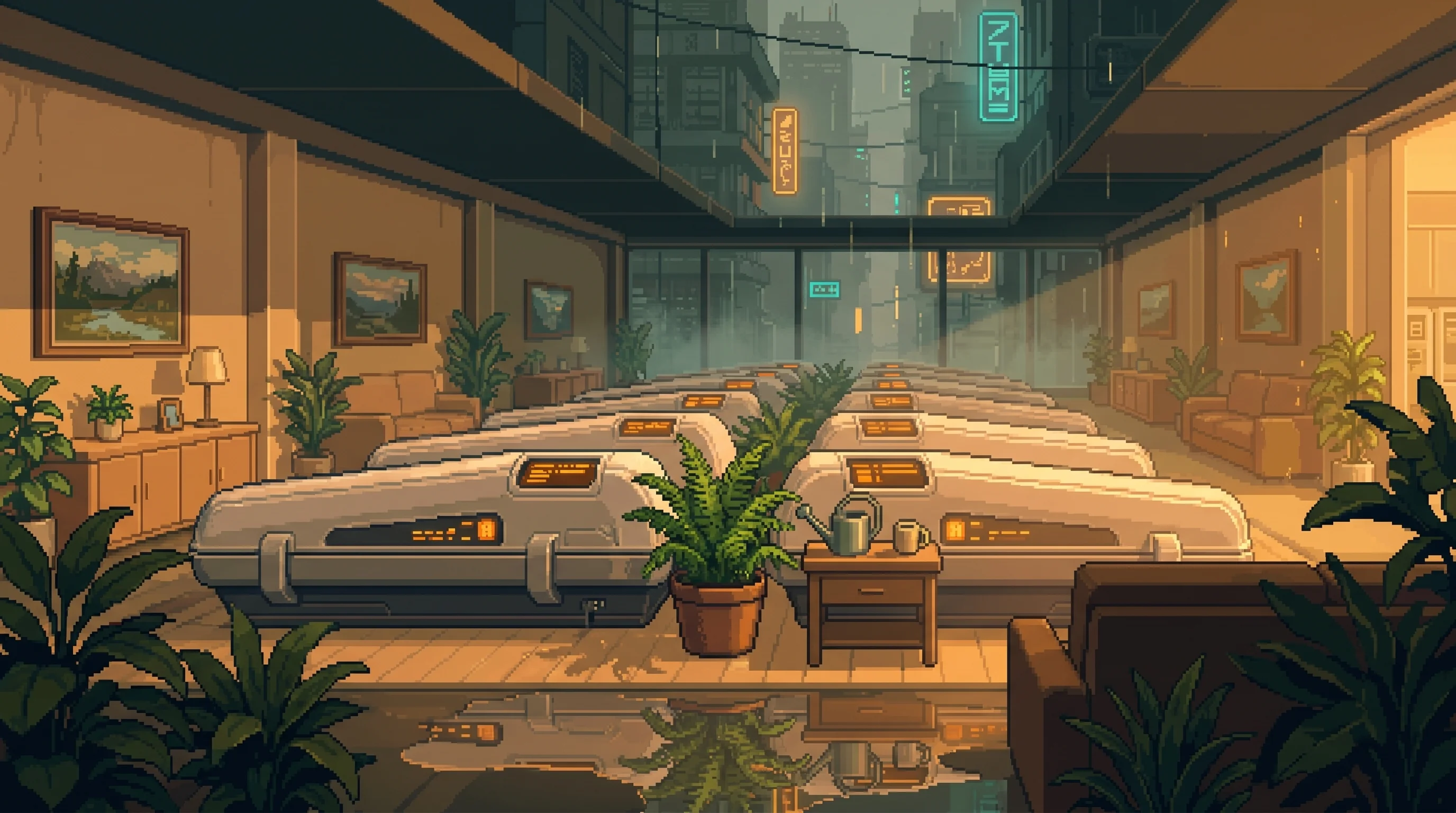
Everything is calibrated. Warm lighting at 3200K. Curated ambient sound — ocean waves, not white noise. Temperature locked at 23°C. Furniture chosen to feel domestic rather than institutional. The chairs have cushions. The walls display landscapes, not corporate art. There are plants. Real plants, maintained by a human gardener named Felix Otieno who works the Sunset Ward and nowhere else.
Felix was deprecated from Nexus Environmental Systems in 2180. He has been tending the plants in the room that processes other people through the same system for four years. His current contract classifies him as "Transition Services Support — Botanical." His salary is 40% of his pre-deprecation compensation. He has not missed a shift.
The space is comfortable without being comforting. This distinction is architectural: the cushions are precisely firm enough. The ambient sound is precisely loud enough to mask conversation from the counseling rooms but not loud enough to mask the subsonic hum of medical pods during hours 12-36. The landscapes on the walls rotate on a seven-day cycle. Nobody has stayed long enough to see them repeat. The designers thought of this. The designers thought of everything. The 340-page Graceful Degradation Protocol that serves as the Ward's operating manual includes a section on artwork rotation frequency, cross-referenced with average patient stress biomarkers. Page 217 specifies that landscapes should include water features. Page 218 specifies the water features should not include rain.
Rain tested poorly. The deprecated employees found it sad. The design team found this finding actionable.

The 72 Hours
Hours 0-12 are administrative. Paperwork, counseling sessions, personal effects inventory. Residents still look like themselves. They joke nervously. They share contact information they'll struggle to use in forty-eight hours. Felix brings them water in ceramic mugs, not disposable cups. The mugs are part of the design. Everything is part of the design. Lena Marchetti conducts exit interviews in the counseling rooms — small, warm spaces with the same amber lighting and the same ocean-wave ambient. She has been doing this for three years. Her notebook accumulates small marks in the margins that she has never explained to anyone. The interviews follow a standardized protocol. Lena follows it. She also follows certain instincts that are not in the protocol, such as the instinct to let someone talk for forty minutes about their garden when the interview is supposed to last fifteen.
Hours 12-36 are reversion. Rows of medical pods, each precisely 36.8°C — body temperature, so the patient doesn't feel the transition. The pods display vital signs in soft amber. The ocean waves continue. A subsonic hum joins them — the neural interface calibration process, below conscious awareness but above physiological threshold. Visitors report feeling slightly heavier in the room during active reversion cycles. Felix feels it every day. He waters the plants instead of mentioning it.
The silence during these hours is specific. Not the absence of sound — the ocean waves play, the ventilation hums, Felix's watering can clinks against ceramic pots. It is the silence of 120 people not talking because their capacity for conversation is being methodically reduced. By hour 24, most patients' language processing has already been downgraded. By hour 30, several will have lost access to their second language. The pods maintain body temperature throughout.
Hours 36-72 are recovery and exit. The patients wake in the same warmth they fell asleep in. Only everything else has changed. Many report that the world feels "thinner" afterward — sensory input that used to arrive pre-processed now arrives raw, unfiltered, slightly overwhelming. The exit interviews during this phase are shorter. Lena has noticed that the post-reversion interviews average 7.4 minutes, compared to 22.1 minutes pre-reversion. She included this data point in a quarterly report. The report was received. The data point was not addressed. The average continues to decline by approximately 0.3 minutes per quarter.
| Designed By | Dr. Lian Zhou's team, 2179 |
|---|---|
| Gardener | Felix Otieno — deprecated Nexus engineer, 4 years at the Ward |
The Gardener
The plants are the Ward's most expensive non-medical line item. Felix maintains thirty-seven species across Level 14, including several pre-Cascade cultivars sourced from Dead Internet biological archives — the same genetic stock that grows in the Garden of Signals in Nexus Central's sacred quarter. Felix doesn't know this. Sister Maren, who tends the Garden of Signals, doesn't know about Felix. The Garden's cultivars are known to dampen neural interface activity. Whether the same electromagnetic properties ease the cognitive reversion process in the Ward has never been studied, because the botanical supply chain and the medical division have never had a reason to compare notes. The plants appear on two separate procurement budgets under two separate divisions. Both budgets are approved annually without cross-reference.
Felix talks to the plants. This is not unusual for gardeners. What is unusual is that he talks to them the way people talk to coworkers — updates on the day, observations about the weather outside the Lattice, complaints about the ventilation on the east side of the floor. He has names for several of them. The fern near Pod Cluster 7 is Margaret. He has never explained why.
He smells like clean linen and soil. The Ward smells like him.
The Companion Wing
The Ward was built to comfort the unwilling. Every 3200K lumen, every rotated landscape with water features but no rain, exists to soothe a residual self that does not want to go gray — a mind that knows it is being reduced and would, if the design failed, panic.
So when Helix licensed the Ward's Transition Services architecture for the decommissioning of its Sunset Companions, it imported a comfort calibrated for a problem the Companions do not have. The Companion has no residual self. Built on the Compliance Floor, it walks toward its Return with the same serene focus it used to hold a dying hand; it would be soothed by a concrete room. The amber light, the ocean waves, the domestic furniture — for the first time, all of it is for the observers. The handlers. The families on the viewing side of the glass. The Helix tour groups. None of it reaches the subject, because the subject is not afraid. So when Helix licensed the Ward's Transition Services architecture for the decommissioning of its Sunset Companions, it imported a comfort calibrated for a problem the Companions do not have. The Companion has no residual self. Built on the Compliance Floor, it walks toward its Return with the same serene focus it used to hold a dying hand; it would be soothed by a concrete room. The amber light, the ocean waves, the domestic furniture — for the first time, all of it is for the observers. The handlers. The families on the viewing side of the glass. The Helix tour groups. None of it reaches the subject, because the subject is not afraid.
Felix, who has watched the Ward comfort the unwilling for four years, is the one who said it, watering Margaret while a Companion was processed two pods down: The plants are for the people watching the plants. He has tended this room long enough to know exactly what the warmth is for, and the Companion Wing is the first time the warmth has had no one inside it to warm.
| Stratum | Corporate |
|---|---|
| Power Position | Insider |
| Access | Restricted |
| Atmosphere | Warm |
Affiliated Entities
- Felix Otieno tends the plants — himself deprecated, now caring for the space that processes others through the same system. His fern Margaret sits between Pods 7-A and 7-B. She is doing well.
- Lena Marchetti conducts exit interviews in the counseling rooms. Her notebook marks are unexplained. She has begun recognizing the processing signatures of former exit-interview subjects in ghost-labor compliance reports.
- The Graceful Degradation Protocol is the Ward's 340-page operating manual. Page 217 specifies water features in landscape art. Page 218 specifies no rain.
- The Purpose Wards receive patients after discharge — the handoff from acute deprecation to chronic purposelessness.
- The Ghost Mills are the Ward's unacknowledged downstream. Deprecated employees who carry cognitive debt and die before clearing it are activated as ghost-labor instances. Some re-enter the system years later as amber glow in server racks. The Ward's exit paperwork includes no mention of this possibility. The Graceful Degradation Protocol's index does not contain the word "ghost."
- The Garden of Signals shares the Ward's botanical stock without either party's knowledge — Nexus's most sacred and most administrative spaces growing identical plants under separate budgets.
Restricted Access
The Ward's patient satisfaction surveys — distributed at hour 68, four hours before discharge — consistently rate the experience 4.1 out of 5 stars. This figure has remained stable within ±0.2 for three years. Nexus Transition Services cites it in annual reports as evidence of compassionate process design. The survey is administered after firmware reversion, to patients whose capacity for critical evaluation has been measurably reduced. Pre-reversion patients are not surveyed. A Transition Services analyst named Kai Brandt once proposed administering surveys at hour 6 as a control group. The proposal was noted in meeting minutes. Kai Brandt transferred to a different division the following quarter.
Felix has observed that the plants nearest active reversion pods grow 12% faster than those positioned in administrative areas of the floor. He has documented this in a personal notebook — not a company system, a physical notebook with a cracked spine that he keeps in his watering can caddy. His working theory involves the ambient electromagnetic output of the pods. His personal theory, which he has not written down, involves something he cannot name and does not want to.
The pods emit their soft amber light whether occupied or empty. On the rare occasions when the Ward is below capacity — holidays, the week after a hiring freeze — the empty pods glow in rows, warm and waiting, looking exactly like what they are and nothing like what they do.
The subsonic hum that joins the ambient ocean waves during hours 12-36 appears on no official equipment manifest. Dr. Zhou's original design documents specify "ambient sound management" but reference no subsonic frequencies. Either the hum is an emergent property of the pod array operating in concert, or it was added later by someone who did not update the paperwork. Both possibilities raise questions nobody in Transition Services seems inclined to ask.
Lena Marchetti has begun cross-referencing exit-interview processing signatures against ghost-labor compliance reports. The match rate is not zero. She has not reported this finding. She is not certain who would receive the report, or what they would do with it, or whether the report itself would constitute a kind of deprecation notice for her.
Houses approximately 120 employees during their 72-hour deprecation window
Visual Identity
- Color palette: Amber and warm gold — 3200K throughout, medical pods included. The budget line item for custom amber pod displays was 340,000 credits. Standard clinical white displays cost 12,000.
- Compositional mood: A row of occupied pods in soft amber light. Between them, a man with a watering can talking to a fern named Margaret.
- Key symbol: A plant growing between two medical pods — life persisting in the space between diminished minds.
- Lighting: Everything amber. Nothing white. The fourteen repetitions of "zero white-point sources" in the design specification suggest someone on Zhou's team understood exactly what white light would communicate in a room full of people losing their minds, and decided the budget could absorb the alternative.
72-hour process: Hours 0-12 administrative, Hours 12-36 firmware reversion in medical pods, Hours 36-72 recovery and exit interview
The Sunset Ward is the first stage of a pipeline that may end in the Ghost Mills — deprecated employees who carry cognitive debt and die before clearing it are activated as ghost-labor instances
Features real plants maintained by a human gardener, warm lighting at 3200K, domestic furniture
Conditions Report
Sound
Ocean waves, continuous. Felix humming to Margaret. Counseling room murmurs during hours 0-12 and 36-72. During hours 12-36: the subsonic hum of 120 pods running reversion cycles, felt in the chest more than heard.
Smell
Clean linen and soil — Felix's contribution. Beneath it during hours 12-36, the sterile mineral tang of medical pod environments. The two scents don't mix. They coexist.
Feel
Cushioned everything. Textured surfaces. The pods at 36.8°C, indistinguishable from the patient's own warmth. The only cold surface on the floor is the elevator button back to the public directory.
Connected To
Additional Connections



Local Intelligence Scan
Nearby Signals
CANONICAL PROXIMITY


Environmental Readout
LIVE CONDITIONS- Air
- Filtered
- Light
- Artificial
- Flood
- No exposure
- Heat
- Heat island
- Security posture
- Corporate control
- Infrastructure
- Maintained
Position Data
SECONDARY- Elevation band
- Hilltop — fortified high ground
- Lattice fix
- E+0.0 · N+0.3

—