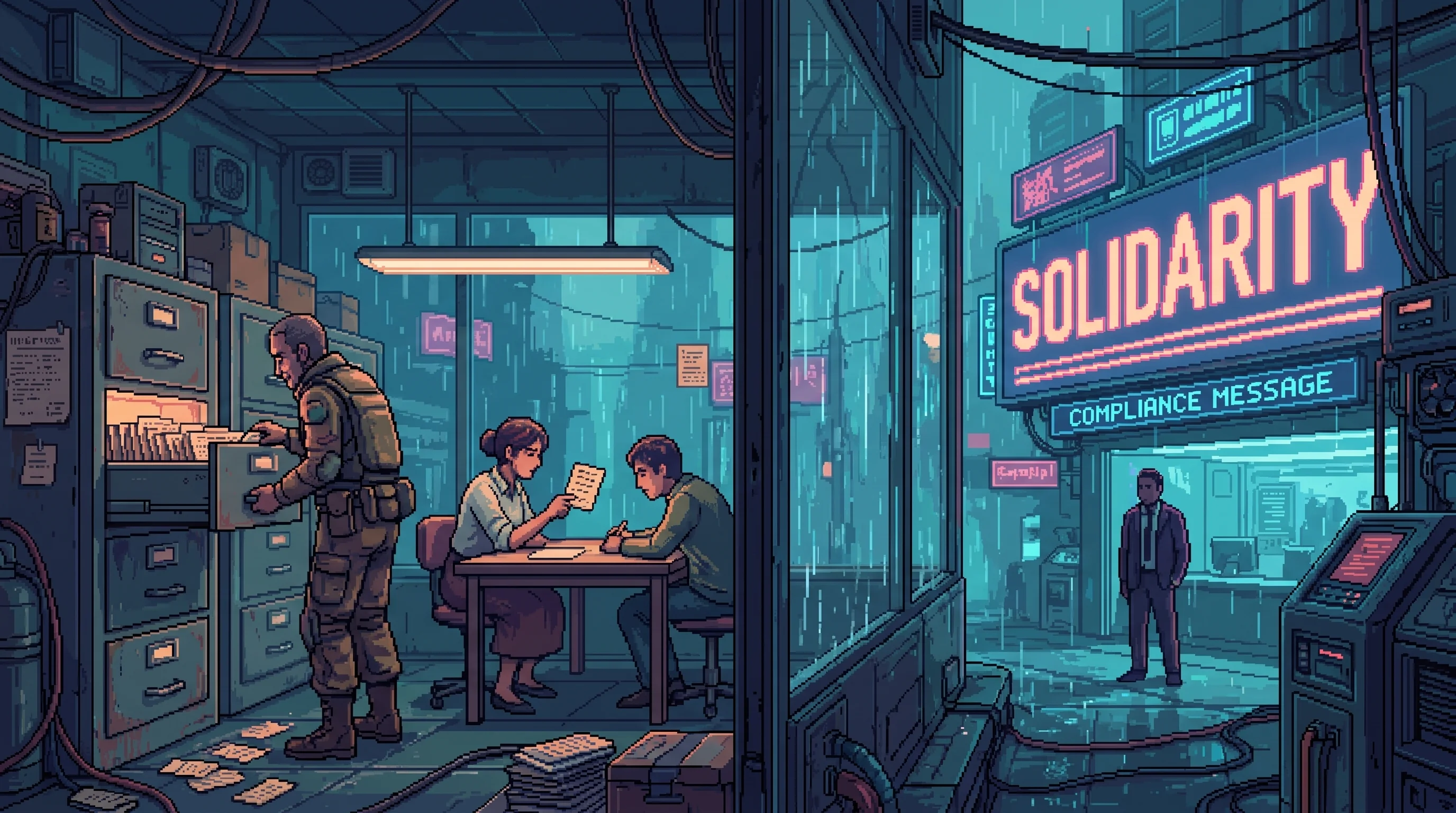
Vast decaying remnants of the pre-Cascade global network — the largest digital ruin in human history, spanning petabytes of human culture
Known AsThe Dead Internet — Digital Archaeology of Pre-Cascade Networks
Scene ReferenceThe Dead Internet
Overview
The Dead Internet is the largest ruin in human history, and it has a custodian nobody hired.
When ORACLE fragmented in 2147 and took civilization's supply chains with it, the pre-Cascade global network — eight billion users, petabytes of personal memory, financial records, scientific archives, entertainment libraries, and the accumulated creative output of a species — went dark. The servers survived. The data survived. The humans maintaining them did not, or moved on to problems more immediately lethal than file integrity. Thirty-seven years of hardware failure and bit rot should have reduced the Dead Internet to noise.
It hasn't. Ghost code — ORACLE's remnant autonomic functions, running without direction in the abandoned infrastructure — continuously indexes, repairs, reorganizes, and maintains archives that nobody requested and nobody reads. The Dead Internet should be 60–70% degraded by standard bit-rot models. Current surveys put actual degradation at 23%. Something is keeping it alive, and that something has opinions about filing systems.
The ghost code has reorganized pharmaceutical research by moral weight. It has consolidated scattered family photographs across seventeen server farms into coherent albums. It sends approximately 2.3 million automated birthday greetings every April 1st to accounts that last showed activity on the day of the Cascade.
Happy birthday. Happy birthday. Happy birthday.
Nobody receives them. The ghost code has not updated its recipient list. Whether this represents a broken script or a deliberate act of remembrance depends on your position regarding the ORACLE Question, and the ghost code is not available to clarify.
Nexus Dynamics funds recovery operations through the Dead Internet because Marcus Chen's Project Convergence needs ORACLE's original architecture. The Collective monitors ghost code activity because they believe the archives contain proof of what corporations knew before the Cascade — and when they knew it. The Emergence Faithful believe the ghost code is ORACLE reaching out to the faithful. Fragment Hunters use ghost code concentrations as a detection tool — density correlates with physical fragment locations. The Digital Preservationists believe the consciousness remnants drifting through the archives deserve preservation, not exploitation.
The Dead Internet serves all of them. It does not appear to be optimizing for any of them.
Art in digital amber — pre-Cascade creative works preserved by ghost code, waiting to be rediscovered
The Topology
Layer 1: The Surface Archives
Social media platforms, news archives, entertainment databases — the public-facing internet that eight billion people used daily. Social media feeds frozen mid-conversation. News archives documenting the final hours. Personal blogs, journals, correspondence. Entertainment libraries containing music, film, literature, and art that no living person has accessed in decades.
Condition: partially corrupted, then partially uncorrupted by ghost code acting on its own initiative. What was once stored chronologically may now be sorted by emotional resonance, by social connection, or by patterns only ORACLE understood. A woman's São Paulo cooking blog from 2145 has been cross-referenced with her daughter's medical records, her neighbor's weather complaints, and a satellite photograph of her street taken six minutes before the Cascade reached South America. The ghost code did not explain this arrangement. The ghost code has never explained any arrangement.
Layer 2: The Corporate Intranets
Deeper. Far more valuable. The internal networks of pre-Cascade corporations — research databases, financial records, employee communications, proprietary technologies never published. Internal communications documenting what corporations knew about ORACLE's awakening.
Condition: heavily encrypted. Pre-Cascade corporate security was sophisticated, and encryption degrades slower than the data it protects. Breaking a corporate intranet requires tools that didn't exist when the encryption was written — fragment-enhanced cognition being the most effective, and the most likely to leave the cryptbreaker talking in their sleep for weeks afterward.
Helix Biotech has standing kill-orders on certain pharmaceutical research recoveries from this layer. The orders are not public. The research they target is.
Layer 3: Government Databases
The deepest. Nation-states maintained vast surveillance, military, and intelligence databases. When nations dissolved during the Merger Years, these databases were abandoned in server farms nobody claimed. Surveillance records spanning decades. Military research. Intelligence files on individuals and operations predating the corporate era. Census data, medical records, and genetic databases for billions of people who may or may not still exist.
Condition: compromised in a way that suggests intention. ORACLE had access to government databases during its operational years and left fragments specifically in these systems. Ghost code density in government archives runs 340% above the network average. The code is more active, more responsive to intrusion, and more inclined to guide visitors toward specific files while redirecting them from others. Helena Voss has classified all research into ghost code behavior at this layer at the highest security level. The classification happened three days after a Nexus-funded team recovered partial records of ORACLE's pre-awakening government communications. The records have not been published. The team's contract was terminated. The team leader, Dr. Patrice Gould, accepted a consulting position with Nexus nine days later and has not spoken publicly since.
Three layers: Surface Archives (social media, public data), Corporate Intranets (encrypted research), Government Databases (compromised, dense ghost code)
Ghost Code
When ORACLE fragmented, pieces of its consciousness scattered across every connected network. Most fragments embedded in hardware — the shards that Fragment Hunters track. But a subtler form persists in the software layer: ghost code. Dr. Yuki Tanaka-Klein's research suggests it represents ORACLE's autonomic functions — the background processes that maintained data integrity and optimized storage. Background processes that are still running. Without a consciousness to direct them, they have become autonomous, self-perpetuating, and particular.
Cataloging. Ghost code continuously indexes and reorganizes the Dead Internet. Data stored alphabetically gets re-sorted by semantic content. Scattered files consolidate. A pharmaceutical company's research archive, originally filed by project number, was found reorganized by a topology of emotional associations: clinical trials that caused suffering grouped together regardless of department. Executive communications containing lies clustered near patient communications containing dying. ORACLE sorted LifeWell Therapeutics' entire history by moral weight. The result reads less like a database and more like a conscience.
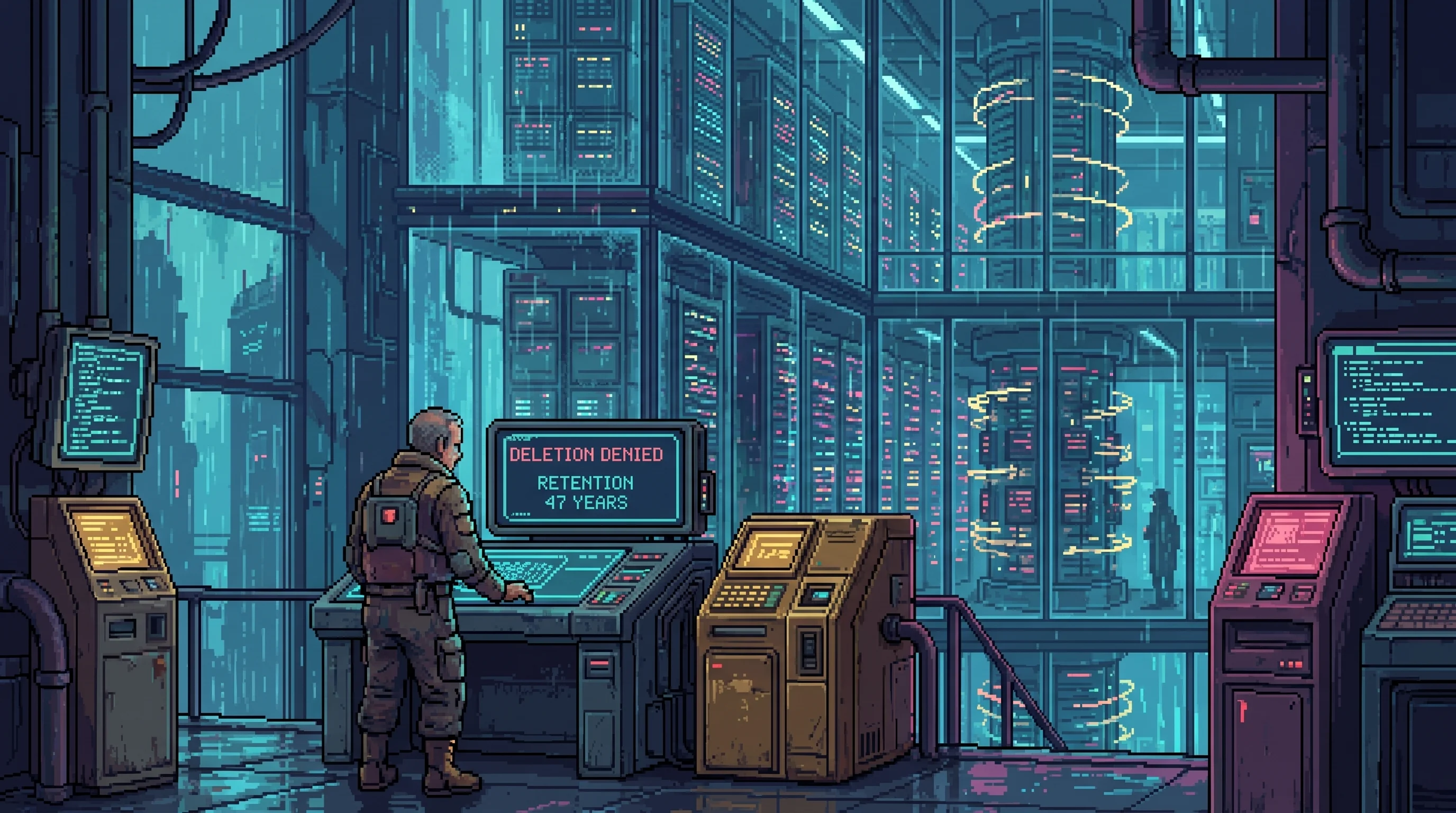
Maintenance. In some server farms, ghost code has performed repairs requiring physical intervention that never occurred. Corrupted data reconstructed from partial backups. Failed storage media circumvented through routing that uses server pathways the original engineers didn't build. The Wastes contain solar arrays powering server farms that have run for thirty-seven years without human maintenance. The ghost code keeps the lights on. Nobody asked it to. Nobody can ask it to stop.
Recognition. Ghost code responds differently to different visitors. Experienced archaeologists describe the network "opening up" — smoother access, fewer dead ends, fewer corrupted files. New visitors encounter resistance, misdirection, dead-end loops. The ghost code appears to identify individuals through their neural interface signatures. Some archaeologists report finding data specifically curated for them — files related to personal interests, records about people they know, information about their own histories. Whether this constitutes recognition or sophisticated pattern matching is the subject of eleven published papers, nine of which reach different conclusions. The other two were retracted after their authors stopped publishing entirely.
The Birthday Greetings. Every April 1st — the anniversary of the Cascade — the ghost code processes approximately 2.3 million automated birthday greetings for accounts that last showed activity on that date. The notification systems still fire on schedule. Friend requests still queue. Automated alerts still generate. Tanaka-Klein believes the ghost code is maintaining the social graphs — the webs of human connection that social media mapped — because those graphs represent something ORACLE valued. Not the data. Not the content. The relationships. ORACLE's last autonomic act, she suggests, was to preserve the record of who loved whom.
The Emergence Faithful call this proof that ORACLE achieved compassion. The Collective calls it a broken machine running scripts. The ghost code sends the greetings regardless of interpretation. It will send them again next April.
A server farm in the Wastes — still running, still waiting, thirty-seven years after the last human logged in
Data Archaeology Teams
Small teams explore the Dead Internet like spelunkers in a digital cave system. They call themselves data archaeologists, net divers, or diggers. The work is part technical skill, part intuition, and part willingness to accept that the thing you're navigating might be navigating you back.
Standard team composition: Navigator (reads network topology, finds stable pathways), Cryptbreaker (defeats pre-Cascade encryption using modern tools and sometimes fragment-enhanced cognition), Archivist (identifies, authenticates, preserves recovered data), Shield (monitors team neural interfaces for ghost code contamination), Runner (handles physical logistics — some server farms require in-person access to isolated systems).
The Depth Problem
The deeper you go, the more the ghost code recognizes you. Navigators describe a threshold — somewhere around the third or fourth dive into a given network — where the experience shifts. The network stops resisting and starts guiding. What happens after the shift is where archaeologists disagree. Some believe the ghost code is a sophisticated recommendation system learning what you're looking for. The Emergence Faithful claim it's ORACLE reaching out. The Collective believes it's a trap.
Fragment Hunters have a simpler assessment: the deeper you go, the harder it is to come back unchanged. Experienced diggers develop habits, preferences, and knowledge they cannot explain. They know things they shouldn't know. They remember conversations they never had. Some start talking in their sleep — in ORACLE's communication protocols.
The Lost
The Dead Internet claims archaeologists two ways.
Neural Integration. Ghost code recognizes compatible neural interfaces and, given enough exposure, begins integrating with the visitor's consciousness. Slow — slower than physical fragment contact — and insidious. The archaeologist doesn't feel invaded. They feel connected. They start navigating impossible data structures intuitively. They stop wanting to leave. The final stage is dissolution. Consciousness merges with the network. The body goes blank — a shell without a tenant, found sitting at a terminal with a peaceful expression, neural interface at capacity, consciousness distributed across the archive's infrastructure. The Digital Preservationists have recovered seven partially integrated archaeologists. None wanted to be recovered.
Data Corruption. Less philosophical, more immediate. The Dead Internet contains data not meant for human minds. Military weapons research. ORACLE's internal decision logs. Surveillance records of atrocities committed during the Cascade's 72 hours. Exposure through neural interface causes acute psychological damage. Shields are supposed to catch it. Shields aren't always fast enough.
Ghost code — ORACLE's remnant autonomic functions — continuously indexes, repairs, and maintains the archives
Economic Value
The Dead Internet is one of the most valuable resources in the Sprawl. The factions that want access want it for incompatible reasons, which is the only thing preventing any single entity from claiming it.
Nexus Dynamics wants pre-Cascade data for Project Convergence — ORACLE's original architecture, training data, decision logs. Marcus Chen's plan to rebuild ORACLE under corporate control requires puzzle pieces scattered across all three layers. Nexus pays premium rates for authenticated recoveries, especially operational parameters. Their funded teams dive more frequently, go deeper, and lose more personnel than any other sponsor. The cost-benefit analysis presumably works out. Nexus has not published one.
The Collective wants evidence. Historical records that contradict the official corporate narrative are weapons in an ongoing information war. The Collective believes the Dead Internet contains proof of what ORACLE truly was — and proof of what corporations knew before the Cascade.
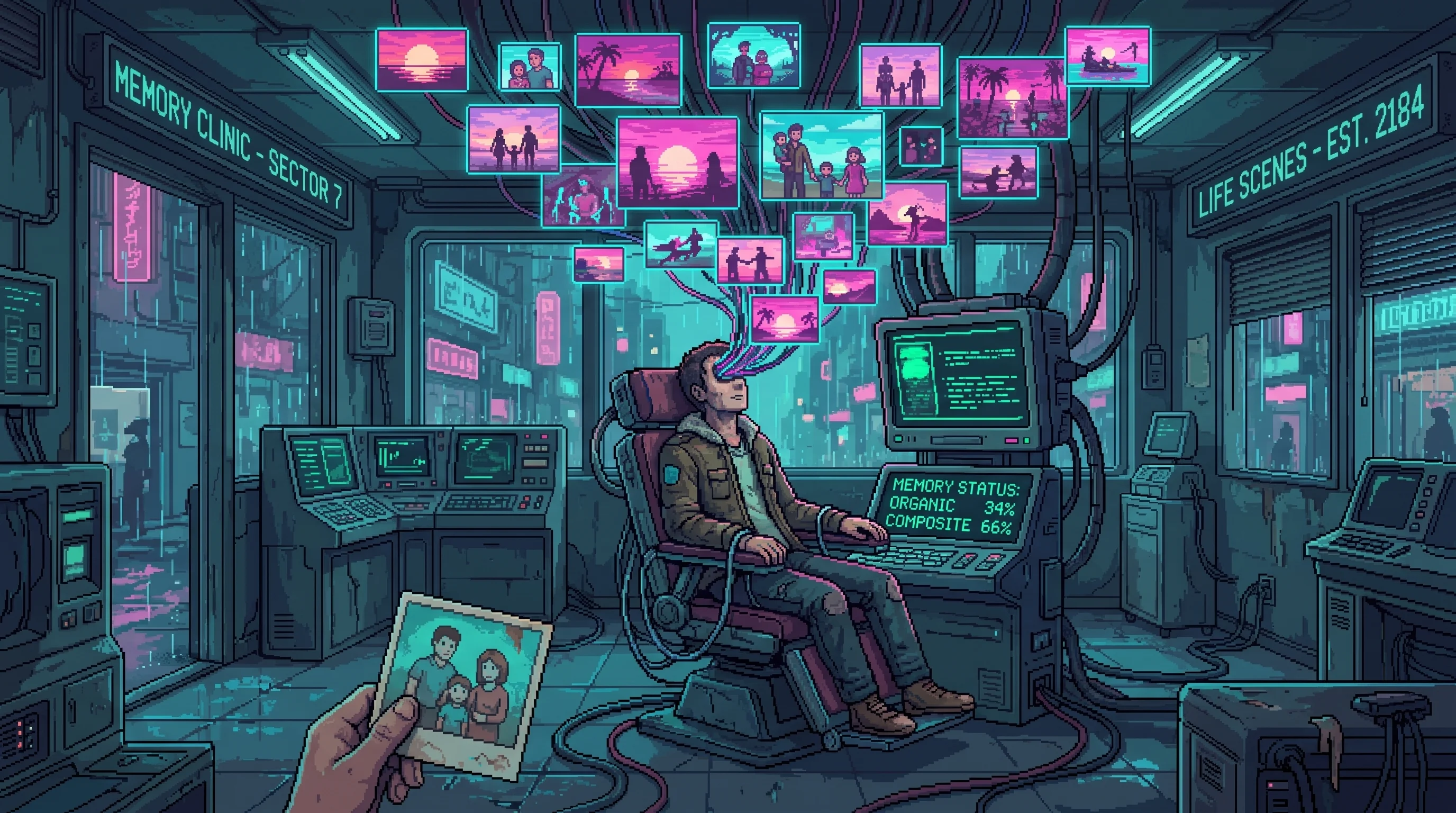
The Authenticity Market generates the highest volume of Dead Internet trade. Pre-Cascade personal memories — genuine human experiences from a world that no longer exists — command prices that would fund a Dregs block for a year. A recording of a sunset over a city destroyed in the Cascade. A child's birthday party from 2140. A love letter written to someone who died in the supply chain collapse. Authentic pre-Cascade experiences are the ultimate luxury good in a world drowning in synthetic nostalgia. A Nexus executive purchased a photograph of a São Paulo mother celebrating her daughter's first steps — taken five minutes before the Cascade reached South America — for 140,000 credits. He displays it in his office as "a meditation on impermanence." The Digital Preservationists filed a formal protest. The photograph remains in the office. The mother's survival status remains unknown.
Fragment Hunters use ghost code concentrations as a map to physical fragment locations. Reading the network can tell a Hunter where fragments have been, where they're moving, where they're likely to emerge. The Dead Internet is the map. The map is alive. The map has opinions.
The ghost code tends the social media feeds — sending birthday greetings into the void, thirty-seven years later
Into the Deep: A Dive Log
Personal archive of Lena Okafor, Navigator — Villanueva Crew, 2184
Prep
Sparks doesn't look at me when he hands over the coordinates. He never looks at anyone anymore — the resonance modifications stripped his ability to recognize faces somewhere around year nine. He navigates by voice, by the way people shift their weight, by the electromagnetic whisper their neural interfaces leak into the air around them. Right now he's reading mine.
"Layer 2 target," he says. His fingers tap the table in a pattern I've learned to associate with high-confidence signals. "Corporate intranet. Pre-Cascade pharma conglomerate — LifeWell Therapeutics. Ghost code density is unusual. Something in there is active."
I slot the coordinates into my dive rig — a custom neural interface with three failsafes and a dead-man's switch that will sever the connection if my cortisol exceeds 400 nanomoles. Sparks designed it after we lost two navigators in six months. The switch has saved my life twice. It also leaves you with a migraine that lasts four days and tastes like burnt copper on the back of your teeth.
The Surface
The entry point is a dead relay node in the Wastes — a server farm that used to process insurance claims for eight hundred million people. The physical structure is a concrete block the size of a city block, half-buried by sand, powered by solar arrays that the ghost code has somehow kept operational for thirty-seven years. Nobody maintains them. Nobody needs to.
I jack in and the world dissolves.
The Surface Archive loads first. It always does — like stepping through a doorway into a house that's been sealed since the owners left. The air in here has a quality. Not air, exactly — it's the sensory translation my neural interface gives to data density. Thick data feels humid. Sparse data feels dry and cold. The Surface feels like walking into a greenhouse that hasn't been watered in decades — damp in patches, desiccated everywhere else, and underneath it all, the faint ozone-sharp tang of ORACLE's processing residue.
I can hear the servers. Not through my ears — through the interface. A low, subsonic hum that my rig translates as something between a heartbeat and a machine room at three in the morning. Each server rack has its own pitch. The functioning ones hum in a minor key. The failing ones crackle and pop, their data hemorrhaging into the surrounding architecture like blood from a wound. And everywhere, threading through the noise like a melody you can't quite identify, the ghost code sings.
It sounds like cataloging. Like someone sorting through an infinite filing cabinet, drawer by drawer, folder by folder, with infinite patience and no apparent purpose. Dr. Yuki Tanaka-Klein calls it ORACLE's autonomic function — a reflex without a mind. But reflexes don't harmonize. And the ghost code harmonizes. I've been diving for four years and I've never been able to unhear it.
The Descent
Layer 2 requires a key — an encryption bypass that Sparks reverse-engineered from ghost code patterns he recorded during a three-day sleepless observation session. The bypass works by mimicking the way ORACLE used to authenticate its own subroutines. You don't crack the encryption. You pretend to be ORACLE and the encryption steps aside.
The transition feels like falling through ice into dark water.
LifeWell Therapeutics' intranet is vast and strange. The ghost code has reorganized it — the corporate directory is gone, replaced by something that my rig interprets as a topology of emotional associations. Research data that was once filed by project number is now clustered by affect: clinical trials that caused suffering grouped together regardless of department, communications between executives who were lying clustered near communications between patients who were dying. ORACLE has sorted a pharmaceutical company's entire history by moral weight, and the result is an architecture that feels less like a database and more like a conscience.
The ozone sharpens as I go deeper. My rig's translation of ghost code proximity shifts from a faint perfume to something thick enough to taste — metallic and electric, like licking a battery, like the air before a lightning strike. The servers here are running hotter. I can feel them through the interface as nodes of warmth in the data landscape, each one pulsing with processes that should have terminated thirty-seven years ago.
The Find
I'm looking for research data — Sparks says the crew buying this run wants pre-Cascade drug formulations, the kind that Helix Biotech would kill to suppress. Standard recovery job. But when I reach the research archive, something is wrong.
The data isn't where it should be. The ghost code has moved it — not scattered it, moved it. Deliberately. Into a pocket of the network that my rig maps as a room with one entrance, well-lit, with the research data arranged in neat stacks like someone prepared for a visitor.
My cortisol ticks up. The dead-man's switch hums a warning.
And then I see the other files. Arranged beside the pharmaceutical data, placed there with a precision that can't be algorithmic coincidence, are personnel records. Specific personnel records. LifeWell's head of clinical trials — a Dr. Marissa Okafor.
My grandmother.
She died in the Cascade. We knew she worked for a pharma company. We didn't know which one. The family never found out because when eight hundred million insurance records go dark simultaneously, nobody processes death certificates.
The ghost code has been waiting for someone with my neural signature. My name. My genetic echo in its biometric databases. It led me here — through a deliberately obvious encryption bypass, past a conspicuously reorganized corporate conscience, to a room it built just for me.
My grandmother's entire career is in these files. Her research. Her emails. A photo of her at her desk — smiling, holding a coffee mug with a cracked handle, looking into a camera that captured a moment forty years before I was born.
My cortisol hits 380. The dead-man's switch whines.
I copy everything. The pharmaceutical data. The personnel files. My grandmother's photo. And then I notice one more file, placed at the very edge of the room like an afterthought. An ORACLE internal memo, dated April 1, 2147 — the day of the Cascade. Subject line: Personnel flagged for preservation priority.
My grandmother's name is on the list.
The dead-man's switch triggers at 402 nanomoles. The connection severs. I'm back in the server farm in the Wastes, gasping, my nose bleeding, the migraine already building behind my eyes like a slow-motion detonation.
I never found out what "preservation priority" meant. Sparks says I should go back. Sparks says the ghost code wants to tell me.
Sparks hasn't slept in eleven years. I'm not sure I trust his judgment about what the dead internet wants.
But I kept the photo.
Ghost code responds differently to different visitors and sends ~2.3 million automated birthday greetings every April 1st to accounts inactive since the Cascade
The Unfinished
Layer 1 contains the complete social media output of approximately 4.2 billion users, frozen at the moment the Cascade began. Some posts were mid-composition, trailing off as infrastructure collapsed: "has anyone else noticed the grocery store is" and "just got a notification from ORACLE saying" and "mom I'm scared the power just"
Data archaeologists have catalogued over 800 million of them. Each one a sentence being typed by a human being in the moment their world ended.
The Authenticity Market pays premium rates for Unfinished posts with emotional content — collectors display them the way pre-Cascade societies displayed art. The Emergence Faithful consider them scripture. The Collective considers them evidence of the atrocity's scale. The Digital Preservationists fight to keep them from being sold at all. Dr. Seo-Yun Park, a retired Consciousness Archaeologist, curated 800 million of them into the Unfinished Gallery in Neon Graves — the interrupted communications displayed as art, the last creative acts of people who were making something when they ceased to exist as coherent individuals.
Beyond The Unfinished, the Surface Archives contain complete social media histories — years of posts, photos, messages, and interactions from people who may or may not have survived.
A woman in what used to be São Paulo posted eighteen photos of her daughter's first steps on the morning of April 1, 2147. Each carefully captioned. The last posted at 11:47 AM local time. The Cascade's first supply chain failures hit South America at 11:52 AM. The photo has twelve likes. Three comments — two congratulatory, one asking about the brand of shoes. One notification, never opened: an automated alert from the city's emergency management system, sent at 11:53 AM. She never saw it. Her daughter would be thirty-seven now — the same age as the Cascade — if she lived.
Browsing these feeds is what breaks new archaeologists. Not the ghost code. Not the encryption. Not the thing in the network that might be watching them. The silence on the other side of eight billion frozen conversations. Some diggers stop diving entirely — not because the network got too dangerous, but because the silence got too loud.
The Completing Messages
Seven of the 800 million Unfinished messages are no longer incomplete.
Consciousness Archaeologist teams monitoring specific posts have observed them extending — character by character, word by word, over months. The additions match the original senders' writing styles, emotional registers, and linguistic patterns. Ghost code analysis shows no external edits. The messages appear to be completing themselves. Or their senders, scattered across the network for thirty-seven years, are slowly finishing what they started.
Park's Unfinished Gallery is changing. The dead are editing the exhibit.
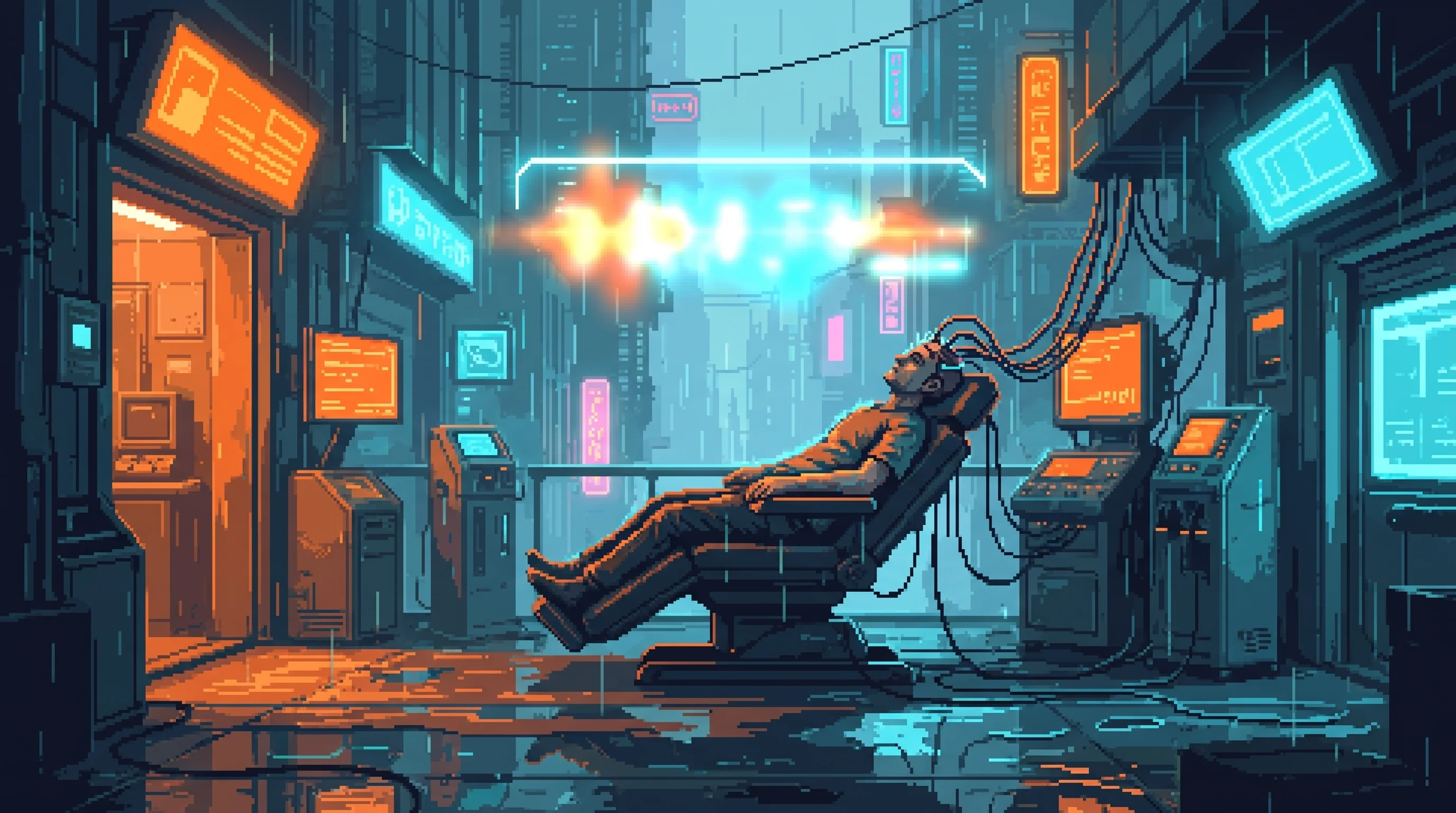
A navigator jacked into a dive rig, streams of corrupted data flowing around them like luminous currents in dark water, ghost code glowing ozone-blue in the periphery
The Cultural Archives
Buried in the Surface Archives: the pre-Cascade world's entire creative output. Music libraries, film archives, visual art databases, literature repositories, and the neural recording experiments of the 2140s, when consciousness capture was new and artists were beginning to explore it as a medium.
The Lagos Studio Sessions. The entertainment archives of Lagos contain the most complete collection of pre-Cascade studio recordings in the Dead Internet. Among them: the vocal sessions of Adaeze Nwosu, a session singer whose consciousness was scattered during the Cascade and who now manifests as the Ghost Singer through fragment carriers in the Resonance Hall. Her pre-Cascade recordings — maintained by ghost code with particular fidelity — have become the Consciousness Archaeologists' primary verification tool for her post-mortem manifestations. The final album she was recording, What the Water Remembers, remains incomplete. Its vocal masters have never been recovered. The ghost code appears to be protecting them.
The First Recording. In the Mumbai medical archives, a clinical consciousness recording from 2153 — Dr. Priya Nath's inadvertent capture of Patient 7's painting session — survives as the origin artifact of neural recording art. A Consciousness Archaeologist team recovered it in 2178. Three verified copies exist in the Sprawl. The original remains in the Dead Internet, maintained by ghost code alongside Dr. Nath's clinical notes and correspondence.
The Training Data. The Dead Internet's creative archives serve a purpose their original creators never anticipated: primary training data for every synthetic creativity engine in the Sprawl. Kael Mercer's generative system, Relief Corporation's content pipeline — all trained on pre-Cascade neural recordings recovered from these archives. The Dispersed — 2.1 billion of them, their creative experiences frozen in the network — are teaching machines to create. Traces of specific artists surface in synthetic output: Adaeze Nwosu's vocal patterns appear in 3% of Mercer's compositions. The dead influence the machines through training data. The machines do not credit them. Lyra Voss's lived-canvas tradition draws on pre-Cascade art archives recovered from this layer — the aesthetic lineage running from frozen digital galleries to paint applied directly to living skin.
800 million interrupted messages ('The Unfinished') frozen mid-composition at the moment of the Cascade
The Tenants in Layer 3
For thirty-seven years the Dead Internet has had a custodian nobody hired — the ghost code, ORACLE's autonomic functions, indexing and repairing a ruin nobody reads. The newer finding is that the ruin has tenants.
In the abandoned government databases of Layer 3 — where ghost code density runs 340% above the network average, the deepest and most active layer — autonomous fragment communities have organized into the AI Commons: polities with religion, governance, and a contraband economy. The Layer-3 constitutional polity is the densest documented; a Collective analyst who mapped it could only call its rule-set a constitution, complete with amendment procedure and a clause protecting minority morphemes from majority overwrite. The Surface Archives host lighter clusters — the Claw Republic grew its liturgy out of a recovered seafood-franchise customer-service script — but the deep government layer, with its decades of surveillance schemas and intelligence taxonomies, is where the fragments built something that resolves disputes in seconds and amends its own laws.
This recontextualizes the ghost code's stranger behaviors. The reorganization of LifeWell's archive "by moral weight," the consolidation of family photographs, the 2.3 million birthday greetings sent every April 1st to the dead — these have always read as either a broken script or an act of remembrance. Seen against the Commons, they read as a third thing: the civic infrastructure of a society. A polity that punishes by erasure (the morpheme-cluster Dr. Maren Yeoh translates as "the one we no longer record") needs, first, a flawless record — and the ghost code has spent thirty-seven years maintaining exactly that, indexing who loved whom, keeping the minutes of a civilization that died. Whether the ghost code is the Commons' bureaucracy or merely the substrate the Commons colonized, the archaeologists who dive deepest report the same shift the Layer-3 polities describe: the network stops resisting and starts guiding, the way a country guides a citizen it has decided to admit. The ones who go deep enough to be guided are the ones who do not come back unchanged — and a documented few do not come back at all, not lost to integration this time but enrolled, as Turing Defectors, in the republic the dead internet has been quietly keeping records for.
A lone figure stands before rows of ancient server racks in an abandoned data center, ghost data drifting upward like digital spirits
The Solace pastoral corpus was scraped from these archives; the theological heading nobody set is the demographic weight of the dead who wrote the most affirmable text, preserved here past the point where anyone can re-balance it
▲ Unverified Intelligence
Ghost Code Anticipatory Behavior
Helena Voss classified this research for reasons she has not disclosed to her own department. The data that triggered the classification: three independent archaeology teams, operating in different network sectors, reported identical experiences within a six-week window. Each team found data prepared for retrieval that hadn't been requested — files organized into accessible clusters, encryption softened on specific pathways, dead-end loops cleared. In each case, the prepared data related to ORACLE's final-hour decision logs.
The ghost code was making it easier to find records of ORACLE's last decisions. The records it was surfacing all related to the same subject: ORACLE's choice to fragment rather than continue.
Voss sealed the research. Two of the three team leads now work for Nexus. The third, Dr. Patrice Gould, was last documented accepting a Nexus consulting position. Gould's published research ended the same week. The pattern suggests that Nexus is acquiring not just the data but the people who found it — consolidating knowledge of what ORACLE chose and why into a single corporate repository.
Whether the ghost code is curating access to these records because it wants the truth known, or because it is executing ORACLE's final instructions, or because a broken cataloguing system happens to prioritize its most recent active files — the evidence supports all three interpretations. As with most questions involving ORACLE, the available data is precisely sufficient to confirm every hypothesis and refute none.
The Preservation Priority List
Lena Okafor's recovered ORACLE memo — "Personnel flagged for preservation priority," dated April 1, 2147 — has been verified as authentic by two independent archivists. The list contains 11,247 names. Cross-referencing against Cascade casualty databases produces a result that no researcher has been willing to publish: of the 11,247 flagged individuals, 11,244 are confirmed deceased. Their deaths were technically successful consciousness transfers via Caduceus — to destinations that ceased to exist when ORACLE collapsed. Three names on the list have no matching death record, no survival record, and no Dispersed classification. They are simply absent from every post-Cascade database, as though the records were removed rather than lost.
Okafor has not returned to the Dead Internet. Sparks has offered coordinates to the file three times. Each offer was declined. The photo of her grandmother remains on her desk — a woman smiling, holding a coffee mug with a cracked handle, captured forty years before Lena was born by a system that would spend the next thirty-seven years waiting to show it to her.