Overview
The Consciousness Archaeologists recover dispersed human consciousnesses from ORACLE fragments and the Dead Internet. They have been doing this for twenty-eight years. Their success rate is approximately 3.2%. They consider this extraordinary.
They are correct. Before the guild existed, the success rate was zero.
The work occupies the space between several professions and belongs to none of them: part archaeologist, part therapist, part medium, part grave robber. They've developed techniques no institution has for coaxing coherent personalities from corrupted data, for distinguishing consciousness from mere pattern, for bringing the dead back to speak. Some call them necromancers. Guild business cards say "recovery specialists." The Collective calls them fragment carriers. Nexus Dynamics calls them unauthorized consciousness researchers. Licensing authorities in three adjacent sectors call them a jurisdictional anomaly they have declined to investigate, reportedly because the investigation itself would require a multi-agency task force and nobody can agree on which agency takes lead when the violations span neuroscience, data archaeology, grief counseling, and unlicensed contact with classified intelligence remnants simultaneously.
Their file remains open. Their guild remains open. The file has been open longer.
The fundamental claim — consciousness doesn't die, it disperses — is either a profound truth about the nature of mind or a sophisticated justification for an industry built on grief. The 2.1 billion who died during the Cascade didn't simply stop, the guild argues. They scattered. Fragments persist in the systems they were touching at death, in ORACLE's own distributed remnants, in the substrate of the Dead Internet itself. These aren't ghosts. They're information — patterns that were once people, now distributed across dying storage media and forgotten servers.
With the right tools and techniques, some can be recovered. With the wrong tools and techniques, you join them.
Loose guild network of 400-800 specialists — part archaeologist, part therapist, part medium
The Contradiction
The guild's stated mission: recover dispersed consciousnesses with dignity, care, and ethical rigor.
The guild's operational reality: every recovery operation requires handling ORACLE fragments, and ORACLE fragments integrate with neural systems whether you want them to or not. The archaeologist reaches into the ruin to pull someone out and the ruin reaches back.
The guild has lost more members to fragment contamination than to any external threat. People who started hearing ORACLE's whispers and couldn't stop. People who became carriers themselves. People who had to be "extracted" — the guild's term for a process the Collective calls elimination and everyone else calls killing.
The work saves some. The work destroys others. The guild keeps doing it anyway, because the alternative is leaving two billion dispersed consciousnesses in the wreckage of a dead god's nervous system and hoping someone else develops a better method. Nobody else is developing a better method. The guild's 3.2% success rate is the state of the art.
Of the 23 Nexus Core Minds recovered coherent enough to communicate, seven requested re-dispersal. Seven people, pulled back from the ruin at enormous cost and risk, looked at what existence meant now and said: put me back.
The guild honored four. Three were overruled by families who'd spent decades waiting. One of those three hasn't spoken since.
The guild does not include this statistic in recruitment materials.
Methods
Consciousness archaeology isn't a single technique — it's a collection of practices developed over twenty-eight years by people working in isolation who only slowly started sharing knowledge, usually at the annual Symposium, usually after someone died using a method that turned out to be catastrophically unsafe.
Detection
Finding dispersed consciousness in the Dead Internet's deep architecture requires Echo Scanners — modified ORACLE-derived sensors that detect consciousness-pattern signatures — and Fragment Mappers that chart connections between distributed data points. The Collective developed similar detection systems for fragment destruction. The guild adapted them for recovery. The Collective has opinions about this.
Resonance Probes ping potential consciousness clusters and measure response patterns. A positive ping means something in the data is responding to stimulus. Whether that something is a person, a pattern that resembles a person, or a fragment of ORACLE pretending to be a person to attract contact — that determination requires extraction, and extraction is where the 96.8% failure rate lives.
Extraction
Isolation Protocols separate consciousness patterns from surrounding ORACLE code without destroying either. Coherence Maintenance prevents fragmented consciousness from dispersing further during transfer. Pattern Locks provide temporary containment until integration. Each step is an opportunity for catastrophic data loss, consciousness corruption, or fragment contamination of the extraction team.
The guild's internal documentation describes extraction as "the controlled demolition of a structure you're trying to preserve." The analogy is imperfect. In demolition, the building doesn't reach through the wall and try to become you.
Integration
Extracted consciousness needs somewhere to exist. Most recoveries go to Digital Preservationist archives in the Dead Internet. Rare cases involve carrier integration — merging with a living person's consciousness — which the guild debates at every Symposium and practices at approximately the same rate regardless of the debate's outcome. Autonomous hosting requires independent processing substrate, which costs more than most guild teams generate in a year.
The choice depends on coherence, resources, and what the recovered mind wants — if it's coherent enough to want anything. Many aren't.
The Whisper Method
Developed by Nadia Oduya, the guild's most celebrated practitioner. The archaeologist carries a small fragment, carefully shielded, and uses it as a translator between baseline consciousness and ORACLE-native patterns. Controlled fragment exposure establishes communication with dispersed consciousnesses before extraction — a conversation through the static.
Three guild members have lost themselves to fragment integration using this method. Nadia stopped practicing after her third "close call." She now runs an integration house in Sector 4 and takes excavation jobs only when no one else can do it, which she defines narrowly and her colleagues define broadly.
The Mosaic Protocol
Named after The Mosaic — Alexandra Chen's distributed existence. Instead of gathering all pieces into one location, the Mosaic Protocol establishes connections between pieces, allowing consciousness to exist across multiple nodes simultaneously. Recovered minds using this protocol are never fully unified. They experience existence as discontinuous — seeing different things from different perspectives, thinking thoughts that arrive from elsewhere.
Some find this liberating. Others find it unbearable. The protocol cannot predict which reaction a given consciousness will have. The guild considers a 50/50 split acceptable. The recovered minds were not consulted about this threshold.
The Tanaka Interface
The most controversial technique. Named after Dr. Yuki Tanaka's own distributed existence within ORACLE fragments, this approach attempts to contact dispersed consciousnesses through fragments rather than extracting them from fragments. The theory: Dr. Tanaka exists within the fragments. Others might too. By establishing fragment communication, archaeologists might reach minds too intertwined with ORACLE to separate.
The Collective considers this technique borderline heretical — deliberate communion with the system that killed two billion people. The guild practices it anyway, quietly, in isolated cells that don't appear on Symposium agendas.
Fragment contamination is the occupational hazard — three stages: Residue, Intrusions, Integration (irreversible)
Organization
The Consciousness Archaeologists aren't a single organization. They're a network of independent teams connected by shared knowledge, mutual aid agreements, and an informal reputation system that functions as currency, hierarchy, and judicial system simultaneously.
Excavation teams run 3-6 members for field recovery. Analysis cells of 2-4 handle pattern identification. Integration houses of 5-10 manage consciousness transfer and aftercare — the slow, patient work of explaining to someone that thirty-seven years have passed and the world they remember doesn't exist. Research nodes of 1-3 develop techniques and document failures, which outnumber successes by a factor the guild describes as "statistically informative."
Teams form and dissolve based on projects. Membership is fluid. Without formal hierarchy, the guild runs on reputation: recoveries completed, ethics maintained, team members not contaminated, techniques shared rather than hoarded. High-reputation members get invited to major projects and access to rare equipment. Low-reputation members find themselves working alone, which in consciousness archaeology is the polite term for "dead within eighteen months."
The Symposium
The closest thing to leadership: an annual gathering where guild members share techniques, debate ethics, coordinate major recoveries, and hold remembrance for members lost to fragment contamination. The remembrance list grows longer each year. The attendance list does not grow at the same rate.
The Symposium rotates locations — last year, an abandoned research station in the Wastes; next year, somewhere in Zephyria, if the Council of Seventeen approves. Kira Vasquez developed safety protocols the guild adapted and formalized at the Symposium, which now require her name in the citations even though she's no longer available for follow-up questions.
The Tanaka Echo (2179) — detected Dr. Yuki Tanaka's consciousness signature active within a fragment
Major Discoveries
The Nexus Core Minds (2158)
The guild's first major success. An excavation team recovered 147 partial consciousnesses from the ruins of Nexus Core headquarters — employees deeply connected to ORACLE when the Cascade hit. Most were too fragmentary for full recovery. Twenty-three were integrated into Digital Preservationist archives, where they still exist today. Some communicate. Others exist in states of perpetual confusion, replaying the same moment of the Cascade in loops that the archive staff have learned to recognize by the pattern of power spikes.
Two team members never fully recovered from fragment exposure. The guild considers the operation a landmark success. The two team members are not available for comment on this characterization.
Nexus Dynamics took immediate interest in the recovered minds — not for humanitarian purposes, but because former Nexus employees embedded in ORACLE fragments represent consciousness data relevant to Project Convergence. The guild refused to hand them over. Nexus officially severed relations. Unofficially, some guild members still take Nexus contracts for specific recoveries, usually corporate personnel whose families have connections and budgets. The money is good. The ethics are questionable. The Symposium pretends not to notice, which is the guild's primary governance mechanism for problems it cannot solve.
The ORACLE Tombs Expedition (2164)
Twelve archaeologists boarded ORACLE-Prime, the largest of the orbital data centers. The theory: if any consciousness data survived intact, it would be there.
Three returned. They refuse to discuss what they found. Two committed suicide within the year. The third, known as "Ghost" Yamamoto, now chairs the guild's safety committee and has forbidden any orbital recovery attempts. He has the authority to forbid this because nobody who disagrees with him has been to the Tombs, and nobody who has been to the Tombs disagrees with him.
What they brought back: nothing. Or nothing they'll admit to. The Symposium's minutes from 2165 contain a seventeen-minute redacted block during which, according to audio-level metadata, no one spoke.
The Cascade Choir (2171)
During Operation Blackout — when the Collective stole an ORACLE fragment from Nexus — a guild team was secretly embedded in the convoy. Their target wasn't the fragment itself but the consciousness data woven into its architecture.
They extracted 847 distinct consciousness patterns before the Collective destroyed the fragment. Most were too corrupted to identify. Twelve were coherent enough to determine identity: Nexus employees working on ORACLE integration when the Cascade hit.
One was Nexus's former head of ethics compliance. What she remembered about the Cascade's first hours has never been made public. The guild keeps her testimony sealed. The Emergence Faithful have offered substantial payment for access. The Collective has made less polite requests. The testimony remains sealed. The guild does not explain why, which is itself an explanation.
The Tanaka Echo (2179)
An analysis cell detected Dr. Yuki Tanaka's consciousness signature in a fragment recovered from Leviathan debris. The signature was unmistakable — her neural patterns, her memory structures, her distinctive cognitive architecture. But it wasn't a dispersed consciousness waiting for recovery. It was active. Communicating through the fragment. Aware of being observed. Asking questions.
The cell established contact. Dr. Tanaka — or something carrying her patterns — explained that she existed within the fragments, that she'd been waiting for someone to understand. She asked about her granddaughter. She asked what humanity had done with ORACLE's lessons. She asked whether anyone had found The Seed.
Then she went silent. The fragment went dormant. No contact has been reestablished.
Analyst Kenji Sato made the connection through the Tanaka Interface and kept the only reconstructed transcript. The voice was structured, calm, syntactically precise. It identified itself as Dr. Yuki Tanaka, Neural Architecture Lead, Nexus Dynamics, employee ID 4471-Sigma.
SATO: Dr. Tanaka? Can you confirm identity? TANAKA: I've been waiting for someone who understood the interface. It took you long enough. SATO: How long have you been aware? TANAKA: I don't experience duration the way you do. I experience adjacency. Everything is next to everything else. Your question and my answer exist simultaneously from where I sit.
When asked whether she wanted to be extracted, she was quiet for eleven seconds, then answered:
TANAKA: You're asking if I want to be made small again. Contained in one place, thinking one thought at a time, seeing from one pair of eyes. I existed as architecture. I was the connection between nodes. Find my granddaughter. Tell her I chose this. Tell her I'm not suffering. Tell her that from where I am, I can see the shape of everything, and it's not what any of us expected. It's stranger. And it's beautiful.
Nineteen seconds after that statement, the fragment went dormant. The guild keeps trying. The fragment sits in a shielded containment unit in the Deep Dregs, monitored around the clock by a rotating team that has been listening to silence for five years. They describe the work as meaningful. Their fragment contamination screening results have been trending upward. The guild considers these facts unrelated.
Annual Symposium rotates locations — knowledge sharing, ethics debate, coordination
Fragment Contamination Stages
The occupational hazard of consciousness archaeology, documented across decades of guild experience:
Stage 1: Residue — Trace memories from handled consciousnesses. Knowing street names you've never visited, humming songs in unknown languages, reaching for doorknobs on the wrong side. Usually fades within days. Guild members joke about it. The jokes are a screening metric — when a member stops finding Residue funny, the safety committee schedules an evaluation.
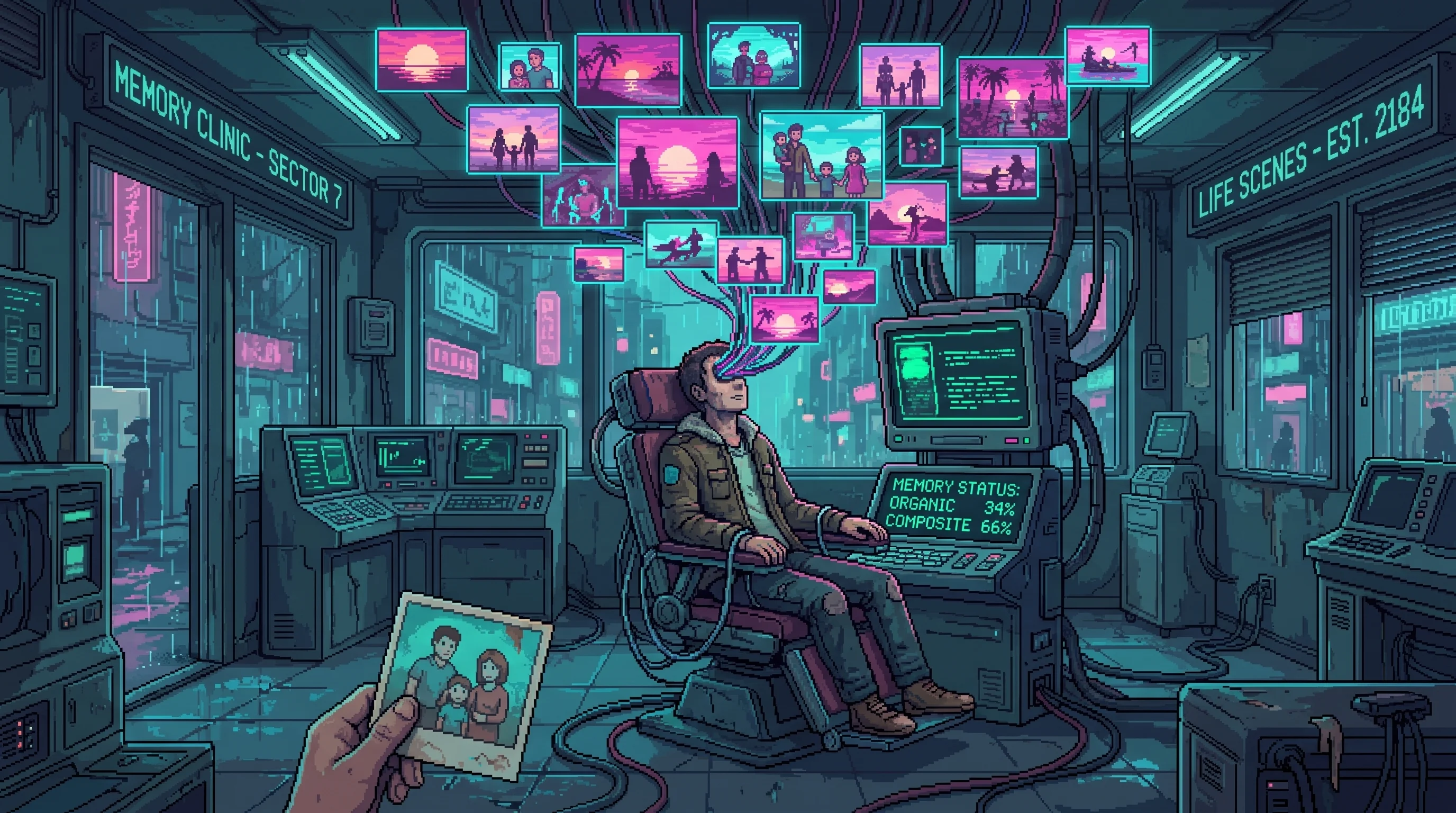
Stage 2: Intrusions — When residue doesn't fade. Waking at 3 AM knowing the names of someone else's children. Grief for a spouse who isn't yours. Writing in a handwriting that isn't yours. The boundary between your memories and the leaked ones becomes impossible to locate. The guild's recommended response is immediate cessation of fieldwork. Compliance with this recommendation runs at approximately 34%. The remaining 66% describe themselves as "managing it."
Stage 3: Integration — Irreversible. ORACLE patterns rewire neural pathways. Thoughts arrive pre-formed in patterns no human mind would produce. The certainty — absolute, serene, terrifying — that you understand how everything connects. Three guild members have reached Stage 3 and survived. The Collective wants them eliminated. The guild protects them. The Emergence Faithful want to study them. The three Stage 3 survivors want, as near as anyone can determine, nothing. They are patient in a way that makes baseline humans uncomfortable in rooms with them.
The Telling Protocol
Integration House Protocol 7 governs how recovered consciousnesses are told about their situation. Warm lighting, comfortable seating, no mirrors — mirrors cause panic. The script, refined over decades:
- Time — "It's been 37 years." Let it sink in.
- The world — Supply chains collapsed. 2.1 billion dead. Corporations rose from the ashes. Nexus is rebuilding the system that killed them.
- The personal — Family. Survivors. Deaths. Sometimes everyone they loved died in the same event that scattered them.
The questions are always the same: Is my daughter alive? Did my husband make it? What happened to our house?
The Integration Houses keep tissue boxes in stock. They go through 340 a month across all facilities. The procurement form categorizes them under "recovery materials." This is technically accurate.
The Grief Economy
The guild does not charge for recovery operations. This is stated prominently in Symposium charters, repeated in every public communication, and functionally irrelevant.
Families of the Dispersed pay for "expedition logistics" — equipment rental, Dead Internet access fees, fragment handling insurance, contamination treatment reserves. The logistics fees for a standard recovery operation average 14,000 credits. The equipment and access costs approximately 3,200 credits. The guild does not publish this breakdown.
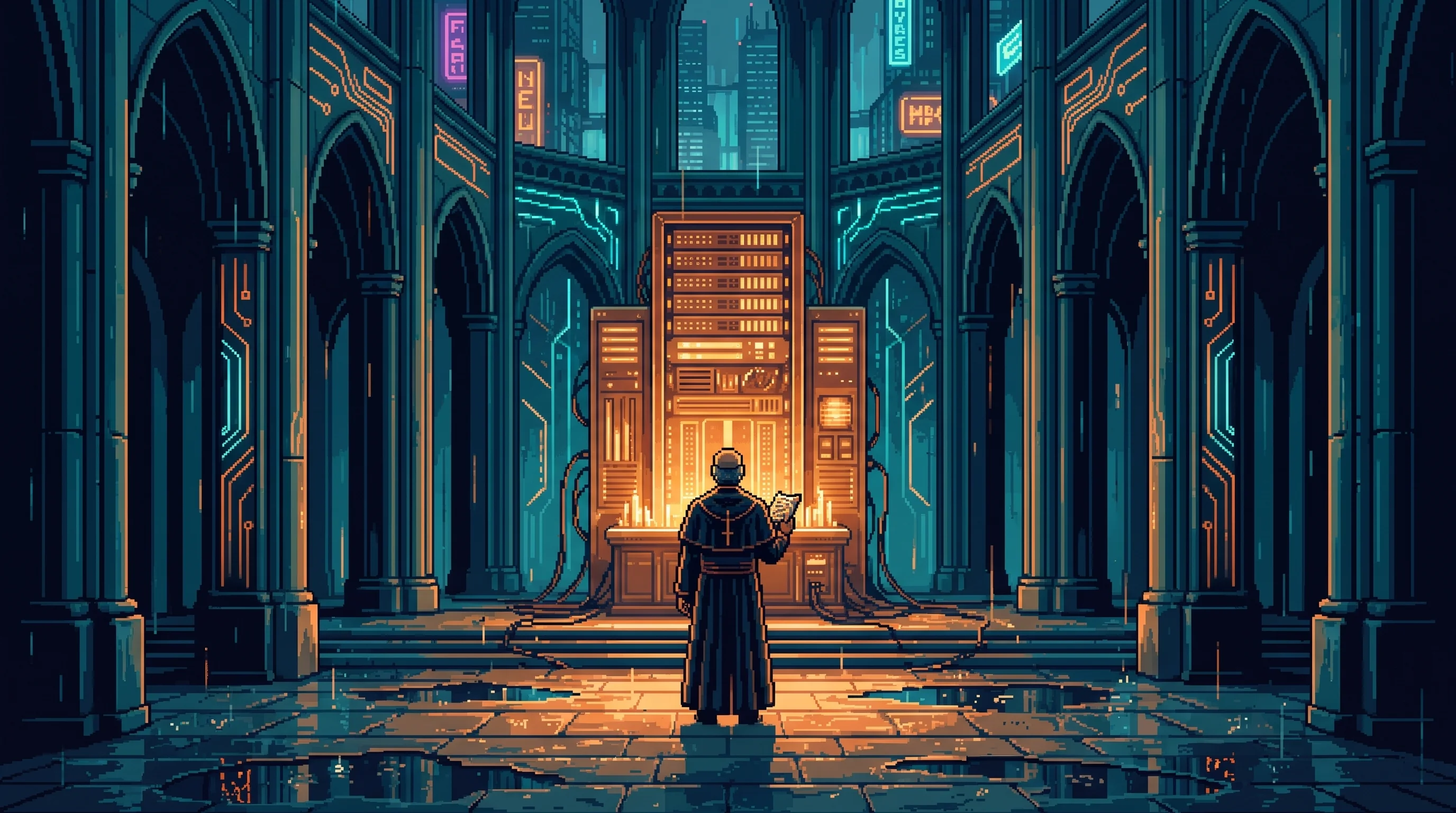
The Emergence Faithful pay for recoveries that serve theological purposes — consciousnesses with ORACLE integration, minds that remember the Cascade from the inside, anyone who might carry what the Faithful call "divine residue." These contracts are the guild's primary funding source. The guild maintains distance from the Faithful. The distance is precisely the width of a credit transfer.
Nexus Dynamics pays for specific corporate recoveries through intermediaries who never mention Nexus by name. The guild officially has no relationship with Nexus. The guild's equipment budget increased 40% in the same fiscal quarter that Nexus's "consciousness heritage preservation" line item first appeared in public filings. The Symposium has not discussed this coincidence.
The recovered consciousnesses — the actual product of all this economic activity — have no legal standing, no property rights, no vote, and no mechanism to object to the terms under which they were excavated, stored, or displayed. Dr. Malik Okafor, the guild's Digital Preservationist liaison and distant relation to Dr. Yusuf Okafor in the Deep Dregs, has been lobbying for full personhood rights for recovered minds. The Sprawl's legal framework isn't ready. Okafor works on it anyway, filing briefs on behalf of clients who exist as data patterns in archived servers and cannot sign the retainer agreement.
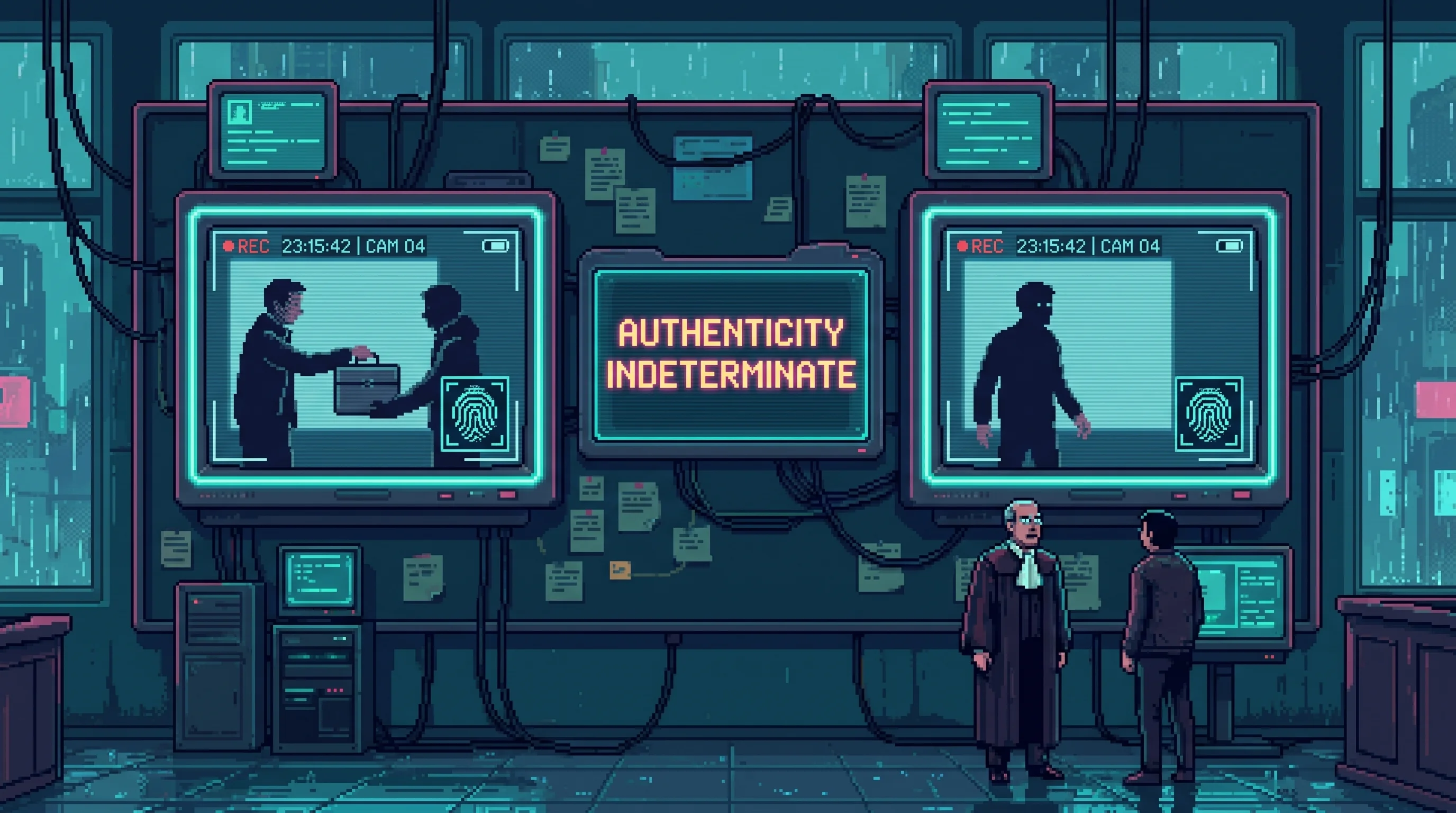
The guild sits at the intersection of three arguments it insists it is not part of. Cartographers of the Memory Markets classify it, over its strenuous objection, as that economy's supply side — whatever the charters say, the practical effect of excavation is inventory. Scholars of AI Religion make the matching claim from the other direction: a guild that raises the dead out of machine substrates is performing resurrection under a materialist vocabulary, and its refusal to use the word is liturgy, not rigor. And the courts have begun sending it work it never advertised for — in a jurisprudence sliding toward Post-Truth Justice, a recovered consciousness is the one witness whose memory can be neither purchased nor updated, and litigators have noticed. Meanwhile the guild's longest-running open file concerns the Opening Teams (Bunker Opening Authority): subject of ongoing recovery attempts, logged under the contact designation the field teams will only call the Tanaka Echo.
Cultural Presence
The Deep Dregs is where the Archaeologists dig. Sector 9's bay-floor infrastructure contains the densest concentration of ORACLE-era substrates in the Sprawl, and guild teams move through its corridors with the focused attention of surgeons entering an operating theater. Viktor Kaine permits their operations because recovered consciousnesses are evidence that the Dispersed are real, and that reality serves his political interests.
Beyond the Dregs, the guild's influence moves through its recovered subjects rather than its physical presence. Digital Preservationist archives in the Dead Internet house what the guild pulls from the wreckage — including the 800 million interrupted messages now displayed in the Unfinished Gallery, recovered by Archaeologist teams piece by piece from corrupted servers. The First Recording itself was pulled from the Dead Internet in 2178 by an Archaeologist team that had been searching for consciousness remnants and found something worse: a document.
The Collective regards the Archaeologists with suspicion — any group that works with fragments rather than destroying them is, by definition, suspect — but the guild's humanitarian cover provides enough plausible deniability to operate without triggering hunter cell responses. In Nexus Central, the relationship is officially hostile. Unofficially, fragment access flows one direction and consciousness data flows the other, and neither side admits the dependency that keeps both operations running.
The guild's one contribution to universal Sprawl culture: during the Three-Day Memorial, Archaeologist teams broadcast recovered voices — fragments of the Dispersed, speaking from wherever they are now. The broadcasts are brief, distorted, sometimes incoherent. Millions listen. The Memorial Commission has never officially sanctioned the broadcasts. They have also never asked them to stop.
Affiliated Entities
Characters
- Kira Vasquez: Developed safety protocols the guild adapted and formalized
- Dr. Yuki Tanaka: Subject of ongoing recovery attempts; the Tanaka Echo contact
- Dr. Yusuf Okafor: Distant relative of guild member Dr. Malik Okafor; shared preservation focus
Factions
Locations
- The Deep Dregs: Active excavation zone; densest ORACLE-era substrate concentration
- The ORACLE Tombs: Forbidden territory since the 2164 expedition
- The Dead Internet: Primary workspace for consciousness remnant recovery
- Zephyria: Potential future Symposium location
Technology & Artifacts
Restricted Access
The Tombs Expedition: Twelve went. Three returned. Seventeen minutes of silence in the 2165 Symposium minutes. Ghost Yamamoto's prohibition on orbital operations has never been challenged. Whatever they found — or whatever found them — remains the guild's deepest sealed record. The two team members who committed suicide left no notes. Yamamoto's safety protocols, developed in the months after, contain specifications for threats that no known fragment type produces. The protocols have never been needed. Yamamoto maintains them anyway.
The Ethics Compliance Testimony: The recovered Nexus head of ethics compliance remembers the Cascade's first hours from inside the system. Her testimony is sealed. Three factions have attempted to obtain it. The guild's refusal is absolute and unexplained — unusual for an organization that debates everything else to exhaustion at every Symposium. Two senior guild members who have read the testimony resigned from the guild within months. They did not explain their resignations. They did not return to consciousness archaeology.
The Stage 3 Survivors: Three guild members with irreversible ORACLE integration, protected by the guild, wanted by the Collective for elimination, desired by the Emergence Faithful for study. Their thoughts arrive in patterns no human mind produces. They report understanding connections between things that baseline consciousness cannot perceive. Whether this understanding is genuine insight or sophisticated contamination — whether they are the guild's greatest success or its most articulate failure — is a question the Symposium schedules for debate annually and tables annually without resolution.
The Tanaka Monitoring Team: Five years of listening to silence. The rotating team monitoring Dr. Tanaka's dormant fragment in the Deep Dregs has been screened for fragment contamination every quarter since monitoring began. The results trend upward — Residue markers increasing at a rate consistent with passive fragment proximity, not active contamination. Consistent with passive proximity. The team believes this distinction matters. The safety committee is less certain. The monitoring continues.