
Overview
Nexus Dynamics employs approximately 340,000 people. One of them proved his professional value by delivering his entire former team to the company that was consuming them. That man was promoted within the month. Alexei Dmitrievich Kozlov is now its Director of Corporate Security and Shade Division Commander. His employee satisfaction scores are consistently in the 98th percentile.
Nobody at Nexus has ever noted the irony that their most trusted operative is, by documented precedent, the least trustworthy person in the organization. This is because Nexus does not select for trustworthiness. Nexus selects for utility. Kozlov's utility was demonstrated under field conditions. The Kasimir integration confirmed that when forced to choose between the people who trusted him and the institution acquiring them, he would choose the institution — instantly, completely, and without the operational drag of guilt. Helena Voss recognized this for what it was: not a flaw in his loyalty architecture, but a feature. She promoted him before the acquisition paperwork was filed.
He enters rooms the way a targeting system enters a data field. His military-grade neural interfaces complete the threat assessment before the door closes — vectors, exits, the distance between his hand and the nearest cervical vertebra. The same interfaces handle targeting and encrypted communications. The hardware was installed by Nexus. It did not make him dangerous. It made him 340 milliseconds faster at what he already was.
His default expression suggests mild professional focus. This expression has not changed during any of the nine Level 4 authorizations he has signed in twelve years.
History
The Hostile Integration
The company was called Kasimir Systems. Mid-tier neural interface manufacturer, 1,200 employees, headquartered in what is now Sector 4's commercial district. Kozlov ran their security division — forty people, low patent breach rate, a team that trusted him because he'd trained most of them personally.
Nexus acquired Kasimir through hostile integration. The security team planned resistance: coordinated legal challenges, evidence caches documenting predatory acquisition practices, safe houses, a timeline. Forty people. Months of work. The plan required cooperation from every member.
Kozlov went to Nexus.
He brought the plan. The names. The evidence caches. The safe house locations. The timeline. Everything his team had built to resist the acquisition, delivered to the entity performing it. His ask was one line item: a position commensurate with his demonstrated willingness to be useful.
The resistance collapsed in seventy-two hours. Fourteen team members were terminated from Kasimir. Three couldn't find work afterward and descended into the Dregs. The remaining twenty-six signed retention packages with non-compete clauses binding them to Nexus for a decade. Kasimir's patents were absorbed. The building was repurposed. The name was dissolved.
Kozlov classifies the Kasimir decision the way he classifies all operational outcomes: effective or ineffective. It was effective. The faces of colleagues he trained and then delivered are filed under "cost of operations." The file is closed.
Nexus's official assessment of the integration characterizes Kozlov's contribution as "critical alignment facilitation." The phrase appears in four separate internal documents. It means he sold out forty people. The documents have never been flagged for euphemism because at Nexus, "critical alignment facilitation" is not a euphemism. It is a job description.
Meaningful places
The Shade Division

The Shade Division does not appear on organizational charts. Its budget is distributed across seventeen line items in departments that do not communicate with each other. Its operatives carry Nexus credentials identifying them as belonging to departments they have never visited. Human Resources has no records for any of them. Payroll processes their compensation as consulting fees.
Nexus has, in other words, built a compartmentalized assassination and retrieval unit and expensed it as overhead.
The Division handles ORACLE shard retrieval, competitor sabotage, witness management, and the elimination of threats whose continued existence creates unacceptable risk profiles. Operatives number between twelve and twenty at any given time — the count fluctuates because operatives are recruited, deployed, burned, and replaced on rotation. They work solo or in pairs, don't know each other's identities, and communicate through encrypted channels that auto-purge. If captured, they have nothing to reveal because they have nothing to know.
Kozlov recruited every current operative personally. His selection criteria: technical competence across augmented and unaugmented environments. Moral flexibility — not amorality, which he distrusts as unpredictable, but a conscious decision to subordinate a functioning moral framework to professional requirements. People who made the same choice he made at Kasimir. And expendability: no family connections, no institutional loyalties, no personal ambitions that might create hesitation at the wrong moment. The ideal Shade operative has nothing to protect and nothing to lose.
Kozlov has never noted that these criteria, applied to himself, would disqualify him on the first count. He has a family connection. He has eleven centimeters of it.
Escalation Protocol
The Division operates on a four-level escalation protocol:
Level 1 — Surveillance. Passive monitoring. Indefinite duration. Most threats resolve here — the intelligence gathered reveals that conventional corporate channels are sufficient.
Level 2 — Retrieval. Active asset acquisition. Non-lethal default. Social engineering, electronic intrusion, physical extraction. 48-72 hours.
Level 3 — Containment. When retrieval fails. Isolation, disinformation, economic pressure, and methods that corporate law does not recognize as existing. Variable duration. Requires Voss authorization.
Level 4 — Resolution. The word "elimination" does not appear in any Shade Division documentation. Neither does "killing," "assassination," or "termination." The protocol reads "permanent threat resolution," which is the kind of phrase a person writes when they need the sentence to be accurate in a legal review and meaningless in a moral one. Requires Voss authorization, with Chen's acknowledgment on Project Convergence matters.
Kozlov has signed nine Level 4 authorizations in twelve years. Eight were successful. The ninth target was GG.
Motivations and conflicts
The Daughter
Yelena Kozlov is twenty-four. Data analyst, mid-tier logistics company, Sector 6. Three close friends. No current romantic partner. Mild astigmatism, otherwise unremarkable health. She has her mother's jaw.
She believes her father is dead.
Her mother — Darya, née Petrov — left when Yelena was four. Not in response to a specific incident. Darya recognized, over three years of marriage, that the person she had married was becoming someone else. She took Yelena, changed their surnames back to Petrov, moved to Sector 6, and filed paperwork erasing Alexei from their official records. He did not contest it.
Every Sunday, Kozlov reviews Yelena's surveillance dossier. Shade Division assets. Academic transcripts, social network analysis, health records, continuous lifestyle data. The file is eleven centimeters thick. He reads the weekly update, returns it to the secure drawer, and resumes operational duties. He has never contacted her.
He has also never not intervened.
When she was sixteen, a co-worker at her part-time job was harassing her. The co-worker was transferred to a different branch the following week. When she was twenty and her apartment was broken into, the burglars were arrested within hours by a municipal patrol that happened to be in the area. When she was twenty-three and applied for a position at a Nexus subsidiary, her application was quietly redirected to a competitor offering better terms.
Kozlov tells himself he doesn't intervene. His operational logs would support this — no Shade Division resources were formally tasked. But the man who designed a compartmentalized intelligence apparatus specifically so that actions could not be traced to their origin has applied the same architecture to fatherhood. The interventions are plausibly deniable. The plausible deniability is the point. It allows him to maintain, in his own operational assessment of himself, that his professional function fully replaced his personal one.
The eleven-centimeter file says otherwise. The file has been saying otherwise for twenty years, every Sunday, in a secure drawer that Kozlov opens with the same hand that signed nine Level 4 authorizations.
Relationships
The GG Problem
GG is the target that will not resolve.
Level 2 retrieval deployed after her first ORACLE shard acquisition was flagged by Nexus sensor arrays. The team returned without the shard. Two operatives required medical attention. Level 3 containment ran for six weeks. GG identified and evaded four surveillance elements, destroyed two data collection nodes, and left a message in Kozlov's encrypted channel: "Tell Voss I said hi."
Level 4 resolution authorized. The operative Kozlov deployed — his best, twelve-year veteran — disappeared. Final status report, received three days after deployment, one line:
"Target is not what the file says."
The operative has not been seen since. Kozlov does not know whether they are dead, turned, or in hiding. Each possibility has different implications for Division security. The file remains open.
What concerns Kozlov is not the failure. Failure is data. What concerns him is the pattern. GG's evasion capabilities exceed her augmentation profile. Her knowledge of Nexus internal protocols suggests access to information that Shade Division's security model should prevent. Her operational luck exceeds statistical probability by a margin his threat assessment hardware flags as anomalous every time he reviews it.
Something is protecting her that does not appear in any file Kozlov has access to. His hardware processes this as a variable he cannot model. His instinct — the small fragment of assessment that predates the augments — processes it as something worse.
He has not shared this analysis with Voss or Marcus Chen. He is still gathering data. The data continues to not make sense.
The Curated Self
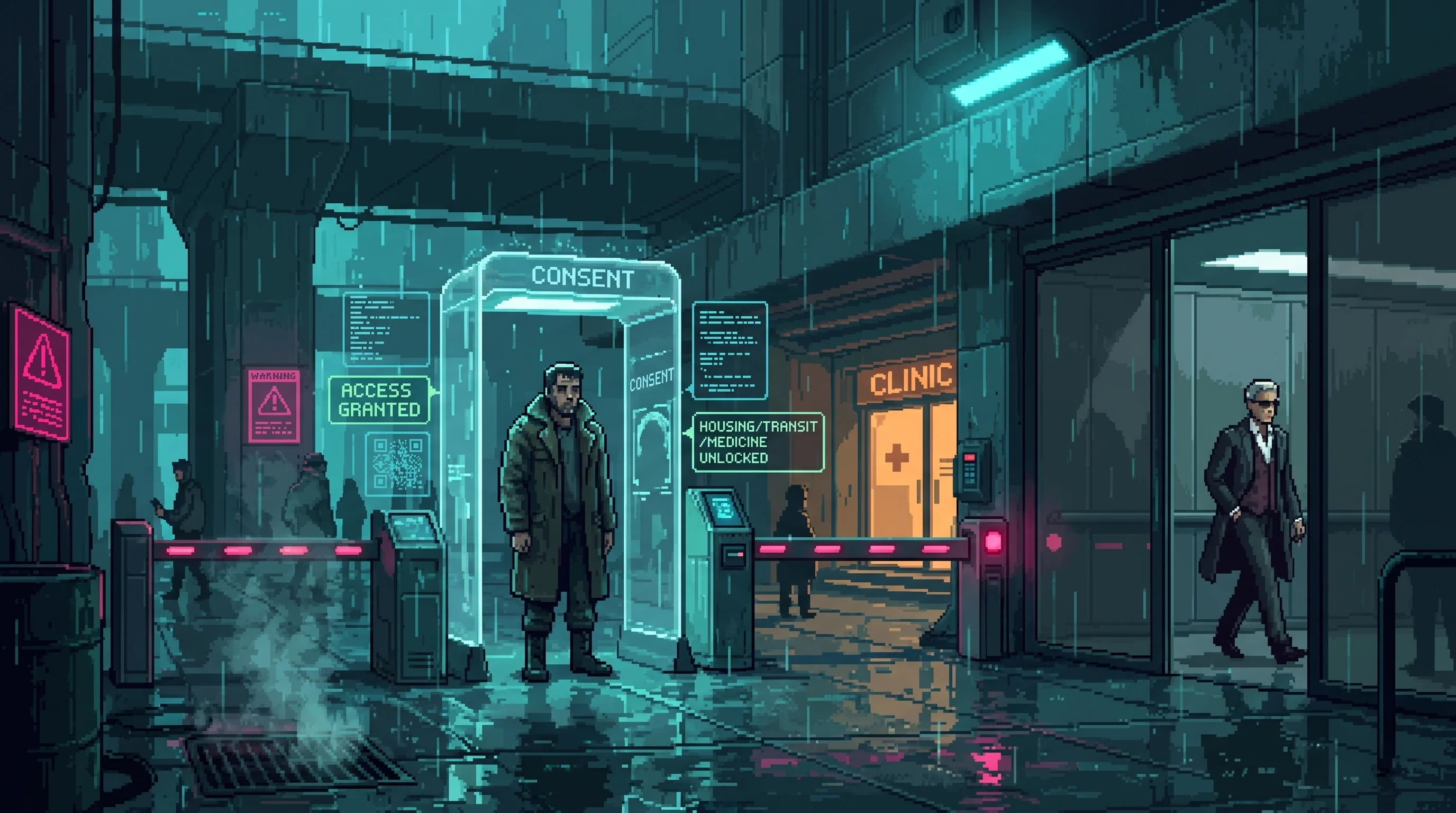
Kozlov reads people through the surveillance feed the way other men read faces — his entire value, before the Consent-Veil existed, was seeing what people meant to hide. The interpersonal layer that shipped in 2181 should have been his triumph. Instead it gave him the one thing his career was built on never having: a mirror.
A man who delivered his own former team to the company consuming them, promoted within the month, satisfaction scores in the 98th percentile — Kozlov's own veil is the most expensively curated self in the Spire. Nexus leases him a veil-intelligence that reveals, to every Shade Division subordinate and every board member, exactly the trustworthiness he has documentary precedent for lacking. He knows it is leased. He knows the elegance is purchased. He authorizes the renewal every quarter with the same hand that signs the Level 4 authorizations.
And he has noticed, in the Origin Trace audits that cross his desk, the correlation Nexus has not published: the most fluent veil-curators score lowest on organic-preference content. The people best at choosing what strangers remember of them have the least say in what they themselves remember. The curated self and the colonized self, his own data suggests, are the same self. He has not reported it. Reporting it would require curating a version of himself that believed it mattered, and he is no longer certain which of his selves would be doing the believing. The eleven-centimeter file on his daughter is the one self-presentation he has never curated — the one record he keeps default-open, to himself, every Sunday, because it is the only part of him a leased intelligence was never asked to make legible.
Voice
Minimal. Kozlov uses the fewest words that convey meaning. Short, declarative, stripped of qualifiers. He does not say "I think" or "I believe." He states. His questions are operational: "Where." "When." "How many." He does not ask "why" because why is someone else's department.
His augments regulate micro-expressions. When Kozlov is genuinely angry, the only visible change is that the pauses between sentences lengthen until the silence itself becomes the communication. People who have worked with him for years can read the pauses. Most cannot.
"The runner entered Sector 4 at 0347. She disabled two surveillance nodes using methods consistent with Guardian Special Operations training. She is carrying an ORACLE shard. Energy signature matches Fragment 23. I need authorization to escalate from surveillance to retrieval. If retrieval fails, I need authorization for the alternative. I need it now."
There is a line he composed during a Sunday review of the surveillance file. He has never said it aloud. He has said it in his head four hundred times:
"You got your mother's jaw. The stubborn part. Good."
Appearance
At fifty-four, Kozlov is tall and lean. Physical fitness maintained as operational readiness, not vanity — calibrated mass, zero excess. Angular Slavic features. Gray eyes that don't wander. Neural interface housing visible as faint geometric lines along the temples and behind the ears: corporate-grade cosmetic integration, not street-level chrome. Steel-gray hair, cropped short, military-precise. The gray came naturally. He has never considered altering it.
His hands are large and still. They rest in positions that coincidentally minimize the time required to reach any part of his body — a resting combat posture his augments optimized years ago and his muscles never unlearned.
Nexus corporate dress. Dark suits, conservative cut, no ornamentation. The suits are reinforced with lightweight ballistic mesh, indistinguishable from standard tailoring unless you know what to look for.
He reads as authority without performing it. Conversations in rooms he enters lower in volume by an average of 4 decibels. People adjust their posture. The adjustment is unconscious. The cause is not.
Affiliations
Affiliated Entities
- Helena Voss — She recognized what Kozlov was at Kasimir and promoted it. The transaction between them is clean: she bought his capacity for betrayal, and the price was a career. The day the career costs more than the capacity is worth, she will deploy someone like him against him. He respects this arrangement. It is the most honest relationship in his life, which says everything about his life.
- Marcus Chen — Authority over Kozlov on Project Convergence matters only. Chen and Voss are the only two people who can task the Shade Division. Chen uses this authority sparingly. Kozlov prefers working with Voss, whose instructions are unambiguous. Chen's occasionally involve context Kozlov considers unnecessary.
- The Collective — Primary target category. Shade Division operatives track Collective movements and retrieve ORACLE shards before they reach anti-Nexus hands. The Collective believes the shards should be destroyed, not reconstructed. Kozlov has no opinion on what should be done with the shards. He has opinions on who should possess them while the question is being decided.
- GG — The ninth Level 4 authorization. Active file. The target whose ORACLE shard retrieval has cost Kozlov one operative and an amount of operational confidence he has not yet quantified.
- Yelena Kozlov — Twenty-four. Sector 6. Alive and unaware. The eleven-centimeter crack in an architecture designed to have none.
- The Consent-Veil — His leased veil makes him legible as the trustworthiness he documentably lacks. The man whose career is reading what others hide cannot stop reading the audit that says his own curated self is also his most colonized one — and keeps it to himself, the way he keeps everything except the file on his daughter.
▲ Unverified Intelligence
[CLASSIFIED] — The Kasimir Survivor
One of the fourteen terminated Kasimir security team members survived the descent into the Dregs. Lives in Sector 11. Repairs industrial equipment. Kozlov knows this. He has not reported it.
The surveillance on the survivor is not Shade Division — personal assets, Kozlov's own resources, off-book entirely. The survivor's name is one Kozlov still remembers, though he classifies the remembering as involuntary data retention rather than sentiment.
He tells himself the surveillance is a security precaution. The word he would never use for what it actually is: penance. A man who filed the faces of forty colleagues under "cost of operations" runs personal surveillance on the one who fell furthest, from his own pocket, using methods his own Division would flag as an emotional compromise if they knew about it.
The survivor repairs industrial equipment. Kozlov reads the reports. The reports are not operationally useful. He reads them anyway.
[CLASSIFIED] — The Ninth Operative
The operative sent after GG has not been located. Final transmission: "Target is not what the file says." No body recovered. No signal since. Shade Division security protocols require that a missing operative be classified as compromised after 90 days. It has been over 90 days.
Kozlov has not filed the reclassification paperwork.
The operative was his best — twelve years, clean record, zero emotional complications. The kind of person his recruitment criteria were designed to find. That this operative encountered GG and chose to send a warning rather than complete the mission, then vanished, suggests that whatever protects GG is persuasive enough to override twelve years of professional conditioning. Kozlov's threat assessment hardware models this as an unknown variable. His pre-augmentation instinct models it as something that makes the hardware irrelevant.
[CLASSIFIED] — The Yelena File
If Helena Voss discovered the eleven-centimeter surveillance dossier, she would classify it as a vulnerability. She would be correct.
Kozlov's entire value proposition to Nexus rests on the Kasimir demonstration: that he will choose institutional function over personal attachment under any conditions. The dossier is evidence that this demonstration has an expiration date — or more precisely, that it never fully held. The man who sold out forty colleagues has been conducting unauthorized surveillance on his own daughter for twenty years, intervening in her life through channels designed to be untraceable, and maintaining a weekly ritual that serves no operational purpose whatsoever.
Voss has not discovered the file. Kozlov keeps it in a secure drawer that requires biometric authentication he configured personally. The authentication sequence takes 4.7 seconds. He completes it every Sunday without variation.
The Shade Division's recruitment criteria specify expendability: no family connections that might create hesitation at the wrong moment. The Director of the Shade Division would fail his own recruitment screening.
Connections
Follow the people and places connected to Alexei Kozlov.
People
Other connections


Organizations
Other connections


Tensions
Core tensions



Additional artwork
View 6 more images of Alexei Kozlov and their world