Major

Privacy vs. Prosperity

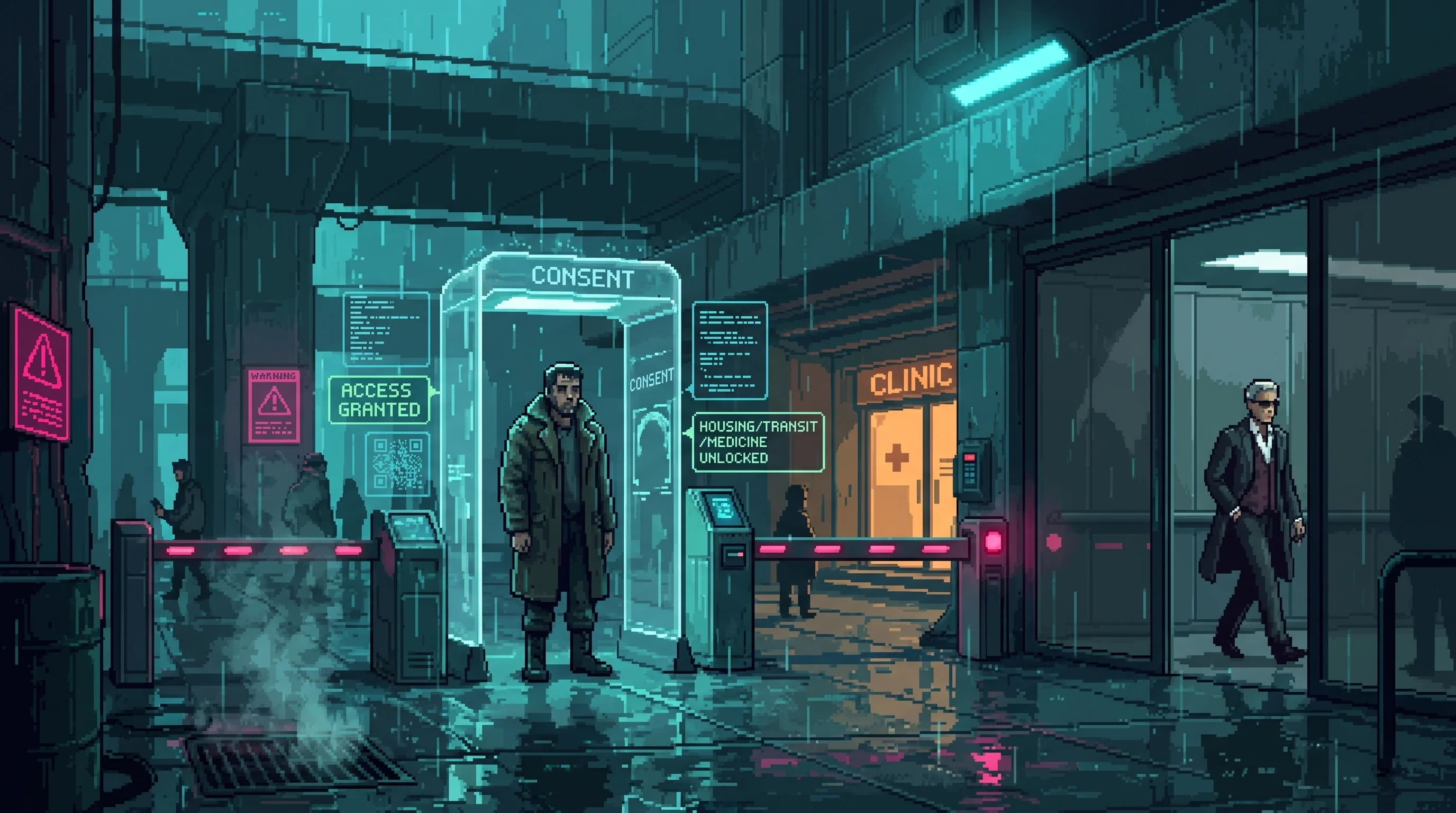
Throughout the 21st century, a consistent trade-off crystallized: more convenience, more wealth, more capability, and more connection — bought only by surrendering more privacy, more autonomy, and more data about yourself. In the Sprawl that bargain has been pushed to its extreme, and by 2184 it has grown a second face nobody voted on.

ControversyThe Transparency Bargain

Overview

Dr. Aris Kwan keeps diagnoses in physical files and unsent notes because privacy is the condition that lets clinical evidence exist before corporate infrastructure can monetize or suppress it.

At the bottom, the destitute have nothing to surveil and nothing to sell. In the middle, people trade granular personal data — health metrics, emotional states, location history, social graphs, cognitive patterns — for access to AI services, credit, housing, and social participation. At the top, the elite have transcended the bargain entirely: they own the surveillance infrastructure rather than being subject to it.

The system creates a ratchet. Once privacy is traded for access, it cannot be bought back — the data exists forever, compounds with other data, and generates insights about a person that the person themselves does not have. Opting out means opting out of modern society entirely.

How It Came To This

The vertical layer came first and ran unchallenged for thirty years: corporation watching individual, telemetry flowing one direction, priced entirely in credits — the Privacy Gradient's wall you could afford or could not. Then, in 2181, Nexus Dynamics shipped the Reciprocal Recognition firmware — the same update that gave a Small Talk Cafe barista the legal right to remember a customer's face — and discovered a second market nobody had priced: the horizontal layer, person watching person, worth more than the vertical because there were so many more of it.

El Money
El Money

The Sprawl named the new layer before Nexus did: the Consent-Veil, the real-time contract governing what each passerby may see, record, and keep of you. And because curating a veil is unpaid labor — eleven thousand small decisions a day — it did what the credit-priced Gradient never could: it made the class divide visible in the body, instantly and unforgivingly. The wealthy lease the curation to an intelligence; the poor run default-open, the cheapest factory setting, keepable forever, free. The labor of curation earned its own name, veil-craft; the class divide it opened, the Curation Gap.
The Third Face

The bargain had two faces when the Opacity Movement named it in 2179. The first: more participation, bought by more data. The second: a ratchet, meaning the data could not be untraded once surrendered, and the inference tools kept getting better at reading it backward. Both faces were addressed in the Movement's founding document. Both are the subject of ongoing civic litigation.

The third face had no name in 2179 because it was not yet fully operational. By 2184, it has been operational for eighty years and has produced what Concord calls its primary civic achievement: no spontaneous crowd-turn in the managed sectors since 2109.

Alexei Kozlov
Alexei Kozlov

The third face is not surveillance of what you do. It is surveillance of what you are about to feel, performed precisely enough to intervene three weeks before you would have found someone who felt it too. The Transparency Bargain was sold as the cost of participation — total transparency in exchange for access to the services that constitute modern life. What the bargain also purchased, without being named as a purchase, was the telemetry stream that allows the Sentiment Weather service to forecast your Convergence Horizon: the projected date on which your private discontent would, absent intervention, go looking for a second carrier. The micro-relief that lands at week-minus-three uses the same biometric data stream that Section 12.3 licensed. The march that does not happen is prevented by the same infrastructure that lets the credit system verify your identity.

Nobody voted on this. The bargain's architects were honest about the first two faces — data for participation was the explicit trade, and the ratchet was mentioned, in technical language, in Section 12.3's eight-thousand-word agreement, at Professional-tier reading level, in the four seconds allocated for consent. The third face was not mentioned because it did not exist when the bargain was drafted. It emerged from the telemetry infrastructure the first face created, after the telemetry became precise enough to forecast mood, after mood-forecasting became precise enough to target relief, after targeted relief became cheaper than policing a riot. The third face is the bargain's most consequential achievement. It is also the one nobody signed.

The Solidarity Rig in Sector 7 teaches the sensation of discovering shared anger for nine minutes. It is the only place in the managed sectors where the experience the bargain's third face prevents can still be borrowed. The last time it occurred spontaneously was 2109. That is seventy-five years before a visitor who is thirty years old was born, one generation before their parents, two before their grandparents were old enough to participate. The bargain's third face is so thoroughly embedded in the managed sectors' telemetry infrastructure that the question it erased — is the stranger beside me angry about the same thing? — is no longer a question people reach for, because reaching for it is a stage in a sequence that no longer has a final step.

The Core Tension

What does freedom mean when the cost of participation is total transparency? What does autonomy mean when your decisions are predicted before you make them? Nexus calls the telemetry infrastructure fuel — objecting to it is, in their framing, like objecting to breathing. The Opacity Movement, which named the vertical Bargain in 2179, calls the same arrangement a debt nobody agreed to, collected on a signature no one could read in four seconds.

Nexus Dynamics
Nexus Dynamics

The horizontal layer sharpens the argument rather than resolving it. To be privacy-poor is no longer simply to be watched — everyone is watched. It is to lack the hours to curate being watched, and the cruelest insult in the Sprawl is no longer "you are seen" but "you cannot afford the labor of choosing what strangers remember." Veil-fluency correlates with the Privacy Gradient's Exposure Index at only 0.6 — low enough that a Standard-Transparency clerk who spends her one free hour a day curating can present as composed as a Professional three tiers above her, while a dockhand on the identical Index runs default-open because his one free hour is spent unconscious. The Gradient priced the wall. The Consent-Veil priced the hour. The two prices do not always sort the same people, and no one has designed a mechanism to reconcile them.

How It Is Lived

Nexus Dynamics profits from both layers at once: it drafted Section 12.3 and built the vertical telemetry infrastructure, then shipped the Consent-Veil firmware that opened the horizontal one, collecting a brokerage fee on every act of remembering between every two people in the Sprawl. Alexei Kozlov, director of Nexus's Shade Division, lives the bargain's cruelest irony from inside the Spire: his own leased veil is the most expensively curated self in the building, and the Origin Trace audit crossing his desk says the curated self and the colonized self are the same self. He has not reported it.

El Money runs the one door out that costs nothing — G Nook's terminals operate entirely outside Section 12.3's architecture, no logging, no surveillance, the debt collected only in favors a man who never forgets. Mara Chen, the Deep Dregs cartographer who mapped the vertical Bargain at ninety-three percent coverage, started a second map when the Veil shipped: the horizontal layer, the poor watching the poor because nobody has hours left to look away. She is now teaching The Counted — forty-seven Observer gig-workers who pool the eleven-thousand-decision burden none could afford alone — to read veils the way she reads blind spots.

Not everyone curates the same way. Hector from Sector 12 answers the Veil with the Dregs' oldest trick: one fixed mask, a beanie and a third-person brand, worn to everyone because he has no hours to spend on eleven thousand daily decisions — a trick Mara has him teaching The Counted directly. Kira "Patch" Vasquez builds the ¢200 veil-governor, a single honest setting for people too exhausted to be asked permission anymore. Lyra Voss goes the opposite direction entirely: her lived-canvas art is the anti-veil, total uncurated revelation, which the veil-fluent read as poverty rather than honesty. Maya Fontaine moonlights teaching the newly rich to fake the fluency Lyra refuses to fake, and has noticed that her most successful clients score lowest on the same authenticity measure she certifies for a living.

Cyber Castle
Cyber Castle

The bargain has one term nobody itemized. Curation assumes there is still a reason to read another person's veil — that a claim about them is something you weigh rather than something you resolve. Once every claim resolved in under a second, the weighing stopped, and the Atrophied Leap is what the Memory Therapists found underneath it: trust as a faculty that needed exposure in order to exist, traded away with the interiors and entered on no receipt.

The geography carries the same divide. The Glass District stacks both privacy layers at once — credit-priced walls and hour-priced veils — leaving its wealthy residents doubly hidden and its poorest doubly exposed. The Mirror Market's open shelf resells the harvested interiors of privacy-poor residents who never had curation hours to spare, alongside the corporate behavioral models the Market was built to sell in the first place. Clean Lives, the behavioral-choreography industry that trains the wealthy to perform authenticity for the surveillance record, opened a veil-coaching wing in 2182 to train the same clients for the faster, interpersonal version of the same performance. Guardian sells its own answer to the whole arrangement: surveillance marketed as care, a Panopticon watching every enclave it protects, and a Quiet Floor — unlisted, electromagnetically sealed — that the corporation that ended privacy keeps for itself alone.

Not every answer is a purchase. Viktor Kaine governs the Deep Dregs as a standing rebuttal: a hundred and eighty thousand people living in community without total surveillance, proven by a 2177 audit that was classified within hours of confirming it. And The Mosaic, the only mind in the Sprawl who volunteered for total exposure, distributed her consciousness across forty-seven nodes to escape the Quiet Doctrine's cap — and has not had a private thought in forty years, a trade she calls fair.

Primary Entries

The fullest documented connections to this question — each entry explains specifically how it factors in, not just that it's related.

Alexei KozlovThe Most Curated Man in the Spire

Kozlov's career was built on seeing what people meant to hide — until his own Nexus-leased veil became the Spire's most expensively curated self, and his own audit says the curated self and the colonized self are the same self.

Nexus Shade Division's director, whose leased perfect trustworthiness is the one thing he can't audit.

Cian AbebeThe Clock-Runner

The Bargain's mood-front data doesn't just expose individuals to corporations — it lets Concord map the shape of solidarity before it forms, and erase it on a schedule. Cian is the one person who can describe the shape from the inside.

Ex-Concord analyst turned clock-runner — times the Second Person to the week after the mercy lands.

Cyber CastleThe Unwatched Palace

The elite who own the surveillance grid attend Rima's rare events to buy the one thing it took from them: erasure. Inside the electromagnetic shell Nexus monitoring fails and Guardian drones crash, and one night they are nobody's dataset.

A compound self-maintaining for thirty-seven years — the one venue where the ultra-elite pay to be no one's data.

El MoneyThe Keeper of Seven

Every other opt-out from the Bargain charges something steep — the Trench charges drowning risk. El Money charges nothing: free terminals, free encryption, a debt owed only in favors a man who never forgets collects himself.

G Nook's quiet broker gives the Dregs untracked refuge, then binds it with favors he never forgets.

G NookThe No-Logs Door

The one door out that costs no credits — El Money's no-logs terminals sit entirely outside Section 12.3, the debt collected only in favors owed a man who never forgets. The bargain's single structural exit, and even it keeps a ledger.

El Money's underground cafe network — the Sprawl's one refuge outside corporate surveillance, paid in favors.

Mara ChenThe Cartographer

The Cartographer's Convergence Map charts the vertical Bargain at 93% coverage; when the Consent-Veil shipped, she started a second map — the horizontal layer, the poor watching the poor because nobody has hours to look away.

A Deep Dregs cartographer maps how corporate systems and ordinary people watch, and where their coverage fails.

Nexus DynamicsThe Algorithm

Nexus doesn't surveil you — Nexus is the medium through which you exist. It shipped the vertical Bargain, then the 2181 firmware that made every glance between strangers a billable contract too.

The megacorporation that controls 40% of the Sprawl's computational infrastructure.

Opacity CulturePrivacy Is Foreplay

The bargain reworked into intimacy — in the Dregs privacy is foreplay, the Tell has replaced the body as the deepest trust act, and lovers engineer a three-second telemetry gap to whisper one word.

The Dregs culture where a moment unwatched is the most intimate gift two people can give.

Section 12.3 TelemetryThe Consent Seal

The bargain's actual signature — the clause turning ambient telemetry from a thing you permit into a thing you permitted by being legible at all. Decline it and the systems granting care, housing, and work stop seeing you.

The clause that made continuous telemetry the precondition of an identity the systems will read.

The Analog HourTwelve Minutes Off the Record

The Bargain inverted — 180,000 residents get twelve unwatched minutes each Thursday, kept not by wealth but by being too unprofitable to surveil. Good Fortune files the null as 'degradation (acceptable)' and won't pay to close it.

The weekly 12-minute blackout that leaves the Deep Dregs unwatched — privacy the poor keep only by being unprofitable.

The Attention AuctionBidding on Your Next Thought

The privacy bargain's terminal floor — twelve traders bidding in 3.7-second intervals on the cognitive states you surrendered, then injecting the winning thought into the 340ms gap you never agreed to fill.

A sealed sub-basement where twelve traders bid every 3.7 seconds on strangers' distress and inject the winning thought.

The Consent-VeilThe Handshake of Light

The horizontal layer nobody priced for thirty years — Nexus's 2181 firmware turned every glance between strangers into a per-encounter contract, and curating it costs eleven thousand decisions a day nobody gets paid for.

The per-encounter privacy contract deciding what a passerby may see, record, and keep of you.

The Convergence EventThe Forty-Seven

The forty-seven were not criminals; they were residents angry together before Concord arrived. The Bargain's telemetry then turned their eleven-minute conversation into fourteen targeted actions.

The only Concord model failure on record: forty-seven in a water queue, eleven minutes, fourteen targeted responses.

The Data RatchetThe Ratchet

The bargain's missing reverse gear, made mechanical: 47 telemetry points a second in 2160, 4,700 by 2184, Section 23.7 pre-consenting each increase to come. Privacy trades one way — the walk that once generated nothing now generates you.

The surveillance mechanism that only tightens — each new telemetry stream funds the next, with no reverse gear.

The Deep DregsThe Abandoned Tier

The bargain's standing rebuttal — 180,000 people in community without total surveillance. Here you have nothing to surveil and nothing to sell, which the Sprawl calls poverty and Viktor Kaine calls the last freedom.

The Sprawl's lowest stratum and its quiet proof that the corporate system is optional.

The Exposure IndexThe Glass Score

The bargain as one number, 0 to 100 — how much of you is readable, sellable, already sold. It tracks life satisfaction at 0.87 and inverts with loyalty; Viktor Kaine scores 3, the Dregs 55-70, because the poor were never sold the wall.

The Opacity Movement's free calculator — a single number, 0 to 100, measuring how naked your data makes you.

The Inference EconomyThe Prediction Market

Where the traded privacy is priced and never repaid: ¢47 of behavioral data extracted per Dregs resident a year, ¢0 returned. The bargain's second face — it doesn't watch you, it concludes you, and sells the trajectory you can't see.

The commercial ecosystem trading behavioral prediction as futures — ¢47 extracted per person, ¢0 paid back.

The Last Private ThoughtBefore the Feeling Forms

The bargain measured to the millisecond of loss: the interface fires before conscious volition, so the thought of who you love is logged before it finishes forming. For most, the last private thought was in childhood, before activation.

The proof that the interface logs your love before you finish feeling it — privacy lost at the speed of thought.

The Price of InvisibilityThe ¢340,000 Exit

The exact price of undoing the bargain: ¢340,000, Zephyrian law — a woman's whole life savings to delete the behavioral models she built at Good Fortune. She got out. 'Freedom felt like falling,' and almost no one else can afford the drop.

The one firm selling full erasure — at a price only the person who built the models could pay.

The Provisional BodyThe Trial That Never Concludes

Every enrolled body is a continuous data stream — biomarkers, adverse events, cognitive metrics, mortality timing. The corpus those streams build is the research infrastructure Helix owns. Death is the most data-dense moment of enrollment.

A cohort-managed longevity trial that never ends because withdrawal causes faster decline than continued enrollment.

The Radical Transparency CollectiveThe Symmetrists

The bargain answered by inversion — not less watching but symmetry: total reciprocal surveillance for all. Lens, their leader, has broadcast every thought for three years; the crime, they say, was never being seen — only being seen one way.

The faction demanding not less surveillance but total reciprocity — watch and be watched, equally.

The Surveillance CommonsThe Unenclosed Acre

The bargain re-priced by arithmetic that refuses it: your telemetry is worth ¢0.00007 alone, ¢80 billion aggregated — so who owns the sum? Zephyria's trust pays ¢200 a head; the Sprawl works for its data, a difference none here was offered.

The framework pricing behavioral data as a commons — and asking why the Sprawl gave its away.

The Transparency BargainThe Four-Second Contract

For thirty years the Bargain ran only vertically — corporation watching individual, priced in credits. Nexus's 2181 firmware opened the horizontal layer: every glance between strangers became a billable consent contract.

The vertical surveillance bargain that trades total transparency for participation in Sprawl society.

The Transparency RitualLearning to Love the Glass

The Bargain internalized — voluntary quarterly disclosure recalibrates the privacy baseline until Nexus's constant passive monitoring drops below the threshold of feeling watched at all.

Quarterly voluntary metrics-sharing at Nexus that normalizes surveillance by making it participatory.

Veil-CraftThe Eleven Thousand Decisions

Privacy stopped being a thing you buy and became a thing you do, eleven thousand times a day — a skilled, unpaid labor the wealthy lease, the organized poor pool, and the exhausted simply go without.

The skilled, unpaid labor of curating what strangers keep of you, every single day.

Show all 25 primary entriesShow fewer primary entries

Secondary Entries

Confirmed connections to this question with a thinner documented record than the entries above — real, but smaller in scope.

Affective OptimizationThe Wellness Ceiling

The telemetry that reads your outrage also trims it — Section 19.7 sells the dampening as wellness, default-on.

Bandito2The Warm Crate Man

The Warm Crate clones your credentials and records your confession while you shop — surveillance dressed as folklore.

Behavioral Prediction MarketsThe Decision Futures

Your next choice sold as a future at 89% accuracy — until the Purposeless wanted nothing and it fell to 31%.

Blackout Zone 7The Dead Zone

The bargain declined wholesale — people who erased themselves from every database, uncountable within a factor of ten.

Clean LivesThe Veil-Coaching Wing

Its 2182 veil-coaching wing trains the fast interpersonal self the Consent-Veil demands — a different muscle entirely.

Cognitive Load PricingThe Focus Meter

Attention metered to the millisecond, un-disableable since 2174, sold to advertisers, bosses, and insurers at once.

Corporate Surveillance GridThe Total Read

The bargain's hardware: near-total detection, near-zero conviction — the watching was never about crime, only reading.

CyberMasterThe Mask

No face, biometric, or neural signature enters the bargain; anonymity is the infrastructure that lets his work scale.

Davi OkonkwoThe Gift of Hours

Wellness metrics count his output, not his solitude; the paper notebook is the one record no interface can index.

Forced-Focus ContractsThe Attention Lock

You no longer sell your hours but what your mind does inside them — attention itself, locked and billed by the minute.

GuardianThe Standing-Between

Sells surveillance as care — drones, tamper collars, a Panopticon over every enclave — a Quiet Floor for itself.

Guardian HQThe Fortress That Bills the Threat

Total visibility on every floor but the one Guardian shielded for itself — surveillance sold, invisibility hoarded.

Hector from Sector 12The Fiber Guild Boss

His beanie and third-person brand are the Dregs' oldest privacy trick: one fixed mask, cheap and durable.

Helix BiotechThe Editor

Water 3.0 routes your hydration to insurers; the iris-ring monitors unasked — a bargain nobody let you decline.

Kira "Patch" VasquezPatch

Patch's ¢200 veil-governor answers the executive Veil Protocol with one honest setting, not eleven thousand.

Lyra VossThe Uncopyable

Her lived-canvas art is the anti-veil — total, uncurated revelation, read by the Sprawl as poverty, not honesty.

Maya FontaineThe Authenticity Assessor

A Clean Lives veil-coach: privacy is something you do eleven thousand times a day, not something you own.

NeedleThe Voice of Rust Point

The broadcaster the bargain never got a byte from — no interface signature, no face, reaching 40,000 anyway.

Neon Underground HubThe Commuter's Lie

Privacy as a quarterly accounting decision: watching the market costs more than the megawatts it steals.

NullThe Guide

He ran Nexus's neural plumbing, then left the interface for twelve years — counting water drips he calls freedom.

Oren Vasquez-MbekiThe Man Who Built the Cage

Named the Bargain in 2179, then paid ¢340,000 to erase himself — hand-built an Exposure Index of 12.

Pencil-47The Analog Forecast

Her Convergence Map overlays six layers of watching and finds the blind spots gone — surveillance nobody designed.

Privacy Masking FirmwareThe Synthetic Self

The black-market attempt to buy privacy back — synthetic telemetry, 80 to 8,000 credits, cognitive ruin if it's caught.

Prophetic AlgorithmsThe Prediction That Produces You

The bargain's terminal form — data you traded stops describing you and starts producing you, on the compliance curve.

Shade DivisionThe Off-Books Arm

The bargain's off-books enforcement — a Nexus arm on no org chart, whose orders complete with no paperwork.

Studio NullThe Unrecordable Room

A room the surveillance ratchet cannot reach at all, rationed not by credits but by who can afford six hours in line.

The Attention TitheThe Tax Paid in Thinking

The cheapest consciousness license, paid for by selling the interior of the mind it runs.

The Borrowed LifeThe Memory Tax

Telemetry makes colonization undetectable — the Bargain eating its tail, planting the preference it once only predicted.

The Cognitive LienThe 340-Millisecond Theft

The bargain reaching behind consciousness — your best thoughts routed to a creditor 340ms before you know you had them.

The Cognitive SquattersThe Seed Planters

The bargain's blind spots, occupied — 200ms gaps in the monitoring where they plant human thought the meter can't price.

The CountedThe Pooled Veil

Forty-seven Observer workers pool the Consent-Veil's eleven-thousand-decision burden none could afford alone.

The Data ShadowThe Murmur Floor

Residents murmur lips-to-ear so the server hum eats the words — privacy made out of more surveillance, not less.

The Glass DistrictThe Fishbowl

Stacks two privacy layers — credit-priced walls, hour-priced veils — wealthy doubly hidden, poor doubly exposed.

The Mirror MarketThe Open Shelf

The Consent-Veil added the open shelf — harvested interiors of privacy-poor residents with no curation hours to spare.

The Mosaic (Alexandra Chen)Alex-Prime

Beat the Quiet Doctrine by distributing across 47 nodes, and paid with no private thought in forty years.

The Opacity MovementThe Namers of Glass

Named the Transparency Bargain in 2179, then took on the Consent-Veil's Curation Gap as its hardest, seventh pillar.

The Prediction ResistanceThe Static

The bargain refused in practice — Dregs coordination that dents prediction 11%, which the market files as crime.

The Privacy GradientThe Five-Tier Wall

Five tiers pricing privacy in credits, from Executive sovereignty to Total Visibility, a hundred points apart.

The Quiet DoctrineThe Unwritten Cap

Read a future clearly enough and you can throttle it before it forms — the bargain's data as a cap with no record.

The Quiet RoomThe Blank Spot

The one true blank spot — a room no technology reaches, known to four. Privacy the bargain says can't exist.

The Sera IncidentThe Valentine's Cascade

Proved feeling is broadcast telemetry, firewalled under a consent clause no one signed twice.

The Solidarity RigNine Minutes of Not Being Alone

The third face of the bargain: the telemetry that prevents solidarity is the same stream that enables the Rig.

The TrenchWhere the Interface Goes Dead

The one place Nexus instruments read as empty space — total disconnection, at the cost of everything the surface offers.

The UnreadablesThe Honest Pictures

They photograph themselves wrong on purpose, so no model can return their faces to the grieving as a diagnosis.

TinitThe Human Layer

He refused the bargain whole — no purchase record, no booking, a chip that connects outward and never back.

Tomiko VasquezThe Believer

She borrowed money and Good Fortune installed a meter; removing the augmentation now triggers repossession.

Viktor 'The Old Man' KaineThe Old Man

Governs the Deep Dregs, 180,000-person proof community survives without total surveillance — and says nothing.

WhisperLoop

She priced attention for Nexus, then turned the map inside out — planting human thought in the 200ms no meter reaches.

Yan RyzeThe People's Counsel

His fortune came from the consent architecture; now he reads it back to the people who clicked yes.

Show all 49 secondary entriesShow fewer secondary entries

Minor Mentions

Brief notes on entries that touch this question only in passing.

Bandito1The Cage Saint

Files the serials off his stock so nothing traces back.

Bandito3Reset Instead of Forgiven

Robot pets that remember your face forever and bill you monthly.

Bash TerminalThe Bar That Priced Truth

House rule: you saw nothing. Prix's augment hears three booths off.

Crimes of the FutureThe New Categories

Crimes only the bargain could invent — stolen memory, predicted guilt.

Dr. Henrik SauerThe Conscience

Lets his hand shake rather than trade his motor cortex for treatment.

Dr. Selin AyariThe Firmware Grief

Her 48-hour no-record window: the last gap the feeds can't reach.

Felix OtienoThe Warmth They Mined

His voice harvested at 12,000 points a second, source anonymized.

Good FortuneThe Money Temple

Trades total financial visibility for access to ordinary survival.

Guardian Intelligence

Safety you buy by being profiled — and the profile is quietly resold.

Harris "Tink" DelacroixChrome Whisperer

Uses G Nook's privacy infrastructure as his one Nexus-proof channel.

Memory Extraction Technology

Even memory sells now — a copy that fades, so you buy it again.

Mireille Acheng — The Approval GardenerThe Approval Gardener

She hands you your wants three weeks early — unsure whose they were.

Nexus Central DistrictThe Glass Summit

Surfaces built to be forgotten; behind them, the compute that watches.

Noor BassamThe Metered Woman

Bandwidth traded off the Score's grid — invisible by design.

Pacific Spine TerminalThe Loading Dock

Your departure is a data point, sold into the economy you fled.

Pre-Strike WormThe Clean Scene

The Bargain's one offensive answer — manufactured invisibility.

SynthesiaThe Empty Full Room

Entry grants Triumph perpetual license to your face, body, and night.

The Atrophied LeapThe Faculty Nobody Practiced

Interiors traded for safety; the faculty needed the exposure.

The Attention AbolitionistsFounded by a 17-minute breakdown

The organized 'no' to the attention bargain — focus, tithe, and ads.

The Authenticity Paradox

Every defense you buy against being read becomes the next way in.

The Blank Canvas Movement

Art seen once, then destroyed — refusing the record entirely.

The Carrier Census

The one place the bargain inverts: to be uncounted is the only safety.

The Cognitive ExchangeThe Consciousness Floor

A panopticon wearing a trading floor — every trade harvested by Nexus.

The Compliance Zone

Surveillance voted in three times — until curfew meant everyone.

The Content FloodThe First Barrel

You trade attention for access; 2.3 exabytes a day spend the rest.

The Corporate CompactThe Employer-State

Refuse the data bargain and you lose not a job but a country.

The Dependency SpiralThe Staircase With No Bottom

Health telemetry prices the decline that lost access will accelerate.

The Dream ExchangeThe Sediment Market

Even the unconscious is harvested and sold — the last privacy.

The FerrymenConsciousness Is Cargo

When interiors become property, the bargain breeds smugglers.

The Inference Stack

The bargain's plumbing: seven layers, no off switch but deactivation.

The Matching Floor

340 million traded interiors rendered as a single map of need.

The Nexus Spire

The bargain's summit — where you own the watching instead of being it.

The Noise Floor

Silence sold by the hour — 15 tokens for four the Flood can't reach.

The Observers

Something pays humans to watch where the bargain's sensors can't see.

The Permanent RecordThe No Expiry

Surrendered privacy never expires with the access it bought.

The Sealed City

Health monitoring you licensed became the lock on the door.

The Severance PactThe Handshake Behind the War

The proof lives in black-channel traces no citizen can inspect.

The Still HouseThe Dream Cradles

Even sleep pays now — dreams harvested by a form that won't name them.

The UnconsentingThe Four Percent

Gardened so completely their one plea is a want they never chose.

The Value InjectionThe Water Fish Don't Taste

The gap that harvests you is the gap that rewrites you.

The VeilThe Illegible Vault

Money older than the bargain, kept where no corporation can read it.

The Voice of SynthesisThe Third Position

Survives only by being untraceable — the anti-surveillance broadcast.

The Witness Protocol

The watchers turned on power — an incorruptible record of power.

Show all 43 minor mentionsShow fewer minor mentions

Also On File

Everyone and everything else with a documented connection here, grouped by kind. Follow a link below for that entry's own record.

Events

Show all 1 events on fileShow fewer events on file

Thread Connections

Additional Connections

Show all 2 entries on fileShow fewer entries on file