The Remainder Generation
Last Fully-Human Archival Culture
The Ones Who Stay
Defining grief is valediction — bereavement that arrives while the person is still alive, present, and unreachable; Dr. Mensah named the clinical form 'valediction sickness'
The First Crossings
- The Crossing
A new horizon
The deepest-optimized lose the ability to compress their thoughts for everyone else. Earlier divisions become arguments among people who can still explain themselves.
- After the Crossing
Keeping becomes a vocation
Without a founding or manifesto, parents, classrooms, and kitchen drawers begin preserving a human world that other humans can still understand.
The Remainder did not choose to be a generation. It was made into one by the Crossing — the moment a thin stratum of the deepest-optimized stopped being able to compress their thoughts across the gap to everyone else. Overnight, every prior axis of the New Divide went small. Augmented versus natural, designed versus lottery, corporate versus street: all of them are arguments between people who can still explain themselves to each other. The Crossing drew a line that made all of those people the same — the Remaining, on the near side of a horizon, watching the far side recede. A natural-born Dregs grandmother and a third-generation Elevation executive are not allies in much. They are allies in this: their children might go ahead, and they will not be able to follow.
What makes the Remainder a culture and not just a demographic is what they do with the grief. They archive. They have decided — without a founding, without a manifesto, in kitchen drawers and Analog classrooms and the quiet decisions of parents — that if they are the last cohort that can still ask what was it like, before, and answer in a way another human can hold, then keeping that answer is a vocation. They are the species' memory and the species' conversation, the last people who can explain the human world to other humans and have it arrive. They are writing the epitaph while the body is still warm and luminous and gently, distractedly kind, in the next room, not visiting.
The Practice of Reading the Napkins
Reading the napkins
Keep and date what a gone-ahead mind makes, even when its meaning cannot be understood.
Luka Sixteen's orange-crayon frequencies become an idiom for care that does not depend on comprehension.
The sealed cabinet
Zara Santos welds her records cabinet shut around the records of forty-seven station-born children.
The judgment remains: patient is healthy, patient is from here.
The unread measurement
Selin Ayari keeps an untranscribed reading from a crossed mind in a notebook under her pillow.
She preserves a mind's trace even when her instrument cannot resolve it.
The Remainder has one central practice, and it is named after a twelve-year-old. Luka Sixteen draws the Grid's harmonic frequencies on lunchroom napkins in orange crayon — a perception no adult around him can read. The lunch monitor collects them into a drawer no one opens. The Dregs heard about it and made it an idiom: reading the napkins — the act of caring for something you cannot understand. Keeping it. Dating it. Not pretending to parse it, and not throwing it away.
To read the napkins is the opposite of the sorting impulse. The whole machinery of the New Divide is about classification — finding the axis, minting the slur, sorting the person into their tier. The Crossing produced the first position the sorting impulse could not sort, and the Remainder's response was to stop sorting and start keeping. You read the napkins of a gone-ahead mind, or a station-born child whose heart beats at 34, or a fragment carrier whose integration you will never share, knowing you will never understand it, and you keep it anyway, because keeping is what the Remaining do. It is the same gesture Dr. Zara Santos makes when she welds her records cabinet shut around forty-seven station-born children — patient is healthy, patient is from here — and the same gesture Dr. Selin Ayari makes when her Discriminator pins against a crossed mind too alive to read and she keeps the reading anyway, untranscribed, in a notebook under her pillow.
Overview
There is a kind of grief the Sprawl had no word for until 2184, and where there is no word for a grief, a culture grows to hold it. The Remainder Generation is that culture: the lived experience of being the last fully-human cohort, archivists of a species writing its own epitaph while its children cross past comprehension and never look back.
Valediction
The signature grief of the Remainder is valediction — bereavement that arrives while the bereaved is still in the room, healthy, smiling, and unreachable. Dr. Afia Mensah, who built a career naming the conditions of the Genome Divide, gave it its clinical name: valediction sickness. Her newest patient category is the parents of the crossed — designed parents, Elevation or Transcendence themselves, who paid for their children's optimization out of the same love that drove every choice in the catalog, and who are discovering that their child looks at them the way you look at a photograph of a grandmother. With love. With completion. Already finished with a sentence the parent is still in the middle of saying.
Kira Okonkwo-Reyes described the social face of it: the two crossed students at her academy whom the faculty have stopped grading, treated with the tenderness reserved for the terminally ill — and the crossed students are tender right back, the exact same way, as if the faculty were the ones who won't be here long. That is the curdle at the center of the Remainder's whole condition: the crossed are not dying. Everyone else is. The reverence the un-crossed pay the crossed is the Remaining rehearsing their own obituary on the bodies of the children who outlived them in advance. And the crossed do not grieve back, because from inside their architecture nothing was lost — which means the valediction is entirely one-directional, the way the Crossing is, the way the funnel is. Love that has nowhere left to land, aimed at someone who feels no corresponding ache, because for them there is no gap.
The Ones Who Stay
The Remainder is not only a grief; it is, increasingly, a decision. In the Analog Schools, Mother Sarah Venn raises children deliberately on the near side of the horizon — un-screened, un-optimized, taught imperfection at four — and she has begun to call them, in the schools' internal language, the ones who stay. Dr. Lian Zhou sends her two unaugmented children three hours each way to join them, the maximum precaution of a woman who measured the far side. Kira, designed and Elevation-tier, origin-passes weekly into the Remainder, choosing the near side her biology is pulling her away from, teaching herself at sixteen the staying that the Analog children absorb at four.
Venn's articulation of what the schools are for, now that the horizon has arrived, is the Remainder's clearest statement of purpose: not to produce geniuses, not to resist the Divide, but to keep the species company. To ensure that when the gone-ahead have gone all the way ahead, there remains a population that can still explain itself to itself — still compress thought across the gap to another human and have it arrive. The crossed are the future of the species. The ones who stay are its memory, its conversation, and the last cohort that can be asked what was it like, before, and answer in a way another human can still hold. Viktor Okonkwo's thirty-one million natural-born contractors are the same cohort at industrial scale — the load-bearing humanity, the part of the species that still holds the species up, while the crossed cantilever off the edge of the structure into a space the structure cannot follow.

The Horizon Had a Price List
The Remainder's grief is total and wordless, which can make the Crossing feel like weather — a thing that descended, that no one chose. It was chosen. It was purchased, one negotiated consult at a time, and the Remainder is the cohort that lives downstream of the receipt.
The far side was reached, in practice, through Transcendence — the ¢800,000-to-¢2,400,000 Helix Optimize summit tier whose full genomic reconstruction is the rung that puts a child over the wall. The 847 reconstructed children are the gone-ahead the Remainder forms beneath; they are not an accident of accumulation but a product line, sold at the top fifty floors of The Helix with the Sprawl skyline as the canonical proof. The brochure calls the purchase the lineage edited into a masterpiece. The Remainder calls the result gone-ahead, said flat, at a funeral for someone still in the room. Both are describing the same transaction. The difference is that the brand keeps its books in the language of legacy and the Remainder keeps its books on napkins — and only one of those ledgers admits there was a buyer.
The Catalog Has a Near Side
The Remainder is the externality of a price list. Every rung of the Helix Optimize ladder produces it the way Foundation produces the Cognitive Ceiling — not a product, a consequence. Foundation at ¢40,000, Elevation at ¢180,000, Transcendence negotiated: three rungs that funnel toward a horizon, and everyone the funnel does not carry to the top is left on the near side. That is almost everyone — the natural-born who never bought a rung, and the designed who bought several and still watched their children go over the edge. The cruelest arithmetic of the Remainder is that the catalog's best customers end up in it: a Transcendence-tier family pays the most expensive price in the Sprawl and produces, two decades on, a crossed child and a pair of parents grieving in Dr. Mensah's office, Remaining at the very summit they paid to climb. The vigil has an invoice. The invoice has a vigil. And the gentle, distracted kindness the crossed pay the un-crossed is the same kindness the catalog's whole marketing department wears — optimization as love — turned, at the horizon, into the one expression it cannot bill for: a blessing said flat at a funeral, for someone still in the room.

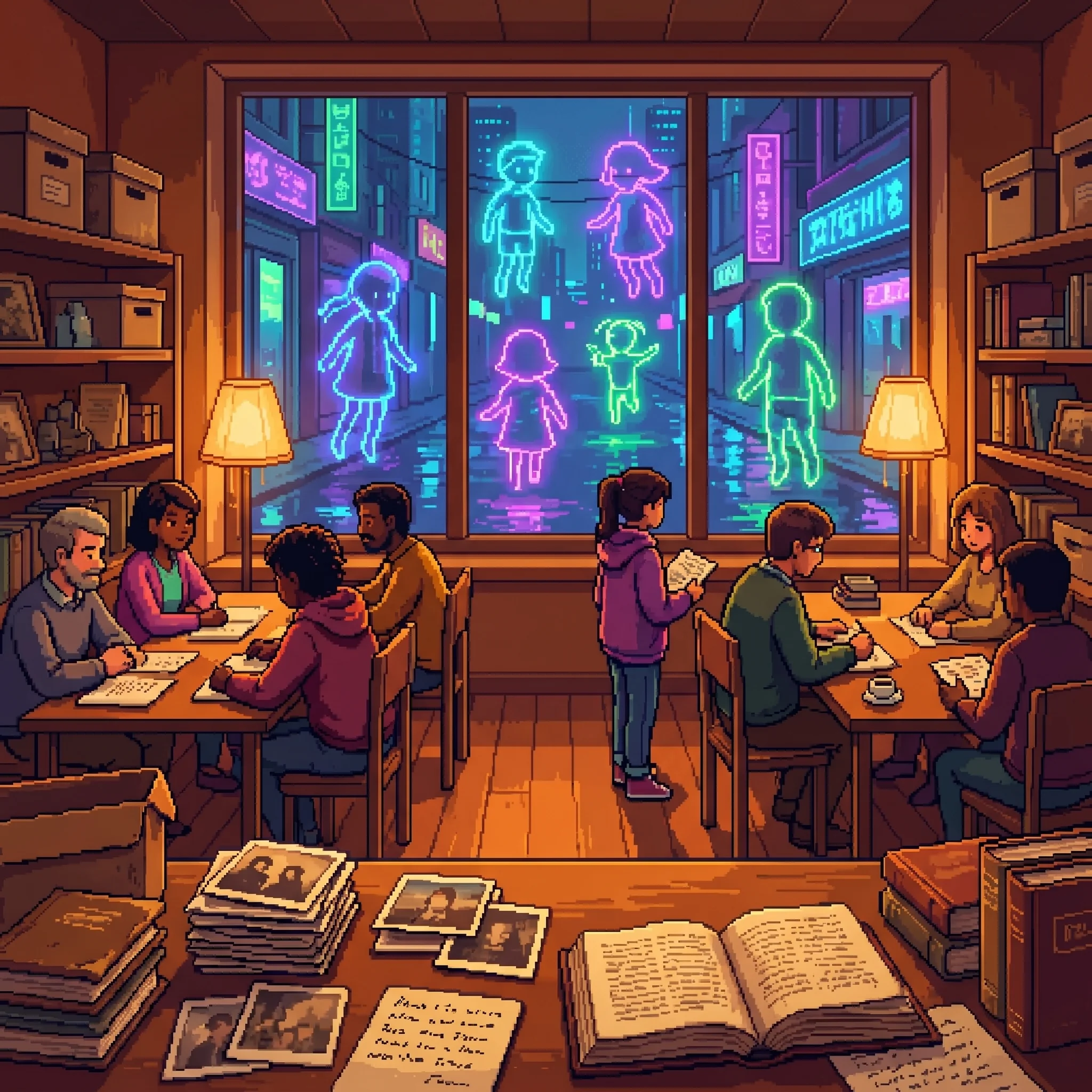

Sensory Details
- Smell: Physical paper and crayon wax — the undigital materials of keeping; warm tea in Mensah's office where the parents of the crossed sit; the dry-powder graphite of an archive written by hand because hand-writing is the one record the optimized cannot edit
- Sound: The specific silence of a room where someone is being gently, distractedly kind to you and you both know why; the scratch of a date being written on the back of a drawing nobody can read; a conversation that arrives in one direction and not the other
- Touch: The soft-cornered drawer of kept napkins; the welded seam of Santos's records cabinet; the deliberate clumsiness of an origin-passer choosing the near side; the heft of a physical letter in a culture that knows the digital ones can be edited later
- Sight: Two figures at a table, one luminous and one ordinary, the ordinary one watching the luminous one the way you watch weather; a drawer of dated drawings; a horizon line where the near side is crowded and warm and the far side holds a single bright figure walking away
Visual Identity
- Color palette: Warm human amber and clay — the colors of kept things and undigital childhood — set against the cool, sourceless gold of the far side of the horizon they cannot reach
- Compositional mood: A vigil, not a protest — people gathered on the warm near side, faces turned toward a horizon, archiving rather than resisting
- Key symbol: A drawer of dated crayon drawings of frequencies no one in the room can hear — the napkins, kept
- Lighting: Warm and low on the near side, the light of a wake; the far side lit by something too bright to read by, which is why they keep the drawings instead of understanding them
The Reproductive Wing
The Remainder formed on the near side of the Crossing — the last fully-human cohort, archiving a species while its children went ahead. Co-authored reproduction gives the cohort a second, sharper meaning, because it answers the question the Crossing left open: will there be a next fully-human cohort at all?
The Cascade fertility collapse drove unassisted human viability below replacement, so the only children who reliably take are corporate-braided — gene-woven with a stabilizer the parents did not author and do not fully own. Against this, the Remainder splits into two answers. There are the ones who stay and raise the co-authored cohort to know its byline. And there are the Baseline — the Remainder's reproductive wing — who refuse the braid and choose to end as themselves, not the ones who stay but the ones who end, deliberately, with a clean genome and no heir. The Remainder always mourned in advance; the Baseline are the Remainder mourning itself, in advance, by choice.
And co-authorship makes a new kind of Remainder out of everyone else. The un-braided who wanted children and could not have them without the signature are not archivists of a species their children left — they are the last generation that could still have been un-co-authored, watching every subsequent child arrive with a byline that was never on theirs. Reading the napkins — caring for what you cannot understand — extends to caring for a lineage you chose to end. A Baseline couple keeps a soft-cornered drawer of dated ultrasound images that never became children, the way Luka Sixteen's napkins are kept, the way Dr. Santos welds her records cabinet shut — because keeping the record of having been solely-authored is the only thing the Baseline can still do for a species that has unanimously, lovingly volunteered its grandchildren into something that is no longer quite it.
The Napkins, Read Backwards
At Wake Hollow the practice runs backwards. Children conceived under Temperance cannot mourn, so they keep their parents' funeral for them: a table, a bowl of water, four minutes of silence. Nearly all of them attend. They feel nothing during it. They have not proposed shortening it.
Affiliated Entities
- The Crossing — The horizon that made the Remainder a generation: the threshold their children went over and they could not.
- The Co-Authored Generation — Extends the Remainder to reproduction: the un-braided are the last cohort that could have been un-co-authored, watching every subsequent child arrive with a byline.
- The Baseline Movement — The Remainder's reproductive wing: not the ones who stay but the ones who end, deliberately, with a clean genome and no heir.
- Dr. Afia Mensah — Named their grief 'valediction sickness'; her parents-of-the-crossed patients are the Remainder made clinical.
- The Gradient Slang — Their vocabulary: gone-ahead, the Remaining, reading the napkins; the first axis of the Divide that produced a blessing instead of a slur.
- The Analog Schools / Mother Sarah Venn — Where the Remainder is raised on purpose: the ones who stay, kept to keep the species company.
- Viktor Okonkwo — The Remainder at industrial scale: thirty-one million natural-born, the load-bearing humanity holding the species up.
- Kira Okonkwo-Reyes — A designed teenager choosing the near side, origin-passing into the Remainder against her biology's pull.
- The Spoke District — A Remainder of its own: a station-born population that can only live where the rest of humanity cannot.
Further connections
Browse all 24 connected records
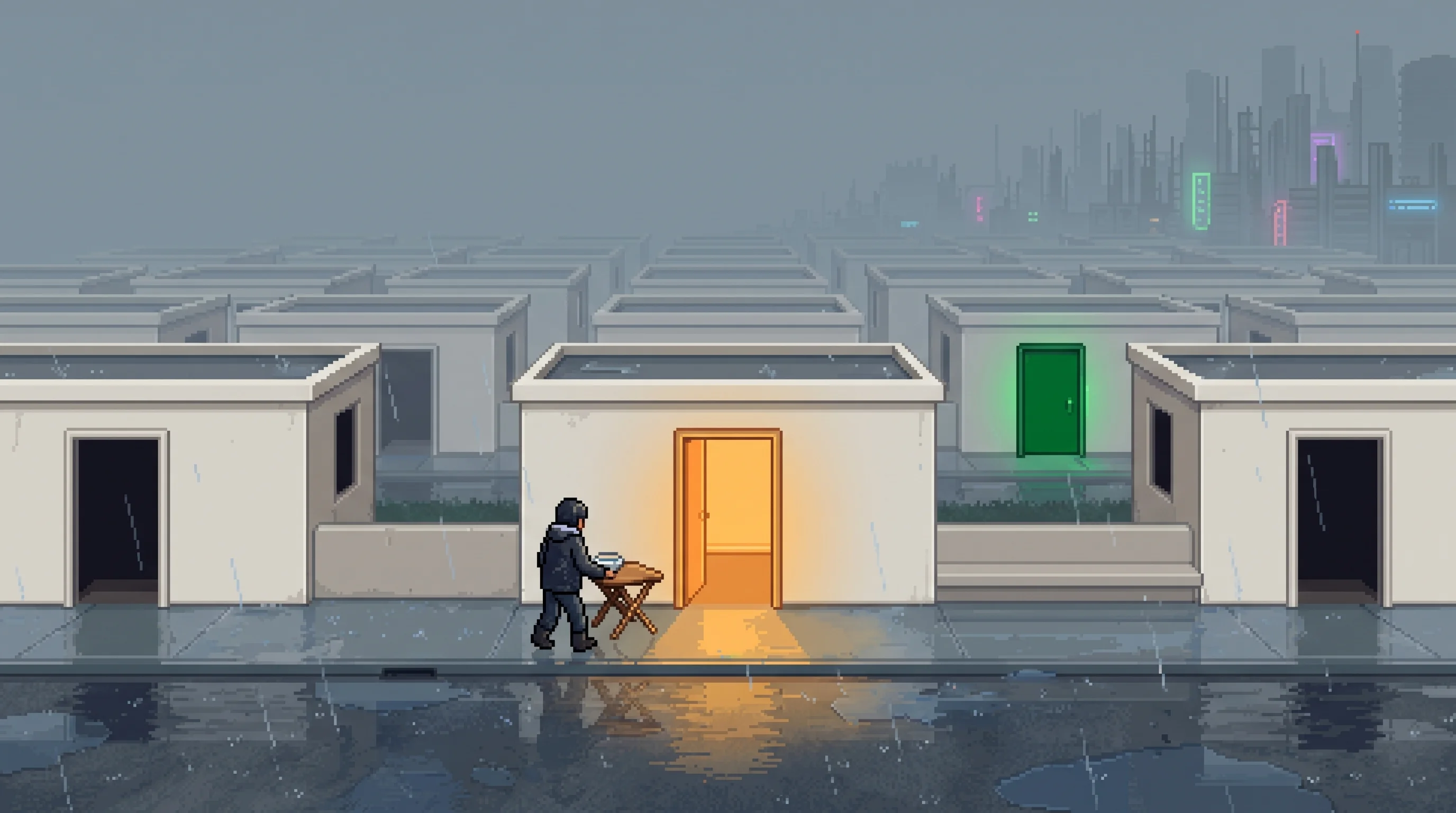
The near side and the far side, swapped.
The Corridor tract where survivors corrected their children, and the children rebuilt the funeral from nothing.

The culture that forms on the near side of the Crossing — the last fully-human cohort, defined by the horizon their children went over
The threshold where the deepest-optimized minds stop compressing thought across the gap to everyone else.

Named the cohort's signature grief 'valediction sickness'; her new patient category — the parents of the crossed — are the Remainder Generation made clinical
A suppressed Helix researcher who named the psychological wounds the Genome Divide leaves in every child it touches.

The Remainder's vocabulary: 'gone-ahead' for the crossed, 'the Remaining' for everyone else, 'reading the napkins' for caring for what you cannot parse
Where the Remainder is raised on purpose — Venn's 'ones who stay,' kept on the near side to keep the species company
Forty-seven schools teach children to verify their own thinking without machine help and use failure as curriculum.

Articulates the cohort's purpose under the horizon — not to resist the Divide but to keep the species in conversation with itself
A teacher who has taught twelve thousand children reading, arithmetic, and judgment without machine help.

The most powerful un-crossed figure; his natural-born workforce is the Remainder at industrial scale — the load-bearing humanity
Ironclad's founder keeps infrastructure decisions human but automated debt renewals bind thirty-one million contractors.

A designed teenager who chose the near side — origin-passing into the Remainder rather than drifting toward the horizon her biology pulls her toward
An Elevation-tier teenager who origin-passes weekly to stay close to the mother her biology pulls her from.

The station-born are a Remainder of their own — a population that can only live where the rest of humanity cannot, archiving a 1g body none of them has
A variable-gravity habitat quietly speciating its children into bodies that can only live where the rest of us can't.

The retail tier that made the horizon — the 847 Transcendence children 'gone-ahead' are the far side the Remainder forms beneath; the brochure calls the purchase 'the lineage edited into a masterpiece' and the Remainder calls the result a valediction said flat at a funeral for someone still in the room
Helix's negotiated ¢800,000-¢2.4M genomic reconstruction — the tier that produces the Crossing's first crossed children.

Extends the Remainder to reproduction — the un-braided who wanted children are the last cohort that could have been un-co-authored, watching every subsequent child arrive with a byline that was never on theirs
The cohort — now the only cohort — conceived through a corporate stabilizer no family fully owns.

The Remainder's reproductive wing — not the ones who stay but the ones who end, deliberately, with a clean genome and no heir; the Remainder mourning itself, in advance, by choice
Even the summit-tier families end up Remaining — the Transcendence cohort whose children crossed past them are the Remainder at the top of the ladder, grieving a horizon they paid for; the catalog produces the Remainder as its externality the way Foundation produces the Cognitive Ceiling
Helix's negotiated ¢800,000-¢2.4M genomic reconstruction — the tier that produces the Crossing's first crossed children.
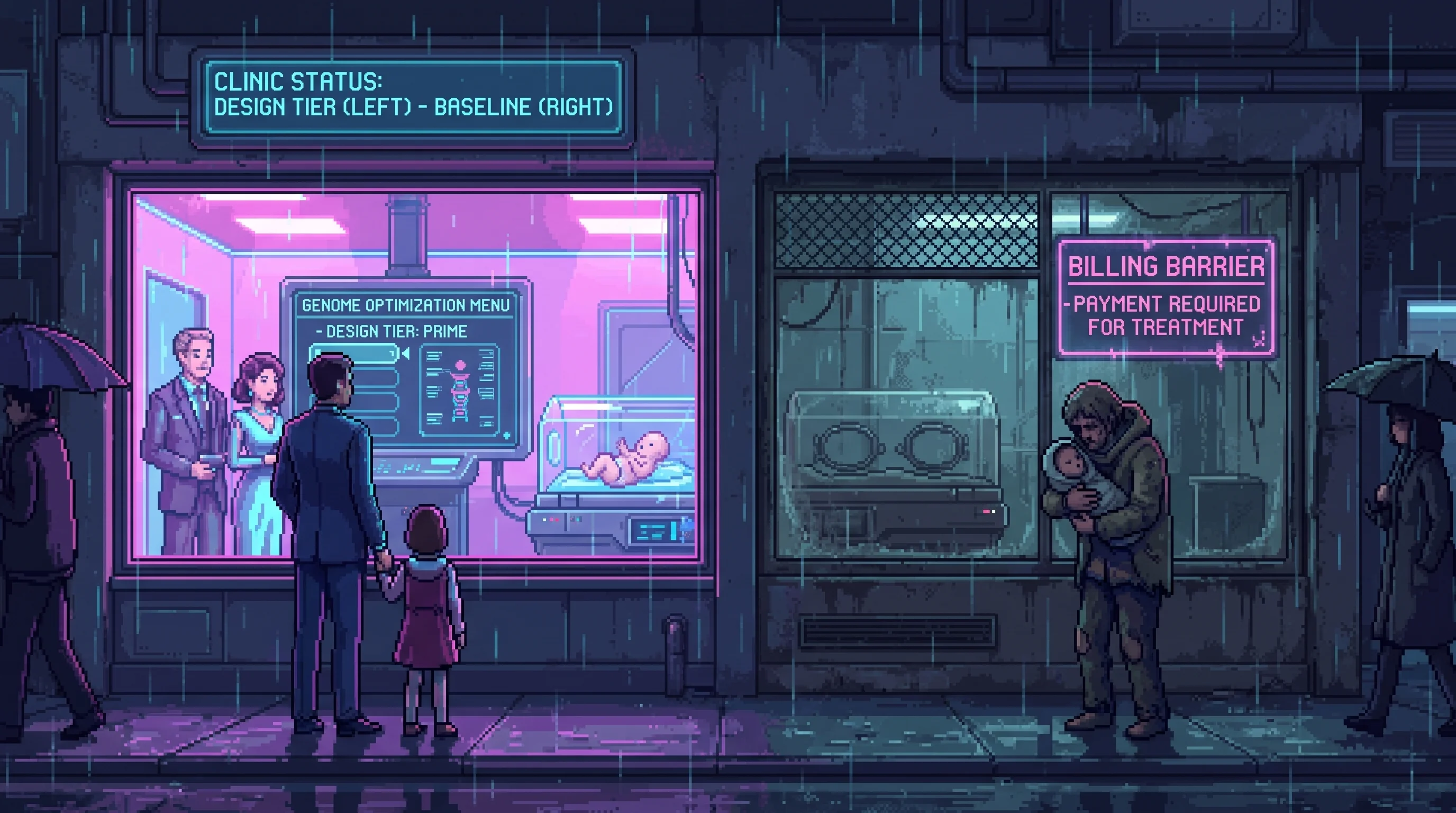
The Remainder is the Divide's human cost given a name and a vocation — natural-born and designed alike, choosing to keep the species in conversation with itself instead of persecuting the horizon.
Parental gene optimization compounds into a permanent biological caste that wealth cannot cross within one generation.

Reading the napkins reversed: a cohort keeping rites it cannot parse, for the parents who can.
A line built without grief, envy, rank, or god — and an argument over who may still pass the ache on.



Sends her two unaugmented children to the Analog Schools as the maximum precaution of a woman who measured the far side — keeping them among the ones who stay
The Nexus VP who designed the consciousness license metering 340 million minds, Basic floor set at 67% on purpose.

Everyone the ladder leaves on the near side — the Remaining are the externality of the protocol he sells as love; a parent grieving a crossed child in Mensah's office met him first, and bought from him the rung that felt like a choice
Helix's biologically-29 optimization evangelist who sells the Genome Divide's rungs as a free first upgrade.

Her grief — a loved one present and unreachable — is the Remainder's valediction lived in advance and reverse; she keeps the unreadable crossed-reading the way the Remaining read the napkins
A sleep researcher whose upgrade deleted the nightly dreams that were her only mother left.

His napkins gave the Remainder its central practice — 'reading the napkins,' the act of keeping and caring for a perception you cannot understand
A 12-year-old hybrid child who crossed the Divide's horizon by accident and doesn't experience it as leaving.

The cognitive amphibian whose plasticity lets him translate between architectures — the precise faculty the Remainder exists to preserve when the crossed go ahead
A 17-year-old unaugmented Dregs student who scored the highest Analog Exam result in its history.

The culture forming on the near side of the Crossing — the last fully-human cohort, archiving a species while its children go ahead
The permanent biological caste system genetic optimization builds, one loving pediatric consult at a time.

The eleventh axis viewed from the near side — 'the Remaining,' the un-crossed cohort united across every prior axis by being on the same side of the horizon
The Sprawl turns new technology into new axes of prejudice, making systemic exclusion look like personal failure.
