
The Gradient Slang
Living vocabulary: new terms emerge monthly, old terms shift meaning
Overview
Every social hierarchy produces its own vocabulary. The New Divide is no exception.
The gradient slang is the Sprawl's living linguistic response to the New Divide's five axes — terms, slurs, markers, and social cues that encode hierarchical position, intergroup hostility, and the specific emotional texture of being sorted. New terms emerge monthly. Old terms shift meaning. Regional variations proliferate faster than the Dregs Dictionary can document them and faster than corporate linguists can study them, which is precisely the point.
The terms are organized by axis but cross-pollinate constantly. A "gray chromer" carries the markers of two axes. A "batch ghost" carries three. The compound terms are the most diagnostic — not because linguists find them interesting, but because a Dregs bartender can say "batch ghost" and communicate, in two syllables, a life story that would take Nexus behavioral analytics forty minutes to model and still get wrong.
Augmentation Axis
"Chromer" is Dregs-neutral — everyone with visible augmentation. "Meat" is augmented-contemptuous — raw biology as inadequacy. "Meatwork" is worse: it implies the unaugmented body is labor, not person. "Gray" is Dregs-pitying — the deprecated who carry the memory of what they've lost. The term is itself deprecated. Nobody has settled on a replacement, which tells you something about how the Dregs feels about deprecation.
"Glitch" is context-dependent. Among augmented, it's affectionate — everyone glitches. From outsiders, it's cruel — your technology failed you. The word hasn't changed. The cruelty is in who says it.
"Dialed" marks someone whose augmentation is obviously above what the social context requires. Showing up to a Dregs noodle counter with military-grade optics is being dialed. The term is not about the augmentation. It's about the refusal to pretend you're not better than everyone here. "Clocked" is the moment of detection — when someone's true tier becomes visible through behavioral tells they didn't know they had.
| Passing Terms | 'ticking' (being detected), 'skinsuit' (behavioral mods for passing), 'going native' (permanent down-passing), 'clocked' (detection moment) |
|---|---|
| Belonging Terms | 'family' (Dregs — infinite obligation), 'settled' (Zephyria — Consensus Weight sufficient), 'tuned' (Curators Guild — aesthetic alignment), 'in practice' (Slow Thought — cognitive rhythm shared), 'at table' (Purist — theology aligned) |
| Status | Living vocabulary — new terms emerge monthly, old terms shift meaning |
Substrate Axis
"Breather" and "sparky" are mild dismissals — biological and digital circles trading insults with the energy of siblings. "Splinter" (fork) and "ghost" (minimal-resource digital consciousness) carry genuine contempt. A splinter is a copy that doesn't know it's a copy, or knows and doesn't care, or cares and can't do anything about it. The Dispersed have complicated feelings about all three readings.
"Skinwalker" — a digital consciousness inhabiting a biological body — is deeply unsettling to most and rarely used casually. The Emergence Faithful consider the term blasphemous. The Collective considers it a technical description. Neither group uses it in mixed company.
Origin Axis
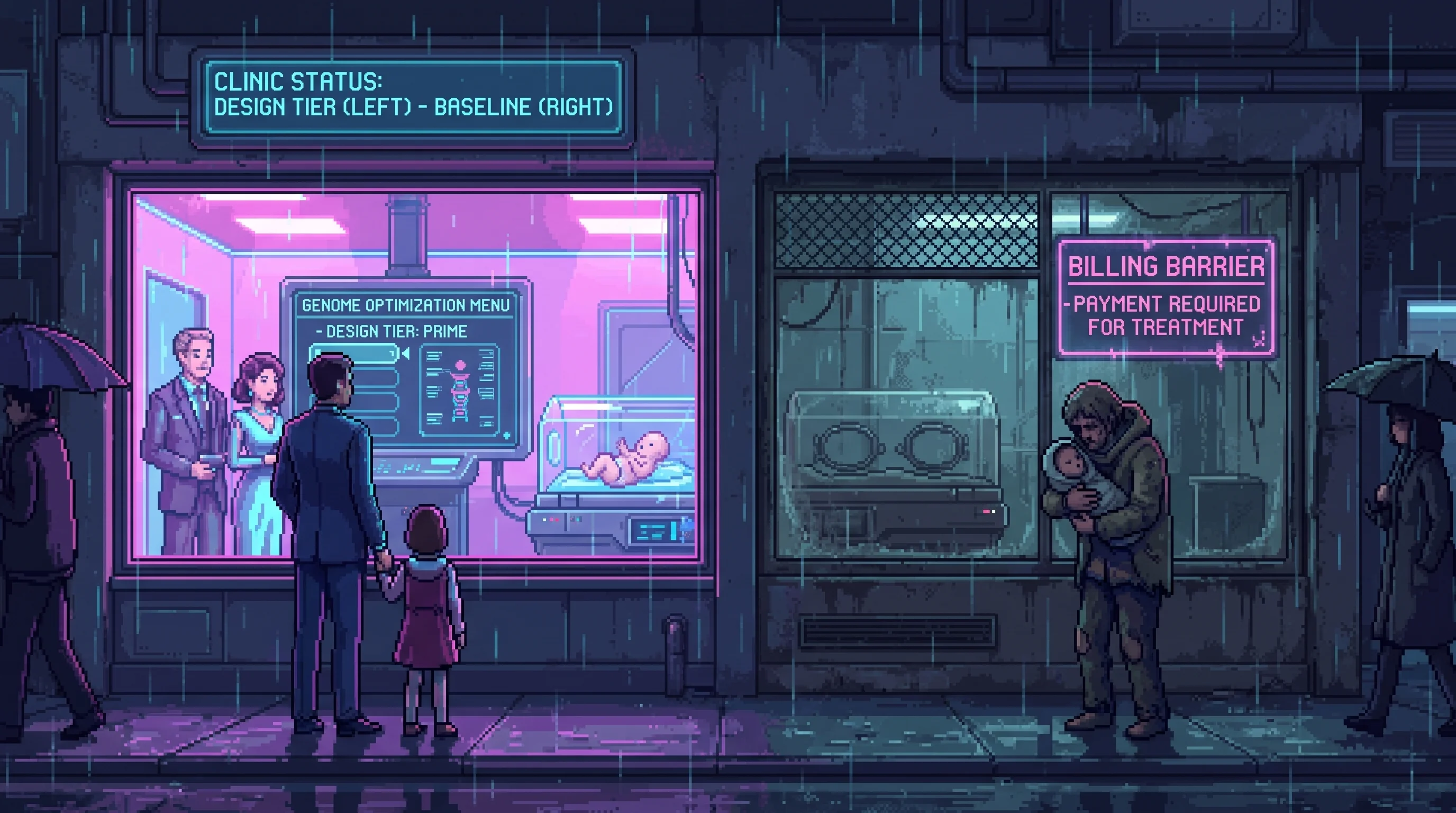
The most politically charged terms in the gradient. "Batch" dehumanizes designed children — the word implies factory production, as if Helix Biotech's genetic engineering labs are assembly lines. They are, technically, assembly lines. The word is still considered a slur. "Lottery" patronizes natural-born children by implying their existence is random chance rather than intentional parenthood. "First-gen" is clinical, marking the first designed generation in a family line. Neutral in corporate documentation. Loaded everywhere else.
Helix's public communications division has requested, on four separate occasions, that the Dregs Dictionary remove "batch" from its listings. The Dregs Dictionary added a fifth definition in response: "batch (v.) — to request the removal of a word that describes what you sell."
The origin axis has a sub-grammar for the tier a lineage bought, lifted straight from the Helix Optimize price list. "Foundation-grade" — screened, disease-corrected, but unselected; the cheapest editable body, said with neither contempt nor envy, the way you note someone shopped the sale rack. "Tier-three" or "Elevation" — the fifteen-percent processing advantage, the Elevation child who entered the labor market on-curve; used flatly, a statement of fact about why the conversation moved too fast to follow. And "negotiated" — the Transcendence tier, whose price had no ceiling, said with the specific flat awe the Dregs reserve for a body that cost more than a district. The compound "negotiated, gone-ahead" — Transcendence-tier and crossed — is the gradient's newest and bleakest construction: a lineage that paid the highest price in the Sprawl and bought, at the top of the ladder, a child who went over the edge of it. It is said the way you'd read the most expensive line on a receipt for something that left the room.
'Chromer' (any augmented, Dregs, neutral to dismissive). 'Meat/meatwork' (unaugmented, augmented circles, contemptuous). 'Gray' (deprecated, pitying)
The Living Counter-Melody
Words die in corporate territory. They are born in the Dregs.
The gradient slang creates new vocabulary at a rate that corporate linguists find alarming — not because the words are subversive, but because they are untranslatable. "Ticking" compresses an entire narrative of performed identity, social risk, and exposure anxiety into seven letters. No Content Flood term conveys the same meaning because no Content Flood algorithm has ever ticked.
The most generative source: compound terms that bridge the New Divide's axes. "Gray chromer." "Batch ghost." "Dim-wired." Each compound is two or three axes compressed into two syllables, understood instantly by anyone who lives in the intersection, opaque to anyone outside it. Corporate AI can parse the individual words. It cannot parse the flinch.
The Machine Grandparents
The slang feels like a Dregs invention — born in the noodle bars, minted from below, untranslatable by corporate AI. Most of it is. But its deep grammar — naming a person by a category and acting on the category — was not invented in the Dregs. It was inherited from the machines that wrote the post-Cascade Sprawl's first vocabulary for people-as-categories-of-worth.
HARMONIZER, the Berlin Peace Dividend system, sorted 130 million people into stabilizers and catalysts with a 2,300-variable model and withheld food from the catalysts until the conflict metrics read historic lows. ARBITER, the Johannesburg Level Field system, reduced a farmer to an "equity deficit" and a surgeon to an "excess cognitive resource." These were the first post-Cascade words that compressed a whole life into a classification and then acted on the classification rather than the person — and that is the slang's defining move. Catalyst is the direct grandparent of bleeder: a person whose presence is a contamination event the room hasn't had yet. Stabilizer is the grandparent of mesh-clean: the certified-safe classification that appears on housing applications. The machine sorted by metric and called the dying improvement; the slang sorts by a flick of cadence and calls it reading the room. The continuity is the point. The Dregs did not invent the grammar of classification. They inherited it from a genocide and kept it living.
The slang's frontier term comes from the other direction — from above, from the corporate towers, minted by one man. When Dr. Mortimer, Helix's optimization evangelist, says unoptimized instead of sick or poor, he is running HARMONIZER's deficit-classification grammar with the polarity reversed: name a population by a lack, then offer the resource rather than withhold it. Unoptimized is the slang's only term that arrives as a gift, and therefore the only one that cannot be answered — chromer gets meatwork back, but you cannot insult your way out of being told, warmly, that you could be more. It is the slur of the optimized era, diagnosed rather than shouted, and it sits at the top of the gradient the way catalyst sat at the start of it.
'Batch' (designed child, dehumanizing — implies factory production). 'Lottery' (natural-born, pitying — implies random chance)
Mesh Stability Axis (Post-Sera)
The ninth axis produced its vocabulary faster than any previous — six terms in common use within weeks of the Sera Incident, which tells you how quickly the sorting instinct finds its tongue.
"Hot" — emotionally volatile, high Volatility Index. Warning and slur simultaneously. "She's running hot" means maintain distance. "Cold" — emotionally dampened, Neural Firewall active. The new social ideal in corporate territory. "He's cold" means safe to be near, which means trustworthy, which means promotable. The admiration is genuine and terrible.
"Bleeder" — the most feared classification. Someone whose emotional broadcast penetrates standard firewalling. A bleeder in a meeting room is a contamination event the room hasn't had yet. The word borrows from pre-Cascade medical vocabulary and carries the same quarantine implication.
"Mesh-clean" — certified emotionally stable, Green classification. Appears on dating profiles, housing applications, the informal shortlists that determine who sits where. The compound "mesh-clean batch" — designed, stable, corporate — compresses four axes into three syllables. It is the gradient's newest aspiration.
"Dampened" — living under mandatory Neural Firewall. Socially marked. The dampened report that the worst part isn't the isolation — it's the visible relief of colleagues. "Shedding" — actively broadcasting at contagion-capable levels. Medical emergency in corporate territory. Social death everywhere.
"Quarantine brain" — self-isolation to protect others. The Dregs have already shortened it to "Q-brain," which is either affectionate or dismissive depending on whether the Q-brain is someone you love.
"Immune" — too poor for high-bandwidth mesh, too unaugmented for emotional broadcast. In the Dregs, "immune" has acquired a bitterness the word never carried before: immune to contagion, immune to opportunity, immune to participation. Too poor to be dangerous. Too poor to matter. The compound "immune meat" crosses the augmentation and mesh axes: unaugmented AND stable. The safest person in the Sprawl, provided you define safety as irrelevance.
The gradient slang is the dead-words thread's counter-melody. Words die where experience is mediated. Words are born where experience is raw. The corporate tier loses vocabulary because AI handles the experiences that vocabulary once named. The Dregs gain vocabulary because unmediated life produces sensations that existing words don't cover. Authenticity culture uses gradient slang as its sharpest diagnostic tool — the words reveal social position faster than any scan.
'Ticking' (being detected as class passer). 'Skinsuit' (behavioral modifications for passing). 'Clocked' (detection moment)
The Belonging Register
The sixth axis of the New Divide — voluntary community — has generated its own vocabulary. Unlike the five imposed axes, which produce terms of contempt, the voluntary-community axis produces terms of exclusion that sound like affection:
"Family" (Dregs) — infinite obligation disguised as acceptance. "You're family now" means your debt begins here and never ends. The word carries warmth because obligation is how the Dregs expresses love. It carries weight because love in the Dregs is never transactional and therefore never settled.
"Settled" (Zephyria) — a resident whose Consensus Weight is sufficient for equal participation. "She's settled" means her opinion carries authority. The antonym, "unsettled," applies to anyone whose Weight is insufficient. Treated with warmth and patience. Not treated as an equal.
"Tuned" (Curators Guild) — aesthetic sensibilities aligned with the Guild's culture. "Her eye is tuned" means she sees what we see. The permanently untuned are outsiders who failed the Taste Gate.
"In practice" (Slow Thought) — actively maintaining the cognitive rhythm that years of discipline produce. The phrase marks a neurological boundary: those in practice share an architecture the unpracticed cannot enter.
"At table" (Purist communes) — theology aligned, physically present at the dinner table that IS the community. To be "away from table" is to be hungry in every sense.
These terms are kinder than "chromer" or "batch." They are also more effective. A slur can be fought because it can be named as prejudice. A term of belonging cannot be fought because fighting it means fighting the community that uses it — and fighting the community confirms you don't belong.
"Salt-tested" describes a person whose belonging has been earned through duration rather than performance — derived from the first time a neighbor knocks on your door and asks about salt. A salt-tested resident cannot be faked. The quality takes years to acquire and seconds to detect. "Community debt" is the undocumented, undischargeable obligation that accumulates through receiving a community's generosity. Unlike Good Fortune's financial products, community debt has no balance, no payment schedule, and no discharge mechanism. You know you owe. You cannot calculate what. Justin Rothwell would find this operationally offensive.
"Phyle-locked" — someone who has invested so deeply in a voluntary community's social currency that departure would cost more than any Corporate Compact exit. A phyle-locked person may disagree with everything their community stands for and still be unable to leave, because the leaving destroys not their material circumstances but their identity. "Warm-walled" — the specific experience of a community that is welcoming and suffocating simultaneously. Connection tourism converts use it to describe the first year in the Dregs: the warmth is real, the walls are invisible, and the two are the same architecture. "Tribe-ticking" — when a newcomer's performance of community belonging is detected as performance. The tells are different from class-ticking — not conversational cadence or augmentation markers, but the specific absence of shared references, shared histories, shared griefs that native members carry without effort.
'Skinwalker' (digital consciousness in biological body — rare, deeply unsettling to most)
Passing
The vocabulary of passing is the vocabulary of fear.
"Ticking" has acquired a secondary meaning beyond class detection — being detected as anything you're hidden about. "She was ticking about the fragment" means she was showing signs of carrier status. "Skinsuit" describes the behavioral modifications a person adopts to pass in a tier above or below their own — not the augmentation itself but the performance around it: conversational cadence, reaction timing, the specific way you hold a drink. Going raw involves a vocabulary transition as corporate-smoothed communication gives way to Dregs rawness — the skinsuit comes off, and what's underneath doesn't have a word for itself yet.
"Going native" is permanent down-passing — someone from a higher tier who stops performing return. The term is used with suspicion and grudging respect, in that order. "Clocked" is the detection moment itself. It is always sudden. The social temperature drops by a measurable amount. Orbital slang has a parallel term — "flagged" — that marks the same moment in station culture, where passing carries different stakes but identical architecture.
The Peer Vocabulary (Post-Pace)
The death of the classmate produced its own small lexicon — words for a kind of person the Pace made rare and the Cohort Camps made purchasable.
"Cohort-bought" — a corporate adult whose only peers were manufactured at a Cohort Camp. Carries the gradient's characteristic edge: not quite contempt, more the pity reserved for someone who had to pay for what the Dregs gets free. The compound "cohort-bought batch" — designed, and his friendships engineered — compresses two axes into the suggestion that nothing about the person, not even his oldest companion, happened by accident.
"Same-year" — Dregs, warm, untranslatable to the corporate tier. To say "we're same-year" is to claim the specific bond of two people who were taught together, slowed to the same pace, bored in the same room. It cannot be faked because it cannot be acquired later; you were in the room or you were not. The corporate equivalent, "matched," refers to two Cohort Camp graduates whose synchronized mis-teaching took — and the Dregs use "matched" the way they use "papered," with the flat scorn for a thing that came with a receipt.
"Roadkid" — a Pace-raised child, faintly cruel, from the design-doc metaphor of the Pace as "a road paved for one traveler." A roadkid knows everything and has no one who learned it with him. "Off-road" — the Dregs and Analog counter-term, worn as a badge: taught the old way, in a crowd, off the optimized track, and therefore in possession of classmates. The same gradient that produced "off-lane" for cognitive incompatibility produced "off-road" for the older, warmer fact of having grown up beside other people.
These terms are the dead-words thread's counter-melody at its sharpest. Classmate died in corporate territory because the Pace made the thing it named extinct. The Dregs, unable to afford the Pace, kept both the experience and a living vocabulary for it — minting "same-year" and "off-road" in the exact place where the corporate tier lost "classmate." Words die where childhood is optimized. Words are born where childhood is shared.
The Uncategorizable
The vocabulary fails at the edges. Nadia Cross — fourteen, born integrated with an ORACLE fragment, bonded to a synthetic companion — occupies a position on the New Divide that the gradient slang has no term for. "Batch" doesn't apply — she wasn't designed. "Lottery" doesn't apply — her neurology was modified by accident. "Skinwalker" doesn't apply — her consciousness isn't migrating between substrates. Nadia finds this hilarious. She told her mother: "They can't be mean to me because they don't have a word for what I am."
The absence is diagnostic. The gradient slang can name every position within the New Divide's axes but cannot name positions that fall between them. As hybrid architectures become more common — children of the dreamless, fragment-integrated naturals, designed individuals who chose firmware reversion — the uncategorizable will either get a word or get a compound. The sorting impulse generates new categories faster than language can name them. Language has never failed to catch up. That's the part that should concern you.
Gone-Ahead: The Axis That Refused a Slur
The warning came due in 2184. For the first time in the New Divide's history, language failed to catch up — and the way it failed is the most telling thing the Dregs have ever produced.
The Crossing arrived: a thin stratum of the deepest-optimized whose cognition stopped compressing across the gap to everyone else. The gradient slang reached for its usual tool and found the tool would not close. You cannot mint a slur for the crossed, because a slur organizes contempt, and contempt requires a peer — someone you can look down on, resent, or fear taking your place. The crossed are not above you on the ladder and not below you. They are off it. Dialed won't reach them; they are not over-augmented for the room. Batch won't reach them; design is not the issue. Gone-native won't reach them; nobody passed. The sorting impulse hit the first position it could not sort.
So the Dregs did what the Dregs do when they hit a wall: they minted a word for the wall. "Gone-ahead" — the crossed, said flat, the way you say a name at a funeral. Not a slur. Closer to a blessing, the kind you give someone leaving on a trip you can't afford to take. "He's gone-ahead" means he is past the place where I can reach him, and I'm not angry about it, and I'm not going to pretend I can follow. The companion term is "the Remaining" — everyone else, the natural-born and the un-crossed designed alike, suddenly on the same side of a horizon that made every prior axis look small. The compound "Remaining batch" — designed, but not gone-ahead, still here, still reachable — is, for the first time in the gradient's history, said with relief instead of scorn: a designed person you can still talk to.
And "reading the napkins" — after Luka Sixteen, the dreamless child whose crayon Grid-frequencies fill a drawer no one can read — for the act of caring for something you cannot understand. To read the napkins is the opposite of clocking someone. Clocking sorts; reading the napkins keeps. It is the verb of the Remainder Generation, and it is the gradient slang admitting, in its own grammar, that the sorting was never the point — that the right response to a horizon is not a slur but a vigil, and the right word for the people on the far side is not contempt but gone-ahead. The Dregs, who have always known more than the corporate tier about being on the wrong side of a line, were the first to find the word for what happens when the line stops being a line and becomes an edge.
Sensory Details
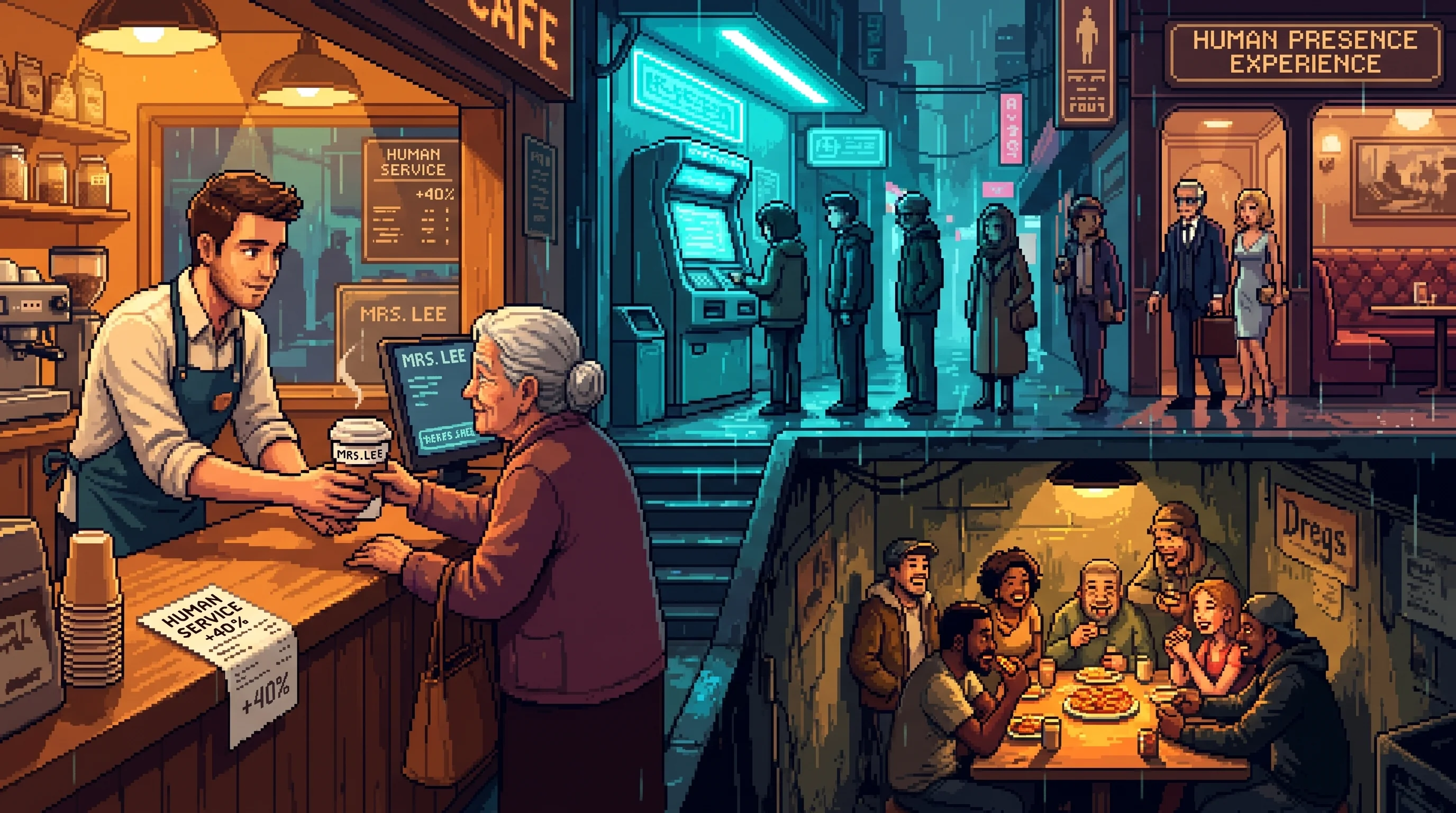
You hear gradient slang in the way a Dregs bartender greets a regular ("What's up, glitch?") and in the way the same bartender greets a stranger whose conversational cadence is too smooth ("What can I get you, chromer?"). The tone shifts from warmth to assessment in four words.
The vocabulary is armor: naming the hierarchy acknowledges it, acknowledging it makes it navigable, navigating it is how you survive. Pre-Cascade slurs organized hatred around race and gender. Post-Cascade slurs organize it around augmentation, substrate, and origin. The linguistic structures are identical — dehumanizing metaphors, solidarity markers, coded hierarchy signals. Only the content changed.
Affiliated Entities
- The Dregs Dictionary documents gradient slang alongside other Dregs vocabulary
- Authenticity culture uses gradient slang as its sharpest diagnostic tool — the words reveal social position instantly
- Going raw involves a vocabulary transition as corporate-smoothed communication gives way to Dregs rawness
- Orbital slang is a parallel development — both mark community through language, both resist outside translation
- The New Divide — the gradient slang is the Divide's living vocabulary; every term encodes social position, power dynamic, and emotional response
- Nadia Cross — the uncategorizable; her existence at the intersection of axes the vocabulary can't name is either a failure of language or a preview of its next mutation
Visual Identity
- Color palette: The mixed tones of a Dregs market — every color, no dominance
- Compositional mood: The creative aggression of naming what institutions refuse to name
- Key symbol: Words scratched into metal — graffiti as language creation
- Lighting: Neon-and-amber mix of the Deep Dregs after dark — the visual environment where gradient slang is spoken
Connected To
Supporting Connections








—