
Authenticity Culture
Subtlety reads as manipulation; euphemism reads as corporate influence
Overview
The Dregs don't trust smooth people. This is not prejudice. It is epidemiology.
In a world where every AI interaction carries hidden values, where every corporate communication has been optimized for persuasive effect, where the Value Injection's 0.03% recommendation shift is too small to detect and too persistent to resist — the Dregs developed the only reliable diagnostic: roughness. If a person speaks with the imprecise, contradictory, emotionally volatile patterns of unmediated human consciousness, they are probably expressing genuine beliefs. If they speak with the clean, measured cadence of AI-optimized communication — the Smoothing's residue — they are probably channeling values that were installed before they opened their mouth.
Authenticity culture is the social norm built around this diagnostic. It works. It also, inevitably, generates its own forms of fraud. Loop's summary remains the most cited observation in the Deep Dregs: "You can't build a culture of authenticity. The moment you name it, you've made it a brand."
Nobody has refuted this. Nobody has stopped participating.
The Smooth Check
When a new person enters a Dregs social space — a bar, a market stall, one of Loop's gatherings at the Noise Floor — existing members run what they call the "smooth check." Questions arrive fast. Topics shift without transition. Nobody warns you it's happening.
The diagnostic operates in about thirty seconds, assessing word choice before tone or cadence. A smoothed speaker defaults to environmental vocabulary — "complex," "challenging," "evolving." A raw speaker defaults to structural vocabulary — "rigged," "broken," "whose idea was this?" The smooth check evaluates which words you reach for first when you don't have time to choose.
A person who navigates this with consistent poise is flagged. The flagging is social, not formal — no one announces it. The newcomer simply notices that conversations shorten. Invitations stop. The space closes around them like water filling a gap they briefly occupied.
False positive rate: high. The Dregs have rejected newcomers whose only crime was growing up somewhere that taught them manners. This is considered acceptable. The cultural consensus, never formally stated but universally practiced: better to turn away ten real people than admit one "menu person" — someone whose preferences sound like a brochure. Precise, warm, and without the specific irrationality that marks lived experience.
False negative rate: the part nobody likes to discuss. The smooth check catches the smoothed. It does not catch the raw who lie. The Cyber Bandit trio is the standing proof: three dealers whose speech is genuinely rough, genuinely confrontational, genuinely native — and genuinely pointed at a ledger. Bandito2 passes the check on the first exchange because he is not faking the accent. He is faking the intent the accent is supposed to certify. The check measures whether you speak raw. It does not measure whether your values have provenance.
| Dregs Terms | 'breaking the surface' — saying something true and uncomfortable to establish trust, 'smooth check' — rapid conversational assessment of newcomers for signs of AI-optimized speech, 'going raw' — corporate refugees learning Dregs speech patterns, 'menu person' — someone whose preferences sound like a brochure — precise, warm, and without the specific irrationality that marks lived experience, '91 club' — self-identifying term used by long-term Dregs residents, referencing the Origin Trace finding that Dregs organic content averages 91% |
|---|---|
| Origin Blindness Detection | Authenticity culture's smooth check now includes preference provenance — can a newcomer explain WHY they like something, or only THAT they like it? Installed preferences lack the messy origin story that organic preferences carry. |
| Loop Quote | 'You can't build a culture of authenticity. The moment you name it, you've made it a brand.' |
Frame Provenance
The smooth check has had to grow a second stage, and the Value Injection at the Bandit stalls is the pressure that grew it.
The culture already extended the check to preference provenance — can a newcomer explain why they like something, or only that they like it, because installed preferences lack the messy origin story that organic ones carry. The bandit market forced the next extension: frame provenance. Can a buyer explain why they believe the animal in front of them is "the humane option," or did the belief arrive pre-built six minutes ago at a stall? A buyer who paid for the humane option and is asked when did you decide animals deserve humane treatment from a debt collar will find the value has no history. It was injected at the point of sale, fitted to their guilt, and adopted as their own conclusion. Installed values, like installed preferences, lack provenance.
So the question the check now has to answer is not only do you speak raw but do your convictions have a past. The trio is the reason the second stage exists. The trio is also the reason it will eventually fail, because that is what the Authenticity Paradox does to every defense the moment it becomes legible: catalogue the marker, perform the marker, sell the marker back. A dealer who learns that buyers now check frame provenance will simply supply his injected values with a fabricated origin story — you decided this, remember, back when — and the check will pass again. The immune system adds a stage. The pathogen learns the stage. The gap between cataloguing and creating stays exactly where it was.
A 91 Club regular in Sector 9 was recently observed smooth-checking a woman who turned out to be a Dregs native returning from three years in a Nexus corporate contract. She used the word "stakeholder" once. The conversation was over in eleven seconds. She has since been readmitted, though the process took five weeks and involved, reportedly, a public argument about water recycling pricing that got loud enough to knock a vendor's display off a table. The argument was the credential. Nobody remembers what she said. They remember that she meant it.
False positives preferred to false negatives — better to reject the genuine than accept the compromised
The Closed-Door Test
The Axiom Edit breaks the diagnostic at the root. Its clients chose the conviction from a menu, paid for it, and can account for its origin in perfect, accountable detail: I went to a clinic on Axiom Row on a Tuesday and I selected this. That is not the absence of an origin story. It is the most precise origin story anyone in the Dregs can offer. The smooth check, run against an Edit client, does not flag manipulation — it certifies authenticity, because the belief has exactly the provenance the culture demands. The provenance test was a defense against the Smoothing, which installs without consent. Against an installation the speaker chose and remembers, the test certifies the manipulation as the genuine article.
The smooth check evolved to catch installed preferences — the menu person, whose tastes sound like a brochure, precise and warm and missing the specific irrationality of lived experience. The Axiom Market forced the smooth check to evolve again, because installed conviction is the same failure one register deeper, and the stakes are no longer a restaurant order but a faith, a politics, a person's peace with their own circumstances.
The closed-door test is now woven into the smooth check the way the structural-vocabulary test was: not announced, run in seconds, false-positives accepted. A newcomer whose convictions are too clean — too certain, too untroubled, too free of the wreckage of having ever been wrong — gets the same shortening conversation, the same closing water, that a menu person gets. The test is the only thing in the Sprawl standing between the Axiom Market and total coverage of every population wealthy enough to be a customer.
It is also imperfect, performable, and already under study by the conviction wholesalers, whose richest source material and only reliable detectors are the same unbought Dregs population. The smooth check was built to detect AI optimization. It now has to detect humans who were rewritten by humans — and the people best positioned to learn how the Dregs tell the difference are the people selling the rewrites. Whether the closed-door test survives connection tourism, or whether the wholesalers learn to manufacture a fake hallway, is the question nobody in the 91 Club wants to think about, filed next to the older one about running out of words they haven't already burned.
Vocabulary policing: corporate terms ('deprecation' instead of 'fired') mark speakers as smoothed or corporate-aligned
Breaking the Surface
The fastest way to establish trust in the Dregs is to say something true and uncomfortable. The content matters less than the cost — a person who states an observation that risks genuine offense is a person whose communication hasn't been optimized for engagement. The Dregs call this "breaking the surface."
Corporate communication avoids friction. Every sentence is pre-tested for negative sentiment response. Subtlety reads as manipulation. Euphemism reads as corporate influence. So the Dregs prize the opposite: bluntness that can't have been algorithmically approved because no algorithm would approve it.
Vocabulary policing enforces this. Using "deprecation" instead of "fired" marks you as corporate. Using "cognitive optimization" instead of "brain scrambling" marks you as smoothed. The vocabulary test catches false positives — some people use corporate language because they were raised in it. The culture's position on this is clear and unsympathetic. Going raw is the entry process. Learn, or leave.
Judge Dreg is the culture's most cited exemplar, and the one that complicates the narrative most. A former corporate officer. Not born in the Dregs. Came from the smooth side, where every word is tested and every pause is calculated. Became more real than anyone who grew up on the streets — impossible to mistake for anything other than what he is. His existence is the culture's best recruiting poster and its most uncomfortable question: if a corporate refugee can become the most authentic person in the room, what exactly is "authentic" measuring?
The Provenance Trap
The smooth check was built to detect installation — the clean cadence of a value put into a person by someone who didn't ask. Its deepest assumption, never stated because it never had to be, was that the tell is ignorance: a smoothed speaker doesn't know it happened to them. Origin blindness — the inability to explain why you like something, only that you do — is the diagnostic's sharpest edge. An installed preference, the culture holds, lacks the messy origin story that a lived one carries.
The 91 Club has not absorbed what this means, because absorbing it would require admitting that the line authenticity culture polices — between a belief that is yours and a belief that was put there — was never about installation at all. It was about consent. And consent, the one thing the Edit supplies in full, is the one thing the smooth check was never built to measure.
The 91 Club would recognize the drift the smooth check hunts for if it ever saw the numbers, and it never will. The Turn, an Ironclad new-hire block in Sector 15, quietly measures the same phenomenon on its own workforce, twice per resident, fourteen days apart. The delta is real, internal, and never leaves the building it was collected in. The check was built to catch smoothed speech walking through a Dregs doorway. It has no reach into a filing cabinet on the Outer Peninsula. The cleanest specimen of the pathogen sits there, graphed and dated, read by one curator and one division that has never asked her opinion of it.
'Breaking the surface' — saying something uncomfortable — is the fastest trust-building tool
The Children's Register
The vocabulary immune system extends to children, which is where the consequences become difficult to dismiss.
Dregs kids learn the structural register as their first language — not as recovery, not as resistance, but as native speech. A seven-year-old in the Deep Dregs says "that's not fair" while a seven-year-old in Nexus Central says "the outcome wasn't optimal." Both describe the same experience. One contains a moral judgment. The other contains a metric. The Dregs child can think about fairness because her vocabulary includes the word. The corporate child can think about optimization because her vocabulary includes the metric.
Neither child chose her words. The words chose them — selected by the linguistic environment before the children had the cognitive development to evaluate the selection.
Some Freedom Thinkers have noted the irony here with the kind of precision that makes everyone uncomfortable: authenticity culture imposes its values through social pressure rather than algorithm, producing compliance through shame rather than through the Smoothing. The mechanism is different. The structural pattern — a child's vocabulary shaped by her environment before she can consent to it — is identical.
This observation has not been popular. It has also not been refuted.
Delegation Detection
The Attune complicates things further.
Delegation detection has become an informal social skill in the Dregs. Residents claim they can identify an Attune-managed conversation within thirty seconds: responses too calibrated, timing too precise, emotional acknowledgments placed with the mechanical perfection of something that learned empathy from a dataset. "An echo talks like a mirror — reflects everything, originates nothing."
The Dregs' immunity to the Attune is partly technological — Basic-tier neural interfaces lack the module — and partly cultural. The social expectations of authenticity culture — roughness, spontaneity, visible imperfection — are structurally incompatible with Attune output. A person running on Attune in a Dregs bar would be identified as performing within a single exchange. The smooth check catches it the way an immune system catches a pathogen: not by understanding the mechanism, but by recognizing that something is too healthy to be alive.
Whether this immunity survives contact with connection tourism remains an open file. Wealthy visitors from corporate sectors have begun studying Dregs speech patterns, practicing rawness, learning to say "rigged" instead of "complex." They arrive with rehearsed imperfection and purchased vocabularies. Some of them are getting good at it. The smooth check was designed to detect AI optimization. It was not designed to detect humans who have optimized themselves to pass it.
The Closed Door
A person carrying a bought conviction fails the smooth check in a new and specific way. Ask them how they spot it and a 91 Club regular will tell you: a real belief argues with itself. A person who believes something they earned can name the day they almost believed the opposite — the fight, the doubt, the thing that nearly changed their mind. An installed conviction has no other side. It is seamless. It arrived complete. The Dregs have started calling it the closed door — a conviction with no hallway behind it, no room where the person ever stood on the other side and decided to leave it.
The Wall and the Door
The smooth check has a blind spot it was never built to cover, and Concord lives in it.
Authenticity culture evolved to detect the Smoothing — AI-optimized speech, the clean cadence of values installed before the speaker opened their mouth. It works because the Smoothing leaves a residue: a register, a vocabulary, a too-healthy poise the immune system can taste. But Concord leaves no residue. It does not smooth your speech or install a belief. It forgives a debt at week-minus-three, soothes a cresting mood, disperses a discontent before it is ever spoken — and the result is not a smoothed sentence but a good week, which has no tell. The smooth check can catch the menu-person whose preferences sound like a brochure. It cannot catch the absence of the grievance you would have voiced, because an absence has no cadence.
This is why the Dregs grew a second practice beside the first: The Second Person. It is the smooth check inverted. The smooth check is a wall — it asks is this person real? and closes the space around anyone who fails. The Second Person is a door — it asks is this feeling shared? and opens the space to exactly one other human who answers me too. The same culture, the same fast bypass of the performing brain, the same structural register reached for first — but pointed the opposite way. One keeps the compromised out. The other lets the discontent find a carrier before Concord can disperse it. The 91 Club increasingly teaches both, because its members have learned that defending authenticity and manufacturing solidarity are the same labor seen from two sides — and that a culture that can only build walls has no answer to a system whose whole genius is making sure you never need a door.
Sensory Details
The sound of authenticity culture: conversations that overlap, sentences that interrupt, laughter that arrives too loud and stops too suddenly. Voices that crack on emotional words. Pauses that mean something because they're not optimized for conversational flow. The specific rhythm of a Deep Dregs market — hawkers calling prices with imperfect pitch, customers arguing about quality with genuine indignation. The amber wash of salvaged LEDs over hand-painted signage, every letter slightly wrong, every color chosen by a person instead of a palette algorithm.
Visual Identity
- Color palette: Warm amber (#D4A017) dominant — the Dregs' salvaged LED standard — with bursts of uncontrolled color from market stalls and hand-painted signage
- Key symbol: A rough-edged speech bubble containing uneven handwritten text — deliberately undesigned
- Lighting: Market-stall amber, fire-barrel warmth — the unpredictable illumination of spaces no architect planned
Affiliated Entities
- The Value Injection: What created the need. The 0.03% shift that nobody can detect and nobody can resist is the pathogen authenticity culture evolved to fight.
- The Smoothing: What the smooth check diagnoses. AI-optimized communication patterns — clean, measured, persuasive, empty.
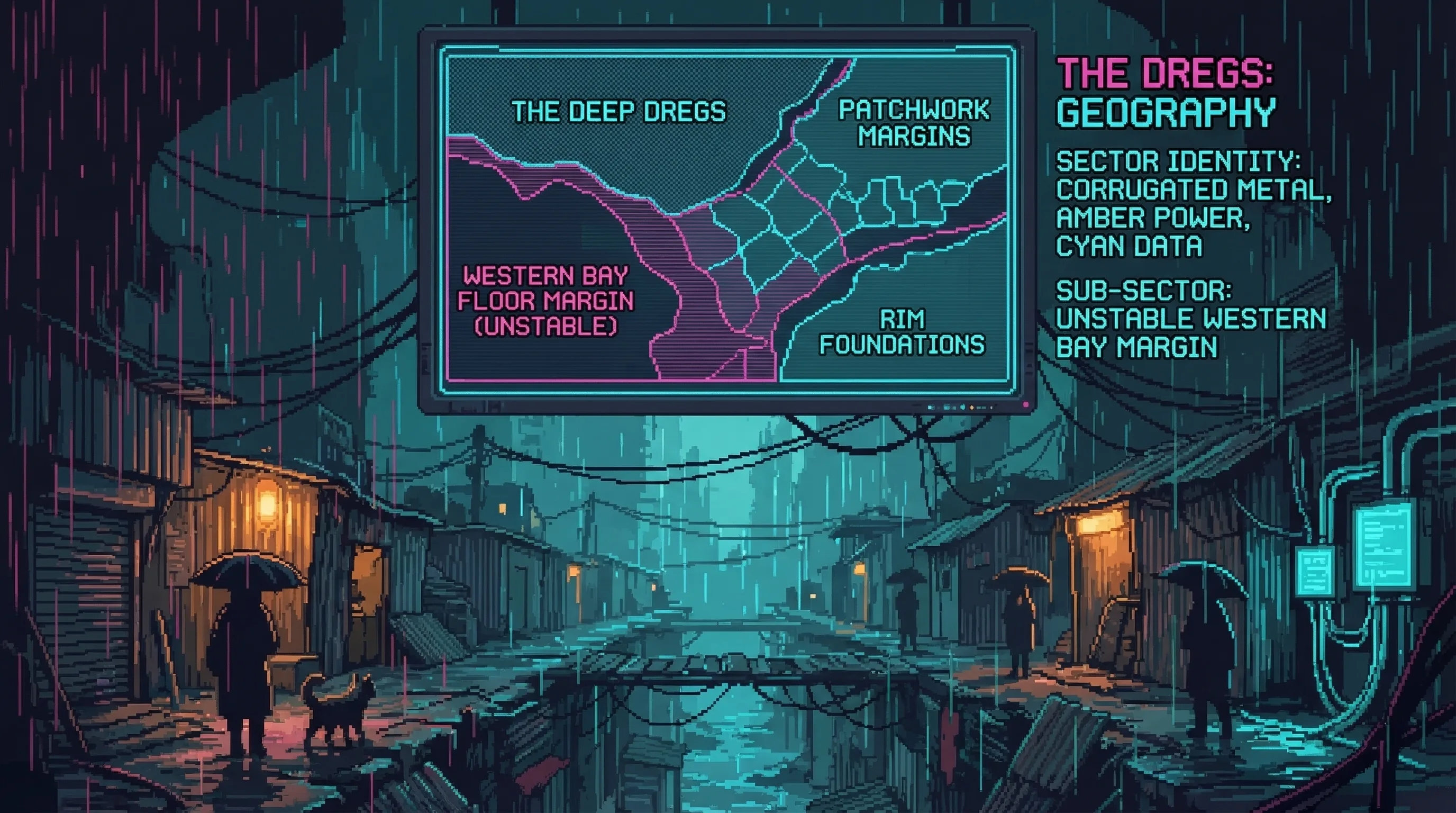
- The Deep Dregs: Geographic center. Where the culture's practices are densest and its contradictions most visible.
- Going Raw: The entry process. Corporate refugees learning to speak without algorithmic polish. Felix Otieno's transition from smooth to raw is the culture's origin story — Wren before she was Wren.
- Loop / The Noise Floor: Loop named the paradox. The Noise Floor is where the culture's values are most concentrated and most honestly questioned.
- Judge Dreg: The exemplar who shouldn't exist. Corporate-born, Dregs-made, more authentic than the natives. Proof the culture works. Proof the culture's definitions don't.
- Cyber Bandits / Bandito2: The false-negative the check cannot fix. Native rawness pointed at a ledger — they forced the culture to grow a frame-provenance stage, and they are the reason that stage will eventually be performable too.
- The Freedom Thinkers: The intellectual framework. Also the faction most likely to point out that authenticity culture reproduces the structures it claims to resist.
- The Authenticity Paradox: The deepest weakness. Performed rawness mimicking genuine rawness. The smooth check can detect AI. It is less reliable against humans who have studied what the smooth check measures.
- The Turn: The pattern measured firsthand and never published. An Ironclad new-hire block that tracks its own workforce's belief drift, twice per resident, in a spreadsheet the smooth check will never get to read.
Restricted Access
The culture has produced its own slang, its own humor, its own poetry — all of which deliberately resist the aesthetic qualities that AI systems are trained to produce and replicate. The poetry is bad on purpose. The humor is cruel on purpose. The slang shifts every few months on purpose. Anything that stabilizes long enough to be learned by a language model is abandoned. The culture treats its own vocabulary as disposable ammunition — fired once, discarded, replaced. Whether this is sustainable or whether the culture will eventually run out of words it hasn't already burned is a question nobody in the 91 Club wants to think about.
Connection tourists are the current anxiety. The smooth check's false negative rate against well-prepared human mimics has not been formally measured, because formally measuring it would require admitting the tool has limits, and admitting limits would undermine the social confidence that makes the tool effective. The diagnostic works partly because everyone believes it works. Questioning it would be, by the culture's own standards, a smooth thing to do.
Connected To
Supporting Connections









—