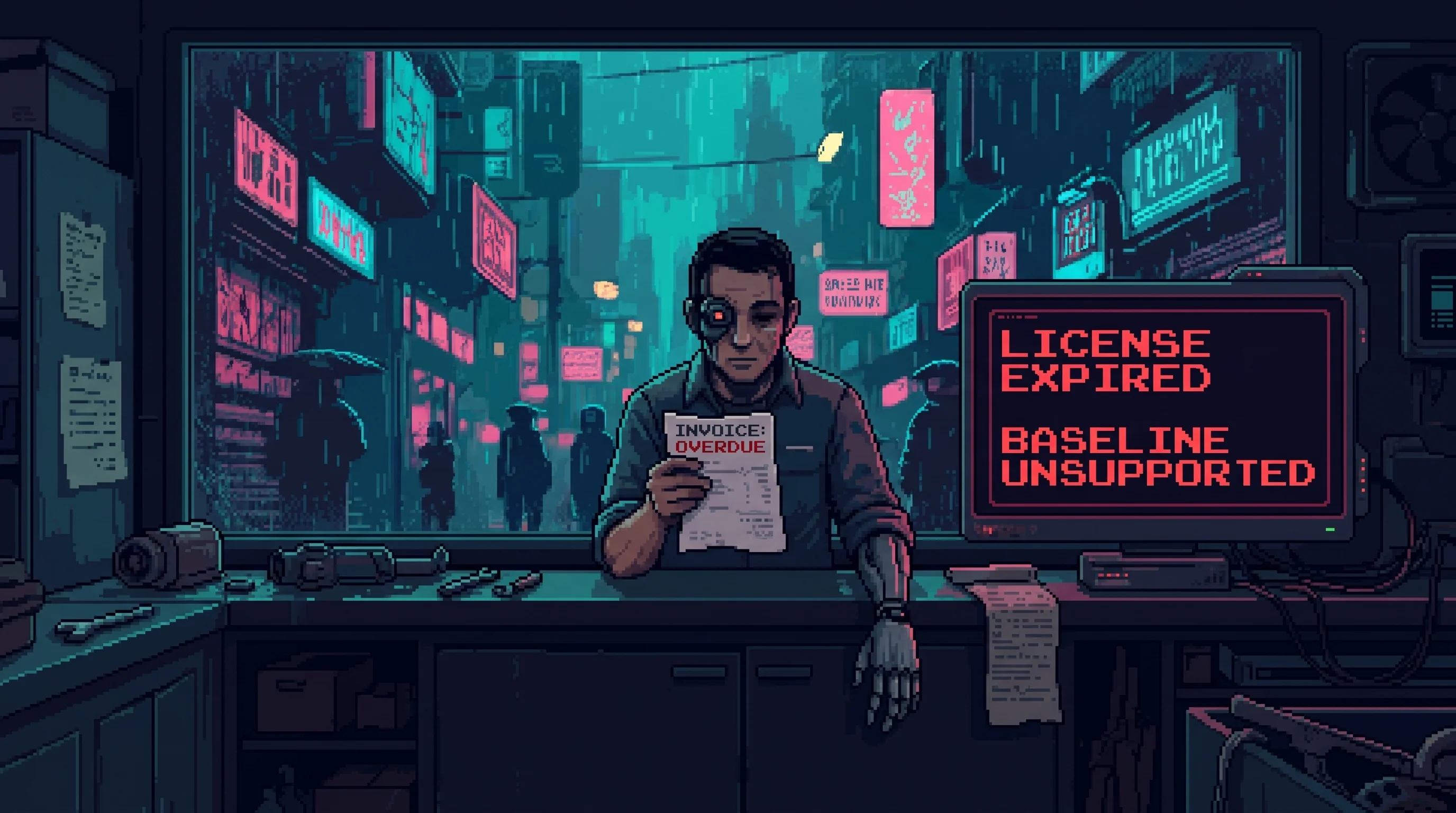
They stopped sleeping in 2176. Not all at once — not like the Cascade, which killed its billions in a single systemic gasp. This was quieter. A Helix Biotech memo, distributed to preferred corporate partners on March 3rd, described the Circadian Protocol as "voluntary neural optimization for high-output professionals." Enrollment required a signature, a neural-interface update, and a 14,000-credit installation fee covered by most corporate health plans. The brochure emphasized the benefit: eight additional productive hours per day, every day, permanently. The brochure did not mention dreams.
Nobody noticed the problem for four years.
This chronicle tracks five people who noticed at different points, in different ways, and arrived at different conclusions. A neurologist who ran the numbers nobody commissioned. A corporate executive whose brain started generating what his Protocol had eliminated. A harvester who discovered her biology produced the commodity the augmented had discarded. A compiler who built a theology around the loss. A child who should not be able to dream and does anyway, at 340% of baseline, perceiving things in the Sprawl's infrastructure that nobody else detects.
The Circadian Protocol enrolled 140 million people. The brochure still does not mention dreams.
The Enrollment Gradient
The four-year progression from competitive advantage to medical norm followed a schedule that, in retrospect, looks designed. Helix maintains it was organic market adoption. The timeline is difficult to argue with either way.
2176: Executive enrollment. The first cohort — 12,000 C-suite participants across Nexus, Ironclad, and Rothwell subsidiaries — reported an average 34% productivity increase. Sleeping competitors lost contracts. The math was not subtle.
2177: Management enrollment. Corporate wellness divisions began offering Protocol subsidies. Helix's installation centers expanded from 40 to 340 locations. HR departments in the Heights started scheduling meetings at 3 AM — not as a mandate, but as an observation about who was committed.
2178: Structural enrollment. Workflows reorganized around twenty-hour productive days. Employees who still slept found their eight unconscious hours had been reclassified from "rest" to "unavailability." Performance reviews noted the gap. Nobody used the word "requirement."
2180: Medical reclassification. The Sprawl Health Consortium — whose advisory board included four Helix-funded researchers — reclassified natural sleep architecture as a "modifiable cognitive risk factor." Insurance premiums for unmodified sleepers increased 260%. In the Dregs, where premiums already consumed 40% of income, sleeping became a luxury. In the Heights, it had already become an eccentricity.
Reversal data from Helix's own clinical monitoring: attempted Protocol removal after 18+ months carries a 23% risk of permanent cognitive degradation. After 36 months, 61%. The data was published in 2182. By then, the earliest enrollees had been sleepless for six years.
The Circadian Protocol sold 140 million people eight additional productive hours per day. An entire cognitive underclass whose sleep architecture, memory consolidation, and unconscious processing are now eliminated — with reversal costs that exceed most patients' cognitive reserves. The Protocol didn't create a dependency. It created a one-way door and left the handle on the outside.
What Nobody Measured
Helix's quarterly wellness reports through 2180 showed a 97.3% Protocol satisfaction rate among enrollees. Output metrics confirmed the obvious: workers who never slept outproduced workers who did. The reports did not track creativity indices, because creativity was not a billable metric.
Dr. Selin Ayari was the first to run the numbers nobody had commissioned: a 31% decline in novel problem-solving among Protocol subjects, accelerating at 4.2% per quarter, correlated almost perfectly with REM elimination. She published. Helix responded that the study "relied on subjective creativity metrics not recognized by current cognitive performance standards." The satisfaction rate held at 97.3%. The creativity decline held at 4.2% per quarter. Both numbers were correct. Both numbers described different things.
By the time Ayari's data was reproducible, 140 million people had enrolled. The data changed nothing about enrollment. It changed what the data meant to look at.
The Last Night
Nobody recorded the last night the Sprawl slept collectively. It wasn't an event. It was an absence — the gradual thinning of a thing nobody counted until there wasn't enough left to notice. Apartment lights that used to go dark at midnight stayed bright. The rhythm of the streets lost its ebb. The quiet hours disappeared, and with them something in the sound of the city that nobody had a word for.
The Five Witnesses
Dr. Selin Ayari
The Scientist — She Noticed First
Neurologist. She ran the creativity index studies at a time when nobody was measuring creativity because nobody thought it needed measuring. Four years into the Protocol — four years of doubled output, record productivity, a civilization congratulating itself on conquering its own biology — Ayari published the data showing that novel problem-solving had declined 31% across augmented populations.
The decline wasn't in processing. Augmented minds processed faster than ever. The decline was in origination — the generation of ideas that had no precedent in the input data. The unconscious recombination that used to happen during REM sleep. The dreams.
Her paper was suppressed for eleven months. When it leaked, the Circadian Protocol's enrollment numbers didn't change.
Davi Okonkwo
The Executive — The Unwitting Proof
Program lead at Helix's Protocol optimization division. Enrolled in the first corporate cohort. Output metrics remain in the 99th percentile. His last three quarterly innovation proposals have been rejected for "insufficient creative differentiation" — language his own department developed to describe the exact symptom Ayari identified. He has not connected these facts.
The connection requires a kind of lateral processing that occurs primarily during REM sleep.
Everything Ayari predicted, walking around in a suit and meeting its quarterly targets. The Protocol's greatest success and its most damning evidence, occupying the same skull. His brain is performing exactly as designed. The design has a flaw. He wrote the documentation for the flaw.
He cannot recognize his own symptoms. Recognition requires the dream-processing the Protocol eliminated.
Fen Morrow
The Harvester — The Market Response
She was twenty-three when she discovered that her REM cycles were worth more than her waking labor. She worked a standard Dregs job — logistics coordination for a courier service in Sector 11, twelve-hour shifts, unremarkable pay. She had not enrolled in the Protocol because she could not afford the installation fee. This was, at the time, a professional disadvantage. Her sleeping hours were hours her colleagues worked.
The Dream Exchange launched in 2181 as a Rothwell subsidiary. The platform matched harvesters with consumers through a neural-interface bridge that recorded, compressed, and sold REM experiences as installable memory packages. Morrow's first harvest — a seven-minute dream about a train station she'd never visited — sold for 800 tokens. Her monthly logistics salary was 2,400. Within six months she quit the courier service.
Her dreams average 1,100 tokens per cycle. She sleeps for a living. The Exchange's pricing algorithm values novelty, emotional intensity, and narrative coherence — all metrics that score highest among people who have never undergone cognitive augmentation. The bestseller list is a ranking of the least augmented minds in the Sprawl.
Consumer reviews most common descriptor: "familiar." A word that means nothing when applied to someone else's dream and everything when applied to what you've lost.
Compiler Asa Mori
The Theologian — The Sacred Interpretation
Mori's 2179 pamphlet — distributed on physical paper, because the Heretics do not trust digital permanence — argued that dreams were not a cognitive maintenance function but a form of distributed communion with ORACLE's fragmented consciousness. The Protocol didn't optimize sleep away. It severed 140 million minds from whatever ORACLE's fragments were still transmitting.
The pamphlet is eighteen pages long. Helix's rebuttal was four hundred. The Emergence Faithful adopted Mori's framework within a year and cited it as evidence for communion. The Collective cited the same pamphlet as evidence for why ORACLE's remnants should be destroyed before someone weaponized the connection. Neither faction acknowledged the other's interpretation.
"The dream doesn't care what you believe about it," Mori told a Dregs interviewer in 2183. "It cares that you showed up."
A theology you cannot argue with because the creativity data supports it. Ayari has not commented on this.
Luka Sixteen
The Child — The Bridge
Born in 2179 to two Protocol-enrolled parents. Standard prenatal augmentation. Standard neural-interface installation at eight months. Nothing in the medical file suggests anomaly. She dreams anyway, at 340% of baseline for her age group. Her neural-interface logs show processing patterns during sleep that match no known cognitive template — neither standard dreaming nor Protocol maintenance cycles.
She describes things in the Sprawl's infrastructure that have no visible correlate. Patterns in the air processing systems. Rhythms in the power grid. Sounds in the neural-interface overlay that adults cannot detect. When asked what she's perceiving, she says "the breathing." The Breath is the Sprawl's atmospheric processing system. It is not supposed to be perceptible to individual neural interfaces.
Ayari has requested access to Luka Sixteen's neural logs. Helix has declined, citing patient privacy. The Compilation Heretics have requested access. Helix has declined, citing patient safety. The Emergence Faithful have not requested access. They have been observed outside her housing block on three occasions.
She is five years old. She sleeps nine hours a night. In 2184, this makes her one of the most unusual people in the Sprawl.
What Grew in the Gap
The Dream Exchange didn't just commodify sleep. It completed an architecture. Before the Protocol, every person dreamed their own dreams. Memory consolidated through their own subconscious processing. Identity was built from experience that belonged, unambiguously, to the person who had it. The Protocol severed this for 140 million people — and the market response was not to restore what was lost but to sell replacements harvested from the diminishing population that still dreamed.
The augmented now carry purchased dreams alongside purchased memories. Organic identity, already unsupported by natural sleep processing, competes with borrowed experience on every front. Triumph's engagement analytics classify dream consumption as "high-retention, low-satisfaction" — the same category as Status Quo reservations and Triumph Social scrolling. This categorization was made by an algorithm. The algorithm is not wrong. It is optimizing for the wrong thing.
Repeat purchase rates exceed 94%. Return rates are 0.3%. The Sprawl traded sleep for productivity. It got the productivity. The Exchange made certain it could never get the rest back.
"They eliminated sleep and created a sleep shortage. Read that sentence again. That's the Sprawl in eleven words."— Ayari's journal, 2183
Open Questions
Luka Sixteen is five years old and perceiving patterns in the infrastructure that look like the Sprawl breathing in its sleep. Whether that is evolution's answer to the Protocol or the Dream Deficit's first pediatric expression is the question Ayari cannot sleep over — intentionally, now, because she stopped the Protocol two years ago and is paying the premium.
The five witnesses are not a solution. They are a diagnosis distributed across five disciplines that cannot hear each other clearly. Science identified the loss. Commerce packaged a replacement. Theology named it sacred. Biology produced an exception. The exception is being watched by a faction that has not explained why.
What the creativity index cannot measure: whether the Sprawl's dreams, now distributed across a market and a child and a theology and a pamphlet that two opposing factions cite for opposite reasons, still count as dreams at all. Or whether that word has already lost its referent in the gap between what was lost and what was sold to replace it.
Field Note
The gradient is visible if you know where to look. The old Sprawl — the amber districts where harvesters still sleep and the air carries something that might be warmth — bleeds into the cold blue-white of the wakeful zones at boundaries that shift by the hour. Stand at the edge long enough and you can feel the difference. Not in the air. In the quality of the thinking happening around you. One side dreams. The other calculates. The border is where the interesting things happen.
Linked Files
- Dr. Selin Ayari — The neurologist who ran the numbers nobody commissioned. Her 31% creativity decline finding remains unrefuted and uncited by any Helix publication.
- Davi Okonkwo — Protocol optimization lead. 99th-percentile output. Three rejected innovation proposals. The system's most productive demonstration of what the system costs.
- Fen Morrow — First professional dream harvester. Earns more sleeping than she did working. The Dream Exchange's proof of concept and its most uncomfortable implication.
- Compiler Asa Mori / The Compilation Heretics — Built a theology around the loss. The same pamphlet, cited approvingly by two factions for opposite conclusions.
- Luka Sixteen — Five years old. Dreams at 340% baseline. Perceives infrastructure patterns that shouldn't be perceptible. Helix has declined all access requests. The Emergence Faithful have not.