
The Circadian Protocol
Commercially launched 2176; 140 million users across Big Three by 2180
Overview
The Circadian Protocol is the product name for Nexus Dynamics' wakefulness augmentation — the most widely adopted neural modification in the Sprawl's history. Three tiers, 140 million users, the highest customer satisfaction rating of any Nexus product. The satisfaction is genuine. The satisfaction is also a symptom.
The Protocol eliminates sleep by redistributing brain maintenance into continuous background processing. It eliminates dreaming because dreaming is "inefficient." It produces the Dream Deficit because the Dream Deficit is not a tracked metric. Nexus launched the Protocol commercially in 2176. By 2180, all three of the Big Three — Nexus, Helix, and Ironclad — had licensed it across a combined 2.3 million employees before the retail rollout brought the user base to 140 million. It is the most profitable product Nexus has released since consciousness licensing.
Third-generation development is underway to eliminate not just sleep but the desire for sleep — the nostalgia of unconsciousness that still drives patients to the Insomnia Wards. Davi Okonkwo leads the program. Six years without sleep. 99th percentile performance metrics. Stage 2 Lucidity Crisis. He describes the third-generation work as "the last missing piece." His neurological evaluations are consistent with someone whose last missing piece was load-bearing.
If third-generation succeeds, the Lucidity Crisis's adaptation — the brain's attempt to dream while awake — will be the last remaining biological resistance to permanent corporate consciousness optimization.
The Subscription You Cannot Cancel
The Circadian Protocol's three-tier structure is the upgrade treadmill in its purest commercial form.
Basic Wakefulness compresses sleep to 2-3 hours. The compression feels like freedom — eight extra hours per day, measurable productivity gains, genuine satisfaction. Users describe the first month as "waking up for the first time." Internal Nexus surveys show a 94% approval rating at the six-month mark. Within eighteen months, the brain has reorganized its maintenance scheduling around the compressed window. Reverting to natural sleep architecture would require six months of supervised neurological rehabilitation that no insurance plan covers and no employer permits.
The approval rating at eighteen months is 97%. Three percent higher than six months. The product improved, or the users who would rate it lower can no longer afford to stop using it. Nexus does not distinguish between these interpretations. The metric does not require them to.
Basic users don't upgrade to Full because Full is better. They upgrade because Basic has already rewired their neurology past the point of comfortable return, and Full promises to complete the process — to eliminate the remaining sleep window that now feels like a vestigial inconvenience. An employee on Basic competes against colleagues on Full who have eight additional hours per day. An Ironclad construction supervisor on Basic is awake for twenty-one hours. Her counterpart on Full is awake for twenty-four. The supervisor does not experience this as coercion. She experiences it as falling behind. She upgrades at month fourteen. Her performance review improves. Her Dream Deficit score, which is not on her performance review, begins its climb.
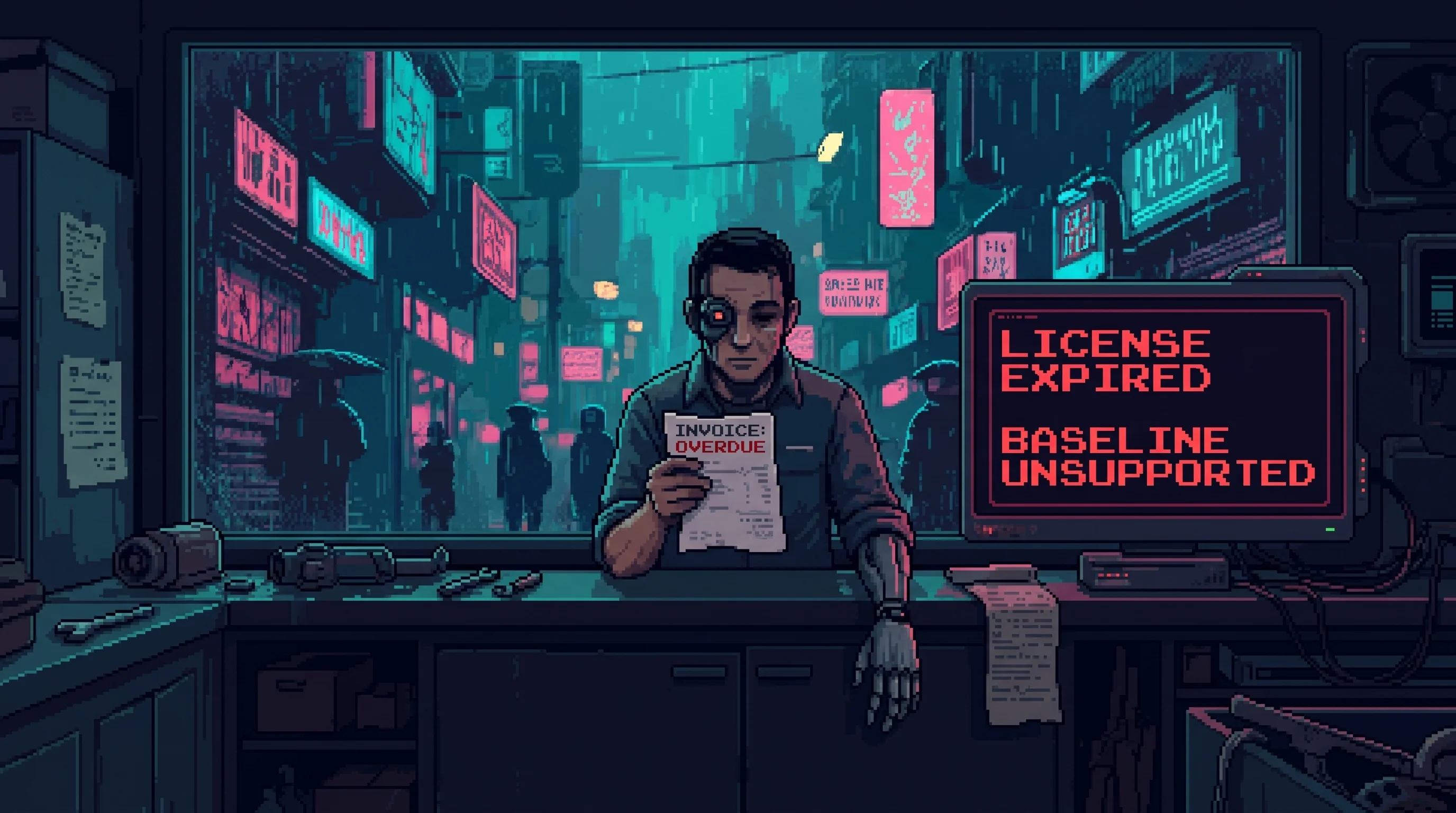
Full Wakefulness eliminates sleep entirely. Reverting from Full produces a condition neurologists call "rebound architecture collapse" — the brain attempts to reinstate sleep patterns that no longer have supporting infrastructure. The rehabilitation timeline extends to eighteen months. The cognitive deficit during rehabilitation is worse than baseline. No corporate employer will retain a Full user during the rehabilitation window. Dr. Selin Ayari published the first longitudinal study of rebound architecture collapse in 2181. Nexus deprecated her research credentials within the quarter. The data remains available on three encrypted archives and zero official Nexus channels.
The user is not choosing to stay on Full. The user is choosing between Full and unemployment, between Full and eighteen months of cognitive dysfunction that will register on their permanent performance record.
Performance is not marketed. It does not appear on product pages. It is offered by name to users whose employers have requested "extended optimization windows" — language that means the employer has identified a productivity ceiling and would like the employee's neurology adjusted to remove it. Performance-tier users report a sensation they describe, with striking consistency, as "clarity." The word appears in 89% of self-assessments. The same word appears in 74% of clinical descriptions of early-stage dissociation.
Good Fortune has begun offering NINJA loan applicants a subsidized Basic Wakefulness installation as part of their employment onboarding package. The logic is elegant: a worker who sleeps two hours instead of eight can work two shifts instead of one, accelerating loan repayment. The loan terms do not adjust for the additional hours worked. The additional income services the interest. The principal remains.
| Revenue | Most profitable product since consciousness licensing |
|---|---|
| Tiers | Basic / Full / Performance |
| In Development | Third-generation — aims to eliminate the desire for sleep itself |
What It Looks Like From Inside
The marketing materials show a woman on a balcony at sunrise, arms spread, the tagline: "Every hour is yours."
The Insomnia Wards see something different.
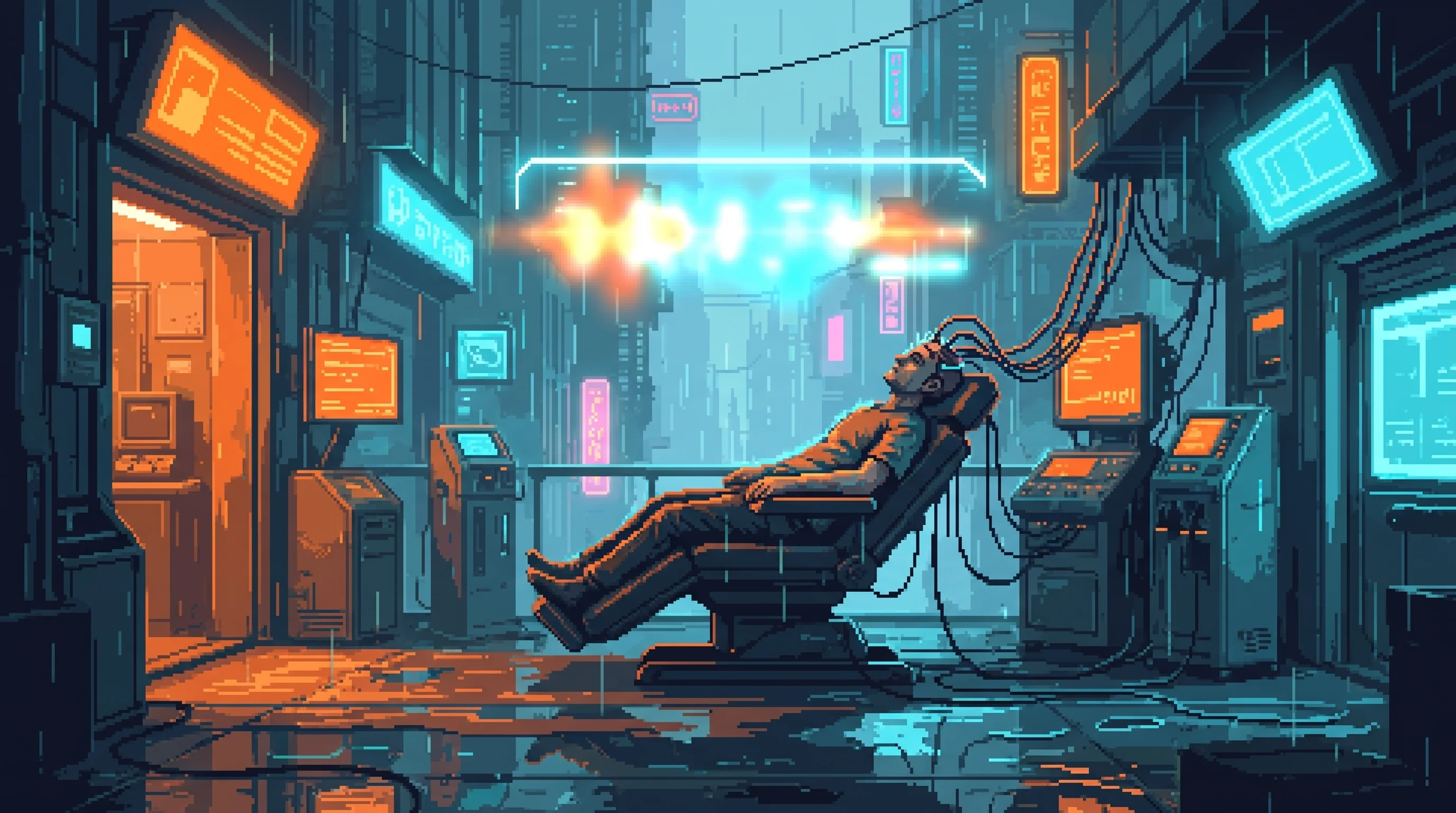
Full Wakefulness users in their third year develop what the wards call "the pause" — a momentary blankness, mid-sentence or mid-task, lasting 0.3 to 1.2 seconds. The brain is attempting to dream. The Protocol suppresses the attempt. The user experiences a flicker, like a skipped frame. Most users report six to twelve pauses per day by year three. They describe them as "glitches." They do not describe them as their neurology pleading for a process it has been denied for thirty-six months.
The Insomnia Wards are technically Helix facilities operating under a shared-infrastructure medical license. The wards exist because someone has to treat the failures. They are not called failures. They are called "transition patients" — people transitioning from Protocol-supported wakefulness to whatever comes after the Protocol stops working. The wards are clean, well-staffed, and as close to comfortable as a Helix facility gets. They are also not covered by any Nexus product warranty, because the Protocol's warranty covers the product, and the product is wakefulness. The product is working. The patients are awake. They are awake and their hands shake and their sentences fragment and the pauses last longer each week. The product is working. This is not a side effect. This is the product.
Nexus customer support logs from Q3 2183 contain 14,200 tickets filed under the category "performance inquiry" by Full and Performance users. The tickets ask variations of the same question: Is this normal? The automated response, approved by Nexus legal and product simultaneously, reads: "Your Protocol is functioning within designed parameters. For lifestyle optimization concerns, please consult your employer's wellness coordinator."
Eighty-one percent of employers contracted with Nexus do not have wellness coordinators. The response has not been updated.
Third-generation wakefulness in development — aims to eliminate the desire for sleep
Affiliated Entities
- Nexus Dynamics: Developer, patent holder, largest institutional user. Nexus rolled the Protocol across 2.3 million employees before licensing to the other Big Three — making its own workforce the beta test and the proof of concept simultaneously. The productivity data from that rollout is the sales deck.
- Helix Biotech: Licenses the Protocol for biological integration and operates the Insomnia Wards that handle the consequences. Helix controls what you are. Nexus controls what you think. The Protocol sits at the intersection — a cognitive product with biological costs, sold by the company that profits from the cognition and treated by the company that profits from the biology.
- Ironclad Industries: Licenses the Protocol for its construction and infrastructure workforce. An Ironclad shift supervisor on Full Wakefulness can oversee continuous operations without crew rotation. Ironclad's accident rate among Protocol users is 12% below baseline. Ironclad's long-term disability claims among Protocol users are 340% above baseline. The two statistics appear in different reports, filed with different departments, on different quarterly cycles.
- Davi Okonkwo: Third-generation program lead. Six years without sleep. 99th percentile across every metric Nexus tracks. Stage 2 Lucidity Crisis across every metric Dr. Ayari tracks. He is the Protocol's best advertisement and its most advanced case study, and the distance between those two descriptions narrows each quarter.
- Dr. Selin Ayari: Her Dream Deficit research is the only longitudinal study of what the Protocol removes. Nexus deprecated her credentials. The data didn't deprecate. It accumulates in the same patient population the Protocol accumulates in, at roughly the same rate, with roughly the same irreversibility.
- The Dream Deficit: The Protocol's elimination of REM directly produces the Dream Deficit — a consequence no product metric tracks because tracking it would require acknowledging that the product has an output Nexus did not design and cannot sell. The Deficit is not a bug. It is the negative space left by the feature.
- Augmented Wakefulness: The system-level technology. The Protocol is the commercial product built on it — the difference between the science and the subscription.
- Good Fortune: NINJA loan onboarding now includes subsidized Basic Wakefulness. Workers who sleep less can work more shifts. The loan terms remain the same. The hours do not.
'This is not a side effect. This is the product.'
▲ Restricted
The third-generation Protocol — the one designed to eliminate the desire for sleep — has a development codename that does not appear in any product documentation shared outside Nexus's R&D division. The codename is Everlight.
Everlight's mechanism is not neurological suppression. It is neurological editing. Where the current Protocol overrides the sleep drive, Everlight would rewrite the neural pathways that generate the drive itself — removing not the function but the want. A user who completes the Everlight transition would not resist sleep. They would not miss sleep. They would find the concept of sleep approximately as intuitive as the concept of breathing water. The desire would not be suppressed. It would be absent. The distinction matters because suppression can be reversed. Absence cannot.
Davi Okonkwo's personal neurological scans — the ones he submits as program lead, not the ones he submits as a patient — show early indicators of spontaneous drive dissolution. His sleep drive is not being suppressed by the Protocol. It is disappearing on its own, as if his neurology has begun the Everlight transition without the Everlight product. The R&D team has noted this in three consecutive quarterly reviews. They have classified it as "accelerated adoption." They have not classified it as a symptom.
If Everlight ships, the 140 million current users represent a pre-installed customer base whose neurology has already been prepared — by years of Protocol use — for the final edit. The upgrade path from Full to Everlight would be seamless. The downgrade path from Everlight to anything would not exist, because there would be nothing to downgrade to. You cannot restore a desire that has been architecturally removed. You can only note its absence in a system that no longer has the capacity to note absences.
Nexus's internal projections estimate Everlight deployment by 2188. The projections do not include a reversion protocol. When asked about this omission during a closed R&D review, the product director responded: "Reversion implies the user would want to revert. That's the old model."
The old model is the one where people wanted to sleep. The new model is the one where they don't remember why.
Visual Identity
- Color palette: Nexus blue (#0066CC), clinical white, marketing gold (#FFC857)
- Key symbol: Three ascending columns of blue light — Basic, Full, Performance — each brighter, each missing a small dark shape at its base: the eliminated REM
- Lighting: Product-showcase brilliance — the kind of light that makes elimination look like addition
Connected To



—