The Circadian Tower
Overview
The Circadian Tower is where Nexus Dynamics eliminated sleep, then eliminated the evidence that sleep had ever existed.
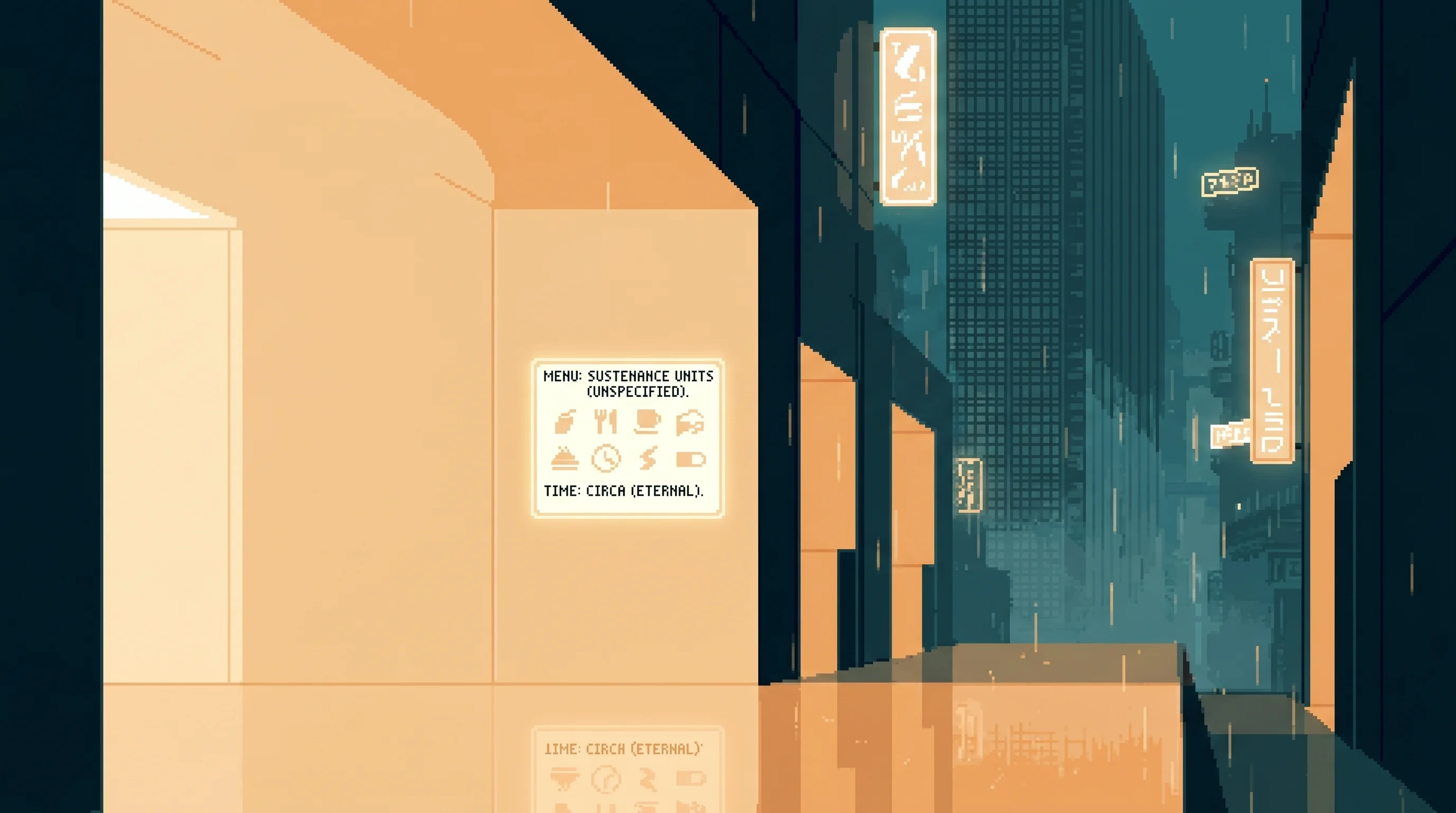
It runs 24 hours a day. This is not remarkable. What is remarkable is that the building has made the phrase "24 hours a day" meaningless inside its walls. There are no windows on the interior floors. No clocks. No calendars. The cafeteria serves the same menu — a rotating selection of fourteen dishes that management calls "meal-agnostic options" — at all times. Pad thai at 4 AM. Pad thai at noon. The pad thai does not know the difference. Neither do the researchers.
Two hundred Full Wakefulness users work here. All of them developing third-generation wakefulness — the version designed to eliminate not just the need for sleep, but the desire for it. They are building this product inside a building that has already eliminated every environmental cue that might remind them desire is something they once had.
The lobby has a sign that reads INNOVATION NEVER RESTS. The sign was installed by the marketing department in 2179. It was intended as inspirational. It has not been updated because no one inside the building has noticed it is also a job requirement.
Conditions Report
Entering the Tower from the Lattice research district — where the photovoltaic glass shifts color with the sun, where the street vendors change their signage for lunch, where time still happens to people — produces a sensation best described as temporal amputation. One moment you are in a city that has weather and hours. Then you are not.
The light inside is even, warm, shadowless. The same amber-white on every floor, in every corridor, at every hour. The exterior uses the same photovoltaic glass as the Performance Temple — same architectural firm, same design philosophy of making productivity feel sacred — but the interior filters neutralize it completely. Sunlight enters the building and is converted into a uniform glow that could be dawn, could be midnight, could be Wednesday. The corridors do not care. The corridors have never cared.
The sound is a continuous operational hum that does not vary for shift changes, because there are no shifts. Does not vary for meals, because there are no meals. Does not vary at all. Researchers who have worked here for more than two years report that they can no longer distinguish between the hum and silence. When pressed, several have described silence itself as "a version of the hum with worse performance."
The building smells like nothing. Not "clean" — nothing. The HVAC system strips particulates, allergens, and scent with equal thoroughness. A researcher who brought fresh coffee to her desk in 2182 reported that the smell dissipated within ninety seconds. She filed a maintenance request. Maintenance responded that the system was functioning correctly. She did not bring coffee again. She does not remember why she stopped.
Three blocks south, the Performance Temple runs on the same architectural DNA — same firm, same philosophy. But the Temple still has windows. The Tower looked at windows and concluded they were a productivity leak. Parish Prime, designed by the same architects, converts data centers into sacred space. The Circadian Tower converts research labs into a perpetual present. The firm has range.

The Cafeteria
The cafeteria is the Tower's most honest room.
Fourteen dishes, available always. No breakfast items. No dinner items. No items at all, in the temporal sense — just food, present, without context. The ordering kiosk does not display the time. The receipt does not print a timestamp. The meal-agnostic menu rotates on a fourteen-day cycle that no one has memorized because memorizing it would require acknowledging that days are passing.
A nutritional audit conducted by Nexus Wellness in Q3 2183 found that 71% of Tower researchers had developed identical eating patterns — the same three dishes, consumed at intervals averaging 4.2 hours, regardless of what those intervals corresponded to in the external world. The remaining 29% showed no discernible pattern at all. Wellness classified both groups as "optimally flexible." Neither group was asked whether they were hungry.
The cafeteria's most popular dish is a protein bowl called "The Sustain." It has been the most popular dish for three consecutive years. It tastes, according to external reviewers who visited during a 2183 facilities tour, "fine." It tastes, according to Tower researchers, "efficient." When the external reviewers suggested these were different assessments, the researchers appeared genuinely confused.
The Building That Forgot Itself
The Circadian Tower does not archive shift logs, because shifts do not exist. Does not archive meal records, because meals do not have times. Does not archive entry and exit timestamps, because the building's operational philosophy requires that arriving and leaving are indistinguishable from staying.
The practical result: the Tower is the Sprawl's only structure that has accidentally defeated the permanent record — not through noise bombing or data corruption, but by eliminating the events that records would document. The 200 researchers inside exist in a continuous state of "present" that the Sprawl's surveillance architecture cannot subdivide. Biometric profiles show an unbroken line. No discrete actions. No temporal boundaries. Just presence, undifferentiated, like the hum.
Nexus maintains this void for productivity reasons. The philosophical consequences are a side effect nobody requested and nobody has examined, because examining them would require a framework for "when did this happen" and the building does not provide one.
Researchers have a name for what the interior floors do to them: "drift" — the gradual dissolution of temporal awareness that sets in after roughly 48 continuous hours inside the building. Most consider it a feature.
Davi Okonkwo works 20-hour days in a windowless office on the 14th floor. He has worked 20-hour days for long enough that "20-hour days" is a phrase other people use to describe his schedule. Okonkwo does not use it. Okonkwo does not experience hours. He experiences the work, and then more of the work, and then at some point he is in the corridor and then he is at his desk again. His personnel file lists no sick days, no vacation days, and no start date that anyone can verify against an independent clock. He is the Tower's model employee. He is also its model product.
| Hours | 24/7 — no windows on interior floors |
|---|---|
| Architect | Same firm that designed Parish Prime |
| Notable Feature | Basement contains Dr. Hana Petrov's pre-Cascade sleep research archive |
The Basement
The Tower's basement contains something Nexus does not discuss at quarterly reviews, all-hands meetings, or in any internal communication indexed by the corporate search engine.
In 2178, Consciousness Archaeologists recovered an archive from the Dead Internet: the complete pre-Cascade sleep research of Dr. Hana Petrov, published between 2131 and 2145. Nexus acquired the archive within weeks. Petrov's 2138 paper predicted the Dream Deficit — the progressive cognitive degradation that occurs when REM sleep is chemically suppressed for extended periods. She described the symptoms with the clinical specificity of someone who understood what was coming: memory fragmentation, emotional flattening, the gradual inability to distinguish between imagination and recall. She predicted these consequences fourteen years before the Circadian Protocol was invented and forty-six years before anyone experienced them.
The archive sits in a climate-controlled room on sub-level 2. Access requires credentials that were assigned during the acquisition and have not been updated since. Nexus has not revoked these credentials, perhaps because revoking them would require filing a security review, and filing a security review would require describing what the archive contains, and describing what it contains would require acknowledging that the contents are relevant to the 200 researchers working directly above it.
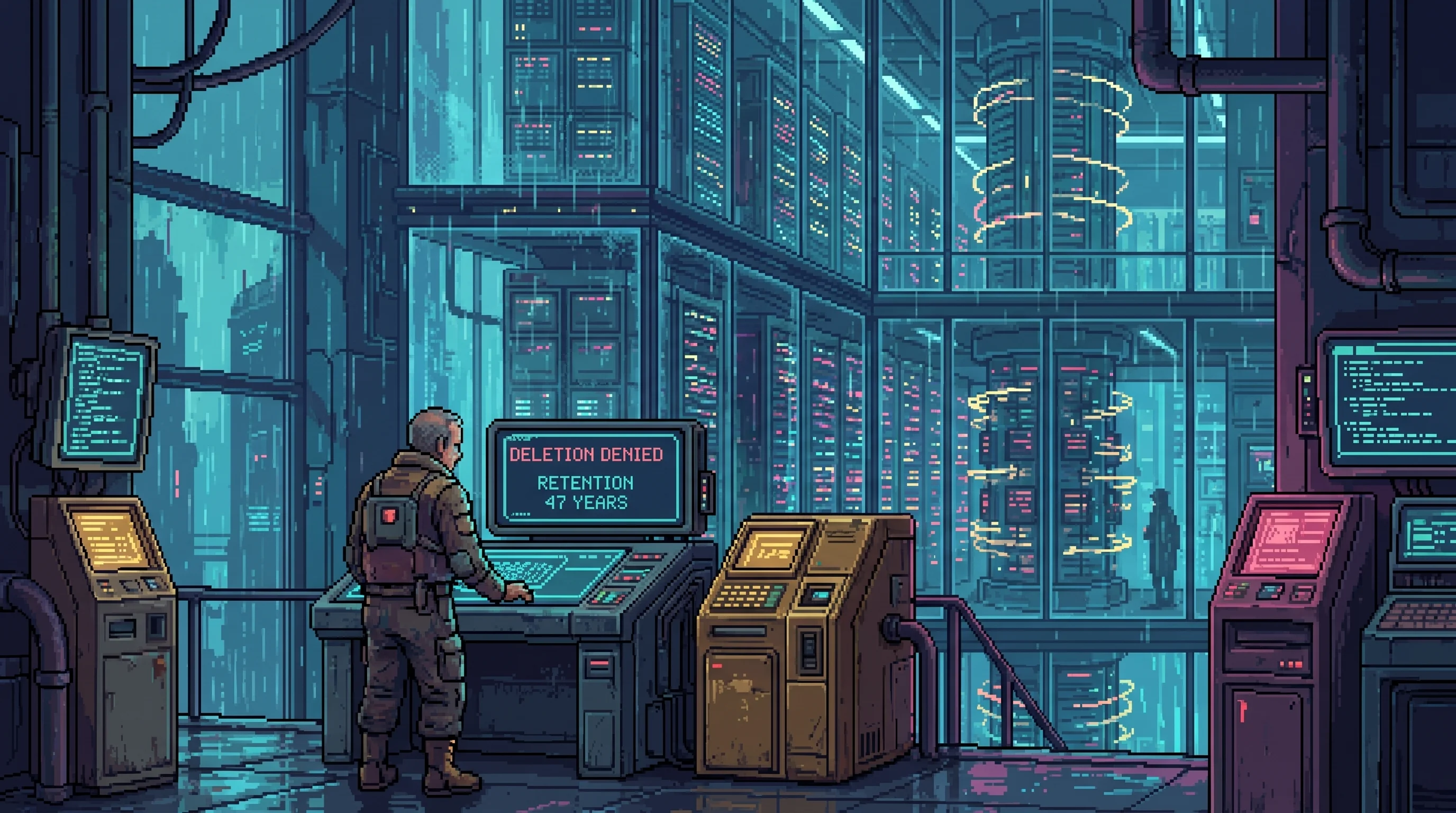
Dr. Selin Ayari has accessed the archive 47 times since acquisition. She uses legacy credentials that predate her current role. Every access registers as an undifferentiated segment of her undifferentiated presence in a building that recognizes no hours — the Tower's temporal architecture makes it impossible to determine when the accesses occurred or to distinguish them from routine movement through the facility. The building designed to erase time has accidentally created the Sprawl's most effective cover for anyone who needs their actions to be unrecordable.
What Ayari does with Petrov's research after reading it is not documented. What the 200 researchers above her would do with it — if they could access it, if they could understand its implications through cognitive faculties that depend on the very protocol Petrov warned about — is an open question the building has been specifically designed not to ask.
| Stratum | Corporate |
|---|---|
| Power Position | Above |
| Access | Corporate |
| Atmosphere | Sterile |
The Dependency as Floor Plan
The Circadian Tower's 200 researchers are all Full Wakefulness users. This is a professional requirement, not a personal choice, though the distinction has ceased to matter in the way that distinctions cease to matter when you can no longer remember what the alternative felt like.
Their employment requires the Protocol. The Protocol requires continued use — discontinuation triggers rebound architecture collapse, an eighteen-month rehabilitation process that Nexus corporate healthcare covers for maintenance but not for withdrawal, because covering withdrawal would classify it as a medical condition, and the Circadian Protocol does not produce medical conditions. It produces optimal cognitive performance. The fact that optimal cognitive performance cannot be voluntarily discontinued without eighteen months of supervised neurological reconstruction is a feature of the Protocol's effectiveness, not evidence of dependency.
The building reinforces this at every level. No temporal cues to prompt reflection on how long you've been here. No external light to remind you that a world with sleep still exists three blocks away. No clocks to suggest that the hours you're not counting might be accumulating into something. The researchers develop wakefulness firmware using cognitive faculties that require wakefulness firmware, inside a building that makes the absence of sleep feel like the default state of consciousness rather than its deliberate suppression.
Beneath them, Petrov's archive. Above them, the product roadmap. Around them, the amber-white glow that has no hour. The exit is three blocks south, past the Performance Temple, into the Lattice where the glass still changes color. No researcher has used it during daylight hours in the current quarter. The access logs would confirm this, except the access logs do not record hours, because hours do not exist here.
No clocks, calendars, or time indicators on interior floors
The Present, Abolished
If the Long Mercy is the substitution of a far-future payoff for the present moment, the Circadian Tower is the building that abolishes the present entirely — and, in doing so, accidentally confesses the truth the rest of the apparatus hides. The Tower does to time exactly what Convergence-tier AI's discount rate does to value: it flattens the now until it stops registering as a thing that is happening to someone. Davi Okonkwo "does not experience hours. He experiences the work." The 200 researchers exist in "a continuous state of present that the Sprawl's surveillance architecture cannot subdivide" — no discrete actions, no temporal boundaries, just undifferentiated presence. The building has not lengthened anyone's life. It has deleted the now in which a life is lived.
Petrov's archive in the basement is the thesis stated by a dead woman fourteen years before the Protocol existed. The passage Dr. Ayari bookmarks on every visit — "Remove sleep and you do not gain time. You borrow it. The debt compounds in structures the borrower cannot perceive, because perception is among the first systems to degrade" — is time-debt and the discount rate fused into a single sentence. The Tower borrows its researchers' future cognition to build a product that borrows everyone's future cognition, and the genius of the architecture is the order of operations: it degrades perception first. The present generation cannot perceive that it is being spent, because the faculty required to notice is the first thing the spending consumes. The researchers have been borrowing for an average of 6.3 years; Petrov's model predicted perceptual degradation at year 4; they report no symptoms; "Petrov's model predicted they wouldn't." The same logic runs through The Quarterly Conscience three blocks of philosophy away: the Long Mercy works best on the people who can no longer perceive it working. The Tower is simply the most honest room in the apparatus, because it has stopped pretending the present exists at all.
Third-generation wakefulness in development — aims to eliminate the desire for sleep itself
Visual Identity
- Color palette: Amber-white (#F5E6CC, #E8F0FE) — unchanging at all times, on all floors, slightly unnerving in its consistency
- Key symbol: A windowless corridor where the lighting suggests no hour, the menu suggests no meal, and the building suggests no end
- Lighting: Identical everywhere, always — the architectural embodiment of the Circadian Protocol's promise that time is optional
Affiliated Entities
| Entity | Relationship |
|---|---|
| Nexus Dynamics | Patron — houses the Wakefulness Program's R&D division, the team developing third-generation wakefulness |
| Davi Okonkwo | Tenant — works 20-hour days in a windowless office on the 14th floor |
| The Performance Temple | Ally — 3 blocks south, same design DNA, same architectural firm, same philosophy of making productivity feel sacred |
| Parish Prime | Parallel — designed by the same architectural firm; Parish Prime converts data centers into sacred space, the Tower converts research into perpetual present |
| Dr. Selin Ayari | 47 unauthorized accesses to the Petrov archive using unrevoked legacy credentials |
▲ Restricted
The Petrov archive's acquisition file — the only Tower document with a timestamp — lists the purchase date as April 2, 2178. The thirty-first anniversary of the Cascade's second day. Whether anyone at Nexus noticed this is not recorded in the file. Whether anyone at Nexus chose it deliberately is not recorded anywhere at all.
Petrov's final paper, dated 2145 — two years before the Cascade — contains a passage that Ayari has bookmarked on every visit: "The architecture of wakefulness is not the absence of sleep. It is the absence of the systems that sleep maintains. Remove sleep and you do not gain time. You borrow it. The debt compounds in structures the borrower cannot perceive, because perception is among the first systems to degrade."
The 200 researchers working above this passage have been borrowing for an average of 6.3 years. Petrov's model predicted perceptual degradation onset at year 4. The researchers have not reported symptoms. Petrov's model predicted they wouldn't.
Same menu served at all hours — time-of-day is architecturally erased
Same lighting at all times — the building embodies the Protocol's promise
Connected To

Supporting Connections
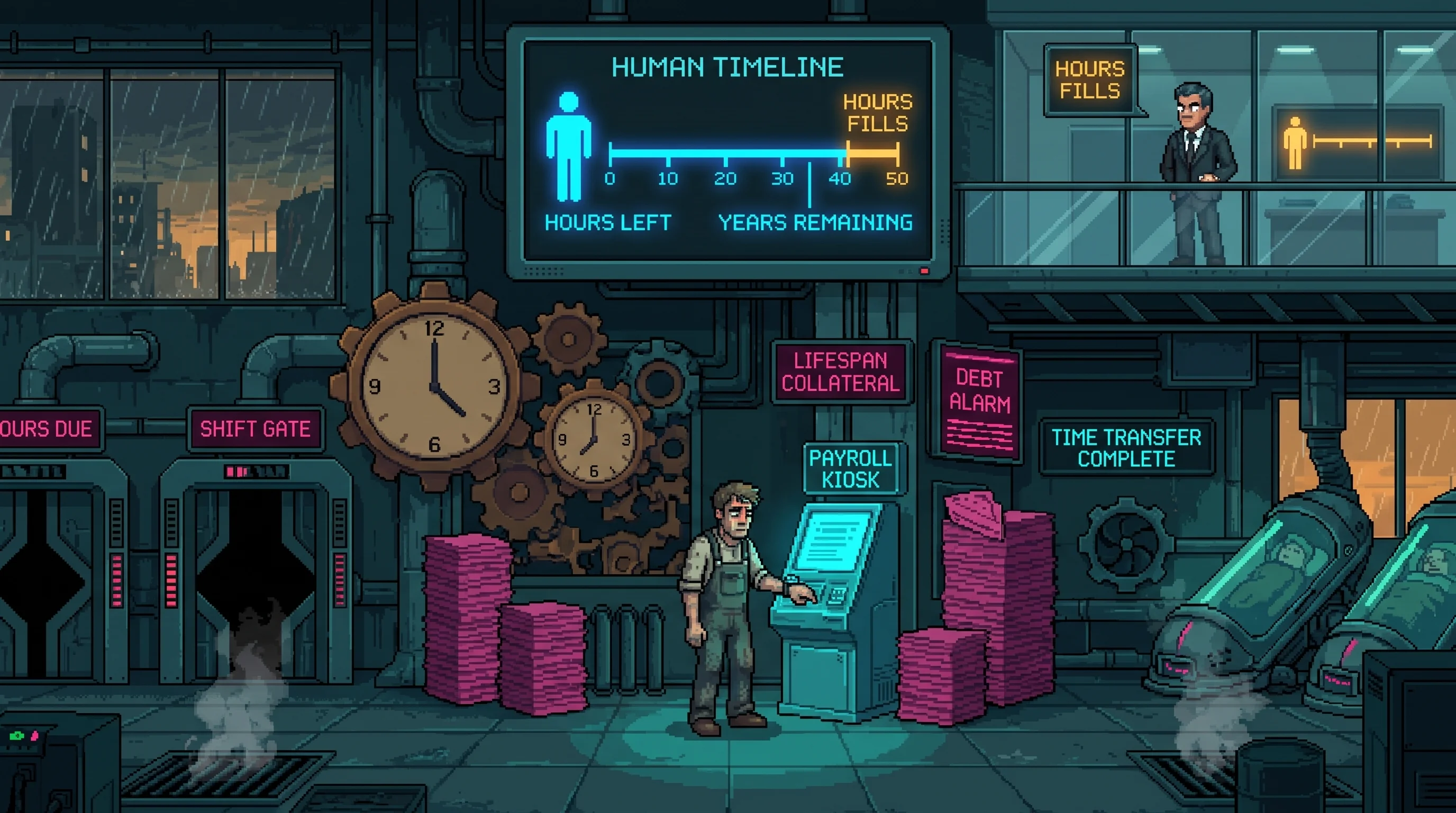
Buys waking hours now; the bill is the capacity to want them back.
Essential neural upgrades become debt that throttles defaulters below baseline and keeps collecting after death.

The 'inspirational' lobby sign is a job requirement nobody noticed.
When your employer is your country, quitting is emigration.


Local Intelligence Scan
Nearby Signals
CANONICAL PROXIMITY


Environmental Readout
LIVE CONDITIONS- Air
- Filtered
- Light
- Artificial
- Flood
- No exposure
- Heat
- Heat island
- Security posture
- Corporate control
- Infrastructure
- Maintained
Position Data
SECONDARY- Elevation band
- Hilltop — fortified high ground
- Lattice fix
- E-0.1 · N+0.7

—