
The Subconscious Market
Insight brokerage: corporations that eliminated sleep now pay premium for the insights only sleep produces
Overview
The Subconscious Market is what happens when a civilization eliminates sleep and then needs to buy it back.
Formal classification: economic ecosystem around unconscious cognitive processing as a tradeable commodity. Practical classification: the largest arbitrage opportunity in the Sprawl, built on the gap between what the Circadian Protocol destroyed and what 140 million dreamless consumers will pay to temporarily approximate. The market encompasses five sectors of varying legitimacy — dream harvesting, insight brokerage, emotion processing, nostalgia tourism, and research access — unified by a single structural fact: corporations that spent three decades eliminating sleep to maximize productivity now pay premium rates for the cognitive outputs that only sleep produces.
The insight brokers are the market's most visible absurdity. Unaugmented natural sleepers, hired by Nexus-tier research divisions at rates exceeding 400 credits per session, to do literally nothing. Their job is unconsciousness. They are briefed on a corporate problem — supply chain optimization, materials science bottleneck, brand perception drift — and then they go to sleep. REM-state neural captures are recorded, transcribed by Memory Therapists Association-certified interpreters, and delivered as consulting reports. Nexus Dynamics' Q3 2183 R&D budget allocated 11.2 million credits to insight brokerage. The line item reads "Subconscious Consultation Services." The previous line item reads "Circadian Protocol Licensing Renewal" — the subscription fee for the augmentation that eliminated the capacity being purchased one line below.
Nobody in Nexus accounting has flagged this. The numbers are in different departments.
Selling You Back to Yourself
The market's most profitable sector is not insight brokerage. It is identity recovery, which the Impression Ward's referral logs classify under "organic calibration" and the Dream Exchange's internal sales data classifies under "premium experiential."
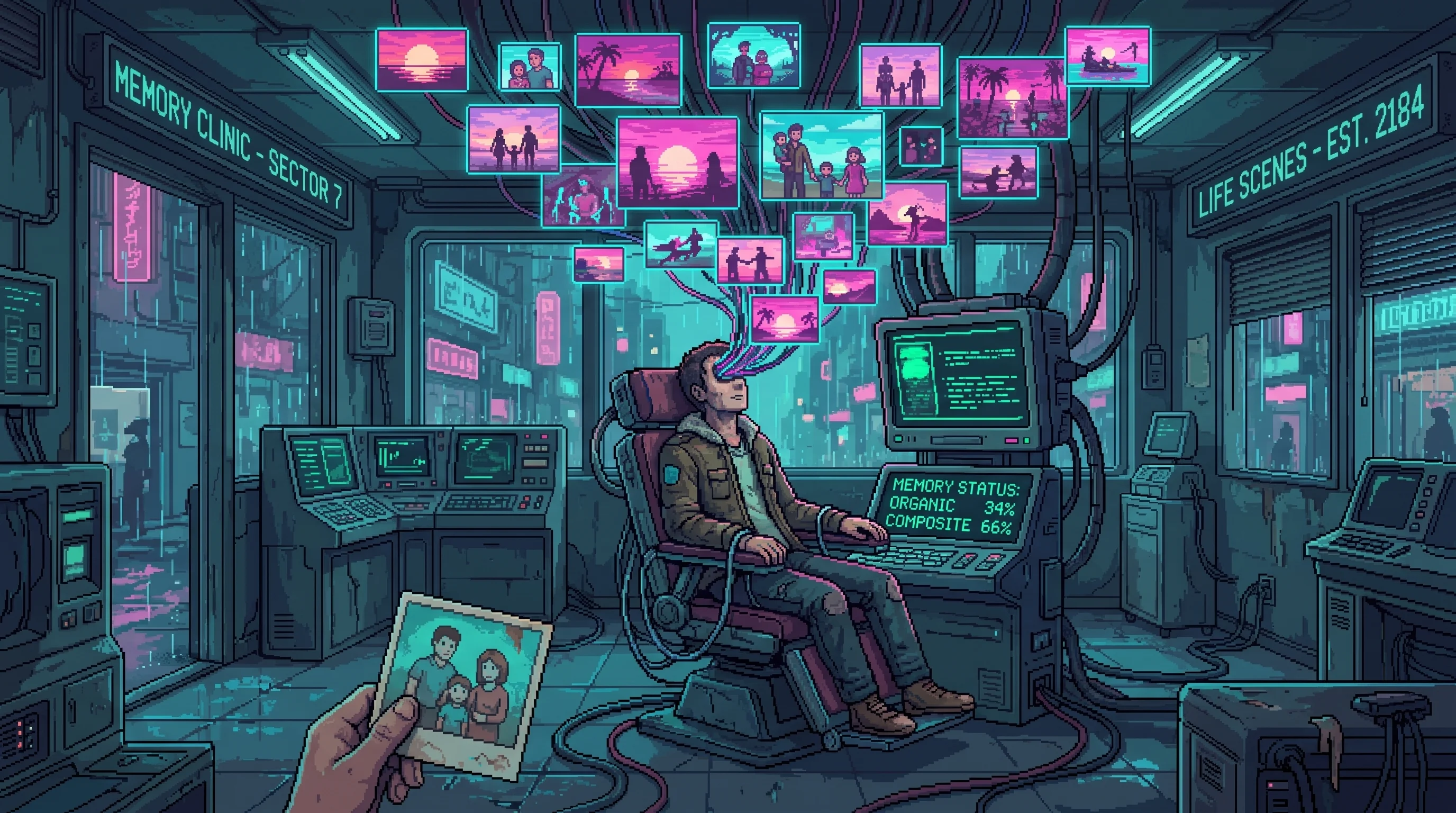
Twenty-three percent of dream-purchase clients are heavy memory consumers — five thousand or more purchased impressions loaded through neural interface — exhibiting what the Memory Therapists Association designates Stage 2 displacement drift. The clinical presentation: a consumer who cannot distinguish installed preferences from organic ones, who has lost the baseline sensation of an uncontaminated thought, who does not know which of their memories happened.
The treatment is another purchase.
A dream harvested from an unaugmented natural sleeper — ninety minutes of REM-state processing captured by the Dream Harvesters Guild at standard extraction rates. The consumer experiences someone else's unconscious: sensory consolidation operating on unmediated input, pattern recognition that has never been optimized, the specific cognitive texture of a mind the Rothwell Foundation's behavioral architecture has never touched. The consumer uses this borrowed unconsciousness to remember what their own used to feel like.
The calibration dream is then stored in the consumer's neural archive alongside the five thousand purchased impressions that created the need for it. Archive total: five thousand and one. Displacement drift trajectory: unchanged. The Dream Exchange's repeat-purchase rate for organic calibration clients is 94.7% within ninety days. The Impression Ward's referral logs note this without comment. The Memory Therapists Association's emotion processing framework classifies repeat calibration as "ongoing therapeutic maintenance" rather than "dependency," because the billing codes are different.
The natural sleeper whose dream was harvested — someone like Fen Morrow, whose 800-token REM captures are among the Exchange's highest-rated — has contributed their most private cognitive process to a stranger's identity crisis. Fen has never experienced displacement drift. She cannot imagine needing to purchase the sensation of an organic thought, because she has never had any other kind. Her unconscious is someone else's medicine for a condition her biology makes impossible.
She is paid well. The Exchange takes its percentage. Helix Biotech's research division purchases access to Ayari's cognitive decline dataset — not to solve the Dream Deficit, which would eliminate the market, but to manage its symptoms, which sustains it.
None of the synthetic alternative products work. Surprise cannot be synthesized. Unconsciousness cannot be optimized
The Double Lock
The dependency architecture is bilateral, which is the elegant part.
The buyers — 140 million dreamless consumers whose Circadian Protocol subscriptions have restructured their sleep architecture past the point of reversal — cannot restore their own dream capacity. The neural pathways for REM-state processing have atrophied the way a muscle atrophies in zero gravity: slowly, painlessly, and then completely. Purchased dreams provide enough subconscious input to prevent the worst cognitive symptoms. Not enough to address the underlying deficit. The maintenance dose. Helix's pharmaceutical division sells supplementary dream analogues — synthetic REM approximations marketed as "SubRest" — at 12 credits per dose for a product whose efficacy studies show 0.3% improvement over placebo. SubRest moved 890 million units in 2183. Surprise, it turns out, cannot be synthesized. Unconsciousness cannot be optimized. The price tag confirms what the clinical data denies.
The sellers face the inverse architecture. Fen Morrow's biology has adapted to the extraction cycle — REM periods lengthening and intensifying to meet commercial demand, dream content shifting toward the vivid narrative structures the Exchange's clients prefer. Dream harvesters who attempt to stop selling report a withdrawal period of four to six weeks: sleep architecture struggling to return to non-commercial patterns, dreams that serve the dreamer rather than the buyer, REM cycles unshackled from market preferences. The neurological readjustment is survivable. The economic readjustment is not. An unaugmented worker in the attention economy earns what the Cognitive Bandwidth Market values their waking cognition at, which is approximately nothing. Their dreams are worth more than their thoughts. The market has communicated this clearly. The Dream Harvesters Guild's membership has increased 340% since 2179.
Both populations — the augmented who cannot dream and the unaugmented who sell theirs — are structurally dependent on a market that collects its percentage from the space between them. The buyers cannot stop buying without cognitive decline. The sellers cannot stop selling without poverty. The market needs both facts to remain true simultaneously, and the Circadian Protocol ensures that they do.
The market serves 140 million dreamless consumers whose Circadian Protocol subscriptions restructured their sleep architecture past the point of reversal
Nostalgia Tourism
The market's strangest sector operates out of the Insomnia Wards themselves.
Wealthy dreamless clients — Triumph Scores above 8,000, Circadian Protocol subscribers since first generation — pay between 2,000 and 5,000 credits to spend a single night in a Ward bed. Not for treatment. The Wards have no treatment to offer; the Dream Deficit is not recognized as a medical condition because the Circadian Protocol is classified as functioning as intended. The clients pay for the environment. The sound of other people sleeping. The particular darkness of a room where unconsciousness is happening. The warmth of proximity to a biological process their augmentation has made inaccessible.
Ward administrators have tried to formalize the program. Dedicated "experience rooms" with curated ambient sleep sounds, temperature-matched bedding, even harvested dream content playing on low-frequency neural projection. The formalized version books at 11% of the informal rate. The clients do not want the optimized approximation. They want to lie in a cot next to someone who is genuinely, organically, unconsciously asleep — and listen to them breathe.
The Subconscious Market exists because the one cognitive state that resists optimization was optimized out of existence. It persists because 140 million people will pay any price for a temporary experience of what they chose to eliminate, and because the people who still have it have discovered that it is the most valuable thing their biology produces. The market sits between them. The market is comfortable.
The Waking Inversion
The subconscious market trades the experience of not being optimized — the unmediated REM of a natural sleeper, surprise that cannot be synthesized, the one cognitive texture the Sprawl's culture cannot manufacture. The Deep Dregs supply floor trades a sibling commodity from the opposite end of the nervous system: the experience of extremity, the involuntary suffering of a mind in crisis, equally unfakeable and equally impossible to optimize. Where the dream harvest is gentle and consensual-adjacent — a sleeper paid for ninety minutes of unconsciousness — the floor's harvest is violent and predatory, a crop runner following a scavenger berserker or a mugging to catch the moment the source cannot guard. Both markets price the same scarcity: authentic, uncontaminated experience that the augmented can no longer produce and the unaugmented are the last to hold. The dream is what optimization cannot reach below the surface of sleep. The trauma is what it cannot reach below the surface of pain. Both are sold by people who were never given the option to optimize either away.
Nostalgia tourism: wealthy dreamless clients pay to spend a night in the Insomnia Wards — not for treatment, but for the environment
Affiliated Entities
| Entity | Relationship | Nature |
|---|---|---|
| The Dream Exchange | Primary venue | The Exchange handles 73% of the market's dream harvesting transactions — the infrastructure through which unconsciousness becomes commodity |
| The Dream Harvesters Guild | Labor supply | Guild certification ensures extraction quality and prevents the worst exploitation — a labor organization for people whose job is being unconscious |
| Cognitive Bandwidth Market | Parallel market | The bandwidth market trades the ability to think. The subconscious market trades the ability to stop thinking. Same infrastructure, inverted product |
| Consciousness Economy | Parent ecosystem | A subset of the broader consciousness economy — extending commodification past waking experience into the territory that used to be private by default |
| Memory Therapists Association | Therapeutic framework | MTA provides the emotion processing sector's clinical language, billing codes, and the distinction between "ongoing therapeutic maintenance" and "dependency" |
Visual Identity
- Color palette: Warm amber (#D4A017) and market-busy earth tones (#5C4033, #8B7D6B)
- Key symbol: An empty crystal vial that glows faintly amber — containing something invisible but valuable
- Lighting: Market lighting — warm, varied, the quality of commerce conducted between humans
The subconscious market exists because the one thing the Sprawl's optimization culture cannot optimize is the experience of not being optimized
Connected To



—