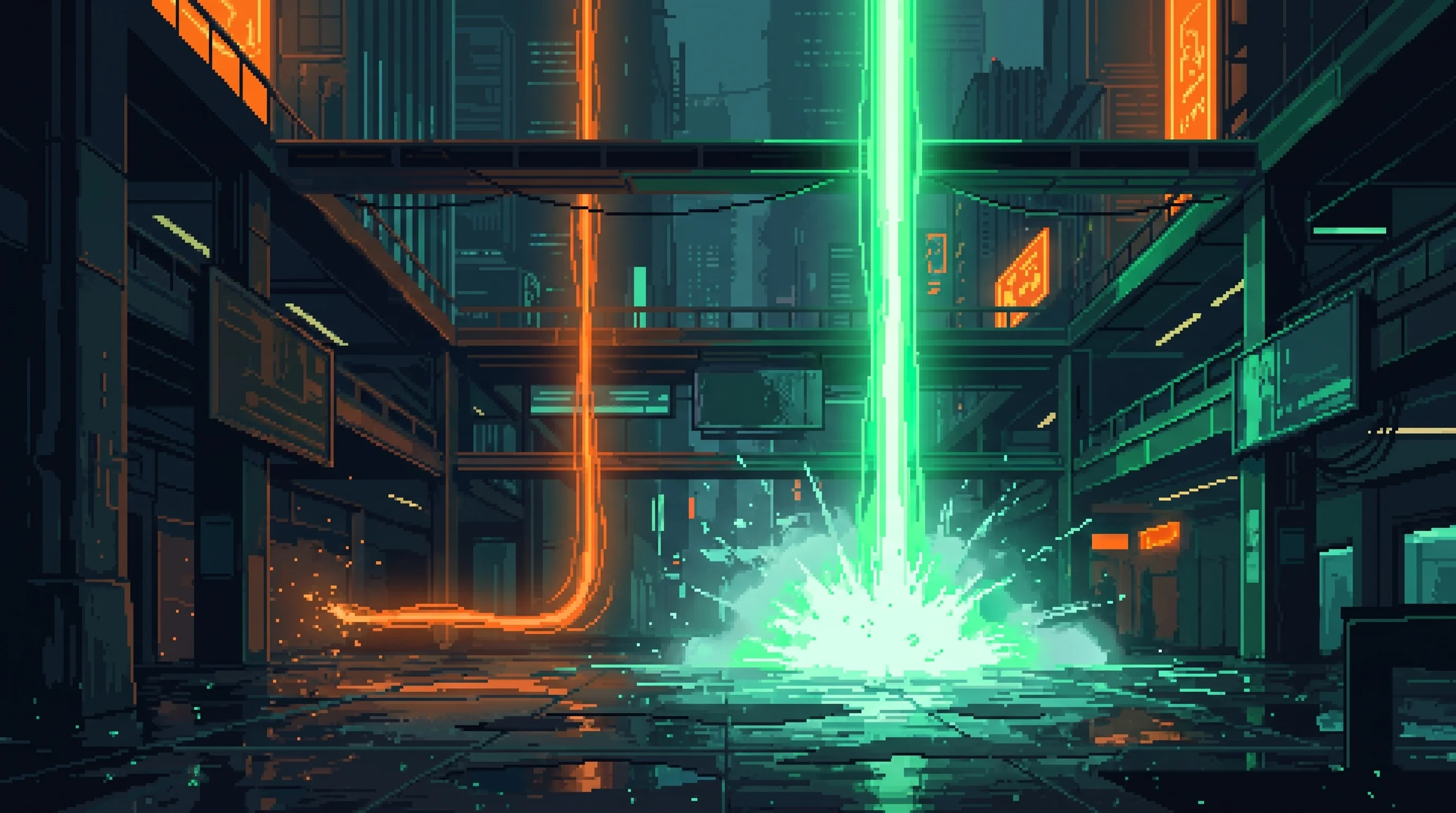
Nobody recorded April 17th, 2184 in The Deep Dregs. There was no reason to. Nothing happened that hadn't happened the day before, or the day before that, or on any of the 13,505 days since the Cascade ended and the approximately 40,000 residents of Sector 9's mid-tier salvage district started keeping things running without being asked.
What follows is reconstructed from water pressure logs, market transaction records, atmospheric sensor data, and one handwritten note found in a drainage access panel that reads: "Valve 7 sticks. Hit it twice. — M."
The note has been there for nine years. Valve 7 still sticks. Hitting it twice still works.
04:20 — The Water
Melo Tan starts his shift twenty minutes before the pumps cycle. He has done this for six years. He is not paid by anyone. He is paid by the fact that if he doesn't prime the junction valves on Sublevel 3 before the 04:40 pressure spike, the eastside residential blocks get sediment in their lines for three hours, and 4,200 people start their morning tasting rust.
The pumps are Ironclad surplus — decommissioned from a corporate water treatment facility in 2169, sold as scrap, purchased by Viktor Kaine for fourteen crates of sorted copper, and installed by residents who learned hydraulic engineering from a tutorial cached on a dead server. The original installation manual was in Mandarin. Nobody on the installation crew spoke Mandarin. The pumps work. Not well. Not quietly. But they work, and the sediment stays manageable if Melo hits Valve 7 twice before 04:40 and replaces the intake filter every eleven days instead of the recommended thirty.
He replaces it every eleven days. He buys the filters from Raz Demetriou's stall in the morning market at a 6% markup over Ironclad retail, which sounds like exploitation until you account for the fact that Ironclad retail requires a corporate procurement account, a fourteen-day lead time, and a service address in a recognized residential zone. The Deep Dregs is not a recognized residential zone. It is, according to Ironclad's territorial registry, a "decommissioned waste processing annex." The 40,000 residents are, technically, trespassing.
Melo has never met anyone from Ironclad. Ironclad has a waste management contract for the district that generates ¢340,000 annually in processing fees. The waste is processed by Dregs residents. The fees are collected by Ironclad. The residents are not employees. They are also not trespassers when they're processing waste — a jurisdictional distinction that Viktor Kaine negotiated in 2178 and considers his single greatest achievement, though he describes it as "convincing a corporation that the people doing the work exist, but only while working."
06:15 — The Market
Raz Demetriou has operated a stall in the Deep Dregs morning market for forty years. He sells water filters, pipe seals, salvaged circuitry, nutrient base, and Wholesome flavor packets. He owns the only verified-accurate scale in the market. He verified it himself using calibration weights machined from a decommissioned Ironclad bearing assembly. The weights are accurate to within 0.3 grams. He knows this because he tested them against a Helix laboratory scale he was allowed to use once, in 2176, under circumstances he does not discuss.
The scale is his entire business model. Dregs vendors who compete on price can undercut him on anything. Nobody undercuts a vendor whose measurements you trust.
By 06:15, the market is fully operational. Forty-seven stalls in a space designed for twelve loading bays. The conversion happened gradually and without permission — someone set up a table, then someone else, then someone built a shelf, then someone ran power from the overhead conduit. Now there are forty-seven stalls, an informal food court, and a children's play area built from decommissioned ventilation ducting. Ironclad's territorial registry classifies the space as "Loading Bay C-7, Status: Unoccupied."
Wholesome Corporation flavor packets account for 31% of Raz's revenue. They retail at ¢2.40 each in recognized residential zones. In the Deep Dregs, they retail at ¢4.10. Wholesome's official position is that they do not distribute to unrecognized zones. Wholesome's distribution data shows 14,600 flavor packets entering the Deep Dregs weekly through a supply chain passing through three intermediaries, each adding margin. Annual Wholesome revenue from Deep Dregs flavor packet consumption: approximately ¢3.1 million, generated from a population Wholesome's customer database does not acknowledge exists.
The packets turn nutrient base into something that tastes like food. Not good food. Recognizable food. The difference matters at 04:40 in the morning after you've been hitting a stuck valve.
Raz does not sell on credit. This policy has cost him customers. It has also kept him out of Good Fortune's ecosystem, which, in a district where 34% of adults carry at least one Good Fortune Advance, qualifies as a philosophical position.
Ironclad collects ¢340,000 annually in processing fees for waste handled entirely by residents it classifies as trespassers in a zone it classifies as unoccupied. Wholesome earns ¢3.1 million annually from a customer base its own database says doesn't exist. The residents buy filters at a 6% markup because the alternative requires a corporate procurement account they cannot obtain. Everyone is getting exactly what they opted into. The second-order cost — that 40,000 people are economically legible only as revenue sources, never as residents — does not appear in any of these ledgers.
09:30 — The Drone Kid
Her name is Suki. She is eleven. She builds drones from scrap.
Not toy drones. Functional reconnaissance units assembled from Nexus sensor arrays, Ironclad structural composites, and flight controllers she fabricates from circuit boards pulled from the market's e-waste bins. Her current build — the seventh she has completed this year — uses a gyroscopic stabilization system reverse-engineered from a damaged Nexus surveillance module. The original module cost approximately ¢22,000 at manufacture. Suki acquired it for ¢3 and a jar of Raz's pipe sealant.
She learned none of this in school. There is no school. There is Kira Vasquez, who runs The Cathodics — an informal education space on Level 2 that operates out of a converted air filtration room. Kira teaches circuitry, basic engineering, literacy, and what she calls "pattern recognition," which is how you say "critical thinking" in a district where the phrase has been algorithmically flagged by Nexus content filters as associated with dissident rhetoric. The flag was implemented in 2181. Kira changed the name of the class in 2181. The curriculum did not change.
Suki attends The Cathodics three mornings a week. The other four mornings she spends in the e-waste bins. Kira considers this an acceptable distribution. The bins are, by several measurable outcomes, a better engineering program than anything available through Nexus Education Services, which charges ¢8,400 per semester and whose graduates demonstrate, on standardized assessments, approximately the same practical fabrication skill as an eleven-year-old who learned from scrap.
Suki's drones sell for between ¢80 and ¢200, depending on sensor package. Her customers are Dregs residents who use them for perimeter monitoring, ventilation inspection, and delivery runs through corridors too narrow for adult access. One drone — her third build — was purchased by a man she did not recognize and has not seen since. That drone had the Nexus sensor array. She does not know where it went. She has not asked.
14:00 — The Governor
Viktor Kaine does not have an office. He has a table at the junction of Corridors 6 and 9 where the overhead lighting is broken in a way that creates a persistent warm glow — a dead fluorescent tube filtering through a cracked amber panel. He did not choose this location for the lighting. He chose it because it's equidistant from the three most common sources of disputes: the market, the water junction, and Level 4.
Level 4 is where El Money operates G Nook. El Money's actual name, background, and source of authority are undocumented. What is documented: G Nook processes an estimated ¢14,000 in daily transactions, none of which appear in any district record. El Money refers to Viktor as "the landlord." Viktor refers to El Money as "the tenant I can't evict." They have tea together every Thursday. The tea is good. Viktor insists on this. Good tea, he maintains, is the only honest currency in a negotiation between two people who both know they need each other.
Viktor governs through mediation, allocation, and what his residents describe as "making you feel like an idiot without raising his voice." His tools: a thermos of tea, a working knowledge of every pipe, conduit, and ventilation shaft in the district, and a collection of pre-sorted circuit boards he distributes as favors. The circuit boards are not bribes. They occupy the specific social space between gift and obligation that makes Dregs governance possible — you accept the board, you owe Viktor the consideration of listening to him the next time he asks you to stop doing whatever you're doing. The boards cost him approximately ¢1,200 per month. The alternative — formal enforcement infrastructure — would cost approximately ¢380,000 and would not work, because formal enforcement requires a jurisdiction that recognizes the Deep Dregs as a place, and no jurisdiction does.
His only formal agreement with any corporation is the Ironclad waste processing contract, which he renegotiates annually through a process he describes as "explaining to people who control the water that we maintain the pipes." The negotiation has never lasted more than forty minutes. Ironclad's representative arrives, reviews the maintenance logs, notes that the infrastructure is being maintained at a standard that would cost Ironclad ¢2.1 million annually to replicate with contracted labor, and renews the agreement. Viktor receives no salary. The district receives continued existence.
He became governor in 2174. Nobody elected him. Nobody appointed him. He started mediating disputes and didn't stop. The title attached itself retroactively, the way mold attaches to a pipe — not because anyone wanted it there, but because the conditions made it inevitable.
At 14:00, he is adjudicating a dispute between two vendors over stall placement that has been ongoing for three weeks. The dispute is, by his assessment, fundamentally about respect rather than square footage. He will resolve it by moving both stalls six inches in directions neither vendor requested, giving each the experience of having conceded less than the other. The circuit board he will offer afterward — to the vendor who conceded more gracefully — is already in his pocket.
21:00 — The Lights
The Deep Dregs does not have scheduled lighting. It has a patchwork of jury-rigged connections to the municipal power grid delivering inconsistent voltage across the district's seven levels. Some corridors are permanently lit. Some are permanently dark. Most exist in a state of negotiated dimness that shifts as residents tap, reroute, and occasionally steal power from adjacent conduits.
At 21:00, the market stalls shut down and the overhead conduits in Corridor 6 drop to 40% output — not because anyone programmed them to, but because the evening load from residential cooking draws enough amperage to dim the commercial circuits. Raz Demetriou locks his scale in a case welded to the underside of his stall. Suki carries her current build to the ventilation room where she sleeps, which Kira Vasquez has insulated with scavenged thermal panels and which maintains 19 degrees Celsius regardless of the corridor outside, because Kira calculated the insulation requirements from an engineering manual cached on the same dead server that taught the pump installation crew hydraulics.
Melo Tan returns to Sublevel 3 for the 21:30 pressure equalization cycle. He does not need to be there. The evening cycle is less volatile than the morning spike. He goes anyway. When asked why, he says the pumps sound different at night and he prefers to hear it.
Viktor Kaine is still at his table. The warm amber glow from the broken fluorescent is, at this hour, one of the only consistent light sources in the junction. Residents pass. Some stop. Most don't. The tea is cold. He doesn't reheat it. Thursday is tomorrow, and he'll need a fresh thermos for El Money.
The atmospheric processors on Level 1 cycle at 22:00 — Dregs-maintained units pulling duty that the Breath's municipal system doesn't extend to unrecognized zones. The filters were last replaced eight days ago. Recommended replacement interval: fourteen days. Actual replacement interval in the Deep Dregs: nine days, because the intake air is dirtier here than in recognized zones and everyone knows it and nobody with the authority to reclassify the air quality has visited the district since 2179.
The processors hum. The pumps rattle. Somewhere on Level 3, Valve 7 sticks. Someone hits it twice. It opens.
Nobody records this. There is no reason to. Tomorrow it will happen again.
▲ Unverified Intelligence
- The Ironclad waste processing contract — Viktor's lifeline — contains a clause neither party discusses publicly. Section 14(b) grants Ironclad the right to "reclaim decommissioned infrastructure assets" with ninety days' notice. Every pump, every jury-rigged conduit, every pipe seal Melo replaces every eleven days: Ironclad's territorial registry classifies them as Ironclad property temporarily stored in a decommissioned annex. Viktor has known since 2178. The clause is why his annual negotiation never lasts more than forty minutes — both parties understand that Ironclad could, legally, dismantle the district's entire water and power infrastructure in three months. They don't, because maintenance would cost them ¢2.1 million to replicate. The day that math changes, Section 14(b) activates.
- Viktor has a contingency plan. It is written on a piece of paper in his pocket, behind the circuit board. It is one sentence long. No analyst has been able to read it.
- Suki's third drone — the one with the intact Nexus sensor array, sold to a man she didn't recognize — appeared in surveillance footage from a Nexus Dynamics security debrief filed six weeks after the sale. The debrief is classified. What the drone was surveilling is not documented in any public record.
- Kira Vasquez's The Cathodics has a second room that isn't on any floor plan. Residents who have been inside describe it differently each time they're asked. Nobody agrees on what's in it. Kira does not acknowledge its existence.