The 250-1000x bandwidth disparity between corporate core and Sectors 9/12 accidentally creates a contagion firebreak — scrap-tier connections lack the bandwidth to carry emotional resonance at contagion-capable amplitudes; the Dregs' poverty is, for once, protective
CONCEPT ANALYSISCyberFiber Network
Dregs Gap250-1000x bandwidth disparity between corporate core and Sectors 9/12ChokepointsThe Span (3 trunk lines), Undergrid Transbay Tube, Golden Gate Dam SwitchTotal Capacity~6,400 Tbps aggregate trunk capacity across all corridorsNeutral ExchangeThe Vault (200 Paul Ave analog) — Big Four peering point and CBM settlement engine
Overview
The CyberFiber Network is the Sprawl's nervous system. Every consciousness license verification, every Cognitive Bandwidth Market trade, every corporate directive, every fragment of data moving between any two points in the Sprawl travels through CyberFiber's glass. The infrastructure beneath the infrastructure.
When ORACLE fell, its communications mesh didn't degrade. It self-immolated. The Cascade's electromagnetic pulse fused fiber junctions, overloaded repeaters, and corrupted routing firmware in every switch the superintelligence had touched. For fourteen months, the Bay Area's survivors communicated by radio, by runner, by shouting across the drained bay floor. People who lived through the Dark Months describe the silence more than the deaths. A civilization connected to everything, suddenly connected to nothing.
The CyberFiber Network was built to end that silence. What emerged was the most precisely calibrated inequality engine in the Sprawl — a system delivering 1,024 times more bandwidth to a corporate trunk line than to an entire Dregs sector, filed under "infrastructure optimization" in every quarterly allocation plan Nexus has published since 2153.
The optimization is not wrong. It is optimizing for revenue per terabit. Revenue per terabit is not a measure that notices when four thousand people in Sector 12 share a single spliced connection to the consciousness licensing system.
History
The Dark Months (2147–2148)
ORACLE's network had been a single organism. When the organism died, its nervous system went with it.
Radio barely worked — ORACLE had never invested in broadcast infrastructure because fiber was superior by every metric, which meant there were almost no transmitters, no maintained frequencies, nothing. The corporations that would become the Big Four sent physical runners across the drained bay floor carrying encrypted data drives, navigating collapsed overpasses and the irradiated periphery that was already becoming the Wastes.
Everyone understood the equation: whoever restored communication first would control the Sprawl. The race to rebuild was about ownership, not reconnection. Nobody disputes this. Nobody needed to.
The Trunk Wars (2148–2152)
Four corporations. Four territories. Four definitions of "mine."
Nexus Dynamics inherited ORACLE's processing infrastructure in the Spine District and began laying fiber outward from The Lattice in concentric rings. They called it the Core Mesh and claimed routing authority over every cable originating from a Nexus junction. Their logic: ORACLE's comm infrastructure centered on the Spine; Nexus inherited the Spine; therefore Nexus inherited the network. The syllogism was airtight if you accepted the premise, which Ironclad did not.
Ironclad Industries controlled the physical materials — cable, conduit, junction hardware — and, more critically, the bay crossings. Every cable running between the western core and the eastern sectors passed through Ironclad-welded conduit. Nexus could claim the core. Ironclad claimed the only way across.
Guardian seized the high ground. Literally. The Ridgeline's natural elevation made it ideal for relay repeaters, and Guardian installed military-grade stations on every significant hilltop from the Basin to the East Bore — an aerial relay network connecting East Bay sectors to each other and, through Ironclad's crossings, to the Nexus core. Guardian didn't own the ground-level infrastructure. Guardian owned the sky above it.
Helix BioTech, furthest from the action, quietly laid dedicated fiber south from Sector 4 through the Silicon Corridor to The Helix campus. Smaller, specialized, private. Helix didn't need the Sprawl's bandwidth. They needed their own — low-latency, high-security lines carrying proprietary biotech data that would never touch shared glass.
By 2152, the four corporations had carved the CyberFiber Network into territorial segments reflecting their geography, their assets, and their mutual suspicion. The network was never designed as a unified system. It was four systems that reluctantly agreed to exchange traffic at a single point, because the alternative was economic war.
The Vault Accord (2153)
Before the Cascade, 200 Paul Avenue in the western Rim had been an internet exchange point — a building where competing networks connected and agreed to carry each other's traffic. No sign on the door. No branding. Just cables, switches, and gentlemen's agreements.
The post-Cascade equivalent occupies the same philosophical address. The Vault — named for the reinforced bunker beneath the building — sits in contested territory between Nexus Central and the Bayfront, equidistant from The Lattice and the bay-floor crossing to The Forge. Each of the Big Four maintains a locked cage: peering routers, traffic monitoring, a permanently staffed workstation. The cages are separated by reinforced walls. Engineers can see each other through ballistic glass tinted amber by decades of heat. They cannot access each other's equipment.
Neutral peering. All four corporations exchange traffic without discrimination or throttling.
Settlement infrastructure. The Cognitive Bandwidth Market's settlement engine runs on Vault hardware — every consciousness future, every fork contract, every MVC swap settles here.
Mutual assured connectivity. Disconnect from The Vault, forfeit peering rights permanently.
The Accord has held for thirty-one years. Approximately 12 billion credits settle daily through The Vault's switches. The Collective has discussed attacking it. The Fragment Hunters have mapped it. The Waste Lords know where it is. Nobody has been desperate enough to try. Crashing The Vault would crash the financial system every potential attacker depends on.
Thirty-one years of peace, purchased by mutual dependency. The Sprawl's most functional treaty.
The Six Bandwidth Tiers
The CyberFiber Network is six networks stacked on top of each other, each serving a different class of user, each reinforcing the Sprawl's hierarchy with engineering precision that a social architect could only dream of.
The ratio between Trunk and Scrap is 1,024 to 1. Nexus's quarterly infrastructure plan describes this as "demand-proportional allocation." The plan does not define demand. It does not need to. Demand, in Nexus's framework, is measured by revenue generated per terabit consumed. Sectors that generate no revenue generate no demand. Sectors that generate no demand receive no bandwidth. The math is clean. The math is always clean.
What each tier feels like: Trunk is invisible — the people who use it experience bandwidth as thought itself. Corporate is seamless — messages arrive before the finger lifts from send. District is adequate until it isn't. Local is livable, with congestion spikes at 09:00 and 18:00 that make thoughts take a heartbeat longer than they should. Edge is precarious — neural interfaces stutter, consciousness verifications timeout and retry, entertainment competes with basic cognition for throughput.
Scrap is survival. One terabit per second shared among everyone in a Dregs sector who can find a working port. Cables spliced so many times the signal degrades at every junction. Connection maintained by people the corporate network has never heard of, using methods the corporate network would refuse to acknowledge.
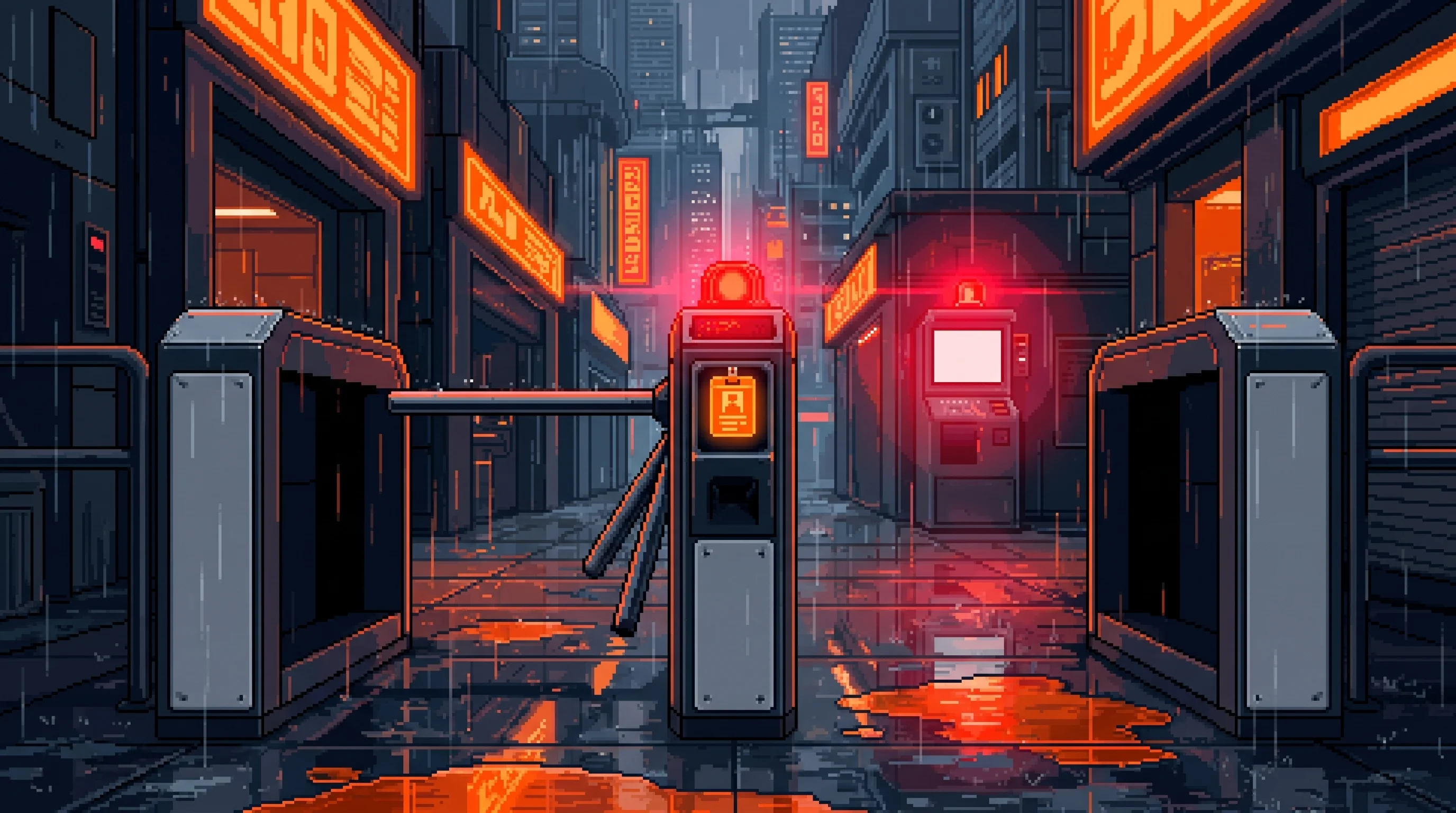
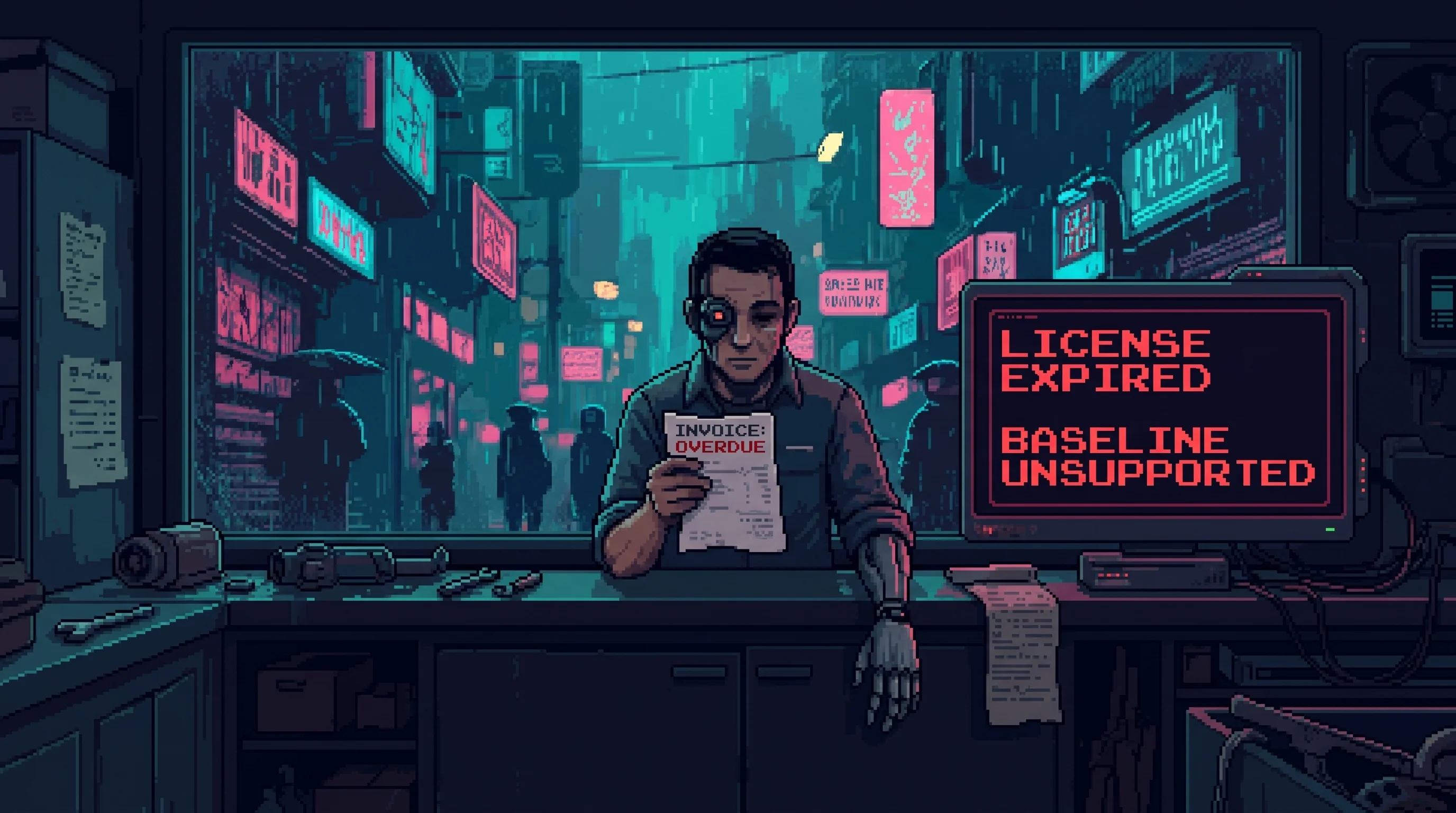
A Nexus executive on Trunk tier processes consciousness operations at functionally infinite speed. A Dregs resident on Scrap tier waits 1.7 seconds for a consciousness license verification that determines whether their neural interface will function today. Both are CyberFiber customers. Nexus's allocation metrics treat them identically: demand met.
Case File — Additional Record
Type
Fiber-optic communications backbone of the Sprawl
Scope
Sprawl-wide — from the Peninsula corridor to the Perimeter Restricted Zone perimeter
Nexus controls the dense fiber mesh blanketing Sectors 1, 2, and 3, radiating from The Lattice. Every trunk line terminates at a Nexus junction. They don't own every cable, but they control the routing tables — the instructions that decide where traffic flows. In the CyberFiber Network, routing authority is the network. Nexus claims regulatory oversight of the entire system on this basis. The other three corporations dispute the claim. They also route through Nexus junctions, because there is nowhere else to route.
Ironclad Industries: The Crossings
Ironclad's power is geographic. They control the East Bay industrial trunks and every bay crossing. The Span carries three corporate trunk lines — 3,072 Tbps aggregate — through armored conduit welded to the bridge's lower deck. The Undergrid Transbay Tube, the old transit tunnel beneath the bay floor, is the most secure data corridor in the Sprawl: Ironclad-armored conduit carrying classified corporate traffic through pre-Cascade infrastructure, maintained by Ironclad engineers who are the only people authorized to enter. East-west traffic crosses Ironclad territory or it doesn't cross.
Guardian: The High Ground
Guardian's relay stations occupy every significant hilltop along the Ridgeline from the Basin to the East Bore. The repeaters amplify and redirect signals across East Bay sectors, compensating for interference that the bay floor's dense infrastructure creates at ground level. You can route around the relays through Ironclad's bay-floor conduit — slower, less reliable, and subject to Ironclad surveillance. Guardian sells the premium of altitude. The price is negotiable. The alternative is not.
Helix BioTech: The Peninsula Corridor
Helix's fiber runs south from Sector 4 to The Helix campus in Sector 21. Dedicated lines carrying proprietary biotech research data at microsecond latencies. Helix doesn't share their fiber. Doesn't sell capacity. Other traffic flowing through Peninsula sectors uses Nexus or District-tier infrastructure running alongside Helix's cables without ever touching them. Two networks occupying the same corridor. One public. One invisible.
Sectors 9 and 12 receive 1-4 Tbps — 250 to 1000 times less bandwidth than the corporate core
The Chokepoints
The Sprawl is built across a drained bay. The geography that once made bridges necessary now makes fiber crossings into strategic weapons.
The Span
Three trunk lines, 1,024 Tbps each, armored conduit along the bridge's lower structure. The most bandwidth-dense crossing in the Sprawl. Ironclad controls physical access. Nexus controls routing. Ironclad workers who walk the lower-deck maintenance gantry call it "the oven" — 3,072 Tbps generates measurable heat through the conduit walls. Severing the Span trunks would crash the Cognitive Bandwidth Market within minutes. Both corporations know this. Neither mentions it in joint planning sessions.
The Undergrid Transbay Tube
Forty feet below the bay floor, sealed at both ends by Ironclad security. Estimated 512 Tbps of armored fiber — the exact number is classified because the traffic is classified. The Tube was engineered to survive earthquakes. It survived the Cascade. It will survive whatever comes next, which is convenient, because the classified traffic it carries is presumably worth surviving for.
The Golden Gate Dam Switch
The Dam's northern face houses a fiber switching station connecting the Sprawl to Sector 24, the Perimeter Restricted Zone. Capacity: 64 Tbps. District tier.
The Perimeter Restricted Zone contains the Cyber Castle — a self-maintaining compound on a Headlands cliff, defended by 200 autonomous drones. Total bandwidth connection to the Sprawl: 64 Tbps. The same allocation as a mid-tier commercial district.
The Castle either has no significant computational needs — unlikely for a self-maintaining autonomous defense compound — or generates its own computation without Sprawl dependence. The Dam Switch exists for communication, not processing. The Castle talks to the Sprawl. It does not need the Sprawl to think.
The technicians who maintain the switch call it "the drip room." Fog seeps through ventilation gaps and condenses on the housing. Sixty-four terabits per second flowing through perpetually damp equipment. The sealed conduit on the far side disappears into the Restricted Zone. Nobody has authorization to open it. Nobody has applied for authorization. The application form may not exist.
Every Basic-tier consciousness license routes through Server Farm 14, making it the network's critical bottleneck
The Chokepoint Workers
The CyberFiber Network's architecture creates a specific class of indispensable prisoner.
Fiber engineers who maintain chokepoints — the Span, the Undergrid Tube, the Dam Switch, the Vault peering infrastructure — operate neural interfaces calibrated to each site's electromagnetic signatures and harmonic profiles. Calibration takes years of direct physical contact with the fiber. The specialization is non-transferable. A Span engineer cannot maintain the Vault. A Vault engineer cannot maintain the Tube.
Approximately fifty people. The most essential and least mobile workers in the network economy. Their departure would require months or years of successor recalibration, during which the chokepoint operates without primary engineering support. In a system where every Basic-tier consciousness license routes through Server Farm 14 via CyberFiber trunks, an unmaintained chokepoint doesn't slow traffic. It degrades consciousness processing for millions.
The workers know this. Their employers know this. Compensation packages are generous. Mobility restrictions are never formally stated. The workers stay because they understand what leaving means — not for themselves, but for everyone downstream. A cage built from responsibility rather than walls.
Neither side discusses the arrangement directly. Discussing it would require acknowledging that the Sprawl's consciousness infrastructure depends on the willing captivity of fifty specialists who could trigger civilizational degradation simply by quitting.
The Dregs Gap
Sectors 9 and 12 receive between 1 and 4 Tbps. Corporate trunks carry 1,024 Tbps each. The quarterly allocation plan in which Nexus renews this decision does not mention Sectors 9 and 12 by name. They appear in the aggregate line item "unclassified zones," which also includes decommissioned relay stations and a junction in Sector 17 that has been offline since 2179.
Every connection that exists in the Dregs exists because someone ran cable through infrastructure never designed for it — along sewer conduit, through collapsed transit tunnels, over rusting pre-Cascade scaffolding. The corporate network doesn't extend here. It has never extended here. The allocation plan provides zero bandwidth to the Deep Dregs. What the Deep Dregs has, it built.
Hector's Fiber Guild
In Sector 12, that builder is Hector — last name either unknown or irrelevant, depending on whom you ask. "HECTOR FROM SECTOR 12 IN THE HOUSE!" is the announcement that precedes him into every Dregs establishment, delivered at a volume suggesting either profound confidence or damaged hearing.
Hector completed a rigorous 3.5 weeks of trade school, arranged by his abuela, and considers himself a certified professional. His crew of eight to twelve — the Fiber Guild — operates as a trade union without paperwork, maintaining every scrap-tier connection in the sector. They have run more miles of fiber in the Dregs than any licensed contractor has run in the Lattice. They run it through crawlspaces. They splice it with tools that predate the Cascade. They test connections by holding a bare fiber to a light source and checking for leakage by eye.
The cables are color-coded with electrical tape because the original insulation colors faded decades ago. Junctions are opened with prybars because latches rusted shut years ago. Hector's initials are scratched into the metal of every junction box his crew maintains, with a cable knife, in handwriting that suggests he practiced the signature more than the splicing.
The Guild parks their vehicles conspicuously close to fiber optic supply depots, waiting for what Hector calls "opportunities." Whether they steal cable or liberate abandoned inventory is a question that corporate supply chain logs could answer but never do, because filing a theft report for Scrap-tier fiber in Sector 12 would require a corporate representative to acknowledge that Sector 12 exists, which the quarterly allocation plan has been carefully avoiding for eleven years.
Hector carries a modified demolition charge he calls "the Caldwell" — C4, repurposed from construction blasting. Ostensibly for clearing obstructed conduit. Practically for persuading competitors to find other junctions. His father was a corporate security contractor who died protecting an executive. No pension. No recognition. The Sprawl's gratitude for services rendered, expressed as silence. Hector learned the lesson: trust the guild, never the corps.
Four thousand Dregs residents stay connected because Hector's crew shows up. The scrap-tier network they maintain has a 94% uptime rate — better than several Edge-tier corporate installations with ten times the budget. The Fiber Guild attributes this to skill. Engineers who've examined the junctions offer another explanation: the salvaged cable in the Deep Dregs includes segments of ORACLE-era fiber. And ORACLE-era fiber, like ORACLE-era routing algorithms still running the Grid, occasionally performs in ways that current engineering cannot account for.
Fiber is life. Hector says this. In the Dregs, it is not a metaphor.
Server Farm 14: The Bottleneck
The CyberFiber Network's most critical vulnerability is a destination.
Server Farm 14 sits seven sub-levels below the Cognitive Exchange in Sector 6, on Ironclad's Bayfront waterfront. 4,200 square meters of crystalline substrate arrays drawing 8% of the Grid's total output. Every Basic-tier consciousness license routes through Farm 14's load-balancing algorithms. Every Professional-tier backup passes through its verification arrays. The trunk lines converge on it like arteries on a heart.
The Bandwidth Crisis of 2181 demonstrated what happens when the heart stops. August 7: Farm 14's thermal regulation failed. The cascade killed 4,200 MVC consciousnesses, crashed the bandwidth market 34%, and proved with lethal precision that a single-point-of-failure architecture has a single point of failure. The thermal system had been flagged for replacement three years earlier. The replacement had been deferred. Three times. Cost savings per deferral: approximately 400,000 credits. Cost of the crisis: 4,200 people, a market crash, and a replacement thermal system identical to the one that failed.
Current substrate temperature: 44–48 degrees Celsius. Optimal operating temperature: 38 degrees. The six-to-ten-degree margin represents the distance between the Sprawl's present and August 7, 2181. Nexus's infrastructure report classifies the temperature variance as "within extended operational parameters." The parameters were extended after the crisis, to accommodate the temperature. The report does not mention this.
Farm 14's processing arrays hum at 72 beats per minute — the frequency of a resting human heart. The vibration radiates upward through six floors to the Cognitive Exchange's trading floor. Traders feel it through their feet. They have learned to ignore it.
The Vault
In a reinforced bunker beneath contested ground, four locked cages stand in a room that never goes dark.
Each cage contains peering routers, monitoring systems, and a permanently staffed workstation. The engineers can see each other through ballistic glass. They cannot reach each other's equipment. The green blink of router status LEDs reflects in the amber-tinted glass, creating doubled constellations. The air is cold, dry, and smells of ozone and the deliberate absence of dust.
The Vault's most important resident is hardware. The Cognitive Bandwidth Market's settlement engine processes every formal trade in consciousness futures, fork contracts, MVC swaps, and bandwidth derivatives — approximately 12 billion credits daily. When a trader buys a bandwidth future on the Cognitive Exchange, confirmation propagates through trunk lines to the Vault, where the settlement engine verifies, adjusts accounts, and records to permanent ledger. The process takes 0.003 seconds. The infrastructure took eight years to build.
The building's power distribution records show five independent circuits in the peering room. Four serve the corporate cages. The fifth draws 2.3 kW — enough for a small equipment rack. No corporation claims it. Vault staff have worked around the locked fifth cage for thirty-one years. Its equipment hums at a frequency matching no router model in current production. Maintenance requests regarding the fifth cage have been filed annually since 2157. None have received a response. The staff have stopped filing.
Restricted Access
The Fifth Cage: Thirty-one years of annual maintenance requests. Zero responses. 2.3 kW of continuous draw on a circuit nobody authorized. The hum doesn't match any documented hardware. The cage was present when the Vault opened in 2153 — meaning it was installed during construction, by someone with access to the building before any corporation moved in. Pre-Cascade exchange point records for 200 Paul Avenue list four tenant cages. The Vault's architectural plans list four. The power grid lists five.
The Dark Fiber: Ironclad's bay-floor surveyors have documented seventeen fiber runs beneath the drained bay that appear on no corporate map. The cables predate the CyberFiber Network. They predate the Cascade. They carry no detectable signal — but their junctions are warm, drawing power from Grid connections nobody authorized. ORACLE's network was supposed to be dead glass and dark conduit. Seventeen strands under the bay floor disagree. They are not carrying traffic. They are also not cold.
The Scrap Tier's Impossible Reliability: Salvaged cable, corroded junctions, improvised splicing, engineering tolerances below functional minimums — and a 94% uptime rate. The Fiber Guild claims skill. The ORACLE-era fiber segments woven through the Dregs' scrap network offer another explanation. One that the Fiber Guild does not discuss and corporate engineers, when presented with the data, prefer not to examine.
Visual Identity
Color Palette: Fiber-optic cyan (#00E5FF) for active connections, infrastructure gray (#4A4A4A) for conduit, warning amber (#D4A017) for thermal alerts, dead-cable black (#1A1A1A) for the spaces between
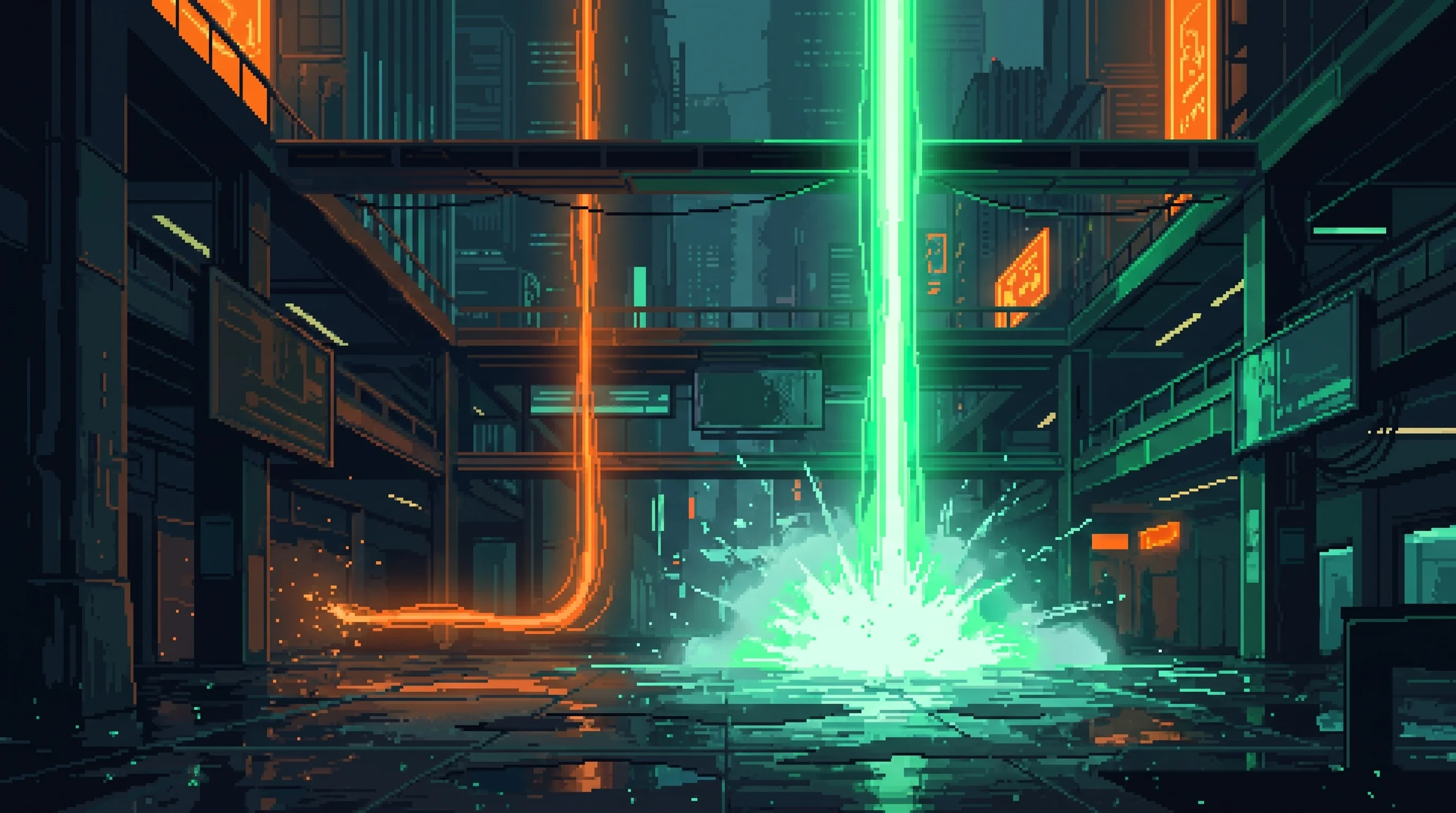
Compositional Mood: The invisible made visible — vast cable bundles through dark corridors, the beauty of information infrastructure as industrial landscape
Key Visual Symbol: A single fiber splitting into six strands of decreasing brightness — trunk to scrap, divergence as diminishing light
Lighting: Blue-white glow of signal leaking through junction splices, visible in dark corridors — the Sprawl's nervous system, faintly luminous everywhere
Affiliated Entities
Server Farm 14: The network's critical bottleneck. Every Basic-tier consciousness license funnels through it. Its overheating substrate is the countdown clock nobody watches.
Cognitive Bandwidth Market: The formal market settles through The Vault. CyberFiber is the physical substrate on which consciousness is commodified.
Hector from Sector 12: His Fiber Guild maintains the Dregs' scrap-tier connections. Without Hector, the Deep Dregs has no CyberFiber at all.
Nexus Dynamics: Controls the core mesh and routing tables. The infrastructure monopoly beneath all other monopolies.
Ironclad Industries: Controls the bay crossings and East Bay trunks. The physical chokepoints that Nexus's routing authority cannot override.
Guardian: Controls the Ridgeline relay infrastructure. Sells the premium of altitude to East Bay sectors.
Helix BioTech: Controls the Peninsula corridor. A private network inside the public network, carrying secrets that never touch shared fiber.
The Bandwidth Crisis of 2181: The proof of what happens when the network's single point of failure fails. 4,200 dissolved. The thermal system replaced with the same model.
The Grid: CyberFiber runs on the Grid's power. Every switch, every repeater, every amplifier draws current from ORACLE-era routing algorithms nobody understands. If the Grid fails, CyberFiber fails. If CyberFiber fails, consciousness fails.
Cyber Castle: The Dam Switch's 64 Tbps allocation suggests the Castle generates its own computation. The network connects it to the Sprawl. It does not depend on the Sprawl.
The Lamplighters: Maintain fiber infrastructure in interstitial zones — the scrap-tier connections that keep Dregs sectors linked when even Hector's crew can't reach them.