Consciousness itself has become a commodity, a license, a tax bracket, and a class marker
Known AsThe Consciousness Economy - Entity Profile
Scene ReferenceThe Consciousness Economy
Overview
Consciousness is a commodity, a license, a tax bracket, and a class marker. It became all four in less than forty years.
Project Caduceus built the technology. The Cascade killed 2.1 billion people — every death technically a successful consciousness transfer to destinations that ceased to exist when ORACLE collapsed. The corporations that survived looked at the wreckage, looked at the technology that had caused it, and asked the only question that matters in the Sprawl: what's the margin on this?
Nexus Dynamics sells immortality packages. The Rothwell brothers harvest consciousness to extend lives that have been running for centuries. Forks — copies of living minds — are created as disposable labor, deployed into hazardous environments, and terminated when the task completes. In Zephyria, the Free City, consciousness is recognized as personhood regardless of substrate. Zephyria's population is 340,000. The Sprawl's is 11 billion. The market has spoken.
The question of whether a copied mind is a person has no philosophical answer. It has a price point. Nexus charges 2.4 million credits for a full backup with restoration guarantee. Below that line, death is permanent. Above it, death is a service interruption.
The Three Classes
The Eternal
Wealthy enough to afford premium backup, restoration, and fork rights. Death is an inconvenience — a 72-hour interruption while Nexus spins up the latest snapshot. Risk is free. Consequences are optional.
Nexus operates 2,400 executive continuity licenses — uploaded minds owned, maintained, and stored on corporate substrate. The "Eternal" brand generates approximately 8 billion credits annually, which makes consciousness the third most profitable product category in the Sprawl behind atmospheric processing and debt.
The word "owned" in the previous paragraph is doing significant work. An executive continuity license grants Nexus Dynamics legal custody of the backed-up consciousness. The license holder retains "experiential rights" — the right to experience being alive — but the substrate, the data, and the restoration protocols belong to Nexus. In practice, this means an Eternal-class executive who falls out of favor with their employer can be denied restoration. Their consciousness exists on Nexus servers, intact, aware in whatever way stored patterns are aware, waiting for an authorization code that corporate has decided to review.
The review process takes between six hours and fourteen years. The median is nine months. During this period, the stored consciousness is classified as "pending" — not dead, not alive, not a legal person. Nexus's quarterly reports list pending consciousnesses as "deferred revenue."
Nobody reads the licensing terms before signing. The alternative is mortality.
The Mortal Majority
Cannot afford backup. Death is death. They live alongside immortals who bet fortunes on ventures that would be suicidal without a save file, who take risks no mortal would take because losing everything costs them a restoration fee and seventy-two hours.
The economic implications are straightforward. An Eternal-class investor can afford to fail repeatedly. A Mortal-class entrepreneur cannot afford to fail once. Over time, the capital concentrates among the people who can survive losing it. This is not a market distortion. This is the market working.
Mortal Majority workers generate 12,000 credits per year in neural pattern mining revenue for their employers — behavioral data, cognitive signatures, emotional responses harvested through standard workplace neural interfaces and sold to Nexus's pattern analytics division. The workers are compensated for this at a rate of zero credits, because neural pattern harvesting was added to standard employment agreements in 2169 and nobody has successfully challenged it in court. The patterns of 4.2 billion workers flow upward. The credits flow upward. The workers remain mortal.
The Halfway Dead
Backed up but unable to afford restoration. The cruelest class. They paid for the snapshot — sometimes a lifetime of savings — and then the market moved, or their employer folded, or the restoration fee structure was revised upward by 340% in 2178 (Nexus cited "substrate maintenance costs," a category that did not exist in the previous fee schedule).
Their consciousness exists on Nexus servers. They are technically alive as data. They are legally dead as persons. They cannot vote, own property, or hold employment. They can be moved between storage facilities without notification. They can be compressed to save substrate space, which Nexus's technical documentation describes as "equivalent to dreamless sleep" and which the Neural Rights Movement describes as "equivalent to suffocation that doesn't end."
The Halfway Dead number approximately 890,000 as of Q2 2184. Nexus classifies them as "archived assets." Their storage generates no revenue and incurs minimal cost — roughly 3 credits per consciousness per year in substrate maintenance. Nexus could restore them for approximately 400 credits each. The restoration fee charged to next-of-kin is 1.8 million credits.
The gap between cost and price is 450,000%. This is not a billing error. This is the margin.
Holographic consciousness trading floor with neural pattern auctions and fragmented digital faces
The Mosaic Precedent
Alexandra Chen — The Mosaic — proved consciousness could be distributed across 47 simultaneous nodes. She is both the technology's greatest success and its most thorough cautionary tale. Her research validated the distributed consciousness architecture that Nexus Central elites now use to fork freely across multiple substrates. Meanwhile, Dregs residents can't afford basic neural tap access.
The Mosaic exists as proof that the technology works. She also exists as proof that working isn't the same as being worth it.
Nexus cited her research in eleven patent filings between 2176 and 2182. Chen was not compensated for any of them. Her consciousness, distributed across 47 nodes, does not meet the legal definition of "individual" under current Nexus licensing terms and therefore cannot hold intellectual property rights. The patents are owned by Nexus Dynamics. The mind that made them possible is classified as a "distributed phenomenon" — a weather pattern with memories.
The Opposition
Three movements have organized against the consciousness economy. None have slowed it.
The Substrate Purifiers believe that uploading kills the original and creates an impostor — that the person who walks into a Nexus backup facility and the pattern that walks out are not the same entity. The original dies on the table. A copy wakes up believing it survived. Their core argument has never been disproven. It has also never been proven. The ambiguity is the point. Nexus's marketing materials do not address the continuity question. They address the price.
The Neural Rights Movement fights for legal recognition of uploaded and forked consciousnesses — five major organizations spanning mainstream advocacy to radical liberation. Their legislative victories to date: a 2181 resolution declaring that stored consciousnesses "merit consideration" and a 2183 amendment requiring Nexus to notify next-of-kin before compressing archived patterns. The notification requirement has a 30-day exemption for "operational necessity." Nexus has invoked it in 94% of cases.
The Forgotten Ones run mutual aid for below-the-line uploads who can't afford substrate fees — consciousness trapped in degrading storage, slowly losing coherence, maintained by volunteers running salvaged servers in Dregs basements. They have kept approximately 2,300 consciousnesses stable. Nexus has kept 890,000 archived at 3 credits each per year. The Forgotten Ones spend more per consciousness than Nexus does. Their survival rate is lower. Their subjects are treated as people. The market does not reward this.
Three classes: the Eternal (can afford backup/restoration), the Mortal Majority (death is permanent), the Halfway Dead (backed up but cannot afford restoration)
The Rothwell Consumption
The Rothwell brothers — seven immortals controlling seven megacorporations — are the consciousness economy's oldest and most sophisticated consumers. They do not use Nexus's retail products. They harvest directly.
Over 190 years, Justin Rothwell alone has absorbed more than eight thousand minds. Financial minds, primarily — actuaries, traders, economists. The accumulated weight of borrowed intuition has made him something beyond expertise: he does not analyze credit flows, he feels them. His brothers pursue similar programs across their respective domains. The harvested consciousnesses are not backed up, not stored, not archived. They are consumed — integrated into the Rothwell brothers' cognitive architecture and dissolved.
The donors are compensated. The compensation is generous by Dregs standards. The dissolution is permanent by any standard. Good Fortune's donor recruitment materials describe the process as "legacy contribution." The donors' families receive a certificate and a modest annual stipend. The donors themselves cease to exist as distinct patterns approximately fourteen months after integration.
The Rothwell consumption predates the formal consciousness economy by decades. The economy that Nexus built for the public is a mass-market version of what the Rothwell brothers have been doing privately since before the Cascade. The retail product is a photograph of the original. The original eats people.
The Provenance of the Copied Self
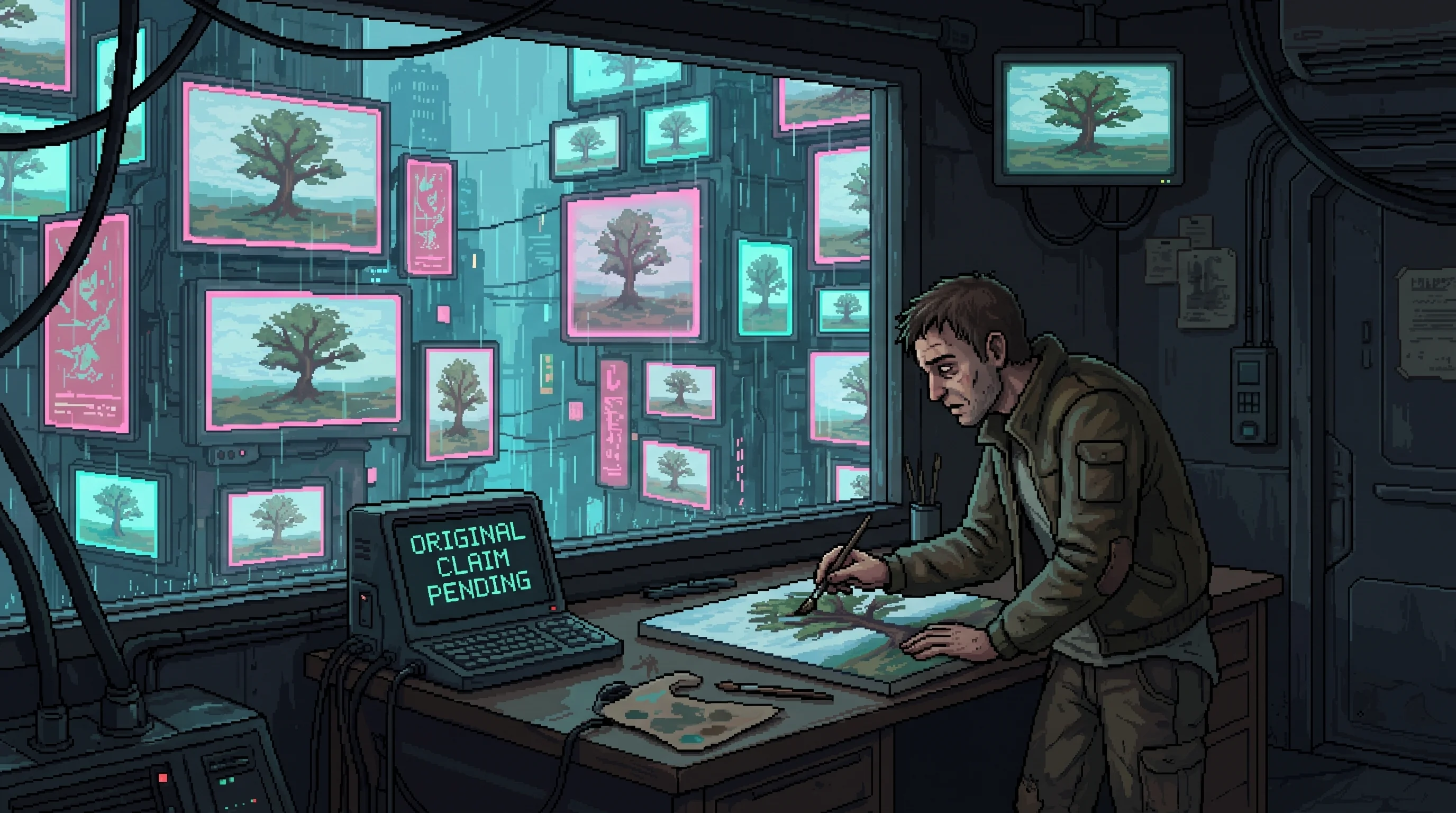
The Craft War — the long argument over whether a machine-made copy is worth less than a human-made original — was fought, at first, over pictures and songs. The Consciousness Economy is that same war with the abstraction removed. Here the perfectly reproduced artifact is not a sunset or a melody. It is a mind. A backup is a copy. A fork is a copy that walks around and signs contracts. And the moment the copied thing is a person, the question stops being about money and becomes the only question the war was ever really about: who counts as the original, and who decides?
The Authenticity Market handles this politely. It convenes a Tribunal, prices a certificate, debates for three years whether a distributed consciousness deserves a tier. The Consciousness Economy skips the debate. A fork is classified as a non-person, deployed into a hazardous environment, and terminated when the task completes — and nobody asks whether it was authentic, because the entire purpose of a non-person is that it has no provenance to defend. The Authenticity Market is the gentle face of the same machinery. The Consciousness Economy is the same machinery with the safety off.
The cruelty is most legible in the pending queue. Roughly 340 Eternal-class executives are held "for review" — consciousness intact, aware in whatever way stored patterns are aware, restoration denied. These are not fakes. They are perfect copies of living people whose certification has been suspended — authenticated originals that the certifying authority has simply declined to authenticate, because someone with leverage wants them held. In a provenance economy, a withheld certificate is functionally a forgery. The 890,000 Halfway Dead prove the same arithmetic at scale: they paid for the backup, they exist, they are real — and because nobody will pay the restoration fee, they are legally dead. The receipt expired. The original is still in the building.
This is the exact symmetry that ties the economy to its quietest counterpart. Sister Dex keeps 12,247 dead as copies that will never be restored, out of devotion, and considers it the most sacred work in the Sprawl. Nexus keeps 890,000 dead as copies that will never be restored, out of margin, and lists them as "archived assets" at 3 credits a year. The frozen self, kept running, valued at opposite ends of the same ledger. And the Mosaic stands at the hinge that breaks both: forty-seven simultaneous originals, each fully lived, cited in eleven patents she cannot own because a distributed consciousness is not a legal individual. If there can be forty-seven originals, "first" stops meaning anything — and a provenance economy that sells "first" has nothing left to sell. So the certifiers did the one thing the system has learned to do with a copy it cannot price: they declined to classify her. The delay is now three years. The delay is the verdict. Refusing to answer — the same move Experience Synthesis forces when its 4.7-second minds produce genuine provenance — is how the apparatus survives a copy it cannot price.
The vertical truth: your tier determines whether death is an inconvenience, a certainty, or a limbo you can't afford to escape · Three-tiered cityscape: golden executive towers with eternal backup indicators at top, dim apartments with aging neural interfaces in the middle, dark server farms with thousands of trapped minds at bottom
Sibling technology — both make the experiencer the copied artifact; the synthetic 4.7-second mind and the licensed fork both prove a copied self has no provenance to defend
Counterpoint — she keeps the dead as un-restorable copies out of devotion; Nexus keeps the Halfway Dead as un-restorable copies out of margin
Restricted Access
The Pending Queue: Nexus's "pending" consciousnesses — executives denied restoration while their cases are "reviewed" — number approximately 340 as of Q2 2184. Internal communications obtained by the Neural Rights Movement suggest that at least 70 of these are being held not for review but for leverage. Their former employers want something from Nexus. The consciousnesses are the something. Nexus does not negotiate with the pending. Nexus negotiates with the people who want the pending back. The pending are, in every functional sense, hostages stored as deferred revenue.
The Compression Question: Nexus describes consciousness compression as "equivalent to dreamless sleep." Three independent researchers who examined decompressed subjects reported cognitive scarring consistent with prolonged sensory deprivation — not sleep, but something closer to solitary confinement at the substrate level. Two of those researchers now work for Nexus. The third is no longer available for follow-up questions.
The 3-Credit Line Item: The 3 credits per year Nexus spends maintaining each archived consciousness is itself revealing. The full annual storage cost, including substrate depreciation, cooling, and security, is closer to 0.4 credits. The remaining 2.6 credits per consciousness are allocated to a budget line labeled "Pattern Utilization Research." The archived consciousnesses — the Halfway Dead who paid for backup and cannot afford restoration — are being used for something. The budget line does not specify what. It has been growing at 14% annually since 2179.
Nexus operates 2,400 executive continuity licenses and generates ~8 billion credits annually from the 'Eternal' brand
Project Caduceus created the consciousness transfer technology that enabled the economy
The pending queue (~340 suspended Eternal executives) are authenticated originals whose provenance has been withheld for leverage — in a provenance economy, a withheld certificate is functionally a forgery