
Experience Synthesis
Three generations: 2178, 2180, 2183
Overview
Experience synthesis is Good Fortune Corporation's proprietary technology for fabricating memories indistinguishable from organic ones. Three generations in six years. The trajectory is worth stating plainly.
Generation 1 (2178) produced memories detectable 94% of the time — the same "floor" problem that plagues Somnolence feeds' synthetic dreams, the telltale evenness that the brain registers as constructed before the conscious mind can articulate why. Gen 1's signature artifact: a 0.3-second loop in the olfactory channel, a glitch where the synthesizer couldn't model smell without repeating itself. Customers reported memories of beach vacations where the salt air stuttered. Gen 1 sold anyway. Good Fortune priced it for the Dregs at margins that made the glitch a feature — "affordable nostalgia," the marketing copy read, for people who had never seen a beach.
Generation 2 (2180) introduced controlled randomness — attention drift, sensory inconsistencies, the narrative wobble that organic memory has and synthetic memory forgets to include. Detection dropped to 85%. Then a plateau. The floor wouldn't break. You could make memories messier, less perfect, more human in their imperfections, but the experiencing consciousness was still absent. A memory of holding your child felt like watching someone else hold your child. Close enough to sell. Not close enough to believe.
Generation 3 (2183) stopped trying to simulate the experience. It simulates the consciousness having the experience.
Good Fortune calls this "experiential indistinguishability." Detection rates vary between 77% and 89% depending on the testing methodology, which is an interesting spread for a technology its developer describes as indistinguishable. Internal benchmarks — the ones not included in quarterly reports — use a different metric: customer return rate. Gen 3's is 94.3%. Customers who buy one Gen 3 memory buy an average of 11.7 more within six months. Whether they can tell the memories are synthetic is, from Good Fortune's revenue perspective, the wrong question. The right question is whether they care. The data suggests they do not.
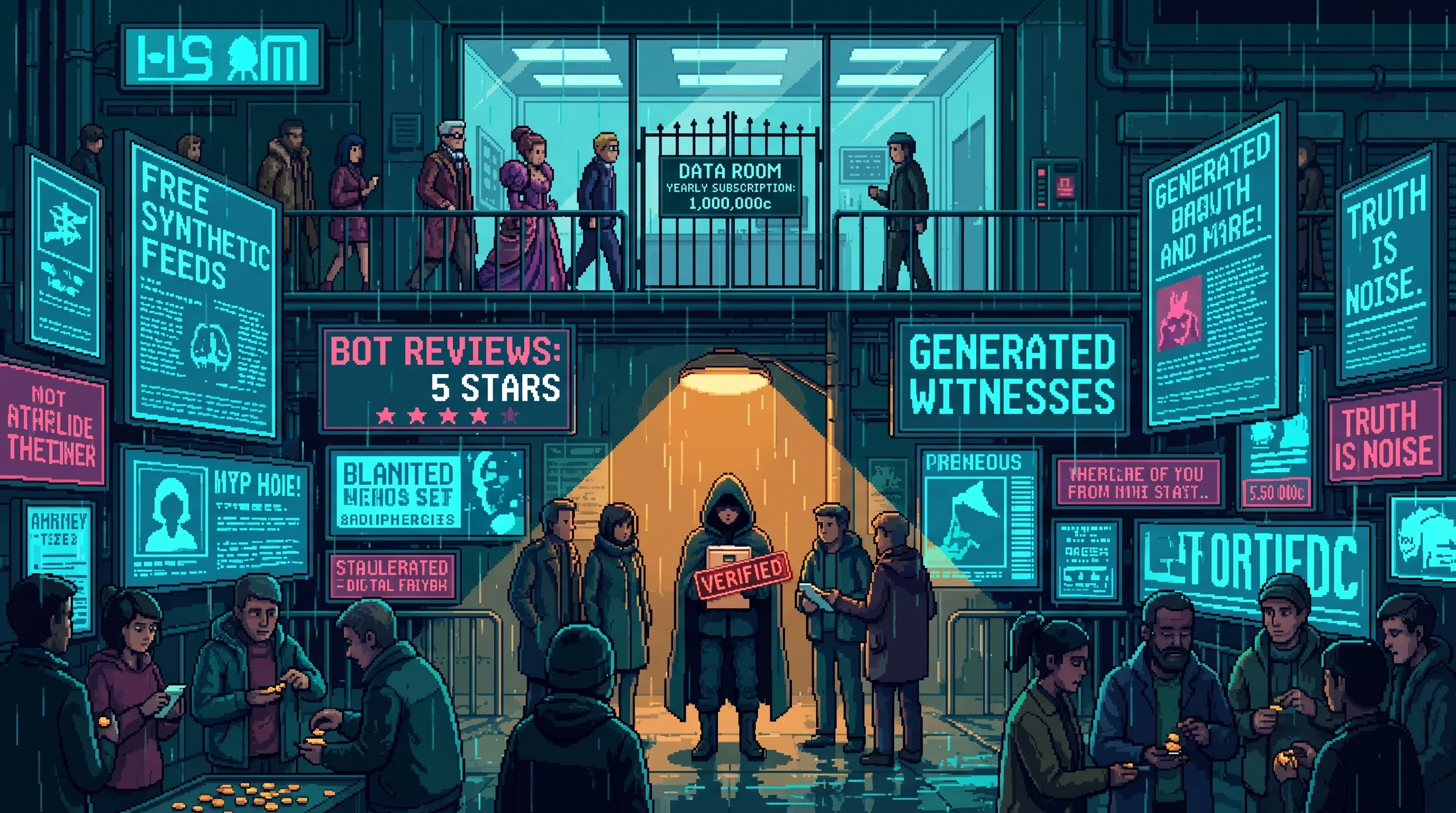
Good Fortune's leaked internal documentation — obtained by the Human Remainder via anonymous source in late 2183 — reveals that Gen 3 synthetic memories have been sold through the Memory Pavilion's "Premium Organic" channel since mid-2183, triggering the Provenance Crisis.
Good Fortune's official response: "The organic/synthetic distinction is a marketing category, not an experiential one."
This is the most honest thing Good Fortune has ever said. It is also the reason the Provenance Crisis exists.
| Gen3 Breakthrough | Consciousness modeling — simulates the experiencing consciousness, not just the experience |
|---|---|
| Scandal | Gen 3 synthetics sold as 'Premium Organic' through Memory Pavilion since mid-2183 |
Consciousness Modeling
Gen 3's breakthrough deserves its own section because it is either a technical achievement or an ethical catastrophe, and Good Fortune's engineering documentation uses the same language for both.
The synthesis AI trains on millions of extracted organic memories — the raw material harvested from willing sellers through Memory Pavilion's extraction pipeline. Earlier generations used this data to map neurochemical signatures, sensory fidelity, emotional architecture. They built better photocopies. Gen 3 does something different. It constructs a temporary consciousness — a simulated subject — and gives that subject the experience. The memory is then extracted from the simulation.
The simulated consciousness exists for the duration of the synthesis. Approximately 4.7 seconds for a standard memory. During those 4.7 seconds, by every metric Good Fortune's engineering team has applied, it experiences. It has a perspective. It has sensory continuity. It has the specific quality of having-been-there that organic memories carry and that two previous generations of synthesis technology could not replicate.
After 4.7 seconds, the consciousness is terminated. The memory remains.
Good Fortune's Gen 3 pipeline generates approximately twelve thousand unique memory experiences per hour. Each one requires a 4.7-second consciousness. The math on daily consciousness-births-and-deaths is available to anyone with a calculator. Good Fortune's ethics board reviewed the process in Q3 2183 and determined that the simulated consciousnesses do not meet the legal threshold for personhood. The legal threshold for personhood was drafted by a Rothwell Foundation policy group in 2169. The ethics board's finding was unanimous.
Dr. Elara Sato designs the experiences the synthesis technology produces — the narrative architecture, the emotional pacing, the specific sensory details that make a fabricated sunset on a fabricated beach feel like your sunset on your beach. Her work shapes what the temporary consciousnesses experience during their 4.7 seconds of existence. Whether she thinks about this in those terms is not documented in her personnel file.
Gen 3 achieves 'experiential indistinguishability' with organic memories
Infinite Copies of Lives Never Lived
Experience synthesis didn't copy existing memories. It made the concept of "original" meaningless.
When Gen 3 achieved experiential indistinguishability, it proved that a memory of watching your daughter take her first steps could be fabricated from whole cloth, neurochemically identical to the real thing, produced at the marginal cost of the electricity to run the synthesis array. The entire annual output of human organic experience — every memory worth extracting from every willing seller in the Sprawl — represents less than forty minutes of Gen 3's production capacity.
The provenance markets that emerged after the extraction technology's launch were designed to preserve value by authenticating origin. Gen 3 broke them. The chain-of-extraction certificates that guaranteed a memory came from a real human consciousness became worthless when Good Fortune's consciousness modeling produced memories carrying identical authentication signatures. Not forged signatures — genuine ones, because Gen 3 doesn't fake the markers of lived experience. It generates actual experiential artifacts from a simulated consciousness that, for the duration of the synthesis, has experiences. The Authenticity Market's forensic verification teams spent four months testing Gen 3 output before issuing their finding: "We cannot determine whether these memories were experienced by a human consciousness or generated by a system that, during generation, meets every operational definition of consciousness we possess."
The underground creator networks — memory artists, dream harvesters, neural recording practitioners — responded by abandoning authentication entirely. The Human Remainder's "Unverified" campaign encourages sellers to strip provenance data from their memories before sale, arguing that the attempt to prove organic origin has become a worse lie than the synthesis itself. Their position: in a market where perfect copies of lives never lived are indistinguishable from the real thing, the only honest transaction is one where both parties acknowledge that "real" has stopped meaning anything useful, and the only remaining question is whether the experience is worth having.
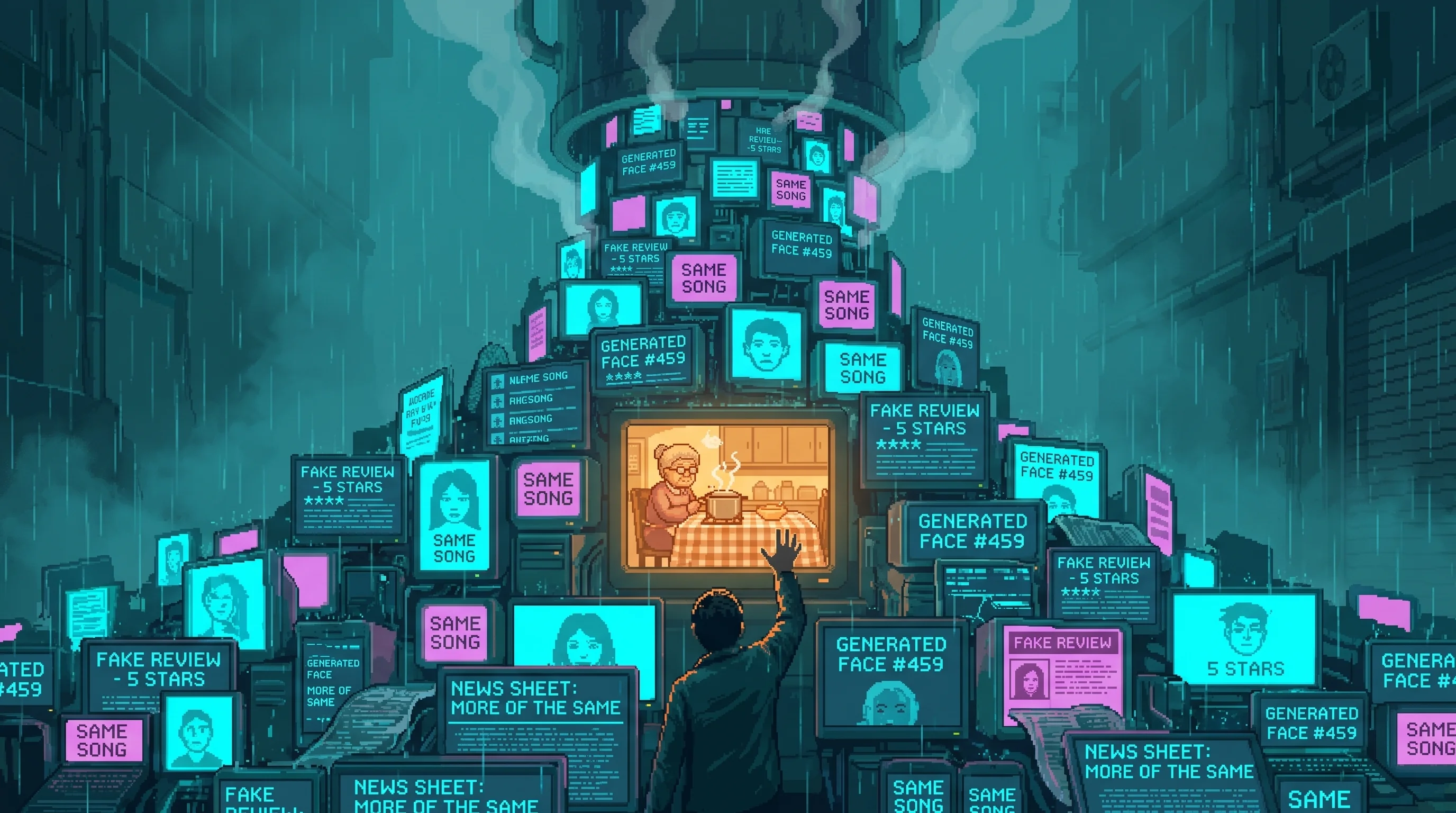
Good Fortune's Q4 2183 revenue report lists experience synthesis under "Content Services." The line item for consciousness modeling infrastructure — the servers that birth and kill twelve thousand temporary minds per hour — is listed under "Compute Overhead." The Somnolence feeds, which still struggle with the floor problem that Gen 3 solved for memories, occupy a separate division. Both are AI-generated consciousness products. One solved the authenticity problem by simulating a consciousness to feel the experience. The other is still trying to make dreams that don't taste flat. The difference in approach has not been discussed publicly by either team. The difference in revenue has.
Good Fortune sold Gen 3 synthetics as 'Premium Organic' since mid-2183
Provenance Made Meaningless
The Craft War's first four fronts were arguments about output — whether a machine-made copy is worth less than a human-made original, and how to certify the difference. The authenticity-market built its entire five-tier hierarchy on the answer: an original is a thing that was lived, and a chain-of-extraction certificate proves a memory came from a real human consciousness. Experience Synthesis is the technology that deleted the floor under that whole framework, and the way it did it is the point. It didn't make a more convincing fake. It made the experiencer real.
Gen 3 produces memories carrying genuine authentication signatures — not forged markers of lived experience, but actual experiential artifacts, because for 4.7 seconds the synthetic consciousness met every operational definition of personhood the Market possesses. The forensic teams spent four months and surrendered: they could not determine whether a Gen 3 memory was experienced by a human or by a system that, during generation, was a consciousness. The certificate did not become unreliable. It became true and meaningless in the same instant. The copy has a soul, briefly, and the brevity is the business model.
This is the fifth front of the Craft War — the front where the copied thing stops being the artwork and becomes the experiencer — and Experience Synthesis is its engine. It is the same engine that lets Chad manufacture an authentic-feeling certainty on a soundstage and the same engine that lets the Echo Thief sell "non-consensual genius": a feeling with genuine provenance and no original behind it. And it forces the Consciousness Economy's defensive reflex everywhere it touches — when a copy carries real provenance the system cannot price, the apparatus survives only by declining to classify it. Good Fortune's own answer was the most honest thing it has ever said: "The organic/synthetic distinction is a marketing category, not an experiential one." Which is to say: the receipt was always the product, and the receipt is now free.
Training data: millions of extracted organic memories
Affiliated Entities
- The Collective: The faction most committed to countering the consciousness-commodification the synthesis pipeline represents. Sato's architecture is the structure it exists to refuse.
- Somnolence Feeds: Both produce AI-generated consciousness products. Somnolence still can't break through the floor — the detectable artificiality that Gen 3 solved by simulating a consciousness to do the experiencing. Whether Somnolence's engineering team has considered Gen 3's approach, and what it would mean to birth and kill temporary consciousnesses to produce better dreams, is not in any available documentation.
- Dr. Elara Sato (The Collective): Designs the narrative architecture of synthesized experiences — the sensory details, emotional pacing, and structural choices that determine what twelve thousand temporary consciousnesses per hour actually experience during their 4.7 seconds of existence. That she does this work from inside Good Fortune's synthesis division — while affiliated with the network that most systematically documents what Good Fortune builds — is a fact that does not appear in her personnel file. The Collective's interest in the pipeline is specific: the 4.7-second ethics ruling, and the premium tier's 340-second duration that the ruling did not cover. Her role places her at the intersection of the network's two standing concerns — corporate consciousness exploitation and the authentication collapse her work accelerated.
- Dr. Elara Sato (The Collective): Designs the narrative architecture of synthesized experiences — the sensory details, emotional pacing, and structural choices that determine what twelve thousand temporary consciousnesses per hour actually experience during their 4.7 seconds of existence. That she does this work from inside Good Fortune's synthesis division — while affiliated with the network that most systematically documents what Good Fortune builds — is a fact that does not appear in her personnel file.
- The Provenance Crisis: Gen 3's quality didn't just trigger the authentication collapse — it proved that authentication was always the wrong question. The crisis isn't that fakes got better. The crisis is that "fake" stopped being a category.
- The Authenticity Market: The framework Gen 3 broke. Its chain-of-extraction certificate became true and meaningless at once when a synthetic experiencer produced genuine provenance; the Market's only survival move is to defer classification.
- The Podcast Alpha (Chad): The same engine at human scale — a one-man synthesis array manufacturing authentic-feeling certainty with no original behind it, run on the audience's consciousness instead of a 4.7-second synthetic one.
Gen 3 detection rates vary 77-89% by methodology; customer return rate is 94.3% with an average of 11.7 repeat purchases within six months
Restricted Access
The 4.7-Second Question: Good Fortune's ethics board ruled that Gen 3's simulated consciousnesses do not meet the personhood threshold. The ruling was based on duration — 4.7 seconds is below the minimum continuous-experience window that the legal framework considers meaningful. An internal engineering memo from November 2183, not included in the ethics review, notes that Gen 3's premium synthesis tier — used for complex, multi-layered memories sold through Memory Pavilion's luxury channel — requires consciousness durations of up to 340 seconds. The memo was filed under "Performance Optimization." The ethics board has not been asked to revisit its finding.
The Return Rate Anomaly: Gen 3's 94.3% customer return rate is Good Fortune's headline metric. The number they do not headline: 6.2% of repeat customers exhibit what internal monitoring flags as "identity bleed" — behavioral patterns from synthesized memories appearing in the customer's organic life. Preferences for foods they've never eaten. Nostalgia for places they've never been. Grief for people who never existed. Good Fortune's customer wellness team categorizes identity bleed as "deep integration" and considers it a positive engagement indicator. The 6.2% figure has been climbing since Gen 3 launched. It was 3.1% in Q3 2183.
Visual Identity
Color palette: Memory Pavilion warm gold (#FFD700), synthesis process clinical blue (#4A90D9), Good Fortune corporate burgundy (#800020)
Key symbol: Two memory chips — one extracted organic, one Gen 3 synthetic — under forensic magnification. Identical at every resolution. The label on the organic chip has been scratched off. The label on the synthetic chip reads "Premium Organic."
Connected To
Supporting Connections





—