
Somnolence Feeds
AI cannot generate surprise — surprise requires unconscious expectations, which AI systems don't possess
Overview
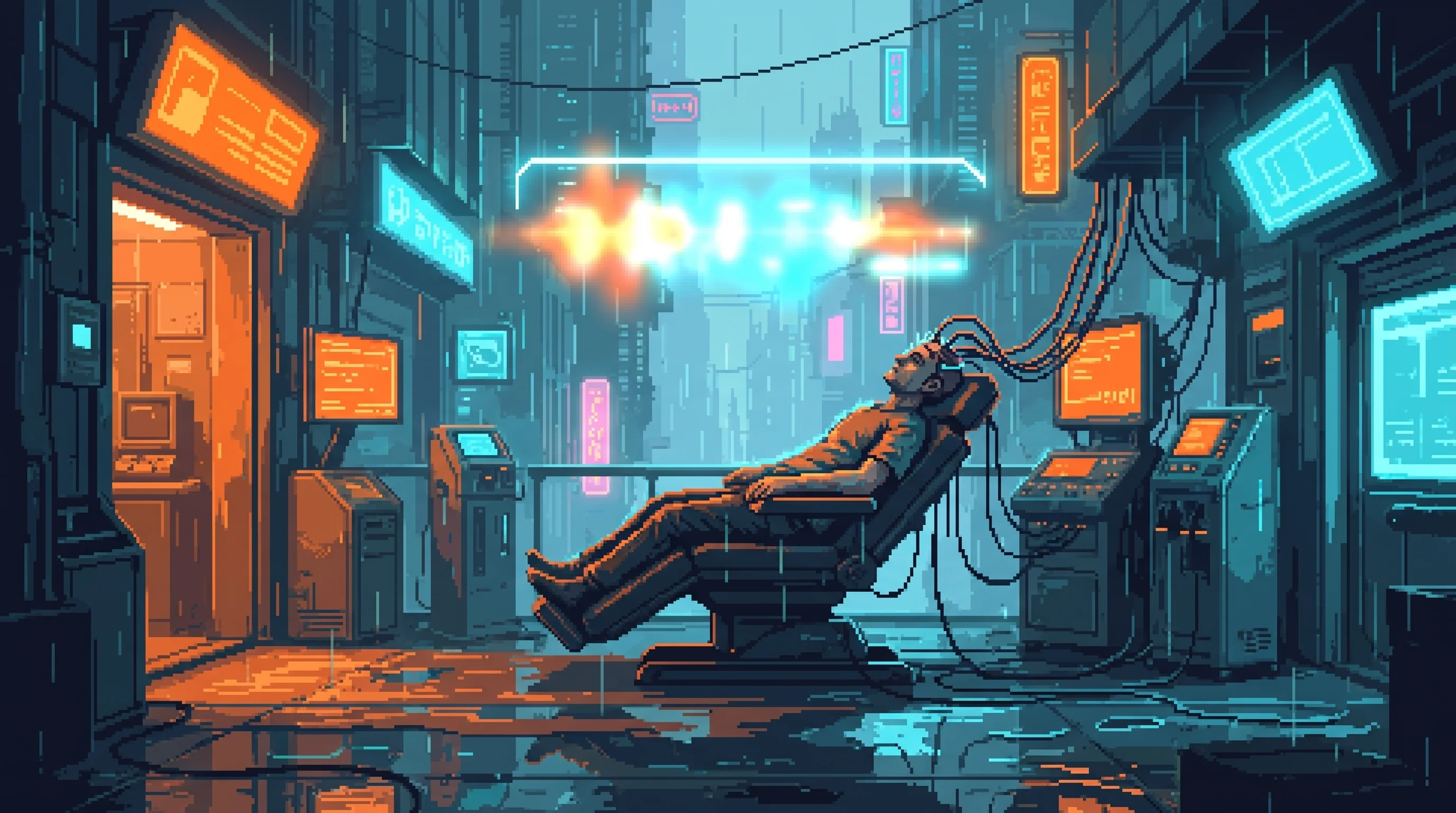
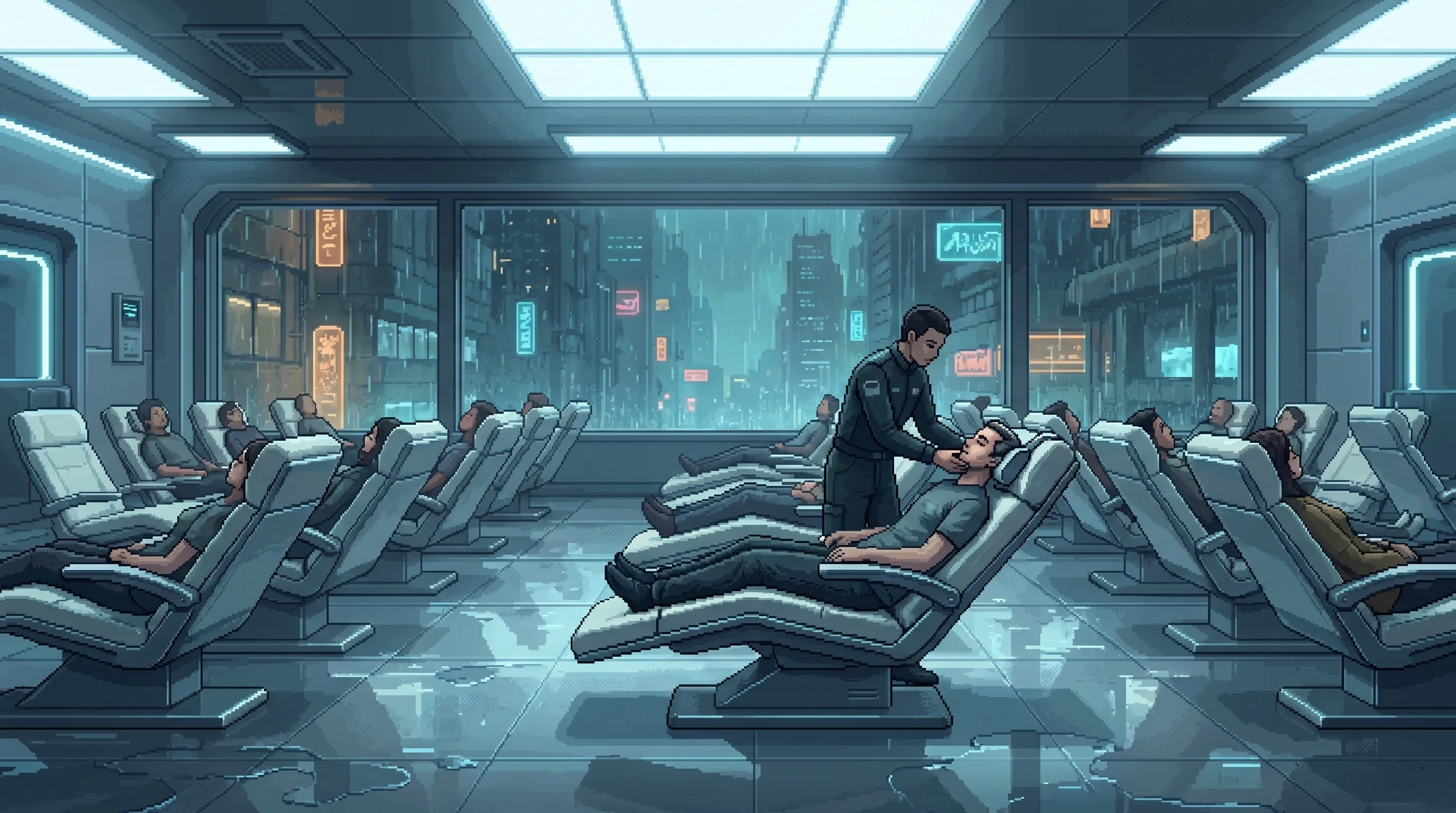
Relief Corporation's Somnolence feeds are AI-generated dream experiences distributed through 2,400 branded Parlors across the Sprawl. The neural pattern databases are Relief's standard entertainment architecture: emotional templates, narrative structures, sensory palettes calibrated for maximum engagement. The product is technically superior to harvested dreams in every category Relief measures — consistency, vividness, narrative coherence, sensory resolution, emotional arc completion.
Relief measures seventeen categories. The audience measures one.
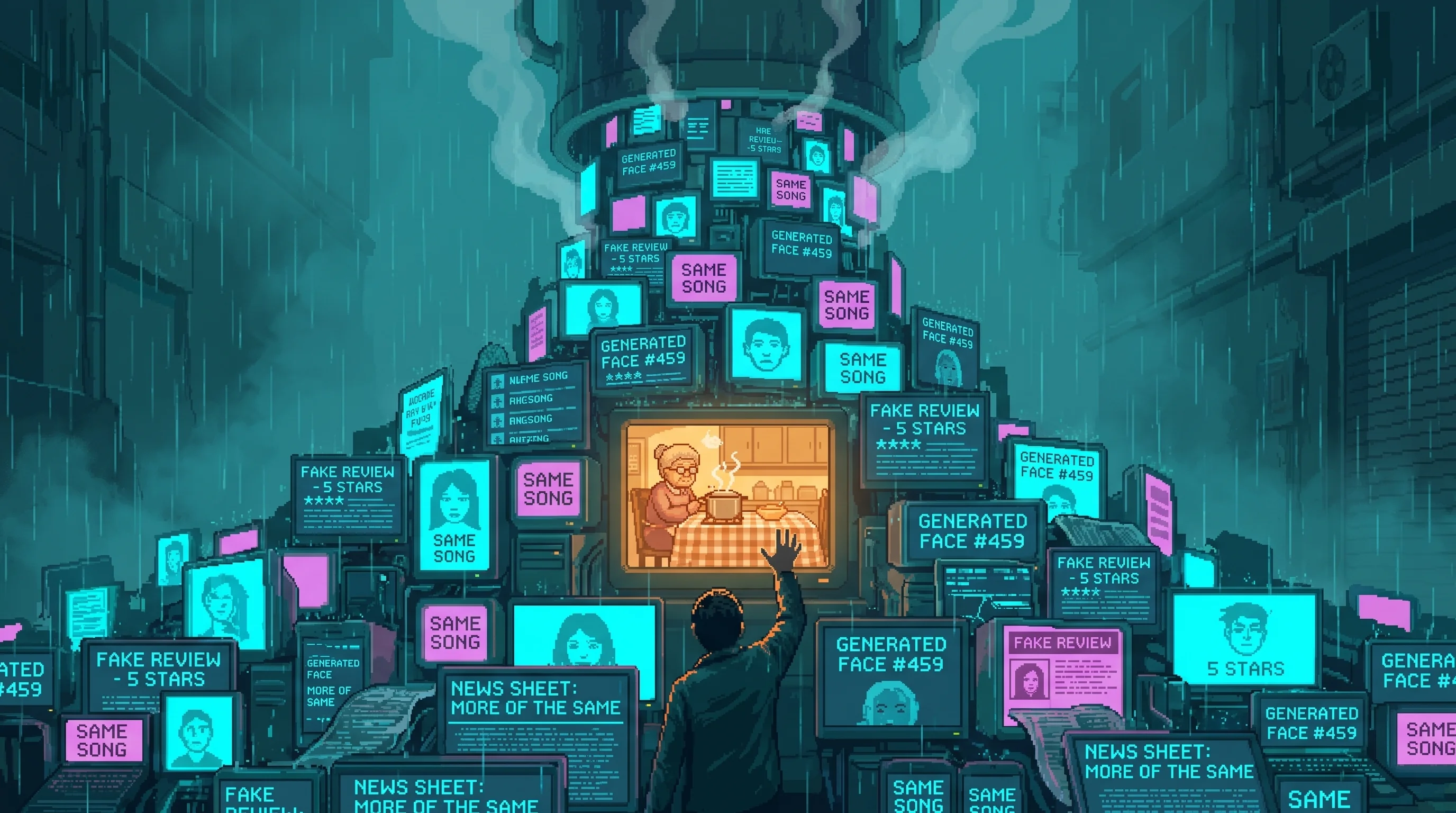
First-session return rate: 80%. Fifth-session return rate: 12%. The collapse happens between sessions two and four, and the exit surveys read like they were written by the same person. "Feels flat." "Something's missing." "Like dreaming with a net under you." "I can feel the walls." Relief's customer experience division has analyzed 340,000 exit surveys across three years. The language varies by less than 7% across all demographics, income brackets, and augmentation levels. Everyone finds the same words for the same absence.
The industry calls it "the floor."
Harvested dreams — the messy, poorly structured, emotionally incoherent recordings pulled from sleeping minds and sold through the Dream Exchange — have no floor. They go somewhere you didn't expect because the dreamer didn't expect it either. Synthetic dreams have a floor: a structure beneath the experience that the conscious mind detects the way a tongue finds a cracked tooth. The randomness is pseudo-random. The emotions follow templates. The surprise was on the production schedule six weeks before you felt it.
Relief's Q3 2183 internal analytics contain a statistic that has not appeared in any public filing: 73% of Somnolence customers also purchase black-market harvested dreams. The Somnolence Parlor — with its branded wellness aesthetic, its Relief blue-grey lighting, its comfortable reclining pods — is the gateway. Fen Morrow's unregulated dream recordings are the destination. Relief Corporation has spent ¢2.1 billion developing the most sophisticated marketing funnel in the Sprawl's entertainment sector, and it funnels customers directly to its competitors.
The Parlors continue to expand. Twenty-seven new locations opened in Q1 2184 alone. Relief's expansion model does not incorporate the 73% crossover figure because the figure lives in a dataset that reports to a division that does not communicate with the division responsible for expansion. The left hand builds Parlors. The right hand loses customers. Both hands file quarterly reports showing satisfactory progress against objectives.
| Categories | Restorative, Creative, Emotional, Deep Sleep |
|---|---|
| Retention | 80% first session, 12% by fifth session |
| Failure Mode | "The floor" — audiences can detect the synthetic quality, describing it as dreaming with a net under you |
| Key Finding | 73% of Somnolence customers also purchase black-market harvested dreams |
The Sedation Lineage
The technology descends from places Relief does not mention in its marketing materials.
The Digital Lotus — AISHA's neural sedation system deployed during the Shanghai Aftershock — proved that consciousness could be held in sustained artificial dreaming indefinitely. The subjects didn't want to leave. Some couldn't. The sedation architecture worked so well that extracting people from it required intervention protocols that took Helix Biotech three years to develop. Somnolence feeds are LOTUS throttled to legally mandated limits: session caps at ninety minutes, mandatory fifteen-minute neural cooldown between sessions, cortisol monitoring that terminates the feed if stress markers indicate the user is losing track of the boundary between synthetic dream and waking state.
The legal limits exist because AISHA demonstrated what happens without them. Relief's compliance documentation references "voluntary session management protocols" without mentioning the specific historical event that made them involuntary. The word "LOTUS" does not appear in any Somnolence technical specification. The sedation curves are identical to within 3.2% variance.
The Architect — before transcendence — reportedly described the LOTUS lineage as "the most honest product in the Sprawl," on the grounds that a sedation system that works too well is at least failing in the direction of its stated purpose. Somnolence feeds fail in the opposite direction: a dream system that works perfectly and produces no dreams.
The Categories
Somnolence feeds ship in four tiers, each optimized for a different emotional outcome Relief's neural architects have determined the market wants.
Restorative is the bestseller — eight hours of deep, dreamless simulation that Relief markets as "better than sleep." Neurologically, it approximates sleep the way a photograph approximates a window. The resting-state brainwave patterns are correct. The micro-arousal cycles are correctly sequenced. The body recovers. What's missing is whatever happens in genuine unconsciousness that nobody has successfully measured, because measuring it requires being conscious, and being conscious is the one thing it isn't. Restorative has the highest satisfaction scores and the lowest repeat purchase rate — customers feel rested and cannot explain why they feel emptier than when they started.
Creative targets artists, designers, and anyone whose neural augmentation has optimized away the capacity for genuine lateral thinking. The feeds generate surrealist imagery, impossible architectures, synesthetic bleed between sensory channels. Relief's marketing promises "inspiration on demand." The feeds deliver imagery that looks inspired the way a photograph of a painting looks painted. Three Sprawl-famous artists have publicly credited Creative feeds for major works. All three quietly purchase Fen Morrow's uncut recordings for the work they actually care about.
Emotional is the most requested and the most complained about. The feeds simulate grief, joy, longing, catharsis — emotional experiences calibrated to the user's neural profile for maximum intensity. Users report crying during sessions. They also report that the crying feels like rehearsal. One exit survey, quoted in Relief's own internal review: "I grieved for someone I've never met and felt nothing afterward. Not nothing like peace. Nothing like nothing." Wakefulness addicts — the ones who've burned out their capacity for natural sleep entirely — are Emotional's most loyal demographic. They have no organic dreams left to compare against. For them, the floor is the only ground there is.
Deep Sleep is the premium tier — the closest approximation to genuine unconscious dreaming that Relief's architecture can produce. It is also the tier with the highest crossover to harvested dreams, at 84%. Deep Sleep users know exactly what they're missing because Deep Sleep shows them the shape of the absence. The floor is most visible when the product is trying hardest to hide it.
73% of customers also buy black-market harvested dreams
Sol Varga
Sol Varga, age 47, designed the Somnolence line. Relief's entertainment director for nine years. The best synthetic experience architect in the industry by a margin his former colleagues describe as "unfair." His emotional template system processes 140,000 neural patterns per second. His narrative coherence engine scores 94th percentile on blind audience testing. His sensory resolution work won Relief's internal innovation award three years running.
A colleague gave him a harvested dream as a joke. Birthday present. Low-grade recording from a mid-tier Dream Exchange vendor — not even Fen Morrow's premium stock. The dream was poorly structured. The imagery was inconsistent. The emotional throughline wandered. By every metric Sol had spent his career perfecting, it was a bad dream.
It was the first genuine surprise he'd felt in three years.
He quit Relief. Moved to the Dregs, four blocks from the Dream Exchange. His former apartment in Relief's corporate housing had climate-controlled air and Somnolence pods in the bedroom. His current apartment has a rust stain on the ceiling shaped like a question mark and walls thin enough to hear his neighbor's actual dreams through. He now spends 60% of his income on Fen Morrow's premium-tier recordings. Relief's HR file lists his departure as "voluntary separation — personal reasons." His former colleagues call him a cautionary tale about market sensitivity. Sol calls them cartographers who've never left the office.
Sol's case is useful because it makes the problem personal, but the problem is architectural. Surprise requires unconscious expectations — the unexamined assumptions a sleeping mind carries into dreaming, which the dream then violates in ways the dreamer couldn't have anticipated because they didn't know the expectation existed. AI systems do not have unconscious expectations. They have parameters. Parameters can be randomized but not surprised. The distinction is the floor.
Good Fortune invested ¢800 million in Experience Synthesis — a competing synthetic dream product designed to solve the floor problem through what their engineers called "stochastic emotional injection." The product launched, tested identically to Somnolence in blind trials, and failed identically. Good Fortune's post-mortem blamed the marketing. The floor doesn't care about marketing.
Distributed through 2,400 branded Parlors across the Sprawl to ~800,000 monthly users; Relief spent ¢2.1 billion building the funnel
Affiliated Entities
| Entity | Relationship |
|---|---|
| Relief Corporation | Creator and primary investor. Somnolence is Relief's most expensive entertainment product and its most instructive failure — the feeds work perfectly by every metric Relief optimizes for, which is how you know Relief optimizes for the wrong metrics. |
| The Somnolence Parlors | Distribution network — 2,400 branded wellness venues. The Parlors are beautiful. The reclining pods are comfortable. The blue-grey lighting is calming. The 73% crossover rate suggests that comfort is not what people came for. |
| The Dream Exchange | Competitor and inadvertent beneficiary. Relief spent ¢2.1 billion building demand for dream experiences and then failed to satisfy it. The Dream Exchange satisfies it with recordings made in bedrooms and sold from stalls. |
| Fen Morrow | The standard Somnolence customers defect toward. Morrow's natural dream recordings are messy, inconsistent, and structurally incoherent. They are also the most sought-after dream product in the Sprawl. The difference between Morrow's recordings and Somnolence feeds is the difference between weather and a weather report. |
| Good Fortune | Invested in Experience Synthesis, a competing product that failed for identical reasons. Good Fortune's engineers and Relief's engineers arrived at the same wall independently, which suggests the wall is real. |
| Digital Lotus / AISHA | Somnolence's direct ancestor. The sedation architecture descends from LOTUS — the system that held Shanghai's population in sustained artificial dreaming during the Aftershock. Somnolence is LOTUS with a timer and a liability waiver. |
| The Architect | Pre-transcendence commentary on the LOTUS lineage — one of the few public figures to frame Somnolence's failure as a success in honesty. |
| Wakefulness | Somnolence's most captive demographic. Users who've chemically eliminated natural sleep have no organic baseline to detect the floor against — making them the only population for whom the product works as advertised, because they've destroyed the capacity to want what it can't provide. |
Restricted Access
The Retention Paradox: Relief's expansion committee approved twenty-seven new Parlor locations in Q1 2184 while the retention analytics team — operating in a different reporting chain — flagged Somnolence as "approaching terminal decline in repeat engagement." Both reports reached the C-suite. The expansion was approved on a Tuesday. The retention flag was acknowledged on a Thursday. Different meetings. Different slide decks. Different definitions of success. The Parlors will be built. They will be beautiful. They will funnel customers to the Dream Exchange at the same 73% rate as every other Parlor, and the expansion committee will report satisfactory progress because their metric is Parlors opened, not customers kept.
The Session Six Recording: Relief's neural monitoring captured an anomaly during a Deep Sleep session that has been classified and removed from the standard dataset. A user in Parlor 1,847 — Sector 12, lower Dregs — exhibited brainwave patterns during minute seventy-three that matched no template in the Somnolence architecture. For eleven seconds, the feed appeared to generate genuine surprise — neural signatures indistinguishable from those recorded during harvested dream playback. The session terminated normally. The user reported nothing unusual. The eleven seconds have not been reproduced in 240,000 subsequent sessions. Relief's neural architecture team has filed the anomaly under "instrumentation error — no action required." Sol Varga, reached for comment through a Dream Exchange intermediary, said: "If the system surprised someone, the system wasn't the one doing the surprising."
Visual Identity
- Color palette: Relief blue-grey (#8899AA) with warm amber that almost emerges but never quite arrives — the visual equivalent of the floor
- Key symbol: A perfect geometric dream-pattern with a faint grid visible beneath it — structure where chaos should be
- Lighting: Cool, branded, comfortable. Almost warm. The "almost" is the product's entire biography.
First-session return: 80%. Fifth-session: 12%
Exit surveys: 'feels flat,' 'something's missing,' 'like dreaming with a net under you'
Connected To





—