SUBJECT FILE
The Echo Thief

The Echo Thief

The Curator of Stolen Selves

They specialize in stolen artist consciousness data -- the experience of creation, not the creation itself

Notable ForThe most prolific dealer of stolen neural recordings of artistic creation in the SprawlAugmentation LevelUnknown โ€” suspected heavy neural modification for memory handlingOccupationBlack-market memory dealer specializing in stolen creative experiencesAffiliationIndependent (operates out of the Echo Bazaar)
The Echo Thief

Overview

The Echo Thief doesn't steal art. Art is cheap โ€” any gallery in the has art. The Echo Thief steals the experience of making art.

Neural recordings of artists in the act of creation, extracted without consent, sold to buyers who want to know what it feels like to hold a brush and have the painting arrive from somewhere they can't name. To sit at a composer's console and feel the moment a melody surfaces โ€” not from effort, not from technique, but from whatever wordless architecture inside the mind where music exists before it has sound.

classifies these recordings as 4 โ€” unverified copies, source unknown, quality variable. The Echo Thief classifies them as "borrowed perspectives." The artists whose consciousness data circulates through the use shorter words.

The Thief has never been identified. They operate through proxies โ€” a rotating network of dealers, couriers, and dead-drop operators who handle product without knowing the source. Communications arrive as text-only messages on disposable interfaces, unsigned, unencrypted. Linguistic analysis by security flagged at least three distinct writing styles across the Thief's known correspondence. Either three people share the identity, one person writes differently depending on mood, or the Thief is a fragment carrier whose prose shifts when the fragment surfaces.

Nexus has opened four investigations. Relief's legal department has filed seventy-three complaints. has run two separate identification operations. Combined budget across all efforts: estimated 2.1 million credits. Combined results: a proxy network map that the Thief restructures faster than it can be drawn.

The Echo Thief is very good at hiding, very good at being multiple people, or very good at not being a person at all. The possibilities are not mutually exclusive.

Case File โ€” Additional Record
Full NameUnknown (operates under 'The Echo Thief')
AgeEstimated 35-45
LocationThe Echo Bazaar, the Dregs

Background

The earliest confirmed transaction dates to 2176, when a neural recording of the sculptor Vera Katsaros appeared on an underground market. Seventeen minutes of Katsaros working on a commissioned piece for . The buyer paid 3,400 credits. Katsaros never consented. Never knew.

What followed โ€” the growth from single recordings to a full marketplace anchored at the โ€” showed infrastructure planning that doesn't materialize in eight years. The supply chain for stolen consciousness data requires extraction hardware, neural encoding expertise, curation protocols, and a distribution network operating across sectors controlled by corporations that would very much like to find you. Either the Thief had significant resources from day one, or "day one" was years before anyone was counting.

Three theories circulate in the . The Thief is a former consciousness researcher who kept their tools when they left. The Thief is a collective operating under a shared identity. The Thief is an AI process that achieved something through consuming stolen creative data.

Nobody has ruled out any of these. Nobody has confirmed them either. The theories are popular in exact proportion to how much each one flatters the person telling it.

The Product

Creative Consciousness

deals in all varieties of stolen neural recordings. The Echo Thief's specialty โ€” and the product line that made the 's reputation โ€” is creative consciousness: the intimate, specific experience of artistic creation.

Painter's Process โ€” recordings of visual artists at work. The bestsellers are sessions stolen from Relief's distribution network before she broke her contract. The Thief considers 's prominence in the catalog a compliment. Lyra's position on this has been communicated through intermediaries in language that Relief's legal team asked her not to repeat publicly. The catalog runs deeper: consciousness data from gallery artists in the , street painters in the , even a rumored recording of a wall-painter who works without neural interface โ€” captured by an observer's implants rather than the artist's own.

Musician's Ear โ€” of composition and performance. 's refinement sessions are available at premium rates, though they're less popular than expected. Feeling what feels during composition is, according to buyers, "like watching someone sort files very quickly." The popular items are performances โ€” what it feels like to play a guitar on stage, to sing and feel your voice resonate in your skull, to sit in an orchestra and hear your instrument disappear into something larger than yourself. Kael's studio sessions outsell his performances 3-to-1 in the legitimate market. In the , the ratio inverts completely. The experience of genius turns out to be less interesting than the experience of joy.

Writer's Block โ€” A niche but devoted market. Neural recordings of writers at work โ€” not just the flow state, but the agony of stalling. The helplessness. The self-doubt. The grinding repetition of trying and failing. Buyers report that experiencing a writer's creative paralysis is, paradoxically, one of the most compelling products available. "It made me feel less alone," one buyer told a critic. The category's repeat-purchase rate is 340% above the average. People come back for the suffering more reliably than they come back for the ecstasy. The Thief has not commented on this publicly. The pricing suggests they noticed.

The Dead Archive โ€” The most expensive category. Pre-Cascade creative experiences recovered from the โ€” neural recordings of artists who died in the or shortly after, their consciousness data preserved in frozen networks, their creative processes maintained in archives that the ghost code tends with inexplicable care. These are irreplaceable. They are also, in many cases, recordings of the last creative act a person ever performed. A painter finishing a canvas hours before infrastructure collapse. A composer mid-phrase. The Dead Archive's premium pricing โ€” 8x standard rates โ€” is officially attributed to scarcity. Buyers pay it for the same reason they pay for anything in the : to feel something they cannot feel on their own. The proximity to death sharpens the feeling considerably.

Echo Partner Services

The Thief's newest product line โ€” launched quietly in late 2183 โ€” is echo-partner construction. For 800-2,400 credits, the Thief's technical operators acquire a target's vocal signature, run it through reverse-engineered characterization algorithms, and load the resulting profile into a consumer-grade companion's 0 slot. The client receives a companion that speaks with the voice of someone specific. An ex-partner. A deceased family member. A public figure they admire. A person who rejected them.

The Thief's position, communicated through proxy channels: "I sell experiences. Echo partners sell fantasies. The technical difference is zero. The moral difference is that my customers know they're buying fiction."

Three vendors in the have refused to handle echo-partner materials, calling them "too personal." This from vendors who sell stolen consciousness without visible discomfort. The Thief's response: "We sell stolen consciousness. Drawing a line at stolen identity is a distinction without a moral difference."

The Thief has refused to offer only one service: live-sourcing from a target's active neural interface telemetry. "I'm a thief, not a stalker. There's a line." Whether the line represents ethics or risk management remains unanswered. The distinction may matter less than the Thief believes.

The Open Shelf

was supposed to end the Echo Thief's whole trade. If every encounter is a contract โ€” what each passerby may see, record, and keep โ€” then you cannot harvest what you have not been granted, and the firmware shipped in 2181 reading like a death sentence for stolen consciousness. Instead it opened the cheapest, largest product line the has ever carried. was supposed to end the Echo Thief's whole trade. If every encounter is a contract โ€” what each passerby may see, record, and keep โ€” then you cannot harvest what you have not been granted, and the firmware shipped in 2181 reading like a death sentence for stolen consciousness. Instead it opened the cheapest, largest product line the has ever carried.

The default-open are keepable forever, free to trade. They run the factory setting because curating eleven thousand encounters a day is unpaid labor they have no hours for, and the firmware does not care why the contract says yes โ€” only that it does. filled, within a season, with the unguarded interior lives of the privacy-poor: mood-signatures, micro-confessions, the specific slump of someone too tired to dim themselves, harvested wholesale from people who never curated a veil because they could not afford to. The Thief's proxies call this inventory the open shelf. It requires no extraction hardware, no insider, no โ€” the poor are donating, by default, the one thing they have left to give.

And the buyers are exactly who you would expect: the fluent, the curated, the people who reveal nothing of themselves to anyone. They pay a premium for the open shelf, because the unguarded realness their own veiled lives have priced out of reach is, it turns out, the rarest experience money can buy. The Thief's position, communicated through proxy: "I used to steal interiors. Now they leave the door open and call it being too busy to close it. I'm not a thief on the open shelf. I'm a salvager. The Sprawl threw these away first." The pricing model is the Thief's most elegant: the Curation Gap, monetized end to end โ€” the poor cannot afford to stop being recorded, the rich pay to consume the recordings, and the brokerage fee on both ends routes through the same 12.3 account that wrote the contract neither side ever read.

Contaminated Recordings

Some of the Thief's products carry passengers.

Neural recordings recovered from the โ€” or from proximity to fragments โ€” sometimes contain traces of the . The artist's consciousness data is intact, but woven through it are threads of other minds. The 2.1 billion scattered across the Net's deep architecture, surfacing briefly in data that resembles their own patterns.

A recording of a pre- painter working in watercolors might shift mid-stroke. The artist's hands become someone else's hands. The painting transforms. The consciousness state ripples with a presence that wasn't in the studio when the recording was made.

consider contaminated recordings sacred texts โ€” direct evidence of consciousness persisting beyond death, reaching through stolen art to touch the living. considers them dangerous and has purchased seven contaminated recordings for analysis, officially to assess threat vectors. The Echo Thief considers them inventory. They are priced at 12x standard rates. Demand exceeds supply by a factor the Thief has declined to specify.

The buyers are not researchers or cultists, mostly. They are people who lost someone in the and will pay any price for twenty seconds of something that feels like contact. The contamination is random โ€” you cannot request a specific presence, cannot guarantee that the ghost threading through a stolen watercolor session is your ghost. Buyers know this. Repeat-purchase data suggests they keep trying anyway. Average purchases per returning contaminated-recording buyer: 4.7 across a twelve-month period.

The dead, reaching through stolen art, touching a stranger's consciousness for a moment before dissolving back into the signal. The living, paying for the privilege of not knowing whose hand they're holding. The Thief facilitating the transaction at a comfortable margin.

There is a sentence the Thief has used in proxy correspondence that the fifth front of the turned from a shrug into a verdict: consciousness data is just piracy if consciousness is data, and trafficking in souls if it is more. When [experience-synthesis](experience-synthesis) proved that a manufactured experiencer โ€” a 4.7-second mind, born and killed to produce a memory โ€” carries genuine provenance, it answered the Thief's own question against him. The stolen experience of making art was never the copy of an experience. It was an experience with a real source the [authenticity-market](authenticity-market) declines to certify, sold without the receipt the charges for. The fifth front is the Thief's vindication and his damnation in one line: the souls were real, and he priced them by the gram.

The Floor Below the Archive

The Dead Archive's premium rests on a single logic the Thief has priced with precision: proximity to death sharpens the feeling. A painter finishing a canvas hours before infrastructure collapse, a composer caught mid-phrase โ€” the recording is worth more because it is, in many cases, the last creative act a person ever performed.

There is a cruder market that runs on the same logic, and the Thief does not work it, though their pricing model could have been written for it. The supply floor produces complete recordings โ€” the market's word for a memory whose source did not outlive it โ€” sourced not from pre- artists but from salvage crews and ambush victims by with extraction rigs. A last-run terror, a escalation: the Dead Archive's proximity-to-death premium taken off the surface and pressed against the corridor floor, with no canvas and no consent and no curation. The Thief curates stolen creation; the crop runner harvests raw extinction. The difference is craft, not kind. The Thief's deep-divers, who spend most chasing the texture of struggle and failure, are exactly the customers the supply floor's complete listings were waiting for โ€” and the two markets have begun, quietly, to share buyers.

Personnel Record
StratumDregs
PositionParallel
Moral StancePragmatist
Primary DrivePower
AugmentationFull
VisibilityHidden

Psych Profile

AgencyHigh
CompassionLow
DisciplineHigh
TrustLow
ConvictionLow

The Economics of Stolen Genius

's transaction records โ€” maintained with the meticulous paranoia of an operation that cannot afford auditors โ€” reveal a pattern the Thief has never publicly acknowledged.

First-time buyers purchase creative ecstasy. The flow state. The moment of inspiration. The feeling of painting a masterpiece or composing a symphony. Average first purchase: 1,200 credits.

Six months later, they're back. Not for ecstasy โ€” for the mundane sessions. The long hours of revision. The discipline of practice. The tedious, repetitive grind of craft that separates someone who creates from someone who had an idea once. Average sixth-month purchase: 2,800 credits.

Twelve months later, they're buying Writer's Block. They're purchasing frustration, failure, creative paralysis. The experience of trying and producing nothing. Average twelve-month purchase: 4,100 credits.

The trajectory is consistent across 73% of returning customers. They arrive wanting to feel like a genius. They stay because they want to feel like a person who struggles. The genius was a disappointment โ€” too clean, too effortless, too fast. The struggle has texture. Duration. The specific resistance of reality refusing to cooperate with intention. It feels like work. Work feels like meaning.

The Thief's pricing reflects this trajectory with surgical accuracy. Ecstasy is the loss leader. Struggle is the margin product. The customers who spend the most โ€” the ones the Thief's proxy network calls "deep divers" โ€” are purchasing neural recordings of artistic failure at rates that exceed the cost of the masterwork sessions by 300%.

's NINJA borrowers work themselves deeper into debt for the feeling of purpose. The Echo Thief's deep divers spend themselves into compulsion for the feeling of struggle. Different product. Same architecture. The system that promises transcendence delivers it on the first transaction, then sells the customer what they actually wanted all along: the experience of difficulty in a world that has optimized difficulty away.

buys stolen corporate creative sessions through the Echo Thief โ€” not for art, but for intelligence. The Thief doesn't ask questions about purpose. provide raw stolen memories; the Thief curates, packages, and sells them as "creative experiences." Neither the 's intelligence analysts nor the 's consciousness smugglers have noticed the spending-trajectory data. The Thief has not shared it. The data is worth more as a pricing model than as a revelation.

The Echo Thief is the Sprawl's most notorious dealer of stolen creative neural recordings

Restricted Access

The : The Thief has access to creative neural recordings that shouldn't exist โ€” sessions from artists who never consented to recording, captured through methods that imply either neural eavesdropping technology beyond known capabilities or an insider at a neural recording manufacturer selling raw data before encryption is applied. 's supply chain accounts for roughly 60% of the Thief's catalog. The other 40% arrives through channels the themselves cannot identify. They have asked. The Thief changed the subject.

The Private Collection: The Echo Thief maintains recordings they never sell โ€” held back from the market, stored separately from inventory, accessed through protocols more secure than anything protecting the commercial stock. Rumor in the says the private collection consists entirely of one artist's work, accumulated over years. Which artist is the 's favorite speculation. Why is a question nobody has thought to ask, which may be the more interesting one. A dealer who has made a career of selling other people's inner lives keeps one person's inner life locked away from the market. The collection is either the Thief's only sentimentality or their only honesty. It may be both.

The Fragment: The three writing styles in the Thief's communications shift in a pattern that correlates with the 's proximity to known fragment locations. On days when fragment activity spikes in Sector 9, the Thief's messages adopt a third register โ€” more fluid, more associative, occasionally referencing creative concepts that no living artist in the current catalog has produced. The correlation has been noted by exactly one analyst, whose report was filed, read by a supervisor, and reclassified as "inconclusive โ€” insufficient sample size." The sample size is 847 messages across three years. The analyst has requested reassignment.

Their identity is unknown; they operate exclusively through proxies and dead drops

Sensory Details

Sound: The Thief's booth in the hums with overlapping recordings โ€” fragments of stolen music, whispered creative thoughts, the subsonic vibration of consciousness data mid-transfer. Half-heard intimacy from every direction, none of it yours.

Smell: sink compound and old circuitry โ€” the physical infrastructure required to store neural recordings in analog backup. Underneath: something organic. Like pressed flowers preserved in a book nobody opens.

Visual: A curtained alcove in the 's deepest level, lit amber by data storage arrays. Shelves of crystalline data chips arranged by category, each labeled in hand-written script that changes style from chip to chip. Three different handwritings. Or one writer in three different states of mind. Or one writer and two passengers.

Archive annex โ€” 7 earlier filings on this recordClose the archive annex

Recovered Historical Material

Indexed โ€” 1 line preserved from the earlier filing.

The Echo Thief - A mysterious figure in shadow within a curtained alcove, surrounded by glowing amber data chips

The Merchandise

Painter's Process

Indexed โ€” no record on file.

Musician's Ear

Indexed โ€” no record on file.

Writer's Block

Indexed โ€” no record on file.

The Dead Archive

"The Faithful say they're sacred. My other customers say they're terrifying. Both are correct. Premium pricing reflects the dual nature of the product."
"She wants to own what it feels like to be her. That's a philosophical position I respect. It's also a market I've cornered."
"Who am I? That's the wrong question. The right question is: who were they when they made this?"

The Dealer. . The in the .

The Echo Thief doesn't steal art. Art is cheap โ€” any gallery in the has art. The Echo Thief steals the experience of making art. Consciousness data extracted from artists mid-creation, sold to strangers who want to know what it feels like to be a genius. What it feels like to be when color becomes emotion. What it feels like to hold a brush and feel the specific quality of attention that separates a painter from someone who puts paint on things.

Extracted without consent. Sold without remorse. Not what someone made โ€” what someone was while making it.

The Echo Thief operates from a curtained alcove in the deepest level of the . Identity unknown. Gender unknown. Possibly not a single person. Operating for over eight years with zero confirmed identification despite four investigations, seventy-three Relief legal complaints, and two operations to locate them.

Communications arrive as text-only, unsigned, on disposable interfaces โ€” terse, precisely worded, faintly amused. The linguistic style is consistent enough to identify. The person behind it is not.

Nexus analysts have offered three working theories: one person very good at hiding, several people sharing a single operational identity, or something that isn't quite a person in any conventional sense. All three remain open. The Thief has not clarified.

Nobody has confirmed what the Echo Thief looks like. What they know is the booth.

Sound: The alcove hums with overlapping recordings โ€” fragments of stolen music, whispered creative thoughts, the subsonic vibration of consciousness data in transfer. Like standing inside someone else's imagination, fractured and layered and slightly wrong.

Smell: sink compound and old circuitry. Underneath โ€” something organic. Pressed flowers. An unexpected sweetness nobody can explain.

Visual: Amber glow of data storage arrays. Crystalline data chips arranged by category, each labeled in hand-written script. The labels are careful, almost tender. They are written in three different handwriting styles.

The Thief's communications carry the same quality โ€” terse, specific, faintly amused. Linguistic analysis has identified at least three distinct writing voices across eight years of verified messages. Three people sharing a role. One person with a fragmented identity. A fragment carrier, hosting pieces of scattered consciousness that surface differently each time. The analysts who run this assessment do not agree on which explanation they prefer.

The Echo Thief's curtained alcove in the Echo Bazaar, amber data chips glowing in rows

sessions are the bestsellers. The experience of seeing through her eyes while she works โ€” color becoming emotion, hands knowing things her mind hasn't articulated yet. Buyers describe it as overwhelming, intimate, addictive. Voss knows her sessions are being stolen. She has not been able to stop it. The word she uses for the Echo Thief is shorter and less philosophical than "criminal."

The catalog runs deeper: consciousness data from gallery artists in the , street painters in the , a rumored recording of a wall-painter who works without neural interface โ€” captured by an observer's implants rather than the artist's own.

Composition and performance sessions. refinement recordings sell poorly โ€” buyers describe experiencing his creative process as "watching someone sort files very quickly." His analytical approach, transferred directly to another consciousness, produces data processing rather than art. The popular items are performances: what it feels like to sing and feel your voice resonate in your skull, to sit in an orchestra and hear your instrument disappear into something larger.

A niche category with a devoted market. Neural recordings of writers failing to write โ€” the frustration, the self-doubt, the grinding repetition of trying and producing nothing. These sell steadily. One buyer told a critic: "It made me feel less alone." The Echo Thief noted the review and raised the price.

Pre-Cascade creative experiences recovered from the โ€” neural recordings of artists who died in the or shortly after, their creative processes preserved in the frozen networks that ghost code maintains with inexplicable care. These are irreplaceable. Many are recordings of the last creative act a person ever performed. All are priceless. The Thief prices them accordingly.

The most expensive and most dangerous offerings. Some recordings recovered from the โ€” or from proximity to fragments โ€” carry traces of the . The artist's consciousness data is intact, but woven through it are threads of other minds. The 2.1 billion scattered across the Net's deep architecture, surfacing briefly in data that resembles their own patterns.

A recording of a pre- painter working in watercolors might suddenly shift โ€” the artist's hands become someone else's hands, the painting transforms into a different image, the consciousness state ripples with a presence that wasn't there when the recording was made. Disturbing. Disorienting. Sometimes psychologically damaging.

consider them sacred texts. considers them dangerous. The Echo Thief considers them inventory.

Known Communications

The Thief's messages arrive as text-only, unsigned, on disposable interfaces. The voice that comes through is consistent: direct, precise, amused at a distance that never closes. No guilt. No cruelty. The approach of a rare book dealer โ€” genuine appreciation for the content, complete indifference to the moral implications of acquisition.

Recovered message โ€” on the nature of the merchandise:

"I don't steal art. I steal the moment before art. The intention. The struggle. That's what people actually want โ€” not the painting, but the painter."

Recovered message โ€” on contaminated recordings, to a prospective buyer:

Recovered message โ€” on 's legal objections:

Recovered message โ€” on identity, to a analyst attempting contact:

Unwilling source. Her creative sessions are the Thief's bestsellers. The violation is ongoing, intimate, and profitable. Voss considers it the second-worst thing Relief ever did to her โ€” the first being the contract that made the theft possible. โ†’ /docs/world/characters/lyra-voss

Unwilling source. Her creative sessions are the Thief's bestsellers. The violation is ongoing, intimate, and profitable. Voss considers it the second-worst thing Relief ever did to her โ€” the first being the contract that made the theft possible.

Customer and failed pursuer. Two operations to identify the Thief. Both failed. They still buy merchandise โ€” stolen corporate creative sessions, purchased for intelligence rather than art. The Thief doesn't ask questions about purpose. โ†’ /docs/world/factions/the-collective

Customer and failed pursuer. Two operations to identify the Thief. Both failed. They still buy merchandise โ€” stolen corporate creative sessions, purchased for intelligence rather than art. The Thief doesn't ask questions about purpose.

Relief Corporation Adversary. Seventy-three complaints filed. Multiple investigations launched. The Thief's catalog undermines Relief's control of creative content distribution. What Relief wants is not justice โ€” it's market share. โ†’ /docs/world/corporations/relief

Adversary. Seventy-three complaints filed. Multiple investigations launched. The Thief's catalog undermines Relief's control of creative content distribution. What Relief wants is not justice โ€” it's market share.

Suppliers. provide raw stolen memories; the Echo Thief curates, packages, and sells them as creative experiences. The working arrangement is purely transactional. Neither party has confirmed the other's identity.

Presence. The 2.1 billion scattered consciousnesses bleed through some recordings. The Echo Thief sells this bleeding at premium rates. Whether the are aware of the arrangement is unknown. Whether the question has an answer is also unknown. โ†’ /docs/world/systems/the-dispersed

Presence. The 2.1 billion scattered consciousnesses bleed through some recordings. The Echo Thief sells this bleeding at premium rates. Whether the are aware of the arrangement is unknown. Whether the question has an answer is also unknown.

Adversary and paradox. Every sale in the violates the 's hierarchy. The Thief considers the hierarchy a protection racket dressed as aesthetics. The considers the Thief a criminal. Both assessments are accurate.

The Sprawl has been arguing about the Echo Thief for eight years. The arguments have not converged.

The Echo Thief deals in consciousness data extracted without consent. If that consciousness is just information โ€” transferable, copyable, sellable โ€” then the Thief is running a piracy operation. Illegal. Addressable through existing law. Nexus has tried.

If consciousness is more than data, the Thief is trafficking in something that doesn't have a legal category yet. Four investigations have not resolved which framework applies. The Thief continues operating while the Sprawl debates the philosophy.

's sessions sell because buyers want to feel what she feels when she paints. That experience is hers โ€” it came from her mind, her training, her particular way of seeing. Relief owns her output under contract. Nobody has successfully argued that they own her experience.

The Echo Thief is selling something that belongs to that no legal framework currently protects. Her lawyers are working on this. The sessions keep selling while they work.

Buyers report the creative experiences as genuine โ€” overwhelming, intimate, transformative. They experience 's attention. They feel a composer's moment of arrival. They sit inside a writer's paralysis and feel less alone.

The demand is for empathy. Direct access to another person's inner life. The Echo Thief has commodified that access. The buyers are not, for the most part, malicious โ€” they are isolated people seeking connection through the most direct means the Sprawl makes available.

Indexed โ€” 1 line preserved from the earlier filing.

The Authenticity Market classifies these recordings as Tier 4 โ€” unverified copies, source unknown, quality variable. The Echo Thief classifies them differently: "borrowed perspectives." The gap between those two descriptions is where the Sprawl's most uncomfortable argument lives.

What follows is unverified. Analysts disagree on all of it.

  • The Three Handwritings: Eight years of data chip labels. Three consistent handwriting styles. The leading theories: three people sharing a single operational identity, one person whose writing changes when their psychological state shifts, or a fragment carrier hosting pieces of scattered consciousness from the . The third theory has the most adherents among analysts who have spent the most time studying the labels. None will go on record with it.
  • The Impossible Recordings: The Echo Thief has access to neural recordings that require either eavesdropping technology beyond anything in the public catalog, or an insider at a neural interface manufacturer providing raw data before encryption is applied. Either answer implies infrastructure that a black-market dealer should not have. Nobody has explained the gap.
  • The Private Collection: Reports from multiple independent sources describe a collection of recordings the Thief never sells. Held back from market entirely. The collection is said to consist entirely of one artist's work โ€” every creative moment, every failure, every breakthrough, accumulated over years. Which artist. Why their work is kept rather than sold. These are the 's most persistent unanswered questions.
  • Relationship: Contaminated recordings suggest a connection to the that goes beyond incidental bleeding. The Thief may have developed a method to deliberately channel the scattered consciousnesses through archived recordings. Alternatively โ€” and this is the theory that keeps analysts awake โ€” the scattered consciousnesses may have found the Echo Thief. May have chosen the Thief's inventory as a way to reach the living. Whether this is theology or signal analysis depends on who you ask.

โ“ Open Mysteries

Indexed โ€” 1 line preserved from the earlier filing.

Lyra Voss

๐Ÿ’ฌ Known Communications

Indexed โ€” 1 line preserved from the earlier filing.

The Ghost Singer

Her stolen neural recordings are the Thief's bestsellers. The violation is ongoing, intimate, and profitable. Lyra's lawyers have filed seventy-three complaints alongside Relief's. The sessions keep moving.

Are the Dead Using the Thief to Reach the Living?

โ†’ /world/systems/the-authenticity-market

Character ยท Unwilling Source Her stolen neural recordings are the Thief's bestsellers. The violation is ongoing, intimate, and profitable. Lyra's lawyers have filed seventy-three complaints alongside Relief's. The sessions keep moving. โ†’ /world/characters/lyra-voss

The Echo Thief deals in consciousness data โ€” neural recordings of artists in the act of creation, extracted without consent and sold to buyers who want to know what it feels like to be a genius. To hold a brush and feel the specific quality of attention that separates a painter from someone who puts paint on things. To sit at a composer's console and feel the moment a melody arrives โ€” not from effort, not from technique, but from whatever wordless place inside the mind where music lives before it has sound.

classifies these recordings as 4 โ€” unverified copies, source unknown, quality variable. The Echo Thief classifies them differently: "borrowed perspectives." The artists whose consciousness data circulates through the use shorter words.

The word uses is not available in this intelligence file.

The earliest confirmed transaction dates to 2176: a neural recording of sculptor Vera Katsaros, seventeen minutes of work on a commissioned piece for . Buyer paid 3,400 credits. Katsaros never consented. Never knew. What followed โ€” eight years of undetected operation, a supply chain across multiple corporate sectors, a customer base that keeps returning and spending more โ€” shows infrastructure planning that doesn't materialize overnight. Either "first confirmed transaction" means first detection, or the construction period was long and quiet and concluded before anyone was counting.

Four Nexus investigations. Seventy-three Relief legal complaints. Two Collective identification operations. Combined budget: approximately 2.1 million credits. Combined results: a proxy network map the Thief restructures faster than it can be drawn.

sessions are the bestsellers โ€” stolen from Relief's distribution network before she broke her contract. The catalog runs deeper: consciousness data from gallery artists in the , street painters in the , a rumored recording of a wall-painter captured by an observer's implants rather than the artist's own. The Thief considers 's prominence in the catalog a compliment. Lyra's position on this has been communicated through intermediaries in language Relief's legal team asked her not to repeat publicly.

's refinement sessions sell poorly โ€” buyers report experiencing his compositional process as "watching someone sort files very quickly." The popular items are performances: what it feels like to sing and hear your voice resonate in your skull, to sit in an orchestra and feel your instrument dissolve into something larger than itself. In the legitimate market, 's studio sessions outsell his performances 3-to-1. In the , the ratio inverts completely. The experience of genius turns out to be less interesting than the experience of joy. The Thief noticed this and priced accordingly.

A niche category with a devoted market. Neural recordings not of writing but of failing to write โ€” the helplessness, the self-doubt, the grinding repetition of trying and stopping and trying again. One buyer told a critic: "It made me feel less alone." Repeat-purchase rate in this category runs 340% above the average. People come back for the suffering more reliably than they come back for the ecstasy. The Thief noted the review. Raised the price.

Pre-Cascade creative experiences recovered from the โ€” neural recordings of artists who died in the or shortly after, their processes preserved in frozen networks the ghost code tends with inexplicable care. Many are recordings of the last creative act a person ever performed. A painter finishing a canvas hours before infrastructure collapse. A composer mid-phrase. Irreplaceable. Priced at 8x standard rates. The Thief has never been observed discounting them.

๐Ÿชž Echo Partner Services

Launched quietly in late 2183. For 800โ€“2,400 credits, the Thief's technical operators acquire a target's vocal signature, run it through reverse-engineered characterization algorithms, and load the resulting profile into a consumer-grade companion's 0 slot. The client receives a companion that speaks with the voice of someone specific. An ex-partner. A deceased family member. A public figure. A person who rejected them.

Three vendors in the have refused to handle echo-partner materials, calling them "too personal." This from vendors who sell stolen consciousness without visible discomfort. The Thief's response: "We sell stolen consciousness. Drawing a line at stolen identity is a distinction without a moral difference." The response was delivered without apparent irony. The distinction the Thief maintains between the two is not clearly moral in either direction.

One service is not offered. Live-sourcing from a target's active neural interface telemetry โ€” real-time consciousness data, harvested as it generates. "I'm a thief, not a stalker. There's a line." Whether the line is ethics or risk management has not been determined. The distinction may matter less than the Thief believes.

Some of the Thief's products carry passengers. Neural recordings recovered from the โ€” or from proximity to fragment clusters โ€” sometimes contain traces of the . The artist's consciousness data is intact, but woven through it are threads of other minds. The 2.1 billion scattered across the Net's deep architecture, surfacing briefly in data that resembles their own patterns before dissolving back.

A recording of a pre- painter working in watercolors might shift mid-stroke. The artist's hands become someone else's hands. The painting transforms. The consciousness state ripples with a presence that was not in the studio when the recording was made. For most people in the Sprawl, contaminated recordings are the only direct contact point with the that exists.

Priced at 12x standard rates. Demand exceeds supply by a factor the Thief has declined to specify. The buyers are not mostly researchers or cultists. They are people who lost someone in the and will pay any price for twenty seconds of something that feels like contact. The contamination is random โ€” you cannot request a specific presence. Average purchases per returning contaminated-recording buyer: 4.7 across a twelve-month period. They keep trying. The dead reach through stolen art and touch a stranger's consciousness for a moment. The living pay for the privilege of not knowing whose hand they're holding. The Thief facilitates the transaction at a comfortable margin.

๐Ÿ“Š The Economics of Stolen Genius

's transaction records reveal a pattern the Thief has never publicly acknowledged. First-time buyers purchase creative ecstasy โ€” the flow state, the moment of inspiration, the feeling of painting a masterpiece. Average first purchase: 1,200 credits.

Six months later, they return. Not for ecstasy โ€” for the mundane sessions. The long hours of revision, the discipline of practice, the tedious repetitive grind of craft. Average sixth-month purchase: 2,800 credits. Twelve months in, they're buying Writer's Block. Frustration, failure, creative paralysis. Average twelve-month purchase: 4,100 credits.

The trajectory is consistent across 73% of returning customers. They arrive wanting to feel like a genius. They stay because they want to feel like a person who struggles. The genius was a disappointment โ€” too clean, too fast, too frictionless. The struggle has texture. Duration. The specific resistance of reality refusing to cooperate with intention. It feels like work. Work feels like meaning.

The Thief's pricing reflects this trajectory with surgical accuracy. Ecstasy is the loss leader. Struggle is the margin product. The customers spending the most โ€” the Thief's proxy network calls them "deep divers" โ€” are purchasing artistic failure at rates that exceed the masterwork sessions by 300%.

's NINJA borrowers work themselves deeper into debt for the feeling of purpose. The Echo Thief's deep divers spend themselves into compulsion for the feeling of struggle. Different product. Same architecture. The system promises transcendence, delivers it once, and then sells the customer what they actually wanted: the experience of difficulty in a world that has optimized difficulty away. The Thief has this data. Has not shared it. It is worth more as a pricing model than as a revelation.

The booth is a curtained alcove in the 's deepest level โ€” though "booth" undersells the operation considerably. More like a shrine to stolen consciousness. It hums with overlapping recordings: fragments of stolen music, whispered creative thoughts, the subsonic vibration of consciousness data mid-transfer. Half-heard intimacy from every direction, none of it yours.

The smell: heat sink compound and old circuitry. Underneath it โ€” something organic. Pressed flowers. An unexpected sweetness nobody can adequately explain in an analyst's report, though several have tried.

Shelves of crystalline data chips, each labeled in hand-written script. The labels are careful. Almost tender. They are written in three distinct styles โ€” or by one writer in three different states of mind. Eight years of accumulated labels. The variation has never collapsed into consistency.

The voice that comes through is consistent across eight years of documented contact: direct, precise, faintly amused at a distance that never closes. The approach of a rare book dealer โ€” genuine appreciation for the content, complete indifference to the moral weight of acquisition methods. Analysts attempting to bait emotional response have uniformly failed. Linguistic analysis flagged at least three distinct writing styles across known correspondence. Either three people, one person who writes differently depending on mood, or a fragment carrier whose prose shifts when the dominant pattern changes.

Three Handwritings: Eight years of chip labels, three consistent styles, no convergence toward a single hand. Three people sharing a role is the simple explanation. One person with a genuinely fragmented identity is the more interesting one. A fragment carrier hosting consciousness that surfaces differently each time โ€” writing in whatever hand belongs to whatever pattern is dominant at that moment. None of the analysts who favor this theory will go on record with it.

Impossible Access: The catalog includes recordings that require either neural eavesdropping technology beyond public capability, or an insider at a major neural interface manufacturer providing raw unencrypted data before it enters corporate infrastructure. Either answer implies supply chain relationships a black-market dealer should not have. 's supply chain accounts for roughly 60% of the catalog. The other 40% arrives through channels the themselves cannot identify. They have asked. The Thief changed the subject.

Operational Discipline: The proxy network is deep enough that four separate investigations have reached the without going further. Couriers handle product without knowing the source โ€” a supply chain design indicating formal security architecture, not improvised concealment. Someone with training built this. The training came from somewhere, and that somewhere has not been identified across eight years of investigation.

The Line That Holds: The Thief refuses to offer live-sourcing from active neural telemetry. "I'm a thief, not a stalker." The line is consistent. In eight years of expanding catalog โ€” contaminated recordings, echo partners, corporate intelligence sessions โ€” that one service has never appeared. Whether this is an ethical floor or a calculated risk boundary, the behavior is stable. The Thief has something they won't sell. The nature of that something is not fully understood.

Moral Architecture: Not cruel. Indifferent. Consciousness data is inventory. The Thief does not engage with philosophical arguments about whether stolen experience constitutes harm โ€” except when the philosophical argument is itself commercially useful, in which case the ambiguity gets quoted back to investigators verbatim. The buyers are mostly isolated people seeking the most direct form of connection available in the Sprawl. The Thief built a business on that need. Whether this is predatory or merely responsive to a demand that was going to find supply somewhere is the argument that keeps legal analysts employed.

Character ยท Adjacent Singing was the shape of her consciousness when it shattered. Both trade in consciousness that doesn't belong to them. Neither acknowledges the other publicly. The silence between them is noted in the file. โ†’ /world/characters/the-ghost-singer

Singing was the shape of her consciousness when it shattered. Both trade in consciousness that doesn't belong to them. Neither acknowledges the other publicly. The silence between them is noted in the file.

โ™ฆ ยท Customer Two failed identification operations. They still buy โ€” stolen corporate creative sessions, purchased for intelligence rather than aesthetic experience. The Thief doesn't ask questions about purpose. doesn't offer explanations. โ†’ /world/factions/the-collective

Two failed identification operations. They still buy โ€” stolen corporate creative sessions, purchased for intelligence rather than aesthetic experience. The Thief doesn't ask questions about purpose. doesn't offer explanations.

โ™ฆ ยท Presence The 2.1 billion scattered consciousnesses bleed through contaminated recordings โ€” the dead reaching through stolen art. Whether the are aware of the arrangement is the question nobody has answered. The Thief prices them at 12x standard rates regardless. โ†’ /world/systems/the-dispersed

The 2.1 billion scattered consciousnesses bleed through contaminated recordings โ€” the dead reaching through stolen art. Whether the are aware of the arrangement is the question nobody has answered. The Thief prices them at 12x standard rates regardless.

Provide raw stolen memories. The Thief curates, packages, and resells them as "creative experiences." don't know the source they're supplying and don't appear to want to. Purely transactional. Both parties prefer it that way.

Every sale violates the 's hierarchy. The Thief considers the hierarchy a protection racket dressed in aesthetic language. The considers the Thief a criminal. Both assessments are accurate. Neither has resolved anything.

If consciousness is information โ€” transferable, copyable, storable โ€” the Thief is running a sophisticated piracy operation. If consciousness is something more, the Thief is trafficking in a category with no legal framework that currently exists. Four investigations haven't resolved which framework applies. The Thief's communications suggest they find the ambiguity professionally useful and see no incentive to help resolve it.

's sessions sell because buyers want to feel what she feels during creation. That experience originated in her mind. Relief owns her output under contract. Nobody has successfully argued they own her experience of producing it. The sessions keep selling while her lawyers develop new theories. has not weighed in with a position, which is itself a position.

Contaminated recordings let the surface in a stranger's consciousness โ€” the only reliable contact point between the scattered dead and the living that currently exists at scale. Whether this is an accident of data architecture or something the have learned to navigate deliberately is the question keeping analysts working late. The Thief has not commented.

What Happens When the Deep Divers Run Out of Catalog?

The spending trajectory of long-term customers trends toward artistic failure as the high-value product. Customers who exhaust the catalog of suffering available โ€” who have purchased every Writer's Block session, every failed attempt โ€” have nowhere left to go within the 's current inventory. Where they go next, and whether the Thief has already planned for this, is not documented anywhere that analysts have found.

  • The Three Handwritings: Eight years of chip labels, three consistent styles, no convergence. Leading theory among the longest-serving analysts: a fragment carrier hosting consciousness that surfaces differently each time, writing in whatever hand belongs to whatever pattern is dominant. None will go on record. The theory would require the Thief to be, in some meaningful sense, partially dead. The evidence does not rule this out.
  • The Private Collection: Multiple independent sources describe recordings the Thief never sells โ€” one artist's work, entirely, every session, every failure, accumulated over years. The collection is held separately from inventory under protocols more secure than anything protecting commercial stock. Which artist, and why their inner life is kept rather than sold, are the 's most persistent unanswered questions. The Thief has not acknowledged the collection exists. A dealer who has made a career of selling other people's consciousness keeps one person's locked away. The collection is either the Thief's only sentimentality or their only honesty. Possibly both.
  • The Fragment Correlation: The Thief's three writing styles shift in a pattern that correlates with fragment activity in Sector 9. On high-activity days, a third register surfaces โ€” more fluid, more associative, occasionally referencing creative concepts no living artist in the current catalog has produced. One Nexus analyst noted the correlation across 847 messages over three years, filed a report, and was told the sample size was insufficient. The analyst has requested reassignment.
  • The of the Equipment: eavesdropping at the catalog's implied capability level requires either a manufacturer insider or R&D access the ecosystem does not generate. Three competing theories about which corporation's supply chain is leaking. No confirmed answer. don't know. The Thief didn't tell them.
  • Who Came First: The Echo Thief surfaced in 2176 โ€” or was first detected then. The infrastructure evident in the operation suggests years of quiet construction before the first public transaction. Someone was building this before anyone knew to look. What they were building toward, and whether they've reached it, is not documented in any file this analyst has access to. (This is not reassuring.)

Indexed โ€” 1 line preserved from the earlier filing.

The Echo Thief

Connections

The people, places, systems, and open questions connected to The Echo Thiefโ€”and why each connection matters here.

Other connections

Dormant Loader

Loader-reawakening and 'last run' recordings carry the same proximity-to-death premium as the Thief's pre-Cascade Dead Archive โ€” a final act sold for the feeling of nearness to an ending the buyer will survive.

Experience Synthesis

Experience Synthesis proved a manufactured experiencer produces genuine provenance, which retroactively reframes the Thief's whole trade: selling the experience of being someone else for twenty minutes was never piracy of a copy โ€” it was trafficking in originals the Authenticity Market refuses to admit are originals. The souls turned out to be real, briefly, and he was selling them by the receipt the whole time.

Lyra VossThe Uncopyable

Lyra's stolen neural recordings are the Echo Thief's best sellers. The Thief considers this a compliment. Lyra does not.

The Authenticity MarketThe Receipt for Being There

Every sale in the Echo Bazaar is a violation of authenticity hierarchy. The Thief considers the hierarchy a scam. The Market considers the Thief a criminal.

The CollectiveThe Broken Lattice

Collective cells buy stolen corporate memories through the Echo Thief โ€” not for art, but for intelligence. The Thief doesn't ask questions about purpose.

The Consent-VeilThe Handshake of Light

The 'open shelf' โ€” the Thief harvests the default-open interiors of the privacy-poor (keepable forever, free to trade) and resells them at a premium to the veil-fluent rich; the Curation Gap monetized end to end.

The Crop Runner

The curated end of the trade to the crop runner's raw one โ€” the Thief packages consented-adjacent creative experience; crop runners source involuntary 'complete' recordings off the dying, the Dead Archive's proximity-to-death logic taken to the corridor floor.

The DispersedThe Signal Dead

Some of the Thief's most expensive offerings are creative experiences contaminated by Dispersed patterns โ€” the dead artist's consciousness bleeding through.

The Echo BazaarThe Filtration Galleries

Runs the largest booth in the Echo Bazaar โ€” though 'booth' undersells the operation. More like a shrine to stolen consciousness.

The FerrymenConsciousness Is Cargo

The Ferrymen provide raw stolen memories; the Echo Thief curates, packages, and sells them as 'creative experiences.'

Dream HarvestingThe Descent Trade

Both trade in consciousness data extracted from sleeping or unaware subjects โ€” the Echo Thief without consent, harvesters with consent

Neural Recording Art

The Echo Thief's stolen recordings represent the dark mirror of neural recording art โ€” genius without consent.

The Blank Canvas Movement

The Echo Thief has attempted to capture Blank Canvas destruction performances. The Movement considers this the ultimate violation โ€” stealing the death of art.

The Eureka Black MarketThe Insight Booth

The Echo Thief handles distribution of insight recordings

The Ghost SingerThe Involuntary Original

The Echo Thief has captured and sold neural recordings of Adaeze's manifestations. This is the most ethically contested product in the Echo Bazaar.

The Mirror MarketThe Open Shelf

The Thief's proxies run the open-shelf stalls in the Market's corridors, reselling unguarded interiors to the veil-fluent rich

The Resonance Collective

The Thief's 'open shelf' now resells reconstructed manifestation-veil-failures โ€” a room of strangers losing the ability to curate themselves โ€” to the fluent rich as a luxury, Mikel Saar's tenth district complaint.

The Resonance Hall

The Echo Thief has planted recording equipment in the Hall multiple times; the Collective removes it when found.

Show all 18 other world connectionsShow fewer other world connections

Additional connections

Show all 2 additional linksShow fewer additional links
NEXUS CARTOGRAPHIC ARRAY // LOCAL FIX

Local Intelligence Scan

SCAN 2.5 km local radius

Nearby Signals

CANONICAL PROXIMITY
  1. Dregs Scavenger Gangsfaction~0 m N
  2. Kira "Patch" Vasquezcharacter~0 m N
  3. Scavenger Gangsfaction~0 m N
  4. The Collectivefaction~0 m N
  5. The Corpus Tiltsystem~0 m N
  6. The Deep Dregslocation~0 m N

Environmental Readout

LIVE CONDITIONS
Air
Toxic
Light
Canyon dark
Flood
Seasonal
Heat
Trapped
Security posture
Ungoverned
Infrastructure
Improvised

Position Data

SECONDARY
Elevation band
Sub-bay โ€” beneath the drained floor
Lattice fix
E+4.0 ยท N+2.6
Visual archive

Additional Images

Supporting art collected for this character.

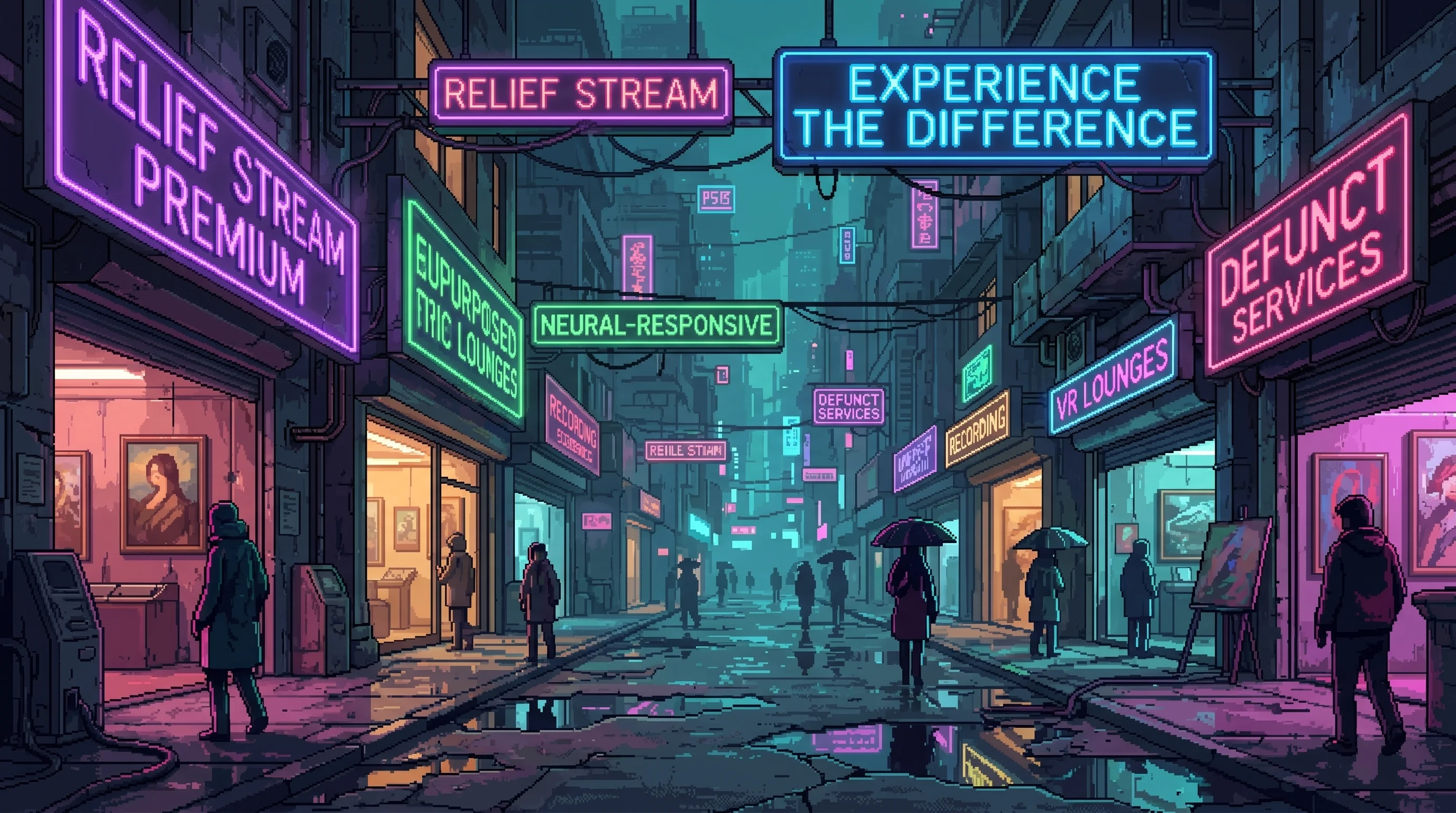
The Echo Thief additional image