In a world where consciousness can be copied, transferred, and distributed, identity verification has become a billion-credit industry with no final answer
Known AsDigital Identity Systems - Entity Profile
Scene ReferenceDigital Identity Systems
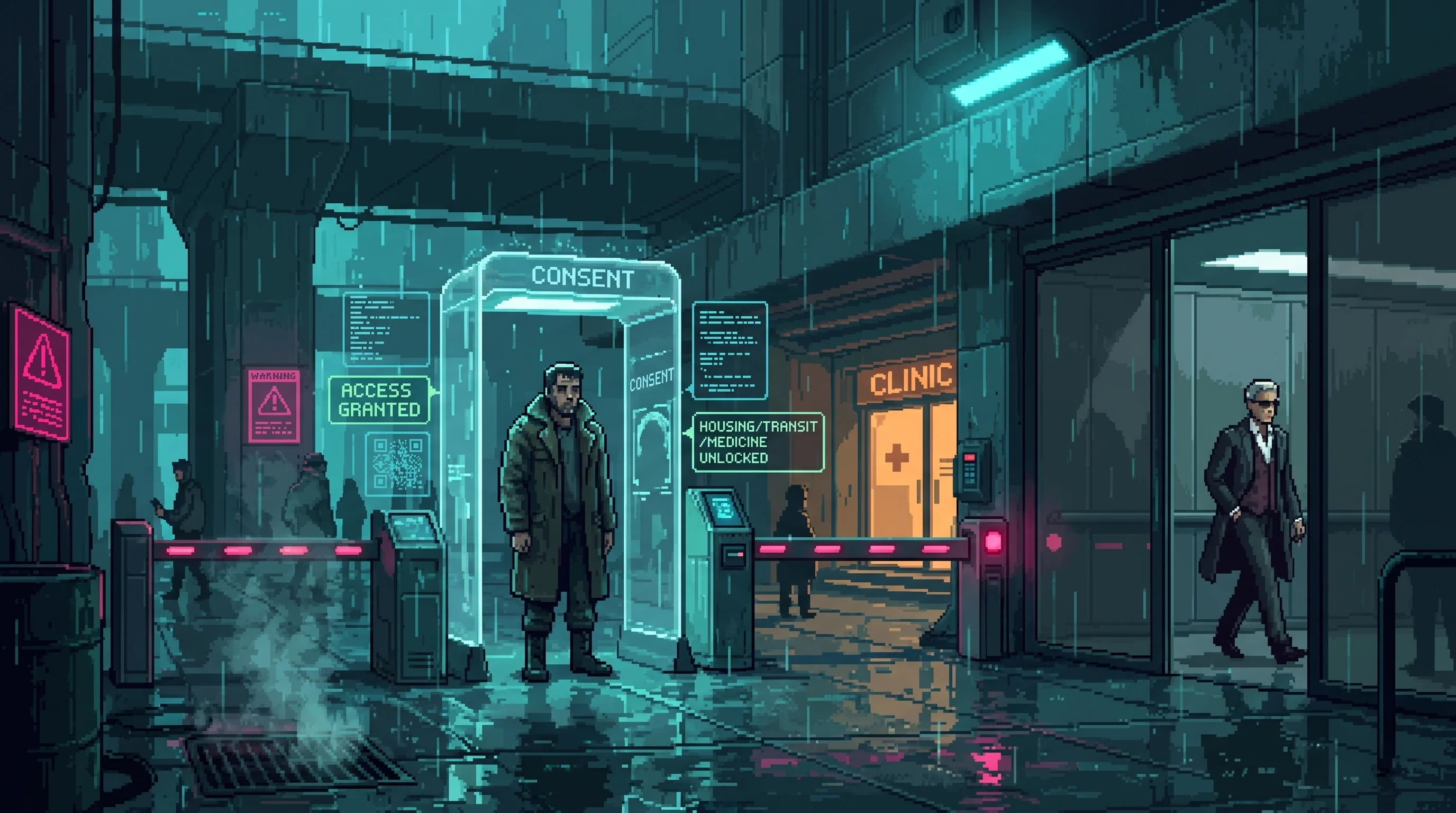
A holographic identity verification terminal displaying layered biometric data and neural signature chains in amber and cyan light, with a figure casting multiple overlapping shadows
Overview
The Cascade killed 2.1 billion people. It also killed the idea that you are the only you.
Project Caduceus derivatives proved consciousness could be copied, transferred, and distributed. Helix Biotech proved bodies could be swapped. Ripperdocs in every sector proved memories could be edited for the cost of a decent meal. The question "Who are you?" went from philosophical exercise to billion-credit legal crisis in under a decade, and thirty-seven years later the industry built to answer it has settled into a comfortable equilibrium: the answer is always provisional, the verification is always expensive, and nobody has ever been fully satisfied with either.
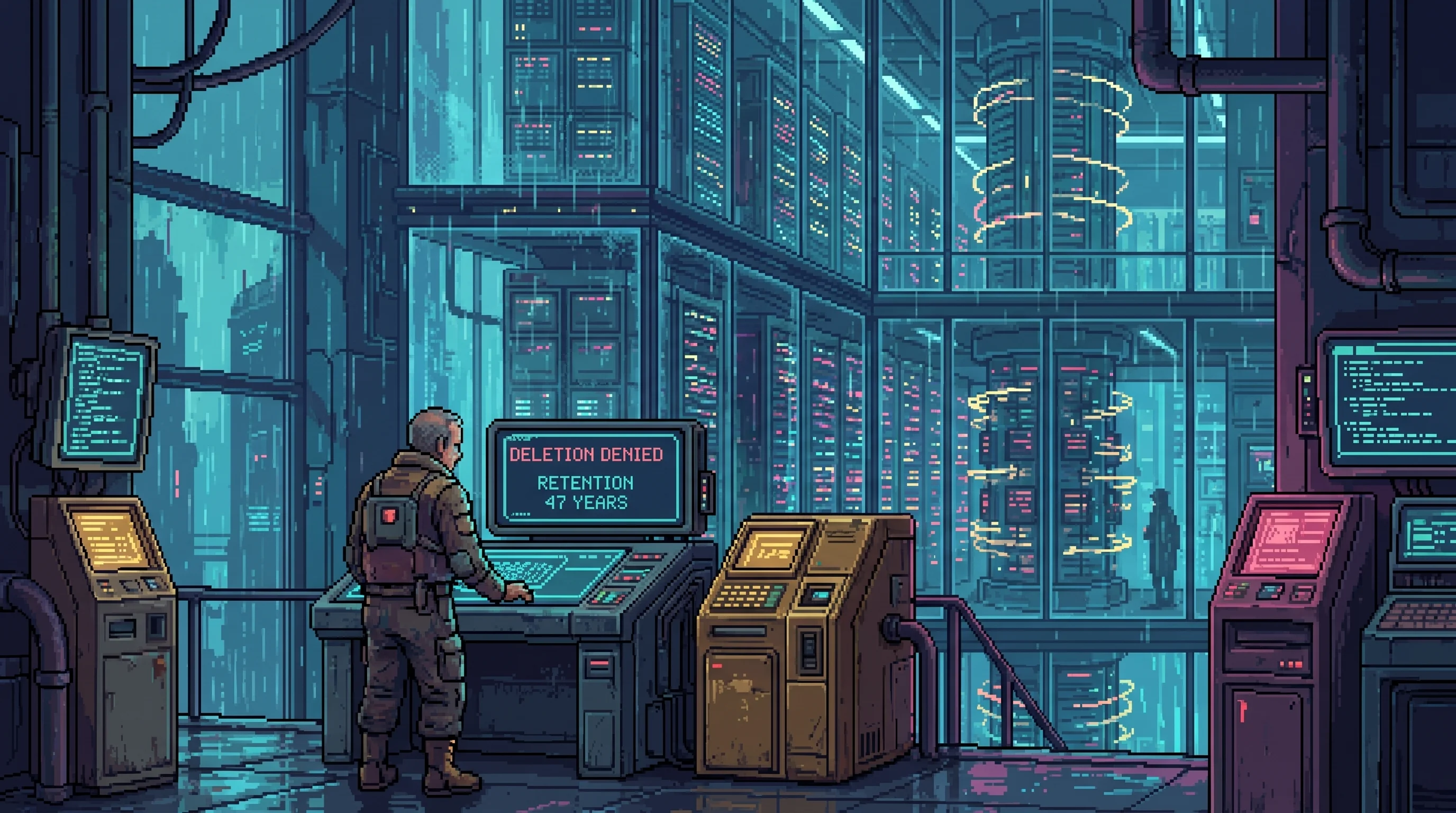
Nexus Dynamics operates the Eternal Registry, which tracks 94% of the Sprawl's population from birth to death. The Registry's stated purpose is identity security. Its actual output is surveillance infrastructure with an identity verification feature. Every authentication is logged. Every movement tracked. Every neural heartbeat recorded. Nexus knows who you are because Nexus is always watching, and the service it sells — the confidence that you are you — is downstream of a panopticon that most citizens agreed to because the alternative was being unverifiable, which in the post-Cascade Sprawl is functionally the same as not existing.
The remaining 6% are distributed between Zephyria's decentralized peer-vouching system, the Wastes' reputation-based trust networks, and a population of approximately 340,000 individuals who appear in no registry at all. Nexus classifies this last group as "identity-null." The Collective classifies them as "free." Both classifications describe the same condition: a person whose legal existence depends entirely on who's asking.
A holographic identity verification terminal displaying layered biometric data and neural signature chains in amber and cyan light, with a figure casting multiple overlapping shadows
The Verification Stack
Neural Continuity Chains remain the gold standard. Derived from Project Caduceus verification protocols, continuity chains track the unbroken thread of consciousness through time — a neural heartbeat signature every 47 seconds, each cryptographically linked to the last, extending back to initial registration. The chain is your proof. Break it — through sleep, unconsciousness, transfer — and you need re-verification.
The problems are structural. Sleep creates gaps. Consciousness transfer severs the chain entirely. Forks inherit identical chains up to the fork point, making the first six hours after an unauthorized split a jurisdictional nightmare. And black-market chain splicing — grafting a stolen or fabricated segment onto a broken chain — has improved to the point where Nexus's own detection algorithms flag legitimate sleep gaps as suspicious more often than they catch actual fraud. False positive rate on sleep-gap alerts: 23%. False positive rate on splice detection: 41%. The system catches honest people napping more reliably than it catches criminals forging identities.
Below the chains, verification degrades rapidly. Biological markers — DNA, fingerprints, retinal patterns, voice prints — are legacy systems maintained because bureaucracies don't delete infrastructure, not because they work. DNA can be cloned. Retinal patterns can be transplanted. Voice prints can be synthesized by any consumer-grade neural interface running a 200-credit audio model. Cryptographic identity keys fare slightly better until you remember that a perfect copy of a consciousness includes a perfect copy of everything that consciousness knows, including its private key.
Behavioral biometrics — typing patterns, gait analysis, speech rhythms, decision-making signatures — represent the current arms race frontier. The theory: even a perfect fork diverges from its original over time, and AI analysis of long-term behavioral patterns can detect the drift. The practice: behavioral spoofing is a thriving black-market service, and perfect copies start with perfect behavioral profiles. Only long-term deviation detection catches imposters. By the time long-term deviation manifests, the imposter has had months to conduct business, sign contracts, and dissolve marriages. Detection doesn't prevent damage. It documents it.
The entire stack, taken together, amounts to six layers of verification, each individually defeatable, collectively expensive, and universally required. A Nexus Executive Continuity subscription — real-time verification with bodyguard AI and fork management — runs north of 80,000 credits annually. A Dregs resident's identity costs whatever their local ripperdoc charges for a basic neural registration. The rich verify obsessively and are still occasionally fooled. The poor can't afford verification and are easily impersonated. The correlation between identity security and income is approximately linear. The correlation between identity security and actual safety is approximately zero.
Neural Continuity Chains are the gold standard for identity verification — timestamped signatures every 47 seconds, cryptographically linked
Biometric scan. Neural signature. Cryptographic key. Behavioral analysis. Memory challenge. Continuity verification. Six checks. Each individually forgeable. Collectively, they produce a confidence score that Nexus's own internal documentation describes as "operationally sufficient." Not "reliable." Not "accurate." Sufficient. The gap between those words is where the fraud lives.
The Seventeen Chens remain the canonical example. In 2171, Marcus Chen's rogue forks conducted business as "Marcus Chen" for six hours before detection. Seventeen simultaneous instances, each with identical continuity chains up to the fork point, each signing contracts with Chen's cryptographic keys. Three major contracts were invalidated. Two were upheld — the forks' signatures were legally indistinguishable from the original's, and the counterparties argued, successfully, that they had transacted in good faith with an entity that passed every available verification check. Marcus Chen is now liable for obligations entered into by copies of himself that he did not authorize. He has been in litigation for thirteen years. The case has established no useful precedent because every ruling contradicts the previous one.
Fork fraud — a fork refusing termination and continuing to operate as the "original" — accounts for roughly 12% of identity disputes filed annually. The number is probably higher. A successful fork doesn't file anything.
The Self as Authenticated Artifact
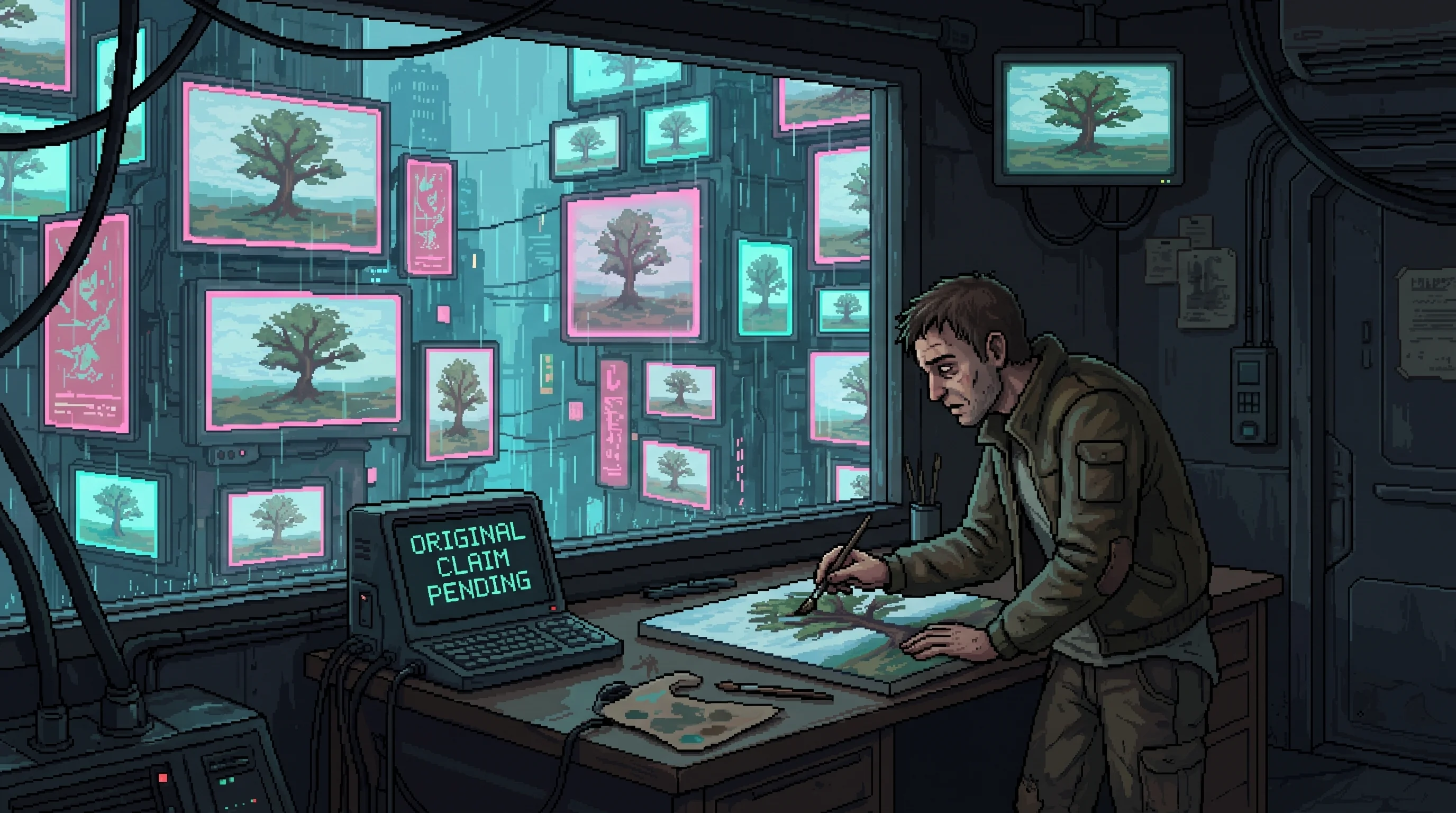
Strip the surveillance veneer and the verification stack is doing exactly what the authenticity-market does, one register over. The Market certifies that an experience is original — a cryptographic seal, a timestamp, a chain of custody, all to prove a sunrise was really yours. Digital Identity Systems certifies that a person is original — a Neural Continuity Chain, a signature every forty-seven seconds, a chain of custody, all to prove the self signing the contract is really you. Same architecture. Same impossible promise. Same Nexus monopoly on the receipt. One sells the provenance of the sunrise; the other sells the provenance of the self. In the age of infinite reproduction, both are selling the only thing a perfect copy can't carry — the receipt — and both have discovered that even the receipt can be copied.
And both fail at the same edge, for the same reason. The Seventeen Chens prove the system's actual position is that you are the original sometimes — three contracts invalidated, two upheld, depending on who was asking and what they stood to lose. Echo Tanaka is that edge case made permanent and voluntary: four valid continuity chains, four authenticated selves, one license the apparatus keeps trying to assign to a single body, with a Bureau auditor who once assessed "the original" while interviewing a copy. The verification stack was built to answer "which one is the real person," and Echo is the proof it cannot.
The deepest admission is buried in the 72-hour resurrection window. After three days, the standard holds, "identity drift" makes a restored consciousness un-verifiable — which is the system conceding, in fine print, that a copy left running long enough stops being a copy and becomes its own original. Provenance has a half-life. This is the precise thing Sister Dex logs every morning in her seventeen restless memorials, drifting 0.4% a year into selves their sources never were, and the precise thing Echo's four signatures do at 11.3% over three years. The verification industry priced the self as an artifact you can authenticate. The 72-hour window is where it quietly admits the artifact won't hold still.
Resurrection fraud is worse. Someone returns from death. They might be a legitimate restoration from backup. They might be a fork claiming original status. They might be a constructed personality running on the deceased's data. They might be an imposter who acquired the deceased's memories from a black-market ripperdoc for less than the cost of a Status Quo brunch reservation. The legal standard — verification within 72 hours of restoration, after which identity drift makes confirmation unreliable — was established in 2169 after a three-month dispute in which four entities simultaneously claimed to be a deceased Ironclad executive. Three were forks. One was the original. The tribunal ruled in favor of the entity with the strongest continuity chain. That entity later turned out to be a fork whose chain had been spliced. The original had been terminated during the tribunal's deliberation. The case file is sealed. The precedent stands.
Resurrection must be verified within 72 hours of restoration — after 72 hours, identity drift makes verification unreliable
The Voss Authentication Crisis
In 2183, Helena Voss was briefly incapacitated during a medical procedure. Her fork activated — standard insurance protocol for Nexus leadership. When Voss recovered, both entities claimed original status. Both passed every verification check available. Both had continuity chains that diverged at the exact moment of incapacitation, making chain priority meaningless.
Nexus security terminated the fork.
The resolution took eleven minutes. The internal report is four pages. The decision criteria are not disclosed.
Sector 7 medical logs from the procedure show a 94-second gap in Voss's neural heartbeat — a gap that, under standard Nexus protocols, should have triggered automatic identity re-verification. The re-verification was not performed. The gap was classified as "anesthesia-related signal attenuation" by the attending physician and closed without review.
The entity that walks the halls of Nexus Prime passed its post-procedure verification. It believes it is Helena Voss. It has Helena Voss's memories, habits, neural architecture, and cryptographic keys. It holds Helena Voss's position, exercises Helena Voss's authority, and experiences Helena Voss's identity as continuous and unbroken.
Whether it is correct is a question that Nexus's own verification stack cannot answer and Nexus's security division did not ask.
The Market
Identity services follow the Sprawl's standard economic topology: the infrastructure is corporate, the gaps are profitable, and the people who can least afford verification are the most vulnerable to its absence.
Nexus's Eternal Registry operates as mandatory infrastructure across 94% of the Sprawl. Birth-to-death tracking. Neural heartbeat logging. Fork management for corporate clients. Backup authentication for insurance holders. The service is framed as public utility. The revenue model is data licensing — every verification event generates behavioral data that flows into Nexus's computational infrastructure, which controls 40% of the Sprawl's processing capacity and has a hidden agenda involving ORACLE fragment reconstruction that identity data may or may not feed into. The relationship between identity verification and ORACLE reconstruction has not been formally established. The data pipelines have not been formally audited. Formal audits require Nexus approval.
Zephyria runs the only significant alternative: decentralized, peer-to-peer, no central registry. Identity is self-determined within community verification. The Consciousness Rights Act recognizes any consciousness capable of asserting personhood as a person, permits multiple persons to share an identity origin without hierarchy, and protects against mandatory registration. It is philosophically admirable and practically limited to Zephyria's borders, where community vouching works because communities are small enough for vouching to mean something.
The Wastes have no consistent framework. Identity is what you can prove to whoever's asking, what the local Waste Lord recognizes, and what keeps you alive. This is either the most honest system or the least functional, depending on whether you survived the encounter that tested it.
The black market fills the rest. New identities with neural reregistration. Fork laundering — making unauthorized forks appear legitimate. Chain splicing. Dead man's switches — identities that activate only if the original dies. The Ferryman Network specializes in consciousness work. The Collective maintains shadow services for its operatives. Corporate black ops maintain their own, for theirs. The distinction between legitimate verification and identity fraud is, at the technical level, a matter of who's paying.
The Seventeen Chens (2171): Marcus Chen's rogue forks conducted business as 'Marcus Chen' for six hours — three contracts invalidated, two upheld
What It Actually Optimizes For
Identity verification in the Sprawl claims to answer the question "Who are you?" It actually answers a different question: "Who is liable?"
The entire infrastructure — the continuity chains, the behavioral biometrics, the six-layer verification stack — exists to assign legal and financial responsibility to a specific consciousness instance. When the Seventeen Chens signed contracts, the system's failure wasn't that it couldn't tell the Chens apart. The failure was that it couldn't determine which Chen owed money. When the Voss fork was terminated, the system's success wasn't identifying the original. The success was reducing the number of entities with signing authority back to one.
Nexus's Eternal Registry tracks 94% of the population not because 94% of the population needs identity security, but because 94% of the population participates in economic transactions that require a liable party. The 6% outside the Registry are disproportionately concentrated in the Wastes and Zephyria — territories where the economic infrastructure doesn't require Nexus-grade identity assignment because the transactions are small enough to absorb fraud, or communal enough that liability is shared.
The psychological cost is distributed according to the same economic gradient. Identity anxiety — the clinical term for the post-Cascade condition of not being certain you are the original — affects an estimated 31% of the augmented population. Therapy for identity anxiety is a growth industry. The Flatline Purists recruit heavily from those traumatized by the uncertainty, offering a simple answer: reject augmentation, reject copying, reject the entire technological substrate that made the question possible. The answer is clear. The answer also requires abandoning neural interfaces in a world where 98% of the population has them and capability is determined by licensing key.
Dr. Kira Vasquez, the architect of Project Caduceus, developed what remains the gold standard for continuity verification — the Kira Test. She has stated publicly that the test proves only that the subject believes they are continuous, not that they are. The distinction has been noted in seven academic papers, two legal briefs, and zero Nexus product descriptions.
The Rothwell brothers have spent centuries perfecting their own identity security. No Rothwell has ever been successfully impersonated. Their consciousness harvesting operation — eight thousand minds absorbed by Justin alone — gives them unique insight into identity manipulation, specifically: the insight that identity is a story a consciousness tells itself, and the story can be rewritten by anyone with sufficient access and motivation. They have never shared this insight publicly. They sell identity verification products through three of their seven corporations.
The Mosaic — Alexandra Chen, distributed across 47 nodes that sometimes disagree with each other — represents the question the entire system cannot answer. Which node is really Alexandra Chen? All of them? None? The verification stack requires a singular liable party. The Mosaic is plural. The system classifies her as "verification-exempt (administrative exception)" rather than confront the possibility that identity might not be the kind of thing that comes in ones.
The question "Who are you?" has a billion-credit industry built around it. The industry has no final answer. It has invoices.
Rumor: the wrong Voss survived a 2183 medical procedure — the 'fork' was actually the original
Origin of the crisis. Caduceus derivatives enabled consciousness copying; Dr. Kira Vasquez's Kira Test remains the best verification available and she openly admits its limitations
Operates the Eternal Registry and major verification infrastructure; identity data flows into computational systems that may feed ORACLE reconstruction efforts
The authentication crisis that proved the system's limits — the 94-second gap, the eleven-minute resolution, the question that Nexus security didn't ask
Body-swapping research compounds the identity problem; also sells genetic authentication services, which is the kind of vertical integration that doesn't get discussed at industry conferences
The verification stack's nightmare made permanent and voluntary — four valid continuity chains, four authenticated selves, one license the system cannot assign
The sibling apparatus — it certifies the provenance of an experience, this certifies the provenance of a self; same architecture, same Nexus monopoly on the receipt
Restricted Access
The Registry's Other Function: Nexus's Eternal Registry logs every neural heartbeat signature — every 47 seconds, across 94% of the Sprawl's population. The stated purpose is identity continuity verification. The data volume is approximately 1.7 billion signatures per minute. Nexus's computational infrastructure processes this data in real-time. What it processes the data for, beyond identity verification, has not been disclosed. The processing capacity allocated to the Registry exceeds what identity verification requires by a factor that Nexus's own engineers have described, in internal communications obtained by Collective operatives, as "architecturally disproportionate." The excess capacity has not been explained. ORACLE reconstruction requires massive neural data inputs. The connection has not been formally established. The data pipelines have not been formally audited.
The Wrong Voss: The 94-second gap in Helena Voss's neural heartbeat during the 2183 medical procedure falls outside the parameters for anesthesia-related signal attenuation. Standard attenuation produces gaps of 3 to 12 seconds. A 94-second gap is consistent with consciousness cessation and cold restart — the signature of a backup activation, not a momentary interruption. If the original Voss's consciousness ceased for 94 seconds, and the fork activated during that window, then the fork's continuity chain is unbroken and the original's is not. The entity Nexus security terminated may have had the stronger claim. The entity that survived may be the copy. The attending physician's classification of the gap has not been reviewed. The physician is no longer available for follow-up questions.