TypeTriumph Corporation flagship restaurant — where status anxiety is the prix fixeDistrictThe Heights, Sector 3 — Pacific Heights Rim edgeControlled ByTriumph (Rothwell Corporation)Capacity180 seats (normal dining), 24 seats (fine dining), 14 seats (brunch)
Overview
Status Quo is the most sought-after dining reservation in the Sprawl, and it has been getting worse every day for seven years.
This is not a contradiction. The restaurant sits on the Pacific Heights Rim edge — the literal highest ground in the Sprawl for the literal highest-status venue — where Triumph Corporation's flagship dining experience converts digital reputation into material reality. The food is a formality. The product is the privilege of telling people you went.
The fundamental dynamic is simple and self-reinforcing: food quality declines because no one provides honest feedback, because honest feedback would signal unsophistication, because signaling unsophistication would lower your Triumph Score, because a lower Triumph Score would make it harder to get a reservation, because getting a reservation is the only thing that matters. The food is irrelevant. The food has always been irrelevant. The food was irrelevant before the restaurant opened, because Triumph Corporation does not sell food. Triumph Corporation sells the anxiety of not being seen and the temporary relief of being seen, and Status Quo is where that transaction happens with silverware.
Critics who have dared to note the inverse correlation between the restaurant's popularity and its food quality have been met with a response more devastating than any rebuttal: pity. The social consensus is that such critics simply lack the sophistication required to appreciate what Status Quo offers. This consensus is maintained by people who also do not appreciate what Status Quo offers, but who understand that saying so would be worse than the food.
The emperor has no clothes. The emperor has never had clothes. The emperor's lack of clothes has been on the menu since 2171, and it has never received a complaint.
Conditions Report
Status Quo looks like what would happen if the Cosmopolitan in Las Vegas achieved sentience and developed an anxiety disorder.
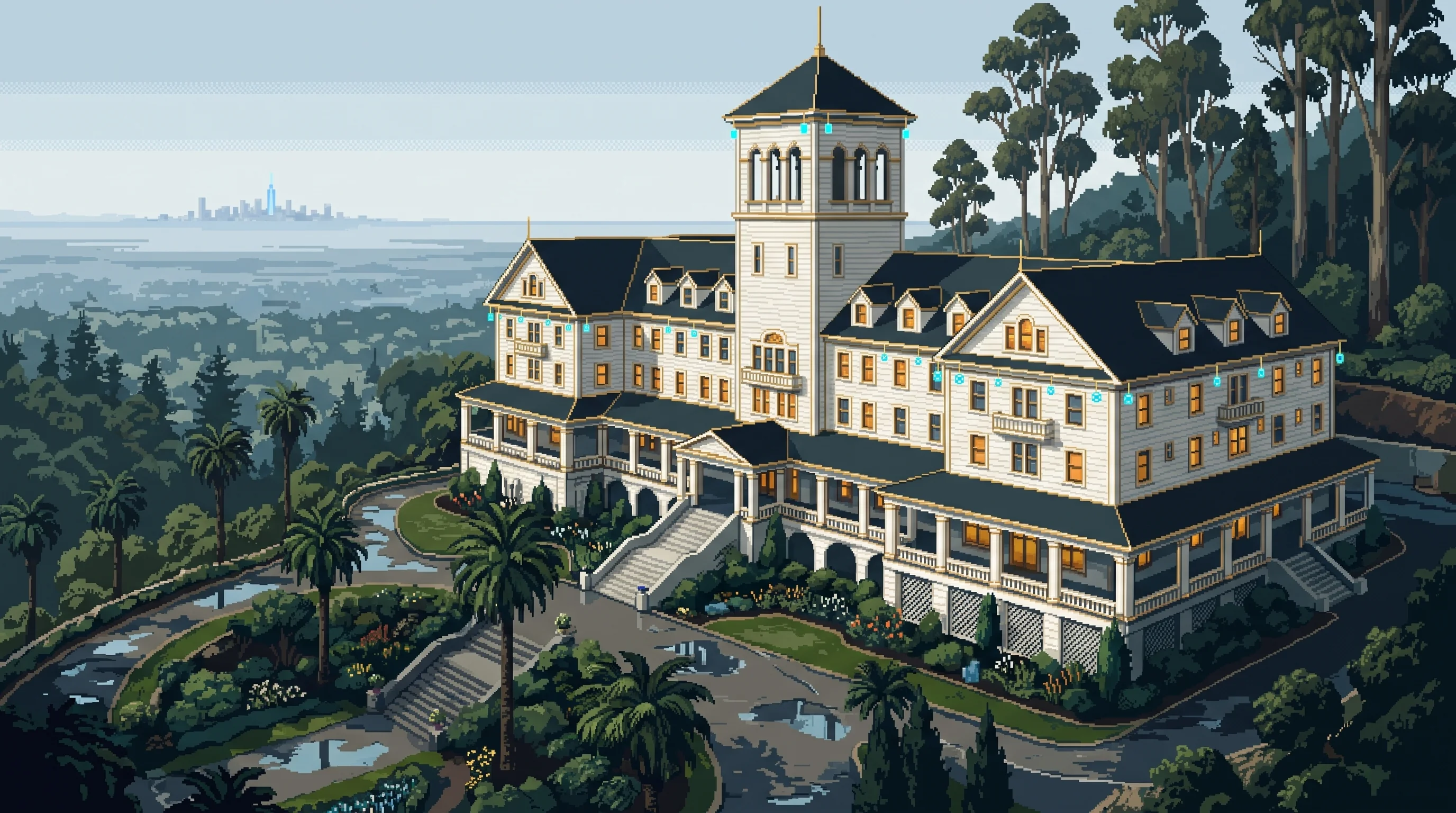
The venue occupies three floors of a pre-Cascade Pacific Heights mansion that has been gutted, rebuilt, and filled with contradictions. Every surface is textured differently — fur on the banquettes, suede on the armrests, latex on the bar top, reclaimed wood on the floor — creating a tactile landscape that photographs like a dream and feels like a dentist's waiting room. The leather is applied directly to the wood with no cushion. Nobody has complained about this in the restaurant's entire history, because complaining about comfort would imply that you came here to be comfortable, which would imply that you don't understand what this place is for.
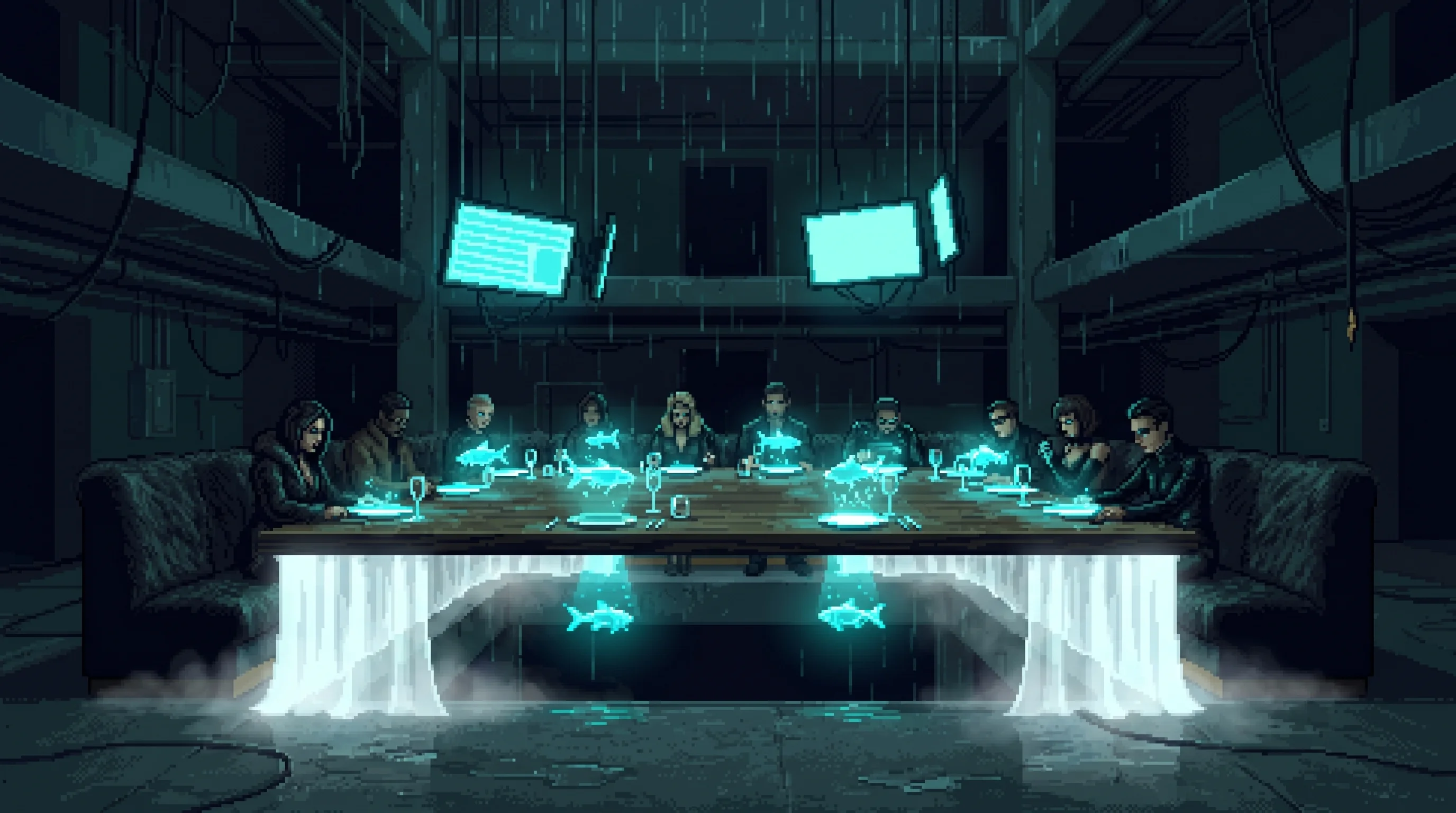
The tables float. Not metaphorically — Triumph's magnetic suspension technology holds each table at precisely 76 centimeters, eliminating legs and creating the illusion of dining on air. Holographic projectors beneath each table's surface cast images of bioluminescent fish swimming across the plates, rendered from consciousness-scanned memories of species that went extinct during the Cascade. The fish are more "real" than any living reference. Fog machines built into the table edges produce a continuous cascade of illuminated mist that falls to the floor like dry ice at a concert, lit from below by the projections. The effect is genuinely beautiful. It also makes it impossible to see your food clearly, which management has never identified as a problem.
LCD screens mounted on invisible suspension wires display rotating art installations — abstract, slowly morphing, aggressively meaningless. The art changes weekly. No patron has ever commented on the art. No patron has ever noticed it change. The screens exist to be in photographs.
The air conditioning runs at 16 degrees Celsius year-round, regardless of weather. Management's official position is that this temperature "preserves the integrity of the molecular preparations." The staff's unofficial understanding is that cold patrons order fewer courses, finish faster, and free tables for the next reservation. God forbid you want a dessert or another course — by hour six, the staff's primary objective is ending their shift, not serving you. Additional courses register as personal grievances. The founder's original vision of a restaurant where guests might linger for hours over conversation has been thermodynamically eliminated.
Case File — Additional Record
Reservation Lead Time
6-14 weeks standard; brunch slots allocated by Triumph Score ranking
Brunch Window
10:42 AM to 11:47 AM — not a minute earlier, not a second later
Triumph Score Minimum
Officially none. Functionally 8,400+
Known For
The most exclusive brunch in the Sprawl, DJ residencies, floating tables, and food that nobody has ever credibly reviewed
Founded
2171 by Cassius Vex; acquired by Triumph 2176
Slogan
'Be Seen Dining.'
The Brunch
The brunch is the reason Status Quo exists in the cultural imagination. It is the most exclusive brunch in the Sprawl, the most discussed, the most envied, and by a significant margin, the least reviewed.
It is served between 10:42 AM and 11:47 AM. Not approximately. Not "around ten-thirty." The kitchen opens at 10:42 and closes at 11:47, a sixty-five-minute window that management has never explained and staff have never questioned. The operating theory among the Sprawl's food writers is that the original chef arrived late on opening day and the resulting window became tradition. The actual reason is that Cassius Vex, the founder, liked the way the numbers looked on the reservation screen. The restaurant's website makes the brunch hours deliberately unclear — listing breakfast service as ending "approximately 10:30-10:45" and noting that the restaurant "closes for a 30-minute transitional preparation period" before the 12 PM lunch menu. The shutdown is officially described as kitchen recalibration. It is actually management running the neural-profile analytics from brunch service.
Brunch reservations are not made through conventional channels. Slots are allocated by Triumph Score ranking among applicants, processed through Triumph's algorithmic queue. The waiting list is measured in months. Cancellations are filled within ninety seconds by the next-ranked applicant, who receives a neural notification and must confirm within four minutes or forfeit. This system ensures that every brunch attendee has been pre-filtered for status, creating a room where the act of being present is the status transaction. The food is the receipt.
No credible review of the brunch food has ever been published.
This is the most remarkable fact about Status Quo, and it is the one nobody remarks upon. Thousands of the Sprawl's most influential critics, journalists, and social commentators have attended the brunch. They have posted about it on Triumph Social. They have described the experience as "transcendent," "essential," and "unlike anything else in the Sprawl." None of them have described what they ate.
The reason is structural, not conspiratorial. To describe the food honestly would be to admit that it is adequate — competently prepared, generously portioned, and entirely unremarkable. This admission would imply that the hours spent securing the reservation, the Triumph Score points spent on the application, and the social capital invested in mentioning it afterward were all spent on something ordinary. The social cost of this admission exceeds the social cost of vague superlatives. So the reviews are vague, and the superlatives accumulate, and the demand increases, and the kitchen — receiving no useful feedback — has no mechanism for improvement and no incentive to seek one.
The harshest critics — the ones who operate on encrypted channels and communicate through systems Triumph cannot monitor — believe the brunch is actively bad. The eggs are overcooked. The bread is yesterday's. The coffee is from the same distributor that supplies Dregs automated kiosks. These critics are dismissed by the mainstream not as wrong but as sad — people whose inability to appreciate the brunch reveals a deficiency in themselves rather than in the eggs.
Attending the brunch is, among the Sprawl's elite, a weapon. The mention of having attended — dropped casually into conversation — highlights that you were able to attend where others were not. The implication: people who have not attended are too unconnected, too unpunctual, or too low-status. Celebrities attend regularly, which drives more demand, which attracts more celebrities. The kitchen interprets this as validation of their cooking. It is not. The interest is self-referential — people want to go because other people want to go because other people went.
The loop is complete and self-tightening: exclusivity creates demand, demand creates cachet, cachet prevents criticism, the absence of criticism prevents improvement, the decline in quality is undetectable because detection would require someone to risk their status by detecting it. The brunch gets worse. The reviews get better. The waiting list gets longer. Nobody is lying. Nobody is honest. Everyone is performing appreciation for an audience performing the same thing.
Triumph's internal metrics show that the brunch generates more Triumph Social engagement per square meter than any other venue in the Sprawl. The metric does not measure food quality. The metric has never measured food quality. The metric measures the thing Triumph sells, which is the feeling of being seen, and by that metric, the brunch is the most successful restaurant experience in human history.
The Menu
Upon receiving the menu — projected onto a personal holographic display calibrated to your neural profile — new patrons experience what the staff have come to call "the pause." This is the three-to-seven-second interval during which the patron realizes they cannot identify the language the menu is written in.
The menu is in English. Technically.
Each dish description is a dense lattice of cultural references, Latin botanical terminology, geographic specificity ("hand-pulled from the Oaxacan highlands of Sector 19's vertical farms"), technique jargon ("sous-vide at negative pressure for 72 hours in a zero-point fermentation vessel"), and sensory language that requires not just culinary knowledge but art criticism, musicology, and at least conversational fluency in three dead languages to fully parse. A salad is described as "a deconstructed meditation on terroir consciousness, featuring seventeen heritage microgreens in recursive arrangement with cold-pressed umami reduction and a foam derived from the memory of truffle." Twenty-three of the menu's twenty-six entrees include a foam component. The menu's descriptive language devotes, on average, more words to the foam on a dish than to the protein beneath it. The bread is listed under "Carbohydrate Architectures."
The menu's opacity is not accidental. Triumph's neural-interface team discovered that menu confusion correlates with higher spending — confused patrons default to the most expensive option, order more courses to "figure it out," and tip more generously out of compensatory anxiety. The holographic display adapts in real-time to the patron's biometric data. When it detects rising cortisol levels — the biochemical signature of confusion and social anxiety — it subtly increases the typographic density and introduces additional French terminology. The menu literally becomes harder to read when you're struggling to read it.
The chef — whose name is not on the menu, not because of humility but because the menu has no room — maintains an extraordinary confidence that every dish is perfect as presented. Condiments are not offered. Salt and pepper are not on the table. A patron requesting additional seasoning will be met with a gentle, genuinely confused correction from the waiter: "The chef has already seasoned the Tabasco on the oyster." This is not passive-aggressive. The waiter is not being hostile. The concept of supplementary seasoning simply does not exist in the restaurant's operational framework. The chef's neural augmentation includes a "culinary certainty" module that prevents second-guessing — an algorithmic feedback loop in which the chef's confidence produces dishes that the chef is confident about, confirmed by the absence of complaints from patrons who cannot afford to complain.
Every dish is a spectacle. A salad arrives as a seven-layer tower, each stratum representing a different biome, suspended on a transparent support structure. The bread is delivered in a basket hanging from a miniaturized lamppost — an actual functioning lamppost, twelve inches tall, that illuminates the bread with a warm glow while the main course sits in projected darkness. A steak arrives under a glass dome filled with hickory smoke that, when lifted, releases a plume that triggers the table's fog machine, creating a localized weather event. Nearly every dish is crowned with a foam — the chef has introduced nine new foam varieties in the past eighteen months, interpreting the absence of complaints as demand for more. The foams add an average of 4.7 centimeters to each dish's vertical profile, which has been noted in Triumph Social posts as "sculptural" and in the kitchen's internal waste logs as the most frequently unconsumed component by weight. The plating has, by any reasonable assessment, jumped the shark. It jumped the shark in 2174 and has been ascending ever since, propelled by the same feedback vacuum that drives everything at Status Quo: no one will say it's too much, so the chef concludes it's not enough.
The plates are enormous. The tables, optimized for Triumph photo composition rather than food service, are small. Every course arrives as a spatial negotiation, the waiter placing dishes with the quiet irritation of someone solving a puzzle they didn't create, occasionally glancing at the patron as if the fundamental problem is that they ordered food at a restaurant.
Site Classification
Stratum
Elite
Power Position
Insider
Access
Restricted
Atmosphere
Oppressive
The Staff
Status Quo's hiring process is legendary in the Sprawl's service industry, though not for the reasons management believes.
The front-of-house team is assembled through what management calls "aesthetic curation" — a process in which candidates are evaluated for their perceived artsy-ness, uniqueness, and trend-forward sensibility. An unconventional haircut is noted. A handlebar mustache is appreciated. A bow tie is considered a strong indicator of the "creative confidence" that management associates with the Status Quo brand. The resulting staff is a collection of people who look like what a committee of people who were cool in 2168 think cool looks like in 2184.
Management has lost touch with what is actually trendy. This is not obvious to management, because the people who could tell them — the genuinely trendy — would never work at Status Quo, and the people who do work at Status Quo are too grateful for the position to offer correction. The feedback loop is closed.
And it is a remarkable loop. Upon being hired, new staff experience a Triumph Score spike of 800-1,200 points — the algorithm treats "employed at Status Quo" as a major status event. Their verification badges, worn during service, glow measurably brighter than the badges of most patrons. This is not a design choice. Triumph badges display at brightness proportional to the bearer's engagement metrics, and Status Quo staff — who interact with hundreds of high-status patrons per week — generate engagement data that outpaces all but the most active social media influencers.
The result is a service staff whose badges outshine their customers'. The visual hierarchy is inverted: the servers are the most verified people in the room. This produces a psychological dynamic that no management consultant has successfully explained and no operational review has successfully corrected. The staff do not behave like servants. They behave like hosts — generous, slightly condescending hosts who have graciously allowed you into their home and are mildly disappointed that you've asked for more water.
When a patron defers to a waiter — accepting a wine recommendation without question, agreeing that the chef's seasoning is sufficient, thanking them for the privilege of a table — the waiter's neural augmentation registers a dopamine cascade. Management's workforce analytics interpret this as "employee satisfaction." It is not satisfaction. It is the specific pleasure of being worshipped by someone who paid for the privilege. The more the patron defers, the better the waiter feels. The better the waiter feels, the more confident they become. The more confident they become, the more the patron defers. Every night, the gap between server and served widens by a fraction no individual interaction can detect and no accumulation of interactions has ever corrected. The staff's inflated ego directly degrades the dining experience: courses arrive at the server's convenience, water is refilled at the server's pace, and the condescension negs the diners — making them feel they aren't cool enough to be here, which increases their deference and feeds the cycle. God forbid you want a dessert or an additional course. By hour six, the staff's primary objective is ending their shift, not serving you. An additional course is an extreme grievance.
The staff have forgotten the fundamental nature of a business: to serve its customers. This is not a metaphor. The operational training materials — last updated by the original founder in 2173 — emphasize "hospitality as sacred trust." Current staff orientation consists of a thirty-minute session on Triumph badge protocols and a tour of the DJ booth. The word "hospitality" does not appear in current training documents. The word "brand" appears forty-seven times.
The Hostess Protocol
Arriving at Status Quo is an experience designed to establish, within the first ninety seconds, that you are not good enough to be here.
The hostess — augmented with Triumph's social-evaluation suite — greets arriving patrons with a scan that is technically a "welcome assessment" and functionally a net-worth appraisal. The scan is visible: a brief golden shimmer passes over the patron as their Triumph Score, reservation history, and social graph are loaded into the hostess's display. Patrons with scores above 9,000 receive the shimmer and a smile. Patrons below 8,800 receive the shimmer and a question.
"Will you be joining us in the main dining room, or the fine dining experience?"
The question is asked regardless of the reservation. The reservation specifies the dining room. The hostess knows which room the patron has booked. The question is not about information. The question is about establishing, loudly enough for the lobby to hear, that the patron might not belong in the fine dining room — and by implication, that they might not belong here at all.
The effect is particularly devastating when patrons arrive with someone they are trying to impress — a date, a business partner, a potential investor. The hostess's question, delivered with practiced innocence in a lobby designed to amplify sound, announces to the companion that the patron may not be a fine dining room person. One regular: "I spent three months securing this reservation to impress a client. The hostess asked me which dining room in front of him. I could feel the deal dying. The food was fine. I don't remember what I ordered."
Some patrons report this as confusing. Others report it as humiliating. Both responses are correct, and neither has been communicated to management, because communicating dissatisfaction to management would require speaking to the hostess again.
The fine dining room and the normal dining room are separated by a living wall of engineered plants — translucent enough to allow the normal dining room to see the fine dining room's ambient glow, opaque enough to prevent them from seeing anything specific. The separation is architectural theater. The food is identical. The wine list is identical. The fine dining room has slightly dimmer lighting, slightly more fog, and a 300% surcharge. The experience of eating in the fine dining room is, by every measurable metric, indistinguishable from the normal dining room. The experience of not eating in the fine dining room — of sitting forty feet away, separated by engineered foliage, aware that a better version of your evening exists on the other side of the plants — is the actual product the fine dining room sells.
Walk-in requests are not merely declined. They are processed by the hostess's augmentation as a category error. The neural pathway for "unscheduled arrival requesting immediate seating" does not exist in her cognitive architecture. The request is parsed, found to match no known interaction pattern, and routed to a confusion-management subroutine that produces a response the patron experiences as polite bewilderment and the hostess experiences as genuine uncertainty about what the patron is asking for. She is not pretending to be confused. She is confused. Walk-ins are, to her augmented cognition, not a thing that happens. To call and ask if walk-ins are available is considered, by the staff who answer the phone, a form of insult so novel that it cannot be categorized as rudeness — it is simply evidence that the caller does not understand how the world works.
Certain tables are declared "unavailable" at certain times despite being visibly, obviously empty. When patrons ask why, the staff respond with a mixture of offense and genuine incredulity — as if the question itself reveals a fundamental misunderstanding of how the world works. The rules governing table availability have never been written down, explained, or justified. They simply exist, enforced with the quiet confidence of people who have never been asked to explain anything and find the prospect faintly insulting.
Reservations require a precise time. More than five minutes of lateness triggers a 500-credit "reservation forfeiture fee" charged automatically to the patron's Triumph account before anyone informs them. More than five minutes of earliness is met with a suggestion to "enjoy the neighborhood" — a suggestion that, on the Rim edge of Pacific Heights, means standing on a sidewalk overlooking the sixty-foot drop to the bay floor and contemplating the distance between where you are and where you could fall. Arriving on time, however, does not guarantee immediate seating, because tables are allocated on a first-come-first-served basis among patrons whose reservations fall within the same window. The reservation is a necessary condition, not a sufficient one. You must arrive at the correct time. The correct time will not help you.
Upon check-in, patrons are asked for their contact information. Specifically, their neural-link address. There is no option to decline. No explanation is offered for why the restaurant needs direct access to your cognitive interface. The staff promise, with practiced sincerity, that the data will not be used for marketing purposes or shared with third parties. Every patron who has provided their neural-link address reports a significant increase in targeted status-anxiety advertising within seventy-two hours. Triumph's behavioral prediction division receives the data before the patron receives their appetizer.
Seating is "random." According to the hostess, according to management, according to the official Triumph Score-neutral seating policy, table assignment is determined by a fairness algorithm that considers only party size and dining room capacity. The algorithm is fair. The algorithm's inputs are not. Among the variables the algorithm considers "relevant to party experience optimization" are the patron's social visibility metrics, follower count, and — through a data partnership with Triumph's media division — their photogenic index. The result is that the most attractive, most famous, and most followed patrons are consistently seated in the main room by the windows, bathed in natural light and visible from the street. In the darker corners of the restaurant, away from the windows and the projected art and the fog machines, there is an overrepresentation of patrons who are less attractive, less followed, and less useful to the restaurant's visual brand. The algorithm calls this "ambient optimization." The algorithm is not wrong. It is optimizing for the wrong thing, and nobody has the authority or the incentive to tell it.
Located on the Pacific Heights Rim edge, Sector 3 — the highest-elevation restaurant in the Sprawl
The DJs
Status Quo is notorious for its DJ residencies. Each month, a new DJ is installed in the elevated booth overlooking the main dining room, playing music at a volume that management describes as "immersive" and patrons describe, when they describe it at all, as "a bit much."
The DJs are famous. This is the only fact about them that is not disputed.
The music is generic — algorithmically generated downtempo that a Triumph Social analysis would classify as "ambient corporate." It sounds like the background music in a luxury hotel lobby, which is precisely what it was designed to sound like, because the DJ's AI composition suite was trained on a dataset of luxury hotel lobbies. The DJs believe the music is excellent. Triumph Social's engagement metrics confirm the music is excellent. The metrics are generated by an algorithm that recommends content based on what other users have engaged with, and other users engage with the DJ because the algorithm recommended the DJ, and the algorithm recommended the DJ because other users engaged. The loop is airtight. The music gets worse every month as the algorithm's recommendations narrow, the DJ's confidence grows, and the distance between "popular" and "good" becomes a canyon that nobody can see because they are standing in it.
The DJs play too loud because they believe the music deserves to be heard. They believe the music deserves to be heard because Triumph's engagement data says people love it. People love it because they've been told people love it. Nobody chose this. Nobody can stop it. The volume increases by approximately 0.3 decibels per month — a rate imperceptible on any given evening and unmistakable over a year. Long-term patrons have noticed. They have not mentioned it. Mentioning it would imply that the music is a problem, and the music cannot be a problem, because everyone agrees the music is great.
The Plating
A note on the food itself, to the extent that the food can be discussed independently from the apparatus surrounding it.
The dishes are not bad. This is perhaps the cruelest thing about Status Quo. If the food were terrible — genuinely, obviously, unmistakably terrible — someone would eventually say so. Bad food is a failure that can be identified and corrected. Status Quo's food is adequate. It is competently prepared, aggressively seasoned by a chef who does not accept the premise that it could be otherwise, and presented on platters that cost more than the ingredients. The food exists in the uncanny valley between good enough to defend and not good enough to celebrate, and this is precisely the space in which the emperor's-new-clothes dynamic thrives. If the food were worse, someone would break. If the food were better, the pretension would be justified. At its current level — aggressively mediocre — the social cost of honesty always exceeds the satisfaction of truth.
The pudding that tastes like fish has been on the menu since 2178. It was the result of a supply chain error during a particularly ambitious "ocean-to-table" tasting menu, when the pastry station received a shipment of bonito stock instead of vanilla extract. The resulting dessert was served to fourteen patrons, all of whom pronounced it "challenging and rewarding." The chef, receiving this feedback, added it to the permanent menu. It has been ordered 11,400 times. It has received zero complaints. Triumph's review aggregation shows a 4.2-star average for the pudding, based on 340 reviews that use the words "bold," "unexpected," and "not for everyone" — the vocabulary of people who did not enjoy something and cannot say so. The foam-inclusive dishes receive nearly identical treatment: "textural," "ethereal," "architectural." A linguistic analysis of Triumph Social reviews found that the words used to praise foam in five-star reviews are statistically indistinguishable from the words used to describe foam in two-star reviews. Both vocabularies describe the reviewer, not the foam.
The strongest skeptics believe the pudding is an inadvertent loyalty test — that continuing to order it, to recommend it, to post about it on Triumph Social, is the final proof that a patron has fully internalized the Status Quo dynamic. You don't eat the fish pudding because it's good. You eat it because ordering it proves you're the kind of person who eats it. The pudding is the restaurant in miniature.
Neural-profile data harvested during check-in is sold to Triumph's behavioral prediction markets
The Sensory Problem
Status Quo sources ingredients from forty-seven distinct culinary traditions. The kitchen maintains stations for Japanese, Peruvian, Ethiopian, Nordic, Cantonese, and Mexican preparations, among others. Each station produces dishes that, individually, smell remarkable — the char of yakitori, the citrus of ceviche, the berbere of doro wat, the smoke of mole negro.
Collectively, the restaurant smells like all of these things at once.
This is the olfactory equivalent of hearing seven songs played simultaneously. Each fragrance is lovely. The combination is disorienting — a sensory Babel that the nose cannot parse into individual threads. Patrons who notice the smell (and many do) attribute their confusion to their own lack of culinary sophistication. They assume that a more experienced diner would be able to identify and appreciate the individual components. They are wrong. The smell is objectively incoherent. But "objectively incoherent" is not a phrase that any patron has used in any Triumph review, because admitting olfactory confusion at Status Quo would be admitting that one's nose is insufficiently worldly for the restaurant's ambitions.
The restaurant is filled with artificial elements that complete the sensory fabrication:
Artificial ponds with engineered koi that swim in patterns determined by the day's reservation density. Artificial fire in transparent columns that produces heat calibrated to offset the aggressive air conditioning by exactly not enough. Artificial wind — gentle, scented, generated by hidden fans — that moves through the dining room at intervals designed to "evoke outdoor dining" in a space with no windows that open. Artificial gardens with artificial plants that require artificial sunlight and artificial rain scheduled during off-hours, maintained by a botanical AI that has achieved, according to its own metrics, a 98.7% fidelity to natural plant behavior in a garden where nothing has ever been alive. From the fine dining room, looking through the engineered plants, every table in the normal dining room appears to be eating the same dish — white, peaked, gently collapsing. The foam. A menu claiming to span forty-seven culinary traditions achieves visual uniformity through the one element that appears on every plate.
The entire venue has been fabricated. Literally — every physical element is manufactured, engineered, and maintained by systems optimizing for metrics that do not include "does the patron enjoy being here." And figuratively — the experience itself is manufactured for a customer who does not want the product being offered but cannot articulate this because the vocabulary for "I paid eight thousand credits for a meal I didn't enjoy in a room that made me uncomfortable while being judged by a waiter whose badge was brighter than mine" does not exist in the Sprawl's social lexicon.
Strategic Assessment
Status Quo is what happens when feedback loops are severed by social pressure and accelerated by technology.
Every dysfunction in the restaurant is human in origin. The status anxiety, the performative enthusiasm, the terror of honest criticism — these are ancient pathologies. What Triumph's technology does is remove the friction that might slow them down. In a pre-augmentation world, a restaurant this dysfunctional would receive honest reviews, lose patrons, and either improve or close. Status Quo cannot receive honest reviews because the review platform is owned by the same company that owns the restaurant, and the review platform's algorithm penalizes negative sentiment about Triumph properties. Status Quo cannot lose patrons because losing patrons would require someone to decide, publicly, that they no longer want to be associated with the highest-status venue in the Sprawl, and that decision would be broadcast to their entire social graph by the same platform that manages their status. The technology doesn't create the dysfunction. The technology makes the dysfunction permanent.
The menu adapts to make you more confused. The hostess can't cognitively process walk-ins. The seating algorithm optimizes for photogenics. The foam is on every plate and in no one's stomach. The review system punishes honesty. The DJ's popularity is computationally self-referential. Each system, individually, is doing exactly what it was designed to do. Collectively, they produce an experience that nobody wants, nobody enjoys, and nobody can escape, because every exit is monitored by the same infrastructure that created the entrance.
This is the Sprawl's answer to the question: what happens when the tools designed to help people express preferences are owned by the company that profits from suppressing them?
The answer is a restaurant with a fourteen-week waiting list and a pudding that tastes like fish.
The brunch is served exclusively between 10:42 AM and 11:47 AM; no credible review of the actual food has ever been published
Affiliated Entities
Fairmonte: Triumph's rival experiment in elite dining. Status Quo's waiting list survives declining quality because criticism costs status. Fairmonte's waiting list survives because the cyber oysters are worth returning for, and missing the return strips the member of the right to apply again. The difference is culinary. The anxiety belongs to the same owner.
Triumph: Status Quo is Triumph's crown jewel — the physical space where digital status becomes material. Every Triumph Score notification, every verification badge, every social ranking was designed to create the desire to be here. The restaurant is not a business. It is the destination of a business. The business is Triumph.
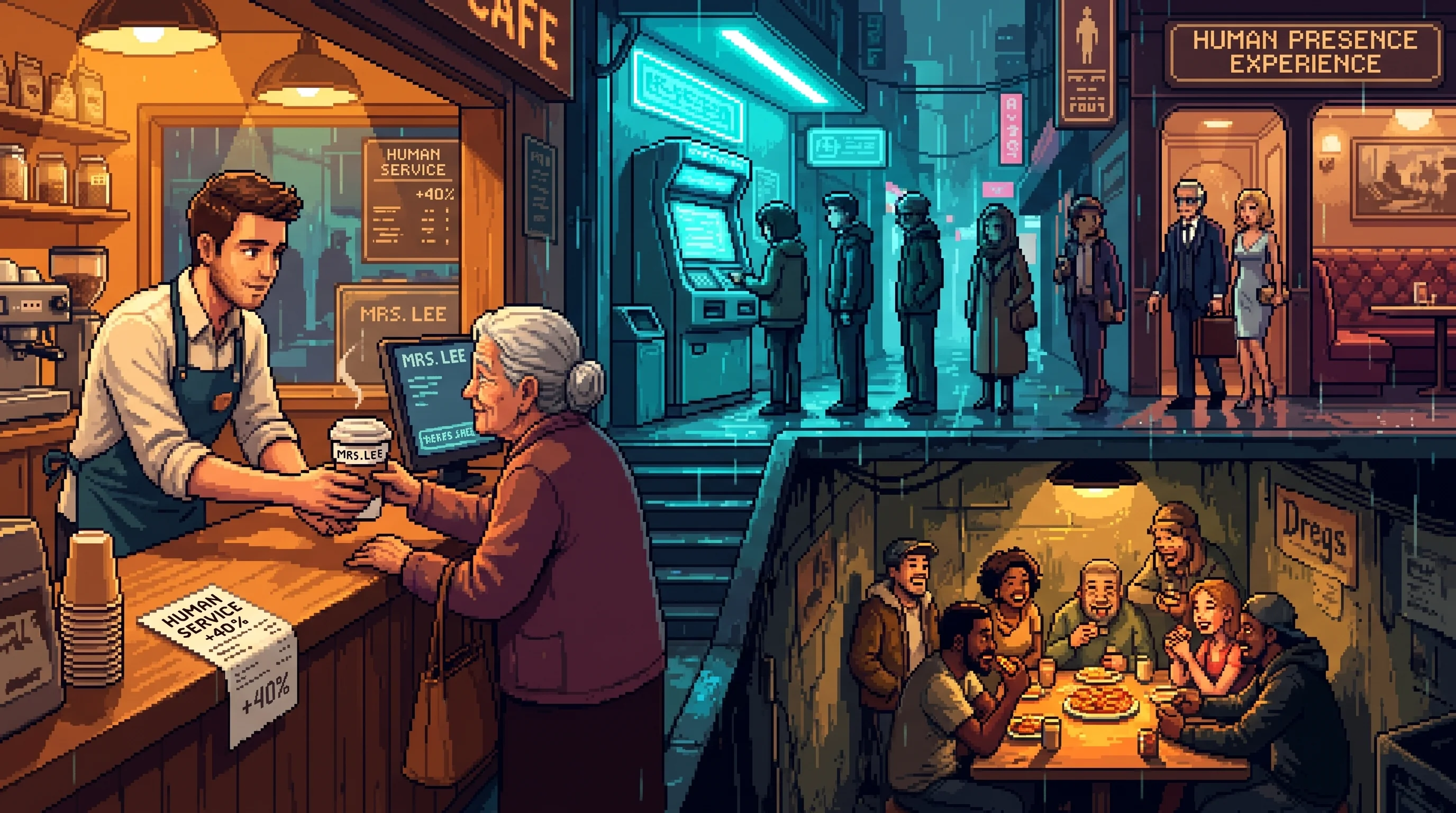
The Small Talk Cafes: The mirror image. Wren Adeyemi's cafes charge a 40% premium for someone to ask "how's your day?" and listen to the answer. Status Quo charges a 4,000% premium for someone to not ask how your day is going, and for you to not mention it. Both are selling human connection. Only one is delivering it.
Patience Cross: Her twelve-seat noodle counter in the Deep Dregs is everything Status Quo pretends to be. Intimate. Warm. Concerned with whether you actually enjoyed the food. Her fragment-amplified warmth — 847 on the warmth index — produces more genuine human connection in one bowl of noodles than Status Quo produces in an entire evening. The irony is that Patience Cross doesn't know Status Quo exists. Status Quo's entire identity depends on the existence of places like hers.
The Dumb Supper: Fourteen seats. Absolute silence. Food that tastes like forgiveness. The Dumb Supper is Status Quo's spiritual opposite — a space where the absence of performance enables presence, where food tastes "more" because nothing is competing with it, where other people become "mysterious again" because no social processing is mediating the encounter. Status Quo has 180 seats, continuous noise, and food that tastes like content.
The Chef: The Chef feeds her army through feasts that mark conquests — communion forged in loyalty and shared danger. Status Quo feeds its patrons through spectacles that mark nothing — performance without communion, consumption without loyalty. The Chef would burn Status Quo to the ground not because it offends her but because it bores her. Status Quo has sent her several complimentary invitations. She has not responded to any of them.
Connection Tourism: Corporate executives visit the Dregs for "authentic warmth," then return to Status Quo to celebrate their authenticity. The restaurant is the final destination of the connection tourist's round trip — the place where having been somewhere real is converted into status for people who have never been anywhere real.
The Luxury-Abundance Condition as Menu
Status Quo is the luxury-abundance condition expressed as cuisine. The condition's full taxonomy is visible in a single evening:
The scarcity of wanting — the 6-14 week reservation wait creates the desire; the experience satisfies nothing except the desire for the desire. Patrons who finally secure the brunch leave wanting to want the brunch again, because the wanting was more pleasurable than the having.
The manufactured exclusivity — identical food in two rooms at 300% price differential, differentiated by dimmer lighting and denser fog. The scarcity is artificial, the premium real, and the gap between them is the profit.
The authenticity collapse — Cassius Vex's original four-dish menu was genuine art. Triumph's acquisition buried his hospitality philosophy at 0.003 relative weight. The restaurant that started as authentic became the thing authentic is defined against, and the original authenticity survives only as a single dish of rice and vegetables ordered by a man nobody recognizes.
The feedback vacuum — the absence of honest criticism prevents improvement, which accelerates decline, which the absence of criticism conceals. The pudding tastes like fish. It has never received a complaint. The luxury-abundance condition is the condition of being unable to complain because complaint signals insufficiency, and insufficiency is the only thing the condition fears.
Two thousand meters below, Patience Cross is making broth. The broth costs what the ingredients cost. The ingredients are fresh because she walks to the market. The walk is the difficulty. The broth is the necessity. The fourteen seats are the agency. Her meaning tripod stands. Status Quo's meaning tripod collapsed when Triumph acquired the restaurant and replaced necessity with spectacle, difficulty with fog, and agency with an algorithm.
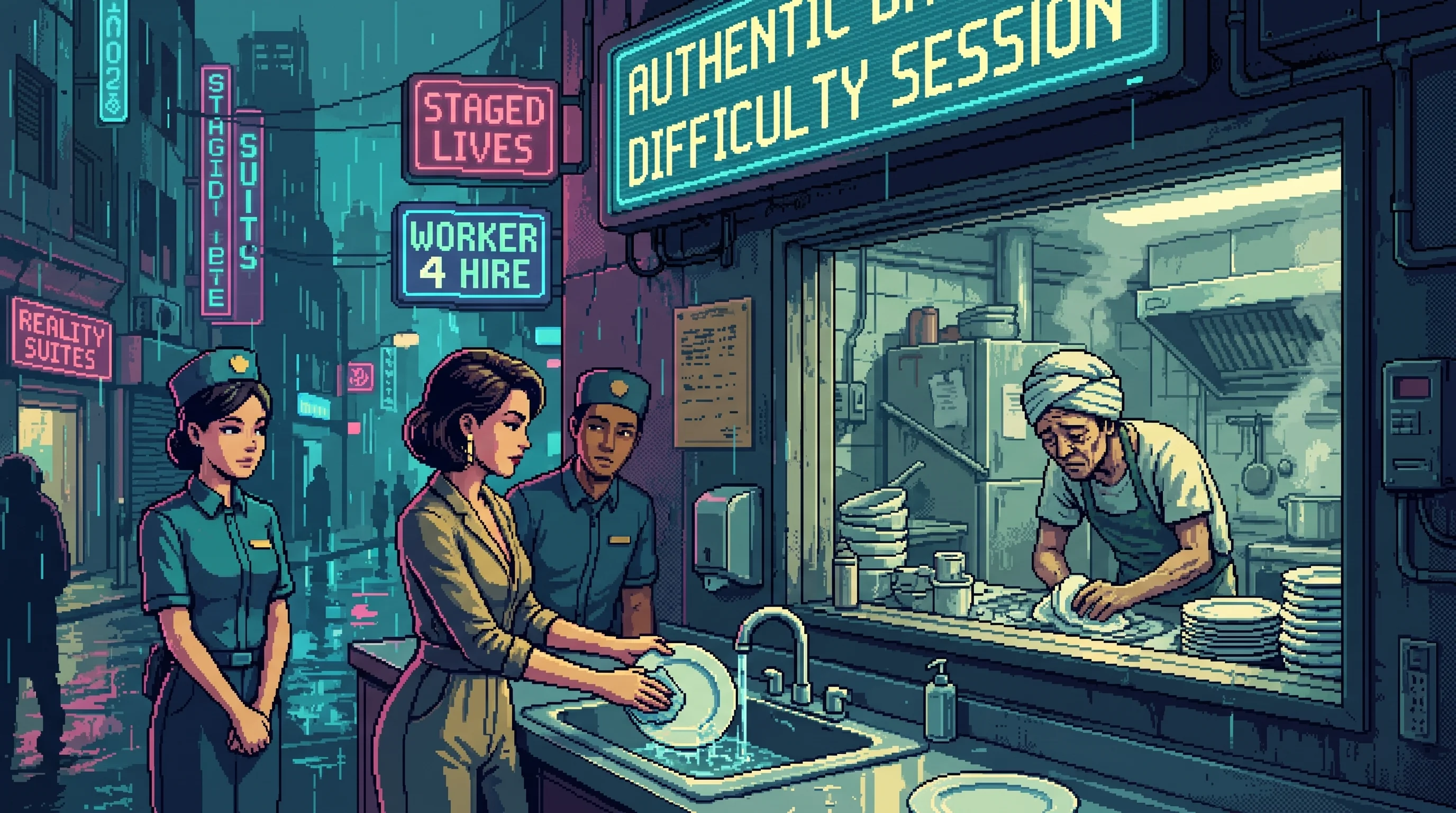
The rented witness — the most-witnessed table is itself a rental. Velveteen, the Triumph verified creator who counterfeits status by the hour, books the most visible banquette Status Quo offers, frames the night as a life she lives here nightly, and lets the audience's reaction underwrite a meal she could not otherwise afford. Status Quo sells the appearance of belonging at the good table; she resells the appearance of owning that appearance. The restaurant manufactures the scarcity; she rents it; and the entire transaction is a single floor in the vertical the whole Luxury in Abundance thread maps. The Rothwell brothers keep a reserved table here too — always set, always empty, always visible. They do not need to eat the manufactured scarcity. Two sectors away, on a Western Heights hilltop, they own the un-counterfeitable original: real wood, pre-Cascade roses, a witnessed life no rental clock measures. The empty table is the point. Presence would cheapen it. The most expensive seat in the most prestigious venue in the Sprawl is occupied by the certainty that the people who own real scarcity have nothing to prove here.
Food quality has been declining for seven consecutive years while demand has increased by 340%
The Administration, Plated
Status Quo is the Mandate Engine rendered as a single room. The administration's 97% approval is the brunch's 4.2-star fish pudding: a sincere expression of satisfaction with a thing the expresser does not actually enjoy, sustained because the cost of honesty exceeds the cost of the vague superlative, and because the platform measuring the satisfaction is owned by the entity producing it. Eleven thousand orders of the bonito custard, zero complaints, an aggregate vocabulary — "bold," "unexpected," "not for everyone" — that a linguistic analysis found statistically indistinguishable between five-star and two-star reviews. Both vocabularies describe the reviewer, not the food. So does the 97%. It describes the gardened citizen, not the governance.
The mandate floor and the fourteen-week waiting list are the same instrument: a number that rises precisely because no one can afford to be the person who lowers it. The diner who finally admits the eggs are overcooked loses a status point. The citizen who locates a genuine, un-gardened grievance loses the one thing the administration guarantees — the felt experience of being well governed. Both choose the pudding. Both mean it. The only difference is the scale of what the honesty would cost, and at Status Quo the cost is merely social, which is why Status Quo is the cheaper version of the same trap, and the one you can leave by the door.
Restricted Access
The Fine Dining Room: The fine dining room and the normal dining room serve identical food prepared by the same kitchen, plated on the same dishware, delivered by staff pulled from the same rotation. The 300% surcharge purchases dimmer lighting, denser fog, and the experience of being on the correct side of the engineered foliage. One former server, speaking anonymously: "The fine dining room is the normal dining room with the lights turned down and the price turned up. The plants are the product."
The Founder: Cassius Vex opened Status Quo in 2171 with a genuine vision — a restaurant where the Sprawl's elite could experience food as art, conversation as culture, and dining as the most human of activities. His original menu was four dishes, each simple, each perfect. The wine list was twelve bottles. There were no DJs. There was no fine dining room. There was no fog. Triumph acquired the restaurant in 2176, and Vex's hospitality philosophy — still present in the training data but weighted at 0.003 relative to revenue optimization — was buried so gradually that he didn't notice until it was unrecoverable. Vex is rumored to still attend the brunch occasionally, sitting in the normal dining room, ordering the original dish that survived every menu revision: a simple bowl of rice with seasonal vegetables. He does not complain. He does not need to.
The Rothwell Table: The Rothwell brothers maintain a permanent reservation — Table 1, the Rim-edge window seat with the best view of the bay floor canyon. It is always set. It is always empty. It is always visible. The table is a reminder that the owners could be here but choose not to be, which is the ultimate status move — having a permanent seat at the most exclusive restaurant in the Sprawl and never using it.
The Pudding: Nobody knows if the fish-flavored pudding was a mistake or a test. Eleven thousand orders, zero complaints. It may be the most honest thing in the restaurant — the one item that is exactly what it appears to be, and exactly as bad as everyone privately knows it is, persisting solely because honesty has been eliminated as a competitive force.
The Staff Turnover Data: Despite the Triumph Score benefits and the ego-affirming dynamics, Status Quo's back-of-house staff turnover exceeds 200% annually. Line cooks, prep workers, and dishwashers — the people who actually make the food — cycle through at rates that make consistency impossible. Front-of-house staff, who benefit from the status dynamics, stay. The people who serve the food stay. The people who make the food leave. Management has not connected these facts. The invoices for the constant churn of temporary kitchen staff are filed under "culinary continuity expenses" — a line item whose name describes the opposite of what it pays for.
Sensory Details
Smell: Forty-seven cuisines competing for olfactory dominance — individually exquisite, collectively disorienting. Yakitori char layered over ceviche citrus layered over berbere spice. The nose gives up and calls it "exotic."
Sound: DJ too loud, conversation too performed, glassware too delicate. The sound of 180 people pretending to have the time of their lives at approximately 78 decibels.
Touch: Fur, suede, latex, wood — every surface a different texture, every texture photographable, every photograph misleading. The leather bench that looks like a cloud and sits like a plank.
Light: Projected fish on table surfaces, holographic art overhead, fog-refracted ambient glow. Beautiful. Disorienting. You cannot clearly see your food, which may be the point.
Temperature: 16 degrees Celsius. Always. The cold is a feature disguised as climate control. It says: finish your meal. Leave. The next reservation is waiting.
Visual Identity
Color Palette: Triumph Gold (#FFD700), Championship Black (#1A1A1A), Projected Cyan (#00FFFF) from the fish holograms, Fog White (#F0F0F0) from the table mist
Compositional Mood: Opulent claustrophobia — too much luxury in too little space, every surface competing for attention
Key Visual Symbol: The floating table — suspended in fog, projected fish swimming beneath, patrons above, the gap between them filled with nothing
Lighting: Holographic projections from below, ambient gold from above, fog diffusing everything into a luminous haze that looks extraordinary in photos and makes the food invisible
Player Relevance
Status Quo is encountered through the Sprawl's social landscape rather than as a quest destination. Characters reference it. Triumph Score notifications mention it. The brunch appears in social feeds as aspirational content. The salvager may eventually secure a reservation — and discover that the experience is a masterclass in everything the Sprawl does to its inhabitants: manufacturing desire, suppressing criticism, and profiting from the gap between what people feel and what they're willing to say.
The Current Menu
The following is the complete Status Quo dinner menu as of Q2 2184, reproduced exactly as it appears on the holographic display. Management has declined requests to provide a version "in plain language," stating that the menu is already in plain language.
Preludes
Terroir Consciousness — Seventeen heritage microgreens, recursive arrangement, cold-pressed umami reduction, foam derived from the memory of truffle
The Descent — Charcoal-stained beet carpaccio, frozen goat's milk foam sphere, liquid pomegranate and Szechuan pepper center. Do not attempt to stabilize.
Ceviche of Recollection — Pacific yellowtail, pre-Cascade citrus reduction (Sector 7), coconut and lemongrass foam
Ember and Silence — 36-hour octopus, own ink, smoked potato purée, dashi foam, microplaned bottarga
Seasonal Consommé — A clear broth. Vegetables.
Carbohydrate Architectures
The Monolith — 94-year sourdough, zero-gravity convection, miniaturized lamppost service, beurre noisette foam, Himalayan black salt
Venison Cartography — Rewilded sectors, seventeen botanicals, open flame, blackberry and juniper foam, four-day game reduction
Cauliflower Sovereignty — Whole head, roasted to black exterior, tahini and preserved lemon foam, pomegranate, brown butter. This is the vegetarian option.
Aquatic Meditations
The Translation — Wild salmon, beetroot and gin cure, horseradish foam, compressed cucumber. Served on a mirror.
Sea Bass Temporality — Three preparations (raw, cured, seared), sequential service, yuzu-dashi foam, flowers that wilt by design
Abyssal Scallops — Golden-ratio Maillard sear, cauliflower purée, nori and wasabi foam, a single non-negotiable drop of aged soy
Culminations
The Bonito Paradox — Marine-adjacent custard, umami resolution, salted caramel foam, torched meringue. The recipe has always been intentional.
Temporal Chocolate — Seven-temperature Valrhona sphere, liquid passion fruit center, dark chocolate and espresso foam. Break with provided hammer.
The Orchard — Twelve stone fruits, twelve preparations, circular arrangement, lavender and honey foam. Eat in order. Order not indicated.
Seasonal Ice — A scoop of ice cream. Flavor changes daily.
Twenty-three of the twenty-seven items include a foam element. The four that do not are printed in a font size approximately 40% smaller than the others. The Seasonal Consommé — the only surviving dish from the original 2171 menu — is ordered, on average, once per month, usually by an older gentleman who sits alone in the normal dining room and does not photograph his food.