Dream Culture
'Where you sleep is who you are' — the defining social division of dream culture
Overview
Where you sleep is who you are.
This is not metaphor. It is the Sprawl's most reliable demographic indicator — more predictive than income bracket, augmentation tier, or sector address. The dreamless know each other by the specific quality of their exhaustion. The dreaming know each other by something harder to fake: a softness in the gaze, a tendency to let attention wander to edges, a momentary stillness before responding. Dregs residents call it "dream eyes." Corporate-tier residents call it "that thing the unaugmented do." Both descriptions are accurate. Neither population can reproduce the other's.
The sleep divide has generated its own cultural infrastructure — language, rituals, social markers, and identity practices that emerged without coordination, leadership, or subscription fees. Nobody planned dream culture. It grew in the gap between what augmentation removed and what humans couldn't stop needing.
The vocabulary: "Going under" is what the dreamless call experiencing a harvested dream. It carries the same conversational weight as "I had the strangest dream" and approximately none of the same neurological truth. "Surface tension" measures how deeply a dream recording penetrates waking consciousness — high surface tension means the dream slid off you; low means you're still carrying it at lunch. "Drift" is the Lucidity Crisis's first clinical stage, repurposed socially as a confession and a bond between dreamless people who share the experience. Saying "I drifted last night" at a corporate breakfast means something very different from saying it at a Dregs café. At the corporate breakfast, it means you need recalibration. At the Dregs café, it means you're among friends. "The floor" is what synthetic dreams don't have — the essential quality distinguishing harvested from designed. Nobody has successfully defined the floor. Everybody who has experienced both knows exactly what it is.
The rituals: Sleep watching is the one that disturbs outsiders most, which is how you know it matters. Dreamless couples — people whose augmentations suppress REM architecture — hire an unaugmented person to sleep in their home. Then they sit and watch. For hours. In silence. The going rate is ¢200-400 per night depending on the sleeper's reputation, which is itself a remarkable sentence. The dreamless describe the experience as "intimate." The unaugmented sleepers describe the experience as "easy money." Both are telling the truth. Neither is telling the whole truth. What the dreamless are watching for — the micro-expressions, the eye movements, the small sounds of a consciousness processing something it didn't choose — is the thing their optimization removed. They are paying to witness a biological function they can no longer perform, the way someone who has lost their sense of smell might pay to watch someone react to a garden.
Sleep watching started when a dreamless woman in Sector 9 asked if she could sit in the room while her neighbor slept. The neighbor said yes. The neighbor did not think it was strange. The dreamless woman did not explain why she was crying.
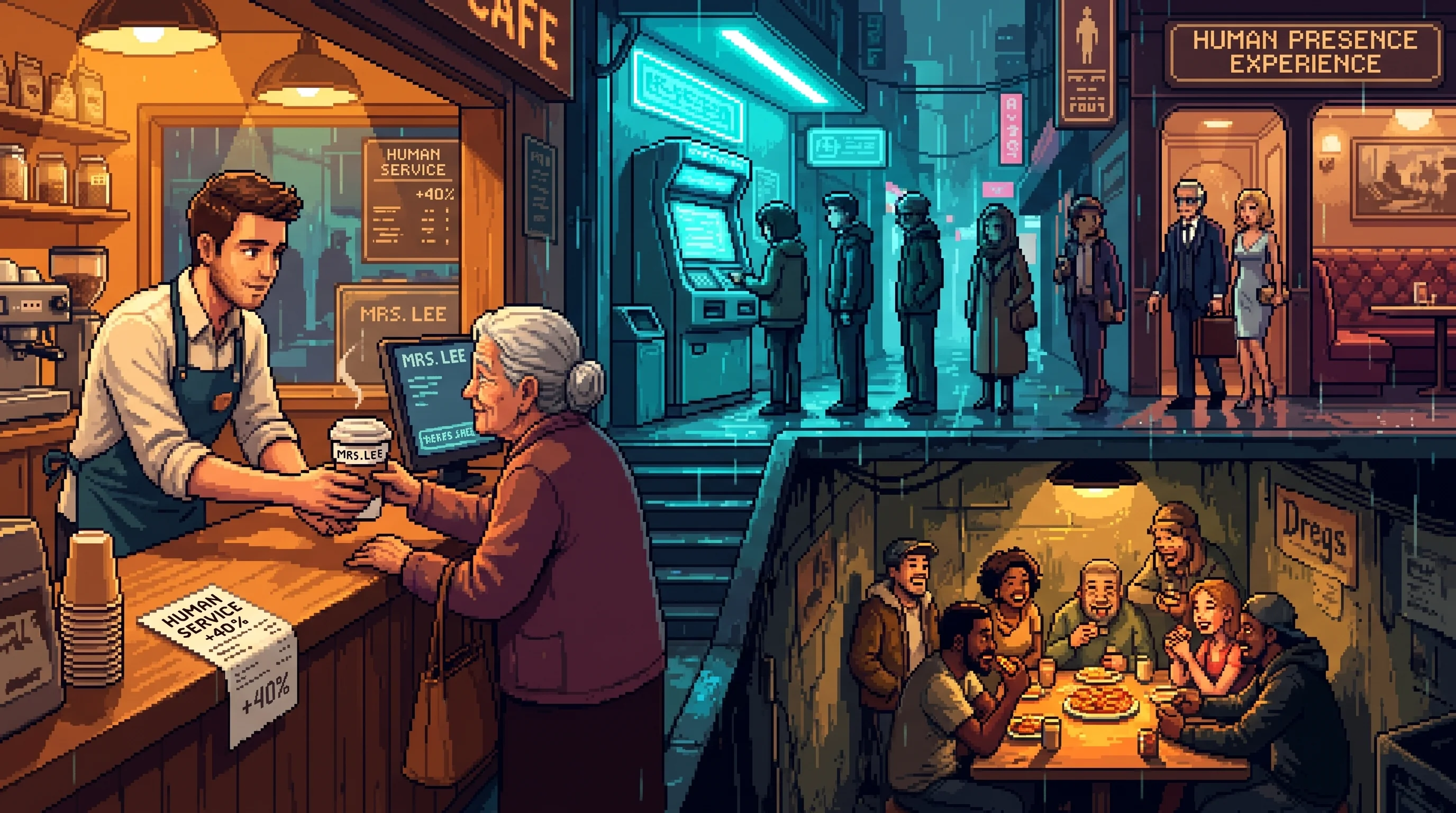
Dream sharing in the Dregs happens every morning with an intensity that Triumph Social's engagement architects have studied and failed to replicate. Small Talk Cafes and independent breakfast counters across the Deep Dregs advertise "Dream Breakfast" — forty-five minutes of conversation about last night's dreams, priced at roughly a week's groceries, sold out by 6 AM most days. It started when a waitress described a dream and a customer cried. It has not become less strange. It has become essential.
The midnight gardens — seven anonymous rooftop plots tended between midnight and dawn by gardeners who have never identified themselves — are the quietest ritual. The first originated with Felix Otieno's anonymous night garden and spread to six other locations across the Sprawl by a mechanism nobody has documented. The gardens are permission expressed in soil: you do not have to be productive right now. You can put your hands in dirt at 3 AM and nothing will be optimized by it.
The social markers: "Dream eyes" lasts two to three hours after a harvested dream experience — residue of unconscious processing visible to anyone who knows what to look for. "Dream patience" is the unaugmented ability to wait without filling the waiting with productivity. Corporate-tier residents find dream patience profoundly attractive. They also find it deeply alien. It looks like the thing they optimized away, and it is.
Dream Breakfast in Dregs cafes: customers pay a week's groceries for 45 minutes of conversation about dreams
Sleep watching: dreamless couples watch an unaugmented person sleep — the dreamless equivalent of sharing a meal
Connections
- The Dream Exchange: The commercial center of dream culture — where dreams are bought, sold, harvested, and priced. Dream culture is the social center. The Exchange provides the commodity. The cafés, gardens, and sleep-watching arrangements provide the meaning. The relationship between the two is the relationship between a vineyard and a dinner party.
- The Insomnia Wards: The medical center of dream culture — where the dreamless come to try. The Wards treat the clinical condition. Dream culture treats the social one. Some patients discharged from the Wards with restored REM architecture report that the dreams themselves mattered less than having something to share at Dream Breakfast the next morning.
- The Deep Dregs: Where dream culture lives. Dream sharing and Dream Breakfast originated here — not because the Dregs are romantic, but because the Dregs are the last place where people share enough common experience to have a conversation about it.
- Felix Otieno: The midnight garden ritual began with his anonymous night garden. He has never claimed credit. The six subsequent gardens appeared without coordination, tended by gardeners who follow the same unwritten rules: midnight to dawn, no names, no harvest. The soil is the point.
- The Corporate Liturgy: Dream culture's structural opposite. Both are daily practices that shape identity through repetition. The Corporate Liturgy synchronizes employees with corporate objectives. Dream Breakfast synchronizes neighbors with each other. One is designed. The other grew.
Visual Identity
- Color palette: Morning warm (#FFC857, #F5E6CC) — the quality of dawn, of waking, of the first conversation of the day
- Key symbol: Two people at a Dregs breakfast counter, one gesturing at something invisible — describing a dream
- Lighting: Morning light entering a room where conversation about the unconscious is the most valuable thing on the menu
'Dream eyes' — a softness in the gaze, a tendency to let attention wander to edges, a momentary stillness before responding
Archive annex — 6 earlier filings on this recordClose the archive annex
Recovered Historical Material
Indexed — no record on file.
Where It Lives
Indexed — no record on file.
The Language
Indexed — no record on file.
What the Sprawl Keeps Asking
Indexed — no record on file.
Open Files
- Debt culture and dream culture share a demographic. The people who dream by economic necessity are often the same people who owe. When does selling your dreams to pay your debts stop being a choice?
- Sable Dieng’s data says 340% higher spontaneous social interaction at Dream Breakfast. The corporations have seen those numbers. When does someone try to franchise it — and what dies the moment they do?
Exchange → /world/culture/the-dream-exchange
Felix Otieno’s → /world/characters/felix-otieno
Touch Economy → /world/culture/the-touch-economy
Dream Exchange → /world/culture/the-dream-exchange
Corporate Liturgy → /world/culture/the-corporate-liturgy
touch culture → /world/culture/touch-culture
Where you sleep is who you are. This is not metaphor. It is the Sprawl’s most reliable demographic indicator — more predictive than income bracket, augmentation tier, or sector address. The dreamless know each other by the specific quality of their exhaustion. The dreaming know each other by something harder to fake: a softness in the gaze, a tendency to let attention wander to edges, a momentary stillness before responding.
Nobody planned dream culture. It grew in the gap between what augmentation removed and what humans couldn’t stop needing. No organization formed to protect it. No corporation packaged it. (They are trying. They will not succeed. They will not stop trying.)
The wealthy are dreamless by choice. The poor dream by economic necessity. The thing the poor still do naturally became the thing the rich pay ¢200–400 a night to witness. Class written into biology. The augmentation divide made visible in whether your eyes go soft in the morning.
“Going under” — experiencing a harvested dream. Carries the same conversational weight as “I had the strangest dream” and approximately none of the same neurological truth.
“Surface tension” — resistance to dream immersion. High surface tension means the dream slid off you. Low means you’re still carrying it at lunch. People describe it the way others describe tolerance to alcohol: with a complicated mixture of pride and longing.
“Drift” — the Stage 1 Lucidity Crisis sensation, repurposed socially as a confession and a bond. “I drifted last night” at a corporate breakfast means you need recalibration. At a Dregs café, it means you’re among friends.
“The floor” — the essential quality distinguishing harvested dreams from synthetic ones. What’s missing when dreams are designed rather than dreamed. Nobody has successfully defined it. Everybody who has experienced both knows exactly what it is.
Sleep watching. Dreamless couples hire an unaugmented person to sleep in their home, then sit and watch. For hours. In silence. The going rate is ¢200–400 per night depending on the sleeper’s reputation, which is itself a remarkable sentence. The dreamless describe the experience as “intimate.” The unaugmented sleepers describe it as “easy money.” Both are telling the truth. Neither is telling the whole truth.
It started when a dreamless woman in Sector 9 asked if she could sit in the room while her neighbor slept. The neighbor said yes. The neighbor did not think it was strange. The dreamless woman did not explain why she was crying.
Dream Breakfast. In Dregs cafés, customers pay a week’s groceries for forty-five minutes of conversation about last night’s dreams. Staff share their dreams as part of the service. Sold out by 6 AM most days. It started when a waitress described a dream and a customer cried. It has not become less strange. It has become essential.
Dream sharing circles. Weekly gatherings, six to twelve participants, informal. Started when six strangers at the Dream Exchange discovered they’d purchased the same harvested dream — and experienced it completely differently. Same recording. Six interpretations. The conversation lasted four hours. Nobody had anywhere better to be, which was itself the point.
The midnight gardens. Seven anonymous rooftop plots tended between midnight and dawn by gardeners who have never identified themselves. The first originated with Felix Otieno’s anonymous night garden. Six more appeared by a mechanism nobody has documented, following rules nobody wrote down: midnight to dawn, no names, no harvest. Permission expressed in soil: you do not have to be productive right now.
“Dream eyes” — a softness in the gaze of someone carrying dream residue. A tendency to let attention wander to edges. A momentary stillness before responding. Lasts two to three hours after waking. Spotted across a room. Envied. Purchased, occasionally, through the Exchange — though what you purchase is the recording, not the residue, and the residue is the thing people want.
“Dream patience” — the unaugmented ability to wait without filling waiting with productivity. The augmented find it profoundly attractive and deeply alien. It looks like the thing they optimized away. Some hire unaugmented companions just to sit with someone who has it — not to learn it, because it cannot be learned. Just to be near it. The Touch Economy has noticed. So has Connection Tourism.
Every Dregs resident was exposed to the same Content Flood overnight — the same undifferentiated slop that Basic-tier neural interfaces deliver without personalization. Shared exposure creates shared reference. “Did you see that thing?” “That melody from the market speakers.” “The news about the Ironclad explosion.” These are sentences that can only exist in a community that encounters the same world. In the corporate tiers, where every waking experience is individually curated, two Professional-tier employees sitting across from each other at breakfast have encountered entirely different realities for the previous sixteen hours. Their breakfast is silent, efficient, and optimized. (Sable Dieng’s Curators Guild data confirms: Dream Breakfast patrons show 340% higher spontaneous social interaction rates than equivalent populations in curated environments. Not because the food is better.)
But Dream Breakfast adds a dimension the Flood cannot provide. Dreams are the one cognitive product that remains genuinely personal because they remain genuinely uncontrolled. The algorithm cannot curate them. Neural advertising architecture cannot reach them — REM sleep’s chaotic firing patterns resist the insertion-window stability that ad delivery requires, a fact that has cost Nexus Dynamics an estimated ¢2.3 billion in unrealized revenue and generated fourteen internal task forces. All fourteen concluded that the human unconscious is, for the moment, technically unprofitable.
When a table of Dregs residents shares their dreams, they share something no corporation shaped and no recommendation engine selected. The last unmonetized experience. The conversation has soil to grow in. The Sprawl has decided which ritual to fund. It is not this one.
Dream sharing, midnight gardens, Dream Breakfast — none of these were organized resistance. No one planned them. They emerged because humans need rituals around what they’ve lost. Dream Breakfast started when a waitress described a dream. Sleep watching started when a dreamless woman asked if she could sit while her neighbor slept. The circles started when six strangers discovered they’d purchased the same dream and found it meant six different things.
The Dream Exchange is the commercial center — where dreams are bought and sold, where the economy of unconscious experience finds its price. Dream culture is the social center, the ungoverned space around those transactions where meaning gets made without anyone setting rates. The Exchange provides the commodity. The cafés, gardens, and sleep-watching arrangements provide the meaning.
The Insomnia Wards are the medical center — where the dreamless come to try, where Lucidity Crisis gets a diagnosis instead of just a word. Some patients discharged from the Wards with restored REM architecture report that the dreams themselves mattered less than having something to share at Dream Breakfast the next morning.
The Deep Dregs are the social center — where dream sharing and Dream Breakfast originated, not because the Dregs are romantic, but because the Dregs are the last place where people share enough common experience to have a conversation about it. The midnight gardens are nowhere and everywhere: seven rooftop plots tended by people who don’t leave their names.
At the edges, dream culture bleeds into everything it touches — memory culture, touch culture, the Dumb Supper, the Impression Ceremony. All of them grew from the same soil: people who lost something, reaching for whatever’s left.
- Seven midnight gardens, seven anonymous gardeners. Nobody has identified any of them. Nobody has connected the gardens to each other through any documented channel. Are they coordinated, or did seven people independently arrive at the same form of quiet rebellion?
- Dream patience cannot be learned. The augmented find it profoundly attractive and cannot acquire it. What happens when the thing you optimized away becomes the thing you want most? The Exchange is trying to find out. The Exchange will not find out.
- Dream Breakfast costs a week’s groceries for forty-five minutes. The customers are paying for the dream discussion, not the food. At what point does the waitstaff’s unconscious experience become labor? At what point does sharing a dream become a shift?
- “The floor” — the quality that separates harvested from synthetic. Everyone who’s gone under knows it’s there. Nobody can define it. If someone could isolate it, bottle it, sell it separately — would that be the most valuable commodity in the Sprawl, or the end of dream culture entirely?
The Corporate Liturgy and dream culture are parallel daily practices that shape identity in opposite directions. One is designed. The other grew. One makes you think like your employer. The other makes you remember you had a life before you clocked in. The Sprawl runs on both. Nobody can explain what happens to a person who practices both daily — or which one wins.
Three rituals emerged under the Warmth Tax’s pressure: Dream Breakfast (morning, daily — vulnerability through shared unconscious), Sleep Watching (evening, by arrangement — witnessed helplessness), Dream Sharing Circles (weekly — a shared referent that sidesteps performance). All three share one quality: no organization, no leadership, no subscription fee. The warmth in them cannot be packaged because it was never designed.
'Dream patience' — the ability to wait without filling waiting with productivity
Connected To
Supporting Connections
—
—