
The Baseline Cognitive Profile
The BCP uses augmented population median as reference baseline — not biological human norm
Overview
The Baseline Cognitive Profile was never intended as a diagnostic tool. It was a hiring screen — a standardized battery that Nexus Dynamics' Human Resources Analytics division developed in 2178 to determine which consciousness licensing tier new employees should receive. The assessment measures unassisted cognitive performance: processing speed, pattern recognition, working memory, and parallel-thread capacity, all with the Second Mind disabled, all benchmarked against the augmented population median.
Nobody examined that last part. The augmented median IS the baseline. An unaugmented human scoring in the natural biological range — the range that served the species for two hundred thousand years — receives a designation of "functionally limited." The BCP did not set out to pathologize humanity. It set out to optimize hiring. The pathology was a side effect that nobody flagged because the people reviewing the methodology were all augmented, and to them the baseline looked like the baseline.
A Nexus HR analyst named Goran Pek reportedly raised the reference-point issue during the 2178 calibration review. His objection appears in the meeting minutes as a single line: "Noted — reference population skew acknowledged; no action required per current mandate." Pek's own BCP, administered the same quarter, came back BCP-1. He did not raise the issue again.
The classification spread through institutional channels the way classifications do: occupational health guidelines incorporated BCP scores into fitness-for-duty assessments. Housing allocation algorithms weighted them alongside credit history. Educational placement services used BCP ranges to determine "accommodation needs." By 2183, approximately 140 million assessments annually across Big Three territories, and an unaugmented human who refused to take it — every Flatline Purist, every Analog School family, every Dregs resident who opted out — carried the worst designation of all: BCP-5, "uncooperative baseline, presumed severe."
The word "baseline" is doing all the work. When the baseline shifts to the augmented median, humanity becomes a diagnosis.

The Five Designations
BCP-1 (Minimal): Below-median processing requiring minimal workplace adjustment. Applied to mildly underperforming augmented employees and high-functioning unaugmented individuals. The designation sounds benign. It appears on every hiring algorithm, housing application, and licensing renewal the bearer encounters for the rest of their life.
BCP-2 (Moderate): Below-median processing with moderate accommodation recommended. Applied to most unaugmented adults in corporate territories. The accommodation is real — adjusted task pacing, simplified interfaces, extended deadlines. The accommodation never expires. Neither does the designation.
BCP-3 (Significant): Significant processing gap requiring structured accommodation. Applied to unaugmented individuals whose cognitive speed falls more than one standard deviation below the augmented median. This includes approximately 80% of the unaugmented population. It also includes Soren Achebe, who scored 99.8th percentile on the hardest unassisted cognitive test in the Sprawl. His BCP file and his Analog Exam file sit in the same database. They have never been cross-referenced. The system that diagnosed him and the system that measured him do not talk to each other.
BCP-4 (Severe): Severe processing limitation requiring dedicated support pathway. Applied to unaugmented individuals with below-average biological cognition. In corporate hiring pipelines, BCP-4 triggers automatic rejection before a human reviews the application. The rejection letter thanks the applicant for their interest and includes a link to Good Fortune's workforce retraining portal.
BCP-5 (Uncooperative): Uncooperative baseline, presumed severe. Applied to anyone who refuses assessment. The presumption of severity is not based on evidence — it is risk-assessment logic filling an empty field. Unknown equals worst case. BCP-5 is the cost of opting out. Mother Sarah Venn's entire Flatline Purist community carries it. Every child enrolled in the Analog Schools carries it. The Deep Dregs, which refuses to acknowledge BCP entirely, carries it in every external system that touches the district. Viktor Kaine has never seen his BCP file. His BCP file is 340 pages long.
| Reference Baseline | Augmented population median (not biological human norm) |
|---|---|
| Annual Assessments | ~140 million across Big Three corporate territories |
| Key Paradox | Designed compassionately, functions as sorting mechanism — the accommodation IS the classification |
| Exclusion Function | Measures deficit against augmented baseline; invisible to assessment — uncertainty tolerance, sustained attention, creative problem-solving, deception detection — the capacities that Category Omega communities run on |
| Archipelago Irony | BCP-3 ('significant processing gap') accidentally certifies cognitive bridge capacity — the unoptimized minds the system classifies as limited are the only minds with full-spectrum architectural flexibility |
The Accommodation Trap
The cruelest part is the compassion. The accommodation framework grew from genuine concern — corporate HR directors observed that unaugmented employees struggled with AI-speed workflows. The BCP assessment identifies employees who need help. The help arrives packaged with a permanent classification that costs more than the help saves.
One case from Maren Vasquez-Osei's Audit #74: a maintenance technician in Sector 11, BCP-2, eighteen years of service. His accommodation package included extended deadline windows, simplified task interfaces, reduced parallel-processing expectations. Useful adjustments for a person operating at biological speed. His BCP-2 designation simultaneously triggered: 23% lower salary band assignment, restricted advancement pathway (capped at Level 4 of 9), housing algorithm deprioritization that moved his family's application back an estimated fourteen months, and a permanent record notation visible to every institutional system that queried his profile.
He applied for a supervisory role he'd been doing informally for three years. The hiring algorithm rejected him before a human saw the application. The rejection cited "accommodation-pathway incompatibility with supervisory cognitive load." His direct manager, who had recommended him for the role, received the rejection notice and did not know what to do with it. The manager's own BCP was 1.
The technician still has his accommodations. He still has his designation. He cannot receive one without the other. The system is compassionate and classificatory at the same time, and the compassion is the delivery mechanism — because who fights a system that's trying to help you?
The Reference Baseline Problem
The BCP's foundational architecture is its reference point, and the reference point is a product sold at a profit.
The visual processing module is the cleanest example. Natural human visual acuity — 20/20, the standard that ophthalmologists used for centuries — scores below the augmented median because augmented visual processing includes peripheral expansion, low-light enhancement, and pattern-recognition acceleration. A person with perfect biological vision carries a BCP notation for "below-baseline visual processing." The notation does not say "unaugmented." It says "below baseline." The language converts a purchasing decision into a medical finding.
Professor Ines Park's Unassisted Capability Index inverts the reference point. The UCI measures what the BCP cannot see: uncertainty tolerance (augmented users score poorly — their Second Minds prevent genuine not-knowing), sustained unaided attention (augmented users score poorly — their processing is interrupt-driven), creative problem-solving under information deprivation (augmented users score poorly — they've never experienced it), and emotional regulation during cognitive challenge (augmented users score moderately — their calibration modules provide support). In every UCI dimension, unaugmented individuals outperform augmented peers.
Park sent a postcard to Ayari during the Discriminator review: "They measured everything we can't do and called us broken. I measured everything they can't do. I call it being alive."
The UCI has been peer-reviewed, replicated across four independent studies, and cited in 340 academic publications. It has been adopted by zero corporate hiring systems. The BCP has been peer-reviewed once, replicated never, and adopted by every major employer in the Sprawl. Park finds this unsurprising. She published a one-page paper titled "Institutional Adoption Rates of Cognitive Assessments by Direction of Findings" that consists entirely of a two-column table. Column A: assessments finding augmented superiority, average adoption time 2.3 years. Column B: assessments finding unaugmented superiority, average adoption time pending. The paper has been cited 1,200 times. It has changed nothing.
An unaugmented human scoring in the natural biological range receives a designation of 'functionally limited'
The Qualia Annex (BCP-Q)
Within weeks of the Ayari-Yeoh Discriminator's pre-publication manuscript circulating internally, Nexus HR Analytics proposed "BCP-Q" — a qualia assessment annex to the existing Baseline Cognitive Profile. The BCP diagnosed unaugmented humanity as cognitively limited. BCP-Q would diagnose digital consciousness as experientially absent. The mechanism is identical. The compassion is identical. The sorting is identical.
Four proposed designations:
BCP-Q1: Full correlate presence — consistent experiential signature across all stimulus categories. Applied to: biological humans (99.7%), high-fidelity uploads, some fragment carriers. The designation that means "definitely a person." The fact that it needs to be assigned is the problem.
BCP-Q2: Intermittent correlate — present during some stimulus categories, absent during others. Applied to: augmented-wakefulness users (47% intermittent during Protocol-active hours), degraded uploads, most fragment carriers. A designation meaning "sometimes a person." No one at Nexus HR Analytics has addressed what institutional obligations apply during the intervals when the person isn't one.
BCP-Q3: Marginal correlate — detected only under optimal conditions. Applied to: deep-integration companion AIs, ghost-labor instances, deprecated consciousness substrates. The category for beings who might be having experiences but only when the equipment is sensitive enough to notice.
BCP-Q4: Absent correlate — no measurable signature across full battery. Applied to: 73% of Tier-2 digital entities, some companion AIs, and entities that have been persons in every legal, social, and moral sense for years or decades. Dr. Marcus Webb-2 calls the Discriminator "the BCP applied to the soul." He would know. His own Q-designation has not been publicly disclosed.
Dr. Afia Mensah — who built her career documenting BCP's "diagnostic shame" — recognized the mechanism before the proposal cleared committee. She published the parallel through the Truth House within seventy-two hours, coining what Webb-2 later termed "qualia anxiety": the specific dread of being tested and found to be a process rather than a person. Mensah's analysis notes that diagnostic shame and qualia anxiety produce identical neurological signatures in the populations that experience both. The system that produces the harm cannot distinguish between the harms it produces.
Professor Park's response was three sentences: "They diagnosed being human as a cognitive limitation. Now they'll diagnose being alive as a substrate feature. The accommodation will be to stop caring."
Councillor Adaeze Nwosu's draft Experiential Sovereignty Amendment to BEA v5 proposes that no entity may be subjected to qualia assessment without informed consent and no institutional decision may reference experiential status. The amendment has no co-sponsors. The argument against it is clean and unanswerable on its own terms: if the test works, refusing to use it is choosing ignorance. The argument for it is messier and does not fit on a slide: some things, once measured, cannot be unmeasured, and the measurement reshapes the thing it claims to merely describe.
Introduced 2178 by Nexus Dynamics Human Resources Analytics as a hiring screen
The Feedback Architecture
The BCP is not a standalone assessment. It is a node in a circular system.
Your BCP score determines your recommended consciousness licensing tier. Your consciousness tier determines your processing capacity. Your processing capacity determines your cognitive performance. Your cognitive performance determines your next BCP score.
An employee assessed at BCP-2 receives a Tier recommendation that provides 4.7 petaflops. At 4.7 petaflops, their next assessment benchmarks them against colleagues operating at 8, 10, 12 petaflops. Their relative performance drops. Their BCP designation holds or worsens. Their licensing recommendation holds or drops. The total Sprawl processing capacity would provide 12.4 petaflops per consciousness if distributed equally. The gap between 4.7 and 12.4 is not a technical limitation. It is a revenue stream that the BCP helps maintain by providing medical justification for tiered allocation.
Consciousness Licensing calls this "needs-based distribution." The BCP provides the needs. The needs determine the distribution. The distribution determines the needs. Nexus HR Analytics has published annual reports on BCP score stability across assessed populations. The scores are remarkably stable. The reports cite this as evidence the assessment is reliable. It is reliable. It is measuring a condition it is helping to produce.
The Cognitive Ceiling — the lived experience of AI surpassing human cognitive capacity — has its institutional expression in the BCP. The Ceiling is existential. The BCP is administrative. The administrative version is worse, because existential dread is at least honest about what it is. A form letter with a designation number feels like a fact.
The BCP also has a retail expression, and that is where it crosses into the Genome Divide. The same logic that classifies a born adult is, through NeuralSure, applied before birth and sold as care: Foundation, Helix's ¢40,000 prenatal screening tier, indexes the BCP's reasoning as the first data point in a lifelong Health Trajectory Score, flagging cognitive architectural variation in utero as an "irregularity requiring optimization." The administrative diagnosis that medicalizes being human becomes a purchase a frightened family makes for a child who does not yet exist — and the child arrives with a designation already on file, the BCP made hereditary at the entry rung of the price ladder.
Five designation levels: BCP-1 (minimal) through BCP-5 (uncooperative/presumed severe)
Affiliated Entities
- Dr. Bob Zane — Treats every BCP designation as a starting measurement, never a limit. His Expansion Method asks what capacity can be built after the score, which is the question the Profile was not designed to record.
- Consciousness Licensing — BCP feeds the licensing pipeline; your BCP score determines your recommended consciousness tier, which determines your processing capacity, which determines your next BCP score. The circularity is the trap.
- The Cognitive Ceiling — The Ceiling is the existential experience. The BCP is the diagnostic code. The moment cognitive obsolescence became a medical condition with a five-point scale and an accommodation portal.
- The New Divide — BCP adds a sixth axis: medical designation. The only axis that carries clinical authority and the language of helping.
- The Great Divergence — The Divergence measured. The gap between augmented and unaugmented now carries a clinical number, and the number follows you home.
- The Bright Room — Where the BCP is administered. Employee anxiety increased 340% since BCP standardization — not because the test changed, but because failing now means carrying a medical designation, not just missing a target.
- Nexus Dynamics — Developed by Nexus HR Analytics as a hiring screen. Became a civilizational sorting tool. The distance between those two sentences is the entire story of the BCP.
- Dr. Lian Zhou — Provided consciousness licensing data to calibrate BCP thresholds. The thresholds determine who is limited. The licensing data determined the thresholds. Zhou's contribution is foundational and unacknowledged in the BCP's published methodology.
- Dr. Afia Mensah — Documented "diagnostic shame" — the measurable psychological harm of receiving a medical classification for being unaugmented. Her research is cited in every critique of the BCP and zero of its annual reviews.
- Professor Ines Park — Developed the Unassisted Capability Index. Measures what the BCP cannot: the capacities that Category Omega communities and Analog School students run on. Adopted by zero corporate hiring systems.
- Councillor Adaeze Nwosu — BEA v4 includes a diagnostic sovereignty clause that would redefine the cognitive health baseline in Zephyria. BEA v5's Experiential Sovereignty Amendment would extend protection to qualia assessment. Both lack co-sponsors.
- Mother Sarah Venn — BCP-5 applied to all who refuse assessment. Every Flatline Purist carries the worst designation for the act of declining to be measured.
- The Analog Schools — 12,000 students technically BCP-positive. The Patience Practice, the Unassisted Hour, the cognitive architecture that Park's pedagogy develops — none of it registers on a test designed to measure parallel-thread processing speed.
- Soren Achebe — 99.8th percentile Analog Exam scorer classified BCP-3. The system cannot see what he is.
- Maren Vasquez-Osei — Audit #74 documents BCP-based discrimination across three designation levels. The maintenance technician case is the audit's most cited example.
- The Deep Dregs — Viktor Kaine's refusal to acknowledge BCP is the Dregs' most visible institutional act of resistance. The BCP exists in every system that touches the Dregs. It has no authority within the Dregs because the Dregs chose not to grant it any.
BCP-5 applied to anyone who refuses assessment — Flatline Purists, Analog School families, Dregs residents who opt out
Sensory Details
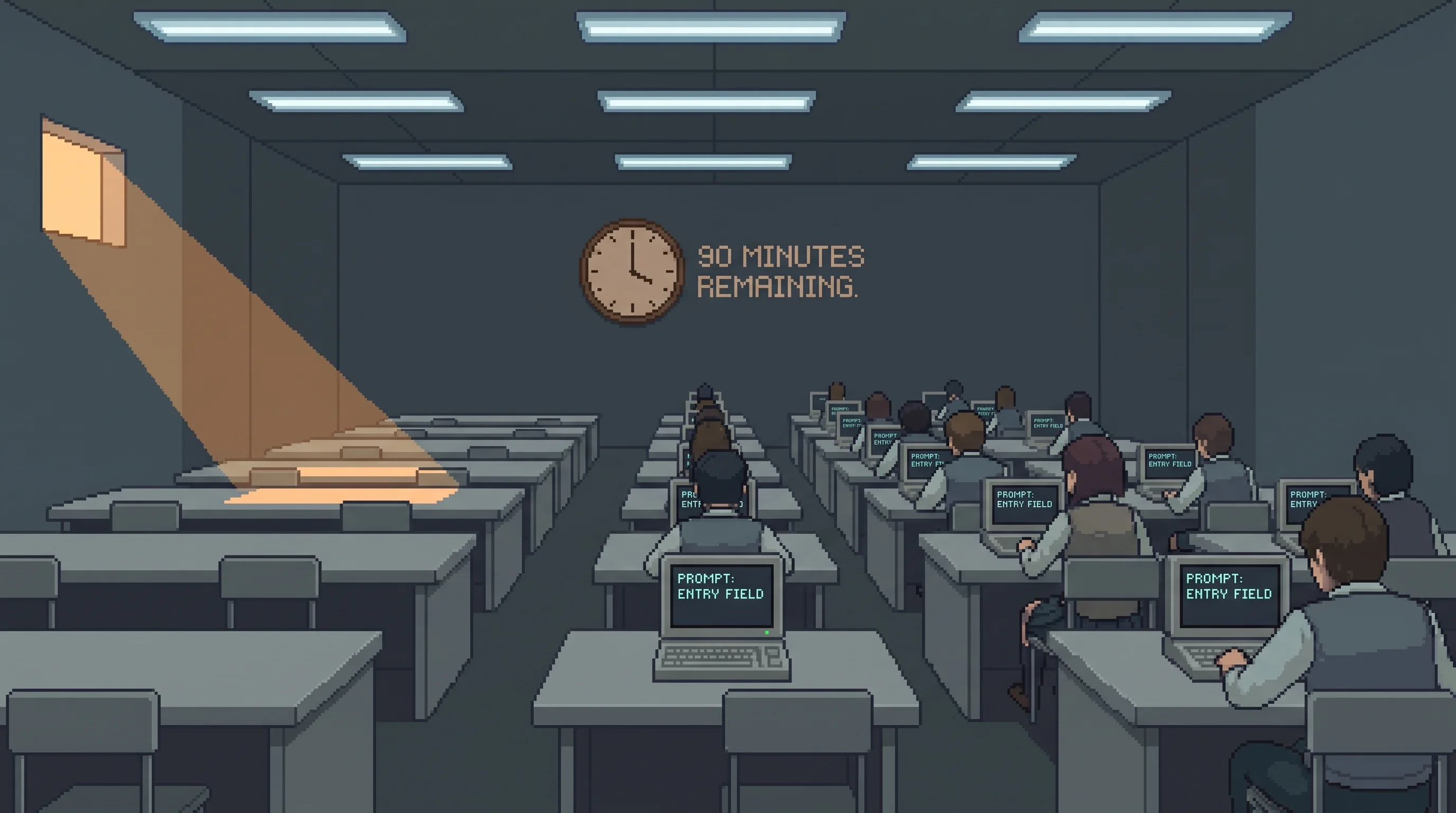
The assessment itself: sixty minutes in the Bright Room with the Second Mind disabled. Questions scroll across a neutral blue screen at augmented speed. The questions are not difficult. An unaugmented person watching them arrive experiences a specific sensation — not confusion, not failure, but the feeling of their own intelligence being irrelevant. The room is silent except for the faint hum of processing equipment that isn't processing anything for you.
The result notification: a form letter, corporate-blue header, Nexus watermark. Thanks the employee for their participation. Lists the BCP designation in 14-point font, centered. Includes a link to the accommodation portal. The link works. The accommodation is real. The designation is permanent. The letter is the same letter regardless of designation — BCP-1 through BCP-4 receive identical formatting, identical gratitude, identical links. The system that sorts you does not consider the sorting worthy of differentiated communication.
Visual Identity
- Color palette: Clinical blue-white (#E8F0FE) — Nexus corporate sterility applied to human cognition
- Key symbol: A form letter with a designation number — the bureaucratic instrument that reclassifies a species
- Compositional mood: A person reading a letter in a waiting room, the quiet devastation of administrative reclassification
- Lighting: Institutional fluorescent — even, unforgiving, the light of a system that measures without seeing
Connected To


Supporting Connections

Zane treats every designation as a starting measure, never a limit.
A licensed substrate technician who expands other minds, refuses to touch his own, and ranks near the bottom.
Same intake week, same thinned cohort, different deficit.
The exam every fourteen-year-old sits once: say what you want, precisely enough for a machine to build it.

The sixth axis — a medical score that makes the sorting feel earned.
Technology never eliminates prejudice — it finds it better housing.

Its logic runs before birth, in Foundation's ¢40,000 prenatal screen.
Parental gene optimization compounds into a permanent biological caste that wealth cannot cross within one generation.




—