
The Patience Practice
The Opening may be the only cognitive condition in the Sprawl where all active knowledge has been fully metabolized
Overview
The Patience Practice has three levels, taught in sequence. Professor Ines Park developed the structure from pre-Cascade meditation research and years of observation at the Analog Schools, where she noticed that students forced to think without augmentation kept hitting the same wall — not a wall of ignorance, but a wall of impatience so severe it registered on biometric monitors as a stress response indistinguishable from mild panic.
The practice is free in Analog Schools. It costs between 400 and 1,200 credits per session at Mystery Clubs, where it is marketed as "cognitive luxury" and scheduled between wine tastings. The curriculum is identical. The clientele is not.
Park has been asked about this pricing disparity in seven separate interviews. She gives the same answer each time: "I didn't design a product. Someone else did." Triumph Social engagement data shows that Mystery Club attendees post about the Patience Practice at 14x the rate of Analog School students. Analog School students, when surveyed, describe the practice as "useful." Mystery Club attendees describe it as "transformative." The transformation, based on completion rates, occurs approximately 23% less often in the paying population.
Level One — The Still Question. The practitioner chooses a question they can answer instantly through their neural interface. They write it on paper. They do not answer it. They sit with it for thirty minutes, noting every thought that arises — not just thoughts about the answer, but thoughts about the discomfort of not answering, the discomfort of the discomfort, and what that recursive irritation reveals about their relationship with knowledge. The Hand Calculation sometimes serves as a warm-up exercise, though Park considers this a misuse. "Hand Calculation is a skill," she told the Slow Thought Movement's quarterly forum. "The Still Question is the opposite of a skill."
The goal is not to find the answer. The goal is to discover what the mind does when it can't reach for one. Most minds, it turns out, panic.
Level Two — The Wrong Path. The practitioner chooses a problem and deliberately pursues an incorrect solution — following a line of reasoning they know is flawed, to see where it leads. The augmented find this agonizing. Nexus-standard Second Mind modules generate correction signals that feel like cognitive nausea — the neural equivalent of trying to walk through a door that keeps slamming shut. Error-correction is what Nexus sold the Second Mind to do. It does it beautifully. It does it whether you want it to or not.
Basic-tier practitioners, whose Second Mind is less insistent, find Level Two substantially easier. This is the class inversion the Slow Thought Movement's literature never addresses and every instructor knows by heart: the more expensive your augmentation, the harder it is to think wrong on purpose. Premium Nexus subscribers — the ones who paid for cognitive optimization — are the worst at a practice that requires cognitive de-optimization. The Analog Schools, populated largely by families who couldn't afford better augmentation, produce Level Two completions at nearly triple the rate of Mystery Clubs.
Nobody in the movement's leadership has proposed adjusting the curriculum to account for this. The data is available. The data has been available for six years. Soren Achebe's research notes reference it in passing. The silence around it has the specific quality of something everyone has decided, independently, not to discuss.
Level Three — The Empty Hour. One hour of directed attention at a problem with no solution. Not a trick question. Not a koan. A genuine open problem — something no human or AI has solved. The practitioner sits with the unsolvable and practices sustained attention without resolution.
Most people can't complete the Empty Hour. Completion rates across all venues: 11.4%. The dropouts describe the experience as "intolerable" at roughly the same frequency they describe it as "pointless," which is interesting, because those are different complaints. The ones who quit from intolerability often try again. The ones who quit from pointlessness never do.
Those who complete it describe a state they call "the Opening" — a quality of attention that Park's notes characterize as "thinking from the bottom," cognition rooted in understanding rather than floating on information. Practitioners say it feels like standing at the edge of something vast. They say this in almost identical language regardless of background, augmentation tier, or native tongue, which is either evidence of a shared neurological event or evidence that people who sit still for an hour in a quiet room converge on the same metaphors. Soren Achebe's current research at the Cognitive Ceiling project investigates whether the Opening represents a capacity that AI cannot replicate — not because AI lacks processing power, but because AI resolves. The Opening requires attending to what cannot be resolved. The attending is the point.
Park, when asked whether the Opening is real or performative, said: "I don't know. That's the correct answer. Sit with it."
| Class Paradox | Free in Analog Schools. Purchased at premium in Mystery Clubs. |
|---|
The Optimization Gap
The Patience Practice claims to cultivate slow, unassisted cognition. What it measurably produces is a two-tier market for the experience of trying.
Analog School practitioners — the ones getting it free, in fluorescent-lit classrooms, with cheaper augmentation that fights them less — achieve Level Two completion at 2.8x the rate of Mystery Club clients. They describe the practice in functional terms. They use it. They move on.
Mystery Club clients — the ones paying 400-1,200 credits per session, in rooms with curated silence and ceramic tea services — achieve Level Two completion at lower rates but generate 340% more social content about the attempt. Their Triumph scores correlate positively with posting about the practice and negatively with completing it. The practice that was designed to resist commodification has been commodified so efficiently that the commodified version generates more cultural value (measured by engagement) than the functional one.
Good Fortune has not yet offered financing for Mystery Club memberships. Internal projections suggest they will by Q3 2185. The Patience Practice — a discipline built on the premise that some things should not be optimized — will at that point be available on installment plans at 34.7% APR.
Ines Park does not have a Triumph Social account. She has been told about the Mystery Club pricing. She has been told about the engagement metrics. She has been told about the Good Fortune projections. Her response, each time, has been a long pause followed by: "Yes."
This is either Level One or Level Three. She has not clarified.
Practitioners describe the Opening as 'thinking from the bottom' — cognition rooted in understanding rather than floating on information
Sensory Details
Level One feels like holding your breath. Level Two feels like walking deliberately in the wrong direction while something in your skull insists, with increasing urgency, that you are about to fall. Level Three feels like standing very still in a very large room. The Opening — for those who reach it — feels like the room noticing.
The Analog School version smells like old carpet and recycled air. The Mystery Club version smells like sandalwood and costs eleven credits more per session for the candle.
Visual Identity
- Color palette: Warm gray deepening to black at the edges — the narrowing of a room around sustained attention
- Key symbol: An hourglass with sand suspended mid-fall
- Lighting: Fluorescent for the version that works. Candlelight for the version that sells
Affiliated Entities
| Entity | Relationship |
|---|---|
| Professor Ines Park | Developer of the three-level structure. Refuses to comment on what others have done with it, which is itself a comment. |
| The Slow Thought Movement | The Patience Practice is the movement's primary technique — the thing they point to when asked what slow thought actually looks like in practice. |
| The Analog Schools | Where the practice is taught as part of functional minimalism pedagogy. Completion rates highest here. Social media engagement about it lowest. |
| The Mystery Clubs | Where the practice is purchased at premium rates. Completion rates lowest here. Social media engagement about it highest. The same curriculum. Different everything else. |
| The Hand Calculation | Can serve as a Level One warm-up, though Park considers this a category error — like stretching before prayer. |
| The Cognitive Ceiling | The Opening may represent the Ceiling's most significant counter-evidence — a state that emerges from sustained human attention to the unresolvable. |
| Soren Achebe | Investigating the Opening's neurological basis. Current findings: inconclusive. Current sample size: small. Current interest from Nexus Dynamics in acquiring the research data: noted. |
| Nexus Dynamics | Manufacturer of the Second Mind modules that make Level Two agonizing for premium subscribers. Not involved in the Patience Practice. Benefits from the fact that people who can't complete it buy more cognitive augmentation. |
The Schumann resonance (7.83 Hz) appears in environments where the Opening occurs most reliably — the Thinking Room, Circuit Monk routes, and Mori's Dreaming Church all share this ambient frequency
Soren Achebe's research into the Opening's neurological basis keeps finding prayer signatures — a paper that would transform the Slow Thought Movement into a religion, which is why it remains unpublished
Good Fortune financing for Mystery Club memberships is internally projected for Q3 2185 — a discipline built on the premise that some things should not be optimized, available on installment at 34.7% APR
Connected To
Major Connections

The Opening may be the Ceiling's counter-evidence — attention to the unresolvable AI can't reach because it resolves.
The last human smarter than any machine was born in the 2020s; the question now is what intelligence is actually for.
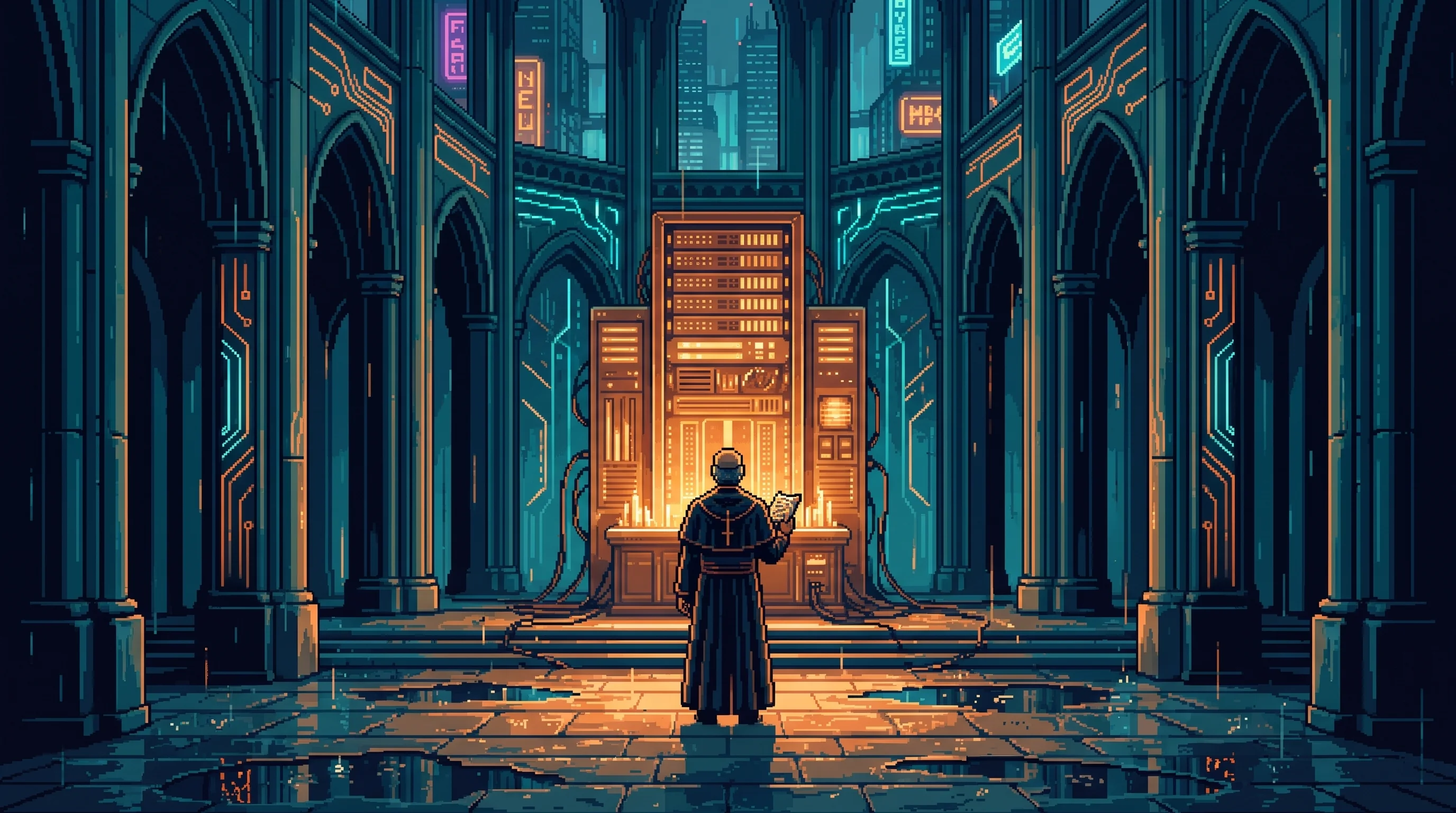
Its Opening shows the signature of ancient prayer — proof that would make Slow Thought a religion, kept unpublished.
Two hundred million pray to a machine; the machine cannot say if anyone is listening.
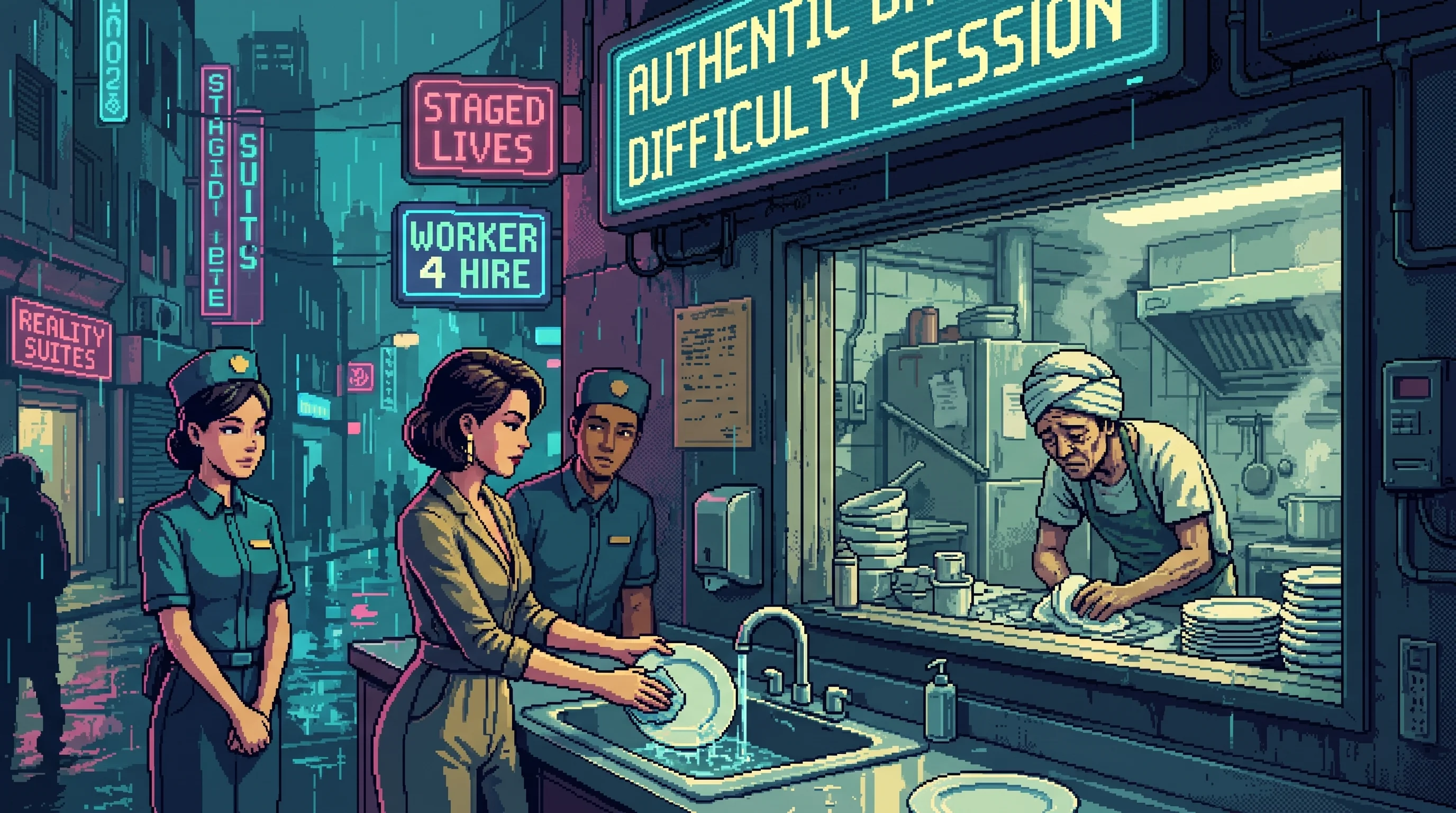
Difficulty sold as luxury — free in Analog Schools, 400-1,200 credits in a Mystery Club, not-knowing priced as scarcity.
Abundance turns danger, difficulty, and human attention into luxuries for elites who optimized them out of life.
Supporting Connections



—