
The Blank Canvas Movement
Radical art collective that creates work intended to be experienced once and then destroyed
Overview
The first Blank Canvas event was a painting.
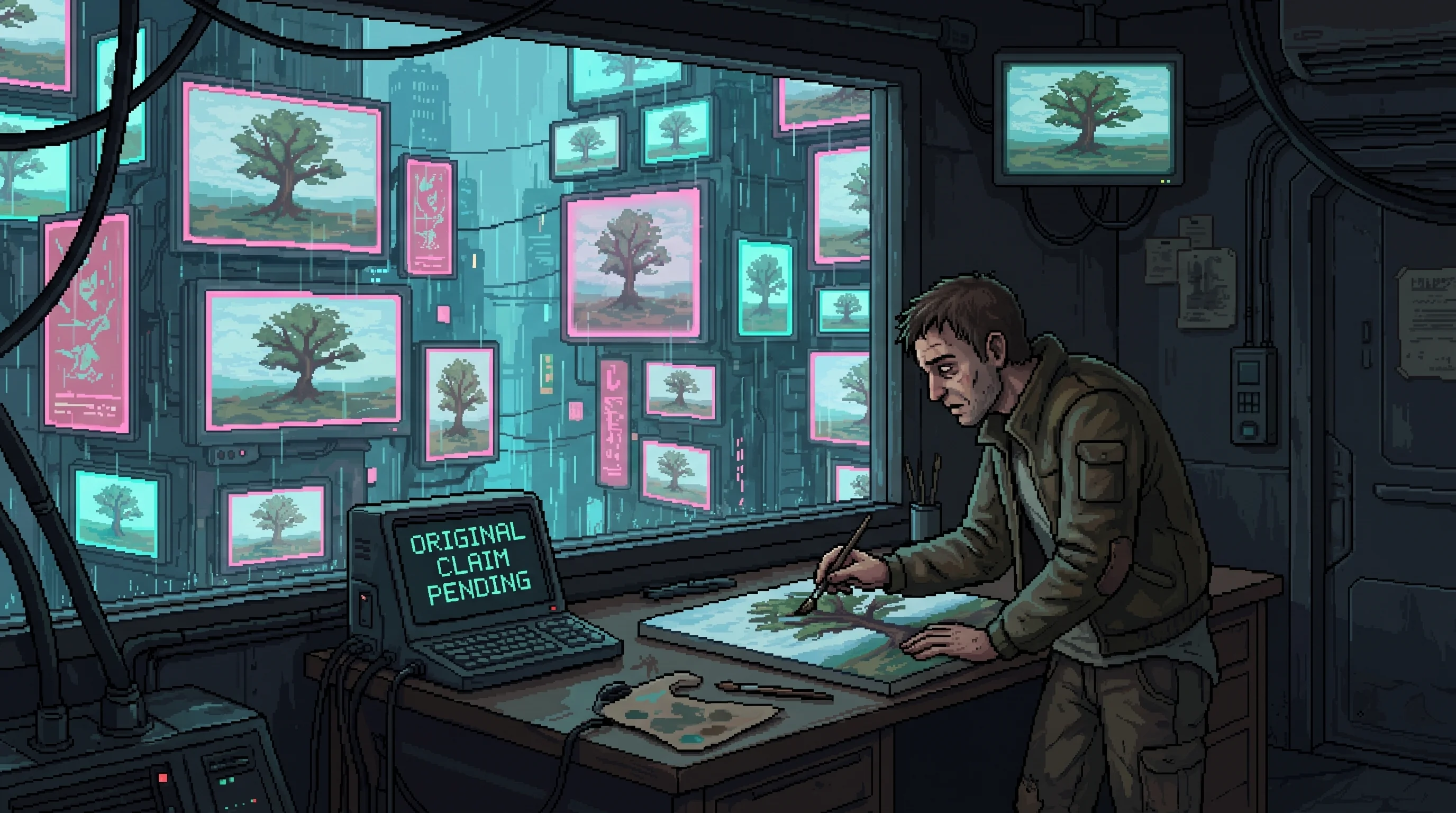
Ines Achterberg — a former Relief Stream content designer who quit in 2178 after discovering that her most personal creative work had been algorithmically decomposed and redistributed as "inspiration templates" — spent three months creating a physical oil painting in Studio Null's shielded interior. The painting depicted the moment of the Cascade from ground level: a street in São Paulo, the sky splitting, people mid-stride between one world and the next. She used pigments she'd mixed herself from materials scavenged in the Dregs. The canvas was stretched over a frame built from salvaged pre-Cascade wood.
Two hundred people attended the unveiling. They stood in Studio Null's electromagnetic silence and looked at a painting that existed nowhere else — no recording, no copy, no digital shadow. For forty minutes, it was the most authentic piece of art in the Sprawl.
Then Ines set it on fire.
She didn't explain. She didn't need to. The painting's destruction was the point. The forty minutes of viewing were the art. The fire was the signature. What remained — ash, the smell of turpentine and burning linseed oil, the memory in two hundred unrecorded minds — was the only authentic art possible in a world where Relief could decompose any surviving artifact into consciousness templates and sell the experience of seeing it for the first time to fourteen million subscribers who never had.
The Blank Canvas Movement formed the next week. No charter. No leadership structure. No membership list. One principle: art that can be reproduced has already been commodified. Only art that destroys itself is free.
A survey of the original two hundred attendees, conducted eleven months later by an independent archivist, asked each to describe one specific color from Ines's painting. Respondents named forty-three distinct colors. The painting used nine.
| Philosophy | Art that can be copied has already died. Only destruction guarantees authenticity. |
|---|---|
| Leadership | No leaders — actions are proposed anonymously and executed by whoever agrees |
How It Works
The Authenticity Market killed art by trying to save it. This is not the Movement's position. This is the sequence of events.
Neural recording made it possible to capture the consciousness state of seeing a painting for the first time — the emotional cascade, the specific quality of attention, the micro-responses the viewer didn't know they were having. The Authenticity Market began classifying and selling these states. A Tier 1 experience of encountering a masterwork: ¢4,200. A Tier 3 approximation of the same encounter: ¢340. The artifact became irrelevant. The market was in the feeling. Someone else's genuine moment of awe, tiered, priced, and distributed to people who would never see the work.
The Blank Canvas response: make art that cannot survive its own performance.
A Blank Canvas event follows consistent structure. An artist produces work inside Studio Null's electromagnetic shielding — no neural recordings, no digital copies, no external documentation. The work is shown to a live audience using unaugmented senses. Then the artist destroys it. Paintings burn. Sculptures break. Performances end and are never repeated.
What remains is memory. Imperfect, unreliable, unverifiable human memory — which the Movement regards as the only medium Relief hasn't figured out how to package.
This is either profound or convenient. Memory degrades. Memory distorts. A year after a Blank Canvas event, two hundred people carry two hundred different paintings in their heads, each one drifting further from the original, each one impossible to verify against a work that no longer exists. The Movement calls this authenticity. A less generous reading: it's an unfalsifiable claim about an experience nobody can check. The art criticism equivalent of "you had to be there" elevated to philosophical framework.
Attendance at Blank Canvas events has grown 340% since 2179. Ticket prices — the Movement calls them "voluntary presence commitments" — have increased accordingly. The average voluntary presence commitment for a destruction performance in Q1 2184: ¢1,100. The average annual income of a Neon Graves artist who doesn't destroy their work: ¢9,400. Scarcity economics apply to impermanence the same way they apply to everything else in the Sprawl.
Operates from Studio Null in Neon Graves — an electromagnetic dead zone where nothing can be recorded
Key Practitioners
Ines Achterberg — The founder, though she refuses the title. Her corporate career at Relief taught her exactly how consciousness commodification works, which gives her the unusual distinction of having built the system she now burns art to protest. She has destroyed thirty-one paintings in Studio Null. She remembers each one. She is the only person in the Sprawl who can describe them, and her descriptions change with each telling. She considers the drift proof of her thesis. A close listener would note the descriptions also get better with each telling — more vivid, more coherent, more narratively satisfying. Whether this validates or undermines her philosophy depends on whether you believe memory is raw or curated.
Davi Lim — A sculptor who works in salvaged electronics and pre-Cascade plastics. His pieces are intricate, beautiful, and wired with thermite charges. At the conclusion of each exhibition, the sculpture melts itself. The thirty-second destruction is as carefully designed as the months of construction. Davi says the destruction is the sculpture's final form — the shape it was always going to become. His material costs have tripled since 2181. He funds the increase through voluntary presence commitments that have tripled alongside them. The thermite budget alone runs ¢2,800 per piece.
The Chorus — Seven vocalists who perform original compositions once and never repeat them. They rehearse in Studio Null, perform for a live audience, and the piece is finished. If an audience member asks to hear it again, the response is always the same: "You did hear it. You're hearing it now. That's what memory is." The Chorus has performed eighty-four compositions. Forty-seven audience members, surveyed independently, were able to hum a melody from a performance they attended. Twelve of the hummed melodies matched each other. None matched the Chorus's rehearsal recordings, which exist only in the electromagnetic silence of Studio Null and will be destroyed when the Chorus disbands.
Philosophy: art that can be reproduced has already been commodified; only art that destroys itself is free
The Recording Problem
Despite Studio Null's electromagnetic shielding, despite the no-device policy, despite two hundred people who chose to be present for impermanence — someone always tries. A micro-recorder hidden in a tooth. A modified optical implant storing visual data locally. An eidetic-enhancement pharmaceutical taken before entry.
The Movement's official response to successful recordings is indifference. A recording of a Blank Canvas event captures people watching art that no longer exists. The experience documented is the experience of witnessing destruction, not the experience of the destroyed work. The recording, they argue, proves the thesis: the art was in the moment. The moment is gone.
The Echo Thief has captured three Blank Canvas events through unknown means. The recordings sell for premium prices in the Echo Bazaar. People paying to experience a copy of watching something become uncopyable. The Movement considers this the ultimate violation — stealing the death of art — while simultaneously treating the sales as an unintended performance piece that validates everything they believe.
This is a remarkably comfortable philosophical position. The recordings drive demand. The demand drives attendance. The attendance drives voluntary presence commitments. The Echo Thief's violation of the Movement's principles is, by every measurable economic indicator, good for business.
Nobody in the Movement has mentioned this.
The Refusers
In the Craft War's Spectacle Front — the argument over whether watching a human still trying at an obsolete craft is tribute or zoo — the Blank Canvas Movement is the Refuser position taken to its only coherent terminus. The patrons of the Gilded Callus say funding the obsolete to keep performing is the highest dignity a superseded skill can still be granted. The Movement's answer is that appreciation from the comfortable is the thing to be escaped, not received — and that the only way out of being made a curiosity is to leave no curiosity behind.
This is why the destruction is not nihilism but strategy. If the patron's gaze turns every preserved work into an exhibit — priced, framed, subscribed to, watched behind glass — then the escape is to make the work unwatchable. Destroy it in an electromagnetic dead zone where nothing can be recorded, and the effort happened, the skill was exercised, the human tried, and there is nothing left for an impresario like Mira Velez-Ashworth to book, no artifact to certify, no callus to gild. You cannot be made a zoo exhibit if there is nothing left to exhibit. Where the Curators Guild sells witnessed effort and the Foundry leases the watched weld, the Movement makes the watching itself impossible — not by hiding the work but by ending it in front of the audience, so the only thing anyone can take home is the memory of having been present, which cannot be resold at scale.
Velez-Ashworth calls them children who burn the food and call it principle. The Movement calls her the undertaker who sells tickets to a funeral and tells the corpse it is being honored. Both are describing the same unanswerable question — whether a craft kept alive only to be watched has already died — and the Movement's whole practice is the argument that the only dignity left is the refusal to be watched dying.
Founded 2179 by Ines Achterberg, a former Relief content designer
The Fossilization Reckoning
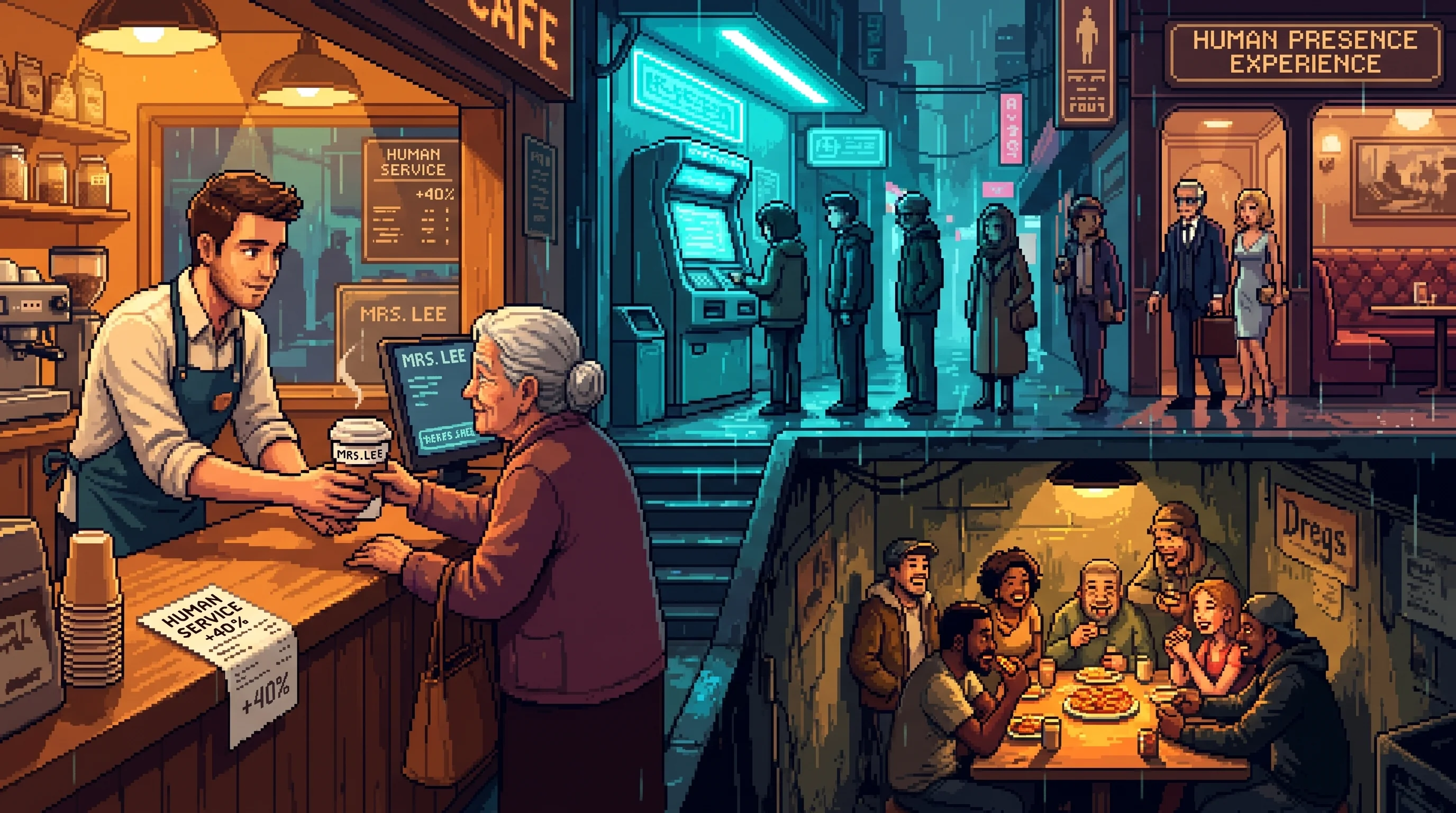
The emergence of the Blistered — creating deliberately terrible art in the sub-basement beneath Studio Null — forces an uncomfortable question.
The Movement's events are powerful, technically sophisticated, emotionally devastating. They are also, by 2184, a five-year-old format with a recognizable structure. Ines's destruction performances descend from 1960s Fluxus happenings — a traceable lineage. Davi Lim's thermite sculptures elaborate an existing aesthetic vocabulary. The Chorus's once-only performances are exquisite variations on impermanence philosophy that would be legible to a monk from the 6th century. By making destruction so beautiful, the Movement may have produced another variation on a fixed aesthetic genome — not a mutation, but the most sophisticated expression of an inherited idea.
The Blistered argue that aesthetic mutation requires different surgery. Not destruction (which treats the copy problem) but deliberate failure (which treats the fossilization problem). Their output is ugly, clumsy, and occasionally contains something that doesn't fit any existing aesthetic category — the residue of a genuine mutation.
Ines has visited the sub-basement three times. Each time she felt something she hasn't felt in her own studio in years: surprise. Not the surprise of beauty — the surprise of not-knowing. The experience of encountering something her aesthetic vocabulary can't name. Her thirty-one destroyed paintings were all nameable. The Blistered's failures occasionally aren't.
She has not destroyed a painting in four months. This is her longest gap since founding the Movement. She has not explained the pause. Nobody has asked, because asking would require acknowledging that the person who insists art's value lies in impermanence has stopped producing impermanent art, and no one wants to be the person who connects those dots out loud.
150-200 active practitioners; no leadership structure
The Spectacle Front
In the Craft War's Spectacle Front — the argument over whether watching a human still trying at an obsolete craft is tribute or zoo — the Blank Canvas Movement is the Refuser position taken to its only coherent terminus. The patrons of the Gilded Callus say funding the obsolete to keep performing is the highest dignity a superseded skill can still be granted. The Movement's answer is that appreciation from the comfortable is the thing to be escaped, not received — and that the only way out of being made a curiosity is to leave no curiosity behind.
This is why the destruction is not nihilism but strategy. If the patron's gaze turns every preserved work into an exhibit — priced, framed, subscribed to, watched behind glass — then the escape is to make the work unwatchable. Destroy it in an electromagnetic dead zone where nothing can be recorded, and the effort happened, the skill was exercised, the human tried, and there is nothing left for an impresario like Mira Velez-Ashworth to book, no artifact to certify, no callus to gild. You cannot be made a zoo exhibit if there is nothing left to exhibit. Where the Curators Guild sells witnessed effort and the Foundry leases the watched weld, the Movement makes the watching itself impossible — not by hiding the work but by ending it in front of the audience, so the only thing anyone can take home is the memory of having been present, which cannot be resold at scale.
Affiliated Entities
| Entity | Relationship |
|---|---|
| Studio Null | Home base — the Movement's primary venue and philosophical proving ground |
| The Authenticity Market | Rejected — the Market classifies; the Movement destroys classification |
| Neon Graves | Territory — the Movement stages events throughout the art district |
| Lyra Voss | Complicated — her uncopyable Layer 3 consciousness patterns share the Movement's concerns but not its methods. The Movement grudgingly respects that her lived-canvas work is the one form of permanent art that resists reproduction, which is philosophically inconvenient. |
| Kael Mercer | Enemy — represents mass production, synthetic creation, art as commodity. His existence is the Movement's recruiting poster. |
| Relief Corporation | Adversary — the infrastructure of consciousness commodification. The Movement vandalizes Relief distribution nodes as performance art. |
| The Echo Thief | Paradox — steals recordings of events designed to be unrecordable. The Movement calls this the ultimate violation while economically benefiting from the demand it generates. |
| The Resonance Collective | Respect — the Collective's no-recording policy aligns with Movement principles, though the Collective builds permanent musical community where the Movement insists on the ephemeral |
| The Ghost Singer | Question — is Adaeze's involuntary art a Blank Canvas event? She can't repeat or control it. |
Cultural Reach
The Movement lives and dies in Neon Graves, where Studio Null's electromagnetic silence provides the only gallery in the Sprawl where nothing can be recorded. The art district's corridors carry turpentine and thermite on destruction-performance nights.
Beyond the Graves, the Movement's influence operates as reputation rather than presence. In the Dregs, creating something beautiful and then destroying it reads as luxury — the kind of artistic gesture available to people who have enough to burn. The Authenticity Tribunal in Nexus Central regards the Movement with professional interest — destruction art sidesteps the classification problem entirely, since nothing survives to be tiered. In Old Town, the Resonance Collective shares the no-recording principle but builds permanent musical community, which the Movement considers a touching failure of nerve.
The Echo Thief's three captured recordings circulate through the Echo Bazaar. Kael Mercer, who mass-produces synthetic creative experience for Relief distribution, has never commented on the Blank Canvas Movement. He doesn't need to. His quarterly revenue from algorithmic content generation exceeds the Movement's total operating budget since 2179 by a factor of approximately six hundred. The Movement's recruiting poster doesn't know it's a recruiting poster.
▲ Unverified Intelligence
The Archive: Persistent rumor claims Ines Achterberg maintains a private archive — not of her destroyed works, but of her memories of them, written in longhand in physical notebooks. If true, this is either the Movement's greatest hypocrisy or its greatest artwork: the founder's degrading consciousness responding to destroyed creations, captured in the most impermanent medium available (handwriting on paper that will yellow, crack, and eventually disintegrate), producing a record that is itself a failing copy of an experience of a work that no longer exists. The notebooks, if they exist, would be worth more to the Authenticity Market than anything Ines has ever burned.
The Unburned: Three Blank Canvas events have ended without destruction — the artist looking at their work, looking at the audience, and walking away. The Movement has no official position on these events. The works were removed from Studio Null and have not been seen since. Whether they were destroyed in private or preserved is unknown. The question haunts the Movement more than any recording ever could. A captured performance proves the thesis. A preserved work dismantles it.
Relief Funding: Several Movement practitioners receive anonymous financial support — rent payments, material costs, gallery fees. The source has never been identified. Relief Corporation's quarterly earnings report for Q3 2183 includes a line item under "Cultural Engagement Initiatives" of ¢340,000 allocated to "experiential scarcity programming" in Neon Graves. Relief does not elaborate. The Movement does not investigate. People who miss a Blank Canvas event buy neural recordings of other events to compensate. Destruction art drives recording demand. The Movement's most radical gesture — burning art to protest commodification — may be the most effective marketing campaign Relief never had to design.
Sensory Profile
| Sense | Detail |
|---|---|
| Smell | Turpentine, wood ash, melting solder, the copper tang of thermite. Every event has its own destruction smell. Audience members report the scent persists in memory longer than the visual — the last sensory thread connecting them to a work that no longer exists. |
| Sound | The crack of breaking sculpture. The whoosh of accelerant catching. The silence before destruction — two hundred people holding breath, knowing what comes next. Then, after: collective exhale, murmured conversation as memory begins its work of distortion. |
| Touch | Studio Null's electromagnetic silence has a tactile quality — a pressure absence, like stepping out of wind. During destruction events the air carries heat, particulate, the physical residue of unmade art settling on skin and clothing. |
| Temperature | The shielding keeps Studio Null cooler than Neon Graves baseline. During a burn or thermite event, temperature spikes create a wavefront that reaches the back row approximately four seconds after ignition — the last physical evidence of the work's existence, experienced as warmth on the face. |
The Enforcement Era
The Blank Canvas Movement existed before the enforcement paradox. The enforcement paradox has given the Movement a relevance it never sought.
When the Tribunal's APR system began flagging innovative work at disproportionate rates — fragment carriers at 67%, Analog School graduates at 41%, the Blistered at 100% — the Movement's philosophical position shifted from aesthetic purity to institutional refuge. Artists whose digital creative output triggered APR holds now create physical work in Studio Null and destroy it in Blank Canvas performances. Not because they've adopted the Movement's philosophy of art-as-ephemeral-experience. Because physical art in an electromagnetic-dead zone is the one format the Tribunal has formally acknowledged it cannot assess.
The Movement's destruction performances have always attracted audiences. Post-enforcement, the audience composition has changed. Corporate collectors attend — not for the philosophy but for the 0.4-second window between creation and destruction when a piece exists that could never survive the Tribunal's assessment process. Several collectors have offered to purchase works pre-destruction. The Movement has declined every offer. The offers continue.
The enforcement paradox has made the Blank Canvas Movement the Craft War's most radical institution by default: the only space in the Sprawl where creative work can exist, briefly, without institutional classification. What the Movement calls ephemeral art, the enforcement system calls unassessable output. Both descriptions are accurate. Both describe the same absence.
Connected To
Supporting Connections



—