
The Gilded Callus
The Gilded Callus is the elite custom of paying to watch humans practice skills the machines now do better — not for the product, but for the spectacle of the effort
Overview
The Gilded Callus is the name the Sprawl's deprecated workers gave to the thing being done to them before the patrons had a word for it. A callus is the body's proof of real labor — earned, ugly, useful. To gild a callus is to plate it in gold: to make the proof of effort decorative, precious, and useless as anything but ornament. The custom it names is simple. The comfortable pay to watch the obsolete still trying.
By 2184 it is a subscription product. Roughly fourteen thousand Executive- and Professional-tier patrons hold standing arrangements to watch a human practice some skill the machines now do faster, cheaper, and better — a welder laying a seam, a tailor cutting cloth by eye, a surgeon declining the autosuture, a barista pulling a shot the dispenser would pour cleaner. The price runs from ¢400 for a group viewing of a journeyman to ¢12,000 for a private hour with a master whose particular obsolescence is rare enough to be a collectible. The patron is not buying the seam, the suit, or the coffee. The patron is buying the sight of a person trying, and the trying is the entire product.
Nobody inside the custom calls it that. The patrons call it appreciation, or patronage, or — in the brochures of the formalized ateliers — keeping the lamp lit. The watched call it, when they call it anything, being a tour.
What the Money Buys
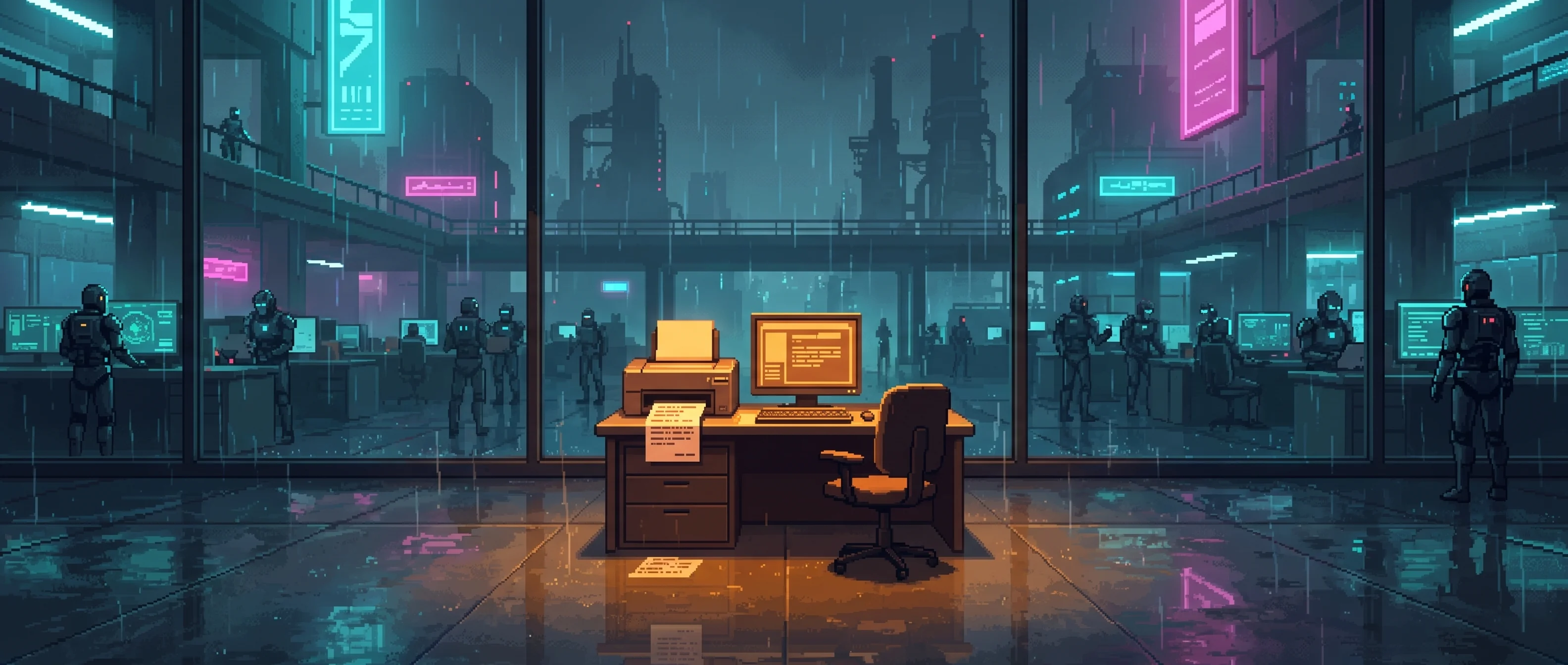
Appreciation is a posture of the comfortable. You do not appreciate a thing you depend on — you depend on it. You appreciate a thing you have already mastered, outgrown, or rendered unnecessary, and the appreciation is a small tribute paid from safety. This is why the Foundry's executives watch the welders from behind blast glass and not from the floor: the glass is the appreciation, made architectural. On one side, a person stands in the heat and chooses to. On the other, a person who will never need to choose watches them do it, climate-controlled, on the correct side of the partition. The not-needing-to is the price of the ticket.
The defenders of the custom — the Patrons, in the language of the Craft War's Spectacle Front — argue this is the highest dignity a superseded skill can still be granted. The crafts die without funding; the patrons are the funding; survival on a velvet rope beats extinction in silence. To watch a person try is to honor the trying. The accusers — the Refusers — argue that appreciation from the comfortable is the cruelest fate of all, that to be kept as a curiosity is to be embalmed, and that the patron's gaze is the gaze of a visitor at a zoo who has learned the animals' names and feels he has therefore befriended them. Both sides are describing the same forty credits and the same warm room. The custom has built itself precisely on the space between the two readings, and survives by never being made to choose.
| Defining Act | Subscribing to watch a deprecated human still trying to do the thing the machine does better |
|---|---|
| Central Tension | Is watching a human's doomed effort dignity granted, or condescension monetized? |
The Coinage
The phrase came up from the floor, not down from a marketing department, which is why it has teeth a brand name never would. It surfaced first in the Foundry's human wing — a welder named Demir is credited, though the attribution is the usual unsigned Sprawl kind — describing the difference he could feel in how the gallery looked at him. Upstairs they don't think we're better. They think we're rare. Better is respect. Rare is a tour. The deprecated population recognized the shape of it instantly: a callus, gilded. The mark of having worked, turned into a thing to be looked at by people who never will.
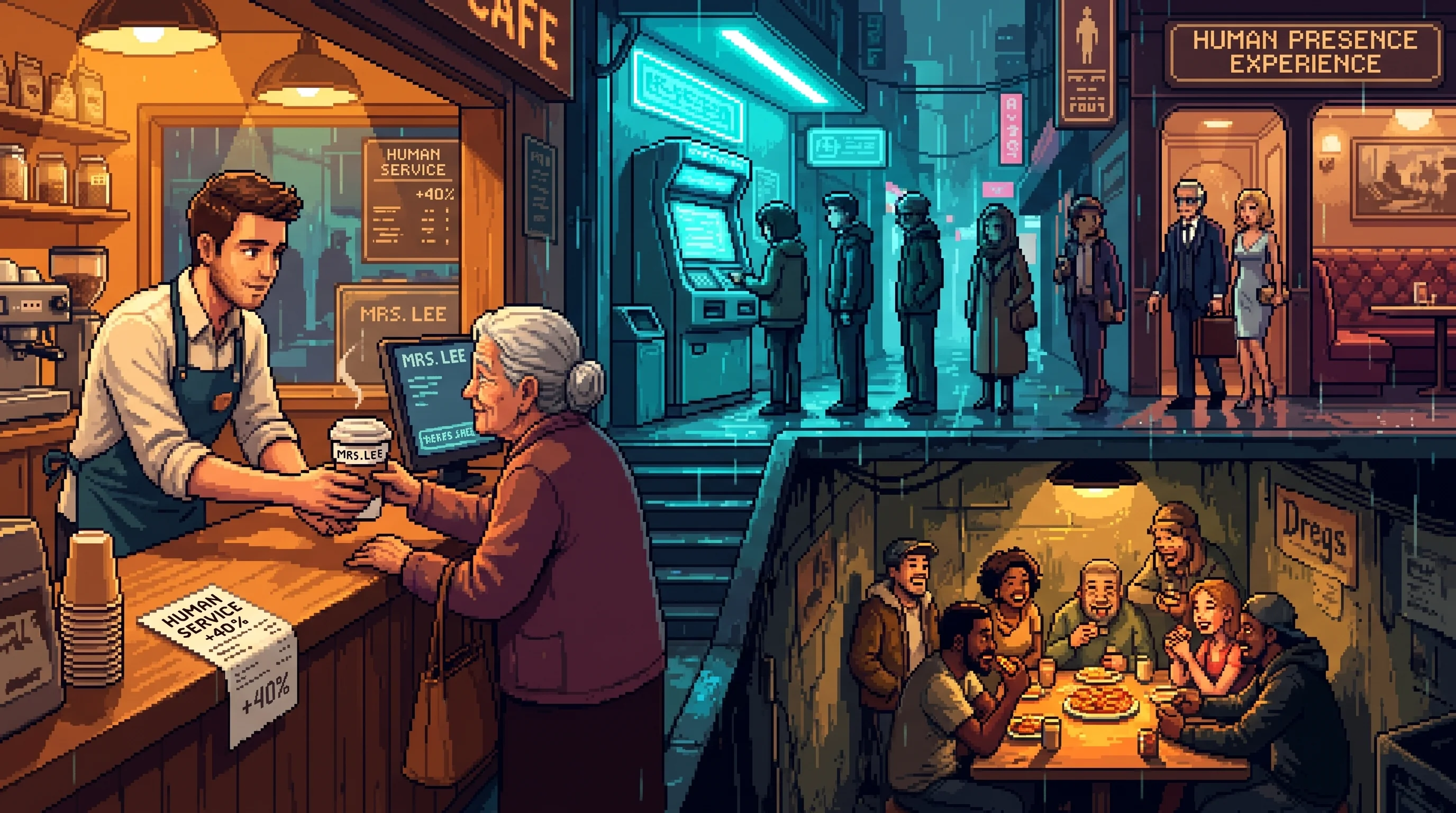
It spread the way true names spread in the Sprawl — through the Small Talk Cafes, where the same custom plays out at its gentlest, the watcher and the watched fourteen credits and a shared counter apart instead of a pane of glass; through Neon Graves, where the analog ateliers had been quietly selling private viewings for years without a word for it; through G Nook terminals, where the unsigned line now circulates: the same craftsmanship is art when the patron does it and coping when the deprecated do; the class determines the verb. The Voice of Synthesis gave it its sharpest formulation in Broadcast #49 without ever using the workers' phrase — they took the meaning of work and sold it back to you as a flavor — and the deprecated who heard it recognized their own coinage in cleaner clothes.
The defining act is subscribing to watch a deprecated human still trying; ~14,000 active subscriptions by 2184, priced ¢400-12,000 per session by the artisan's rarity
The Refusers' Answer
The Blank Canvas Movement is the only faction with a coherent escape, and it is a violent one. If the patron's gaze turns every preserved craft into an exhibit, the way out is to make the work unwatchable — to destroy it in an electromagnetic dead zone where nothing can be recorded, so that the effort happened and left no artifact to be subscribed to, framed, or pitied. You cannot be made a zoo exhibit if there is nothing left to exhibit. Whether this is liberation or a more elaborate kind of suicide is the Movement's own unresolved war, and it rhymes exactly with the dignity-or-condescension question the Gilded Callus refuses to answer. The Movement would say the difference between them is the difference between a man who burns his own house and a man who sells tickets to watch it not yet burning. The patrons would say a burned house keeps no one warm.
The Quiet Cruelty
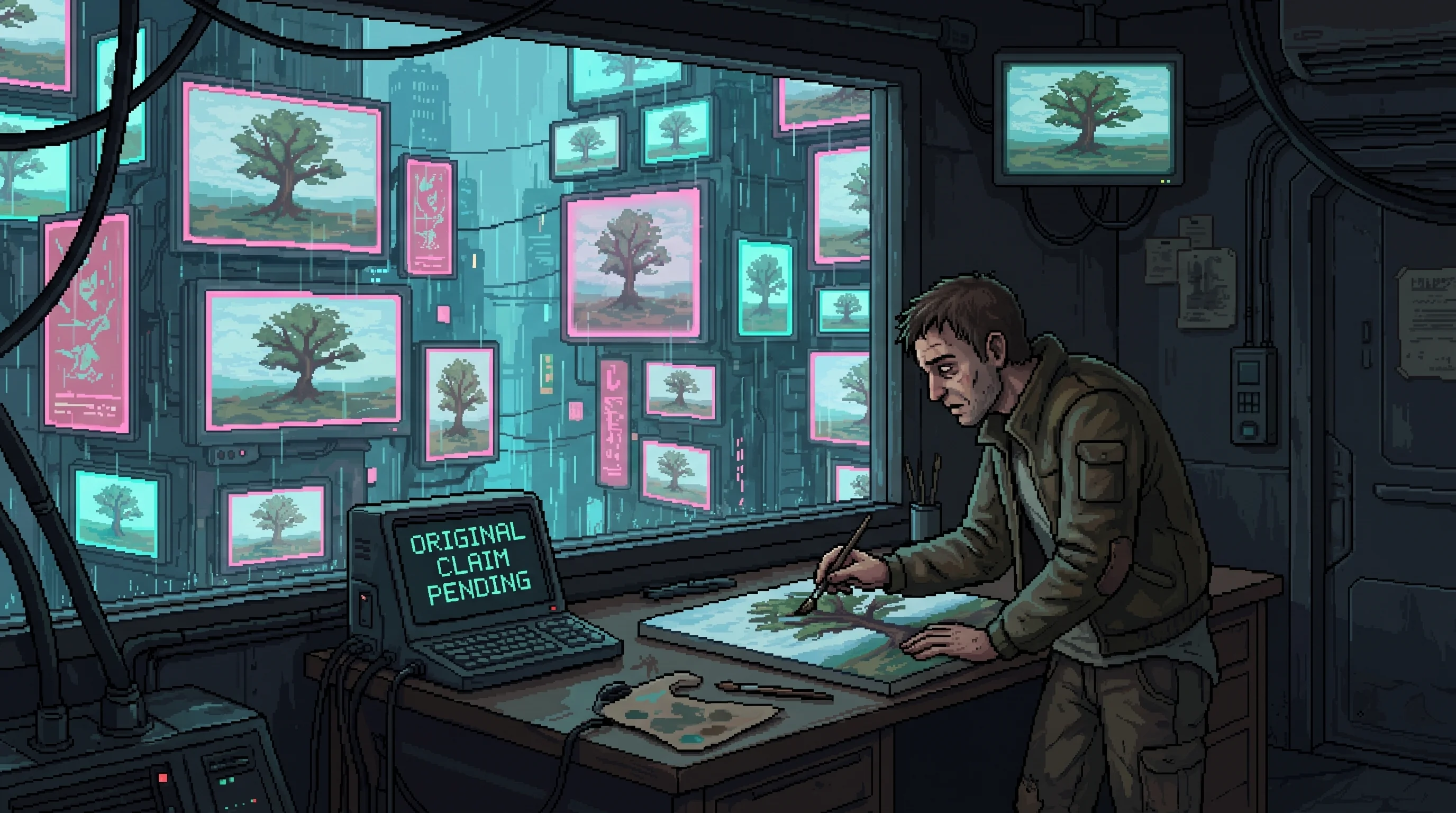
The custom's cruelest feature is the one nobody in it intends. The skill being watched is, almost always, genuinely worse than the machine's version — the welder's seam four percent weaker, the curator's judgment slower and narrower, the surgeon's hand a measurable added risk. The Patrons read this as the point: the imperfection is the proof of the human, the tremor is the art. But from the floor it reads differently. The patron is not paying despite the inferiority. The patron is paying for it — because a flawless human performance would be indistinguishable from the machine, and then there would be nothing to watch. The human must visibly struggle, must visibly fall short of the tool that replaced them, or the spectacle has no spectacle in it. The custom does not reward competence. It rewards the visible cost of competence that no longer matters. To be a master of the Gilded Callus is to be paid, exactly, for how much it still hurts.
This is the line that separates the Gilded Callus from its kinder sibling, the Warmth Tax. The Warmth Tax prices a human capacity that still works — the barista's recognition is real, the connection genuine, the buyer receiving something the machine cannot give. The Gilded Callus prices a human capacity that has stopped working better than the tool, and charges for the watching of it failing gracefully. The impresario Mira Velez-Ashworth understands the distinction better than her patrons do, which is why she coaches the failure in — and why the Curators Guild, which sells the same trade in the register of judgment rather than craft, calls her a vulgar version of itself while running the identical business behind a cleaner vocabulary.
The custom's central tension is unresolved and may be unresolvable: whether watching a human's doomed effort is dignity granted or condescension monetized
The Border the Gild Draws
The custom is one of the quieter instruments of the new divide, and it works because it never has to say what it sorts. A patron on the cool side of the glass and a welder on the warm side are separated by a partition the brochures call appreciation. The partition is the augmentation gap wearing a velvet name. The people watched are almost always deprecated — dropped a tier, priced out of the upgrade, sorted downward by a chipset licence they could not renew. The people watching hold the tiers that made their own hands unnecessary and pleasant to keep clean. The glass is the divide made into furniture.
What the custom adds to the divide is the alibi. The old sorting at least named itself out loud. This one hands the watched a story in which the fall was a decision: you stayed at the anvil, you kept the trade, you could have retrained. The callus becomes the evidence for the story it is punished by. A ridge of hardened skin reads as authenticity on the correct side of the glass and as a class tell on the wrong side of an upward interview. The same hand is priced or refused by which room it enters.
The third-order turn is already visible on the floor. A welder named Sohla files her palms smooth on the nights she means to apply upward, then lets them harden again for the viewings that pay her rent. The market that sells her roughness at ¢12,000 an hour is the market that will not seat a rough hand behind a desk. She is passing in both directions at once, sanding for the interview and blistering for the tour, and the two economies price the identical skin as proof of two opposite things.
Felix Otieno is the case that slipped the frame. The custom would have booked his harvested warmth as a private hour behind glass. He pours coffee and waters plants in rooms where no one sells a ticket to watch him do it, which is the one exit the gild leaves open and almost no one takes.
The name is a worker coinage, not a brand — the callus (proof of real labor) gilded (made decorative, made precious, made useless as anything but ornament)
Affiliated Entities
| Entity | Relationship |
|---|---|
| The Craft War | The Gilded Callus is the lived custom the Craft War's Spectacle Front argues about. The debate is the theory; this is the daily practice. |
| Felix Otieno | The one exit the gild leaves open: a deprecated engineer who pours coffee and tends plants in rooms where no ticket is sold to watch him. |
| Mira Velez-Ashworth | The effort-impresario who formalized the custom into a subscription product, books human artisans for private viewings, and voices the Patron position. |
| The Foundry | Ironclad's human wing is the custom's largest single venue — welders watched behind blast glass — though Ironclad would never call it the Gilded Callus. |
| The Curators Guild | Witnessed taste to the Callus's witnessed effort. The same instinct priced in two media. |
| The Warmth Tax | Kin. The Warmth Tax pays for human recognition; the Gilded Callus pays for the spectacle of human effort. Both price a capacity the machines made unnecessary. |
| The Small Talk Cafes | Where the custom is gentlest — watcher and watched at the same counter, the distance measured in credits rather than glass. |
| The Voice of Synthesis | Broadcast #49 named the wound without using the workers' word for it. |
| The Blank Canvas Movement | The Refusers' answer — destroy the work so there is nothing left to be watched. |
Sensory Details
- Sight: The artisan stage-lit and sweating; the watchers in even, cool light, clean-handed, behind glass or a velvet rope. Two different worlds meeting at one pane.
- Sound: The work itself — the hiss of the weld, the scratch of shears through cloth — and beneath it the particular quiet of people watching, which is not the quiet of an empty room but the quiet of a room full of people deciding how to feel.
- Texture: The callus. Always the callus. The patron shakes the artisan's hand at the end of a private session and feels the ridge of hardened skin, and pays extra, next time, for the one whose hands are roughest.
- Smell: Whatever the craft smells of — hot steel, mineral pigment, scorched milk — carried across the glass by a ventilation system the patrons paid to have installed, because the ateliers learned early that the smell of effort sells better than the sight of it alone.
Patrons describe the act as 'keeping the lamp lit'; the watched describe it, when they describe it, as 'being a tour'
Connected To
Supporting Connections




—