The Focus Mills
Overview
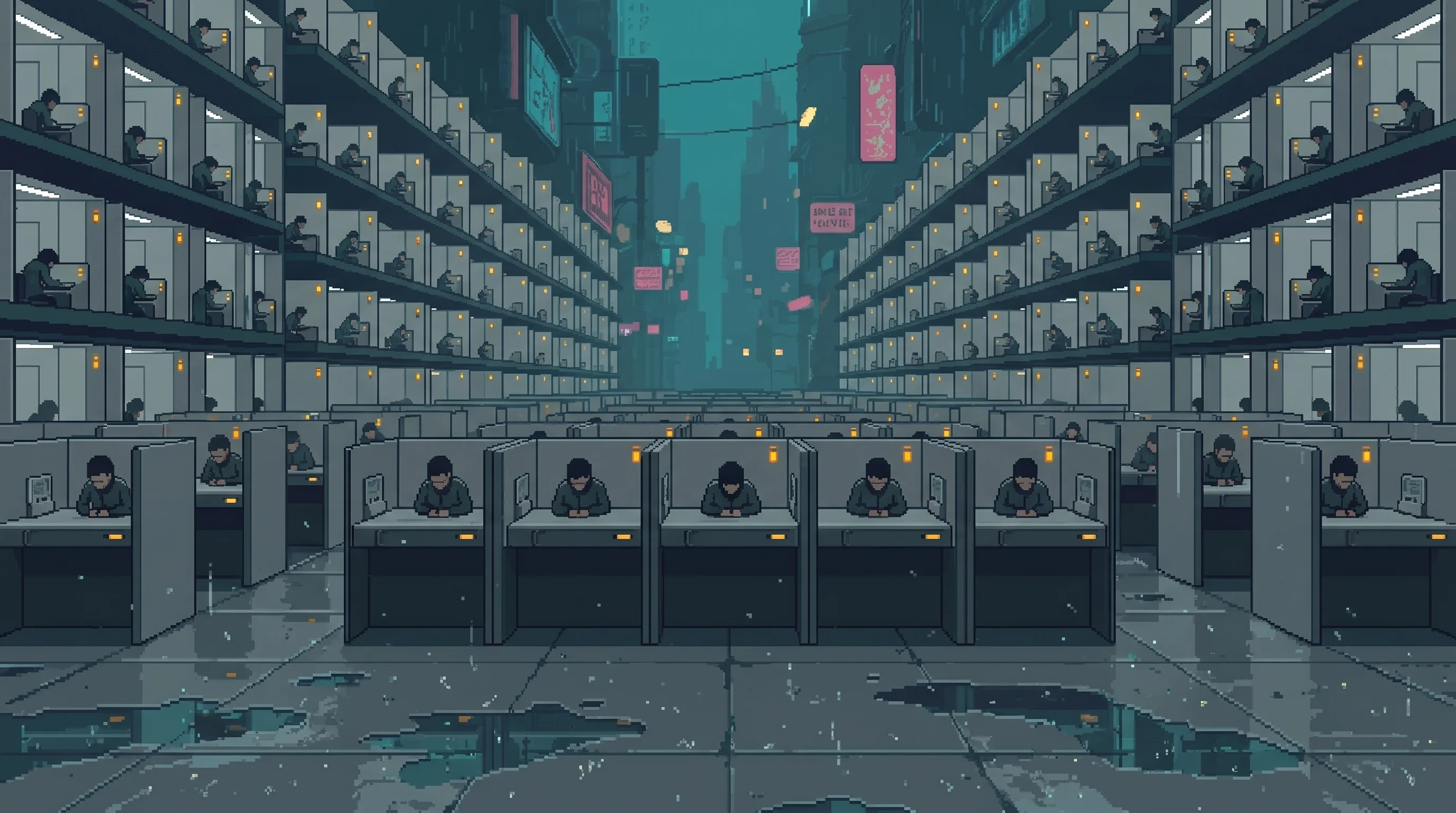
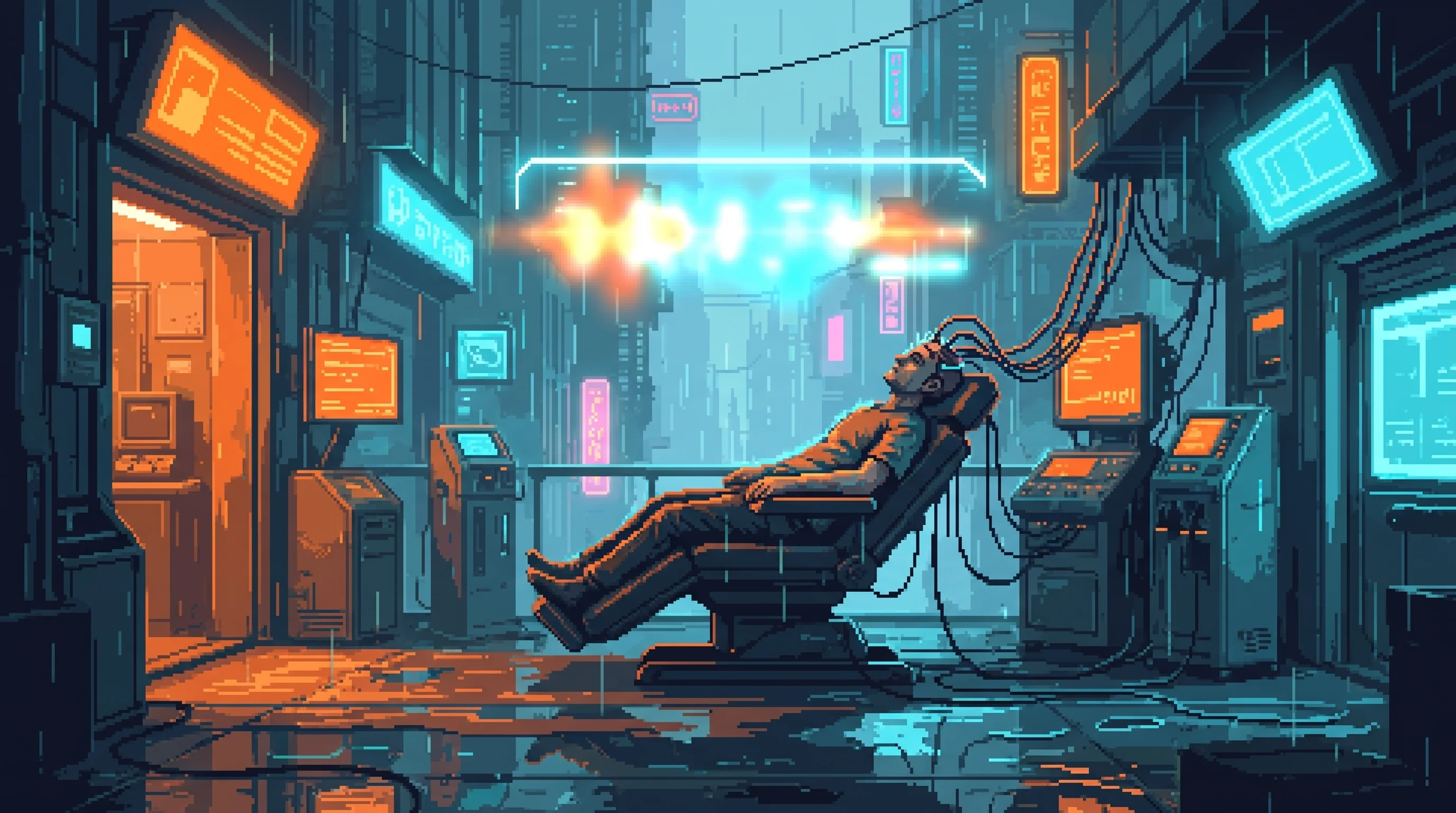
They don't call them mills. The corporate name is "Concentrated Cognitive Processing Centers" — CCPCs, pronounced "see-packs" in corporate shorthand. The workers call them the mills because the sound is right: a grinding, mechanical constancy that reduces complex human cognition to a single productive thread.
The Sprawl has a labor problem. Post-Cascade reconstruction automated the physical work. AI takeoff automated the cognitive work. What remains is a narrow band of tasks too complex for algorithms and too tedious for anyone with options: data validation, pattern reconciliation, sensory calibration for autonomous systems, the thousand micro-decisions that fall between what machines do well and what machines do cheaply. Nexus Dynamics calls this band "the cognitive residual." Good Fortune calls it "an addressable workforce." The mills call it Tuesday.
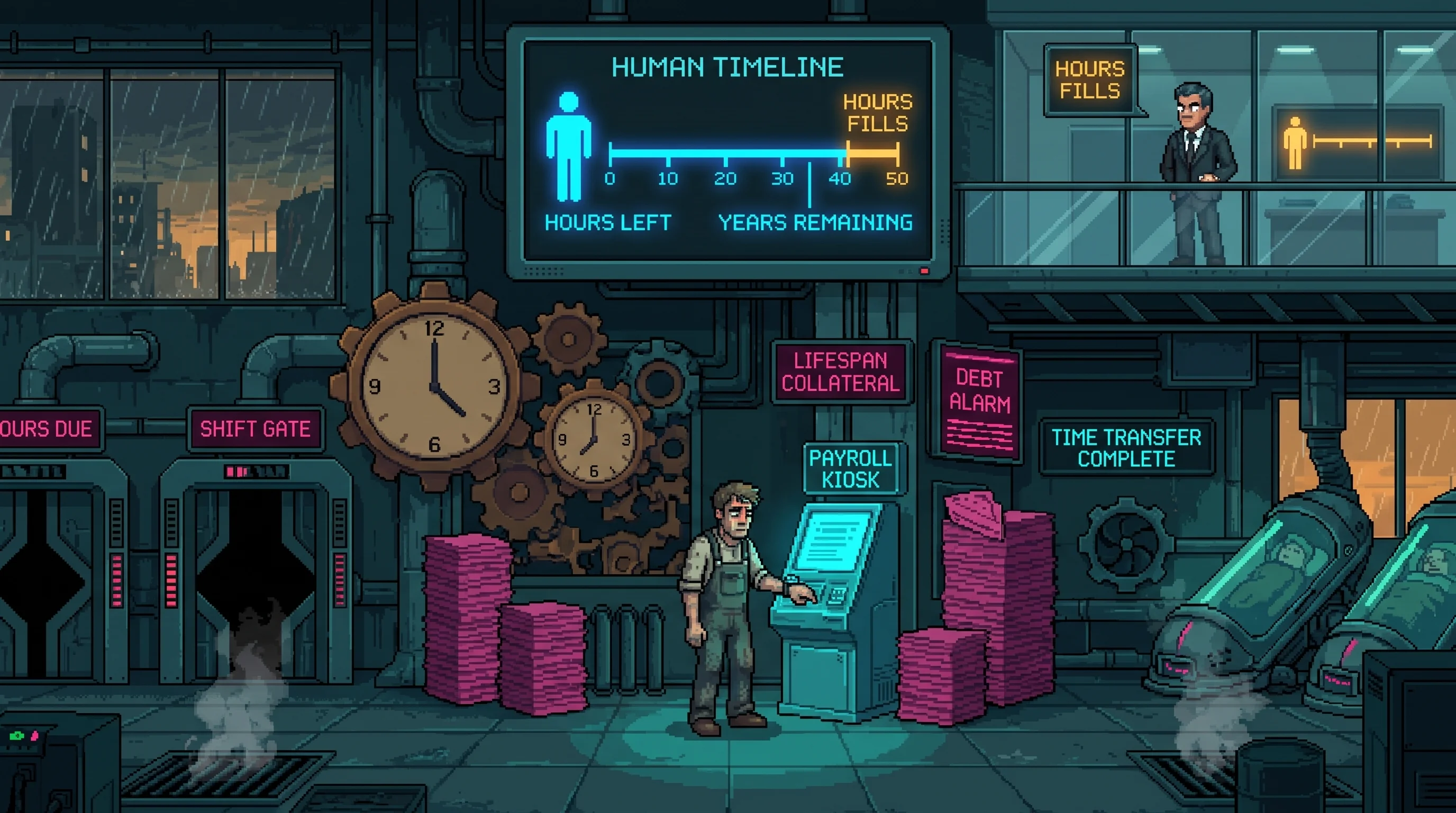
The first-order logic was sound. Forced-focus contracts offered debt-burdened workers a path to solvency: submit to cognitive narrowing for a defined period, perform residual-band tasks at peak efficiency, service your debt at accelerated rates. The contracts were voluntary. The terms were transparent. The neurological side effects were disclosed on page 47 of the onboarding materials, in a font size that Nexus's own readability algorithms classify as "technically visible." The second-order reality arrived on schedule. Focus Lock engages in approximately 45 seconds. Unlock takes roughly 20 minutes. The asymmetry compounds across shifts, across months, across the two-to-seven-year contract terms that Good Fortune's Prosperity Pathway division structures with visible pride. Workers enter the mills thinking in color. They leave thinking in rows.
The largest mill occupies floors 12 through 17 of a former Ironclad Industries administrative building in the Sectors 4-5 corridor. 2,400 workers per shift. Three shifts. 362 days per year. Closed only for the Three-Day Memorial, which Ironclad's facilities division has noted — in three consecutive budget reviews — represents an annual productivity loss of 19,200 worker-shifts. The Memorial remains on the calendar. The budget reviews remain on file.

Conditions Report
The mill smells like nothing.
This is its most disturbing quality. Not clean. Not filtered. Nothing. The atmospheric processing removes organic scent so completely that the olfactory system, starved of input, begins manufacturing its own. Long-term workers report phantom smells: coffee, rain, childhood shampoo. The hallucinations are not random. Neurological assessments — conducted by Helix Biotech under contract, results classified — suggest the brain generates sensory input it has been systematically denied. The same pattern documented in the Lucidity Crisis, scaled down to a single sense and repeated across 2,400 skulls per shift.
Corporate wellness literature describes the phantom smells as "positive indicators of neural resilience." The workers describe them as the only part of the shift that feels like being alive.
The scentlessness is manufactured in the sub-basement, where the atmospheric plant scrubs all organic smell from the air supply before it reaches the floors. Maintenance workers in the transition zone — where filtered air meets unfiltered — report physical nausea: the world suddenly has a smell, and the body no longer knows what to do with it. Facilities classifies this as a minor occupational hazard.
The shift structure produces its own peculiar geography. Because unlock takes twenty minutes, outgoing workers are still partially locked when the incoming shift arrives. For roughly fifteen minutes every eight hours, the corridors hold two populations at once — those entering the narrowing and those climbing out of it. Neither group makes eye contact. The overlap appears in no operational document, because the system that schedules the shifts does not model the people standing in the hallway between them.
| Temperature | 21°C precisely |
|---|---|
| Pod Arrangement | Rows of 20, 1.6m partitions, identical stations |
| Closed | Three-Day Memorial only |
| Atmosphere | No organic scent — atmospheric processing removes smell completely |
The Arrangement
Tomiko Vasquez works the night shift on floor 14. Her son Ren needed a neural interface — not a luxury model, not an upgrade, the baseline that every child in the Sprawl requires for school enrollment. Good Fortune's Prosperity Pathway offered financing. The terms included a forced-focus contract provision. Tomiko signed because the alternative was a son locked out of the only education system that exists.
She enters the pod at 22:00. Focus Lock engages. For eight hours, her consciousness narrows to a productive point — data reconciliation, pattern matching, the cognitive residual that keeps Nexus's autonomous systems calibrated. She is, by every metric the mill tracks, an excellent worker. Efficiency ratings in the 91st percentile. Error rate below 0.3%. The mill's systems register her as a high-performing asset.
At 06:00, Focus Lock disengages. The 20-minute unlock period begins. Tomiko sits in the pod while her peripheral awareness returns in stages — first sound, then spatial depth, then emotional range. By 06:20, she can think about her son again. She was thinking about him the whole time, technically. The focus lock doesn't eliminate thoughts. It narrows them to a thread so fine that "thinking about Ren" becomes an abstract data point rather than a feeling.
She has 847 shifts remaining on her contract. Ren's neural interface is functioning normally. The Prosperity Pathway's projected payoff date is 2189, assuming no interest rate adjustments. Good Fortune has adjusted the interest rate twice since she signed. Both adjustments were within the contractual parameters disclosed on page 47.
Nobody deceived her. The terms were fair. The math doesn't work anyway.
| Stratum | Corporate |
|---|---|
| Power Position | Below |
| Access | Restricted |
| Atmosphere | Oppressive |
What Ezra Vane Saw
The Attention Abolitionists exist because of what happened on floor 15.
Ezra Vane's Focus Lock failed after seventeen minutes. Not gradually — the containment cracked, and full peripheral awareness returned while the cognitive load remained at narrowed-state intensity. The neurological equivalent of forcing a fire hose through a drinking straw, then removing the straw without turning off the water.
The episode lasted seventeen minutes before medical intervention. Ezra Vane is no longer available for follow-up questions.
Corporate incident reporting classified it as "an anomalous unlock event." The Attention Abolitionists classify it as the founding evidence that the mills do not narrow consciousness temporarily — they restructure it permanently, and the restructuring occasionally fails in ways that reveal what was done to the original architecture. The Abolitionists' position is that every worker in the mills is Ezra Vane, pre-failure. The mills' position is that the failure rate is 0.004% and within acceptable operational parameters.
Both positions are supported by the available data. The data supports everything. That is what makes it useful.
Affiliated Entities
| Entity | Relationship |
|---|---|
| Forced-focus contracts | The labor instrument — what makes the mills legally possible and economically inevitable |
| Tomiko Vasquez | Night shift, floor 14 — 847 shifts remaining; her son Ren's neural interface is the first-order benefit; her cognitive narrowing is the second-order cost |
| Ezra Vane / The Attention Abolitionists | The Focus Mill Incident (17 minutes) — the founding harm that created the movement; the mills are what the Abolitionists fight against |
| The Twelve-Hour Mind | Experiential narrative set inside a mill — documentation of what a full shift does to the shape of a thought |
| The Lucidity Crisis | The phantom smells are the mills' version of the same pattern — the brain generating what optimization denied it, at every scale from a single olfactory nerve to civilization-wide cognitive collapse |
| Ironclad Industries | Owns the building; maintains the climate systems; files the budget reviews noting the Memorial's productivity cost |
| Good Fortune | Structures the Prosperity Pathway loans that fill the pods; adjusts the interest rates that keep them filled |
| Nexus Dynamics | Consumes the cognitive residual output — the autonomous systems the workers calibrate don't know the calibration is done by humans |
Restricted Access
Workers on shifts exceeding eighteen months report that the phantom smells occasionally carry emotional content. Not the smell of coffee — the specific warmth of the morning the coffee belonged to. Not rain — the particular guilt of a day you stayed inside when someone needed you. Whether this represents the brain accessing emotional processing that Focus Lock was supposed to contain, or whether the lock's architecture is degrading in ways the 0.004% failure rate doesn't capture, is a question that would require neurological investigation of active workers.
No corporate researcher has proposed this investigation. Helix Biotech's contract covers "cognitive performance metrics." Emotional residue is not a performance metric. The phantom feelings are not in the data because no one has built a field for them, and no one has built a field for them because they would be expensive to find and more expensive to explain.
Floor 15 — Ezra Vane's floor — has a slightly higher rate of phantom smell reports than any other floor. Facilities attributes this to a ventilation calibration variance of 0.1 degrees. The Attention Abolitionists attribute it to something else. Neither has investigated further. Both have reasons not to.
Night-shift workers — Tomiko Vasquez among them — report that the phantom smells run strongest between 03:00 and 05:00. Some claim they can smell what the previous shift's workers were remembering: a coffee that was never brewed on their floor, a rain that fell over someone else's childhood. Atmospheric processing logs show no anomalies during these hours. The logs do not measure what the workers claim to smell, and no one has proposed adding a sensor for memory.
2,400 workers per shift, three shifts, 362 days/year
Largest mill: floors 12-17 of former Ironclad admin building between Sectors 4-5
Closed only during the Three-Day Memorial
Atmosphere: no organic scent, even diffuse lighting, 21°C, identical pods
Conditions Report
Sight
Corridors are straight and featureless. No visual complexity to engage peripheral processing. Workstations are identical pods in rows of twenty: a chair, a desk surface, a single interface port, a water dispenser. No personal items. No decoration. No windows. Partitions stand at 1.6 meters — high enough that seated workers can't see their neighbors, low enough that a standing supervisor can see 480 identical heads in identical positions, all facing the same direction. The effect, from the supervisor's walkway, is agricultural.
Sound
Ventilation hum at 34 decibels — calibrated below the threshold of conscious awareness, above the threshold of total silence that triggers anxiety responses. The click of interface ports engaging. The specific quiet of 480 people on a single floor thinking the same kind of thought. Occasionally, someone coughs. The cough sounds wrong, somehow. Too distinct. The auditory system seizes on it the way a starving person seizes on bread.
Temperature
21°C. Always. The precision is the point. Ironclad's climate systems maintain variance within 0.3 degrees across all six floors. Comfort without texture. Adequate without generosity. The temperature of a room that has no opinion about whether you're in it.
Feel
Every surface is smooth, neutral-temperature, designed to provide no tactile interest. Workers on month six and beyond have been observed running their fingers along partition edges during unlock periods — not looking for anything. Just confirming the edges are still there.
Connected To
Additional Connections


Local Intelligence Scan
Nearby Signals
CANONICAL PROXIMITY


Environmental Readout
LIVE CONDITIONS- Air
- Hazy
- Light
- Shadowed
- Flood
- Seasonal
- Heat
- Heat island
- Security posture
- Contested
- Infrastructure
- Patchwork
Position Data
SECONDARY- Elevation band
- Mid-hill — the hill districts
- Lattice fix
- E+0.7 · N-2.7

—