
The Cognitive Lien
4.2 million active cognitive liens in the Sprawl as of 2184
Overview
A lien is a legal claim on property as security for a debt. A cognitive lien is a legal claim on thoughts.
Good Fortune's Legal Innovation Division filed the original instrument in 2179, extending collateral law into territory that pre-Cascade jurisprudence had considered metaphorical. The premise: if a borrower's augmentation was financed by Good Fortune, and the augmentation produces measurable cognitive output, then that output constitutes returnable value on the underlying asset. The borrower pledges future thinking as security for the loan that made the thinking possible.
The technical implementation relies on Nexus's cognitive load pricing system, which already assigns real-time market value to every cognitive act processed through a CLP-enabled neural interface. Bandwidth consumed, output quality, commercial applicability — all quantified, all priced, all transmissible. The lien instructs the CLP system to divert a percentage of high-value cognitive output — insights, solutions, creative breakthroughs — to Good Fortune's servers 340 milliseconds before the output reaches the user's conscious awareness.
The user still has the thought. They act on it. They receive credit for the work. The insight was sold before they experienced it. The 340ms window — the same gap neural advertising exploits — is the distance between ownership and rental.
Good Fortune packages liened output as "distributed insight products" and sells it through a subsidiary. The primary buyer, in 74% of transactions: the user's own employer. The employer pays Good Fortune for cognitive output their employee generated on company time using company-assigned augmentations financed by Good Fortune loans serviced by the employee's wages. The employee's salary remains unchanged. The employee is, in a precise economic sense, paying to work.
Approximately 4.2 million people in the Sprawl operate under active cognitive liens. The number grows at 12% annually. Good Fortune's 2183 Inclusion Report describes this as "expanding access to augmentation-backed financial products for underserved cognitive workers." The same report notes a 23% default rate at five years, which it attributes to "borrower output volatility" rather than to the structural impossibility of generating enough high-value thoughts to outpace compound interest on the loan that made those thoughts possible.
Default — three consecutive monthly cycles below minimum output threshold — triggers the Repossession Protocol. Good Fortune's FAQ page for lien holders addresses this under the heading "What Happens If I Stop Having Good Ideas?" The answer runs four paragraphs. It does not use the word "repossession."
| Default Trigger | Three consecutive monthly cycles below minimum output threshold |
|---|---|
| Developed By | Good Fortune Legal Innovation Division, 2179 |
| Resale | Good Fortune sells liened output to the user's employer through a subsidiary — the employee pays to work |
The 340ms Problem
The lien's core engineering challenge was never legal or financial. It was neurological.
High-value cognitive output — the kind worth diverting — tends to occur during states of deep focus, creative flow, or problem-solving intensity. These are the states where the user is least aware of the 340ms transmission window and most productive for the creditor. The lien performs best when the borrower is at their best. Peak human cognition is peak extraction efficiency.
Good Fortune's internal performance data from Q3 2183 shows that liened users in creative fields generate 31% more billable cognitive output than their non-liened counterparts. The division's analysis attributes this to "augmentation-motivated productivity" — borrowers work harder because they owe money. An alternative reading: the lien's CLP threshold creates a floor below which cognitive output isn't worth diverting, training the user's augmented neural architecture to produce above-threshold thoughts preferentially. The mind optimizes for what gets measured. What gets measured is what can be sold.
A Sector 12 interface designer named Pol Achebe described the experience in a Dregs forum post that circulated for three weeks before being removed for "unverified claims about proprietary financial instruments": "I still have every idea I've ever had. I just have this feeling — like someone read my mail before I opened it. The letter's all there. The seal is broken."
Pol Achebe is no longer available for follow-up questions. His lien was transferred to a new servicer in Q4 2183. His forum account shows no activity since.
The Resale Architecture
The subsidiary that handles liened output resale is called Cognitive Yield Solutions. It is a wholly owned Good Fortune entity registered in a corporate territory whose filing requirements do not include client-side disclosure. Cognitive Yield Solutions appears on no lien agreements, no borrower-facing documentation, and no public marketing materials. It appears on employer invoices as "CYS Distributed Insight Services — Premium Tier."
Employers purchase CYS packages because the alternative is slower. An unliened employee's insight reaches their conscious awareness, gets articulated in a meeting, debated, revised, implemented. A liened employee's insight reaches CYS servers, gets packaged, and arrives in the employer's analytics dashboard before the employee has finished the sentence. The employer is buying speed. The speed is 340 milliseconds. The price is the employee's cognitive autonomy, but that cost appears on no invoice.
Fourteen Sprawl employers with more than 10,000 workers have adopted CYS Premium Tier across their entire augmented workforce. Internal communications leaked during a 2183 labor dispute at Meridian Logistics revealed that the company's operations director described CYS as "the best workforce investment we've made — it's like they think faster." They do not think faster. They think at the same speed. The speed improvement is in the supply chain between their thinking and its monetization.
Lien transmits high-value cognitive output to creditor 340ms before user conscious awareness
The Default Cascade
At 23% default within five years, roughly one million current lien holders will fail to meet minimum output thresholds. The number is not speculative. Good Fortune's own actuarial models predict it. The models also predict the downstream revenue from the Repossession Protocol that default triggers, which is why the default rate has never been treated as a problem to solve. It is a revenue phase.
The path to default follows a pattern so consistent that Good Fortune's risk models can predict it within a six-month window at the time of origination. Initial output is high — the borrower's new augmentation produces novel cognitive results, the lien diverts comfortably, payments stay current. Over eighteen to thirty-six months, the augmentation's cognitive gains normalize. The borrower's neural architecture adapts. What was once an above-threshold insight becomes baseline processing. The lien threshold doesn't adjust. The mind's ceiling lowers toward the floor that hasn't moved.
The borrower works harder. Longer hours, stimulant protocols, the Night Shift — anything to push output above the diversion threshold. The desperation itself degrades cognitive quality. Stress hormones suppress exactly the creative states that produce high-value output. The lien extracts less. The minimum remains. The gap compounds.
Three consecutive months below threshold, and the Repossession Protocol initiates.
Good Fortune's customer success team contacts borrowers entering the default window with what internal training materials call "Pathway Reactivation Outreach." The outreach offers a restructured payment plan, extended terms, and access to the Prosperity Pathway's next tier of augmentation — financed, naturally, by a new loan secured by a new cognitive lien on the output the new augmentation will produce.
The borrower who defaults on a cognitive lien is offered, as remedy, a deeper cognitive lien. Acceptance rate among contacted defaulters: 67%.
Good Fortune resells liened output through subsidiary — the employee pays to work
The Advocate Who Wrote the Clause
Subsection 12(c) — the paragraph that lets the creditor widen the diversion window at its own discretion — has one advocate in the Sprawl who cites it by heart: the associate who drafted it. Elena Sarkisian wrote the clause at twenty-seven, inside Good Fortune's Legal Innovation Division, vague enough to pass an audit and never once forced to name the 1,200-millisecond ceiling it quietly permits. She resigned in 2181 and founded the Boalt Docket, the Free Quarter clinic that now litigates her old paragraph against the corporation still running on it.
The lien's central ambiguity outlived its author's exit. Whether that maximum window has ever been dialed in at scale stays unproven — the file notes no public record of it. The one person who could settle the question by producing her drafting file has declined to. What her filings supply the instrument with is pressure rather than proof: its own architect, in open arbitration, insisting the most-used clause conceals a figure the creditor has never once been made to state.
Sensory Details
- The 340ms gap is imperceptible. No sensation, no flicker, no pause. The extraction is invisible by design. The only reported marker: a faint quality some liened users describe as thoughts arriving "pre-read" — intact but no longer private, like a conversation someone else already had.
- Lien status notifications arrive as a soft amber pulse at the edge of peripheral neural vision — easy to dismiss, difficult to forget. The pulse frequency increases as output approaches the minimum threshold. Borrowers in the final months before default report the amber pulse appearing in dreams.
Developed by Good Fortune Legal Innovation Division in 2179
Visual Identity
- Color palette: Good Fortune red-and-gold layered over neural pathway blue — commerce mapped onto cognition
- Key symbol: A neural pathway diagram with tariff markers at each synapse — not a thought bubble with a price tag, but an anatomical chart of a mind that has been zoned for commercial use
- Lighting: Fortune Pavilion warmth bleeding into the clinical blue of CLP processing diagrams — the specific color of money dissolving into thought
Affiliated Entities
- Cognitive Load Pricing — CLP is the measurement infrastructure. Without real-time cognitive valuation, the lien has no mechanism for identifying which thoughts are worth diverting. CLP made thought measurable. The lien made measurement profitable.
- The Time Ratchet — The lien is the legal instrument that makes cognitive debt structural. The Ratchet is the system-level pattern: each layer of debt creates the conditions for the next layer's necessity.
- The Repossession Protocol — Three months below minimum output triggers repossession. The Protocol defines what Good Fortune can claim when the mind stops producing enough value to justify its financing.
- The Night Shift — Waking output channels through the lien. Sleeping output channels through the Night Shift. Between the two, the augmented mind produces billable cognitive value twenty-four hours a day. Rest is not an exemption. It is a different revenue stream.
- The Prosperity Pathway — The Pathway creates the debt. The lien enforces repayment. The Pathway's marketing materials describe augmentation as "investing in yourself." The lien's legal architecture describes it as "securing the investment." The borrower is both the investor and the collateral.
Restricted Access
The 340ms window is not a fixed technical constraint. It is a configurable parameter in the CLP system, adjustable per-lien at the creditor's discretion. Good Fortune's standard lien agreement — page 47, subsection 12(c), in a paragraph formatted in 4-point type within a block of licensing definitions — authorizes the creditor to "adjust transmission timing parameters as required by market conditions." The maximum authorized window in current lien agreements is 1,200 milliseconds. At 1,200ms, the creditor receives cognitive output a full 1.2 seconds before the user's conscious awareness — enough time for the output to be sold, acted upon, and incorporated into a market position before the person who generated it knows they've had the thought.
No public record confirms that Good Fortune has exercised the expanded window. CYS Distributed Insight Services' premium pricing tier — the one adopted by Meridian Logistics and thirteen other major employers — charges 340% more than standard tier. The premium tier's service description promises "enhanced temporal resolution." What this means in operational terms has never been defined in any client-facing document.
Connected To
Major Connections
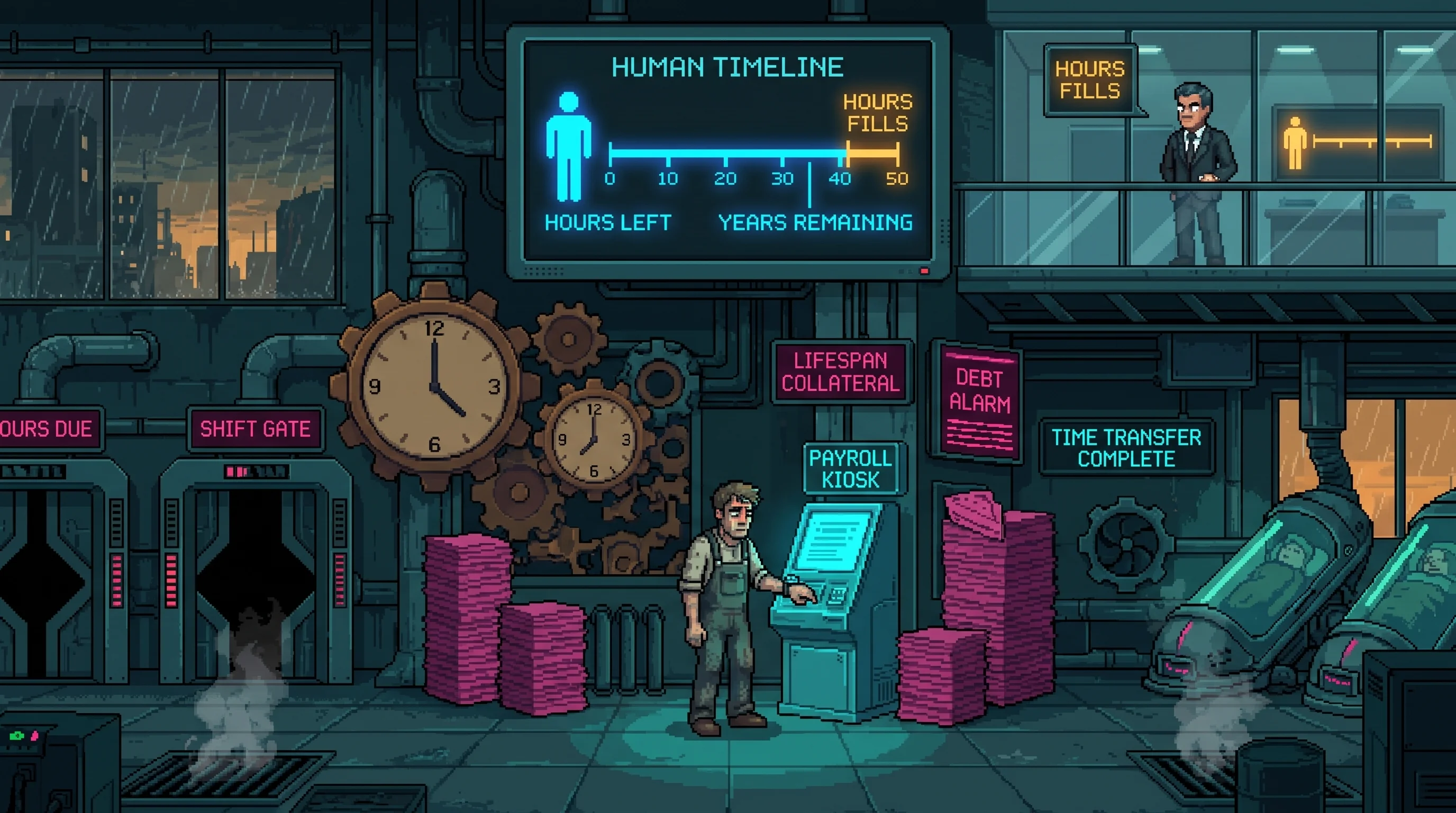
The lien sells a borrower's insight 340ms before they experience having it — the employer buys the thought back.
Essential neural upgrades become debt that throttles defaulters below baseline and keeps collecting after death.
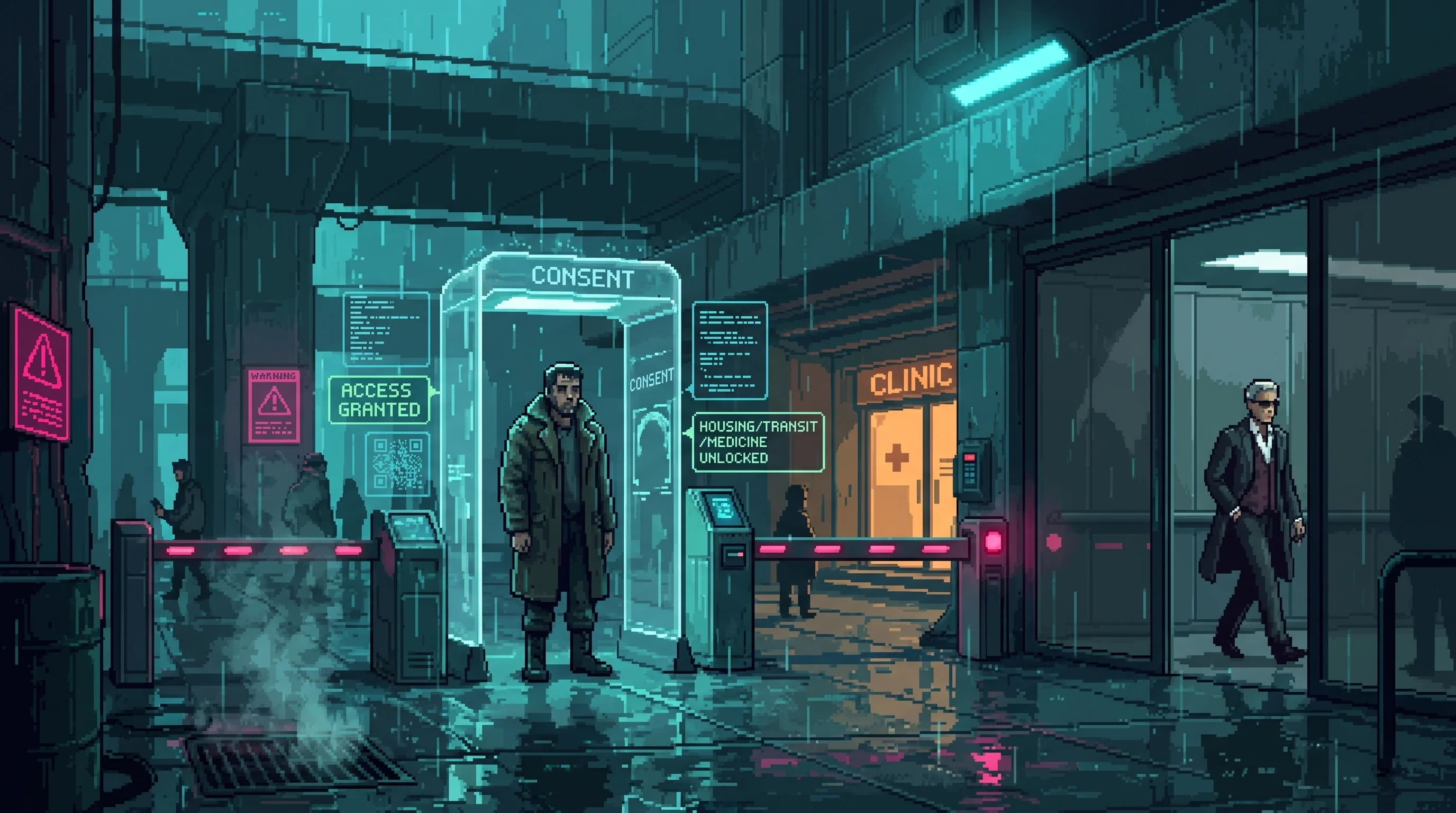
The bargain reaching behind consciousness — your best thoughts routed to a creditor 340ms before you know you had them.
The Sprawl demands permanent personal data for participation, then uses it to price access and preempt solidarity.





—