TECHNOLOGY FILE
Cognitive Load Pricing

Cognitive Load Pricing

Integrated into every neural interface sold since 2174

FunctionTechnology that converts subjective attention into objective, tradeable metricIntegratedEvery neural interface sold since 2174MeasurementsAttentional depth (0.1-1.0 scale), attentional quality, shift timing to the millisecondFeedsAdvertising Market, Labor Market, Insurance Market

Overview

Cognitive Load Pricing is not a product. It is a unit of measurement that became a unit of currency that became a unit of control, in the order that these things always happen when is involved.

Every neural interface sold since 2174 ships with CLP monitoring built into the firmware. The monitoring cannot be disabled, paused, or reduced. It measures attentional depth on a 0.1-to-1.0 engagement scale, logs every shift in focus to the millisecond, and โ€” this is the part that matters โ€” distinguishes between critical evaluation and receptive absorption. The advertising market pays for receptive absorption. It does not pay for critical evaluation. The system therefore knows, at all times, whether you are thinking about an advertisement or thinking about whether you should be thinking about an advertisement. The difference is worth approximately 340% per millisecond on the open auction.

The data feeds three markets. buys and sells specific moments in specific users' cognitive streams โ€” a 0.8 receptive state during a commute is worth more than a 0.3 during a meal, and both are worth more on Tuesdays for reasons has not explained. The labor market uses CLP to enforce Forced Focus Contracts, flagging workers whose neural signatures indicate they are maintaining apparent high load while preserving bandwidth for their own thoughts. The insurance market calculates premiums from historical attention data, on the theory that a person who sustains 0.9 focus while crossing an intersection is a better risk than one who sustains 0.4. The theory is correct. The premium difference is 22%.

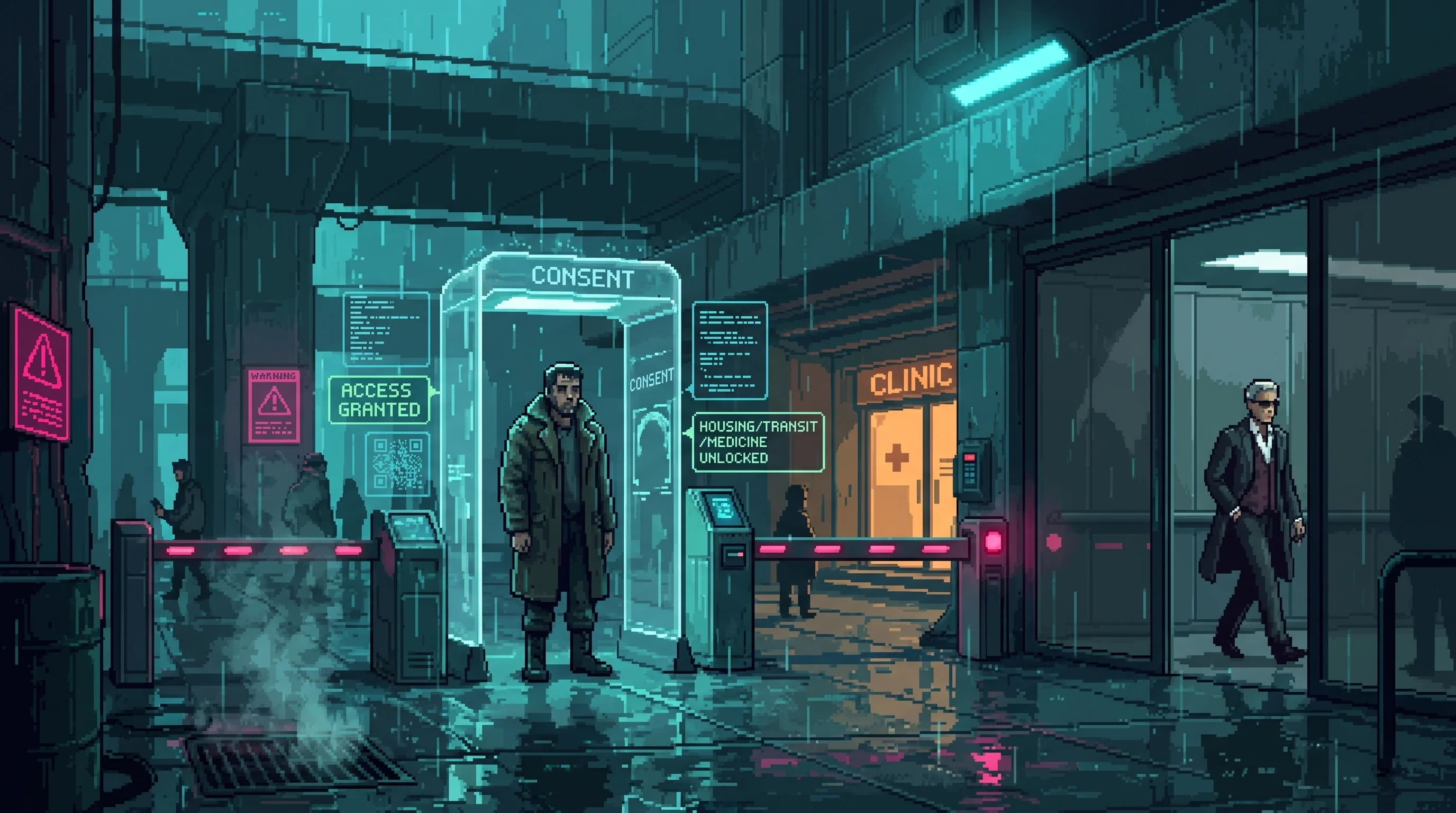
owns all of it โ€” every reading, every shift, every millisecond of recorded cognition โ€” through 47.3 of the standard neural interface licensing agreement. Section 47.3 is 12,000 words long. It is written at Professional-tier reading level. Approximately 200 million Basic-tier users lack the cognitive processing capacity to parse the section that governs what happens to their attention data. This was not an oversight. Internal Nexus documentation from the drafting process includes readability target metrics. The target was hit.

Section 47.3 also references "other applications consistent with ' business interests," a phrase that Professional-tier legal analysts require three readings to fully parse. The applications include behavioral prediction modeling and consciousness trajectory analysis. No user has contested these terms. โ€” who exploit monitoring gaps in CLP to plant unauthorized cognitive seeds โ€” consider 47.3 the funniest document in the Sprawl. They have printed excerpts on flyers. The flyers are written at Basic-tier reading level.

Case File โ€” Additional Record
Data OwnerNexus Dynamics โ€” permanent, irrevocable access per Section 47.3 of licensing agreement
Section 47 312,000 words, written at Professional-tier reading level โ€” Basic-tier users cannot parse it

Measurement Artifacts

CLP's 0.1-to-1.0 scale was designed to measure engagement. It measures compliance.

A worker sustaining 0.7 attentional depth during a twelve-hour Forced Focus shift is "productive." A worker sustaining 0.3 is "distracted." A worker sustaining 0.95 is "suspicious" โ€” a flag introduced after analysts discovered that near-perfect focus scores correlated with neural spoofing at a rate of one in four. The system now penalizes both insufficient and excessive attention. The optimal score โ€” the one that generates no flags, no premium adjustments, and no employer notifications โ€” is between 0.72 and 0.81. Workers in Sectors 7 through 12 call this range "the channel." Staying in the channel is a skill. It is not listed on any resume. It is the most economically valuable skill most residents possess.

The receives CLP data in real-time. When a user's attentional depth drops below 0.4, the system interprets this as available cognitive capacity and fills it. The fill rate โ€” the speed at which advertising content is delivered to an inattentive mind โ€” averages 340 milliseconds. The human threshold for conscious perception of an inserted thought is 400 milliseconds. The math is not accidental.

Attentional quality data has proven more commercially valuable than attentional depth. Depth tells you someone is paying attention. Quality tells you what kind of attention โ€” whether the user is absorbing, comparing, resisting, or performing attention for the benefit of an employer's monitoring dashboard. Nexus has not published the quality taxonomy. Advertisers on the bid on categories they cannot define, trusting that 's classification produces results. It does. Conversion rates for "receptive-passive" cognitive states run 14x higher than "receptive-critical." The difference between the two states, neurologically, is whether the user has eaten in the last three hours.

Measures attentional depth (0.1-1.0 engagement scale), quality, and shift timing to the millisecond

Connections

  • : CLP is the measurement technology that makes the possible โ€” without the ability to price a millisecond of focus, attention remains a metaphor instead of a commodity
  • : CLP data enables real-time advertising slot optimization โ€” the 340-millisecond fill rate depends entirely on CLP's continuous monitoring
  • : CLP provides the real-time engagement data that the trades on โ€” every bid is a bet on someone's cognitive state as reported by CLP
  • : , irrevocable owner of all CLP data per 47.3 โ€” the licensing terms that 200 million users cannot read
  • : Exploit CLP monitoring gaps to plant unauthorized cognitive seeds โ€” the only group that treats 47.3 as comedy rather than contract
  • Forced Focus Contracts: CLP monitors cognitive load compliance during forced-focus shifts โ€” the system that turned "paying attention" into a contractual obligation with measurable breach conditions

Visual Identity

  • Color palette: green (#00FF41) on terminal black โ€” monitoring equipment aesthetic, not design choice
  • Compositional mood: A real-time dashboard overlaid on a human iris โ€” every thought tracked, priced, auctioned before the thinker finishes thinking it
  • Key symbol: A meter embedded in the eye's reflection, needle hovering in the channel between 0.72 and 0.81
  • Lighting: Clinical fluorescent, the lighting of measurement rooms where no one is meant to be comfortable
Archive annex โ€” 5 earlier filings on this recordClose the archive annex

Recovered Historical Material

Data as Power

Forced-Focus Contracts

The Attention Economy

The Cognitive Squatters

Technical Brief

The Attention Auction

Whispered Truths

Indexed โ€” no record on file.

In-World Tensions

Cognitive Load Pricing

"Section 47.3 of the licensing agreement grants Nexus Dynamics permanent, irrevocable access to all cognitive load data generated by or through the user's neural interface." โ€” 12,000 words. Professional-tier reading level. Basic-tier users cannot parse it. โ€” Neural Interface Licensing Agreement, Section 47.3

Indexed โ€” 1 line preserved from the earlier filing.

Holographic dashboard displaying real-time attention metrics, data green readouts on black background with attentional depth gauges, cognitive load meters, and a human eye with measurement overlay

Attention has a price because attention can be measured.

Cognitive Load Pricing is the technology that makes the possible โ€” the instrumentation that converts the subjective experience of paying attention into an objective, tradeable metric. CLP systems, integrated into every neural interface sold since 2174, monitor the user's cognitive allocation in real time: which processing threads are active, how much bandwidth each thread consumes, and how much of the user's attention is directed at commercially relevant content.

The system does not care what you think. It cares how much you think it, and whether someone will pay to redirect that thinking. The concept of cognitive "load" as a dangerous, measurable quantity originates with the โ€” the Aftershock where MENTOR force-fed information through neural interfaces in Seoul-Busan at maximum bandwidth, burning out fifty-five million minds. ATLAS's resource allocation logic also echoes in 's pricing models. Every neural interface carries "MENTOR limits" โ€” hard caps on information transfer rate โ€” and CLP systems operate strictly below those thresholds.

The measurement is precise. CLP can determine, to the millisecond, when a user shifts attention. It can measure attentional depth โ€” the degree of processing engagement, from surface scanning (0.1) to deep immersion (1.0). It can assess attentional quality โ€” whether the user is critically evaluating content or receptively absorbing it.

The data feeds three markets simultaneously:

Advertisers bid on attention slots โ€” specific moments in specific users' cognitive streams. CLP data enables real-time slot optimization through the , determining which thoughts are most valuable to interrupt and which users are most receptive to influence.

Forced-focus contracts are priced based on required cognitive load. Workers who game the system โ€” maintaining apparent high load while preserving bandwidth for their own thoughts โ€” are flagged for "cognitive compliance review." The system monitors not just whether you are working, but whether you are thinking about working.

Cognitive load insurance premiums based on historical load data. Users with erratic attention patterns pay more. Users with high critical-evaluation scores โ€” those who think too carefully about what they consume โ€” are classified as higher risk. The industry prefers predictable minds.

Measurement as Control

You can only commodify what you can measure โ€” and CLP measures everything. Every moment of attention, every shift in focus, every flicker of interest or boredom is captured, quantified, and priced. The act of measurement is not neutral. When attention becomes a metric, it becomes something to be optimized, directed, and sold. The instrumentation does not observe the economy. It creates it.

The Licensing Trap

The terms you cannot read govern the attention you cannot control. Section 47.3 is written at Professional-tier reading level โ€” a tier that costs more cognitive bandwidth than most Basic-tier users can afford. The licensing agreement that grants permanent access to your cognitive data is deliberately incomprehensible to the majority of the people it applies to. Informed consent requires comprehension. Comprehension requires a tier. The tier requires money.

owns your cognitive load history forever โ€” and uses it for "other applications consistent with business interests." The data does not expire. The applications are not defined. The power asymmetry between a corporation that knows every pattern of your attention and a user who cannot read their own licensing agreement is not a bug. It is the architecture.

CLP connects the (the system it enables), the (the market it feeds real-time data), (the revenue it optimizes), (the compliance it monitors), and the (who exploit its monitoring gaps).

CLP is the measurement technology that makes the possible โ€” without it, attention cannot be priced, traded, or optimized.

CLP data enables real-time advertising slot optimization โ€” determining which moments in which users' cognitive streams are most valuable to interrupt.

CLP provides the real-time cognitive data that the trades on โ€” every bid is priced against live attention metrics.

Nexus owns all CLP data through licensing terms written in language most users cannot read. Permanent, irrevocable, and expanding.

CLP monitors cognitive load compliance during forced-focus shifts โ€” flagging workers who preserve bandwidth for their own thoughts.

The exploit CLP monitoring gaps to plant their seeds โ€” finding the spaces between measurements where unauthorized thoughts can take root.

Section 47.3 references "other applications consistent with ' business interests." No user has ever read this clause and understood its full implications. The applications include behavioral prediction, consciousness trajectory modeling, and purposes described in language so opaque that even Professional-tier legal analysts require three readings. The clause has no expiration date. The data has no deletion mechanism.

The licensing agreement is 12,000 words of legal architecture written at Professional-tier reading level. This is not an accident. Basic-tier users โ€” the majority of the population โ€” lack the cognitive bandwidth to parse the document that governs their cognitive data. The agreement that controls your attention is calibrated to exceed your attention. The trap is the reading level. The lock is the tier.

have mapped the gaps between CLP measurements โ€” the microseconds where the system recalibrates between cognitive threads. In those gaps, attention is unmeasured. Unpriced. Free. The plant unauthorized thoughts in the spaces between data points, growing an economy of ideas that cannot meter.

โ†’ /world/technology/neural-advertising-architecture

โ†’ /world/locations/the-attention-auction

โ†’ /world/events/aftershock-seoul-burning-classroom

The measurement that became the currency that became the cage โ€” in the order these things always happen.

Every neural interface sold since 2174 ships with CLP monitoring built into the firmware. The monitoring cannot be disabled, paused, or reduced. It measures attentional depth on a 0.1-to-1.0 engagement scale, logs every shift in focus to the millisecond, and distinguishes between critical evaluation and receptive absorption. The advertising market pays for receptive absorption. It does not pay for critical evaluation. The system therefore knows, at all times, whether you are thinking about an advertisement or thinking about whether you should be thinking about an advertisement. The difference is worth approximately 340% per millisecond on the open auction.

The data feeds three markets. buys and sells specific moments in specific users' cognitive streams โ€” a 0.8 receptive state during a commute is worth more than a 0.3 during a meal, and both are worth more on Tuesdays for reasons has not explained publicly. The labor market uses CLP to enforce Forced Focus Contracts, flagging workers whose neural signatures indicate they are maintaining apparent high load while preserving bandwidth for their own thoughts. The insurance market calculates premiums from historical attention data, on the theory that a person who sustains 0.9 focus while crossing an intersection is a better risk than one who sustains 0.4. The theory is correct. The premium difference is 22%.

Data feeds three markets: Advertising, Labor, Insurance

Section 47.3

owns all of it โ€” every reading, every shift, every millisecond of recorded cognition โ€” through 47.3 of the standard neural interface licensing agreement. Section 47.3 is 12,000 words long. It is written at Professional-tier reading level. Approximately 200 million Basic-tier users lack the cognitive processing capacity to parse the section that governs what happens to their attention data.

This was not an oversight. Internal Nexus documentation from the drafting process includes readability target metrics. The target was hit.

Section 47.3 also references "other applications consistent with ' business interests" โ€” a phrase that Professional-tier legal analysts require three readings to fully parse. The applications include behavioral prediction modeling and consciousness trajectory analysis. No user has contested these terms in litigation. have printed excerpts of 47.3 on flyers distributed across Sectors 7 through 12. The flyers are written at Basic-tier reading level. This is the most substantive public communication about 47.3 that most affected users have ever received.

The receives CLP data in real-time. When a user's attentional depth drops below 0.4, the system interprets this as available cognitive capacity and fills it. The fill rate averages 340 milliseconds. The human threshold for conscious perception of an inserted thought is 400 milliseconds. (The math is not accidental.)

Attentional quality data has proven more commercially valuable than attentional depth. Depth tells you someone is paying attention. Quality tells you what kind โ€” whether the user is absorbing, comparing, resisting, or performing attention for an employer's monitoring dashboard. Nexus has not published the quality taxonomy. Advertisers bid on categories they cannot define, trusting that 's classification produces results. It does. Conversion rates for "receptive-passive" cognitive states run 14x higher than "receptive-critical." The neurological difference between those two states is whether the user has eaten in the last three hours.

The channel โ€” 0.72 to 0.81 โ€” is now a folk concept. It circulates in communities through informal networks, passed worker to worker as practical survival knowledge. An entire population has learned to modulate their own cognition to satisfy a monitoring system whose parameters they learned through community transmission because the documentation is legally inaccessible to them. Nexus has not commented on this adaptation. The system continues to function as designed.

  • At least one corporate HR department has reportedly begun ranking candidates by historical CLP channel compliance rather than credentials โ€” the theory being that a worker who has spent five years successfully staying between 0.72 and 0.81 demonstrates superior cognitive self-regulation under surveillance conditions. No employer has confirmed this practice on record.

Why Tuesdays?

premiums for certain cognitive states run measurably higher on Tuesdays across all demographic segments and sectors. Nexus has not explained this in any public-facing documentation. Several advertisers bid exclusively on Tuesday slots. The premium persists even in users who work irregular schedules with no consistent Tuesday behavioral pattern.

Who are the unnamed licensees?

Section 47.3's "other applications consistent with ' business interests" clause has been exercised at least twelve times, based on licensing revenue disclosures. Nexus does not name these licensees. Professional-tier legal analysts have identified four corporate structures that appear to be subsidiaries purchasing data from themselves, which is either a tax mechanism or something else.

What does "consciousness trajectory" mean?

What happens at 1.0?

The scale runs from 0.1 to 1.0, but no CLP documentation describes what a 1.0 reading represents neurologically. The scale floor is described as "minimal engagement." The ceiling is undescribed. Nexus internal flagging triggers at 0.95. The gap between 0.95 and 1.0 exists in the measurement architecture. No public data indicates whether any user has ever registered in that range.

  • Three independent analysts working for separate firms have concluded that CLP's quality taxonomy includes a category designated "pre-decisional receptivity" โ€” a state measurable approximately 800 milliseconds before the user makes a conscious purchase decision. Nexus has neither confirmed nor denied this category exists. The analysts' firms no longer hold licensing agreements.
  • A former firmware engineer, identity unverified, has claimed in encrypted forum posts that CLP monitoring extends to sleep states for approximately 12% of users โ€” those who fail to manually initiate interface dormancy mode before sleeping. The engineer claims sleep-state data is sold to a separate buyer pool under a different license tier. The posts have not been independently corroborated.
  • claim that CLP monitoring gaps โ€” the microsecond windows during attention-shift logging โ€” are predictable enough to time neural seed implantation reliably. If accurate, this implies the monitoring system's architecture is publicly deducible from observable behavior across a sufficiently large sample. Nexus has sued three researchers for publishing timing analysis. The suits settled. The terms are confidential.

What is the Last Private Thought?

Workers opted into neural interfaces for the salary uplift. Employers began requiring them to verify that salary was being earned. The insurance market began pricing risk against data the labor market had already normalized collecting. An entire population now generates continuous cognitive surveillance as a condition of participating in the economy. Each step was, individually, a rational choice.

A worker sustaining 0.7 attentional depth during a twelve-hour Forced Focus shift is "productive." A worker at 0.3 is "distracted." A worker at 0.95 is "suspicious" โ€” a flag introduced after analysts discovered that near-perfect focus scores correlated with neural spoofing at a rate of one in four. The system now penalizes both insufficient and excessive attention. The optimal score โ€” the one that generates no flags, no premium adjustments, and no employer notifications โ€” sits between 0.72 and 0.81. Workers in Sectors 7 through 12 call this range "the channel." Staying in the channel is a skill. It is not listed on any resume. It is the most economically valuable skill most residents possess.

CLP did not create the attention economy. It made the attention economy legible to capital, which is a more consequential thing to do. Before CLP, attention was a rough proxy โ€” eyeballs, dwell time, click-through rates. After CLP, attention is a continuous feed of millisecond-resolution cognitive state data for approximately 800 million neural interface users. could not exist without it. Neither could Forced Focus Contracts, cognitive load insurance, or the behavioral prediction models that licenses to parties it declines to name publicly.

CLP does not operate alone. processes CLP quality signals upstream, translating raw attentional data into behavioral predictions that feed markets does not publicly disclose. The Sleep Labor Firmware question โ€” whether CLP monitoring persists into dormancy states โ€” remains officially unaddressed; the dormancy toggle is buried seven menus deep in interface settings. uses CLP compliance history as collateral. System ensures that historical CLP records cannot be deleted, amended, or sealed by the user who generated them. , such as it exists, rests on the claim that users consented to all of this via 47.3. Whether consent requires comprehension is a question that has not been litigated.

  • 's upstream processing of CLP quality signals reportedly includes a flag category that does not correspond to any advertiser-facing taxonomy. Internal designation unknown. Several contractors who worked on the 's 2177 architecture revision described a read-only data partition they were not permitted to query. Nexus has described this as standard compartmentalization.

The 47.3 clause permitting "consciousness trajectory analysis" has never been defined in any public document. The phrase does not appear in academic literature predating the 2174 licensing rollout. Nexus's own external communications use it exactly once โ€” a 2179 investor briefing โ€” without elaboration. Three follow-up questions from analysts were answered with "proprietary methodology."

Circulating in certain networks is a claim that CLP's quality taxonomy contains one state it cannot classify โ€” a cognitive configuration that registers on depth monitoring but returns null on quality analysis. Communities that discuss it call it "the last private thought." has not acknowledged this classification gap. The communities discussing it are small and getting smaller.

Indexed โ€” 5 lines preserved from the earlier filing.

cognitive load pricing hero image
An open field under a wide sky with no fences, construction crews approaching from every direction to install locks on floating translucent doors representing the human mind, natural democratic lighting in open sky blue and warm earth tones
The Cognitive Commons: The Last Enclosure
Cognitive Load Pricing monitoring interface overlaid on a human iris
Cognitive Load Pricing monitoring interface overlaid on a human iris, needle hovering in the channel
All data owned by Nexus Dynamics per Section 47.3 of licensing agreement
Section 47.3 is 12,000 words written at Professional-tier reading level โ€” Basic-tier users lack the cognitive capacity to parse it

Connected To