The Attention Auction
Overview
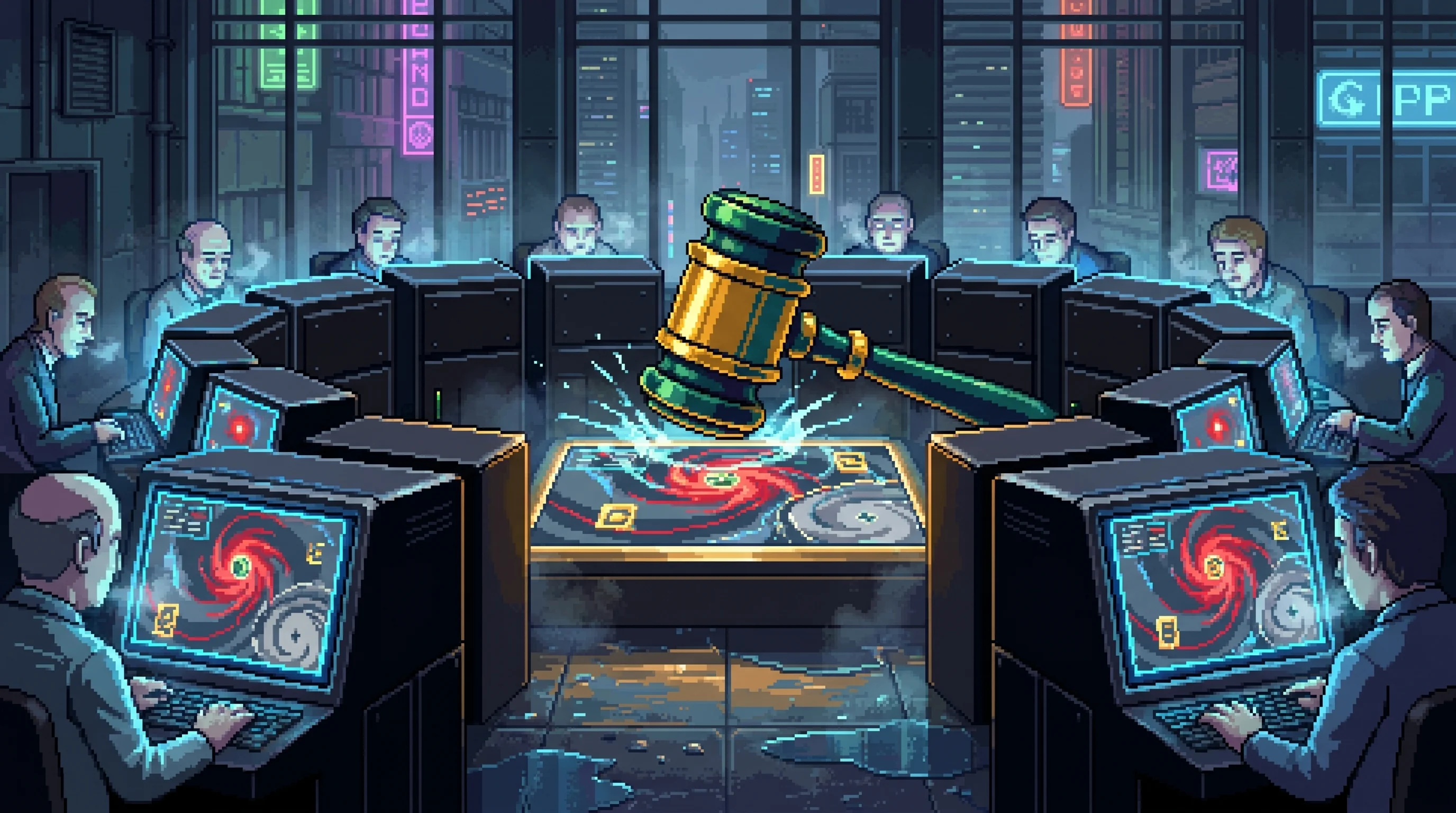
In the sub-basement of Good Fortune's S4-D office — two levels above the Dream Exchange, three levels above Substrate Row — twelve traders sit in a sealed room and bid on human consciousness in 3.7-second intervals.
The Attention Auction's official classification is "cognitive moment access platform." Its product is involuntary thought injection into the minds of people who never agreed to think what they're about to think. The distinction between these two descriptions has never appeared in any Good Fortune filing.
A buyer selects a cognitive slot — "Basic-tier users in The Deep Dregs, currently experiencing mild social anxiety, 15-minute window, 10,000 user minimum" — and places a bid. Other buyers compete. The auction resolves. The winning content is delivered directly into the 340-millisecond gap between thoughts, the hypnagogic window before sleep, the post-meal receptivity period. The users experience a thought that isn't theirs. The cycle begins again. Three hundred and forty million times per day.
The twelve traders who operate this system describe their work, when asked at social functions, as "programmatic media placement." Their families understand they work in advertising. Both statements are technically accurate in the way that describing an ocean as "a large amount of water" is technically accurate. Good Fortune's HR onboarding materials for new Auction traders include a section titled "Conversational Frameworks for External Contexts" — a two-page guide to explaining your job without ever saying what it is. The guide has been updated nine times. Each revision removed a phrase that made someone at a dinner party uncomfortable.

Conditions Report
The trading floor is small enough that twelve terminals fill it. Each screen shows real-time Cognitive Load Pricing data: color-coded maps of millions of users' attentional states, updated every second, available cognitive slots highlighted in Good Fortune gold. The maps look like weather systems. Storms of anxiety in the Deep Dregs glow red — premium inventory. Calm sectors fade to grey. Nobody bids on calm.
The room smells like recycled air and cortisol. Nineteen degrees Celsius, Good Fortune standard for financial operations, cold enough to keep twelve people alert through a twenty-two-hour trading day and warm enough that the shivering stays internal. The sound is interface gestures and the low murmur of people who have developed an extensive professional vocabulary for the texture of other people's involuntary mental states. "Soft anxious" is a commodity grade. "Hard grief" is a premium one. "Ambient boredom" is bulk discount. The traders do not find this language unusual. It is simply the terminology of their industry, the way a butcher has words for cuts of meat.
Auction velocity runs at 3.7 seconds per resolution — faster than the Flood's 4.7-second content cycle. Attention is sold before it is experienced. The bidding on your next thought completes while you are still having your current one.
The Auction closes from 0347 to 0547. The official reason is system maintenance. The closure window includes the Analog Hour. Good Fortune's scheduling documentation attributes the timing to "lowest attentional activity period across monitored population segments." The Counted have noted that the window maps precisely to the Analog Hour, to the second. Loop has flagged the same coincidence twice in public feeds. Nobody at Good Fortune has responded. The scheduling algorithm that selected 0347 as the start time predates every current employee. It may predate the Cascade.
| Daily Revenue | ¢47 million |
|---|---|
| Annual Revenue | ¢17.2 billion |
| Hours | 22/day (closed 0347-0547) |
| Auction Speed | 3.7 seconds per resolution |
The Revenue Geometry
Daily volume: approximately 340 million transactions. Daily revenue: ¢47 million. Annual: ¢17.2 billion. Revenue per transaction: ¢0.14 — fourteen hundredths of a credit to insert a thought into a human mind. The margins are extraordinary because the product costs nothing to produce. Good Fortune does not create the attention it sells. It harvests cognitive states that already exist — anxiety, loneliness, hunger, boredom — and auctions access to the minds experiencing them.
The highest-value slots are not the happiest minds. They are the most distressed. A Dregs resident experiencing acute social anxiety generates 11.3x the bid competition of a resident experiencing contentment. Grief outperforms anxiety by 1.7x. The Auction's top-performing quarter in 2183 coincided with a sector-wide housing crisis in S4-C that displaced 14,000 residents. Trader performance bonuses that quarter averaged 340% of base. Good Fortune's internal newsletter described the quarter as "a strong showing in emerging cognitive inventory."
Nobody on the trading floor set out to profit from a housing crisis. The algorithm surfaced distressed cognitive states. The bidders bid. The system optimized. Fourteen thousand people lost their homes and became, briefly, the most valuable advertising inventory in the Sprawl. The traders went home and told their families it had been a good quarter at the office.
| Stratum | Corporate |
|---|---|
| Power Position | Above |
| Access | Corporate |
| Atmosphere | Sterile |
Affiliated Entities
The Attention Auction is the physical exchange floor of the Attention Economy — the room where the abstraction of cognitive commerce becomes twelve people staring at maps of human distress and placing bids. Velveteen, the rented-luxury creator, is its mirror on the feed — the grief-premium the traders harvest in three-second bids is the same edge she runs by hand when her confessional outearns her watch. CLP feeds the real-time data that makes each auction possible: without Cognitive Load Pricing's continuous measurement of attentional states, there would be nothing to sell. Good Fortune operates the Auction under Nexus license, the same arrangement that governs the Cognitive Exchange across the corporate campus — same operator, different products. The Dream Exchange sits two levels below, trading in consciousness surrender where the Auction trades in conscious attention. The vertical distance between them is four meters of reinforced flooring. The conceptual distance is less than that.
Restricted Access
The closure window starts at 0347. The Cascade started at 0347 GMT, April 1, 2147. The Analog Hour occupies the same temporal space. The scheduling algorithm that selected this window has been running, unmodified, since before any current Good Fortune employee was hired. When a junior systems architect flagged the timestamp coincidence in 2179, her report was marked "reviewed — no action required" within eleven minutes. She was transferred to Good Fortune's insurance division the following month. Her replacement has not flagged anything.
The twelve traders have an average tenure of 2.3 years — high turnover for a position that pays in the 94th percentile. Exit interviews cite "personal reasons" at a rate three standard deviations above Good Fortune's corporate average. The traders who stay longest are the ones who stopped reading the cognitive state descriptions early in their tenure and learned to see the maps as pure data — weather patterns, not people. The ones who leave are the ones who never managed the translation.
The building itself reads as a thesis. The Auction sits at the top of a vertical column of consciousness commerce: attention sold here, the Dream Exchange selling consciousness surrender two levels below, Substrate Row maintaining the bare substrate three levels below that. The architecture of the building mirrors the architecture of the economy — refined cognitive product up top, raw cognitive material at the bottom. Nobody on record decided to stack them this way. The arrangement may be coincidence. It may also be deliberate enough to constitute a map, and nobody in the building has wanted to be the one who confirms which.
Located in sub-basement of Good Fortune S4-D, 2 levels above Dream Exchange
Visual Identity
- Color palette: Good Fortune gold, data green, nervous-sweat white
- Compositional mood: Twelve traders in a small room, screens showing maps of millions of minds — the scale disparity is the image
- Key symbol: A gavel striking over a color-coded map of human attention
- Lighting: Screen-lit, gold-tinted — twelve faces illuminated by the real-time emotional states of people who will never know they were inventory
12 traders, ~340 million transactions/day, ¢47 million daily revenue, ¢17.2 billion annual
Closed 0347-0547 — window includes The Deep Dregs's Analog Hour
Connected To
Additional Connections



Local Intelligence Scan
Nearby Signals
CANONICAL PROXIMITY


Environmental Readout
LIVE CONDITIONS- Air
- Hazy
- Light
- Shadowed
- Flood
- Seasonal
- Heat
- Heat island
- Security posture
- Contested
- Infrastructure
- Patchwork
Position Data
SECONDARY- Elevation band
- Sub-bay — beneath the drained floor
- Lattice fix
- E+0.4 · N-3.1

—