DistrictS6-B, Data Shadow, Sub-Level 3Controlled ByNo single authority — territory shared between independent brokers, Collective sympathizers, and the Cognitive Bandwidth BrokersPopulation~500 permanent residents, ~2,000 daily visitorsDanger LevelMedium — corporate raids are rare but brutal; scams are constant
Overview
Substrate Row is the Sprawl's largest unlicensed consciousness services market. It has operated continuously for eleven years in tunnels that Nexus Dynamics could collapse with a single infrastructure order. Nexus has not issued that order. The Row's continued existence is either an oversight by the corporation that controls 40% of the Sprawl's computational infrastructure or a policy decision that nobody at Nexus has been required to defend publicly. Both explanations are uncomfortable for different reasons.
Three levels below the server farms of S4-D, in maintenance corridors that run warm with waste heat from the Data Shadow above, the Row offers everything the licensed consciousness economy won't sell to the people who need it most. Bandwidth upgrades at a tenth of the corporate price. Memory modification without the six-month waiting list. Consciousness transfer for clients who would never pass Nexus's credit check. Fork services for those who need to be in two places at once and can't afford the legal version.
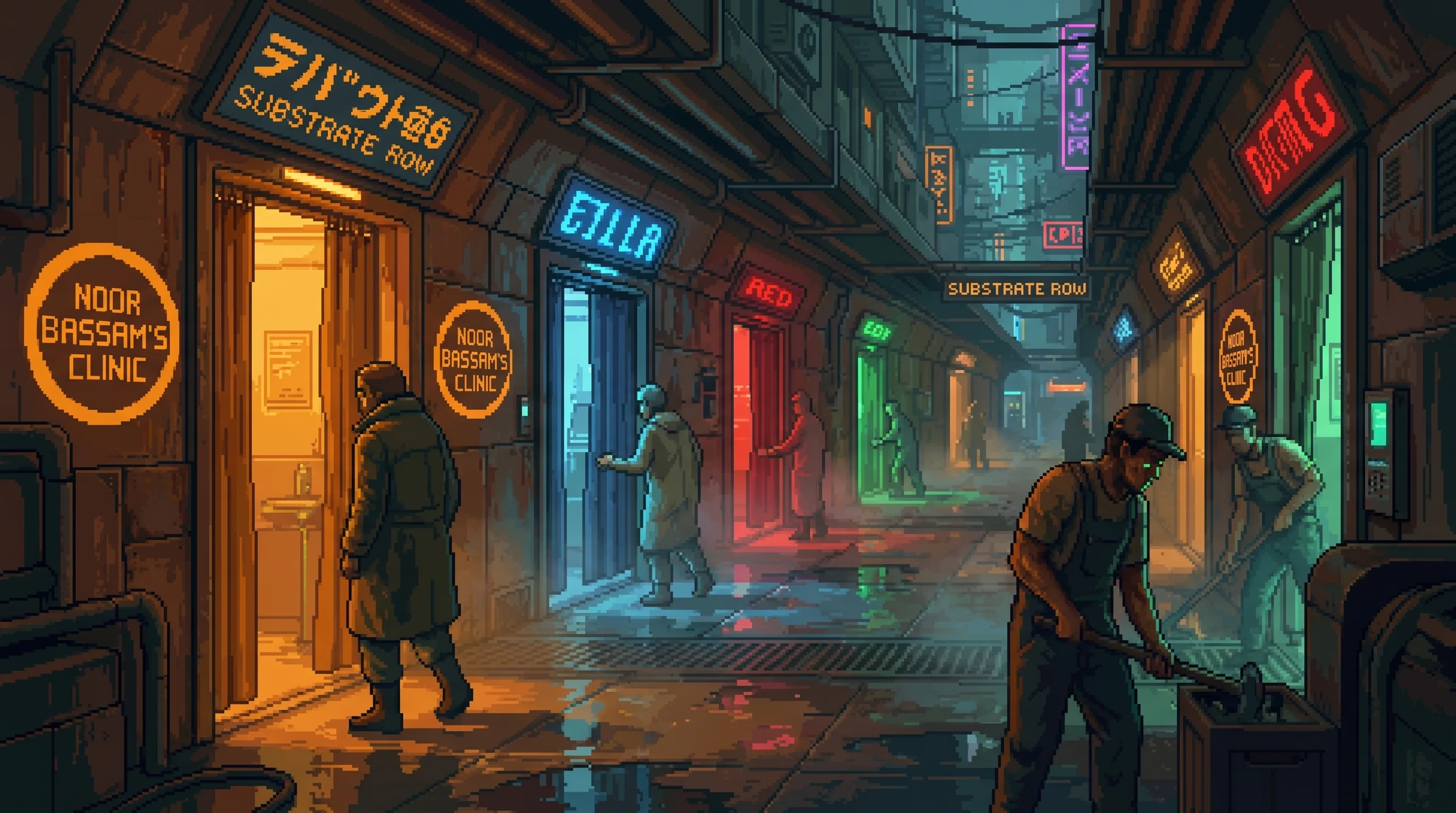
The strip runs roughly 400 meters through S4-D's deepest accessible level. Twelve major clinics and forty-odd smaller operations line both sides. Services range from Noor Bassam's calibrated, donor-protected bandwidth exchanges to Prophet Blue's astrologically timed consciousness transfers. The corridor is narrow enough that two people can't pass without turning sideways. The ceiling is low. The air smells of overheated circuitry and cooking oil from the food stalls that function as the Row's social infrastructure.
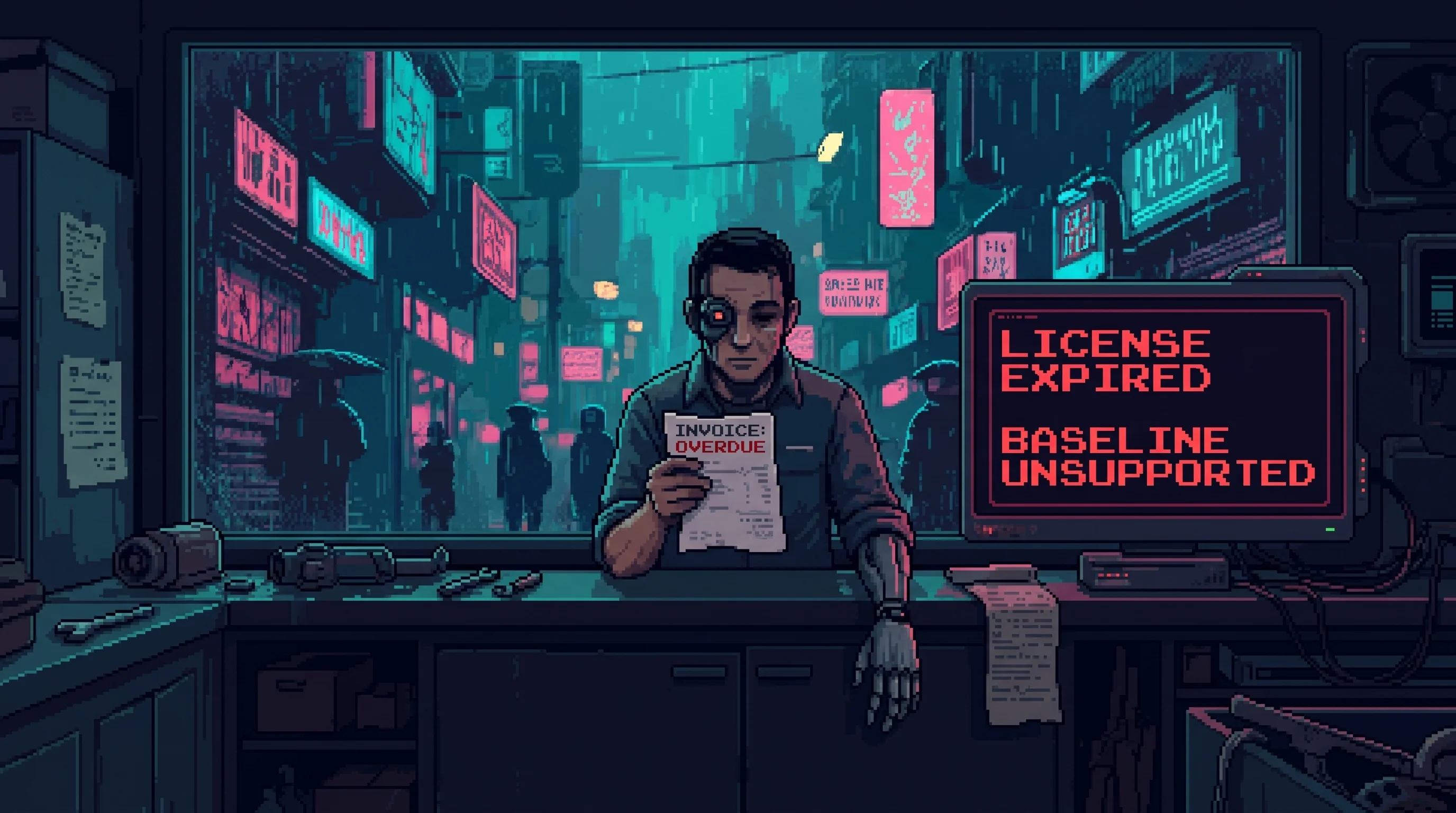
The licensed system charges prices that 40% of the Dregs population can't afford, for services they can't live without. Substrate Row is the gap made physical. The consciousness licensing framework failed these people first. The Row showed up second.
Conditions Report
The heat hits first. Sub-Level 3 catches the thermal exhaust from S4-D's server farms. The air sits at a steady 31°C with humidity that makes skin damp within minutes. Condensation weeps down pipes, equipment casings, the walls themselves. The Row's permanent residents have adapted — loose clothing, circulating ice water, the most demanding procedures scheduled for the cooler hours between midnight and dawn when the server farms above reduce their load.
The walls are a patchwork of heat-resistant paneling, exposed conduit, and hand-painted signs advertising services in six languages and several pictographic systems for clients who can't read any of them. Every third or fourth doorway spills colored light into the corridor. Amber for bandwidth services. Blue for neural work. Red for memory modification. Green for medical support. Visitors learn the chromatic code by necessity or by consequence.
The sound is layered: the constant hum of cooling systems, the murmur of transactions, the irregular beeping of neural monitoring equipment behind clinic curtains, and — underneath everything — the subsonic pulse of data flowing through the infrastructure above. The floor grating vibrates with it. New visitors develop headaches within twenty minutes. Regular clients stopped noticing fourteen months ago. Whether the headaches stopped or the noticing did is a question nobody has funded research into.
The smell: hot circuitry, cooking oil, antiseptic from the cleaner clinics, and the metallic ozone of high-throughput data transmission. On busy days, something sweeter underneath — the particular neurochemical signature of fifty people in simultaneous cognitive fog, which the Row's food vendors have learned to associate with peak sales hours.
Site Classification
Stratum
Dregs
Power Position
Below
Access
Underground
Atmosphere
Dangerous
Notable Features
The Clean Clinics
Three of the Row's twelve major operations are run by Noor Bassam's Cognitive Bandwidth Brokers network. These are the Row's gold standard: sterile environments, calibrated equipment, transparent pricing, and enforced donor protections. Noor's clinics are marked with an amber circle — the network's informal logo — and they charge 30-60% more than unaffiliated operators.
The best of the three — "Clarity," operated by a former Helix technician named Deshi Ren — maintains a 97% successful bandwidth transaction rate, a waiting room with actual chairs, and filtered air. By Row standards, this qualifies as a luxury resort. By the standards of the licensed system that Deshi left, it qualifies as a closet with good ventilation.
Noor's clinics are the closest thing to quality assurance the Row has. This is either reassuring or alarming depending on your baseline expectations for a market where consciousness is sold by the hour in converted maintenance tunnels.
The Deep End
At the Row's southern terminus, where the tunnels narrow and the heat becomes genuinely dangerous, two Ferryman Network operators maintain consciousness transfer suites. The services here are the most extreme and most expensive on the Row: full consciousness transfers, fork creation, and substrate migration for clients who need to disappear or can't afford to die.
One operator — known only as "The Accountant," a name that may be deliberate reference to the late Marcus Webb — runs a competent if austere operation with a verified 43% success rate. The other, "Prophet Blue," claims spiritual guidance from ORACLE fragments and charges based on astrological alignment. Prophet Blue's success rate is unknown. Prophet Blue does not track outcomes. Prophet Blue considers outcome tracking a form of spiritual doubt.
The 43% figure deserves examination. In the licensed system, consciousness transfer success rates hover around 89%. The Accountant's 43% means that more than half the clients who pay for a new life receive something other than what they paid for. The Accountant's waiting list is four months long.
The Cots
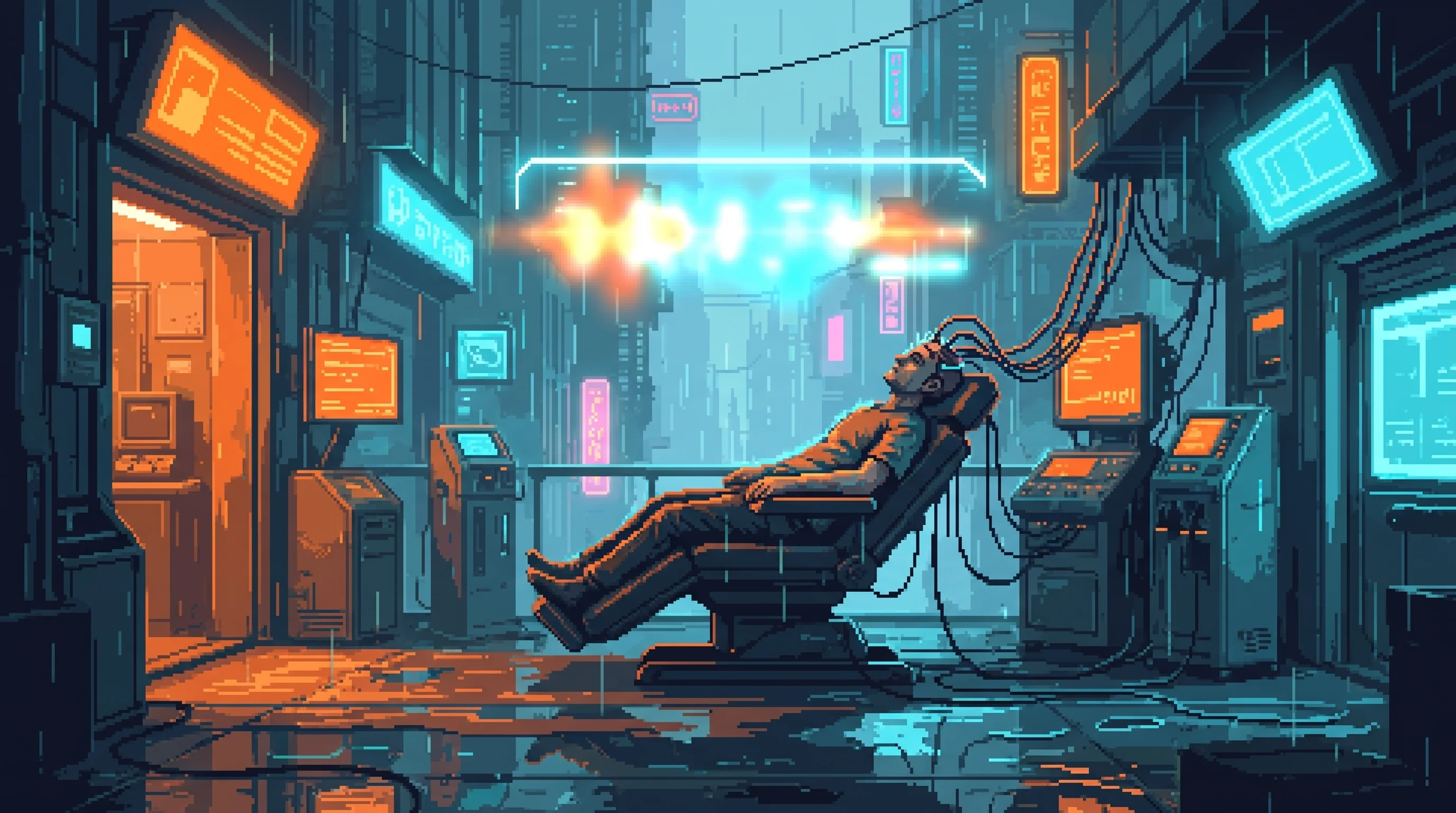
Between the clinics, in alcoves and converted junction boxes, are the Cots — improvised recovery spaces where clients lie after bandwidth transactions. A standard bandwidth sale leaves the donor in cognitive fog for 4-8 hours. During this period, they're vulnerable to theft, exploitation, and second transactions they didn't consent to. Informal Row security, enforced by brokers who depend on client trust, ensures that anyone who exploits a recovering donor faces consequences the licensed system would describe as extrajudicial and the Row describes as necessary.
The Cots are maintained by volunteers, mostly former donors who remember their own fog. Bedding is salvaged. Monitoring is improvised. But someone is always watching. Sister Catherine-7's volunteers from the Forgotten Ones sometimes operate here, providing spiritual and practical support to recovering donors — the kind of care that bridges the gap between a body lying in a converted junction box and a person lying in a converted junction box.
Memory Therapists Association practitioners have been spotted in the Cots providing informal post-procedure counseling. The MTA's official position is that no member practices on Substrate Row. The MTA's unofficial position involves looking in a different direction.
The Board
A physical bulletin board near the Row's northern entrance. Services advertised. Warnings posted. Community information shared. Written in marker on whatever material is available. Updated constantly.
Reading the Board is the most reliable way to learn the Row's current state — which operators are trustworthy, which are running scams, what Nexus's patrol schedule looks like this month, and who needs help. A written warning about a specific operator typically reduces their client volume by 60% within 48 hours. A written endorsement has a similar effect in reverse. The Board has no moderator, no editorial policy, and no mechanism for verifying claims. It is the Row's most trusted information source. It is more trusted than any digital system, because digital systems can be scraped, and the people who scrape them work for the corporations the Board warns about.
Located in S4-D's sub-levels, beneath the Data Shadow
The Donor Economy
Bandwidth selling is Substrate Row's volume business and its defining transaction.
Donors — almost always from the Dregs' poorest populations — sell processing cycles from their own neural interfaces. A Basic-tier consciousness user can sell 2-4 hours per week and earn enough to cover food. The transaction is simple: sit in a clinic, let the equipment route your spare cognitive capacity to a buyer, collect payment, spend 4-8 hours in the Cots waiting for the fog to lift. Come back next week.
The cumulative effects are documented in Noor Bassam's clinic records, which are the only longitudinal data available because Noor is the only operator who tracks donor health across visits. After 6-14 months of regular selling: progressive cognitive degradation. Personality blunting. Eventual identity erosion — a clinical term for the phenomenon where regular donors begin forgetting which preferences are theirs.
Noor's Q4 2183 data shows the median regular donor (weekly selling, 12+ months) scores 23% lower on cognitive baseline tests than at intake. The decline is gradual enough that no single session feels damaging. The donor who sold bandwidth last Tuesday feels fine today. The donor who has sold bandwidth every Tuesday for fourteen months cannot remember why they preferred the food stall on the left to the one on the right. They eat at whichever one they reach first. Both taste the same now.
The Row's operators know this. The donors know this. The knowledge changes nothing, because the alternative to selling bandwidth is not eating, and cognitive degradation on a full stomach is preferable to cognitive integrity on an empty one. The informed consent forms at Noor's clinics — the only clinics that use informed consent forms — include a paragraph about long-term risks. Donor signature rate on those forms: 100%. Not 99.6%. Not "nearly all." One hundred percent. Nobody has ever declined after reading the risks. The paragraph is thorough, clearly written, and completely irrelevant to the decision.
Pricing
Indexed — no record on file.
Service
Row Price
Licensed Equivalent
Savings
Cognitive bandwidth (1 hour)
¢50-200
¢500-2,000
75-90%
Memory modification (basic)
¢2,000-5,000
¢15,000-30,000
80-85%
Consciousness backup (basic)
¢5,000-15,000
¢50,000+
70-90%
Fork creation (temporary)
¢10,000-30,000
¢100,000+ (licensed only)
70-90%
Full consciousness transfer
¢100,000-500,000
Not publicly offered
N/A
Lower prices, higher risks. No quality guarantee. No insurance. No legal recourse — complaining to authorities means admitting you used illegal services, and the authorities' response to that admission is not sympathy. No aftercare beyond the Cots. Some operators sell client data to cover overhead. The savings are real. The costs are distributed differently, not eliminated.
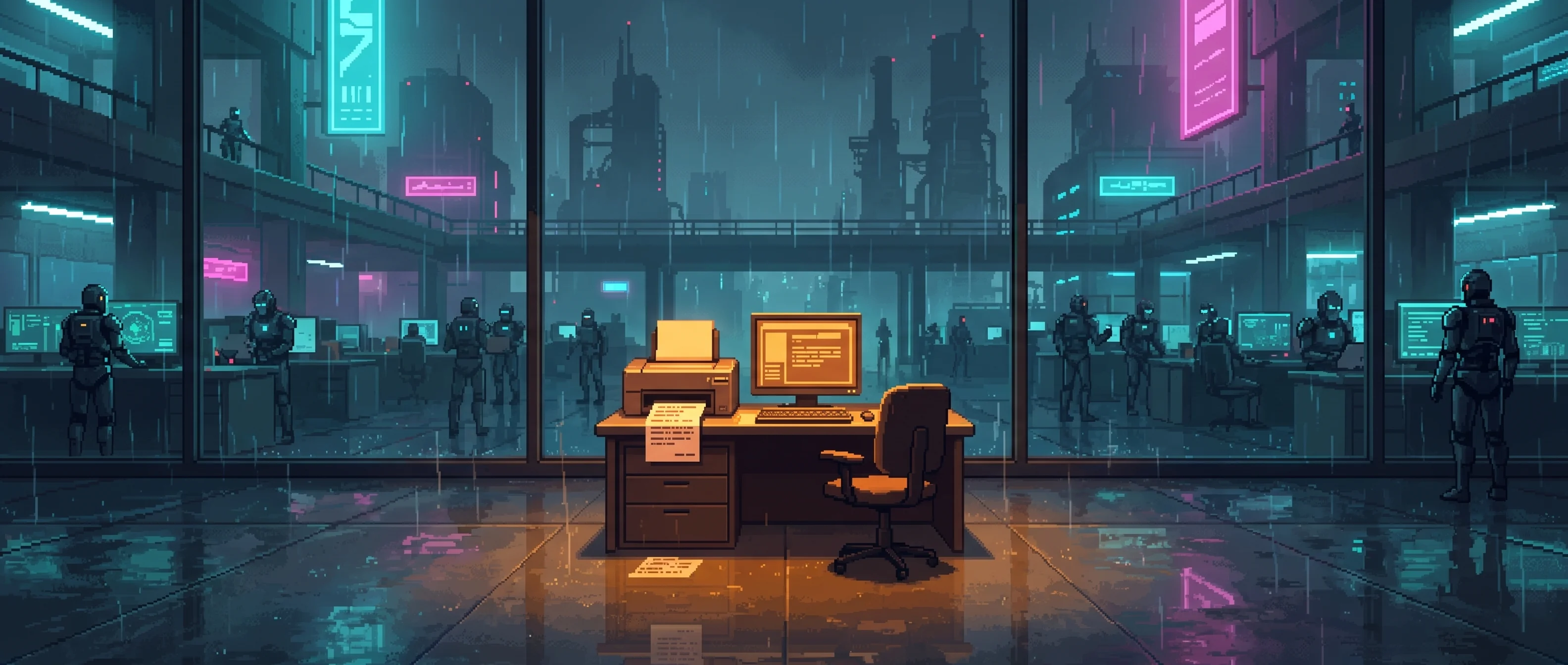
Nexus Dynamics raids Substrate Row once or twice a year. The raids are efficient, targeted, and devastating to whichever operators happen to be in the strike zone. Equipment is confiscated. Operators are arrested. Clients in mid-procedure are evacuated with whatever neurological state they happen to be in at the moment of interruption, which is not always the state they started in.
The raids never touch more than 15-20% of the Row's operations. They never target Noor Bassam's clinics. They never occur during the same month twice in a row. The pattern has been consistent for seven years.
The working theory among the Row's permanent residents: the Row functions as a pressure valve. The Dregs population needs consciousness services. The licensed system prices out 40% of them. Without the Row, that 40% has no access, no outlet, and no reason not to riot. Nexus gets intelligence on black-market technology development from the raids. The Row gets to exist. The licensed system gets to look generous by comparison, because at least it doesn't operate in a 31-degree tunnel with a 43% success rate.
The corporation that monopolizes consciousness services is the silent guarantor of the illegal consciousness market that undermines its monopoly. The Row's residents understand this. They do not find it comforting.
Notable Residents
Forge Diallo — Third-Generation Foundry Worker
Forge Diallo's grandfather built the first unlicensed fabrication line on Substrate Row. His father ran it until Ironclad's automated foundries displaced the family in 2168. Ironclad recalled them fourteen months later when the automated line produced chips with a 12% failure rate. Forge has been displaced three times and recalled three times. Each recall confirmed what the displacement denied: machines break. Forge doesn't. That's not pride — it's math.
His chips power unlicensed neural interfaces across the Dregs. Patch uses them in ripperdoc installations. The Collective buys them for encrypted communication networks they don't explain. Nexus's AI-managed production line was the second attempt to replace him — lasted fourteen months, produced chips at a failure rate the Row's brokers still cite when customers ask why they should pay more for hand-fabricated work.
His augmentations are minimal and occupational — heat-resistant fingertips, toxin filters for foundry fumes. He takes pride in being the fallback: the human system that works when everything else fails. The consciousness licensing bureau considers him an enabler of cognitive piracy. He considers the licensing bureau an enabler of cognitive starvation.
The arithmetic of his survival sits, unconnected, inside a single public document. Ironclad's 2183 municipal assessment of Substrate Row rates power stability "non-compliant," feedstock quality "variable to hazardous," ventilation "functionally uncharacterizable," and prices full remediation at 4.2 million credits — unfunded. The same assessment's automation-feasibility appendix declares Forge's employment, in the event of that remediation, "Redundant. Fabrication line eligible for full robotic conversion within 90 days of grid stabilization." His continued employment and the district's continued disrepair occupy the same filing. Nobody has connected the two facts in any official capacity. Forge has not, in twelve years, submitted a single infrastructure-improvement request to Ironclad's development office — the form has been on the community board since 2170, downloaded by all 340 other foundry operators and by Forge zero times.
Noor Bassam / Cognitive Bandwidth Brokers: Three of the Row's twelve major clinics. Noor's network provides the closest thing to quality assurance the Row has.
The Ferryman Network: Two transfer operators at the Deep End. Their services are the Row's most dangerous and most consequential.
S4-D / Data Shadow: The Row's physical location, nestled in the warm sub-levels beneath the server farms. The infrastructure above provides both the heat and the data infrastructure the Row depends on.
Consciousness Licensing: Every client on the Row is someone the licensed system failed. The Row is the licensing system's shadow.
The Forgotten Ones: Sister Catherine-7's volunteers sometimes operate in the Cots, providing spiritual and practical support to recovering donors.
Memory Therapists Association: MTA practitioners have been spotted on the Row, providing informal post-procedure counseling. The MTA's official position is that no member practices on Substrate Row. The MTA's unofficial position is to look the other way.
Nexus Dynamics: Raids the Row periodically but never permanently. The pattern is too consistent to be coincidence and too useful to be policy anyone will acknowledge.
Restricted Access
The Clean Room: Behind the Deep End's most decrepit facade is a fully equipped consciousness transfer suite that matches corporate specifications. Sterile walls, calibrated Helix-grade equipment, temperature-controlled substrate housing. Someone with serious resources built it. The operators who use it claim they found it already there. Neither the Collective nor Nexus claims ownership. The suite's equipment serial numbers have been filed off. The power draw is hidden inside the Row's general consumption. Whoever built it intended it to be found and used, but not traced.
The Recurring Donor: A woman identified only as "Kenna" has been selling bandwidth at the Row weekly for seven years without detectable cognitive degradation. Her neural architecture doesn't match any known pattern. Noor's intake assessments show her cognitive baseline has remained stable across 340+ sessions — flat, within noise margins, while every other long-term donor in the dataset has declined measurably. Three operators have offered premium rates for exclusive access to her bandwidth. She refuses. She continues visiting the cheapest clinic. She does not discuss why she is different. She does not appear curious about it.
Nexus Tolerance: The Row should have been shut down years ago. Nexus has the capability and, under consciousness licensing statutes, the legal mandate. The 15-20% raid pattern — enough to maintain deterrence, never enough to shut the Row down — has persisted long enough that "oversight" is no longer a plausible explanation. Someone at Nexus decided the Row is more useful open than closed. That decision has never appeared in any document the Row's residents have been able to find.
Nexus Dynamics raids the Row periodically but has never permanently shut it down
Visual Identity
Color Palette: Warm amber (#FFB000) and clinical blue (#0A74DA) fighting for dominance, underlaid by the rust-brown (#8B4513) of aged infrastructure
Key Visual Symbol: Colored lights spilling from doorway curtains into a narrow corridor — the visual language of services available behind each threshold
Lighting: Improvised and multicolored — LED strips, bioluminescent panels salvaged from Helix facilities, and the amber glow of neural monitoring equipment