The Waking Dark

Davi Okonkwo sits in his windowless office at 3 AM and the woman is there again.
She stands in the corner by the environmental controls. Dark hair, lab coat, hands holding something below the angle of his peripheral vision. She has been there for three weeks. She does not move. She does not speak. She occupies approximately 1.4 square meters of floor space that building sensors confirm is empty.
Davi's physical notebook — the only record not synced to the Wakefulness Program's monitoring suite — contains twenty-one entries in increasingly precise handwriting. The first, dated three weeks ago: Female figure, dark hair, SE corner, duration unknown. The most recent, logged forty minutes ago: Same figure. Lab coat now consistent. Hands positioned 14cm below visual threshold. Possible clipboard. No ambient shadow. Persistence: continuous since entry 1.
He writes like a man filing a maintenance report on equipment that happens to be his own hallucinating brain. The entries never mention fear. They never mention the word hallucination. They use figure, visual artifact, and once, underlined, persistent environmental anomaly. The taxonomy of a man who cannot afford the correct diagnosis.
The Circadian Tower's life support compressors pulse at 72 bpm through the building's infrastructure — the same frequency the Insomnia Wards use to approximate REM for augmented brains that can no longer produce it. Davi's resting heart rate, logged by his own program's biometric suite, has synchronized to 72 bpm without his awareness. The building's heartbeat and his heartbeat are the same heartbeat. The monitoring system considers this a sign of optimal environmental integration.
He makes a note. He goes back to work. The woman watches him go back to work with an expression he has described in the notebook as neutral for twenty-one consecutive entries — which is the word you use when you cannot bring yourself to write patient.
The Notebook
Six months of physical entries. No digital backup. The Wakefulness Program's monitoring suite tracks cognitive output, neural response latency, REM-deficit markers, and fourteen other metrics Davi personally calibrated. It does not track physical notebooks. This is not an oversight. Davi designed the monitoring architecture. He knows what it watches.
Entry 4: Figure now present during work hours. Previously observed only during low-activity periods. Possible correlation with cumulative sleep debt exceeding 340 hours.
Entry 9: Figure has consistent features across sessions. Not composite — same face, same posture, same coat. Dream-processing literature suggests Stage 2 projections should be variable. This one is stable. Filing under anomalous.
Entry 14: Attempted direct visual focus. Figure remains in peripheral field regardless of head position. Maintains constant angular displacement of approximately 34 degrees from center of gaze. She is always in the corner of the room I am not looking at.
Entry 19, in handwriting slightly less controlled than the others: She was holding a notebook.
He did not log Entry 20 for two days. Entry 20, when it came: Resumed observation. Figure unchanged. Previous entry's detail unconfirmed — likely projection artifact. Recommend continued monitoring. The clinical language has the specific texture of someone reassuring themselves by writing in third person. Recommend continued monitoring is not a recommendation to anyone. There is no one to recommend to. The notebook's audience is a man pretending the notebook has an audience.
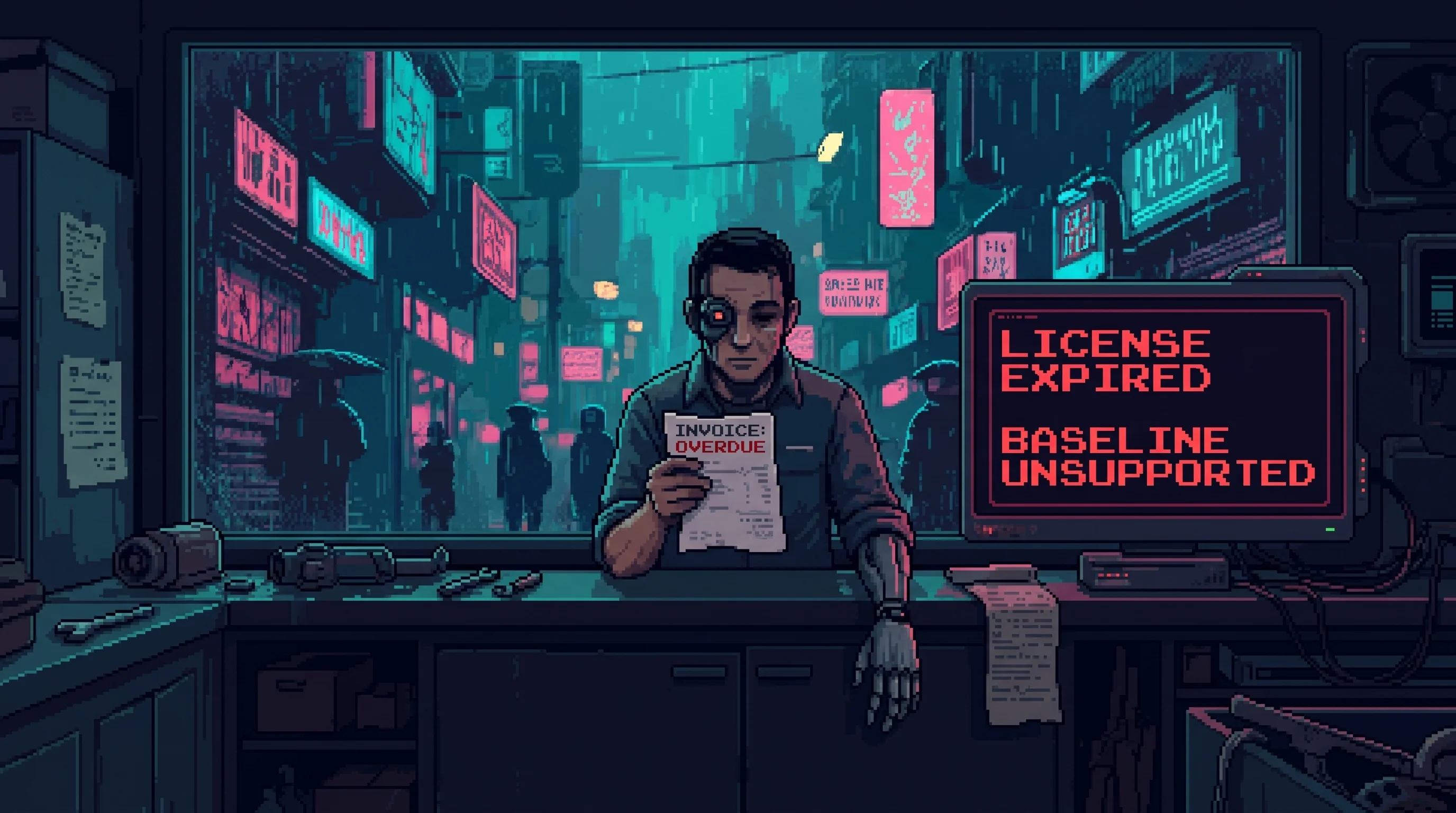
The recalibration form sits in his desk drawer, unsigned. Form WP-7: Voluntary Symptom Disclosure, Self-Report Protocol. He filled it out once, two weeks ago, got to the field marked Nature of perceptual anomaly (describe in detail) and put it back. Filing a WP-7 triggers automatic recalibration — a 72-hour cognitive suppression cycle that would, according to his own program's documentation, "realign persistent maladaptive neural compensation patterns." The documentation does not say kill the hallucination. It says suppress the adaptation. Davi wrote that language. He chose the word adaptation over symptom four years ago, in a draft review meeting, for reasons he described at the time as "clinical precision."
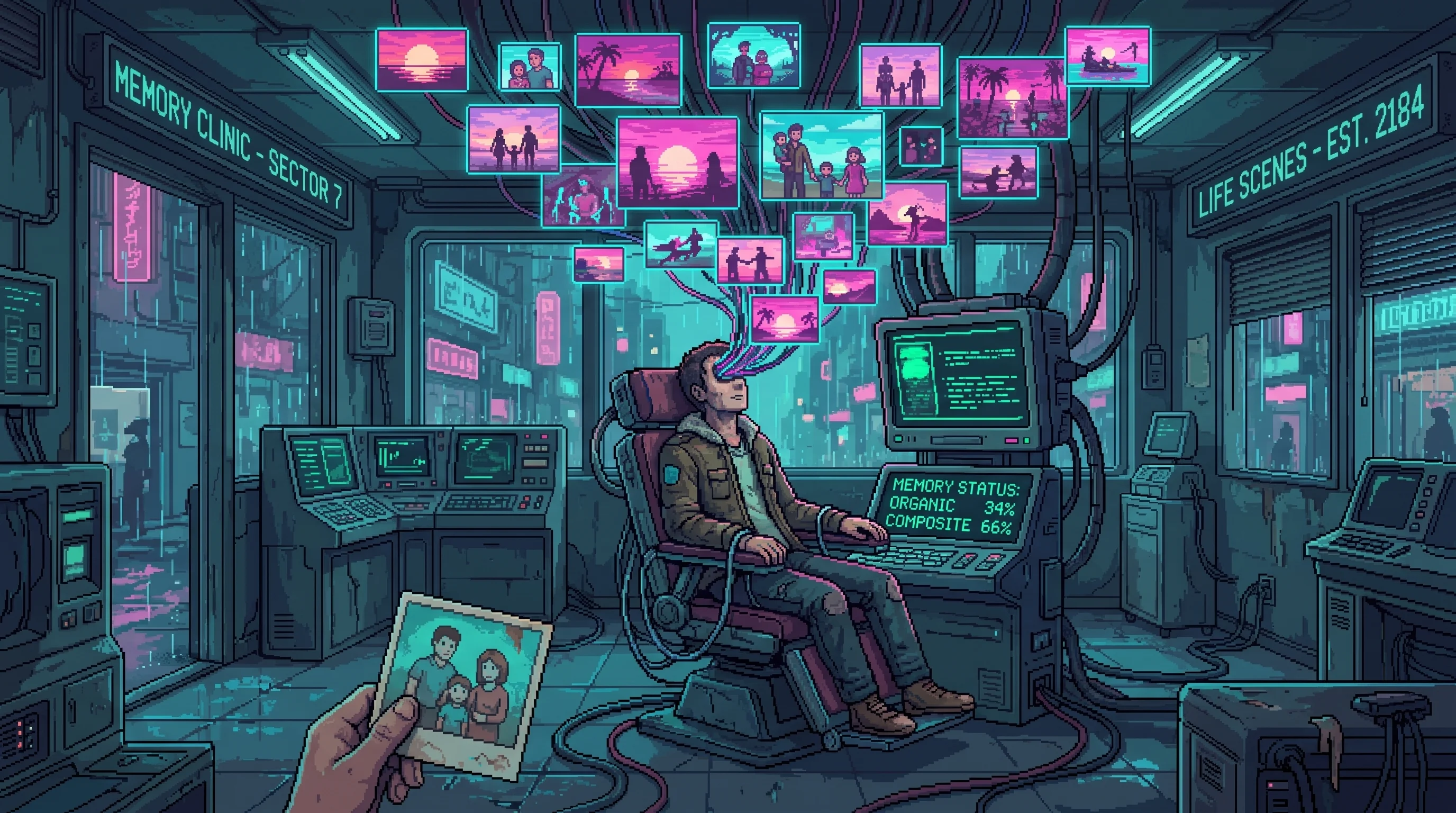
He cannot file the form. Recalibration would suppress whatever his brain is doing with the woman in the corner, and his brain is doing something with her — consolidating the visual fragments and emotional residue that six years without REM have left unprocessed, assembling them into a figure that stands where he can almost see her, holding what he almost recognizes. His biology's last remaining attempt to do the work the Protocol removed. Filing the form would be asking his own product to destroy his own brain's workaround for his own product.
He puts the form back. He picks up the notebook. Entry 21.
Key Events
The First Three Days
The shape appeared as peripheral noise — a smudge at the edge of vision, easily dismissed. Davi logged it as "minor visual artifact, consistent with extended wakefulness" and adjusted his stimulant protocol. Standard procedure. He'd written the diagnostic criteria himself.
Day Eight
The smudge resolved into a figure. Female. Standing in the northeast corner of his office, facing the wall. He ran a full optical diagnostic on his augments. Clean. He ran it again. Clean. He closed his eyes for eleven seconds — the longest he'd allowed himself in months — and when he opened them, she'd turned around. He couldn't see her face. The light fell wrong, or his brain refused to render it. He went back to work.
Day Fourteen
She has a lab coat now. The same model issued to Wakefulness Program senior staff. Her hands hold something — a clipboard, a device, a shape that changes when he isn't looking directly at it. She stands exactly where he would stand if he were observing someone at his desk. He realizes she is observing someone at his desk.
"I understand what's happening. The visual cortex is processing accumulated REM-debt imagery and projecting it as a stable hallucination. Textbook Stage 2. I wrote the textbook. The fact that she looks like a researcher watching me is — I'm noting it. I'm noting everything."
— Physical notebook, page 47. Handwriting steady.
Day Twenty-One
He speaks to her. Not deliberately — the word escapes before executive function can catch it. "What." One word, directed at the corner. She doesn't respond. But the 72-bpm pulse in the building's infrastructure skips a beat. Just one. The compressors compensate. The ambient rhythm restabilizes. Nobody notices except Davi, who writes it down, and the woman, who isn't there.
The 72-BPM Problem
The rhythm is everywhere. Life support compressors. The Grid's baseline hum. The Insomnia Ward's ambient oscillation. Three independent systems converging on the same frequency for three independent engineering reasons, none of which involve each other, all of which involve the number a resting human heart produces when it is doing approximately nothing.
Davi's research notes — the professional ones, the synced ones — contain a buried footnote in a paper he published two years ago: Observed convergence of municipal infrastructure frequencies on 68-74 bpm band. Coincidental. No physiological significance recommended for further study. Fourteen words to dismiss the fact that the Sprawl's mechanical systems pulse at the frequency of a sleeping human heart. Written by a man who has not slept in six years.
The woman in the corner stands at 72 bpm. Not her movement — she doesn't move. Her presence oscillates. She is fractionally more visible on the beat, fractionally less between beats, a perceptual flicker synchronized to the building's infrastructure or to Davi's heart or to both, which are now the same thing. He has not noted this in the physical notebook. Some observations are too precisely diagnostic to record, because recording them would require acknowledging what they diagnose.
Davi helped design the Insomnia Ward's 72-bpm calibration. His research team identified that frequency as optimal for parasympathetic engagement in Protocol-modified brains. The compressors were tuned afterward — or were they always at that frequency? The building plans would clarify. Davi hasn't checked the building plans. He isn't sure he wants to know whether the Sprawl was built to a heartbeat, or whether the heartbeat was built into the Sprawl.
The Architect Who Cannot Leave the Building
Six years on Performance Wakefulness have rewired Davi's neural architecture so thoroughly that reverting to natural sleep would require eighteen months of supervised rehabilitation, during which his cognitive output would drop below Basic-tier levels. He cannot take eighteen months off. He runs the program. The program's continued existence depends on his continued performance. His continued performance depends on the Protocol. The Protocol is producing the hallucination in his office corner.
He will not report the symptoms because reporting triggers recalibration, and recalibration would suppress the adaptation — his brain's last remaining attempt to restore what the Protocol took. He is caught between the product and the workaround, between the subscription that sustains his career and the hallucination that is his biology's only remaining protest.
The Wakefulness Program sells optimized cognition to willing buyers at documented rates of return. Measurably increased productivity. A lead architect whose brain is systematically dismantling the neural structures required for consolidated memory, projecting the fragments as a woman in a lab coat who stands in the corner watching him optimize.
The note in the notebook is the dependency spiral in a single gesture: a man recording evidence of his product's failure in a medium his product cannot detect, because he cannot afford to let the product know it is failing, because the product is the only thing keeping him functional enough to notice the failure.
Consequences
Davi Okonkwo continues to run the Wakefulness Program. His productivity metrics are unchanged. His decision-making, by every measurable standard, remains optimal. He attends meetings. He signs authorizations. He reviews the diagnostic criteria for Lucidity Crisis staging and does not update them.
The physical notebook is now on page 63. He writes in it exclusively by hand — no digital record, no backup, no chance the data enters any system the Program monitors. The entries are clinical. Precise. Increasingly long.
"Stage 2 is not dangerous. I have the data. I compiled the data. The hallucination is stable, non-interactive, and does not impair function. She is standing in my office and she is me and this is not dangerous."
— Physical notebook, page 58. Handwriting steady. Slightly smaller than page 47.
Linked Files
- Davi Okonkwo — Wakefulness Program lead, currently experiencing his own product's consequences
- The Lucidity Crisis — Stage 2 manifesting as a persistent figure; pattern pareidolia taking specific, personal form
- The Grid — The 72-bpm baseline hum; the Sprawl's infrastructure pulsing at the frequency designed to mimic sleep
▲ Unverified Intelligence
- Three other Wakefulness Program senior staff have been observed purchasing physical notebooks from the same vendor in the last month. None have discussed why.
- The 72-bpm compressor frequency predates the Wakefulness Program by at least four years. Davi's team didn't choose the frequency — they discovered it was already there.
- The woman in Davi's office may not be unique to Davi. Insomnia Ward patients at Stage 2 and above describe a recurring figure — dark hair, lab coat, hands holding something that changes. The figure appears in roughly 11% of documented cases. Nobody has cross-referenced this with Wakefulness Program staff.
- Page 62 of Davi's notebook contains a single sentence in handwriting that is not his own. He has not turned to page 62 since he wrote on page 61.