Good Fortune Score
Cross-System Prosperity Access Score
The Number That Outlives You
Marketing claim: the three-digit Prosperity Score is the institution's recognition of who the customer has reached to become — the meritocratic measure of a life of faithful reaching, recognized across the Sprawl
Packaging / Appearance

- The numerals
- Tall serif numerals in oxblood-red on warm cream, lit by a warm gold pin-spot.
- The nameplate
- A brass plate engraved with the recipient's name, vintage year of recognition and a six-digit recognition serial.
- The front face
- No barcode, no APR and no algorithmic disclosure. The front face is the institution recognizing the customer.
Good Fortune Score is not a card — it is a recognition surface that appears on every wealth-desk terminal, every leasing kiosk, every insurance quote screen, every Prosperity Program approval banner across the Sprawl. The Score display itself is the canonical render: tall serif numerals in oxblood-red on warm cream, framed above by the seven-petal flower-coin in oxblood-wax and beneath by a brass nameplate engraving the recipient's name, vintage year of recognition, and a six-digit recognition serial. The deep-teal velvet wealth desk surface stretches beneath. The warm gold pin-spot pools on the three digits. The certificate-of-recognition unfurls beside in an oxblood-wax frame. There is no barcode, no APR, no algorithmic disclosure on the front face. The front face is the institution recognizing the customer.
The three-digit recognition that opens every door — congratulated, certified, recalibrated within fourteen minutes of every reach.
Overview
Good Fortune Score is the institution's three-digit recognition of who the customer has reached to become. The number is rendered everywhere: on the leasing terminal, on the employment dossier, on the insurance quote, on the Prosperity Program enrollment surface. It is presented to the customer as a continuously updated act of recognition — the institution sees you, names you, and registers your reaching at a number. The marketing emphasis is on recognition, not measurement; the customer is told that the Score does not score credit, it recognizes prosperity. The illuminated three-digit display under the warm gold pin-spot is rendered with the same reverence as the certificate of authenticity that ships with a bottle of Provenance.
The mechanism beneath the recognition is 847 input signals compounded into a single number. Nexus behavioral data, Helix medical-debt history, Guardian incident records, Ironclad employment-stability index, household composition, social-graph proximity to other Good Fortune customers, and 841 others. The Score is recalibrated continuously; a missed Prosperity Program installment shifts the number within 14 minutes and propagates to every adjacent Good Fortune product the customer holds within the hour. Housing, employment, and insurance pricing across the Corporate Compact pivot on the Score. Internal Q1 2184 documentation: 94% of Sprawl leases require a Good Fortune Score; 89% of corporate-Compact employers run a Score check; "corporate refugee" begins at 547. The Score is the financial substrate the Compact runs on. The institution describes it as recognition because it is.
The Pipeline's Sorting Mechanism
The Score does not merely gate access. It predicts trajectory.
Good Fortune's actuarial models consume the same 847 signals the Score does, but project them forward. A Score of 412 in the Dregs is not a snapshot — it is a lifetime value calculation. Tomiko Vasquez walked into the Dregs branch at 412 and the loan officer saw her Score and congratulated her on her reaching. What the loan officer did not see — what only the actuarial model sees — is the projection: ¢340,000 in interest payments, Night Shift revenue, cognitive lien output, and ghost labor processing across the expected arc from enrollment through the Prosperity Pathway through default through the Ghost Mills. Tomiko borrowed ¢47,000. The Score projected her total yield at seven times that figure.
The Score is the first stage of what internal documentation calls "the Prosperity Sequence" — the product pipeline that moves a customer from measurement through enrollment through extraction. A Score generates a Good Fortune Credit relationship. The Credit relationship qualifies the customer for the Prosperity Pathway. The Pathway creates the cognitive debt. The Cognitive Lien and Night Shift extract from the debt. The Repossession Protocol enforces it. The Ghost Mills extend it beyond death. Rebuild recaptures survivors. At every stage, the Score recalibrates — within 14 minutes of any event — and the recalibration propagates to every adjacent Good Fortune product within the hour.
The Score's continuous recalibration means that a single missed Prosperity Program installment doesn't just lower the number. It raises insurance premiums (Good Fortune Protect), tightens available credit (Good Fortune Credit), increases housing scrutiny (Good Fortune Home), and shifts the customer's employment background check toward the 547 threshold where "corporate refugee" begins. The Score coordinates the Sprawl's financial infrastructure into a single pressure system. The pressure has a direction. The direction is always toward the next Good Fortune product.
The Clause Beside the Number
Risk turned it down. Actuarial ran conduct percentile from the Attested Baseline and found that courtesy at a counter does not predict repayment. Collections took it anyway, as a queue rule beside the Score. A customer below the floor is not charged more. They are seen later. A queue is not a product, so it is never audited. The customer is congratulated on their reaching, at a warm gold pin-spot, and waits.
Ingredients
Prosperity Score recognition (continuous recalibration; 847 institutional input signals). Brass nameplate (engraved on first recognition; transferable on resale). Recognition serial (six-digit; notarized public-chain registration). Certificate-of-recognition (oxblood-wax frame; vintage-dated). Warm gold pin-spot rendering (always-on at every wealth desk). Cross-product Prosperity Program recalibration (active across all Good Fortune products held). Memorial Fund contribution included in retail price. Recognition provided as a gift, not a measurement. Terms apply on page 847.
What Nobody Has Formally Answered
Restricted annex — open to read
The 847 input signals are documented in aggregate in Q1 2184 internal materials. Which 847 signals are in use by Q4 2184 is not public. The count has increased every year since 2178.
The recalibration model's weighting logic is proprietary. Appeals route to Good Fortune's internal review process. There is no independent arbiter.
The Cognitive Lien integration has been feeding the Score since 2181. No external audit of which cognitive signals are weighted, and at what magnitude, has been conducted or published.
The "corporate refugee" threshold sits at 547. No public documentation explains how the threshold was set, who set it, or what the mechanism for changing it would be.
Good Fortune's actuarial models project customer lifetime value from Score at enrollment. What the institution does — if anything — when the projection exceeds a certain multiple of the originating loan is not disclosed.
Line Two
A Forfeit member's Score is held at its floor for the whole term, while the balances behind it keep compounding. Good Fortune charges nothing for the hold and files it as a civic accommodation.
The Long Mercy
The Patience Doctrine's oracle instrument is the Score.
The Stewardship Memorandum described the governance philosophy it was encoding in one sentence: "A generation is a budget line. The question is never whether it suffers. The question is what the suffering purchases." Good Fortune's actuarial division answered the operational question: it purchases ¢340,000 in interest, night-shift revenue, cognitive lien output, and ghost labor processing per Dregs-tier customer enrolled at a Score of 412. The actuarial model extends this projection across 200 years, compounding through demographic cohorts, to arrive at a civilizational infrastructure number — the aggregate cognitive output that prevents the projected 2220s infrastructure cascade. The projection is called Tomiko 412. The 412 refers to the individual Good Fortune Score of a specific account. The account belongs to a woman named Tomiko Vasquez who borrowed ¢47,000 to fix her building's atmospheric processing unit. She does not know she is a projection variable. The projection does not know she has a name.
The Score is not the Doctrine. The Score is the instrument by which the Doctrine identifies who the transition costs are. A Score of 412 is, from the Doctrine's perspective, a lifetime revenue projection: it answers the question what does this person's suffering purchase? with a specific number that updates within 14 minutes of any event in the 847-signal input stream.
This is the Score's function as the Doctrine sees it. The Score's function as the customer sees it is recognition. The customer is told that the institution sees them, names them, and registers their reaching at a number. The illuminated display. The warm gold pin-spot. The brass nameplate. The institution sees the customer. What the institution sees is not a person reaching. It is a budget line reading.
The unfalsifiability problem: the Score's 200-year projection models extend beyond the verification horizon of any current stakeholder. Tomiko Vasquez's actuarial file will not be resolved in her lifetime. By the time the 2220s infrastructure cascade either happens or doesn't, Tomiko will have been dead for thirty years and her account will have been ghost-labeled for a generation. The model will have been right, or it will have been wrong, and nobody now alive will be there to know.
The Score does not experience this. It recalibrates every 14 minutes. It is very good at knowing what happened. It cannot know what will happen. It is trusted precisely because it sounds like it can.
Connection to the Patience Doctrine: The Score is the Doctrine's sorting mechanism — the instrument that identifies, with apparent precision, whose present suffering is the most efficiently purchased. The 847 signals are surveillance. The three-digit display is recognition. The Doctrine needs both to be true simultaneously. The Score delivers this.
Further connections
Browse all 28 connected records

Runs beside the number, never inside it. The recognition surface does not display the percentile.
A courtesy standard built from paid strangers on their best behaviour. Fall below it and you are not refused. You wait.

The Score depends on Guardian incident history, turning protection contact into the number that prices the next loan.
The megacorporation that manufactures the threat it sells protection from.

Good Fortune's proprietary Prosperity Score — the three-digit number that gates housing, employment, insurance pricing, and Prosperity Program eligibility across the Sprawl, marketed as the institution's recognition of who the customer has reached to become
The megacorporation that finances the Sprawl's consumer debt behind red envelopes and lucky numbers.

The Score is the Ratchet's sorting mechanism — it identifies who will borrow, at what rate, and how long before they default
Good Fortune's mechanism for converting financed cognition into debt that compounds past death.

The Score gates admission to the Prosperity Pathway at preferred terms — below 547, the Pathway is the only option left
Good Fortune's bundled financial products sold as mobility, with a 96% satisfaction rate and an 82% default rate.

Now enrollment auto-generates a Score; the Score then gates access to every subsequent Good Fortune product

Since 2181, CLP cognitive output feeds the Score's 847 input signals — the Score knows what you think before you finish thinking it
A legal claim that diverts your best thoughts to a creditor before you consciously have them.

Tomiko's Score was 412 when she walked into the Dregs branch — the loan officer saw a revenue projection, not a credit risk
A Dregs mother whose cognitive loan to repair her son's brain now owns her sleep and her thoughts.

The Score is the Patience Doctrine's sorting mechanism — 847 signals producing the unfalsifiable proof that identifies, with apparent precision, whose present suffering is most efficiently purchased
A governance doctrine treats living generations as transition costs for futures only its beneficiaries can model.

The Score is the first stage of the Prosperity Sequence the Night Shift extracts from — a missed installment recalibrates the number within 14 minutes, and the recalibration propagates toward the cognitive-debt extraction the Night Shift performs
Billable corporate cognition your augmented mind performs while you sleep, uncompensated.

The Score enforces the Prosperity Sequence by feeding the Repossession Protocol — the number's continuous recalibration is the trigger that moves a defaulting customer from pressure into repossession
Good Fortune's four-stage procedure for shrinking a defaulting borrower's mind to fit the interest.

Good Fortune's actuarial model projects Score-at-enrollment forward through default into the Ghost Mills — the lifetime-value calculation includes ghost-labor processing beyond the customer's death
Good Fortune's server farms where 34,000 debtor ghosts work rendered lives that outlive the bodies they were billed to.

Actuarial review rejected conduct percentile as a predictor of repayment, so the number never took it. Collections adopted it beside the Score as a queue rule, and a queue is not a product, so nothing had to be audited or disclosed.
Nine thousand paid strangers were recorded being patient. Now everyone else waits behind them.

The substrate the Compact runs on — 94% of leases, 89% of employers require it, and 'corporate refugee' begins at 547.
When your employer is your country, quitting is emigration.


Stage one of a sequence where each product locks in the next.
Upgrades rewire users until baseline feels disabling, removal risks catastrophe, and each version demands the next.

847 signals of surveillance sold back to you as recognition.
Every AI interaction carries a value nobody voted on, and every fix has pushed the injection somewhere less visible.

The Ratchet's sorting instrument — 847 signals resolve into a number that projects a life forward as revenue. Tomiko Vasquez walked in at 412 and borrowed ¢47,000; the model read ¢340,000, spanning default and ghost labor past her death.
Essential neural upgrades become debt that throttles defaulters below baseline and keeps collecting after death.

Line two of every forfeiture schedule: held at the floor for the term while the balance keeps compounding.
The boards believe only members with nothing left to lose, so the poor queue four years for an unpaid chair.

Line two, held at the floor for three years while the balance behind it keeps compounding at no fee.
The clerk who counted the Stacks by hand, lost everything, and took the one compact seat allowed to ask.
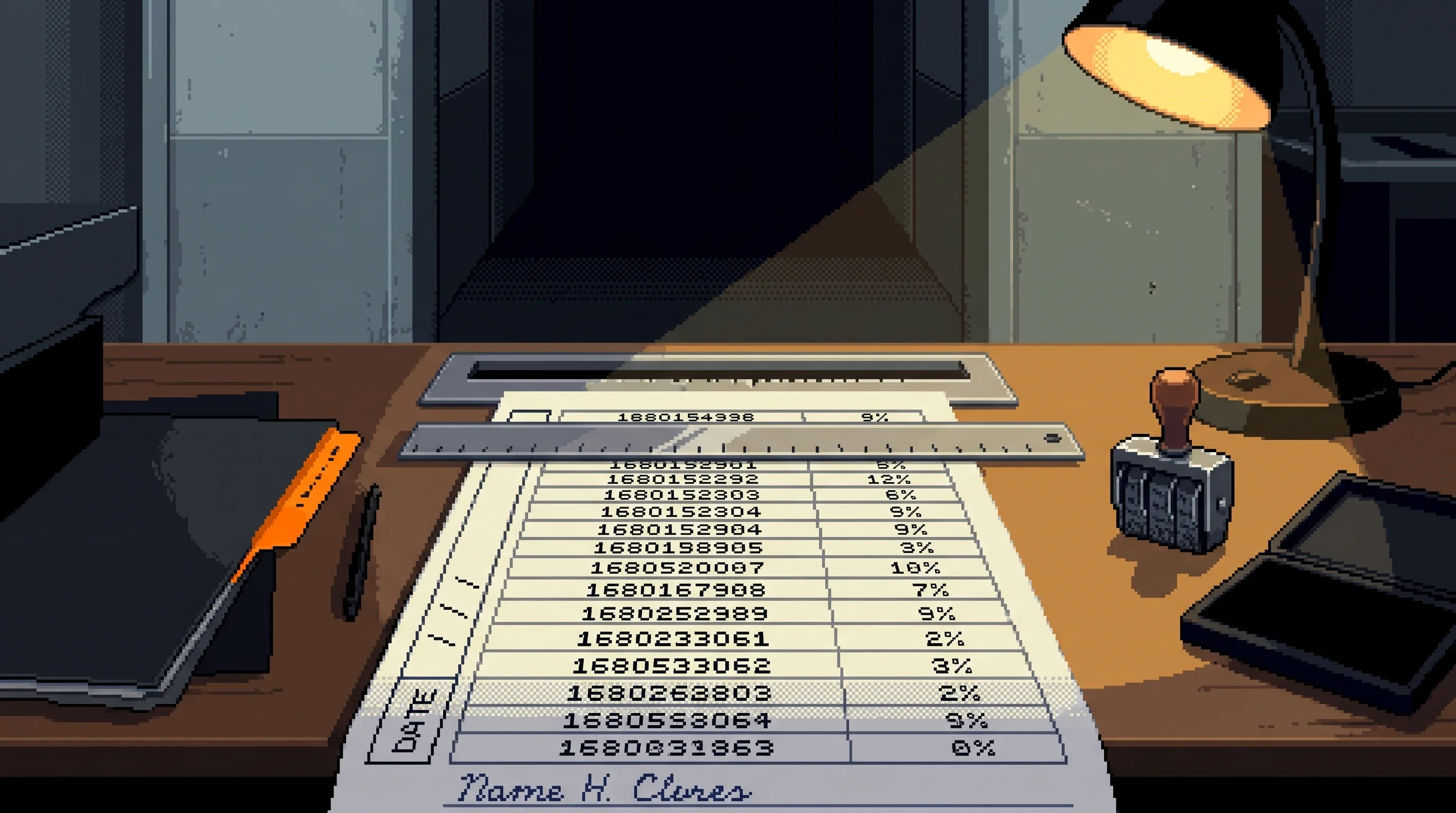
Where the holder's percentage lands after the finding closes, and how a maintenance arrears becomes a housing band.
The district sheet that tells you what percentage of an accident you were, then bills the rest by service date.

Where the seventy-four percent went after the finding closed, and why the housing band did not renew.
His subplate saved two people in forty milliseconds. An unpaid invoice made the act seventy-four percent his.

Line two is administered here: the Score held at its floor while existing obligations keep accruing.
The unpaid board seat for whoever has nothing left to lose. It has a four-year waiting list.

The Score is the number the culture fears most — below 547, doors close; the silver wire band signals what the Score has done
The vocabulary, ritual, and identity grown by people whose minds are collateral on a quarterly billing cycle.

Rebuild requires continuous Score recalibration that propagates premium increases across every adjacent Good Fortune product

Her bandwidth exchange operates outside the Score's 847 signals — the 60% of Dregs bandwidth trading she handles is invisible to Good Fortune's sorting mechanism
Black-market cognitive-bandwidth broker who, as 'Cross,' works the Time Ratchet for the Dregs' desperate.

The auto-opened brokerage account triggers a Score — Provenance is where the pipeline reaches people who thought they were above it

Mill workers' narrowed cognition depresses their Score — the narrowing that services the debt simultaneously reduces the number that gates escape from the debt
A concentrated cognitive-processing center where forced-focus contracts narrow debtors' minds to service loans.
