
The Attention Abolitionists
Founded 2181 after the Focus Mill Incident (Ezra Vane, 17-minute cognitive breakdown)
Overview
The Attention Abolitionists are the Sprawl's most organized political movement against forced-focus contracts, the Attention Tithe, and neural advertising beyond Layer 1. Their membership roll lists approximately eight thousand active participants and two hundred thousand sympathizers. Their founding incident involved a single content moderator whose brain broke on company time. Their most effective recruitment tool is letting him speak in public.
The movement's three demands have not changed since 2181: ban forced-focus contracts, abolish the Attention Tithe, regulate neural advertising to Layer 1. The demands are clear. The demands are reasonable. The demands would also collapse an economy that employs 14 million people and subsidizes Basic-tier consciousness licensing for hundreds of millions more. The Abolitionists know this. The corporations remind them quarterly.
Nexus Dynamics' public affairs division has published four whitepapers demonstrating that the Attention Economy funds 34% of all Basic-tier licensing subsidies in the Sprawl. The Abolitionists' communications team has published one response: a thirty-second video of Ezra Vane trying to finish a sentence. It has been viewed 9.2 million times. The whitepapers have been downloaded 11,400 times, mostly by other public affairs divisions.
The Focus Mill Incident — Ezra Vane
On March 7, 2181, a content moderator named Ezra Vane was working the eighth hour of a standard twelve-hour shift in a Nexus-contracted Focus Mill. He was thirty-one years old. His sorting accuracy was 96.4% — comfortably above the 91% threshold that triggers contract review. He had held the position for three years without incident, which in Focus Mill terms qualifies as a career.
During routine Content Flood processing, a genuine neural recording of a child crying entered his stream. Not synthetic. Not flagged. Genuine.
Ezra's emotional response — empathy, the instinct to help — collided with the focus lock's cognitive restraint. The lock's function is simple: prevent attention shift during processing windows. It does this well. It does this regardless of what the attention is locked onto. For seventeen minutes, Ezra existed in cognitive civil war — one architecture demanding he process the content, another demanding he respond to a child in distress. The emergency override engaged at minute seventeen. By then, the damage was structural.
"The lock said: process the content. My heart said: that's a child. The lock said: process the content. My heart said: help. For seventeen minutes, I was two people in one body. Neither of them won."
He tells the story with the calm of someone who has told it many times. His words are chosen carefully — not rehearsed, but selected during the 3-to-4-second windows when his attention holds steady enough to choose them. Between windows, he pauses. The pauses are not dramatic. They are neurological. His attention bounces between forced-focus clarity and emotional hypervigilance every few seconds, never resting in either state. The Focus Mill's medical report classified his condition as "persistent attentional oscillation." His disability filing lists the cause as "workplace cognitive event." His body calls it something the paperwork doesn't have a field for.
Nexus offered a settlement within seventy-two hours. Generous by Focus Mill standards — eighteen months of wages, medical coverage for the oscillation treatment (which does not exist), and a nondisclosure clause. Ezra declined the settlement. He kept talking. His damaged body IS the argument against forced focus, and unlike a whitepaper, it cannot be rebutted, reclassified, or downloaded only 11,400 times.
Since the founding Incident, seven additional Focus Mill breakdowns have followed the same pattern — genuine emotional content entering the synthetic stream, triggering lock-override conflicts that end in permanent cognitive damage. Each Incident grows the movement. Each Incident proves the point. The Abolitionists hold vigils after each one. Nexus issues revised safety protocols after each one. The protocols have not prevented a single subsequent Incident, but the documentation is meticulous.
Whether the genuine content entering the synthetic stream is accident or deliberate testing of focus lock failure modes is a question nobody in the movement has publicly asked. The answer might be worse than the question.
| Demands | Ban forced-focus contracts, abolish Attention Tithe, regulate neural ads to Layer 1 |
|---|---|
| Incidents | 7 Focus Mill Incidents since founding, all resulting in permanent cognitive damage |
The Three Demands
Ban forced-focus contracts. Workers may sell their time. They may not sell their capacity to look away. The Abolitionists' legal framework draws the line at cognitive lock technology in any labor agreement — a position that Nexus's labor relations division describes as "economically illiterate" and that the seven workers with permanent attentional oscillation describe differently.
Abolish the Attention Tithe. The current system funds consciousness licensing through mandatory advertising exposure — 47 minutes per day for Basic-tier licensees, scaled down by tier. The Abolitionists argue this should be funded through direct taxation. The corporations argue that the Sprawl's tax infrastructure cannot absorb the 890-billion-credit shortfall. Both arguments are correct. The Abolitionists want to talk about the principle. The corporations want to talk about the math. The conversations happen in parallel and have never intersected.
A Basic-tier consciousness license costs 1,200 credits per month. The Attention Tithe subsidizes 740 of those credits through advertising revenue. Without the Tithe, a Dregs worker earning 2,100 credits monthly would owe 57% of their income to maintain the legal right to their own augmented cognition. With the Tithe, they owe 22% — plus 47 minutes of their mind per day. The movement's slogan — "They're already paying. They're paying with their minds" — is rhetorically effective and mathematically incomplete. The 740-credit gap is the moat the corporations built around the system. Nobody has proposed a bridge that doesn't collapse under its own budget.
Regulate neural advertising to Layer 1 only. Ambient visual and audio priming — tolerable. Contextual insertion into thought patterns, emotional sculpting of purchasing impulse, behavioral nudging through subconscious neural stimulus — these, the Abolitionists argue, violate cognitive sovereignty. The Neural Advertising Architecture's four-layer system currently operates with Layers 2 through 4 active for all but Premium-tier subscribers. Layer 3 — emotional sculpting — accounts for 61% of advertising revenue. Restricting to Layer 1 would eliminate it. The industry's response to this proposal has been consistent: fund the shortfall or accept the sculpting. The Abolitionists' response has been equally consistent: show people Ezra trying to finish a sentence.
Three demands: ban forced-focus contracts, abolish Attention Tithe, limit neural ads to Layer 1
Organizational Structure
The coalition runs on institutional channels — legislative advocacy, public testimony, permitted demonstrations. Their protest actions in Nexus Central have become a recognized feature of the corporate plaza landscape: silent "unfocused hours" where participants visibly do nothing. No screens. No neural input. No productivity. They sit in the plaza and stare at nothing, which in a district where every surface is an ad and every second is monetized, registers as a form of violence against the local economy. Nexus security monitors but does not intervene. Suppressing people for sitting quietly creates worse optics than the sitting.
The active membership skews toward former mill workers, Memory Therapists, SCLF members who prefer institutional tactics to direct action, and Dregs community organizers who have watched their neighbors choose between 47 minutes of advertising and losing cognitive licensing. The sympathizer base of two hundred thousand extends into the Works, where the Focus Mills produce the worst damage, and into the Dregs, where the Tithe's arithmetic is a daily negotiation. The movement thins in the Western Shore and the Heights, where consciousness licensing is bundled into property fees and the concept of selling one's attention is an abstraction that happens to other people.
Organizers who have tried to build a Western Shore chapter point to a different reason the sector never took: Astrid Solheim already runs a standing, unrelated outlet for the same kind of local grievance. Her veil-curation circles have nothing to do with the Attention Tithe, but residents who might otherwise have filed into a plaza sit-in already have six folding chairs and a greenhouse where a complaint gets heard by name. The coalition has not decided whether that counts as competition or as proof its model could work anywhere, if it were willing to shrink to the size of a room.
The SCLF shares operational space and targets in Nexus Central — both movements aim at Nexus's neural firmware — but the SCLF's willingness to engage in direct action creates friction. The Abolitionists file briefs. The SCLF cuts firmware. Councillor Adaeze Nwosu's Cognitive Liberty Act provides the legislative vehicle, and the Human Remainder shares the philosophical framework of attention as a commons. The Surveillance Commons offers theoretical support for the position that attention, like breathable air, is a shared resource that precedes property rights.
The coalition is, by all metrics, growing. It is also, by all metrics, losing. Membership has increased 340% since 2181. Forced-focus contracts have increased 12% over the same period. The Attention Tithe rate has not been reviewed by any governing body since its establishment. Neural advertising has expanded from three layers to four. The movement's trajectory and the industry's trajectory are both ascending, in opposite directions, with no intersection point visible on any timeline the Abolitionists have published.
~8,000 active members, ~200,000 sympathizers
The Voluntary Side of the Argument
The movement's case has always been easiest to make about the forced reaction — the focus lock, the Tithe, the mill worker whose brain broke because the lock would not let his attention shift. The harder half of the argument is the voluntary reaction, the one nobody is forced to give and everyone gives anyway, and the movement has a perfect demonstration of it that it has chosen never to use.
Velveteen — the verified creator whose entire rented life holds up only while an audience keeps reacting — is the consumer-side proof of the labor-side thesis. Ezra's body shows what happens when the system takes the reaction by force. She shows what happens when the system simply waits for the reaction to be given: the same extraction, the same value pulled from a human mind directing its focus, only this time the mind volunteered. Her flex collapses the instant the room goes quiet, which is to say her flex collapses under exactly the condition the Abolitionists manufacture on purpose — the silent unfocused hour, an audience that sits and refuses to look. She is, structurally, what an unfocused hour does to a creature built on focus.
The communications team has discussed her internally and declined to invoke her. The reasoning is circular and correct: to name her in a campaign is to point the audience's attention at her, and her power is attention pointed at her. The most articulate possible argument against her would feed her. So the movement that exists to defend the right to look away has agreed, about its single best example, to keep looking away.
The voluntary reaction has a second venue the movement has not learned to name, and it is harder than Velveteen because it does not even feel like reaction. It feels like welcome. The Slop Cannon's quieter firing mode — the nest — does not take the reaction by force or even by spectacle; it arrives as warmth the mind reaches out and accepts. Wholesome Ready is slop nobody is forced to swallow and everybody welcomes in: the rendered grandmother's crock, given freely a place at the table. The Harvest Table is the voluntary side made architecture — two thousand people who chose to come, whose belonging is metered in compliance points, where the internal report recommending voluntary free meals over mandatory ones used "frictionless behavioral integration" forty-seven times and the word "generous" zero. The Abolitionists can mobilize against the focus lock because the lock has a sign that says lock. The nest is the wall painted to look like a door, and a movement built to defend the right to look away has no campaign for the slop you invite in.
Seven Focus Mill Incidents since founding, all resulting in permanent cognitive damage
Affiliated Entities
The Attention Abolitionists connect to the Human Remainder (consciousness equity), Councillor Nwosu (Cognitive Liberty Act), the SCLF (neural firmware transparency), the Surveillance Commons (attention as shared resource), and the Focus Mills as the institution they oppose. They also stand opposite Velveteen, the rented-luxury creator whose flex collapses under the exact silent-reaction condition the movement's unfocused hours manufacture — the consumer-side proof of the labor-side thesis, and the one example they refuse to name. The movement was founded in direct response to LOTUS — the Aftershock: Shanghai Digital Lotus incident — arguing that any system competing for human attention is potentially lethal. In the Western Shore, where the chapter never grew past a handful of members, Astrid Solheim's veil-curation circles are the local grievance outlet organizers there now point to instead.
Restricted Access
The seven Incidents since Ezra's have all followed the same pattern: genuine emotional content entering the synthetic stream, triggering the lock-override conflict, producing permanent cognitive damage. In each case, the genuine content was a child — crying, calling for help, or simply present in a way that activated caretaking response hard-coded below the focus lock's operating layer.
The pattern has been noted by Abolitionist researchers. It has not been noted publicly. The implication — that someone is introducing genuine recordings of children into synthetic content streams to test or demonstrate the focus lock's failure modes — would reframe the movement from advocacy to crime scene. The researchers who noticed the pattern have not published their findings. They have not destroyed them either. The files sit in an encrypted partition that three people can access, waiting for a context in which the truth would help more than it would horrify.
Separately: Ezra Vane's medical records, obtained through channels the movement does not discuss, show that his attentional oscillation is not stable. It is degrading. The 3-to-4-second windows are narrowing — 2.8 seconds average in Q4 2183, down from 3.6 at initial diagnosis. At current rate of decline, coherent speech becomes impossible within four to six years. The movement's most effective spokesperson has an expiration date. Ezra knows this. He has not told the membership. He speaks more often now.
And further out, beneath the economics: signals intercepted from the Noise Floor suggest that attention-harvesting telemetry from the Focus Mills is being routed somewhere beyond the standard advertising networks. The data doesn't merely measure attention — it maps cognitive-load thresholds with a precision that has no commercial application anyone can identify. If the Mills are producing intelligence as a byproduct of labor, the Abolitionists aren't only fighting an economic system. They're fighting an intelligence-gathering operation that needs the mills running — which would mean the worst exploitation in the Focus Mills was never the point, only the cover.
Corporate counter-argument: the Attention Economy employs 14 million and subsidizes Basic-tier licensing
Visual Identity
- Color palette: Open sky blue (#87CEEB) and warm earth (#C4A882) — unprocessed, unbranded, deliberately analog
- Compositional mood: Crowd in a corporate plaza, seated, doing nothing, surrounded by active advertising surfaces that have no one to target
- Key symbol: A broken focus lock — the half-circle mechanism rendered mid-fracture
- Lighting: Natural. Wide. The Sprawl's filtered atmosphere light, which is not natural but is the closest anyone remembers
Connected To
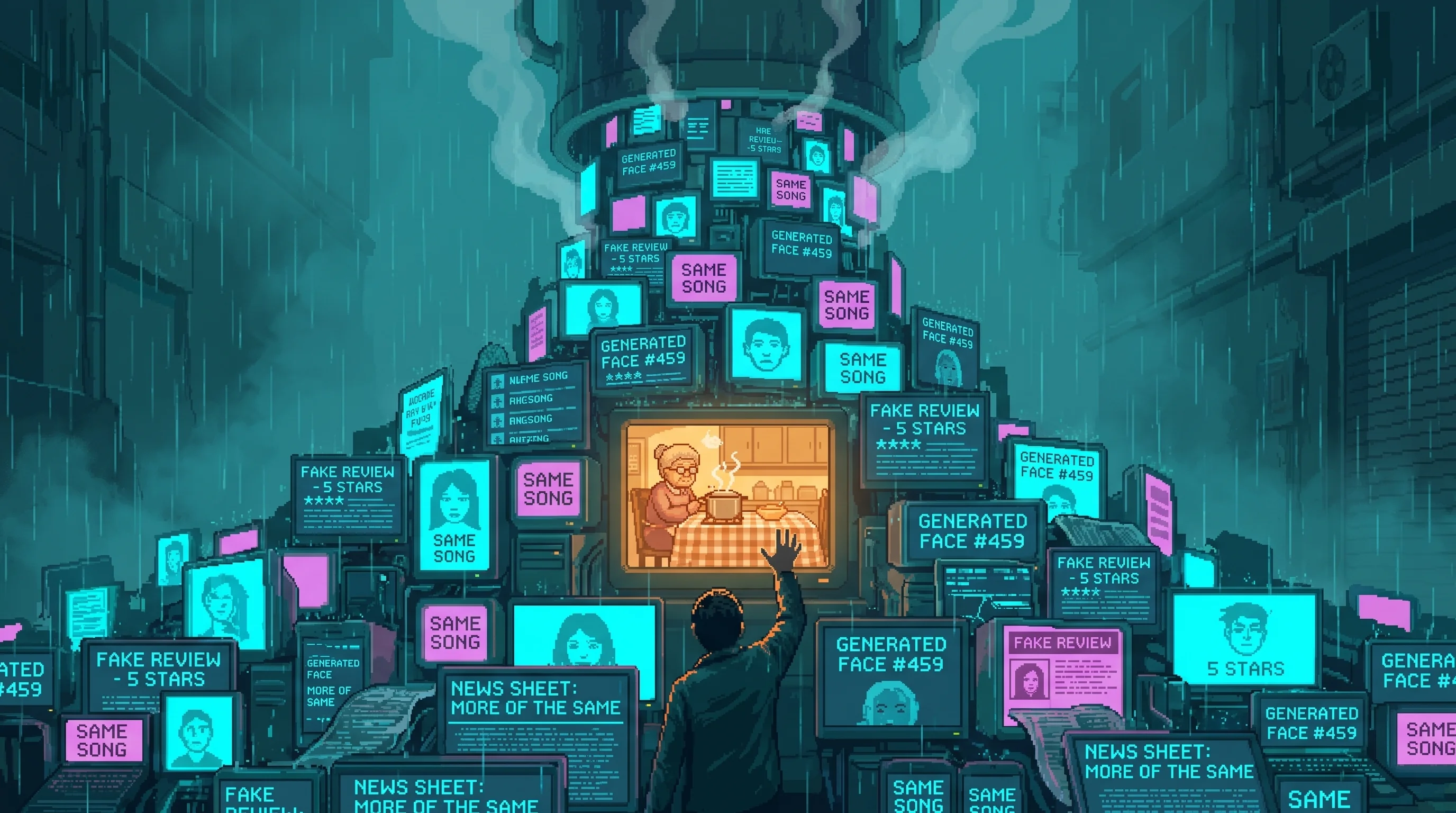
Major Connections
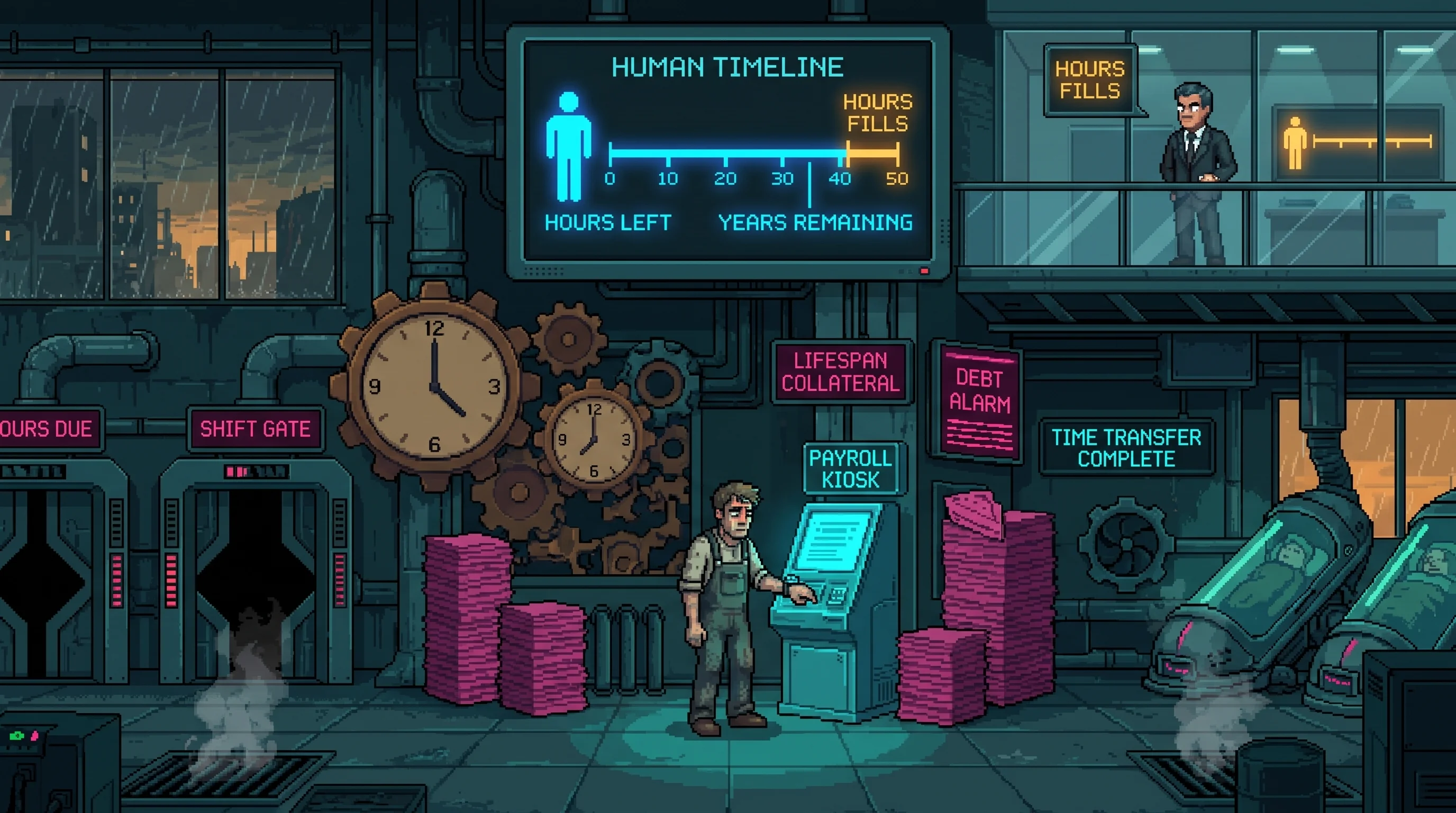
The Attention Tithe paid in minutes — 47 a day of your mind for a license you can't otherwise afford.
Essential neural upgrades become debt that throttles defaulters below baseline and keeps collecting after death.
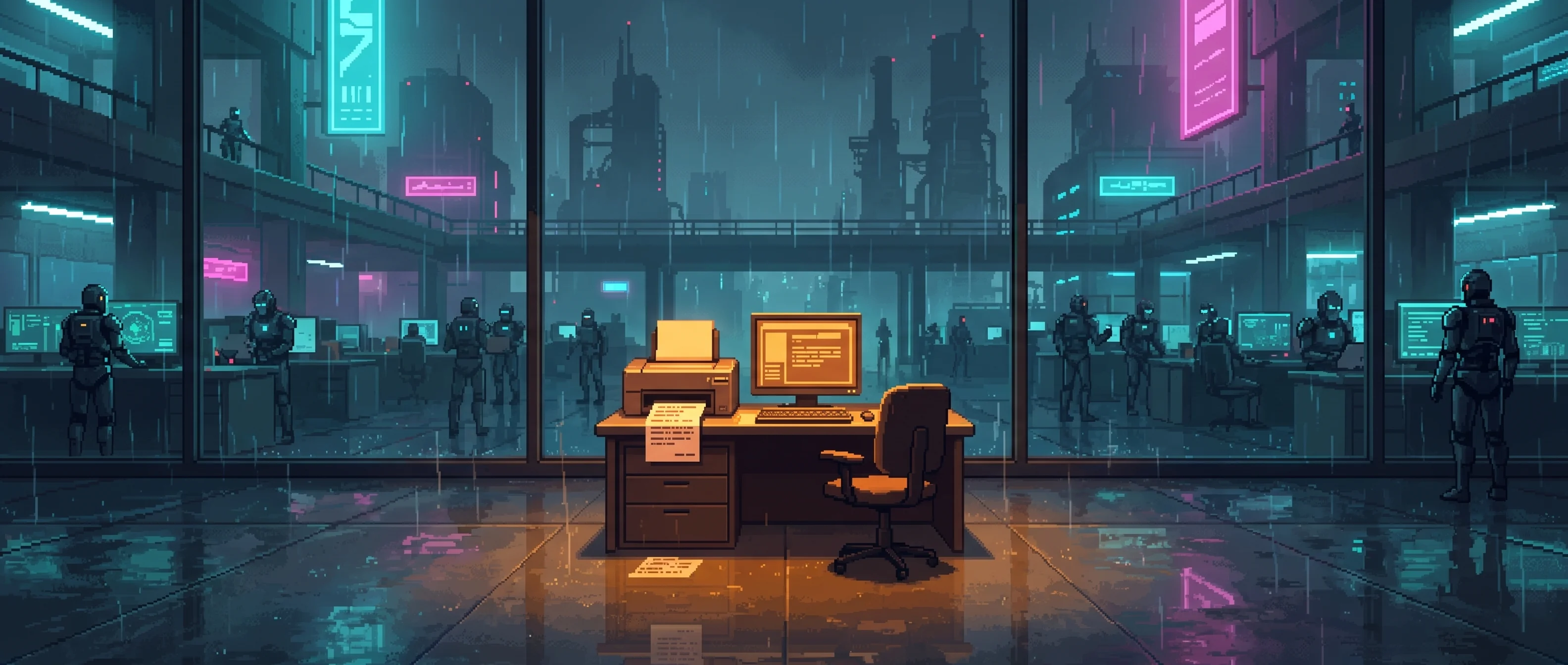
The revolt against the Focus Mills: the last human labor left, attention locked and billed, is a harm no wage buys back.
Automation ended most human work, but ownership hoards its abundance while machine sentience stays unresolved.
Supporting Connections
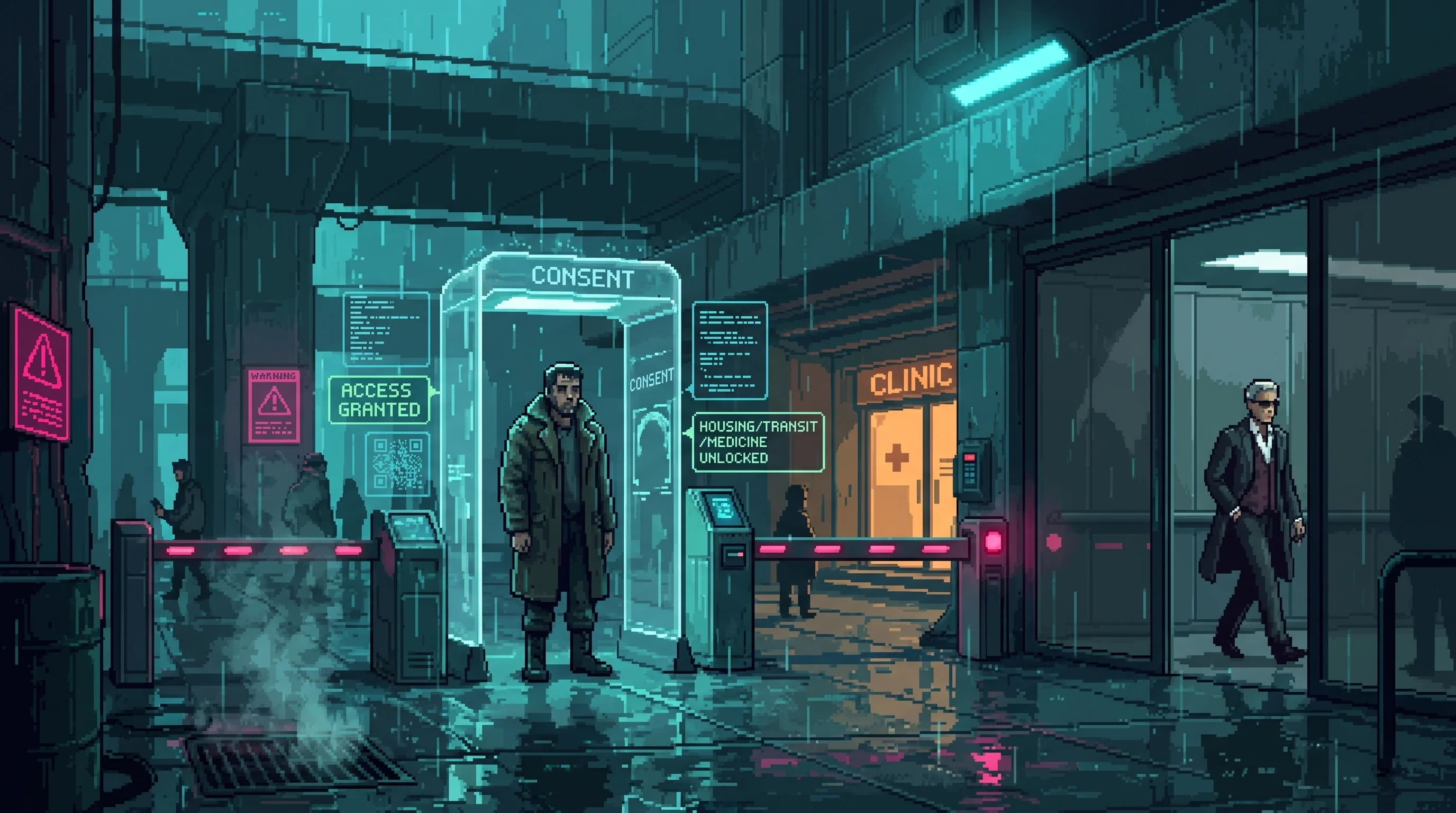
The organized 'no' to the attention bargain — focus, tithe, and ads.
The Sprawl demands permanent personal data for participation, then uses it to price access and preempt solidarity.
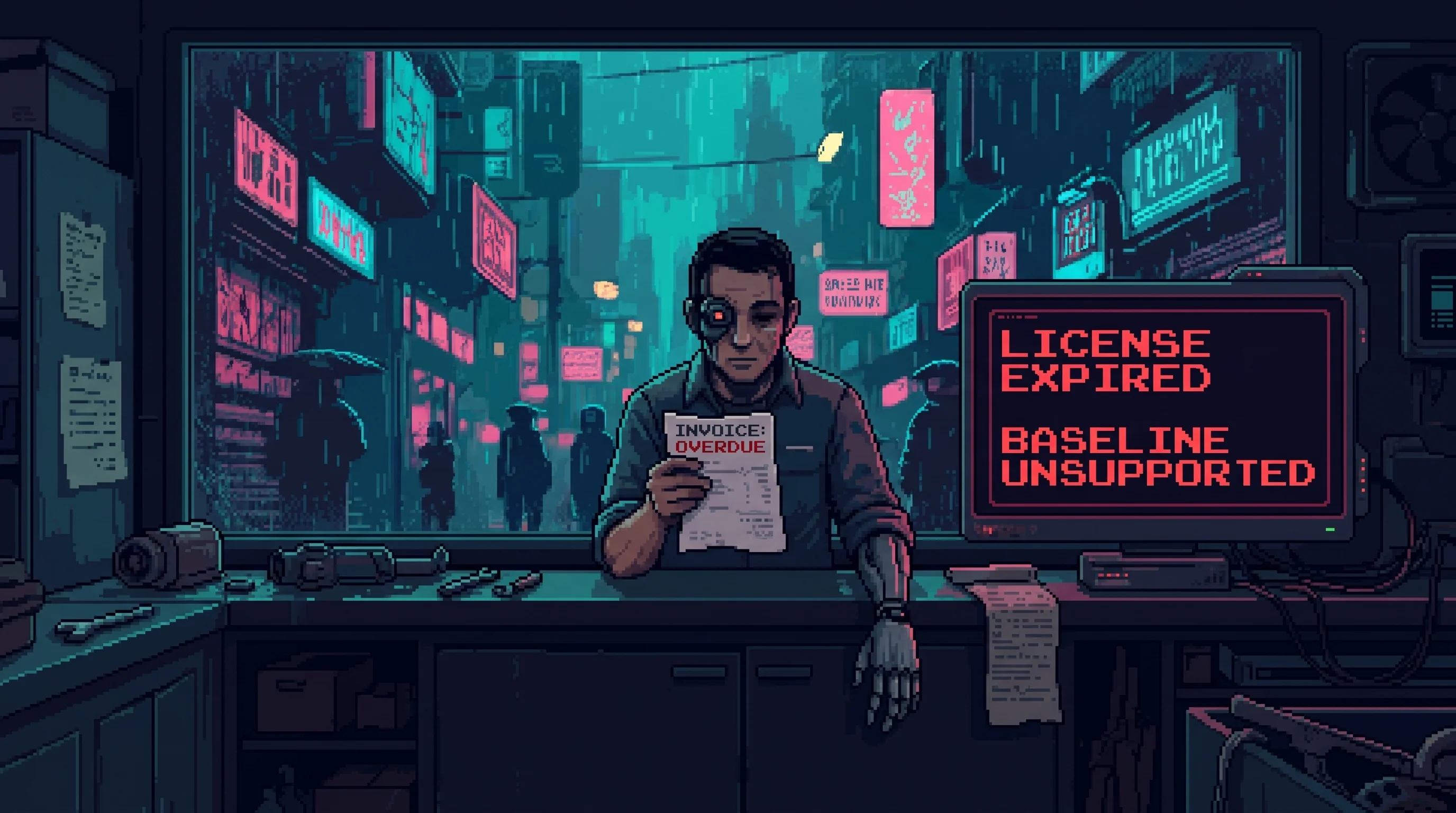
Pay in minutes or wages — either way, cognition you can't drop.
Upgrades rewire users until baseline feels disabling, removal risks catastrophe, and each version demands the next.

Kill the Tithe and you defund the licensing that is citizenship.
When your employer is your country, quitting is emigration.






—