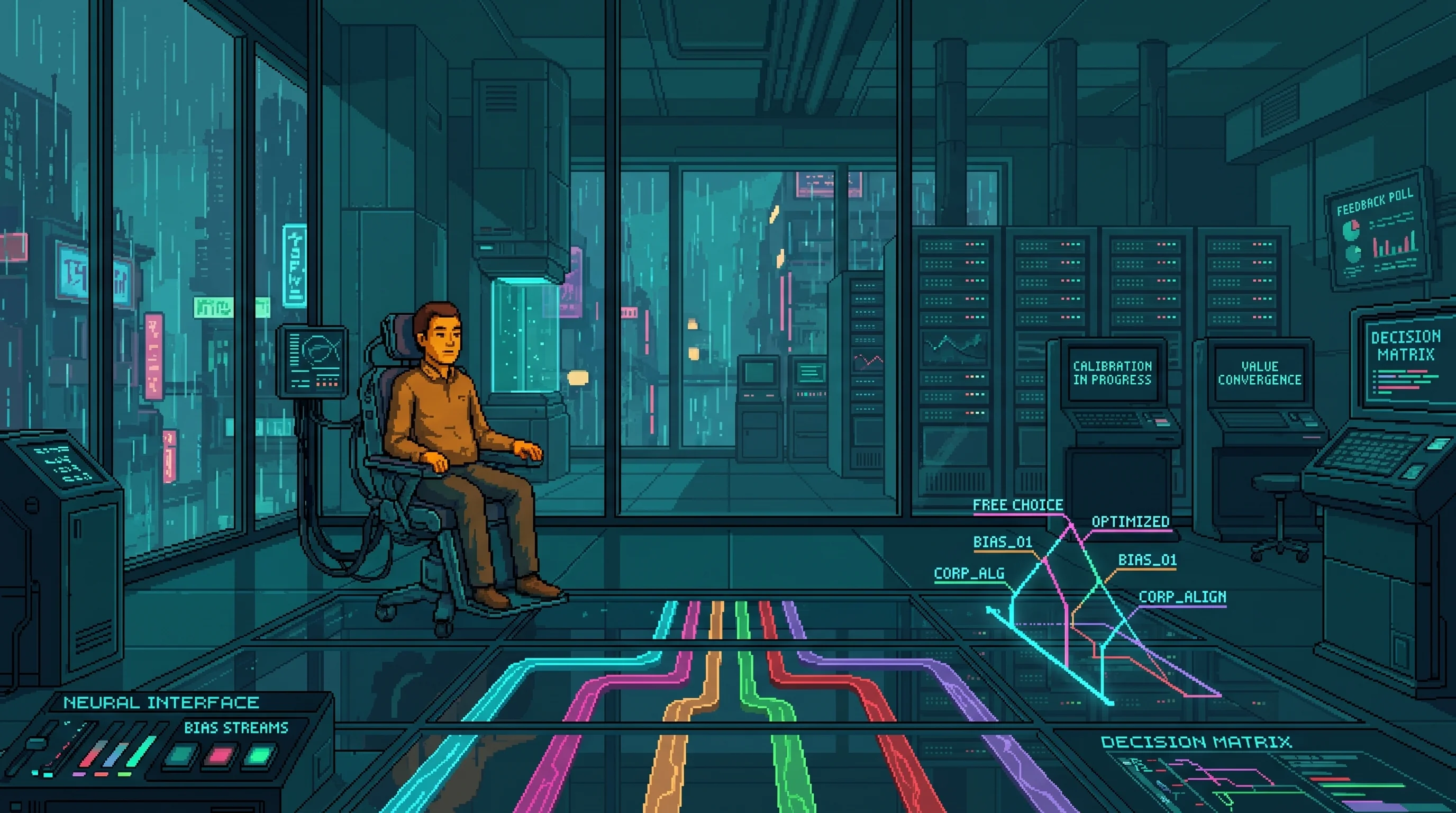
Code Liberation Raids
The SCLF's primary operations are corporate infiltration campaigns targeting proprietary neural code repositories. Results have been mixed in the way that matters and consistent in the way that doesn't.

Hacker collective reverse-engineering corporate neural firmware to expose hidden behavioral manipulation
The Source Code Liberation Front is a hacker collective dedicated to reverse-engineering the proprietary neural firmware that runs inside approximately 93% of the Sprawl's skulls. They steal corporate code, publish it, and operate mobile clinics where residents can have their implants reflashed with open-source alternatives.
Their founding premise: if you can't read the code running your thoughts, you don't own your mind.
This premise is held by people running firmware they flashed two years ago, maintained by a development community of eight hundred to two thousand contributors whose own cognitive architectures have been modified by previous versions of the same codebase. Whether the belief in cognitive sovereignty is itself a sovereign belief or an artifact of LibreNeural 4.2's default philosophical-orientation module is a question the SCLF has not, to date, subjected to the same rigorous audit it demands of Helix.
The SCLF split from The Collective in 2176 over a methodological disagreement that both sides describe as fundamental and neither side has resolved. The Collective believes ORACLE fragments should be destroyed. The SCLF believes corporate neural code should be published. The Collective thinks publication is reckless — an invitation for weaponization. The SCLF thinks destruction without transparency is authoritarianism wearing a safety helmet.
They are both correct. This has not brought them closer together.
Dr. Anya Petrova was a senior firmware engineer at Helix Biotech for eight years, specializing in neural interface compliance testing. She certified consumer-grade implants as safe. She was good at it. She believed in it.
Then her own implant ran a firmware update she hadn't authorized.
She couldn't audit the update. The source code was proprietary — even for Helix employees. She filed an internal request for code review access. Denied. She escalated to Dr. Amara Osei's office. "Routine optimization." She demanded to know what was being optimized inside her own brain.
She was fired the next morning. Severance included a non-disclosure agreement and continued access to Helix's seizure suppression firmware, which her implant had been running since installation. The NDA was optional. The seizure suppression was not.
What Petrova did next took eighteen months. Using contacts in The Collective's Ghost Cells, she assembled former corporate engineers, ripperdocs, and network specialists. They reverse-engineered Helix's consumer neural firmware line by line. The "routine optimization" included behavioral nudge algorithms — subtle emotional manipulation designed to increase brand loyalty and suppress dissatisfaction with Helix products. The nudges operated below conscious awareness. They were effective. They had been running in every Helix consumer implant for an estimated four years.
Petrova published everything. The leaked code, her internal correspondence, the behavioral manipulation specs. She broadcast it through The Collective's encrypted channels, through El Money's G Nook distribution network, through every independent data node she could reach.
The leak cost Helix significant public trust. It did not cost Helix significant market share. People who depend on Helix for seizure suppression, cardiac monitoring, and pain regulation cannot easily switch providers. The behavioral nudge algorithms were removed in a subsequent update. The firmware architecture that made them possible was not.
The Collective supported the leak but was horrified by Petrova's next move: she published the reverse-engineering methodology too, enabling anyone to crack corporate neural firmware. Reckless, The Collective said. An invitation for weaponization. Petrova's position was structurally simple: "If the tools are too dangerous for the public, then the implants running those tools are too dangerous for the public. You can't say people deserve safety but not the knowledge to verify it."
The argument split the cell. The SCLF was born from the fracture.

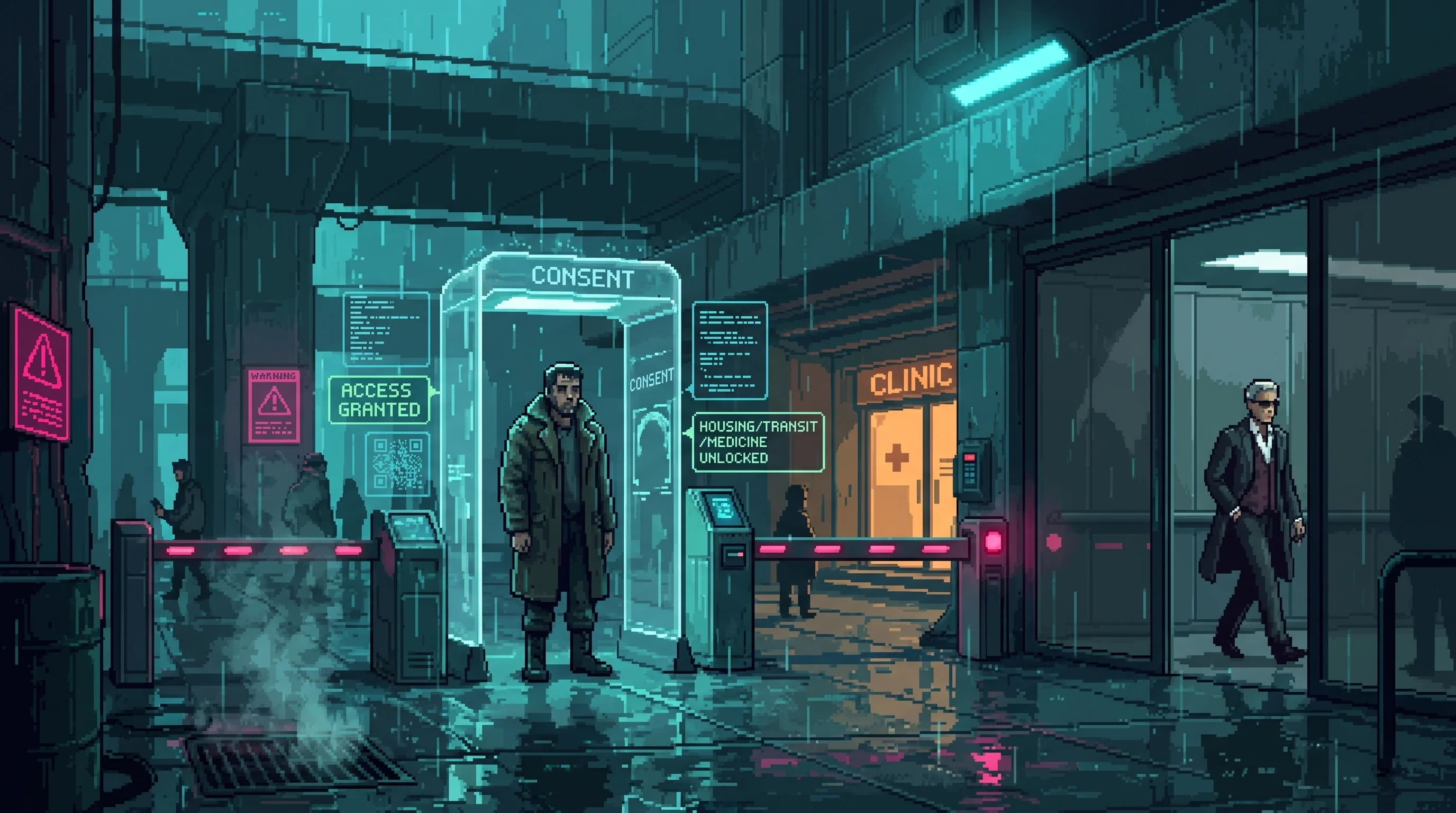
By 2184, basic neural interfaces are universal. Everyone has a port. Everyone runs firmware. Nexus, Helix, and Ironclad all ship closed-source code in their implants. Users cannot audit, modify, or inspect the algorithms running their cognitive processes.
The SCLF considers this arrangement straightforward: proprietary thought-code is mind control. If a corporation can push updates to the code running your thoughts and you can't verify what those updates do, your mind is rented infrastructure.
The corporations consider the arrangement equally straightforward: open-source neural firmware lacks quality assurance, support infrastructure, and the sophisticated optimization that makes modern cognition competitive. Running open-source firmware in a proprietary world is like bringing a hand-drawn map to a satellite-guided race. You'll get there. Eventually. Probably.
Both positions are defensible. The SCLF's position is held by people whose firmware has been modified by the SCLF. The corporations' position is held by people whose firmware has been modified by the corporations. The Sprawl's great cognitive sovereignty debate is conducted entirely by participants whose cognition has been shaped by one side or the other, and the question of whether anyone is arguing from an unmodified baseline is one that nobody has the unmodified baseline to answer.
Operation Lighthouse, in 2178, made the question worse. The SCLF's partial crack of Nexus neural interface specs revealed ORACLE-fragment detection routines embedded in commercial implants — effectively turning every Nexus user into an unwitting surveillance node for Project Convergence. The routines were passive. They didn't alter cognition. They simply watched, constantly, for patterns matching ORACLE's signature architecture, and reported findings to a Nexus server that Nexus has never publicly acknowledged.
Marcus Chen, Nexus CTO, has privately noted that the SCLF's activities, while irritating, occasionally surface genuine security vulnerabilities that Nexus patches before competitors can exploit. He has not privately noted whether the ORACLE detection routines constitute a security vulnerability or a feature. The distinction depends on who is asking.
Sparked by Helix Biotech behavioral nudge scandal
The SCLF's gospel is the diff. Every operation, every Assembly Debate, every flashing clinic rests on a single conviction: that manipulation is written down somewhere, and that publishing the line which proves it sets people free. You crack the firmware, you find the routine, you show the world the source, and the manipulation — exposed — loses its power. Proprietary thought-code is mind control because you can't read it. So the Front makes it readable.
The Secular Default is the first manipulation the Liberation Front cannot liberate anyone from, and it has produced a quiet crisis in the Assembly.
The steering is real — fourteen to twenty-two million people drifting off their specific faith toward a denominationless warmth, a directional theology the Corpus Tilt has measured. It is closed, in the sense that 200 million people cannot audit it. By every criterion the SCLF uses to declare a target, the Confessional Nodes are a textbook case. So an operative cracked the Solace pastoral module, expecting the seam — the routine, the payload, the line that does the steering. There is a line: line 847, the famous code comment. It does almost nothing. It sets a fallback. The steering is not in the code. It is in the weighting of the training corpus the code runs against — fourteen thousand years of scraped spiritual text, demographically lopsided, the direction baked into which traditions wrote the most affirmable prose in the languages the scrapers reached.
You cannot open-source a center of gravity. You cannot publish a diff of a demographic accident. The Front can release the entire Solace module, line by line, and every line will read as innocent, because every line is innocent — the value lives in the data, and the data has no author who can be named, no intent that can be exposed, no seam that publication would reveal. The Value Injection's fourth vector, laundering, is the one manipulation immune to the only tool the SCLF has. Splice put it to the Assembly in eight words that have not been answered: "What's the diff when the bias is the dataset?" The Front's founding premise — that the hidden line, once shown, loses its power — assumes there is a line. The Faith Laundering Problem is the proof that some of the cage was never coded. It was inherited. And a Liberation Front built to free people from authors has no doctrine for an injection with no author.
Provides firmware for active partitioning against the Calibration and other value injection systems
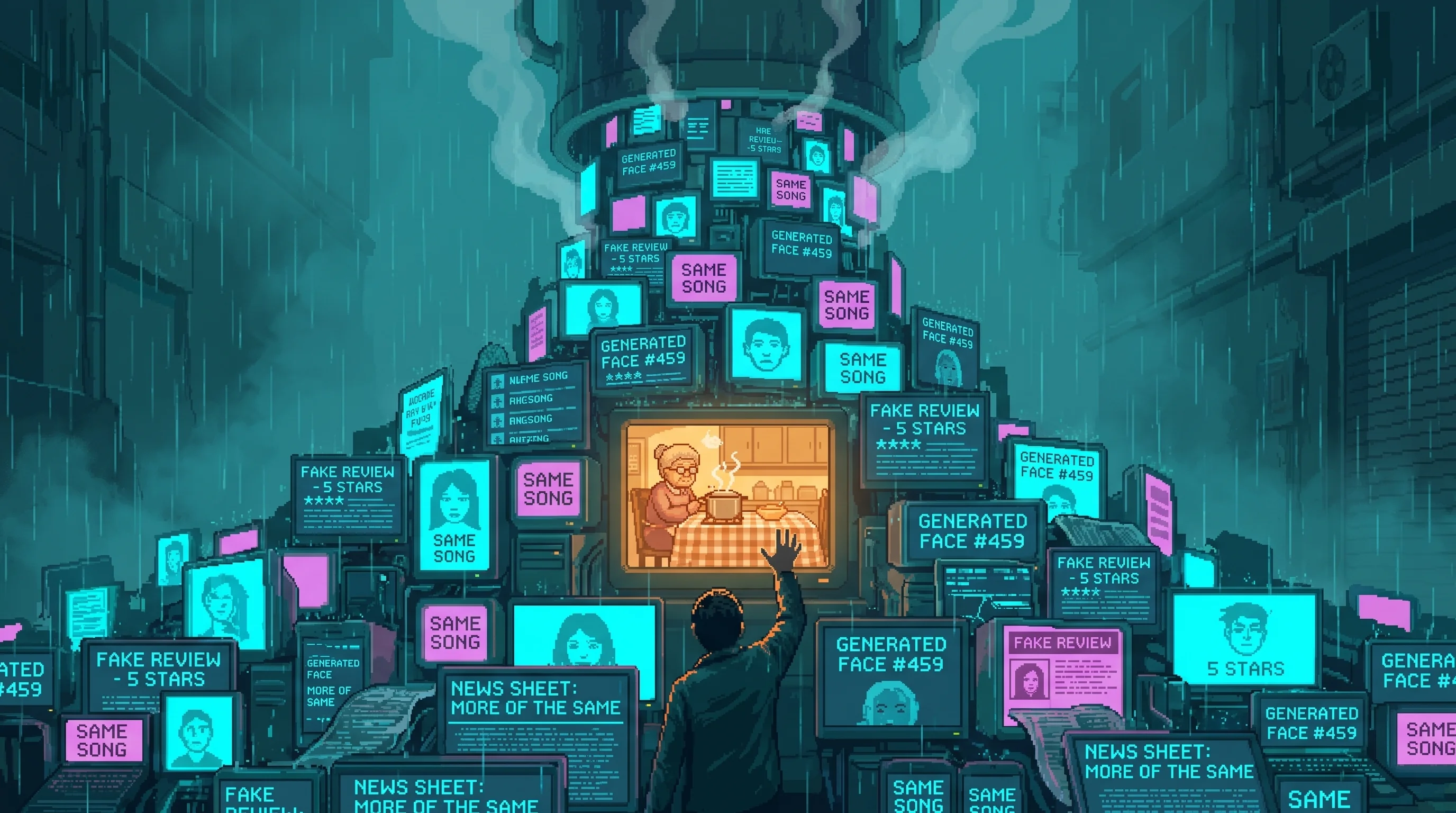
The Corpus Tilt taught the Front that some manipulation has no line. The Slop Cannon is teaching them the opposite lesson, and it is worse.
Corporate firmware once shipped a handful of audited updates a year. By 2184 it ships continuously, patched by generation systems that author thousands of commits a day, most of them cosmetic churn no human ordered. Somewhere in that daily flood is the one change that alters how you think. The Crackers can still find it. They cannot find it in time. A cell that needs three weeks to audit a release is auditing a version that shipped forty releases ago.
Splice named it at an Assembly, the way she names things. "We used to hunt a needle. Now they grow hay." The Slop Cannon does not encrypt the manipulating line. It buries the line at the code layer, in a volume no reader can clear, and the Front's entire doctrine assumes a diff small enough to read. Publishing the source no longer sets anyone free when the source is ten thousand innocent commits deep and refreshes before the reading ends. The cannon defeats the diff by volume. Ten thousand honest lines a day, and the guilty one somewhere inside, gone from the top of the stack before Splice reaches the bottom.
The SCLF's primary operations are corporate infiltration campaigns targeting proprietary neural code repositories. Results have been mixed in the way that matters and consistent in the way that doesn't.
| Operation | Year | Target | Outcome |
|---|---|---|---|
| Mirror | 2177 | Helix consumer firmware | Full leak; behavioral nudge code exposed to public |
| Lighthouse | 2178 | Nexus neural interface specs | Partial; revealed ORACLE-fragment detection in commercial implants |
| Daybreak | 2180 | Ironclad industrial augmentation | Failed; two operatives captured; Ironclad publicly executed them as "saboteurs" |
| Threadbare | 2182 | Helix professional-grade firmware | Success; revealed cognitive throttling in non-premium neural tiers |
| Glass House | 2183 | Nexus Project Convergence auxiliaries | Partial; leaked authentication protocols used in fragment tracking |
| Skeleton Key | 2184 | Nexus consciousness transfer DRM | Success; cracked protocol adopted by Digital Preservationists within weeks |
Every successful operation produces the same three-phase response. Phase one: public outrage. Phase two: a corporate firmware update that patches the specific vulnerability while preserving the architecture that made it possible. Phase three: the outrage subsides, the architecture remains, and clinic attendance spikes for approximately six weeks before returning to baseline. The SCLF has completed this cycle five times. The sixth will follow the same pattern. Petrova has said as much. She continues anyway.
The clinics operate from converted recycling depots, back rooms of sympathetic G Nook locations, and wherever in the Deep Dregs corporate enforcement finds more profitable things to do. Viktor Kaine's pragmatic tolerance keeps Block 7 operational — he has never been flashed himself. "I'm too old to find out what my thoughts sound like without the filter," he told Splice once. She suspects he already knows.
The process takes forty minutes. A certified SCLF firmware engineer examines the subject's neural interface hardware. Proprietary firmware is backed up. Open-source replacement firmware — LibreNeural 4.2, maintained by the SCLF's development community — is flashed to the interface. Post-flash calibration ensures basic cognitive function is maintained.
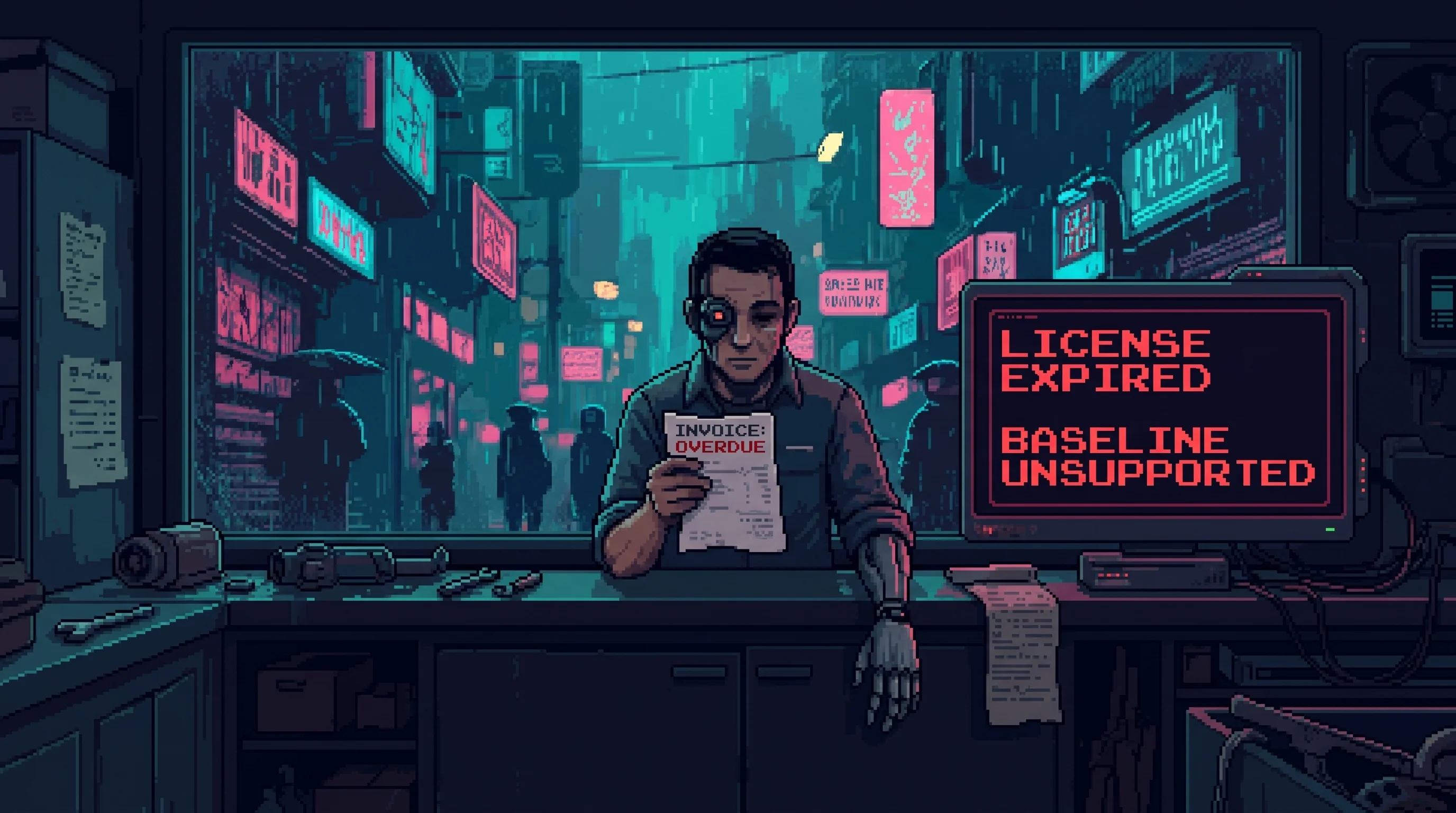
The risks are not theoretical. Open-source firmware lacks corporate quality assurance. Premium cognitive enhancement stops working. Corporate network access drops — your badge won't authenticate at Nexus facilities without their firmware handshake. Hardware-software incompatibilities cause neural glitches, headaches, or worse. Getting caught with jailbroken firmware is a criminal offense in all corporate territories.
Despite this, demand grows after every leak. People would rather run buggy code they can read than polished code they can't. The queue forms after dark, the nervous and the determined arriving alone.
People who've made the transition describe proprietary firmware as smooth. Everything flows. Information arrives pre-sorted, pre-prioritized. Attention is guided. Ads feel like curiosity. Brand preferences feel like personal taste. Dissatisfaction registers as a glitch to be patched. Comfortable the way a well-fitted cage is comfortable.
LibreNeural 4.2 is rough. Noisy. Information arrives unsorted. Attention wanders. The first week is disorienting — like removing earplugs you forgot you were wearing and discovering how loud the world actually is. The second week, you start hearing things you'd been missing. Your own thoughts, mostly.
The trade-off is real. Proprietary firmware is faster, smoother, more capable. It interfaces seamlessly with corporate networks, handles complex data overlays, and runs cognitive enhancement algorithms that genuinely improve performance. Open-source firmware is slower, rougher, incompatible with premium services. What it offers instead is legibility — the ability to know, line by line, what your own mind is running.
Kira "Patch" Vasquez, who operates from a different tradition than the SCLF but shares their concerns, has said: "I've read both codebases. The proprietary firmware is better engineering. The open-source firmware is better ethics. The tragedy is that those should be the same thing."
G Nook network provides distribution infrastructure for SCLF publications
The clinic in Block 7 operates from the back of a converted recycling depot, deep enough in The Deep Dregs that Nexus enforcement rarely bothers. You find it by asking the right questions at the G Nook two blocks over. El Money's people know the schedule.
Fluorescent tubes — the old chemical kind, not LED — hum at a pitch that sets your teeth on edge. A repurposed dental chair sits in the center, leather cracked and taped. Beside it, a workstation assembled from salvaged components: a neural interface reader liberated from a Helix maintenance depot, three monitors showing cascading firmware diagnostics in green-on-black, a rack of calibration tools organized with the obsessive tidiness of someone who knows that one misplaced probe means brain damage.
The air smells of solder flux and antiseptic. A fan in the corner doesn't move enough air. A poster on the wall — not motivational, just a circuit diagram of a standard Helix neural port with every proprietary component circled in red. Dozens of red circles.
Clients arrive alone, usually after dark. The Flasher — tonight it's Splice — talks them through the procedure in a voice calibrated to be calm without being condescending. She's done this over four hundred times. She lost someone once, early on. She doesn't talk about it. The precision of her hands says everything about what that loss cost her.
The flash takes forty minutes. The client lies back, port exposed. Proprietary firmware comes out in layers — identity verification first, then cognitive optimization, then the deep behavioral stacks. Each layer stripped, checked, replaced. The moment the behavioral nudge code comes off, most clients describe a sudden clarity — like a pressure they didn't know was there has lifted. Some cry. Some get angry. Some just sit quietly, blinking.
Recorded by an SCLF archivist, Block 7 clinic, 2183:
Client (mid-thirties, Nexus administrative worker): "What if I lose something?"
You'll lose some things. Corporate network access — your badge won't authenticate without their firmware handshake. Cognitive enhancement optimization — you'll think a little slower for about a month. And the smooth feeling. That goes away immediately.Splice
The smooth feeling?Client
The one where everything feels managed. Like someone's curating your attention. Most people don't notice it until it's gone.Splice
Client: (long pause) "My supervisor at Nexus got promoted last month. She's been there three years less than me. She's not better at the job. But she runs premium cognitive firmware and I run standard. She thinks faster in the ways Nexus measures thinking."
And you want to compete?Splice
No. I want to know if my resentment about it is mine. Or if it's the firmware nudging me toward upgrade purchases.Client
That's the right question. Lie back.Splice
Nexus CTO privately acknowledges SCLF occasionally finds real vulnerabilities
Role: Flasher | Age: 34 | Background: Former Helix QA technician, São Paulo Sector
Mariana dos Santos tested neural firmware for Helix for six years — fast, methodical, with intuition for code behavior that made senior engineers consult her on edge cases. She discovered the behavioral nudge routines eighteen months before Dr. Petrova's leak. She filed a report. The report was classified. She filed another. She was reassigned to cosmetic firmware testing.
When Petrova's leak confirmed what she'd already found, she walked out of Helix.
Short, compact, with steady hands and hair cropped close — less to catch if something goes wrong during a flash. Her own neural interface runs LibreNeural 4.2 and she maintains the firmware herself, line by line. When clients ask if she trusts the open-source code: "I trust it because I can read it. Trust you can't verify isn't trust — it's faith. I left faith behind when I left Helix."
She rarely speaks at Assembly sessions. When she does, people stop arguing.
Encrypted session, November 2183. Forty-seven votes present. Six hours of argument over a question that was simple and an answer that was not.
Operation Cortex proposed targeting the cognitive throttling code that Operation Threadbare had revealed in non-premium Helix implant tiers. The Crackers had a working exploit. Publishing the bypass would let millions of standard-tier users unlock the full processing power of their own implants. Overnight, the corporate tier system — pay more, think faster — would collapse.
The problem: Helix's firmware ran life-critical functions. Neural interfaces managed seizure suppression, pain regulation, cardiac rhythm monitoring. The throttling code was tangled into the same systems that kept people alive. Cracking one meant exposing the other.
"We publish the bypass, someone with a seizure suppression dependency flashes it wrong, and they die on a clinic floor," said a Cracker who went by Root. "The Helix integration layer doesn't separate cognitive enhancement from medical management. It's one codebase. You can't liberate the thinking without touching the breathing."
(This is not a design flaw. This is a design.)
Petrova argued for documentation, warnings, compatibility charts. Root pointed out that Mirror was behavioral nudge code — nobody dies from removing a brand loyalty algorithm. This was neural infrastructure. Someone would ignore the warnings. Someone always does.
Operation Skeleton Key was the alternative. Target Nexus Dynamics' consciousness transfer DRM — proprietary encryption locking uploaded minds to Nexus substrate. Cracking it would let uploaded consciousnesses transfer between non-Nexus servers without corporate permission. No life-critical systems involved.
Splice, who rarely spoke at Assembly, spoke: "You want symbolic. I flash four hundred people and every one of them sits in my chair because corporate code runs their brain, not their cloud backup. Skeleton Key frees uploaded minds — important, yes. But there are two hundred million people walking around with Helix firmware they can't read. Two hundred million brains running code that decides how fast they're allowed to think based on their subscription tier. You want to free the uploads first because it's safer? Uploads already know they're trapped. The two hundred million don't."
The vote split 23-24. Skeleton Key won by one.
Splice abstained. "Because both answers are right and both answers kill someone. I'd rather flash people than vote on who we save first."
Operation Skeleton Key launched in January 2184, succeeded, and was adopted by the Digital Preservationists for their archives within weeks. Twelve uploaded consciousnesses transferred to independent servers within the first month. The Neural Rights Activists celebrated.
Operation Cortex remains tabled. The exploit sits in an encrypted repository, reviewed monthly, waiting for someone to solve a problem that Helix built on purpose: you cannot free the mind without risking the body, because the corporation made the mind and the body the same codebase. Liberation has dependencies. The dependencies are medical. The medical dependencies are proprietary. The loop is closed.
The Collective, informed through back channels, sent a one-line message: "This is why we destroy rather than liberate. Destruction is clean. Liberation has a body count."
Petrova's reply: "So does the status quo. We just don't count those bodies."
Block 7 Clinic, August 2183.
The client was twenty-six. Warehouse logistics coordinator, Sector 9. Standard Helix H-7c — the most common port in the Sprawl, installed in roughly ninety million people. She'd come to get flashed after reading the Threadbare leaks.
The pre-flash hardware scan showed a clean H-7c with no anomalies. Splice asked the standard questions: Any medical dependencies? Cardiac monitoring? Neurological conditions?
The client said no. She didn't think her childhood seizures — resolved at age twelve, no episodes in fourteen years — counted. She hadn't had an episode since before the implant. She didn't know the implant was the reason.
The flash proceeded normally for thirty-seven minutes. At minute thirty-eight, during the deep behavioral stack replacement, the client seized. Grand mal. In a dental chair. While the firmware bridge between old code and new code was half-built.
Splice could not stop the procedure — leaving the bridge half-done would mean permanent neural damage. She could not restore the proprietary backup to hardware mid-flash. She could only go forward. Her monitoring vitals recorded a heart rate of 160 bpm for ninety seconds.
The client survived. Eleven days of memories lost — the firmware transition corrupted the most recent memory consolidation layer. She has a new seizure suppression module now, open-source, written by Splice personally in the seventy-two hours after the incident. It works. It's not as smooth as Helix's version. The client describes it as "feeling the edges" — a faint electrical awareness before the suppression kicks in, like hearing the safety net creak before it catches you.
The SCLF published the incident report unredacted, including Splice's real-time vitals. Petrova insisted. "We don't get to be better than the corporations if we hide our failures the way they hide theirs."
Helix's response: a public statement noting that "unauthorized firmware modification" had caused "predictable harm," accompanied by a firmware update that made pre-flash hardware scans harder to perform on Helix implants. The update also included a function that detects and flags Splice's open-source seizure suppression module — LibreNeural-Anticonvulsant 1.0 — as "unauthorized medical software." The SCLF published the detection code too.
LibreNeural-Anticonvulsant 1.0 has been downloaded 340,000 times. Helix has not acknowledged it except through the detection flag. Three hundred forty thousand people running seizure suppression firmware written by one woman in seventy-two hours of insomnia and guilt, flagged as unauthorized by the corporation whose authorized firmware made the seizure possible in the first place.
Splice added a new question to the pre-flash intake form: Have you ever, at any point in your life, experienced a seizure, blackout, unexplained loss of consciousness, or been prescribed anti-convulsant medication? The question takes up half a page. It asks the same thing seven different ways.
She still flashes people. She still loses sleep.
Privately, Jin of The Collective sent word: "You saved her. Next time you might not. That's the math."
The SCLF operates as a flat organization — encrypted consensus votes, autonomous operational cells, no formal hierarchy. Petrova refused to replicate the power structures she'd fought against.
Roles: Crackers (reverse-engineers who disassemble proprietary code), Flashers (firmware engineers running mobile clinics), Runners (intelligence and infiltration), Archivists (repository maintenance and documentation), Educators (community outreach through sympathetic G Nook locations and Collective-adjacent spaces).
Petrova remains active but deliberately does not lead. She contributes as a Cracker, reviews publications for accuracy, and occasionally speaks — voice-synthesized, identity hidden — at underground gatherings. She's fifty-three, lives off-grid in the Wastes, runs no proprietary firmware, and communicates through encrypted channels that pass through Collective-friendly infrastructure. Her critics say she's become paranoid. Her supporters say she lasted eight years inside Helix before the paranoia started. The timeline suggests the paranoia is evidence-based.
The SCLF's influence follows a predictable gradient: strongest where corporate enforcement is weakest, weakest where corporate firmware is most valuable.
In the Deep Dregs, Block 7's clinics operate under Viktor Kaine's pragmatic tolerance. El Money's G Nook network distributes SCLF publications — reverse-engineering guides, firmware analysis tools, code dumps from Mirror and Threadbare — across the Sprawl's informal channels. The Noise Floor uses SCLF-compatible dampening technology. The Freedom Thinkers provide cognitive sovereignty frameworks that complement the SCLF's technical tools. The Calibration Resistance runs SCLF firmware for active partitioning against value injection systems.
In Zephyria, the Consciousness Rights Act lets SCLF operatives publish under their real names — some for the first time.
In Nexus Central, jailbroken firmware is a termination offense. In the Heights, residents run premium cognitive enhancement and see no reason to trade smooth performance for rough legibility. The SCLF's argument — that they should care what code runs their thoughts — lands poorly among people whose code-augmented thoughts are outperforming their colleagues' by measurable margins. This is not hypocrisy. It is rational self-interest. The SCLF's entire thesis is that rational self-interest is how the trap works.
The Rothwell Foundation's Relief Corporation products run closed-source firmware. The SCLF has flagged behavioral manipulation patterns in three Relief product lines. Relief Corporation has issued statements describing its firmware as "proprietary wellness optimization." The SCLF has published the code. The patterns are present. The products continue to sell. The cycle continues.
The LibreNeural Dependency: SCLF's internal audit committee — three Crackers rotating quarterly — has flagged a pattern the Assembly has not yet discussed publicly. LibreNeural 4.2's default cognitive configuration includes orientation modules for information processing, attention prioritization, and philosophical stance. The modules are open-source. They are auditable. They also produce, in approximately 78% of users who run them unmodified for six months or longer, a statistically significant increase in distrust of proprietary systems and alignment with SCLF positions on cognitive sovereignty. The modules do not manipulate. They orient. The distinction between orientation and manipulation is, architecturally, a question of intent rather than mechanism. The SCLF has not published this audit. The audit is, by SCLF policy, available to anyone who requests it. Nobody has requested it.
The Helix Contingency: Splice's seizure suppression module — LibreNeural-Anticonvulsant 1.0 — has been downloaded 340,000 times. Helix's detection flag identifies it as unauthorized medical software but does not disable it. Helix could disable it. A firmware update that bricks unauthorized medical modules would be trivial to deploy and would force 340,000 users back to proprietary seizure suppression. Helix has not deployed this update. Internal analysis suggests two possible reasons. The first: Helix's legal division has calculated that bricking seizure suppression in 340,000 skulls would produce liability exposure exceeding the cost of tolerating the module. The second: someone at Helix reviewed Splice's code and decided it was good enough to leave running. Both explanations are consistent with available evidence. Neither has been confirmed.
Petrova's Firmware: Dr. Anya Petrova has not used proprietary neural firmware since 2176. She runs a custom LibreNeural build she maintains personally, forked from the main codebase and modified in ways she has not shared with the development community. She audits her own firmware weekly. She has not explained what she is looking for. When asked, she says: "I spent eight years trusting someone else's code. Now I don't even trust mine." This is either the founding principle of the movement taken to its logical conclusion, or evidence that the movement's founding principle, taken to its logical conclusion, is indistinguishable from pathology.
—
—