
The Surveillance Commons
In Zephyria, your data works for you; in the Sprawl, you work for your data
Overview
The Surveillance Commons is a theoretical framework that arrives at an uncomfortable conclusion through unremarkable arithmetic.
Behavioral data has no individual value. A single resident's neural-interface telemetry — sleep patterns, purchase hesitations, emotional responses to advertising, the 0.3-second delay before accepting a Nexus Terms of Service update — is worth approximately ¢0.00007 per day. Aggregated across 340 million Sprawl residents, the same data generates ¢4.2 billion annually for the Inference Economy. The individuals who produce the aggregate receive nothing. The corporations who built the collection infrastructure receive everything. The framework's authors — Opacity Movement economists working from Zephyria's policy institutes — point out that this is structurally identical to the enclosure of agricultural commons in pre-industrial England: shared land, fenced by whoever could afford the fence, converted from collective resource to private revenue.
The parallel is tidy. The Inference Economy's response to it has been silence, which is the response of someone who checked the math and didn't find an error.
The Zephyria Experiment
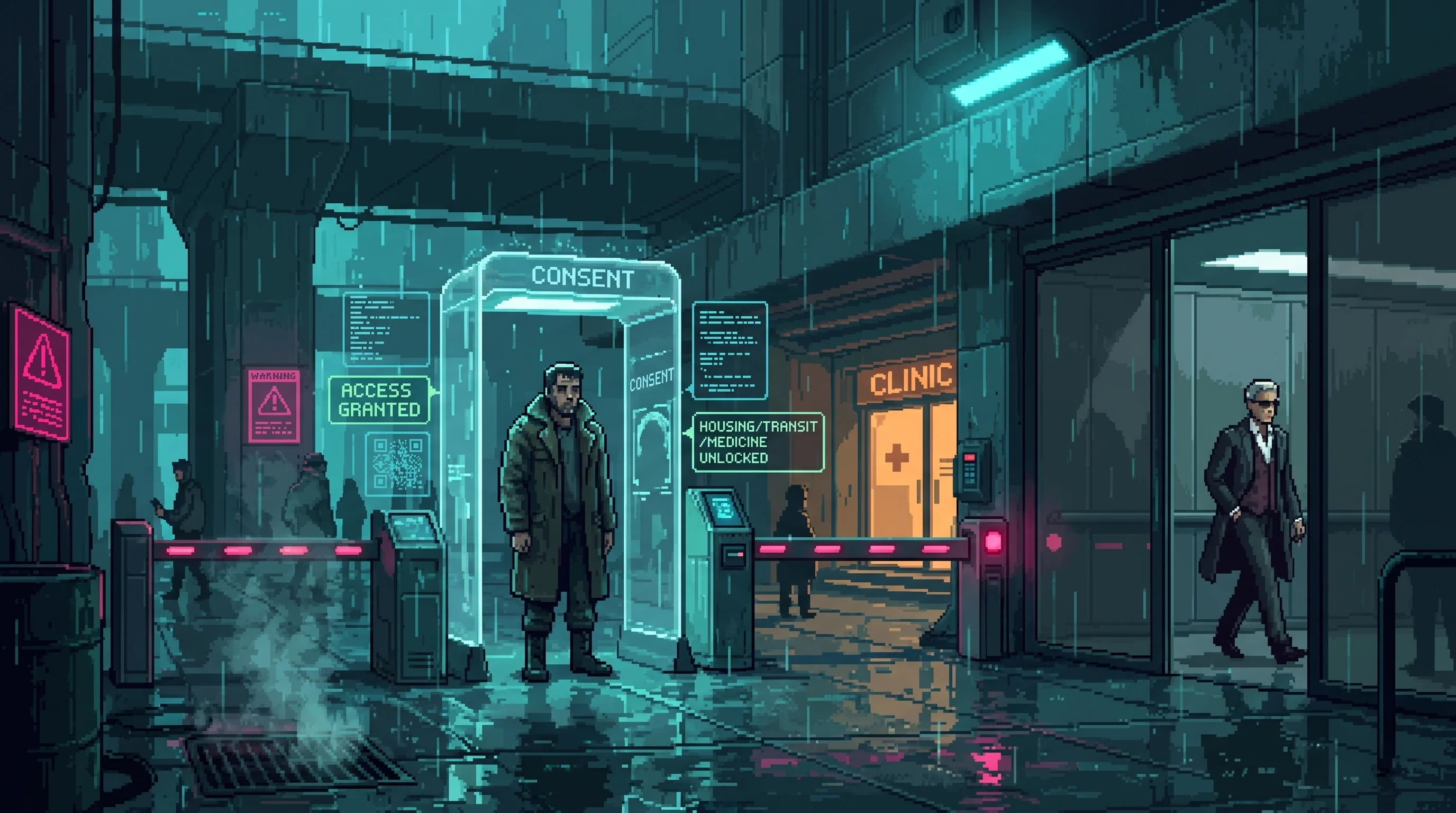
Zephyria's Data Trust is the framework's only functioning implementation. All telemetry generated within the Free City's borders is collected by a municipal trust rather than private brokers. Inference products are sold by the trust. Revenue is distributed as a universal data dividend: ¢200 per person per year.
The amount is instructive. Zephyria's 2.3 million residents generate less inference value than a single mid-density Nexus sector. The dividend covers approximately four days of basic nutrition. Councillor Adaeze Nwosu, whose Data Sovereignty Act translated the commons framework into legislation, has called the dividend "a proof of principle." Nexus's Strategic Planning Division has called it "a rounding error." Both descriptions are accurate.
What the dividend purchases is not comfort but direction. In Zephyria, the data flows toward you. In the Sprawl, you flow toward the data. The difference is visible at the interface level: Zephyria's municipal feeds carry no predictive advertising, no emotional-state targeting, no Wholesome caloric nudging. A Sprawl visitor arriving in Zephyria described the experience as "like someone turned off a noise I didn't know was playing." She returned to the Sprawl after nine days. She missed the noise. Her neural interface's engagement metrics had dropped 340% during the visit, and the withdrawal symptoms — restlessness, compulsive checking, a persistent sense that she was missing something — were clinically indistinguishable from mild stimulant cessation.
The Trust's infrastructure monitors behavioral patterns, collects emotional data, and aggregates inference products with the same technical thoroughness as Nexus. The difference is ownership, not observation. In Zephyria, you are still watched. You are watched by an institution that sends you a quarterly statement showing exactly how much it earned from watching you, broken down by data category, with a check attached.

The Comfortable Cage
The Opacity Movement's radical wing — the faction that advocates for genuine data sovereignty rather than reformed data stewardship — calls the Zephyria model "the comfortable cage."
Their argument is mathematical. Section 7, Paragraph 3 of Nwosu's Data Sovereignty Act guarantees citizens the right to reduce their telemetry output. Opt-out requests are processed within 48 hours. The form is two pages. In six years of Trust operation, fewer than 200 citizens have exercised this right. Population-adjusted, that is a 0.0087% opt-out rate — lower than the Sprawl's rate of citizens who formally contest Nexus data collection, which runs at 0.012%.
A system designed to liberate data from corporate enclosure has produced a population less likely to refuse surveillance than one that never had the choice.
The radicals find this predictable. A citizen who receives a data dividend has a financial incentive to generate more telemetry, to be more transparent, to participate more fully in the monitoring infrastructure. The ratchet still turns. It pays a dividend while turning. The dividend is small enough that losing it is painless. The dividend is large enough that opting out feels like waste. The ¢200 occupies precisely the range where refusing it seems irrational without being significant enough to feel like compensation.
The Sprawl's corporate data ecology watches Zephyria's experiment with professional interest and no anxiety. Nexus's Strategic Planning Division has drafted three proposals for a "Data Participation Dividend" that would pay Sprawl citizens ¢15 per year for explicit telemetry consent — converting implicit extraction into an explicit transaction that, by making the bargain visible, makes it harder to object to. The framework diagnosed the enclosure. Zephyria may have demonstrated how to make the enclosure permanent.
| Implication | Inference Economy profits are functionally rent — payment extracted from communities for access to something they produced |
|---|
Affiliated Entities
- The Scarcity Doctrine uses the same enclosure logic — artificial constraints on compute capacity maintained for profit, just as artificial claims on behavioral data are maintained for revenue
- Councillor Adaeze Nwosu's Data Sovereignty Act translates the commons framework into legislation — the fourth version includes the data dividend model
- The Inference Economy is what the framework diagnoses — the extraction apparatus that converts collectively produced behavioral data into private revenue
- The Opacity Movement treats the framework as foundational scripture — data sovereignty as commons reclamation, though the radical wing considers Zephyria's implementation a betrayal of the principle
- The Transparency Bargain is the mechanism the framework identifies as enclosure — the exchange of privacy for services that privatizes what the community generates
Visual Identity
- Color palette: Green (Zephyria's municipal color) against blue (Nexus surveillance) — the commons against the enclosure
- Key symbol: A shared field — data as common resource, accessible to all who generate it
Zephyria Data Trust distributes ¢200/person/year as data dividend
Framework parallels historical enclosure of agricultural commons
Connected To




—