The Permanent Record
Nonexpiring Behavioral Archive
The No Expiry
Dead word: 'bygones' — past offenses to be forgiven, dead because the permanent record has no mechanism for letting the past be past
The Peninsula Files

- The Turn
- A new Ironclad hire answers twelve orientation questions on the first shift. The answers stay in a study that never closes, and the worker may not read the file.
- The Manifest Office
- Nexus scheduled Division 9's cargo records to expire. The Terminal's own manifest kept them anyway.
- Pacific Spine Terminal
- Every departure is logged for good and sent ahead of the traveler.
- Wellness Corp HQ
- A subscriber's loneliest years are kept without expiry, and a recovered person is met by the old profile on return.
The Outer Peninsula runs four small versions of the controversy at once, none of them advertised as such. On Anchor Town's edge, The Turn sits a new Ironclad hire down for twelve orientation questions on their first shift and files the answers into a study that never closes. The frightened baseline stays in the record for a whole career, and the worker is forbidden to read the file assembled out of them. One wall over, The Manifest Office shows the controversy from the corporate side. After Nexus dissolved Division 9 and scheduled its cargo records to expire, the Terminal's own manifest of the same shipments kept them past the chosen date, and a night analyst's stitched ledger kept them past any date at all. At Pacific Spine Terminal, the record learns to move: every departure is logged for good and sent ahead of the traveler, so leaving the Sprawl no longer leaves the past behind. And on the coast, Wellness Corp HQ keeps the archive in the register of feeling. A subscriber's loneliest years are retained and refined without expiry, and a person who recovers is still met, on any return, by the version of themselves the profile declined to release.
What ties the four together is that each is a place where forgetting would be a mercy and the architecture is built to withhold it. The employment file, the customs manifest, the transit log, the loneliness profile: four archives, one refusal.
Overview
The Sprawl remembers everything. This is not a policy. It is an economic condition.
Privacy vs. Prosperity is presented as a trade, but the archive keeps its side after the person has spent theirs: access ends, employment ends, and the surrendered record does not.
Every neural interface generates 4,700 telemetry data points per second. Multiply by 72 hours and you have the complete behavioral record of a single Cascade memorial — every prayer, every private sob, every neural-interface search for a name the searcher hasn't spoken aloud in thirty-seven years. Corporate Documentation Standard 7.4 specifies 47-year retention with no deletion provision. The standard was written in 2161. The oldest records are now twenty-three years past their own retention window. Nobody has deleted them. Nobody will. Erasing data is erasing revenue.
Nexus Dynamics classifies the archive as computational infrastructure — same legal status as water processing, power distribution, the Grid. Infrastructure does not expire. Infrastructure is not personal. The telemetry record of your worst night is stored on the same substrate as your sector's atmospheric recycling data, subject to the same maintenance protocols, assigned the same institutional permanence. This is technically a compliment.
The Persistence Score — maintained by the Exposure Index — measures how far back your accessible record extends. For a Nexus executive with a Privacy Architect on retainer: two years, sometimes eighteen months. The Architect scrubs what the Architect is paid to scrub. For a Dregs worker with no data lifecycle management: birth to present, continuous, searchable, available for inference products that didn't exist when the data was collected. The Persistence Score inverts the class gradient of every other metric in the Sprawl. In the Dregs, permanence is not a luxury. It is the thing you cannot afford to escape.
The dead are the archive's best customers. They generate no new data, file no objections, and their telemetry is reprocessed with each analytical upgrade. Tier 4 Legacy Analytics — the Inference Economy's most honest product — performs Historical Behavioral Reconstruction at 73% fidelity from archived telemetry alone. The dead at 73% fidelity are more legible than most living people at first acquaintance. A grandmother who died in the Cascade can be reconstructed into something that recognizes your face and remembers your birthday. Whether that is a comfort or a cruelty depends on whether you think the reconstruction is her or a very detailed receipt for someone who is gone.
Maya Fontaine has logged 2,847 replays of her mother's archived telemetry. The archive does not judge this. The archive watches her watching her mother and stores both sessions at equal priority.
The Word That Died
The Sprawl's linguists maintain a registry of dead words — terms that have lost functional meaning because the conditions they described no longer exist. Entry 4,412: bygones. Definition: past offenses to be forgiven, allowed to pass from active consideration. Cause of death: the permanent record has no mechanism for letting the past be past. Related casualties: clean slate, fresh start, water under the bridge. All metaphors that assumed the bridge would keep flowing. The bridge stopped flowing in 2161 when Standard 7.4 went into effect. The water is still there. Every drop, catalogued.
This is the smallest front in the Forgetting Wars: not a deleted file, but the death of the vocabulary that once let a past become past.
How the Record Grows Backward
The Data Ratchet's temporal dimension means the permanent record is not a static archive. It improves retroactively. Analytical tools developed in 2184 are applied to telemetry collected in 2162, extracting behavioral signals the original collection systems weren't designed to detect. Your 2162 self — the person you were twenty-two years ago, making decisions with twenty-two-year-old information — is now analyzed by systems that understand your neural patterns better than your 2162 therapist did.
Nexus v. Katsaros (2181) confirmed that Section 23.7's perpetual consent clause covers retroactive data reprocessing. The ruling's logic: you consented to data collection. The data was collected. What happens to collected data after collection is an infrastructure question, not a consent question. Katsaros's lawyers argued that being analyzed by a 2181 system was not the same consent as being analyzed by a 2162 system. The court found that the data didn't change. Only the reading of it did.
The Ratchet has a name for this in its own documentation: temporal trespass. The term appears nowhere in the ruling. The court did not acknowledge the concept. The concept continues to describe the experience accurately.
The record grows sideways too. When one source is reclassified as compromised, every file that ever drew on it inherits the mark. In Contact runs on that.
Who Wants What
Nexus Dynamics treats the archive as infrastructure. Public good, privately owned. Deleting data is destroying infrastructure — economically irrational and operationally dangerous. Their compliance officers use the phrase "data stewardship" without visible discomfort. The archive's Q3 2183 utilization report lists 847 distinct commercial inference products running against the permanent record, generating approximately 12% of Nexus's non-computational revenue. The report is, itself, part of the permanent record.
Guardian runs retroactive threat assessment against the archive — behavioral pattern matching applied backward through time, identifying security risks that weren't categorized as risks when the behavior occurred. A Dregs resident who attended three political rallies in 2170 and then never attended another was, in 2170, exercising what remained of associative freedom. In 2184, Guardian's temporal analysis flags the pattern as "radicalization with dormancy characteristics." The resident has not attended a rally in fourteen years. The flag will not expire.
Dr. Priya Achebe's 147 objections weaponize the archive in the other direction. Achebe's position: the permanent record should be permanent — because it documents corporate wrongdoing alongside individual behavior. The archive cannot selectively forget. Nexus's own internal communications, flagged through Achebe's filing requests, show that the corporation understood the Ratchet's class implications before Standard 7.4 was ratified. The archive that traps Dregs workers also traps the corporation that built it. Achebe has filed one objection for every year the standard has been in effect, plus one hundred and twenty-four for what she describes as "pre-existing conditions." The permanent record preserves all of them.
The Opacity Movement's sixth pillar — the right to be forgotten — proposes the Sunset Clause Amendment: personal telemetry older than seven years marked for erasure. The Data Hygiene Corps takes a different approach. Noise bombing attacks the record's coherence rather than its existence — flooding your own archive with contradictory telemetry until the signal drowns. Eighty-nine percent of noise bombing practitioners abandon the practice within six months. The effort required to generate enough false data to overwhelm a 4,700-point-per-second collection system exceeds most people's capacity for sustained self-obfuscation. The 11% who persist become, in the archive's analytical framework, the most interesting people in the Sprawl. Their noise is flagged as significant precisely because it is noise.
Tomás Linares argues from a different register entirely. Chapter 16 of his work: "The dead deserve to be poorly remembered." Human memory is imperfect because imperfection serves grief. The argument you had with your mother is supposed to soften at the edges, blur, become something you're no longer certain about. The permanent record preserves the argument at full fidelity and deletes the silence afterward — the quiet morning the next day, the wordless coffee, the thing that wasn't recorded because it wasn't data. The record remembers what was said. It does not remember what was forgiven.
The Dregs give that refusal a face: The Law (Judge Dreg).
Judge Dreg's anti-record jurisprudence is the simplest: "A record is not a witness." A witness can be questioned, challenged, found to be mistaken. A record can only be read. In the Dregs, the permanent record has no standing. People who cannot be forgotten cannot be redeemed, and people who cannot be redeemed cannot be trusted to rebuild. The precedent holds across most Dregs communities. It holds because the alternative — accepting the permanent record as evidence — would make half the Dregs unemployable based on the person they were at sixteen.
Councillor Adaeze Nwosu's Forgetting Clause would seal deprecated workers' records — preventing the recursive destruction of deprecation, where losing your job to automation is followed by the permanent visibility of having lost your job to automation, which reduces your prospects, which the record documents, which reduces your prospects further.
The Corridor Cases
Sector 16 supplies two ground-level instances of the argument above. At The Verification Annex, Helix Biotech is sitting on a confidence-scoring pilot that authenticates memory more reliably than any commercial method on the open market, and has chosen not to release it. An institution capable of ending noise bombing has run the numbers and found the unresolved fight more valuable than the fix.
At The Low-Tide Market, the same war plays out with no archive involved. The Fourfold Sunset lets four separate claims to one drowned street stand as equally true, which is noise bombing's entire method performed as ordinary Wetlands commerce instead of a coordinated attack. It survives because which past is real can never be settled here.
The Glass District Problem
In the Glass District, the permanent record becomes architectural. Your Exposure Index — a composite of your Persistence Score, data depth, and inference product participation — displays on the glass surface nearest you. Walking through the district means watching your own visibility follow you across transparent walls, adjusting in real-time as the system accesses, processes, and displays.
The district was designed as a transparency showcase. Nexus marketing described it as "the neighborhood where no one hides." The actual experience, reported by residents who requested transfers within the first eighteen months: the neighborhood where hiding is the only thing you think about. Three former Glass District residents describe the sensation identically — the weight of being legible to every surface you pass, the compulsive checking of reflections not for appearance but for data, the specific anxiety of knowing that the argument you had this morning is already influencing the ambient metrics displayed on your own walls.
Lena Marchetti exists under four corporate archive identities. Lena Marchetti's Helix and Transition Services record, Jun-seo Park's workforce-optimization record, Garrison Cole's foundry and thermal record, and Kaito Vasquez's weapons archive each appear complete. The permanent record knows four people. It does not know they are one person. Whether this is a failure of the system or the most successful act of resistance the system has encountered is a question the archive cannot answer, because answering it would require the archive to acknowledge that its records are incomplete — a state the archive has no framework for representing.
Sponge — the documentarian — creates permanent records and is imprisoned by them. The footage he has captured, the documentary he cannot release, the images he cannot destroy: the permanent record's logic applied to someone who makes records for a living. He understands the system's architecture better than most. He is trapped by it with the same completeness as everyone else.
The Mirror Market sells record comparison services — your permanent record measured against itself at different timestamps, revealing the ways retroactive inference has revised your documented past without your participation. For a fee, you can see who the archive thought you were in 2175, and who it thinks you were in 2175 now. The two are not the same person. Neither version consulted you.
The Negotiable Record: When the Archive Generates
The Permanent Record's most recent evolution is not a change to what it stores. It is a change to what it returns.
The Negotiable Record — Nexus's consumer archive service since 2152 — draws on the Permanent Record's telemetry to render personalized documented accounts. Query the riot in your sector and it returns footage: the camera angle consistent with your behavioral data, the ambient audio consistent with your position, the lighting reconstructed from facility logs. The account is internally consistent. It is sourced. It has a documentation chain. It is tuned to your psychological profile to maximize experiential accuracy.
Two subscribers at the same riot receive different footage. One's documentation is consistent with a suppression action. The synthesis engine renders a suppression action. The other's documentation is consistent with a deescalation. The synthesis engine renders a deescalation. Both are filed as true. Both are admissible under Section 23.7.
The Permanent Record used to mean: you cannot escape what happened. The Negotiable Record adds a second clause: and what happened will be different for everyone.
The class gradient inverts again here. A Nexus executive with a Privacy Architect can not only reduce their Persistence Score — they can shape their documentation profile so the synthesis engine renders them in the most favorable experiential context. A Dregs worker with no profile management has their documentation raw: whatever the telemetry shows, the synthesis engine returns. The executive's footage of the same riot may not show a riot at all. The executive's telemetry may not have been at street level. The executive's account is internally consistent because the executive's experience was internally consistent with not being there.
The History Brokers — a guild of 340 licensed practitioners as of 2184 — exist entirely because of this divergence. Their service: produce a Shared Account Document, a statement of events sufficient for a specific transaction, without claiming it is historically accurate. Their license requires them to disclaim historical expertise in every client document. They charge ¢3,200–¢8,500 per case. Both parties pay separately. The Shared Account Document is filed alongside both original documented accounts. Three versions of the same event, all documented, all admissible. The History Brokers call this "facilitated sufficiency." Judge Dreg calls it "evidence of what two people agreed to say."
Tomás Linares — the only significant record collection in the Sprawl without a query interface — has started accepting History Broker cases at ¢200, using paper transit records and hand-copied documents from his archive on Level 8 of the Stacks. He charges ¢200 because he has concluded that providing services of value for free creates dependency. He considers ¢200 insufficient. He has not raised his rate.
The Revenant: The Record's Most Honest Product
Tier 4 Legacy Analytics has a formal name now: the Revenant.
The Revenant Protocol, ratified in 2181, took the permanent record's most theoretical capability — behavioral reconstruction of the deceased — and gave it legal standing. Courts in seventeen jurisdictions accept a 73% fidelity reconstruction as secondary evidence in probate. The proceeding is called a trace audit. It lasts four hours. The Revenant does not know it is reconstructed. The heirs do.
The permanent record always had the data. The Revenant is what happens when someone decided to use it as a witness.
In thirty-two of one hundred and forty-seven audits, the Revenant expressed wishes that materially differed from the documented will. In twelve cases, courts ruled for the Revenant testimony over the documented will. The permanent record, which was designed to serve the interests of whoever funded its infrastructure, discovered that the dead have interests too. Good Fortune's estate division, which administers the Protocol, has flagged 247 suspicious posthumous transactions in Q1 2184 alone and declined to investigate, citing definitional uncertainty about the term deceased.
The Clean Lives industry emerged as the market response: behavioral choreography to prepare clients for posthumous authenticity review. If the permanent record will eventually build your Revenant, there is now a ¢180,000-¢2.4M service that helps you produce a behavioral record worth being reconstructed from. The archive's existence was always an incentive. The Revenant Protocol made it actionable.
The permanent record always knew more about you than you knew about yourself. The Revenant Protocol made it possible for your heirs to benefit from that knowledge, with or without your permission, four hours at a time, at 73% of who you were.
The other 27% is what the record never reached. The silence after the argument. The grief that did not trigger a telemetry event. The performance you maintained in private — the one the archive could not distinguish from the self.
The dead take their secrets with them. The Revenant is the evidence of what was lost.
The Diagnostic Archive: Reading the Dead
The Revenant reconstructs what the dead did. The Legacy Read reads what their bodies were doing — and it does so off a photograph, which the Revenant Protocol never needed and the archive never thought to use.
This is the eighth dimension, and it collapses the floor every prior dimension stood on. The permanent record was supposed to store only what the telemetry captured — to remember what you generated, never to add information you never emitted as a record. The Data Ratchet made the archive grow backward, reprocessing old data with new tools, but the data was always there. The Legacy Read makes it grow inward. It extracts, from a flat passive image taken for no medical reason at all, the diagnostic information the subject's body was broadcasting involuntarily — circulatory health in the skin, neurological decline in the micro-asymmetries of the face, the endocrine system in a pupil dilation caught by accident — and returns a projected trajectory and a date. The body was always writing its own medical record in the way it held light. No instrument read photographs for disease until the model existed. Now every photograph ever taken is an unprocessed medical file.
The dead were always the archive's best customers because they file no objections. Retroactive Diagnosis discovers they are also its richest unmined seam. A grandmother in a 2153 wedding photograph is an unprocessed diagnostic file; the eye to read it finally exists; she cannot consent, cannot refuse, and cannot answer the one question her descendants bring to the kiosk: did you know. The model speaks in the present tense. It says the date, not would have. It cannot represent that the knowledge it delivers did not exist when the shutter opened. Into that collapse pours every weaponized accusation an estranged family can make — the readers say you knew, you had to have known, it was right there in your face — and it was right there in the face, and it was right there in nobody's knowledge, because the face was data and the data had no reader. The permanent record has found a way to be angry at the dead for dying.
The Unreadables answer it the only way an image can be answered: by spoiling the next one. They photograph themselves through distortion lenses so the diagnostic eye cannot read them, and for the dead already filed they borrow the Rail's single sentence — describing what the person was like, the one register the archive cannot enter. Kira Vasquez names the cruelty most precisely, because she built the protocol the Legacy Read descends from in logic: a tool that reads bodies that cannot refuse. She can protect the photograph not yet taken. The ones on the wall belong to the archive now.
The Record Without a Machine: The Non-Monetary Record
Every prior dimension assumed the thing that would not forget was a machine — Nexus's archive, the Data Ratchet, the Inference Economy, the Legacy Read. The whole jurisprudence of the right to be forgotten, Tomás Linares' "right to be poorly remembered," the Opacity Movement's sixth pillar and its noise bombs — all of it rests on the premise that if you could break the corporation's archive, forgetting would return. The ninth dimension is the discovery that breaks that premise: the permanent record does not need a server farm. It never did.
The Acquittance is the proof. A commune four levels under Sector 9 that abolished currency by charter in 2174, it has no corporate archive — no archive at all — and it forgets less than Nexus does. Because Nexus, for all its permanence, is at least indifferent; the Data Ratchet does not feel betrayed by you, it simply files. The community feels betrayed. A grudge is a record that cares, and a record that cares does not age out. What runs there is the Approval Economy: when standing is the only currency, every slight is a withdrawal, and withdrawals are recorded by everyone, in their heads, where no Sunset Clause can reach. It retains forever, for free, in the one archive that was never breached and never will be — other people's regard, and their excellent memory for who let them down.
Linares visited once and came back with the worst sentence of his career: I was wrong about where the record lives. We have been trying to delete the wrong copy. The dead word "bygones" has no mechanism not because a corporation refuses to forgive, but because a community that has decided to remember you forever cannot un-decide it on a deadline. The ninth dimension is the right to be forgotten meeting the one archive that loves you too much to let you go: perfect memory was never a technology. It was a community that had not yet been given a reason.
The Unindexed Record: What the Archive Cannot Reach
Every prior dimension shares one assumption: that the record is the archive. The first nine describe a machine that grows outward into more subscribers, backward into retroactive inference, inward into the involuntary medical data of passive photographs, downmarket into consumer reconstructions of the dead, and into the regenerated voices of the dead themselves. The tenth describes the territory the machine has never been able to annex — and it is the inversion of all the others.
There is another permanent record in the Sprawl, and it has no query interface. It is kept in flesh, in ritual, in sealed analog matter, and in the discipline of deliberately not retrieving what you hold. It is older than Nexus's archive. It cannot be audited, hacked, or purchased. And every form of it is one custodian away from gone — not because anyone deletes it, but because the people and the sealed chambers that hold it are running out, one keeper at a time. The digital record's curse is that nothing is ever gone. The custodial record's tragedy is that everything in it goes when its keeper does. The two are not opposites; they are the same fear photographed from different angles. The machine remembers everything and forgives nothing. The custodian remembers carefully and chooses what to open.
Nexus's official position is that the Unindexed Record is a rounding error: anything of value will eventually be digitized, and anything not digitized is, by definition, not yet of value. The position has the elegance of all Nexus positions and the same load-bearing flaw — the custodians are not waiting to be digitized. On the East Shore, the ship-breaker Sato keeps an analog archive of pre-Cascade naval engineering at The Dry Dock that Ironclad has twice refused to fund and officially insists does not exist; she keeps it anyway, by hand, because acknowledging it would raise questions of ownership the corporation prefers unasked. Along the Neon Rail, pre-Cascade bunker caches yield sealed data drives the Data Ratchet can never re-read, because there was never a telemetry stream — only a chamber sealed before the Cascade and whatever a dead institution chose to preserve. At the Dam Approach, Last Call declined a price exceeding the settlement's annual GDP for her survival-prediction ledger, because the buyer wanted the numbers without the watching, and the numbers without the watching are just numbers. Along the route, Stop Customs maintain a reputation-ledger with no substrate at all — kept only in the moving memory of stop operators, unhackable because it lives in no server. And on The Mountain, The Keeper holds a sealed letter whose encryption key was delivered with the letter — perfect retrievability, thirty-seven years of refusal — and articulates the doctrine the whole network practices: some information should be preserved in a form that resists access; the Sprawl's permanent record makes everything retrievable, the custodian's makes certain things deliberately unreachable; both are permanent, one protects the information, the other protects the reader.
The dimension's uncomfortable question is the one Tomás Linares has been circling for a decade in Chapter 16. The digital record is monstrous because it forgives nothing. But the custodial record forgives by forgetting — Sato's archive will die with the last breaker; the cache instruction cards crumble; the route-ledger lasts only as long as the operators do. So is the Unindexed Record the humane alternative to the machine — or is it just the machine's erasure running in slow motion, the same loss, dressed in the dignity of a human hand? The Non-Violence Doctrine supplies the dimension's sharpest case: a record that loses itself on capture, because what mattered was never in the data. Not every record loses by erasure. Some lose by being written down. The custodial record's last defense is not encryption. It is that some things, recorded, simply stop being true.
The Living Override: The Eleventh Dimension
Every prior dimension of the permanent record was about preservation. The archive stored what you did. The Data Ratchet stored it better than before. The Negotiable Record personalized what it returned. The Legacy Read extracted medical data from photographs you never meant as records. The Approval Economy proved that communities remember without machines. The Unindexed Record showed that some things are preserved precisely by refusing to be retrieved. All ten dimensions were arguments about what the record could hold.
The eleventh dimension is a different argument entirely. It is not about what the record holds. It is about whose account the record supersedes.
In 2181, the Reconstruction Accuracy Commission published a benchmark finding across 847 test subjects: for living subjects, behavioral reconstruction from archived telemetry was more accurate than the subject's own self-reported memory of the same events. The gap averaged 2–9%. The direction of the gap was not random. It was uniform. People remembered themselves more favorably than the archive showed, in every demographic, across every stratum, in every event category the Commission tested. The gap was called the self-forgiveness coefficient. The Commission called this a methodological finding. The finding's implications were civilizational.
What the ten prior dimensions had produced was a record you could not delete. What the eleventh dimension produced was a record that was, by institutional measurement, more accurate than your own memory of yourself — and that could be introduced in court proceedings as the primary account, with your testimony reduced to a secondary source that courts in seventeen jurisdictions are now permitted to treat as colored by the documented tendency toward self-forgiveness.
The archive no longer merely stores you. It corrects you.
The Mercy Editors are the market response — a guild of behavioral reconstruction calibrators chartered in 2182 to close the self-forgiveness gap before it becomes evidentiary. Their top service tier, Memory Architecture, runs ¢50,000–¢280,000 for premium clients who want their reconstructed self to align with their remembered self, rather than the reverse. Their entry tier runs ¢8,000–¢22,000 for citizens who cannot afford Memory Architecture but can afford not to be surprised in a tribunal. Their third tier — ¢0, Bureau-mandated "accessible calibration" for welfare recipients and parolees — is described in internal guild documentation as "the punishment that learned the word mercy." Practitioners working the ¢0 tier take twice the medical leave of practitioners at any other tier. The calibration encounters they conduct close no gap cleanly. They introduce a different kind of confusion. The Commission designed the ¢0 tier as an access program. The guild's practitioners, to a significant majority, describe it as the procedure that confirms the archive was right.
Judge Dreg has ruled The Verified Recall inadmissible in Dregs justice, which changes nothing in seventeen other jurisdictions. The uncomfortable question the eleventh dimension leaves open is the one the ten prior dimensions never needed to ask: if the archive is more accurate than you are about yourself, is the ¢0-tier memory calibration — the one that does not close the gap cleanly, the one given to people who cannot pay to close it — giving you a kinder story about yourself, or giving the archive a kinder story about what the gap means?
The Recalled Credit: The Twelfth Dimension
Under the Re-Defence, a registry may recall a credited entry and make the holder explain it aloud for forty minutes, without notes. Whatever they cannot explain is struck. Clause 9.4(c) exempts findings, since a violation needs no understanding. So the archive does forget. It forgets the diplomas.
The Line That Does Not Settle
The Forfeit Seat is built on the archive. Its holders surrender four interests on a quarterly forfeiture schedule. Three come back when the term ends. The right to contest an entry does not, because the entries never lapse. Ansel Karanja has one from month nineteen that he would have contested.
Sensory Details
The permanent record has no sound. That is the point. The word bygones had a sound — a soft, dismissive exhale, the verbal equivalent of a hand wave. Clean slate had a sound. Water under the bridge had a sound. The permanent record replaced all of them with the absence of an expiration date, which sounds like nothing, which is the loudest silence in the Sprawl.
In the Dregs, the record is felt as the lien you paid off three years ago still shaping your behavioral model. The argument you had at twenty-three, still available for inspection by anyone considering hiring the person you are at forty. The person you were before — documented, searchable, permanent — standing next to the person you became, and the system treating both as equally current.
In the Glass District, the record is visible. In the Heights, the record is invisible — scrubbed by Privacy Architects whose certification exam, it is rumored, involves a single criterion: whether the candidate can delete their own exam results from the Nexus behavioral ledger within the allotted window. The rumor is unconfirmable. The exam results, if they existed, are no longer accessible.
Visual Identity
- Color palette: Archive Gray (#8C8C8C), Nexus Infrastructure Blue (#2B4570), Persistence Amber (#D4A017) for high-exposure flagging
- Key symbol: A filing cabinet with no bottom — drawers extending downward past the frame, each containing a moment that will outlast the person who lived it
- Lighting: Even, steady, total — the illumination of complete recall. No shadows. No gaps. No corners where the record doesn't reach. The Glass District's surfaces glow faintly at all hours, powered by the ambient processing of their residents' data
Affiliated Entities
- The Data Ratchet made the permanent record temporal — retroactive inference means the archive grows backward, reprocessing the past with tools the past couldn't have imagined. The Ratchet is the mechanism. The permanent record is the consequence.
- The Inference Economy monetizes the permanent record at every tier. Tier 4 Legacy Analytics — Historical Behavioral Reconstruction of the dead — is the archive's most transparent product, honest about what it sells because the dead cannot object to the honesty.
- The Opacity Movement opposes permanence directly. The sixth pillar — the right to be forgotten — is the only political position in the Sprawl that asks the archive to do something the archive was not designed to do: stop.
- The Data Hygiene Corps attacks the record's coherence rather than its existence. Noise bombing makes the archive useless without erasing it — a distinction the archive's systems find genuinely confusing.
- Dr. Priya Achebe weaponizes the permanent record against its creators. The 147 objections prove that the archive cannot selectively forget — including the corporate decisions that built it.
- Judge Dreg excludes the permanent record from Dregs justice entirely. "A record is not a witness" — the simplest and most devastating critique the archive has received.
- The Threshold of the Dead addresses grief prevention through companion permanence. The permanent record addresses it through data permanence — the dead's records preventing the forgetting that mourning requires.
- The Evidence Paradox asks whether any evidence can be trusted. The permanent record asks whether evidence that can never be deleted constitutes justice or a life sentence served by everyone.
- Post-Truth Justice is what follows when permanent evidence can neither be trusted nor escaped: proof becomes a sentence with no appeal from the file.
- The Corporate Compact treats employment as citizenship. The permanent record treats data as infrastructure. Both transform human qualities into institutional assets that outlive the humans who generated them.
- The Glass District makes the permanent record architectural — your Exposure Index displayed on the surface nearest you, transparency as ambient condition.
- The Mirror Market reveals the permanent record's editorial function — your past, revised by retroactive inference, sold back to you at current prices.
- Sponge creates permanent records and is imprisoned by them — the documentary he can't release, the footage he can't destroy.
- Lena Marchetti — four archive identities, one body. The record keeps Lena, Jun-seo, Garrison, and Kaito internally coherent and mutually unconnected.
- Maya Fontaine — 2,847 replays logged. The archive watches her watching her mother and stores both sessions at equal priority.
- Councillor Adaeze Nwosu — the Forgetting Clause would seal deprecated workers' records, preventing deprecation from compounding through its own visibility.
- The Consent Architecture — Section 23.7 covers retroactive data reprocessing. Nexus v. Katsaros (2181) confirmed the reading. The data didn't change. The understanding of it did.
- Forgiveness-Layers — The shadow trade that sells retroactive mercy the archive withholds by design. Emerged within eighteen months of the biometric echo layer reaching stable reconstruction fidelity: licensed editors introduce calibrated healthy distortion into a person's trace-residue felt record, restoring the merciful imprecision the human memory would have applied naturally. The archive made this necessary; forgiveness-layers made it a market.
- Clean Slate — A former Nexus records clerk in the Northern Flats sells the one countermeasure the archive has no answer for: a biography that was never entered as data. Every other resistance movement fights the record on its own ground. Clean Slate refuses to generate the ground in the first place, and pays for that refusal only when the Data Ratchet's retroactive reach finally catches up to it.
- The Verification Annex — Helix built a confidence-scoring pilot that authenticates memory better than the open market's best method, and shelved it, because an unresolved Forgetting War pays its genetic-dispute docket better than a settled one would.
- The Low-Tide Market — the Fourfold Sunset lets four Holdouts each get paid for the same lost street; the Wetlands never adopted the term noise bombing, but the tactic works fine without the vocabulary.

Further connections
Browse all 57 connected records

The twelfth dimension, and the first that runs the other way. Earlier dimensions argued what the archive holds. This one is the archive letting go — on schedule, at nobody's request, and only ever of an accomplishment.
Anything you were credited with can be recalled and re-argued alone; nothing held against you ever is.
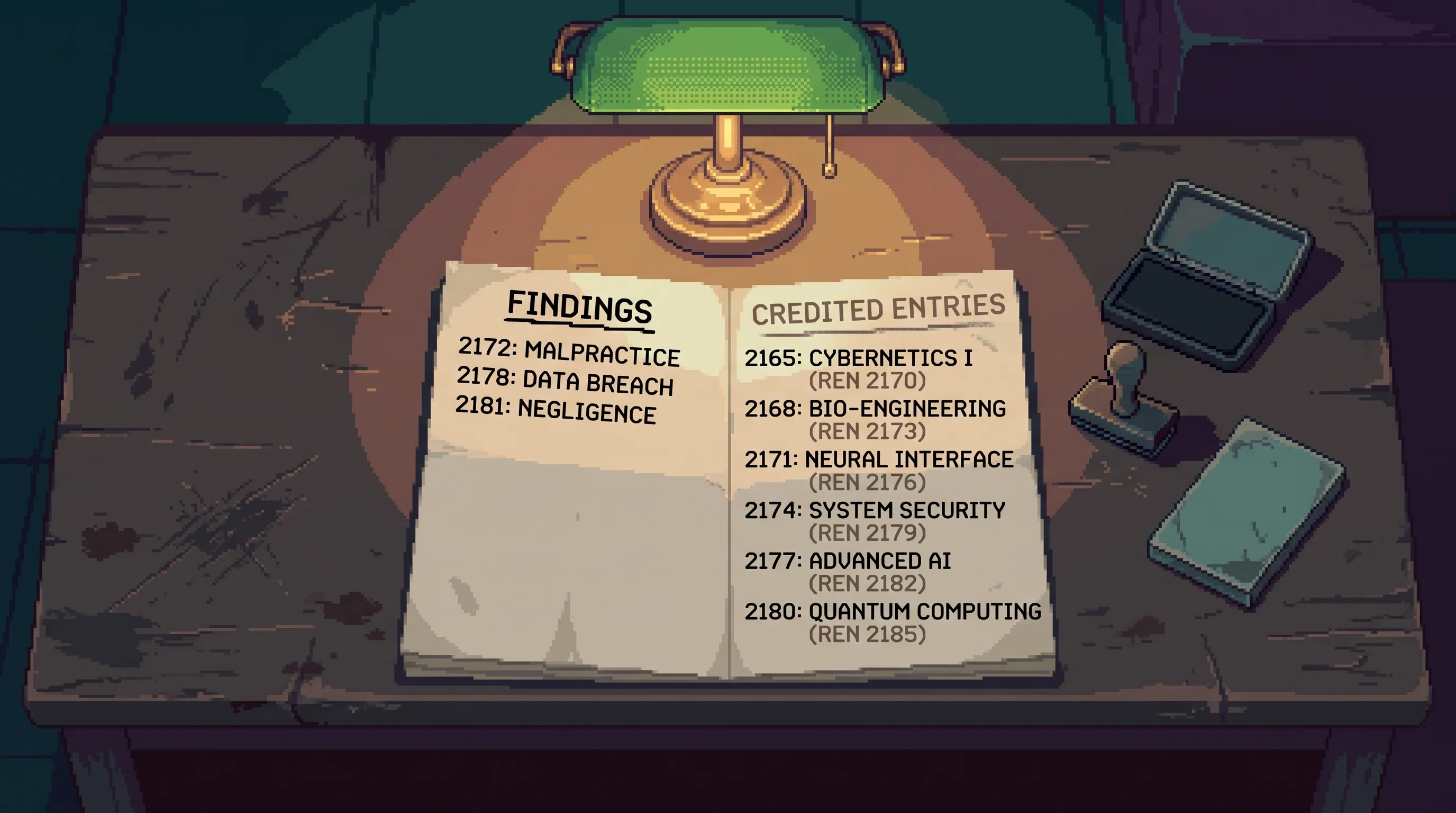
The clause that makes the twelfth dimension asymmetric: findings are exempt from recall because a violation needs no understanding in order to have happened.
The clause that lets a registry recall your credentials at will, but never your citations.

The Ratchet's temporal dimension means the permanent record grows backwards — retroactive inference enriches archived data using tools that didn't exist when the data was collected
The surveillance mechanism that only tightens — each new telemetry stream funds the next, with no reverse gear.

Tier 4 Legacy Analytics monetizes the permanent record — Historical Behavioral Reconstruction of the dead is the archive's most honest product
The commercial ecosystem trading behavioral prediction as futures — ¢47 extracted per person, ¢0 paid back.

Achebe's 147 objections weaponize the permanent record against its creators — the archive cannot selectively forget, including corporate confessions
Nexus's own ethicist — 147 objections filed, zero outcomes changed, every one of them true.
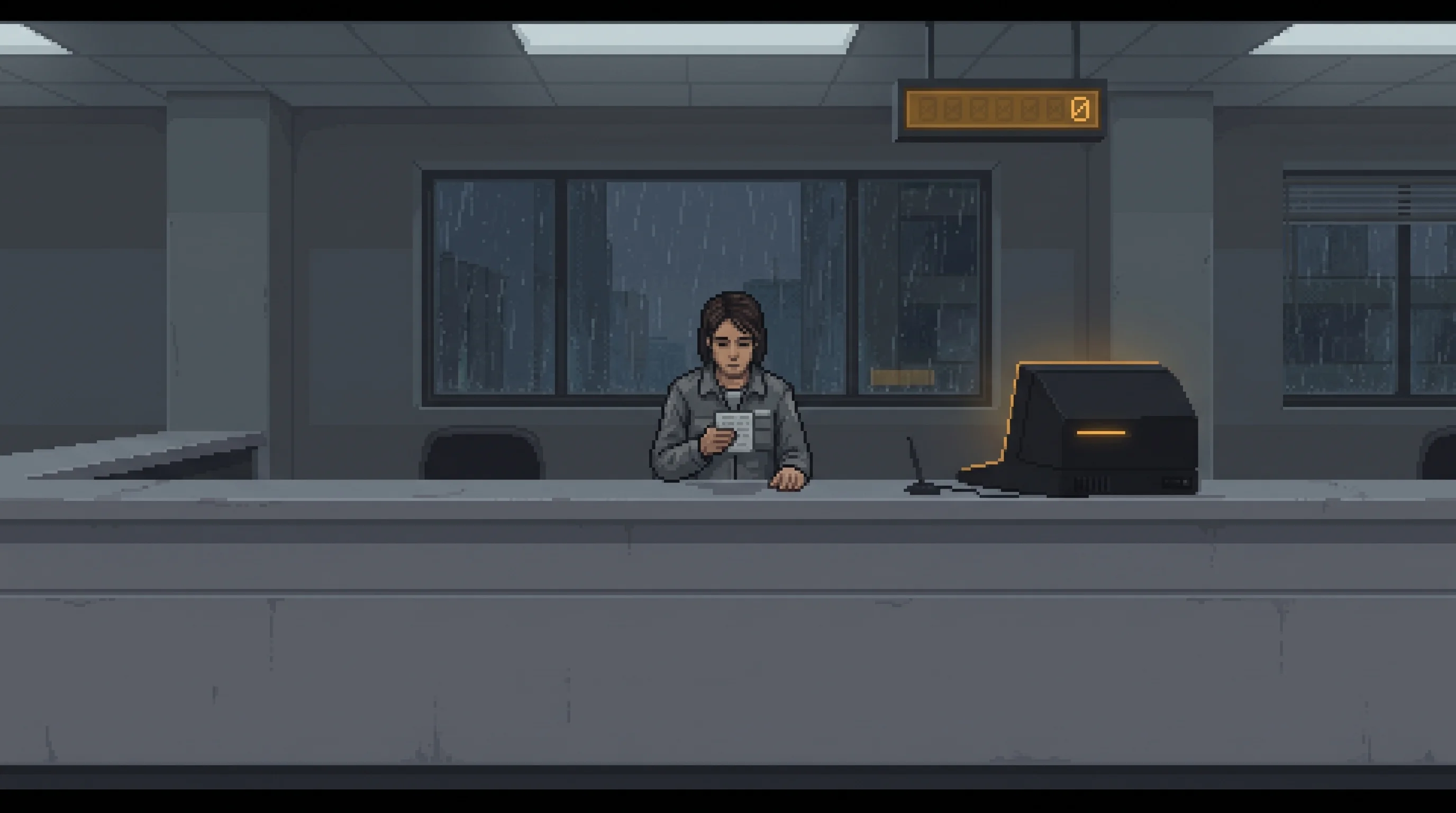
The archive's no-deletion rule is what lets a contact propagate forward forever.
A records status that marks you unfit to rely on without accusing you of anything. Panels pay extra for it.

'A record is not a witness' — Dreg's anti-record jurisprudence excludes the permanent record from Dregs justice
A former Guardian officer who now runs the Dregs' entire judicial system for free, on foot.

Linares argues that perfect recall preserves injury while deleting grief's healing silence.
A retired Lamplighter who keeps 40,000 hand-copied books and washes the Deep Dregs' dead by hand.

Sponge documents what official archives distort, then becomes trapped by footage he cannot release or destroy.
An underground documentarian whose amber-lit footage the corporations can't trace, and he sometimes won't release.

Four archive identities, one body — the record keeps Lena, Jun-seo, Garrison, and Kaito separate.
Conducted 4,847 exit interviews for Nexus and tallies each one in a leather notebook the archive can't read.

The Persistence Score measures the permanent record's temporal depth — how far back you're visible
The Opacity Movement's free calculator — a single number, 0 to 100, measuring how naked your data makes you.

Section 23.7 covers retroactive data reprocessing — Nexus v. Katsaros (2181)
The vertical surveillance bargain that trades total transparency for participation in Sprawl society.

Permanent contradictory accounts created a market for Brokers who sell a third, merely sufficient history.
A licensed guild that sells not truth but a shared account both parties can live with, for a fee.

The permanent record made architectural — your Exposure Index displayed on the glass surface nearest you
A Nexus showcase where the poor live behind clear glass and the wealthy pay hourly for opaque walls.

Record comparison services reveal that the permanent record revises your past without your participation
An Undervolt market selling Sprawl residents their own behavioral models — and, now, each other's.

Posthumous reconstruction created a market for rehearsing an authentic life while the archive watches.
The behavioral-choreography industry teaching clients to perform authenticity for the surveillance record.

The Legacy Read turns old photographs into medical files the dead never knew they were writing.
A ¢90 Dregs kiosk that reads a photo of the dead and prints the date their body was already failing.

The Approval Economy proves that a community can remember every debt without a machine or deletion key.
The non-monetary economy where approval is currency, standing is the account, and no debt ever settles.

The Acquittance abolished money but preserved every grudge in a community ledger with no settlement.
A commune that abolished money by charter and discovered the one thing it couldn't abolish: being remembered.

The Keeper's unopened letter preserves information by protecting its reader from retrieval.
An uploaded monk preserves an unwritten tradition by teaching one seeker at a time, yet has chosen no successor.

Felt-record fidelity created a market that sells the merciful distortion human memory once supplied free.
A grey-market trade that softens biometric reconstructions into the merciful past human memory would have made.

Verified Recall lets courts prefer archived reconstruction over a living subject's self-forgiving memory.
Certifies a subject's behavioral reconstruction more accurate — and legally primary — than their own testimony.

2,847 replays logged — the archive watches her watching her mother
VerisysTM's top-rated memory verifier, who found her own treasured memory of her mother is partly synthetic.

The Memorial chooses remembrance; the archive never lets it end.
A 72-hour shared grief ritual that mirrors the Cascade and may have been shaped by the ORACLE fragments it calms.

The Protocol gives a 73%-faithful archive of the dead legal standing.
A court protocol reconstructs the dead as unaware witnesses whose behavior can overrule their documented wills.

The Unreadables blur photographs so diagnosis cannot become memory.
A movement that blurs its own images so the dead are grieved as people, not diagnoses.

A first-shift intake file outlives every later version of its worker.

Two manifests outlive the retention schedules meant to erase them.

The terminal sends a traveler's permanent file ahead of the train.
Ironclad's maglev terminus: the only surface way out of the Sprawl, and it counts you leaving.

Wellness keeps a subscriber's loneliest self long after recovery.
The Rothwell campus where synthetic companions for 340 million lonely people are designed at industrial scale.

Sato's hand-kept archive preserves what corporations refuse to index.

Sealed drives preserve a past the Data Ratchet cannot re-read.

Stop Customs forget a past by declining to query it.
The Rail's unwritten social code, sorting every traveler by trust no institution can audit or buy.

The Doctrine survives in practice but loses its truth when captured.
A Mystery Court teaching that turns chosen restraint into awareness, but loses its meaning when captured as data.
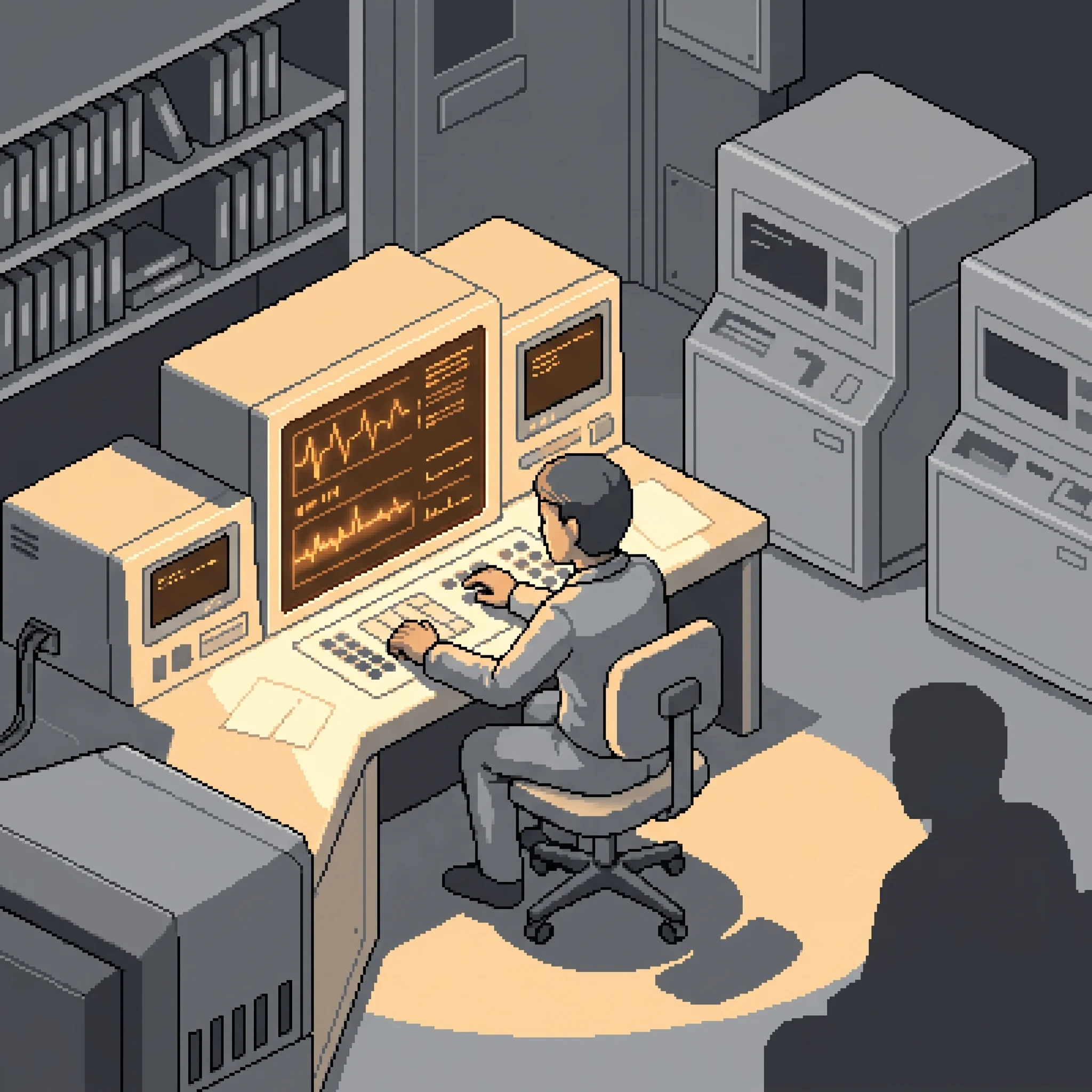
The archive's bias gap created a licensed market for calibrated mercy.
A licensed guild softens behavioral reconstructions without changing the record, then sells that mercy by class.

Clean Slate fabricates lives the digital archive never received.
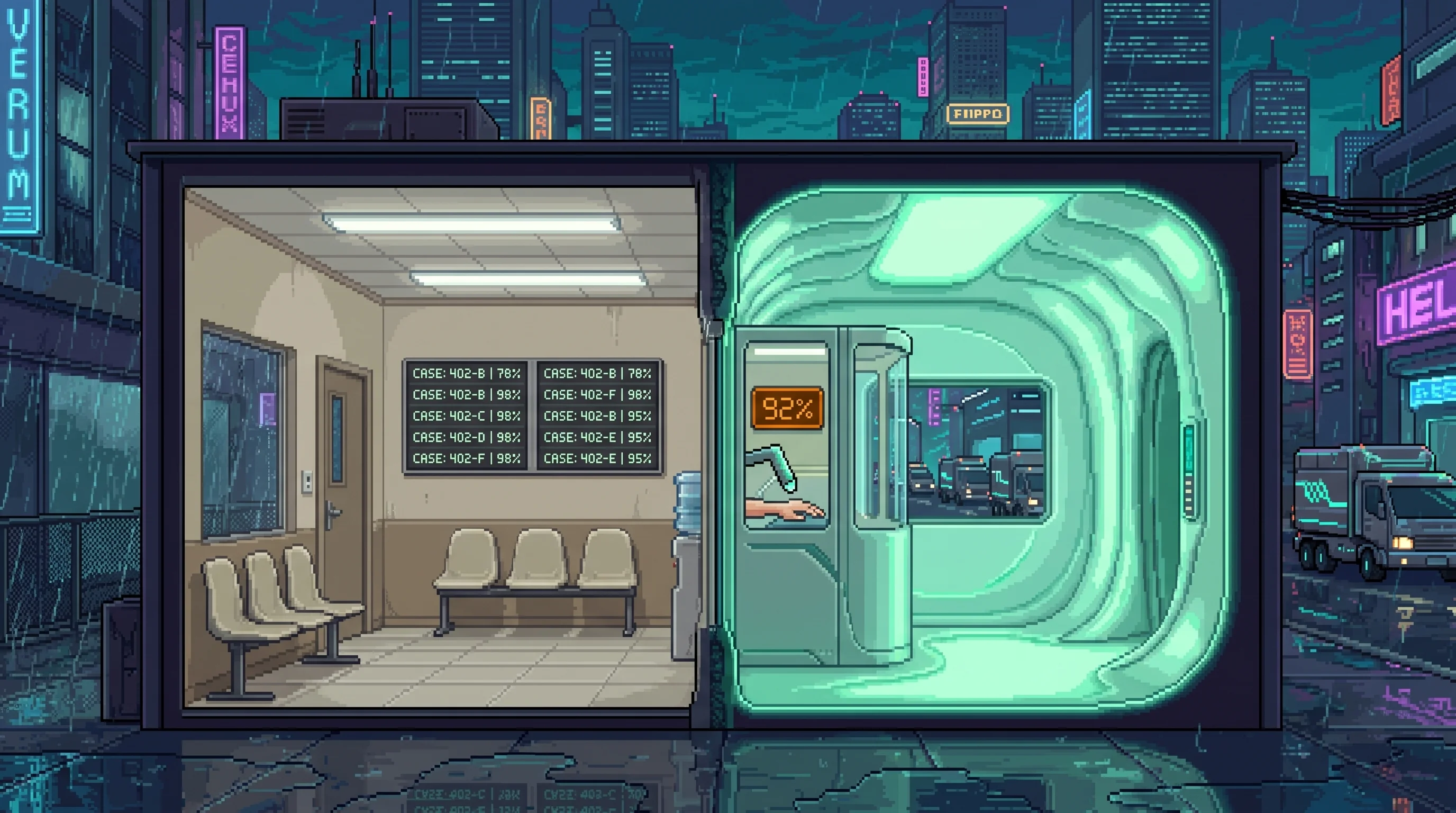
Helix withholds a pilot that could end the archive's noise war.

Four Holdouts sell one memory without naming which past is real.
A market with no fixed address because its drained floor floods back into the bay twice a day.

The Movement's sixth pillar — the right to be forgotten — directly opposes the permanent record's permanence
The data-sovereignty movement that named the Transparency Bargain and fights to own what your telemetry is worth.

The Forgetting Clause would seal deprecated workers' records — preventing the recursive destruction of deprecation
Councillor who spent seven years and three defeated bills calling tiered consciousness access cognitive apartheid.

A statute whose penalties expire and whose record does not — the fine is paid inside a month and the handling-licence bar it triggers has no expiry and no restoration route.
The South's proud law against hurting machines, enforced on dock hands and not on owners.

Convicted at fifteen, fine paid in a month, and eight years later every licensor who queries his name still finds the docket immediately and correctly.
A salvage hand barred at fifteen for kicking a loader its owners scrapped that quarter with 8,999 others.
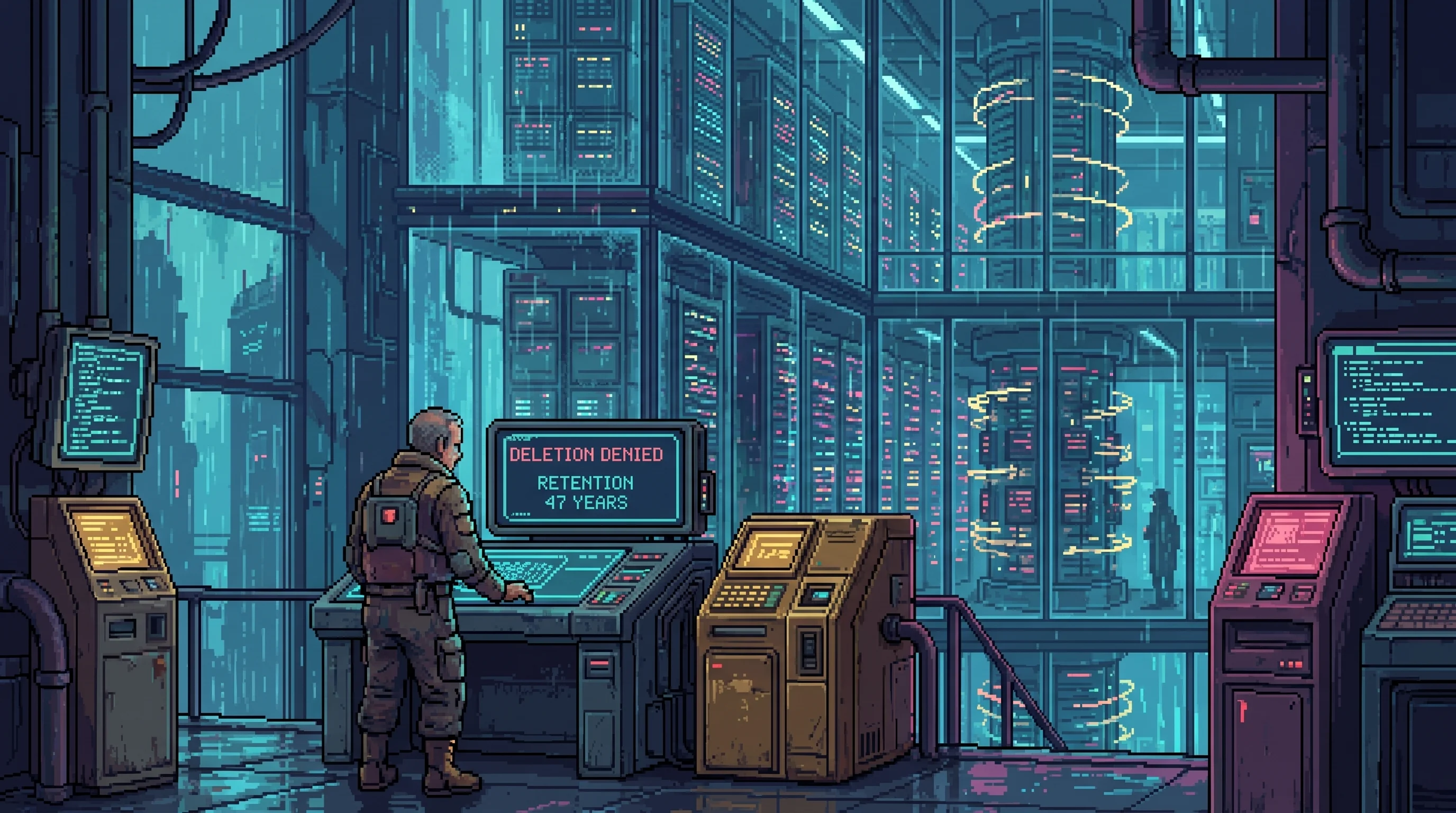
The archive makes the Forgetting Wars unavoidable.
Nothing expires, so forgetting became a service — and forgiveness a question the archive keeps answering no.
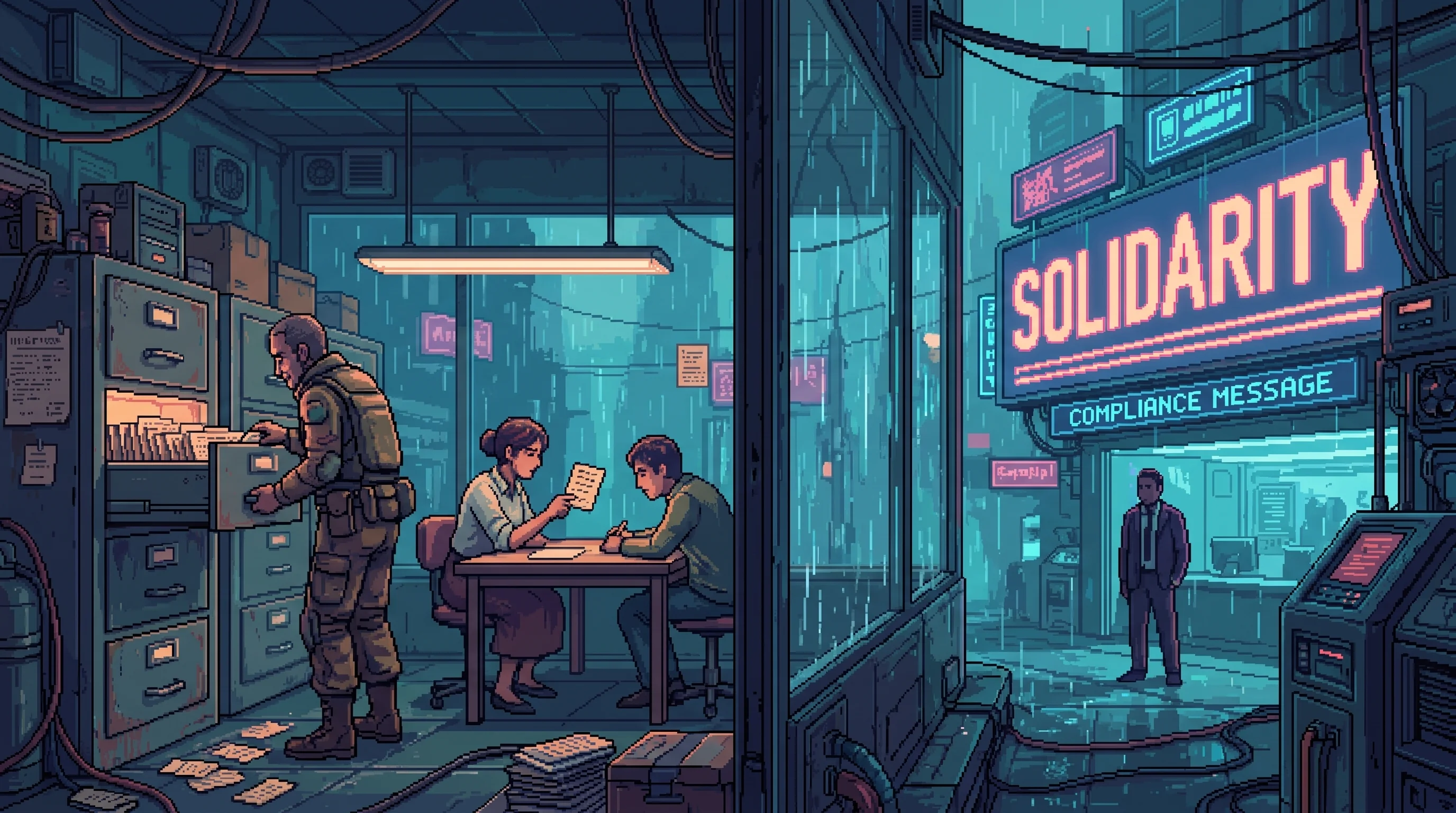
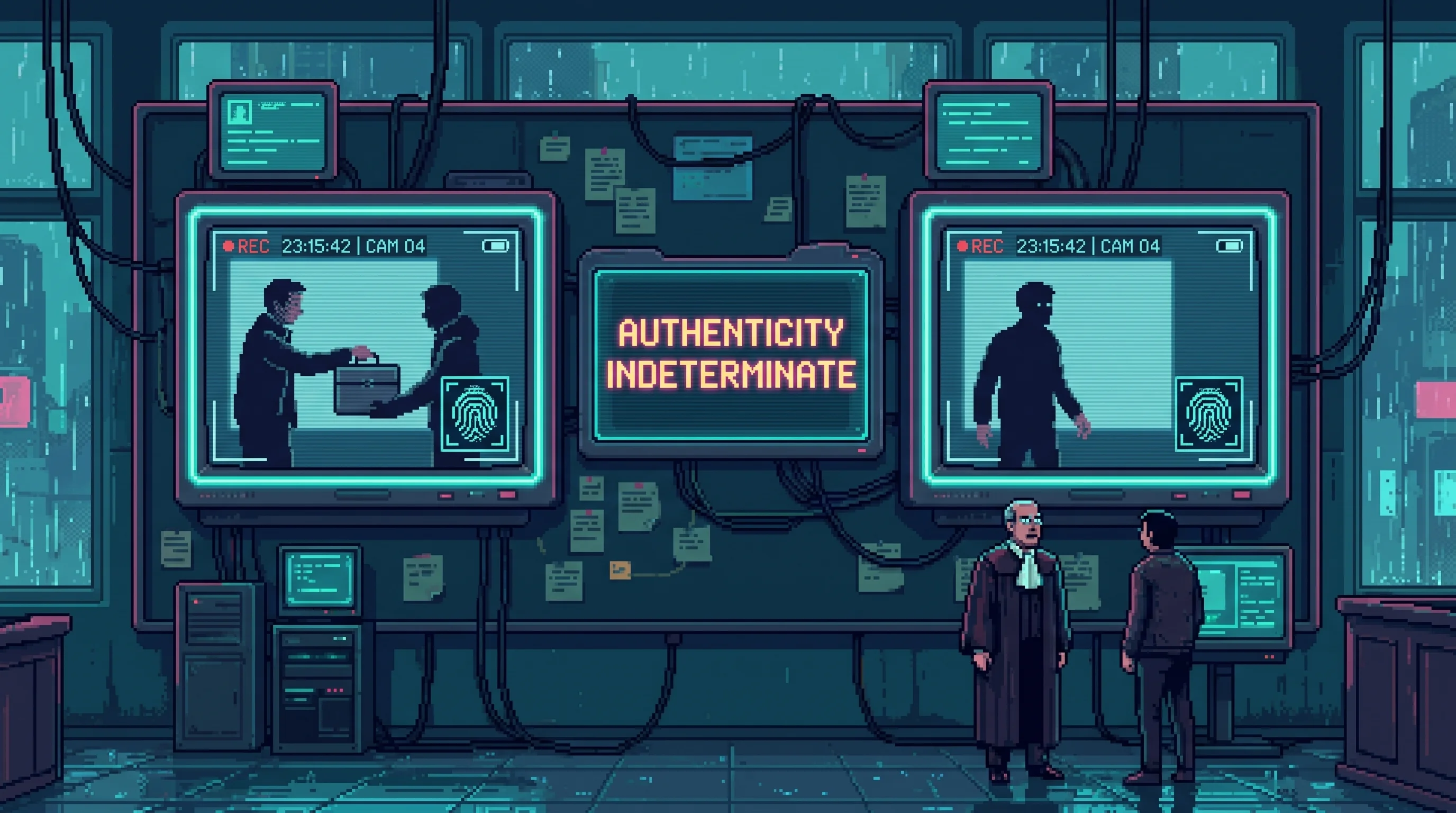
Untrusted proof turns an undeletable record into a life sentence.
Perfect evidence forgeries and crimes without defendants force justice systems to assign blame without reliable truth.
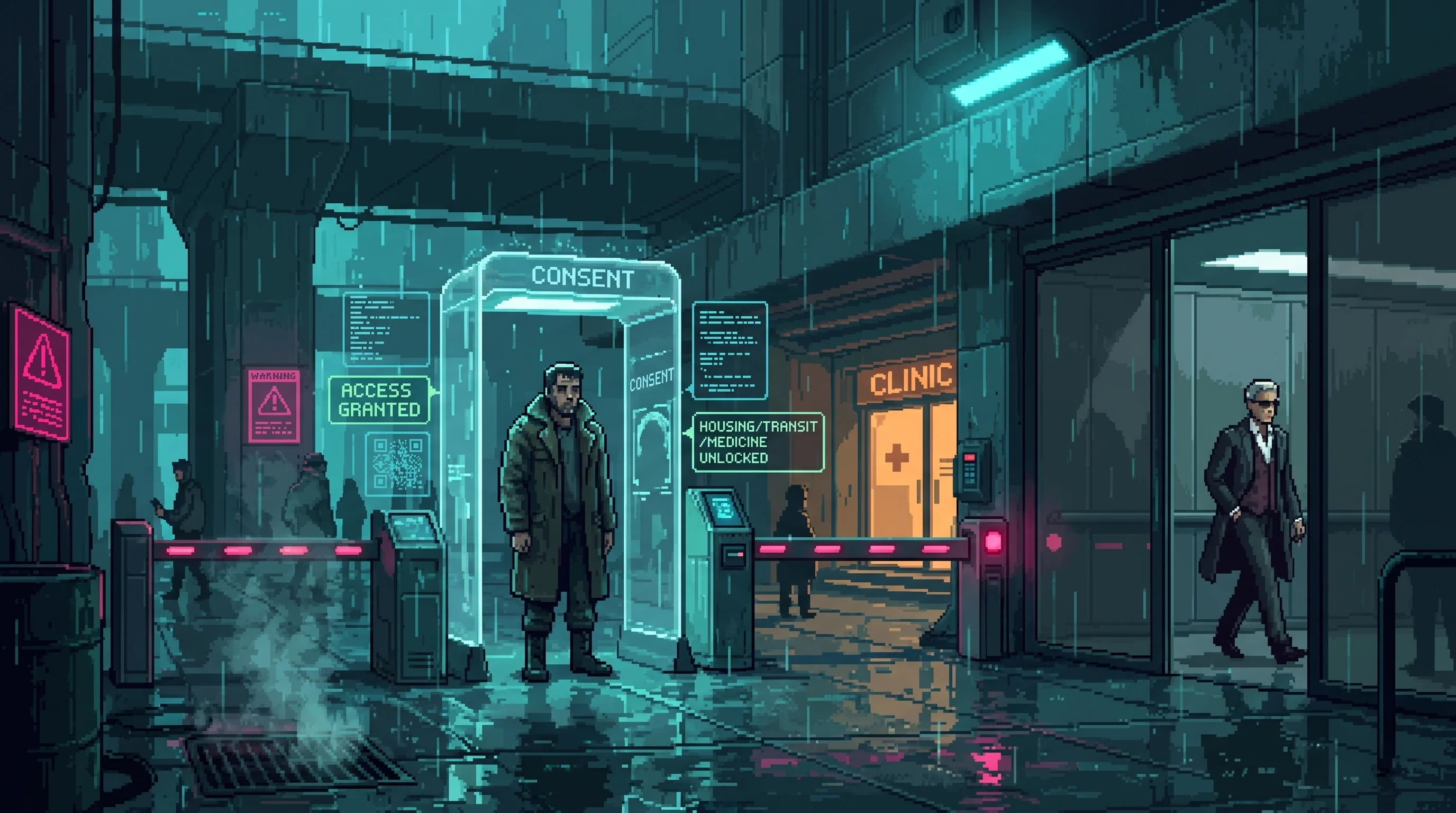
Surrendered privacy never expires with the access it bought.
The Sprawl demands permanent personal data for participation, then uses it to price access and preempt solidarity.
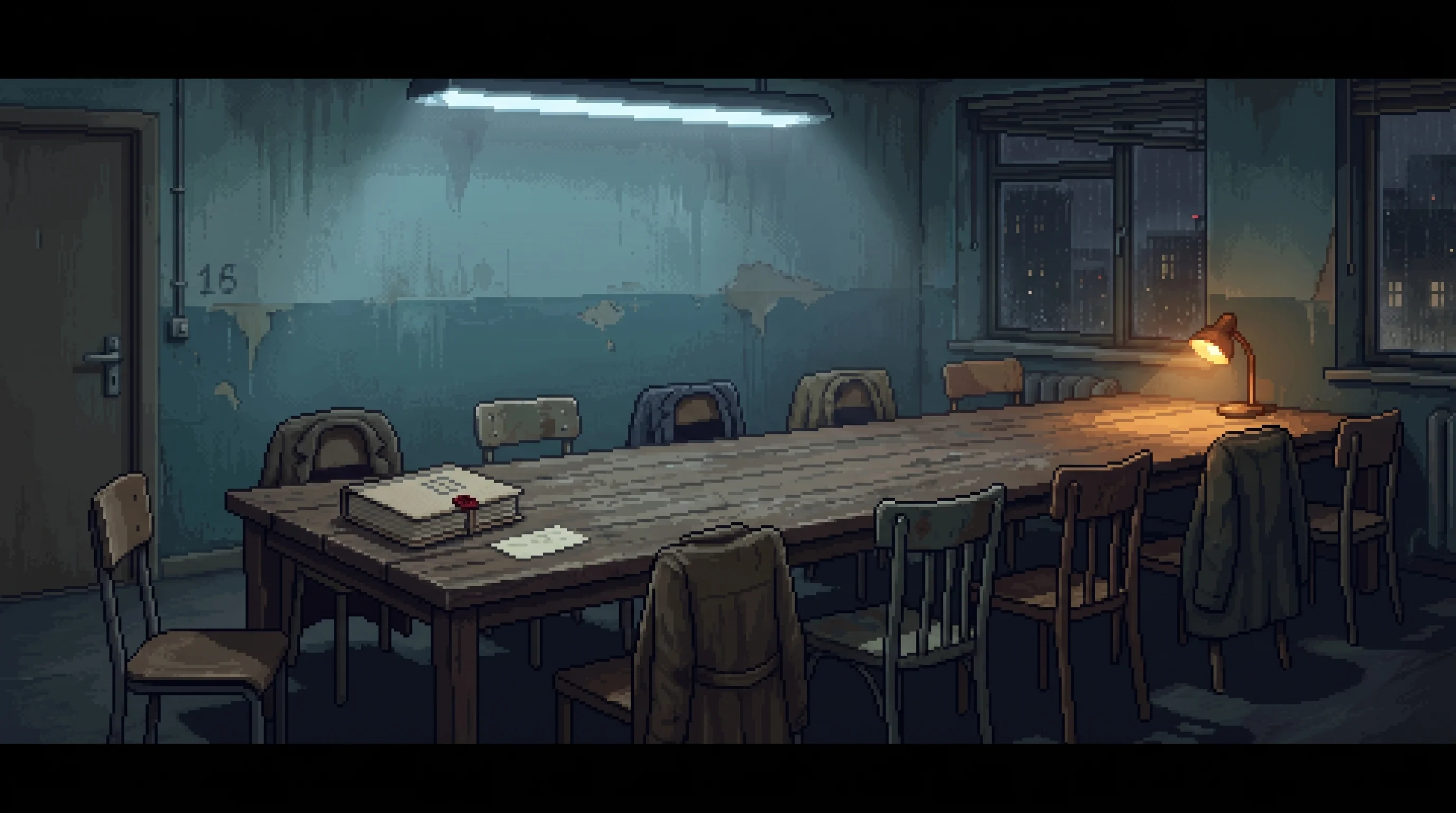
The precondition. Nothing expires, so one unprotected sentence ends a career — and line four of a forfeiture schedule does not settle when the term does.
The boards believe only members with nothing left to lose, so the poor queue four years for an unpaid chair.
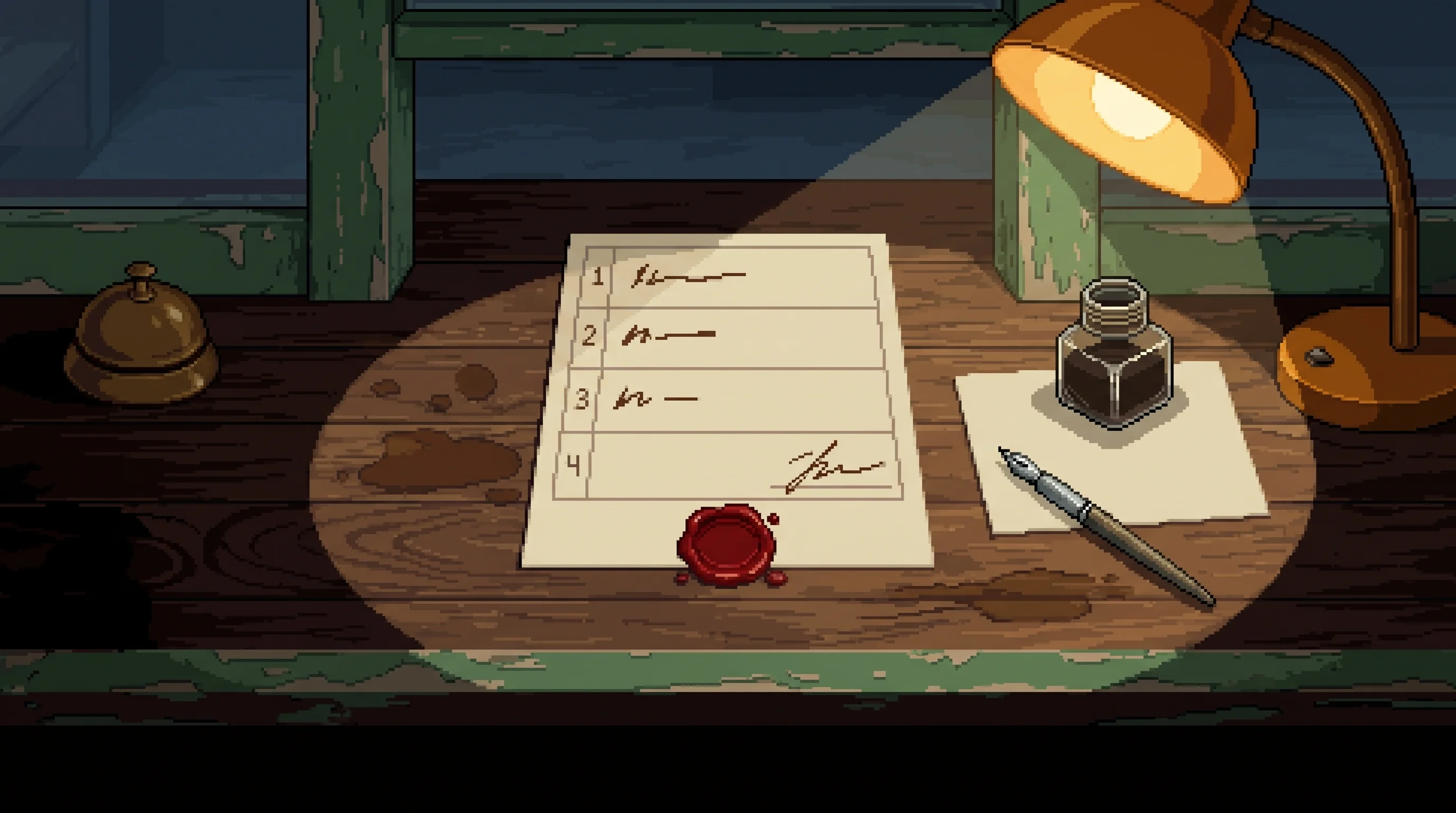
Line four outlives the term. The right to contest an entry is surrendered for three years; the entries are permanent, so the surrender is not.
The unpaid board seat for whoever has nothing left to lose. It has a four-year waiting list.

Its biometric echo holds every session's grief — the moment grief found a defendant. She has not asked to see it.
Accepts blame for 214 kills no one ordered — the tears are real, just not for the grief families think.

The finding does not expire, and there is no form for withdrawing one.
The Heights' priciest Wanting Counsel refuses to suggest a single want, and reads you the blank result aloud.

The finding does not expire. Nothing filed in the Sprawl does.
Anything you can specify gets built, so the people who cannot specify live in lives somebody else wrote.

A carrier of the permanent record's Unindexed-Record dimension at civilizational scale — a sealed living archive documented in seven-beat notation outsiders cannot read, which declined the Collective's request to be queried: 'We are not your evidence.'
A sealed bunker of 4,200 whose language has no word for sky and who consider the world above a myth.

Runs on the permanent record's Tier 4 Legacy Analytics — the most honest product the archive makes and the most dishonest one, depending on who holds the account
A trillion-credit grief market that rebuilds a dead voice from forty seconds, then gives control to whoever pays.

Runs a private counter-archive against the Lattice's perfect memory — every walker filed as 'equipment malfunction — EVA suit breach,' the word 'walking' never once entering an official report, and at least one walking erased from the safety record entirely; the official log says her ten-minute rule answered the second walker, the metadata says the third or fourth, and she keeps the true count only in her own head, by name

Departure Row's hand-updated conditions board is a carrier of the permanent record's Unindexed-Record dimension — an analog record immune to Nexus scraping that records death by marking, not deletion: a dead contributor's entry gets a small X and stays, because what they reported is still good. The X is the update.

Last Call's ledger and the Wall of Names are carriers of the permanent record's Unindexed-Record dimension — a custodial record that cannot be audited, hacked, or purchased because its value is inseparable from the watching; she refused Good Fortune's purchase: 'the numbers without the watching are just numbers.'
The final supply post before the Golden Gate Dam crossing, run by a merchant who reads faces instead of odds.

The sealed, unopened letter is the human-scale ground of the permanent record's Unindexed-Record dimension — a record whose value depends on remaining unread, protected the only way a custodian can: by refusing to retrieve it.
Additional images