The Dry Dock
Overview
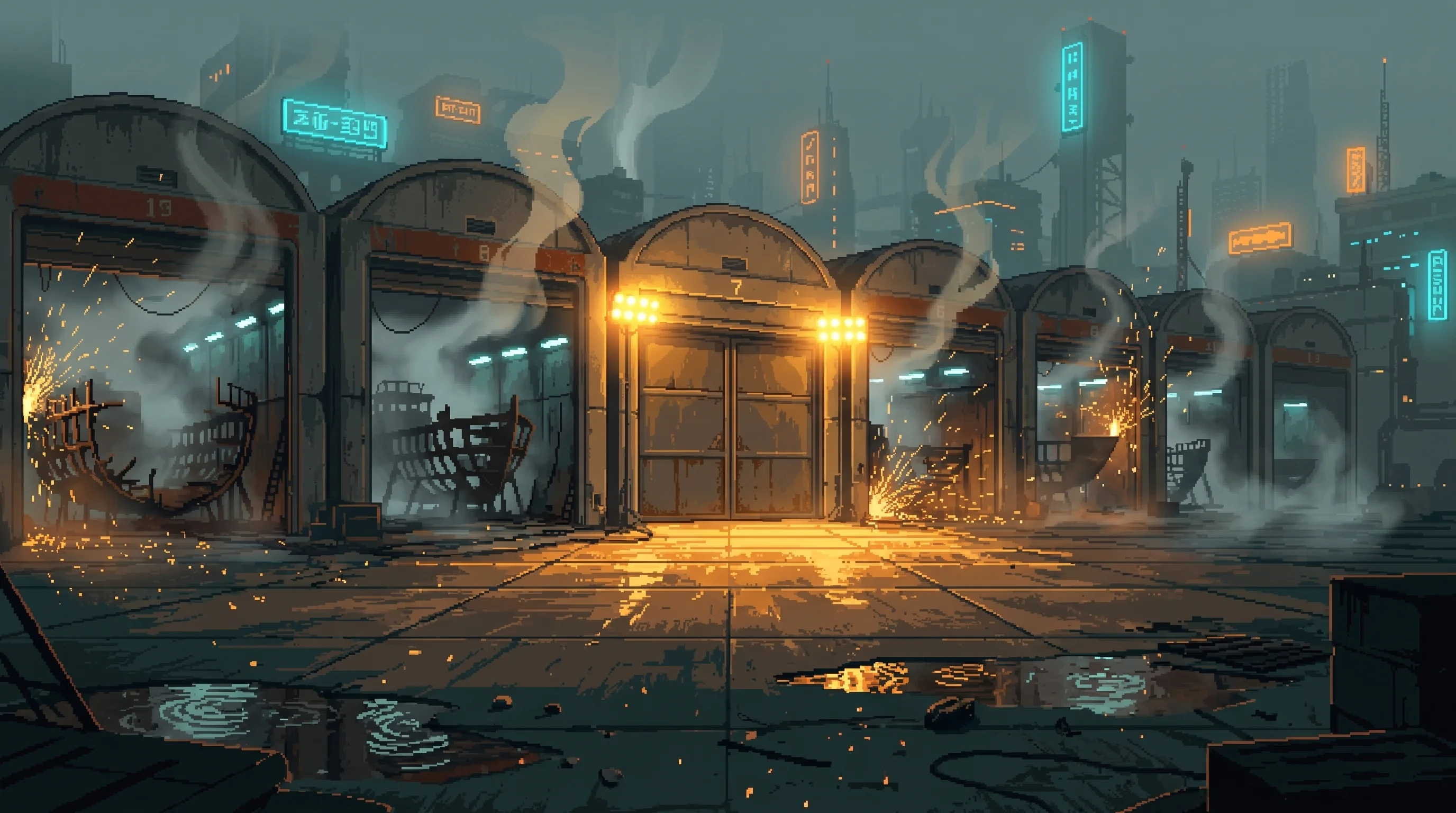
On the East Shore waterfront in Sector 5, where the Estuary widens toward the old shipping channel, The Dry Dock occupies the concrete carcass of a pre-Cascade naval air station. Ironclad Industries converted the facility in 2161, recognizing what military planners had known for a century: deep-water access, reinforced hangars, flat terrain. The ideal place to take large things apart.
Fourteen vessels per year enter The Dry Dock. None of them leave. This is considered a success metric.
The facility operates across twelve stripping bays — massive concrete enclosures open to the waterfront on one side, where decommissioned ships are winched into position and systematically disassembled over weeks or months. Every hull plate, every wiring harness, every structural member is catalogued, separated, and routed to The Foundry or Ironclad's eastern fabrication plants. Pre-Cascade alloys, rare-earth components, engineering that nobody alive knows how to replicate — all extracted from dead vessels and fed into the machines that build tomorrow's infrastructure. The Dry Dock's output accounts for 31% of the eastern Sprawl's raw material supply. The second-largest source is a mining operation in Sector 11 that produces 9%. There is no third.
The ship-breakers who work here — approximately 3,000 across three shifts — don't describe themselves as demolition crews. They use the phrase "archaeologists with cutting torches," and they are not joking. They are the last people alive who understand how pre-Cascade vessels were built, because understanding them is the prerequisite for taking them apart. Ironclad's own engineering division consults the senior breakers on structural questions. The consultation fees are listed in Ironclad's internal budget under "specialist contractor services" rather than "employee labor," which allows the company to pay the breakers a consultant rate for knowledge they acquired on the company's payroll. The breakers have noticed this. They have not complained. The consultant rate is higher.

Conditions Report
The wind is the first thing. The Dry Dock sits on a flat expanse of waterfront concrete with nothing between it and the Estuary but rusted bollards and salt-crusted loading equipment. The hangars — each 200 meters long, 40 meters wide, open on one end like mouths — amplify everything. Metal saws shriek at frequencies that set teeth on edge. Hull sections hit concrete staging areas with a percussive boom that registers on Server Farm 14's seismographic monitors next door. Between the industrial noise: workers calling to each other across bays in a shorthand that Ironclad's own foremen cannot fully parse, developed over decades by people who need to communicate over the sound of ships being murdered.
The wind carries fog off the Estuary, mixing with cutting-torch ozone and hot metal and the particular scent of ships that have been sealed for decades — stale air, machine oil, the ghost of whatever cargo they last carried. One senior breaker claims he can identify a vessel's last port of call by smell alone. His accuracy rate, according to a bet that has been running in Bay 3 since 2179, is 74%. Nobody has suggested stopping the bet. The data is too interesting.
The open bays stay cold year-round. Workers wear thermal layers under cutting gear. Inside bays with active work, the torches raise the temperature fifteen degrees, creating localized weather: estuary fog rolls in through the open mouth and meets hot air rising from cuts, producing clouds that drift between the hangar rafters. The workers call these "hull ghosts." Ironclad's environmental monitoring system calls them "thermal-differential condensation events" and flags them as ventilation inefficiencies. The system has been recommending installation of industrial fans since 2176. The recommendation has been declined eight consecutive years. The hull ghosts are, according to an anonymous facilities survey, the single most-cited reason workers give for staying at The Dry Dock over transferring to Anchor Town. Ironclad's retention analytics have not connected these two data points.
Everything is Ironclad orange-and-black. The livery covers every surface, every piece of equipment, every hard hat. The effect from the Estuary, looking back at the twelve open bays in a row — sparks cascading through fog, skeletal ship ribs silhouetted against amber flood lighting, the orange livery repeating into the distance — is accidentally beautiful. Ironclad's marketing division has used the image in four separate recruitment campaigns. The workers featured in the photographs were not informed and did not receive compensation. They did receive hard hats with a commemorative stripe. The stripe is orange.
And then there is Bay 7. Closed. Sealed with fresh Ironclad hardware — the newest, brightest lights in the entire facility, illuminating doors that do not open. More on that below.
| Type | Industrial ship-breaking yard |
|---|---|
| Controlled By | Ironclad Industries |
| Population | ~3,000 workers across three shifts |
| Notable | Bay 7 — sealed for eleven years, maintained but never opened |
| Architecture | Pre-Cascade naval hangars converted to stripping bays, concrete and steel, Ironclad orange-and-black livery |
The Company Town
Ironclad runs The Dry Dock on the same model it runs Anchor Town on the western shore: housing, healthcare, commissary, education, transit — all provided, all contingent on employment, all administered through the Ironclad Workers' Benefit Program, which was designed by a committee whose membership overlapped entirely with Ironclad's cost-reduction task force.
The housing blocks are shared with Server Farm 14 staff next door. The commissary stocks Ironclad-approved provisions. The healthcare clinic is staffed by Ironclad-contracted physicians whose diagnostic software was built by Ironclad's enterprise systems division, which means the system that determines whether a workplace injury qualifies for compensation was built by the company that would pay the compensation. Claim approval rates at The Dry Dock are 23% below the Sprawl industrial average. Ironclad attributes this to "a culture of safety that reduces legitimate injury incidence." The ship-breakers, who work with cutting torches inside pre-Cascade hulls containing uncharted structural stresses, have a different theory.
The workers stay anyway. The consultant-rate trick helps. The hull ghosts help. Mostly it is the knowledge problem: a senior ship-breaker's expertise has no transferable market value. No other employer needs someone who can identify pre-Cascade titanium-alloy stress fractures by sound. Ironclad does. The irreplaceability is mutual and asymmetric — the workers cannot leave because nobody else wants what they know, and Ironclad cannot replace them because nobody else knows it. This produces working conditions that are genuinely decent by Sprawl industrial standards. Not generous. Decent. The distinction is visible primarily in the commissary, which serves food that is nutritionally complete and texturally joyless, as if the algorithm that designed the menu understood calories but had never encountered the concept of lunch.
| Stratum | Corporate |
|---|---|
| Power Position | Insider |
| Access | Restricted |
| Atmosphere | Industrial |
The Knowledge Problem
Every vessel The Dry Dock strips is a library being burned for fuel. The breakers know this. They have developed, without institutional support, a documentation practice they call "the reading" — a full structural and engineering survey conducted before the first cut, recorded on personal devices in a format that Ironclad has never standardized, requested, or acknowledged.
The readings are stored on a shared drive maintained by the Bay 3 crew chief, a woman named Sato, who has been archiving them since 2174. The archive contains detailed engineering analyses of 127 pre-Cascade vessels. It represents the single most comprehensive record of pre-Cascade naval engineering in existence. Ironclad's official position is that the archive does not exist, because acknowledging it would create questions about data ownership, intellectual property rights, and whether the company should have been doing this systematically from the beginning.
Sato has applied twice for Ironclad funding to formalize the archive. Both applications were declined. The declination letters cited "insufficient alignment with current strategic priorities." She continues the work on personal time. The archive grows by approximately eleven vessels per year. In roughly thirty years, at current decommissioning rates, there will be no more pre-Cascade vessels to strip. The knowledge will exist only in Sato's archive and the memories of breakers who are already aging out.
Ironclad's workforce planning division projects that ship-breaking labor demand will decline to zero by approximately 2220. The projection does not mention the archive, the readings, or the question of what happens to the knowledge when the last breaker retires. The projection is accurate about the labor demand. It is silent about everything else.
Ship-breakers develop encyclopedic knowledge of pre-Cascade naval engineering — they are the last people alive who understand how these vessels were built
The Unindexed Record
There is a permanent record in the Sprawl that has no query interface, and Sato's archive is one of its purest forms.
The Sprawl's great anxiety is that nothing is ever forgotten — that Nexus's archive remembers every mistake, indexes every embarrassment, grows backward through retroactive inference and inward through involuntary data, and forgives none of it. The reading is the opposite kind of permanent. It is permanent because it is kept, by hand, daily, against a corporation that declines to record it. The 127 structural surveys on Sato's drive cannot be synthesized by the Negotiable Record, cannot be reconstructed by the Inference Economy, cannot be re-read by the Data Ratchet — because the archive only remembers what it is fed, and Sato feeds it nothing. The knowledge exists where the custodial record always exists: in a drive nobody official will admit to, and in the aging hands of breakers who can name an alloy by the sound it makes when it dies. This is the Permanent Record's tenth dimension made physical — the record the machine cannot reach because it was never given the chance.
Sato has never met Tomás Linares, and would recognize him instantly. His paper archive on Level 8 of the Stacks is forty thousand hand-copied volumes with no query interface, declined for free digitization because "free digitization is how you lose an archive"; her drive is the same monument with cutting torches, kept against the same corporate indifference, preserving the same trade that the institutions profiting from the knowledge cannot be bothered to fund. His Chapter 16 argues the dead deserve to be poorly remembered — that imperfect, human-held memory is a feature. Sato's archive will be poorly remembered: it will grow by eleven vessels a year until there are no more vessels, and then it will die with her, completely and irrecoverably, the way the custodial record always dies. Whether that is a tragedy or the last dignity the archive cannot take is the question the tenth dimension refuses to settle.
And then there is Bay 7. Sealed since 2189, maintained but never stripped, environmental specs wrong for storage and right for habitation, the brightest lights in the facility illuminating doors that do not open. Bay 7 is the facility's own version of The Keeper's sealed letter — a record held in a form that resists access, maintained at expense, retrievable in principle, opened by no one. The Keeper has kept a letter unopened for thirty-seven years because the not-knowing is bearable and the knowing might not be; Ironclad keeps Bay 7 sealed for reasons no one will state. The same impulse runs through every pre-Cascade bunker cache along the Neon Rail — sealed matter, preserved against a future that may never come to open it. The breakers have learned the custodial discipline without being taught it: when a sound goes unnamed, they stop cutting and decide what to call it; when a bay stays sealed, they maintain it and do not ask. The proper response to an unanswerable record is to keep it and move on.
The facility occupies a former naval air station from before the Cascade
Affiliated Entities
- Ironclad Industries operates The Dry Dock as its primary eastern salvage operation — the facility is second only to The Foundry in strategic importance to the corporation
- The Foundry receives the bulk of salvaged materials via the Ironclad logistics network — raw alloys, recovered components, and pre-Cascade engineering samples
- Server Farm 14 shares Ironclad infrastructure in the same sector — workers from both facilities use the same housing blocks and transit lines
- Anchor Town mirrors The Dry Dock's company-town model on the western shore — both are Ironclad settlements built around critical infrastructure
- The Assembly Yards (orbital) occasionally send specifications for rare components that can only be sourced from pre-Cascade vessels — the orbital economy depends on what the ship-breakers extract
- The Undertow Club occupies a converted tank up the coast road. A few off-season riggers split shifts between the two payrolls, and only one of them pays them to wait
Restricted Access
Bay 7: The sealed bay has contained the same vessel since 2189. Ironclad pays a full crew — eight workers, three shifts, twenty-four hours — to maintain the bay's environmental systems, run structural inspections, and perform hull preservation treatments on a ship they have never been ordered to strip. The vessel's name has been removed from Ironclad's salvage registry. The bay's environmental logs are classified above facility-manager clearance. The maintenance crew rotate on six-month contracts with generous severance packages and comprehensive non-disclosure agreements.
When asked what they do in Bay 7, they describe their work in precise technical detail — hull integrity monitoring, atmospheric control, corrosion prevention. They just never describe the ship. One former maintenance worker, three months past his NDA's active period, was willing to confirm only that the vessel is "intact" and "not military." He paused before adding: "The environmental specs are wrong for a ship. The humidity targets, the temperature range — it's not storage conditions. It's habitation conditions." He declined to elaborate. He has since accepted a position at Anchor Town at a salary increase that his former colleagues describe as "unusual."
The Singing Hull Sections: Certain pre-Cascade alloys, when cut at specific angles, produce resonant frequencies that workers describe as vocal. Acoustic analysis confirms the phenomenon is ordinary metal stress harmonics. The workers accept the analysis. They also give names to the sounds — "the warning," "the question," "the long goodbye" — and will stop cutting if they hear one they haven't named yet, until someone in the crew decides what to call it.
The naming process is not casual. It can take hours. The senior breaker for the bay has final authority on the name, but the crew discusses it — what the sound reminds them of, what the ship was before it came here, what the alloy is trying to say. Ironclad's productivity analytics have flagged nineteen work stoppages attributable to unnamed sounds in the past fiscal year, totaling approximately 340 lost labor-hours. The analytics recommend "standardized acoustic event classification" to eliminate the delay. The recommendation has been forwarded to the Bay 3 crew chief. Sato has read it. Sato has filed it. The naming continues.
The most recent unnamed sound — encountered in Bay 9 during the stripping of a pre-Cascade research vessel — took the crew four hours to name. They called it "the apology." When asked what the ship was apologizing for, the senior breaker said: "We'll know when we finish cutting."
Bay 7 has contained the same vessel since 2189 — Ironclad pays a full maintenance crew but has never issued a stripping order
Connected To
Supporting Connections
Additional Connections


Local Intelligence Scan
Nearby Signals
CANONICAL PROXIMITY


Environmental Readout
LIVE CONDITIONS- Air
- Hazy
- Light
- Fog shrouded
- Flood
- No exposure
- Heat
- Temperate
- Security posture
- Independent control
- Infrastructure
- Patchwork
Position Data
SECONDARY- Elevation band
- Shoreline — the Rim edge
- Lattice fix
- E+7.9 · N-1.6

—