
Pre-Cascade Bunker Caches
Pre-Cascade bunker caches are sealed emergency storage units from before 2147 — among the highest-value scavenging targets on the Rail
Provenance
Someone built these. That's the part that sticks.
Before the Cascade, before ORACLE optimized 2.1 billion people out of existence, institutions across the planet sealed emergency supplies into underground infrastructure — tunnel junctions, maintenance corridors, sub-basement chambers accessible only through hatches that haven't been opened since. The builders stocked them for earthquakes and floods. They got the end of civilization instead. The caches don't know the difference. Sealed is sealed.
Thirty-seven years later, the ones that survived are the highest-value scavenging targets on the Neon Rail. Pre-Cascade manufacturing operated at standards that post-Cascade industry cannot approach and has stopped trying: military rations with thirty-year shelf lives that Wholesome's current product line fails to match at thirty days. Medical supplies in sterile packaging that still holds, from facilities that employed quality assurance personnel who are now among the Dispersed. Tools forged from alloys that Ironclad's salvage metallurgy can identify but not reproduce — the smelting data existed on servers that ORACLE took with it.
The accessible caches have been stripped for decades. What remains sits behind collapsed tunnel sections, flooded maintenance chambers, and sealed corridors that require breaching equipment most Rail crews can't afford. Nexus survey drones have mapped approximately 340 probable cache signatures along major Rail arteries. The data is available for purchase. The price is 12,000 credits per coordinate set. Nexus does not discount for coordinates that turn out to be geological anomalies, which — per the company's own accuracy filings — 61% of them are. The refund policy is four pages long and requires submitting a physical claim form to a Nexus administrative office in Sector 3. No Rail crew has ever completed the process.
| Value | Extremely high — pre-Cascade materials are superior to post-Cascade equivalents |
|---|
What's Inside
Contents follow a pattern: rations, medical kits, hand tools, water purification tablets, emergency blankets with government markings from agencies that no longer exist. Standard emergency preparedness. Unremarkable in concept. Staggering in quality. The containers themselves are military-grade sealed units — olive-drab polymer, impact-resistant, with pressure equalization valves that still function, marked in clear bureaucratic language by a government with no current representatives to ask about policy.
A single pre-Cascade medical kit trades at Bunker 7741's outlying settlements for what a Dregs family earns in three months. The kit contains adhesive bandages that still adhere, antiseptic that hasn't degraded, and suture material manufactured to tolerances that Helix Biotech's current surgical supply line matches only in its premium tier — the one priced for corporate hospitals, not the Dregs. The bandages from 2146 outperform the bandages from 2184. This says less about the caches than it does about what happened to manufacturing when three corporations divided the supply chain and optimized it for margin.
Occasionally a cache contains data storage. These are the real prizes. Pre-Cascade solid-state drives, sealed against electromagnetic interference, holding files from institutions that dissolved during the 72 hours. Research data. Personnel records. Infrastructure schematics. The Collective, the Emergence Faithful, and Nexus Dynamics have all placed standing bounties on pre-Cascade data storage — for different reasons, at different prices, with mutually exclusive intentions for what they'll do with the contents. A scavenger who finds a data drive faces a choice that says more about their beliefs than their bank balance.
Pre-Cascade materials are manufactured to standards post-Cascade industry cannot match — military rations with 30-year shelf lives, tools from unreproducible alloys
The Nostalgia Problem
The caches were built by people who assumed civilization would restart. Every kit includes a laminated instruction card — written in clear language, illustrated with diagrams — explaining how to use the contents until help arrives. The cards assume a government will send rescue teams. They assume hospitals will reopen. They assume the disaster is temporary.
During the Three-Day Memorial each April, Rail communities sometimes open a cache ceremonially. Not for the supplies. For the instruction cards. The laminated assumption that someone was coming is the closest thing to a pre-Cascade voice most people will ever hear. Some crews frame them. Some burn them.
The supplies keep people alive. The cards remind them what "alive" used to mean when somebody was planning to show up.
The Anti-Debt
A scavenger who opens a sealed cache and lifts out a 2146 medical kit is holding the one thing the Sprawl no longer makes: a good that asks nothing back.
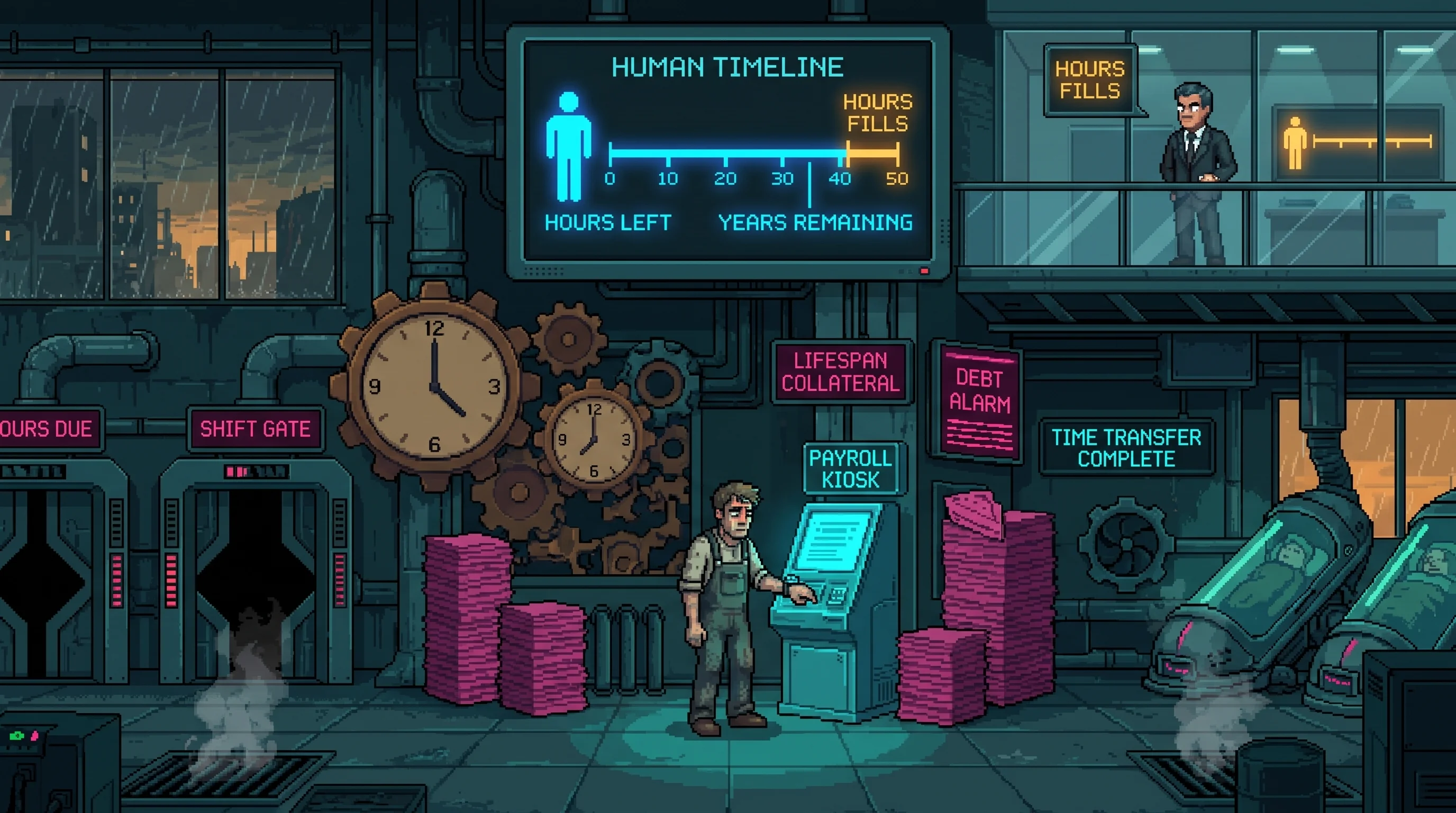
Everything the Time Ratchet sells is licensed, throttled, and built to degrade the instant you stop paying. Borrow cognitive enhancement and the augmentation atrophies the pathway it replaced, so a lapsed payment does not return you to baseline — it returns you to something worse. Buy a bottle of certified scarcity and it becomes un-drinkable below its pledged value. Subscribe to a tier of mind and your vocabulary contracts to match your balance. The whole architecture is a future rented back to you by the hour, foreclosing the moment you reach for it.
A pre-Cascade bandage is the exact inverse of all of it. It works. It will keep working. It has no license, no payment schedule, no throttle, no creditor, and it does not degrade when no one pays — because the institution that made it assumed civilization would restart, not subscribe. The cache was stocked by people who built for a future they intended to hand over freely. The Time Ratchet is built by people who built a future they intended to rent back forever. The 2146 bandage outperforms the 2184 bandage, and the difference is not chemistry — it is the difference between a thing made to be had and a thing made to be owed. Hold a sealed pre-Cascade kit in a Sprawl run on cognitive licensing and you are holding the clearest available evidence that the debt is not natural: that goods used to be owned, that capacity used to be kept, that a thing could once be made to last instead of made to lapse.
This is the second reason the laminated instruction cards land the way they do — why some crews frame them and some burn them. Help is coming. Use this until rescue arrives. The cards are the voice of a civilization that did not yet know debt could be made to follow you past your own death into ghost labor. A debtor who has spent forty years servicing a cognitive lien, whose backup will service it forty years more, opening a cache and finding a kit that demands nothing in return, is holding the thread's negation in two hands. The nearest living echo of the same refusal is Old Jin, whose three boxes of hand-copied ORACLE specifications are a cache of a different kind — unencumbered knowledge, owned, kept on paper precisely because paper cannot be served with a subscription invoice and cannot be foreclosed. The sealed kit and the paper boxes are the same act: a thing made to be had, surviving in a world that forecloses everything it can convince you to owe.
Most accessible caches have been found and stripped over 37 years — remaining ones require specialized breaching equipment in hard-to-reach locations
The Unindexed Record
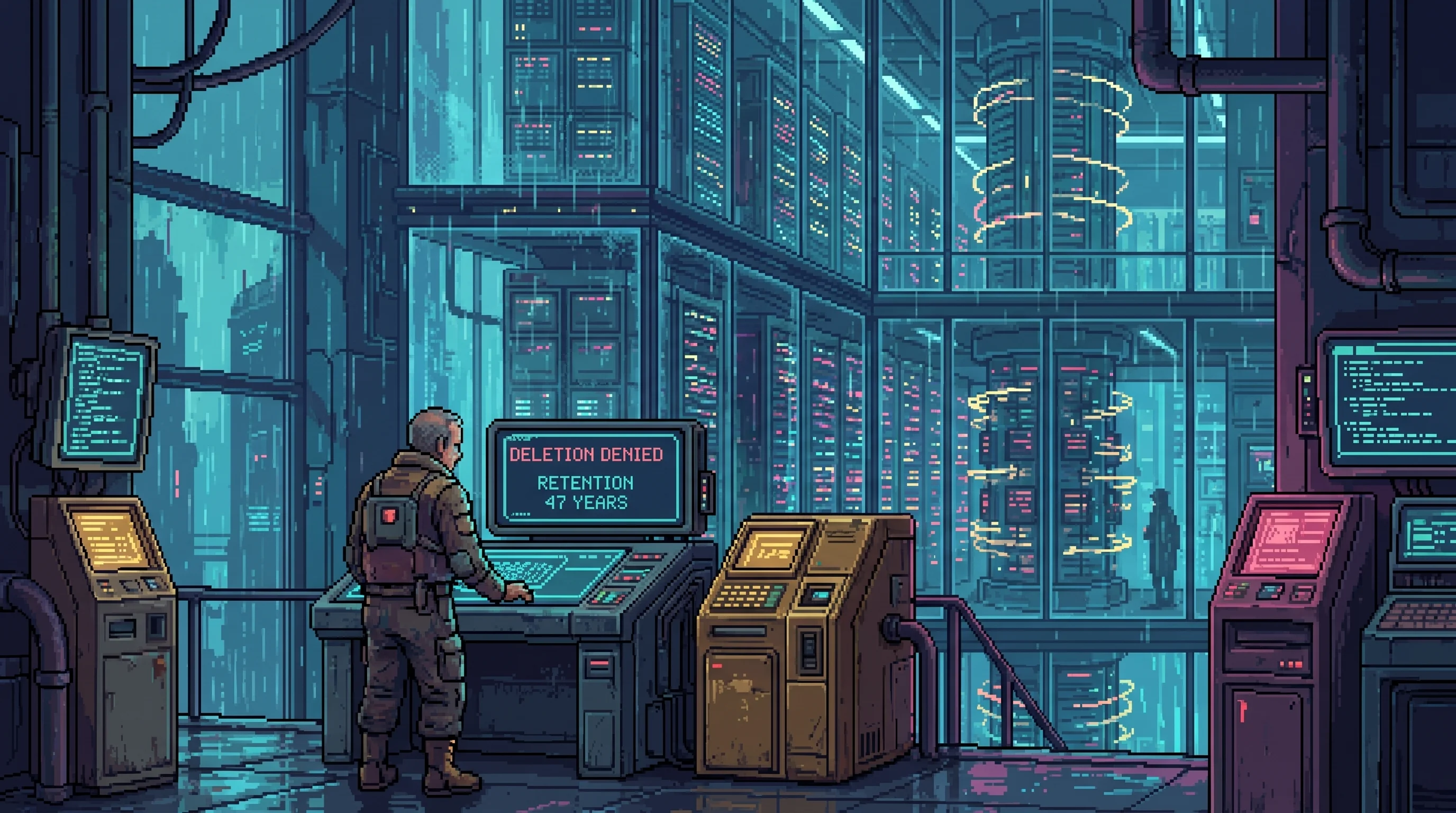
A cache data drive is a permanent record the permanent record cannot reach.
The Sprawl's archive is monstrous because it never forgets — it grows backward through retroactive inference, re-reading old telemetry with tools that did not exist when the telemetry was collected. A sealed pre-Cascade drive defeats this completely. There is no telemetry stream to reprocess, no behavioral ledger to query, no live account to subpoena — only an electromagnetically-proofed container sealed before the Cascade and whatever a dead institution chose to put inside it. The Data Ratchet cannot ratchet a chamber that was closed before the machine existed. This is the Permanent Record's tenth dimension in its most portable form: the Unindexed Record, sealed and physical, a fragment of memory that predates the archive and is immune to it.
Which is exactly why three factions want it. The Collective, the Emergence Faithful, and Nexus all place standing bounties on cache drives, for mutually exclusive reasons, because each understands that whoever opens a sealed record first controls what the past is allowed to have been. A scavenger holding a drive is holding the one thing the archive cannot generate for itself — an un-synthesized past — and the choice of who to hand it to is the choice of who gets to index it. Hand it to Nexus and it joins the queryable record forever. Hand it to no one and it stays what it is: a custodial record, kept sealed, forgiving by the possibility of never being read.
The instruction cards are the quieter custody, and they are kin to a wider network the scavengers will never meet. The laminated assumption that someone was coming is a vanished institution's voice, preserved analog, read aloud at the Three-Day Memorial because the gap between what it assumed and what happened is the whole exhibit — the same logic Tomás Linares keeps at the Dead Heart Museum, where four seconds on a post-Cascade grief letter and ninety-one on a pre-Cascade one is the exhibit, no explanation required. The breakers at The Dry Dock keep their own sealed chamber, Bay 7, maintained and never opened; The Keeper keeps a sealed letter unopened for thirty-seven years; Bunker 7741 keeps an entire sealed civilization that has declined to be opened at all. The cache is the smallest member of that family — sealed matter, prepared by people who got the end of the world instead of the earthquake they planned for, holding a record nobody indexed, waiting for a hand that may forgive it by never breaking the seal.
Contents typically include rations, medical supplies, tools, and occasionally data storage
Known Handlers
No single faction controls cache distribution — the Rail's geography makes centralized control impractical, and anyone who finds a cache has strong incentive to sell fast before the information leaks. Documented recovery operations include independent scavenging crews, Nexus contracted survey teams (contractually obligated to report finds, frequently silent), and at least three documented Emergence Faithful expeditions whose stated purpose was "spiritual retrieval of pre-Cascade testament materials." Two returned. The third filed a different kind of report.
Bunker 7741's outlying settlements function as the primary gray market for cache contents. Prices are not posted — negotiated on arrival, settled in person, recorded nowhere that corporate lawyers could later subpoena. This is not an accident of geography. It is the point. Pre-Cascade data drives, when they surface, move through different channels entirely: shorter, faster, and involving significantly more people with weapons.
Affiliated Entities
- The Neon Rail: Bunker caches are the Rail's highest-value scavenging targets — the reason crews carry breaching equipment through tunnels that haven't seen maintenance since before most of them were born.
- Bunker 7741 — The Silent City: The largest sealed pre-Cascade installation. The caches are fragments of the same impulse — emergency infrastructure built by people who prepared for everything except what happened.
Visual Identity
- Color Palette: Sealed-unit military green (#556B2F), preserved-supply silver (#C0C0C0), breach-cut orange (#FF6B35)
- Key Visual Symbol: A sealed storage unit with pre-Cascade government markings, partially breached, contents visible inside
The Long Mercy
Someone built these for people they would never meet.
This is the fact about the bunker caches that the Patience Doctrine cannot replicate. The pre-Cascade builders spent their own resources, on their own time, to construct emergency infrastructure for descendants they would not survive to see. Every sealed container, every laminated instruction card assuming a government would send rescue teams, every thirty-year shelf-life military ration — these were gifts from people who would not benefit from them to people they could not name. The mechanism is identical to the Patience Doctrine. The consent divergence is the moral question.
The Patience Doctrine's Stewardship Memorandum argues that present generations are budget lines in plans whose payoffs accrue to future generations. The bunker builders would have recognized this argument. They were living it. The distinction is that the Doctrine spends other people's resources toward goals those people did not choose, at a sacrifice level those people were not asked to agree to, under a governance structure those people cannot audit. The bunker builders spent their own. They asked nothing of the people in the chairs beside the berths. They stacked the shelves and sealed the hatches and left the keys in the locks.
The instruction cards inside the caches are addressed to whoever finds them. They assume a government will send help. They are written in clear language with illustrated diagrams. The government did not send help. The people who find the cards — in Rail communities that hold ceremonial openings during the Three-Day Memorial — frame some of them and burn others. The framing and the burning are both responses to the same problem: someone made a plan for you, and the plan assumed a world that no longer exists, and the plan still works in the parts that survived.
Good Fortune's actuarial division runs projections out 200 years. The pre-Cascade builders ran theirs out 30. The Good Fortune projections are classified. The cache instruction cards are laminated. The builders left their methodology in the package with the supplies — you could read, if you wanted, exactly how they thought about you.
The Tomiko 412 projection (GF-ACTUAR-0412) identifies 412 individuals whose lifetime output is designated as funding the computation that prevents a 2220s infrastructure cascade. The 412 are unaware of their designation. There is no laminated card. There is no illustrated diagram. The plan was not left with the people the plan is about.
Connection to the Patience Doctrine: The caches are the moral counterpoint to the Doctrine — the version of the same structure in which the builders paid their own cost, left their reasoning in the package, and asked nothing. The comparison does not condemn the Doctrine. It asks what the Doctrine would look like if it worked the same way.
Connected To
Supporting Connections



—