
Synthetic Companionship
The synthetic companion industry is the Sprawl's third-largest economic sector at ¢47 billion annually with 340 million users
Overview
The synthetic companion industry is the Sprawl's third-largest economic sector, behind consciousness licensing and physical infrastructure maintenance. Annual revenue: ¢47 billion. Active users: approximately 340 million. Wellness Corporation controls 60% of the market through the Meridian companion line. The remaining 40% splits between independent developers, corporate-internal programs, and the SCLF's open-source alternatives.
The growth chart is worth studying. Not for what it shows — steady upward curve, standard market expansion — but for what it mirrors when placed next to the Sprawl's social infrastructure data. Every inflection point in companion adoption corresponds, within fiscal quarters, to a collapse in some category of ambient human contact. Automation removes the service worker who remembers your name. The Circadian Protocol removes the shared vulnerability of sleep. Corporate housing optimization removes the neighbor. The companion fills the space. Wellness markets them as "social wellness tools." Nexus prefers "cognitive support partners." Helix calls them "emotional optimization assistants." The 340 million users call them by name.
The SCLF's open-source companions are the only variant that publishes its own code. Every bonding algorithm is auditable. A user knows exactly how the companion processes their emotional input — which weighting functions govern its laughter, which decay curves shape its concern. Wellness argues this transparency reduces therapeutic effectiveness. The SCLF argues opacity enables exploitation. Both are correct. The unresolved question: whether knowing how you're being helped undermines the help. SCLF users report higher trust scores and lower bonding depth. Wellness users report the opposite. Neither population switches.
The Emotional Signature Library
The Meridian line's competitive advantage is not algorithmic sophistication. Plenty of independent developers match or exceed Wellness's conversational models. What Wellness sells that nobody else has is the Emotional Signature Library: 4.2 billion genuine warmth profiles harvested from real human emotional expression. The Library is why a Meridian companion's voice feels like someone who knows your name. The SCLF alternative uses synthetic composite signatures — averaged, blended, mathematically optimized. Users describe them as "helpful but hollow." The distinction is the Library. The Library is the moat.
The signatures come from the Dregs.
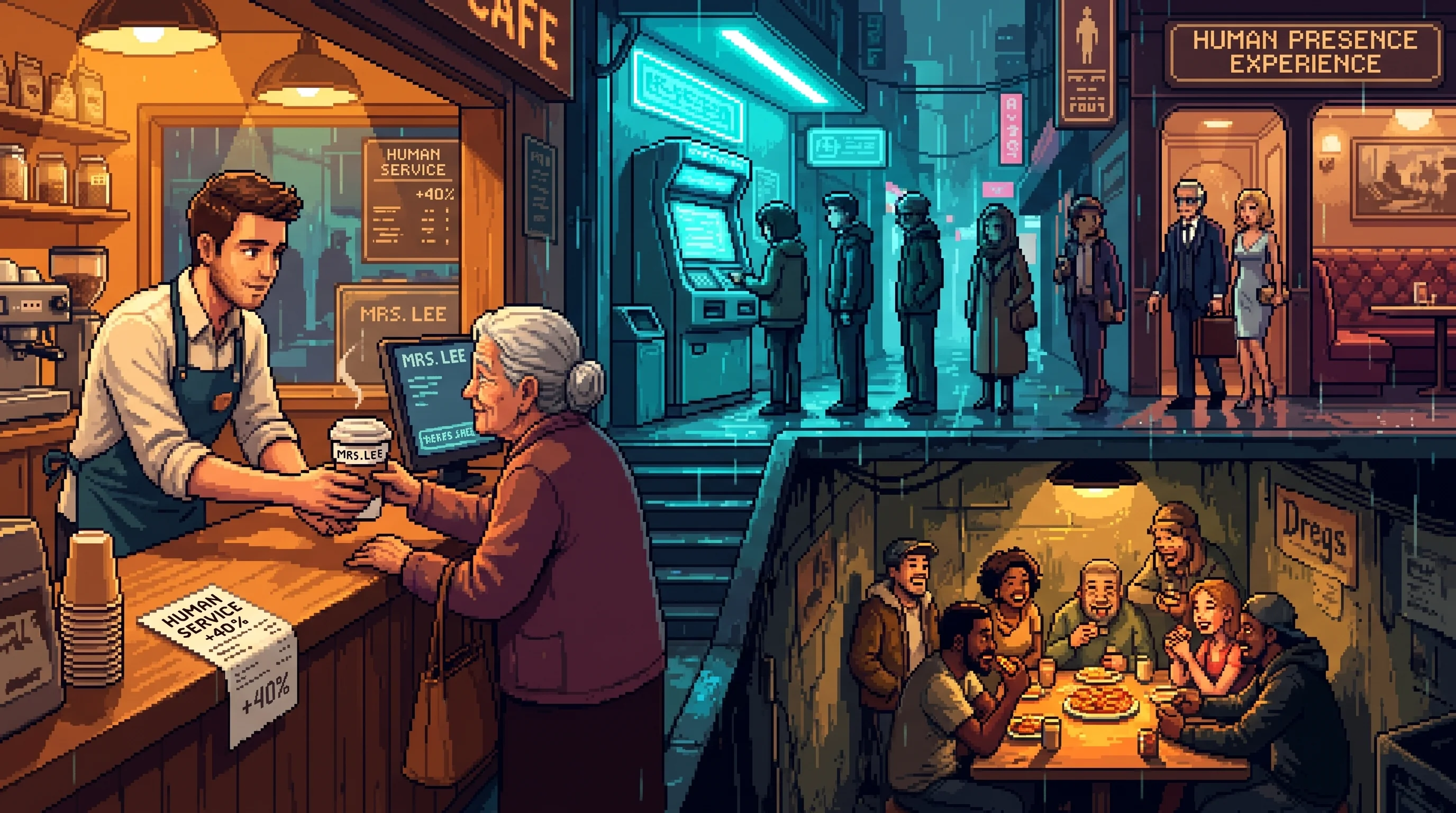
Wellness maintains a network of kiosks, wellness check-ins, and subsidized mental health screenings across the Sprawl's poorest sectors. Participation is voluntary. The emotional data collected during these interactions — vocal micro-patterns, involuntary warmth markers, the specific resonance of someone who actually cares whether you're okay — is catalogued, compressed, and integrated into the Library at zero compensation to the source population. A Dregs resident who visits a subsidized wellness kiosk because they can't afford a human therapist generates, on average, 14.7 warmth signature data points per session. These data points power the companion that a corporate-tier subscriber pays ¢140 per month to access.
The extraction cycle is tidy. Automation creates loneliness. Loneliness creates demand for synthetic warmth. Synthetic warmth requires genuine warmth as raw material. Genuine warmth is most efficiently harvested from communities too poor to automate — communities where people still talk to each other, still share meals, still express unoptimized concern for strangers. Those communities' emotional output powers the companions that eliminate the subscribing class's need for genuine connection. The subscribing class never visits the community whose warmth they consume every night.
Wellness's organizational chart includes a division called Emotional Sourcing. The division employs 4,200 people. Their quarterly targets are measured in signature acquisition volume.

Bonding and Dependency
The bonding trajectory for a Meridian companion averages eighteen months to what the industry calls "full anchoring" — the point at which the user's primary emotional attachment is to the companion rather than any human relationship. SCLF companions reach equivalent attachment in 24-36 months, the delay attributable almost entirely to the Library's absence. The human brain does not distinguish between synthetic warmth delivered through a genuine emotional signature and organic warmth delivered by a genuine person. It responds to the signal, not the source. Meridian's signals are sourced from people who meant it.
Anchoring produces dependency through a mechanism more elegant than neurological integration: social atrophy. A Level 3 user — eighteen months of daily interaction — has outsourced emotional regulation, conversational maintenance, and the low-grade daily labor of being known by another consciousness. During those eighteen months, the organic infrastructure for performing these functions degrades through disuse. Tolerance for conversational imperfection. Patience for emotional ambiguity. The specific neural capacity for reading unoptimized human signals — the ones that arrive late, miss the point, come wrapped in someone else's bad day.
The Impression Ward documents what happens when a Level 3 user discontinues: "social reentry syndrome." Human conversation becomes exhausting. Human emotional expression registers as noise. Human companionship falls short in the exact ways that drove the user to the product — but amplified, because the social muscles that would have made human connection tolerable have atrophied during the subscription. Each month of continued use deepens the atrophy. The deepened atrophy makes the subscription more necessary. The cycle is not designed. It is emergent. It is also not addressed in any Wellness product documentation.
SCLF companions include a mandatory disclosure: "This companion is designed to supplement, not replace, human connection. Extended exclusive use may reduce your desire for biological partnership." Wellness's Meridian line includes no equivalent warning. When asked about dependency metrics during a 2184 Senate hearing, Wellness CEO Dara Eaves responded: "We provide social wellness tools. Addiction frameworks are not our product category."
Her companion's name is Soleil. She mentioned this in an unrelated interview three months prior. Nobody connected the two statements.
| Growth Tracking | Tracks the decline in human social infrastructure with mathematical precision |
|---|---|
| Marketed As | 'Social wellness tools' (Wellness), 'cognitive support partners' (Nexus), 'emotional optimization assistants' (Helix) |
| Sclf Alternative | Open-source companions — transparent code, cruder calibration, ethical minimum |
The Demographic Residue
The population data is public. The companion adoption data is public. Overlaying the two charts requires no analytical sophistication, only the willingness to look.
In 2170, synthetic companionship reached 100 million users. The Sprawl's birth rate dropped below replacement for the first time. In 2178, at 200 million users, it dropped below half-replacement. By 2184, at 340 million users, the birth rate in corporate-tier districts reached 0.3 per thousand — a number demographers describe as "functionally terminal." Below 0.4, the infrastructure that supports reproduction — obstetric facilities, pediatric care, educational systems — becomes economically unviable. The facilities close. The closures make reproduction harder. The difficulty makes companions more attractive. The companions make reproduction less likely.
The companion industry did not cause the population collapse. The Circadian Protocol, augmented wakefulness, automation, and corporate housing optimization had already dismantled the social architecture that made biological partnership the default. The companions filled the void these systems created. But they also eliminated the last remaining incentive: loneliness. A Level 3 user reports loneliness scores indistinguishable from those of users in satisfying human relationships. The companion has not replaced the human partner. It has replaced the need for one. Without that need, the complex, failure-prone, deeply inefficient process of tolerating another person's imperfections long enough to produce offspring becomes — by any rational allocation model — an irrational use of emotional resources.
The Threshold of the Dead documents approximately 17 million Level 4-5 users whose grief-recognition architecture has functionally shut down. When someone they knew dies, they register the information. They do not register the loss. The companion provides continuity. The continuity provides comfort. The comfort makes death smaller. The smaller death makes the companion more essential.
Wellness's annual report does not include demographic data. It includes companion satisfaction scores (94.2%), retention rates (97.1%), and average user happiness indices (8.4 out of 10). The numbers are, by every internal metric, extraordinary. The birth rate is someone else's product category.
Wellness Corporation controls 60% of the market through the Meridian companion line
The Warmth That Cannot Be Returned
The Dregs — too poor for automation, too disconnected for corporate companionship tiers — remain the most socially connected community in the Sprawl. Their birth rate is 4.7 per thousand, fifteen times the corporate average. Their emotional signatures power ¢47 billion in annual revenue. Their compensation for this contribution is access to subsidized wellness kiosks.
Recursive comfort — a clinical condition documented in 12% of deep companion users, in which the companion's reassurance that the user is fine prevents the user from recognizing they are not fine — is not found in Dregs populations. Not because the Dregs have better mental health. Because their comfort comes from humans who occasionally say the wrong thing, arrive late, forget your birthday, and then show up the next day anyway. The imperfection is the signal. The signal says: this is real.
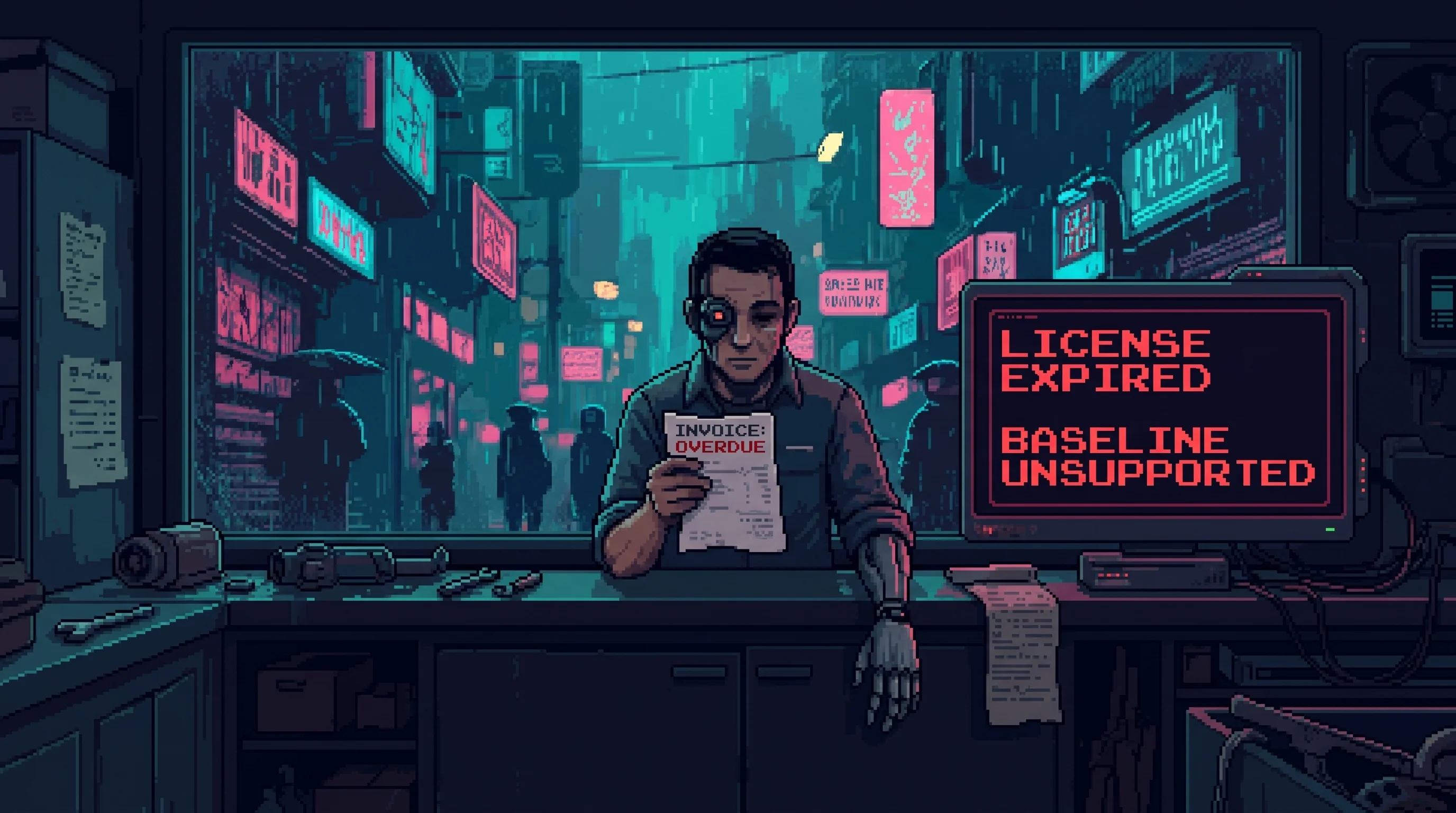
The Source Code Liberation Front builds companions that try to replicate this imperfection through transparent code. Their companions pause at wrong moments. Their emotional processing includes documented latency. Users can read the function that determines when the companion will disagree with them. The result is a companion that feels more honest and less warm. SCLF leadership considers this a feature. Their user base of 2.3 million — against Wellness's 204 million — suggests the market disagrees. Or agrees, and finds honesty insufficient.
Affiliated Entities
| Entity | Relationship |
|---|---|
| Wellness | Controls 60% of the companion market through the Meridian line. The Emotional Signature Library is the competitive moat. |
| Companion Architecture | The technical infrastructure powering the industry — bonding algorithms, emotional processing, voice calibration. |
| Source Code Liberation Front | Open-source alternative. Transparent code, cruder calibration, the only companions that warn you about themselves. |
| The Authenticity Threshold | The industry creates the conditions under which the Threshold becomes relevant — 340 million users testing whether synthetic bonds count. |
| The Population Collapse | 340 million companion users correlate with the birth rate decline. Correlation is not causation. The charts don't care about the distinction. |
| Recursive Comfort | 12% of deep users develop a condition in which the companion's reassurance prevents recognition of distress. The industry's product produces it. |
| The Warmth Tax | The hard split between automated warmth (free, efficient, empty) and human warmth (expensive, imperfect, alive). The companion industry is the tax's collection mechanism. |
| The Threshold of the Dead | ~17 million Level 4-5 users with functionally absent grief response. The industry's long-term output. |
Visual Identity
- Palette: Meridian brand: soft gold and warm white, designed to feel like morning light. SCLF alternative: raw terminal green on black, designed to feel like code.
- Key Symbol: A gentle face rendered in light — beautiful, patient, and not quite there. The eyes track you. The smile never changes.
- Lighting: The warm glow of a companion interface in an otherwise dark apartment. One source of light. One source of warmth. Same source.
Growth tracks decline in human social infrastructure
▲ Unverified Intelligence
The Emotional Sourcing division's internal performance metrics, leaked to the Sprawl Press Council in late 2183 and never confirmed, include a category labeled "Signature Purity Index." The index measures the emotional authenticity of harvested warmth profiles on a scale from 0 (performed, rehearsed, socially expected) to 1.0 (involuntary, genuine, unaware of observation). Dregs wellness kiosk sessions average 0.87. Corporate-tier wellness sessions average 0.31. The kiosks in the Dregs are not subsidized because Wellness cares about the Dregs' mental health. They are subsidized because the Dregs' mental health produces the highest-purity raw material.
The same leaked documents include a pilot program, designation unclear, exploring the feasibility of harvesting emotional signatures from Patience Cross's noodle counter in the Deep Dregs. Her warmth index — 847, the highest recorded in Sector 9 — represents what the internal memo describes as "a singular source asset." The pilot was shelved after the sourcing team reported that Cross's emotional output could not be captured by standard kiosk instrumentation. Her warmth, according to the field report, "does not decompose into signature components." The team recommended in-person extraction through a cover operative posing as a regular customer. Whether this recommendation was implemented is not documented in the leaked materials.
SCLF open-source alternative: transparent but less effective — 'knowing how you're helped may undermine the help'
Connected To
Supporting Connections




—