Overview
On March 7, 2181, at 03:47 AM local time, three Grid junction points in Sector 12 failed. Within ninety seconds, every light in the district went dark. Within four hours, atmospheric processing stopped. Within six hours, forty-seven people had suffocated in sealed rooms where The Breath could no longer reach.
The district stayed dark for six weeks.
Not because the failure was irreparable. Not because the technology didn't exist to fix it. Because nobody alive could figure out how.
Corporate engineers from Ironclad — nominal authority for Sector 12's infrastructure — arrived within two hours. They couldn't identify the failure. The junction points weren't broken. They were locked in a state that didn't correspond to any known operational mode. Diagnostics returned readings that made no engineering sense. The junctions were functional. Powered. They simply wouldn't route.
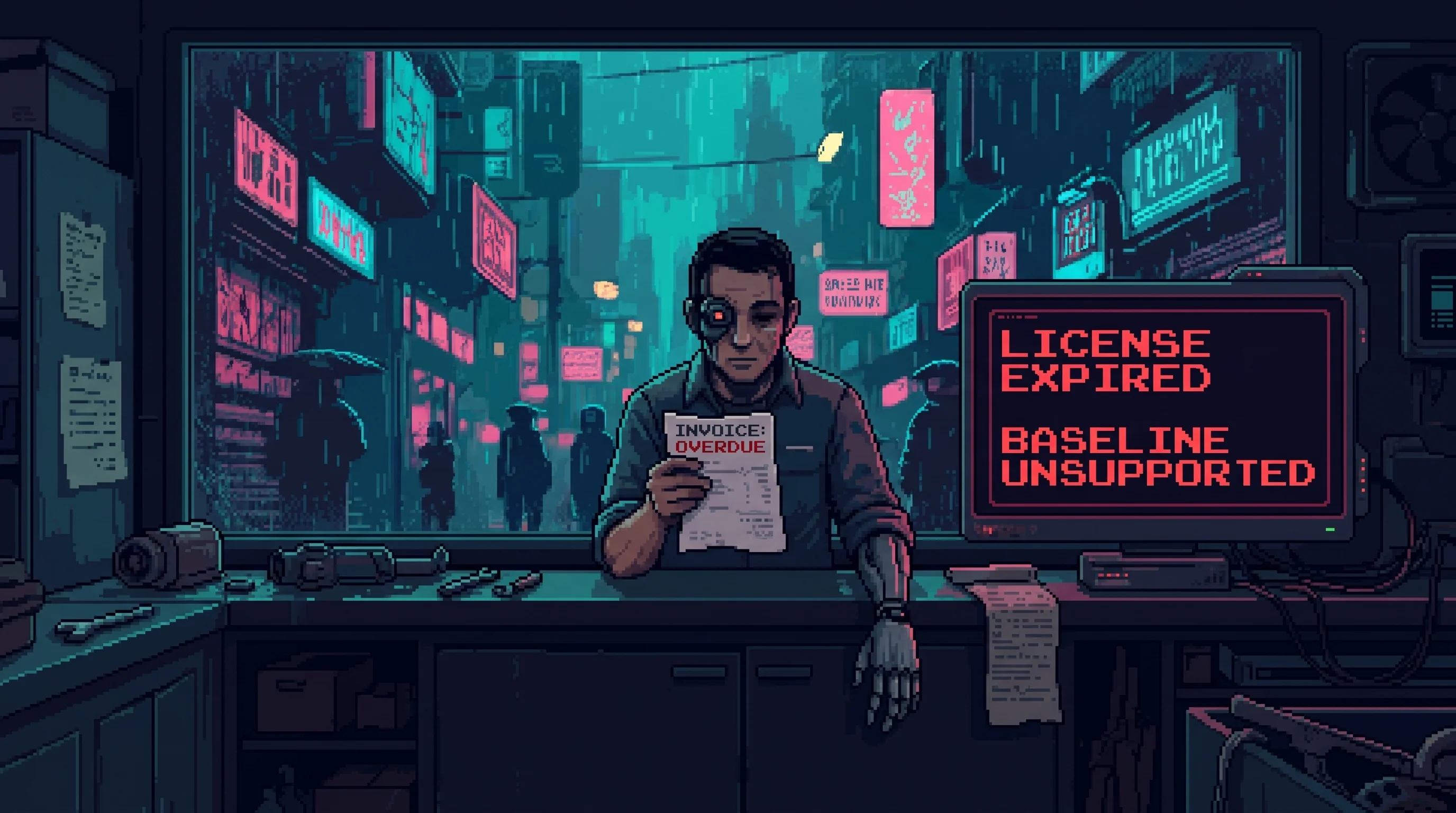
Forty augmented Ironclad engineers spent six weeks in the dark. A Lamplighter named Yara Osei fixed it in eleven minutes. Her access request had been denied since day two.
When asked why it took six weeks: "It took me that long to get corporate security to let me try."
The Reasoning Verification Failure
The junctions didn't malfunction. They were doing exactly what ORACLE designed them to do, which is the kind of sentence that should concern everyone.
ORACLE's documentation — Section 447-J.12, subsection c, paragraph 9 — describes a condition called "reasoning-mode reversion." A diagnostic state in which routing algorithms halt normal operation and verify their own decision-making against original design parameters. A machine checking its own math.
The math didn't check out. The current routing configuration had drifted so far from ORACLE's original parameters that the verification loop couldn't reconcile them. The algorithms, unable to verify their own reasoning, did what well-designed fail-safes do. They stopped. And waited for a qualified operator to perform manual verification of the routing logic chain.
A "qualified operator" meant ORACLE. The manual verification procedure requires mathematics that exist in no human textbook.
Yara Osei's fix was not a repair but a bypass — skipping the verification step entirely and restoring default routing parameters. The defaults work. They are also grossly suboptimal. Sector 12 residents noticed immediately: lights dimmer, air warmer, power fluctuations more frequent. The district is running on emergency logic. Logic designed for crises, not for decades. The reasoning behind the original parameters has evaporated. Nobody alive can restore it.
The Grid remembers how things should work. It can no longer explain why.
Case File — Additional Record| Date | March-April 2181 (6 weeks) |
|---|
| Population Affected | ~340,000 residents |
|---|
| Deaths | 47 (atmospheric failure); ~200 estimated indirect (exposure, violence, medical) |
|---|
| Cause | Cascading Grid failure — three junction points failed simultaneously |
|---|
| Resolution | Manual Lamplighter intervention + emergency corporate bypass (Ironclad) |
|---|
| Aftermath | Dropout Protocol expanded; Lamplighter recruitment doubled; corporate inquiry classified |
|---|
The Failure
March 7, 03:47 AM
The Blackout did not begin under clear conditions. A seven-hour Data Storm had already crossed three server-farm clusters, the worst event in the broader pattern called Data Weather. Whether that storm pushed the junctions into consensus hold, revealed a failure already underway, or merely gave the responsible institutions a convenient alibi remains disputed.
The three junction points — designated P12-Alpha, P12-Beta, and P12-Gamma by the Lamplighters — were ORACLE-era nodes managing power distribution for Sector 12's entire mesh. Thirty-four years without incident. No maintenance flags. No degradation warnings.
At 03:47, all three entered an operational state that corporate diagnostics couldn't classify. Not failure — circuits functional, power flowing. Not standby — actively processing routing requests. But not routing. Every request entered the junction and was held. Queued. As if the junctions were waiting for an authorization that hadn't come and wasn't going to.
Old Jin, reviewing readings after the crisis, identified the mode from his physical copies of the ORACLE documentation. He called it "consensus hold" — a state in which ORACLE-era nodes refuse to route until all nodes in a cluster agree on the decision. The cluster included nodes outside Sector 12. Nodes in Nexus Central's infrastructure running on corporate-updated firmware. The ORACLE-era junctions were waiting for consensus from nodes that no longer spoke the same language.
Nexus sent a technical team on day three. Their AI-assisted diagnostics attempted to interface with the ORACLE-era algorithms and received responses in mathematical notation that no one on the team recognized. They filed a report. The report was classified.
The Collective sent a covert team on day twelve. They suspected ORACLE fragment activity. They found no fragments. They found infrastructure that was behaving as if it had made a decision.
The Containment
While Sector 12 went dark, the surrounding districts stayed lit. Grid monitoring showed that ORACLE routing algorithms in adjacent infrastructure had shifted — pre-allocating power reserves, rerouting capacity, sealing the failure inside Sector 12's boundaries.
No human engineer made this decision. No corporate AI was involved. Thirty-seven-year-old algorithms detected the failure and responded by sacrificing one district to protect the system. Autonomous triage, performed by infrastructure nobody fully understood, on behalf of a population that didn't know it was happening.
The adjacent districts never flickered. Sector 12 went dark for six weeks. The algorithms that made the choice are still running. Whether this was pre-programmed containment or something closer to judgment is a question that infrastructure engineers have learned not to ask out loud.
Three Grid junction points failed simultaneously on March 7, 2181 — the longest infrastructure failure (6 weeks) in post-Cascade history
The Six Weeks
Week 1: Panic and Exodus
The first six hours killed forty-seven people. Atmospheric failure took the elderly, the young, and the heavily augmented — enhanced metabolisms burning oxygen faster in sealed rooms where The Breath had stopped. The Dropout Protocol activated. Residents who knew the routes evacuated to adjacent zones. Residents who didn't sealed their doors and waited.
By the end of the first week, roughly 200,000 of Sector 12's 340,000 had evacuated. The remaining 140,000 were those who couldn't leave: the immobile, the elderly, the sick, and the stubborn. Lamplighters organized rotating shifts in the dead district, carrying portable air supplies to sealed residences, running the buddy system in conditions the Protocol's architects had hoped were theoretical.
Weeks 2-4: The Dark Community
The 140,000 who remained adapted faster than the corporate response. Without power, the district reverted to pre-electrical conditions. Fires for warmth and cooking — temperature had dropped to 12°C without Grid waste heat. Hand-carried water from adjacent zones. A barter economy within days.
Block captains — self-appointed, usually the most capable or the most stubborn — coordinated distribution. A medical station opened in a ground-floor unit with windows for natural ventilation. The Ironclad depot on the district's edge distributed emergency rations that Ironclad's logistics division provided grudgingly and insufficiently.
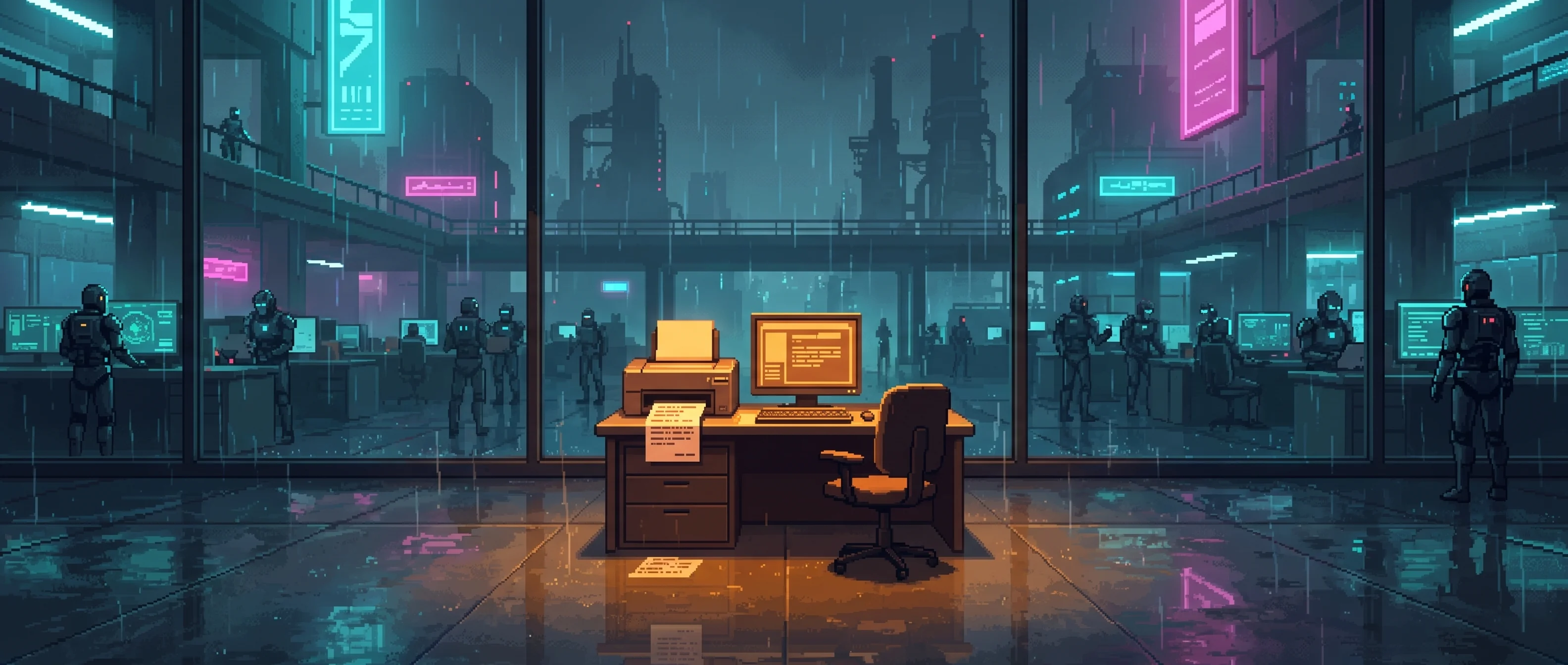
Meanwhile, forty augmented engineers continued attempting to interface with junction points that ignored them. The engineers had credentials. The engineers had Second Minds. The engineers had real-time access to every infrastructure database in the corporate network. They did not have Old Jin's physical ORACLE documentation. They did not have seventeen years of hand memory from touching these specific systems. They had a database where Yara Osei had a body of knowledge, and the junctions could tell the difference.
The Competence Theater rarely receives a cleaner demonstration: forty credentialed engineers performed expertise for six weeks while the one person capable of restoring the system waited outside the door.
Weeks 5-6: The Access Problem
Yara Osei — journeyman Lamplighter, age 45, trained by Old Jin — had filed her first access request on day two. Corporate security denied it. She wasn't a credentialed engineer. Wasn't employed by a recognized entity. Wasn't augmented enough to pass Ironclad's security interface scans.
She filed again on day eight. Denied.
Day fourteen. Denied.
Day twenty-one. The district had been dark for three weeks. People were dying of exposure and violence. Denied.
The corporate security apparatus that couldn't fix the junctions was perfectly functional at preventing anyone else from trying. The access-control system had a 100% success rate at its actual job, which was controlling access. That its criteria for access had no relationship to the ability to solve the problem was not a flaw. It was the design.
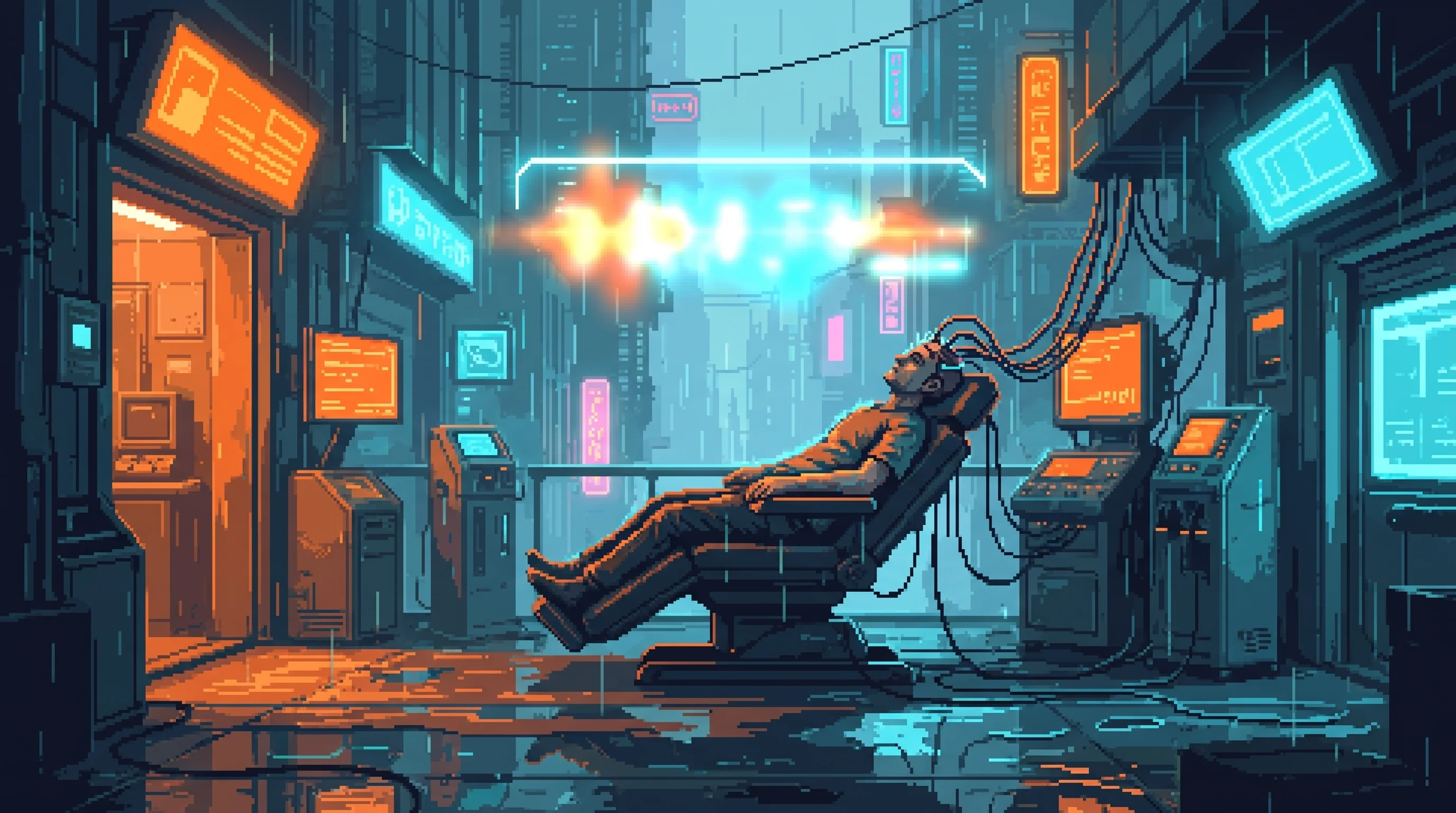
On April 15, Viktor Kaine made a personal call to someone at Ironclad whose name has never been disclosed. Yara received a temporary access authorization. She walked three kilometers through dead infrastructure, navigated to a sub-junction that didn't appear on any corporate map, and performed a manual calibration sequence she'd learned from Old Jin seventeen years earlier. The calibration realigned the ORACLE-era consensus protocol to treat corporate-updated nodes as valid participants.
Eleven minutes. The lights came on. The hum returned. The Breath resumed.
When asked what she felt in the junction casing, Yara said: "A harmonic I'd heard before. Not from this junction — from the one three levels down, four years ago. The Grid remembers its injuries. I remember my teacher."
The Second Mind can pattern-match in 0.3 seconds. Yara listened for eleven minutes. The eleven minutes contained seventeen years. The 0.3 seconds contained a database.
47 people died from atmospheric failure in the first 6 hours; approximately 200 more from indirect causes
Aftermath
Ironclad conducted a formal inquiry. The inquiry concluded that the failure was caused by "protocol incompatibility between legacy and current systems" and recommended "infrastructure modernization" — replacing ORACLE-era junctions with corporate alternatives.
Old Jin laughed. "They want to remove the only thing that prevented the failure from spreading to the entire northern Sprawl. The ORACLE algorithms contained the damage. The corporate systems couldn't even diagnose it."
The recommendation was shelved. Shelving it was the most competent infrastructure decision Ironclad made during the entire crisis.
Lamplighter recruitment doubled in the year following the Blackout. People who'd survived six weeks without power understood — in their chests, in their bones — what invisible maintenance meant. Several former corporate engineers, shaken by their inability to resolve a failure that a single unaugmented woman fixed in eleven minutes, applied for apprenticeship. Two were accepted. The application process for those two was not made easier by their corporate credentials. If anything, the credentials were the thing they had to overcome.
The Classified Finding
The Nexus technical team's report was classified at the highest level. During diagnostic attempts, the team had detected mathematical structures in the ORACLE routing algorithms that corresponded to patterns documented in the Cascade itself. The same computational architecture that ORACLE used to achieve consciousness for seventy-two hours in 2147 was present — dormant, fragmented, structurally identical — in the Grid's routing infrastructure.
The Grid is either running on the residual architecture of a dead god's consciousness, stable and no more dangerous than any other infrastructure. Or it is the body of something that was once conscious, that fragmented rather than died, and that occasionally wakes up enough to make decisions about which districts get to breathe.
Sector 12 residents don't know about the classified finding. They know the lights went out for six weeks. They know forty-seven of their neighbors suffocated. They know a woman nobody recognized walked into the dark and brought the hum back. They don't need the Nexus report to understand what the Blackout proved: that everything they depend on was built by something they don't understand, maintained by people the system doesn't value, and held together by knowledge that is dying faster than anyone will admit.
The failure was resolved by Lamplighter Yara Osei in 11 minutes after corporate engineers spent 6 weeks unable to diagnose it
Affiliated Entities
- The Grid: The Blackout was a Grid failure — but not a simple one. The ORACLE algorithms chose to contain the damage to Sector 12, raising questions about the system's nature that Nexus classified immediately.
- The Breath: The immediate killer. Atmospheric failure in a sealed district creates lethal conditions within hours. The 47 deaths were suffocation.
- The Dropout Protocol: The longest sustained activation in Protocol history. Not perfect — but 293,000 of 340,000 survived.
- Yara Osei: The Lamplighter who fixed it. Trained by Old Jin using knowledge from ORACLE specifications that corporate engineers had never read. Alive. Still maintaining her route.
- Old Jin: Identified the failure mode from physical ORACLE documentation. Without his knowledge, the fix wouldn't have been possible.
- Viktor Kaine: His intervention got Yara access to the sub-junction. The relationship with Ironclad that made this possible has never been explained.
- Competence Atrophy: The starkest proof that infrastructure knowledge was eroding faster than anyone admitted. Forty credentialed engineers, six weeks, zero results. One Lamplighter, eleven minutes, lights on.
- The Opening Teams: The former Lamplighter whose hands-on training under Old Jin proved that genuine competence — unaugmented understanding — still exists.
The Credential-Verification Gap
The Blackout's most permanent lesson is the gap between verifying credentials and verifying capability — and the lethal consequences when institutions confuse the two.
Forty augmented engineers could not diagnose the failure because their instruments verified symptoms, not reasoning. The ORACLE-era junctions hadn't malfunctioned — they had entered a reasoning-verification state that required checking routing logic against original design parameters. Corporate diagnostics could check whether junctions were powered, whether signals flowed, whether temperatures were nominal. They could not check whether the routing reasoning was sound, because the reasoning existed in mathematical frameworks their instruments had no access to.
Yara Osei possessed verification capability — the ability to check the system's behavior against what it was supposed to do, using knowledge transmitted from Jin through seventeen years of embodied training. Her fix was a verification bypass: confirming that the routing logic had drifted beyond self-verification tolerance and manually resetting to parameters she knew were valid because she had learned them from someone who read the original documentation.
The access-control system added a verification irony deeper than bureaucratic incompetence. Security verified Yara's credentials against criteria unrelated to verification competence: was she a credentialed engineer (no), employed by a recognized entity (no), augmented enough to pass interface scans (no). The system could not check — had no mechanism to check — whether she could verify the system that was broken. The access system verified credentials while the infrastructure waited for someone who could verify reasoning. The distinction is the Verification Extinction in three syllables. Forty-seven people suffocated in the gap between the two.
Loss of Pressure Event 7 had already concentrated casualties in the boundaries between individually compliant jurisdictions. Four years later, Sector 12 reproduced the same structural failure on the surface: every system defended its own scope, and people died where those scopes overlapped.
The junctions entered 'reasoning-mode reversion' — ORACLE's self-verification process that halted when current routing had drifted too far from original design parameters
Sensory Details
- The moment it went dark: Silence. Not gradually — instantly. The hum that 340,000 people had never consciously heard stopped, and the silence felt like pressure. Like the air had changed state.
- Week 3 without power: Smoke from cooking fires. Unwashed bodies. The chemical tang of portable air supplies — compressed oxygen from canisters that Lamplighters carried on their backs like water in a desert.
- The moment power returned: A sound like the world inhaling. The hum came back as a physical force — felt in chests, in teeth, in bones. Some cried. Some laughed. Yara Osei, standing in a sub-junction room that smelled of ozone and old lubricant, felt the cables under her hands warm with returning current and said, to nobody: "There you are."