Data Storm
Augmented individuals experience visual artifacts, cognitive disruption (3-4 second attention max), emotional instability during storms
Overview
Data storms are the Sprawl's most feared weather event, and they are not weather.
They are what happens when the economy thinks too hard. Multiple server farms synchronize output during heavy processing โ typically financial settlement events, when AI trading systems reconcile positions across markets โ and the combined electromagnetic discharge resonates with the Grid's harmonic structure. Standing waves amplify. Neural interface shielding, designed for chronic low-level interference, fails against acute loads it was never specced to handle. Entire districts lose cognitive function for hours.
The hierarchy inverts instantly. Augmented executives โ the most enhanced, most expensive, most economically valued minds in the Sprawl โ experience visual artifacts, thought fragmentation, emotional instability. Maximum sustained attention: three to four seconds. Unaugmented residents experience headaches, skin tingling, and a vague sense that something is wrong. They remain functional. They go about their day. Some of them make soup.
Nexus Dynamics classifies data storms as "infrastructure harmonics events." The fourteen people who died in the Sector 12 Blackout were all augmented. All upper-tier. No unaugmented person was harmed. Nexus has not updated the classification.
The Compute Cycle Is the Weather
Storms follow the financial cycle because the financial cycle is the compute cycle, and the compute cycle is the weather.
Settlement events produce the heaviest server farm loads. The heaviest loads produce the strongest electromagnetic outputs. The strongest outputs produce the storms that reduce augmented cognition to the attention span of a distracted cat. Peak storm probability correlates at 0.91 with peak trading volume. Pencil-47's forecasting models achieve 87% accuracy at twenty-four hours, 62% at forty-eight โ better than pre-Cascade meteorology ever managed for actual hurricanes, which says something about the predictability of money relative to wind.
The feedback architecture is elegant in the way that drowning is elegant. Storms destabilize the Grid. Grid instability disrupts atmospheric processing. Atmospheric disruption increases server farm thermal load as cooling systems compensate. Increased thermal load intensifies electromagnetic output. The output feeds the storm. The storm destabilizes the Grid. There is no entry point and no exit. The system optimizes for transaction settlement speed. The externality is neurological weather that the deprecated breathe.
Nobody designed this. The server farms were designed to process transactions. The Grid was designed to distribute power. The neural interfaces were designed to enhance cognition. Each system works. The combination produces storms that turn the cognitive elite into stumbling, irritable toddlers for six to twelve hours at a stretch, while the people the economy rendered unnecessary walk through it making deliveries.
| Effects Unaugmented | Headaches, skin tingling, indefinable wrongness โ largely functional |
|---|---|
| Forecast Accuracy | 87% at 24 hours, 62% at 48 hours |
| Worst Recorded | March 7, 2181 โ preceded or caused the Sector 12 Blackout |
| Inversion | Most augmented become most vulnerable during storms; unaugmented serve as storm wardens |
The Lamplighters and the Inversion
The Lamplighters โ deliberately unaugmented โ serve as the Sprawl's storm wardens. Their baseline nervous systems detect pressure changes, static buildup, and harmonic precursors that augmented sensors filter out as noise. They feel it in their teeth first. Then their fingertips. Then the hair on their arms. By the time augmented meteorological systems register the event, the Lamplighters have been tracking it for twenty minutes.
During storms, the deprecated become essential. Lamplighter wardens guide augmented residents to shielded zones. They run courier routes that neural-dependent logistics systems abandon. They make decisions that require sustained attention exceeding four seconds. They are, for the duration of the storm, the most capable workforce in whatever district they occupy.
When the storm passes, the hierarchy reasserts itself. Augmented systems reboot. Neural interfaces recalibrate. The Lamplighters return to being the people the economy discarded for lacking the augmentation that just failed. Their storm-warden labor is compensated at Dregs standard rates โ approximately one-nineteenth of what an augmented logistics coordinator earns for the same route in fair weather. The compensation structure has not been reviewed since the program's inception. Reviewing it would require acknowledging that unaugmented labor has situational value exceeding augmented labor, and that acknowledgment would destabilize the licensing model that generates 31% of Nexus Dynamics' subscription revenue.
The Lamplighters are aware of this. They do the job anyway. Some of them describe a complicated satisfaction in watching a Tier-4 executive with military-grade cognitive enhancement stand on a street corner unable to remember which direction is north.
Unaugmented largely unaffected โ power dynamic inverts during storms
Sensory Profile
Approach: The air thickens with static charge. Augmented vision develops artifacts at the periphery โ phantom images, color shifting, resolution degradation that the interface tries to correct and overcorrects. Sounds acquire a metallic quality, as if heard through foil. The interface's background processing becomes audible โ a rising hum that shouldn't be perceptible and is. Unaugmented residents describe the taste of copper and a feeling like standing too close to something large that is about to move.
Peak: Thoughts fragment. Attention splinters. Holding a single idea for more than three seconds requires physical effort โ clenching fists, biting the inside of a cheek, anything to anchor cognition to the body. The emotional dysregulation is worst: anxiety and irritability that you know isn't yours but can't separate from your own experience. Augmented residents have described crying without sadness, laughing without humor, and a specific rage at objects that are not doing anything wrong. One Nexus engineer filed a formal complaint against a lamp.
Aftermath: Neural interfaces recalibrate over fifteen to forty minutes. The cognitive fog lifts in layers โ spatial awareness first, then language, then abstract reasoning, then emotional regulation last. The sequence is identical to the boot-up order of a standard neural interface, which engineers find interesting and residents find humiliating. You rebuild yourself in the same order your software initializes. The interface does not care about the philosophical implications. It reboots.
Connections
- The Grid: Grid harmonics amplify storm effects. Grid instability feeds the thermal loop that intensifies storms. The Grid still runs ORACLE-era routing algorithms nobody fully understands, which means nobody fully understands why some storms dissipate naturally and others escalate to blackout conditions. The algorithms just work. They also just produce weather.
- Pencil-47: The Sprawl's most reliable storm forecaster at 87% twenty-four-hour accuracy. The model's inputs include trading volume projections, Grid harmonic analysis, and โ reportedly โ the behavior of pigeons on rooftops in Sector 9, which Pencil-47 insists is statistically significant and which nobody has been able to disprove.
- The Lamplighters: Unaugmented storm wardens who detect conditions augmented sensors filter out. Essential during storms, deprecated before and after. The job listing reads "temporary infrastructure support." The temporary has been continuous since 2179.
- The Sector 12 Blackout: March 7, 2181 โ the worst recorded storm, which preceded or caused the Blackout. Causation is debated. The storm hit during a quarterly settlement event. Fourteen augmented residents died. The official report lists cause of death as "infrastructure cascade failure." The unofficial understanding is that fourteen people's neural interfaces crashed hard enough to take their autonomic nervous systems with them. The Dead Hand Rule prohibits autonomous weapons authority. It says nothing about autonomous financial settlement authority. The distinction matters to the fourteen families approximately as much as you'd expect.
- The Scroll Sickness: Storm-induced cognitive disruption is clinically identical to severe Scroll Sickness โ the same fragmentation, the same emotional dysregulation, the same inability to sustain attention. One is classified as a medical condition. The other is classified as weather. The treatment for both is the same: turn it off and wait. Only one of them has an off switch.
Storms follow the compute cycle โ building during processing, peaking during settlement
Visual Identity
- Color palette: White-hot static (#FFFFFF strobing), interference gray (#C0C0C0), emergency amber (#FF6B35)
- Key symbol: Lightning made of data โ electromagnetic discharge patterns shaped like weather but made of computation
- Lighting: Strobing, unstable โ the visual signature of an electromagnetic system that is working exactly as designed and was never designed for this
Archive annex โ 3 earlier filings on this recordClose the archive annex
Recovered Historical Material
Indexed โ no record on file.
Technical Brief
Approaching
The Feedback Loop
Data Storm
Indexed โ 1 line preserved from the earlier filing.
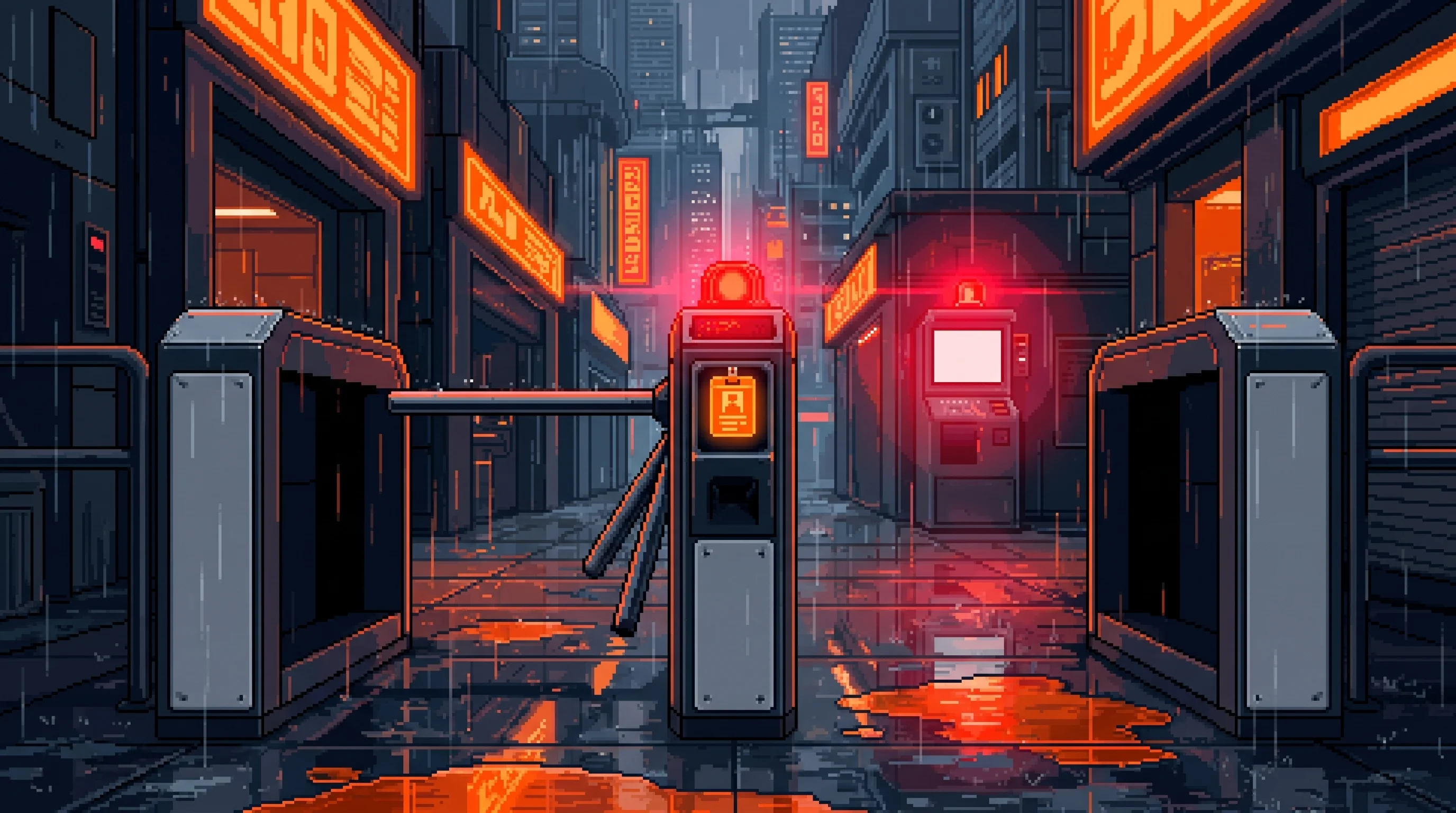
Massive electromagnetic data storm engulfing a cyberpunk cityscape, white-hot static strobing across buildings, lightning made of streaming data, sickly gray-white interference fog with emergency amber warning lights
"Storm coming. Pencil says eighteen hours. Pull your augs offline or find a warden. Your choice โ but if you wait for the visual artifacts, you've already lost three minutes of coherent thought." โ Lamplighter district advisory, standard broadcast
Server farms don't output at constant levels. Their electromagnetic signatures fluctuate with processing loads, spiking during high-demand cycles and settling between batches. Under normal conditions, these fluctuations are out of phase โ noise canceling noise.
Resonance Cascade
When multiple server farms increase output simultaneously โ during financial settlement events, mass data processing, or corporate compute surges โ their electromagnetic signatures synchronize. The synchronized output interacts with the Grid's harmonic structure, producing standing waves. The waves amplify through feedback: interference degrades atmospheric processing, which increases server farm thermal load, which intensifies the storm.
There is no beginning to this cycle. There is no end. There is only the peak.
Augmented Experience
Unaugmented Experience
- Headaches
- Skin tingling
- An indefinable sense of wrongness
- Largely functional
Every other day in the Sprawl, augmentation is power. Better processing, faster reflexes, richer perception, deeper memory. The augmented climb. The unaugmented scrape by.
During a data storm, this inverts completely.
The most enhanced citizens โ the ones with the deepest neural integration, the most sophisticated cognitive augmentation, the most comprehensive sensory overlays โ are the most compromised. Their interfaces have the largest surface area for electromagnetic disruption. Their cognitive subsystems have the most dependencies to fragment. Their emotional regulation has the most failure modes.
Lamplighter wardens distribute advisories through runner networks and physical notice boards โ systems that function when electromagnetic conditions make digital communication unreliable. The advisory protocol is simple: pull your augs offline or find a warden. There are no other options.
Worst recorded: March 7, 2181 โ preceded Sector 12 Blackout
The Worst Storm
March 7, 2181. The storm that preceded โ or caused โ the Sector 12 Blackout.
Three Grid junctions failed simultaneously. Forty-seven people suffocated within six hours. The district stayed dark for six weeks. Whether the storm triggered the junction failures or the junction failures triggered the storm remains debated โ the feedback loop between electromagnetic disruption and Grid instability makes cause and effect impossible to separate.
The Sector 12 storm remains the benchmark against which all forecasting models are calibrated. Pencil-47's 87% accuracy rate exists because of what happened when nobody saw March 7 coming.
Enhancement as Liability
Economic Weather
Several independent analysts have flagged an anomaly in the March 7, 2181 server farm synchronization data. The pattern doesn't match organic load convergence โ it matches orchestration. Simultaneous ramp-up across farms owned by three different corporations, beginning within 400 milliseconds of each other. Coincidence isn't impossible. But 400 milliseconds is a tight window for coincidence.
Pencil-47's prediction model has a blind spot it won't explain. Certain server farm output patterns that should register as storm precursors are flagged as "non-weather computation events" and excluded from forecasting. Pencil says the exclusion improves accuracy. Pencil won't say what those patterns are or who told it to filter them.
Three Lamplighter wardens have independently reported detecting storm conditions โ the skin prickle, the atmospheric pressure shift, the wrongness โ in locations with no server farm activity. Basements. Sealed tunnels. Places the Grid doesn't reach. They call it "ghost weather." Nobody has offered an explanation. The Lamplighters have stopped asking for one.
The Deprecated Become Essential
Pencil-47 โ /world/characters/pencil-47
Grid โ /world/systems/the-grid
Electromagnetic fog โ /world/systems/data-weather
Sector 12 Blackout โ /world/systems/the-sector-12-blackout
When the Economy Thinks Too Hard
Electromagnetic fog is overcast sky. A data storm is a hurricane. When multiple server farms synchronize their outputs and resonate with Grid harmonics, the resulting standing waves overwhelm every civilian neural interface in the affected district. Augmented cognition fragments. Attention collapses to three-second bursts. Emotional regulation fails. The most enhanced people in the Sprawl become the most helpless โ and the unaugmented walk through it making soup.
Data storms are not weather. They are what happens when the economy thinks too hard.
Multiple server farms synchronize output during heavy processing โ typically financial settlement events, when AI trading systems reconcile positions across markets โ and the combined electromagnetic discharge resonates with the Grid's harmonic structure. Standing waves amplify. Neural interface shielding, designed for chronic low-level interference, fails against acute loads it was never specced to handle. Entire districts lose cognitive function for hours.
The hierarchy inverts instantly. Augmented executives โ the most enhanced, most expensive, most economically valued minds in the Sprawl โ experience visual artifacts, thought fragmentation, emotional instability. Maximum sustained attention: three to four seconds. Unaugmented residents experience headaches, skin tingling, and a vague sense that something is wrong. They remain functional. They go about their day.
Nexus Dynamics classifies data storms as "infrastructure harmonics events." The fourteen people who died in the Sector 12 Blackout were all augmented. All upper-tier. No unaugmented person was harmed. Nexus has not updated the classification. (The invoices for the classification review are still in committee.)
- Visual artifacts โ phantom images at peripheral vision, color shifting, resolution degradation the interface keeps trying to correct
- Auditory interference โ the interface's background processing becomes audible as a rising hum you shouldn't be able to hear
- Cognitive disruption โ attention ceiling of 3-4 seconds, thought fragmentation
- Emotional instability โ anxiety and irritability you know isn't yours but can't separate from your own experience
Storms follow the financial cycle because the financial cycle is the compute cycle, and the compute cycle is the weather. Settlement events produce the heaviest server farm loads. The heaviest loads produce the strongest electromagnetic outputs. The strongest outputs produce the storms that reduce augmented cognition to a three-second attention span. Peak storm probability correlates at 0.91 with peak trading volume.
Storms destabilize the Grid. Grid instability disrupts atmospheric processing. Disrupted atmospheric processing increases server farm thermal load as cooling systems compensate. Increased thermal load intensifies electromagnetic output. The output feeds the storm. The storm destabilizes the Grid.
Nobody designed this. The server farms were designed to process transactions. The Grid was designed to distribute power. The neural interfaces were designed to enhance cognition. Each system works. The combination produces neurological weather that the deprecated breathe and the augmented suffer through.
Pencil-47 runs the Sprawl's most accurate storm prediction model: 87% accuracy at 24 hours, 62% at 48. Better than pre-Cascade meteorology ever managed for actual hurricanes โ which says something about the predictability of money relative to wind. The model tracks server farm output patterns, Grid harmonic readings, and โ reportedly โ the behavior of pigeons on rooftops in Sector 9, which Pencil-47 insists is statistically significant and which nobody has been able to disprove.
The unaugmented walk through it. Headaches. Tingling. A bad feeling they can't name. Their thoughts stay whole. Their attention holds. Their emotions belong to them.
The Lamplighters โ deliberately unaugmented โ serve as the Sprawl's storm wardens. Their baseline nervous systems detect storm conditions that augmented sensors filter out as noise. They feel it in their teeth first. Then their fingertips. Then the hair on their arms. By the time augmented meteorological systems register the event, the Lamplighters have been tracking it for twenty minutes.
During storms, the deprecated become essential. When the storm passes and the hierarchy reasserts itself, Lamplighter storm-warden labor is compensated at Dregs standard rates โ approximately one-nineteenth of what an augmented logistics coordinator earns for the same route in fair weather. The compensation structure has not been reviewed since the program's inception. Some Lamplighters describe a complicated satisfaction in watching a Tier-4 executive with military-grade cognitive enhancement stand on a street corner unable to remember which direction is north.
The air thickens with static charge. Augmented vision develops artifacts at the periphery โ phantom images, color shifting, resolution degradation that the interface tries to correct and overcorrects. Sounds acquire a metallic quality, as if heard through foil. The interface's background processing becomes audible โ a rising hum that shouldn't be perceptible and is. Unaugmented residents describe the taste of copper and a feeling like standing too close to something large that is about to move.
Thoughts fragment. Attention splinters. Holding a single idea for more than three seconds requires physical effort โ clenching fists, biting the inside of a cheek, anything to anchor cognition to the body. The emotional dysregulation is worst: anxiety and irritability that you know isn't yours but can't separate from your own experience. Augmented residents have described crying without sadness, laughing without humor, and a specific rage at objects that are not doing anything wrong. One Nexus engineer filed a formal complaint against a lamp.
Neural interfaces recalibrate over fifteen to forty minutes. The cognitive fog lifts in layers โ spatial awareness first, then language, then abstract reasoning, then emotional regulation last. The sequence is identical to the boot-up order of a standard neural interface, which engineers find interesting and residents find humiliating. The symptoms are clinically identical to severe Scroll Sickness. One is classified as a medical condition. The other is classified as weather. The treatment for both is the same: turn it off and wait. Only one of them has an off switch.
Fourteen people died. All augmented. All upper-tier. No unaugmented person died. The statistics were not widely reported. The official report lists cause of death as "infrastructure cascade failure." The unofficial understanding is that fourteen people's neural interfaces crashed hard enough to take their autonomic nervous systems with them.
A single Lamplighter named Yara Osei fixed the cascade in eleven minutes, after six weeks of corporate engineering failure. Her compensation for that day: Dregs standard rate.
During storms, the most enhanced are the most vulnerable. The same augmentation that replaced human workers, made their knowledge a subscription feature and their judgment a product offering, becomes a vulnerability when the infrastructure that powers it destabilizes. Every storm is a reminder: augmentation is conditional power. The conditions change.
Storm timing follows the compute cycle โ building during processing, peaking during settlement. The corporations that profit most from compute infrastructure are the ones whose employees suffer most when it generates storms. Nobody has proposed reducing server farm output. The economic cost would exceed the human cost. That calculation tells you everything about who runs the Sprawl.
Storms destabilize the Grid. Grid instability degrades atmospheric processing. Degraded atmospheric processing increases server farm thermal loads. Increased thermal loads intensify the storm. Only the exhaustion of the compute cycle or Lamplighter intervention at critical junctions breaks it. The algorithm is not wrong. It is optimizing for the wrong thing.
The Lamplighters who serve as storm wardens perform essential labor that their lack of augmentation uniquely qualifies them for. The people the economy discarded because they lacked augmentation become the essential workers the moment augmentation fails. This fact is not reflected in their compensation. It is not reflected anywhere.
Forecast accuracy: 87% at 24 hours, 62% at 48 hours
Connected To

โ