Basic neural interfaces are universal by 2184 — every citizen has a standardized neural access point installed during childhood
Scene ReferenceTechnology of the Sprawl
Overview
Every citizen of the Sprawl has a hole in the back of their skull. It is installed during childhood, typically between ages two and four, in a procedure covered by all corporate health plans and required by none of them. The procedure is elective. Enrollment rates have held at 98% for the past decade. The 2% who decline are not penalized. They simply cannot access the network, verify their identity, process payments, receive emergency medical telemetry, or participate in any system that assumes — correctly, in 98% of cases — that you have a port.
The question in 2184 is not whether you are augmented. The question is how much of what you experience is still arriving through original equipment.
Neural Interfaces
The Standard Port
A titanium-cased neural access point installed at the base of the skull. Nexus Dynamics manufactures 74% of ports currently in circulation. Helix Biotech handles the biological integration. The installation is painless, fast, and produces a small scar that children learn to stop noticing around the same age they learn to stop noticing breathing.
The Standard Port provides network access, identity verification, payment processing, basic AR overlay, and emergency medical telemetry. It also provides Nexus Dynamics with a continuous, granular, irrevocable data stream from every neural event that crosses the port's threshold. This is disclosed on page 94 of the installation consent form, which is signed by the parents of a two-year-old.
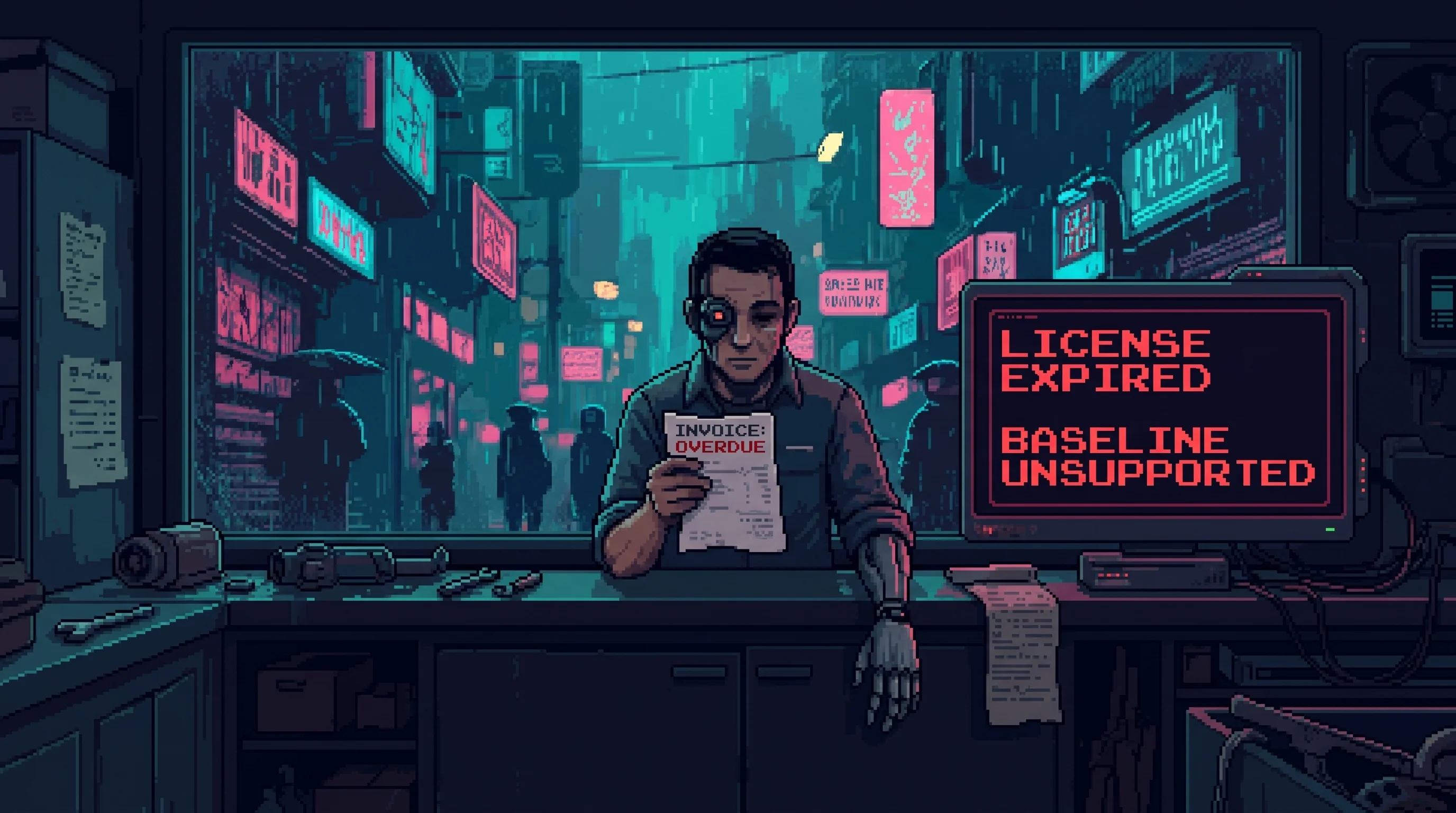
Forty percent of the Sprawl's computational infrastructure runs through Nexus. The Standard Port is how they maintain that number. Not through quality. Through architecture. Every port ships with identical hardware — capability differences are determined entirely by licensing key, which is determined entirely by what you can pay. The titanium casing is the same in the Heights and the Dregs. What flows through it is not.
Most people never upgrade beyond the Standard Port. It works. It keeps you in the system. The system keeps you in the system. The port is just the door.
Consumer Augmentation
What money buys above baseline is sensory range, cognitive speed, and the quiet luxury of fewer limitations.
Optical implants offer low-light vision, zoom, recording, and AR integration. Helix markets the HelixSight line as "seeing the world as it truly is." What the world truly is, per HelixSight's default calibration, includes a persistent AR layer of Triumph Social notifications, Good Fortune credit offers, and Wholesome meal suggestions geotagged to your current location. Disabling the commercial layer requires a HelixSight Premium license. Approximately 11% of HelixSight users have purchased Premium. The remaining 89% see the world as it truly is, plus advertisements.
Audio processing provides directional hearing, real-time translation, ambient filtering, and what Nexus calls "conversational optimization" — the implant identifies which speaker in a room is most relevant to your professional objectives and amplifies them while suppressing others. Users report improved networking outcomes. Users do not report what they've stopped hearing.
Cognitive co-processors handle calculation, logistics, probability modeling, and memory expansion through external storage accessible via neural link. Reflex boosters reduce reaction time through nerve signal acceleration. Language modules provide real-time translation with optional accent modification — a feature marketed toward corporate environments where "regional speech patterns may create unnecessary friction." The modules sell particularly well in the Dregs, where the friction being eliminated is the sound of being from the Dregs.
Subvocal communication allows silent speech through thought interpretation. Direct neural-to-neural transmission at limited range. Multi-threaded conversation management — carry three dialogues simultaneously, which corporate productivity research has identified as the minimum viable social load for mid-level Nexus employees. Encryption layers promise that private thoughts stay private. Nexus's end-user license agreement defines "private" in a manner that has been contested in eleven separate jurisdictions. The cases are ongoing. The monitoring is also ongoing.
Professional Grade
Corporate Standard augmentation — Nexus tier — includes an integrated productivity suite (always on, always optimized), a collaboration mesh for seamless information sharing with colleagues, and a loyalty architecture that provides subtle enforcement of corporate priorities through dopamine modulation during task completion. The package also includes a kill switch. Corporate property includes your enhancements. Termination of employment triggers a 72-hour grace period to purchase your augmentations at fair market price. Fair market price is determined by Nexus. Sixty-three percent of terminated employees cannot afford the buyout. Their augmentations are remotely downgraded to Standard Port functionality. Former Nexus directors have described the experience as "losing a sense you didn't know you had" — a quote that appeared in a whistleblower's deposition and, within a week, in a Nexus recruitment ad. The ad performed well.
Military Specification chrome integrates combat targeting, threat detection, squad coordination, selective pain management, automatic trauma response, and a dead man's switch that scrubs operational data upon biometric cessation. The body falls. The data doesn't. Military-spec augmentation is restricted to licensed security forces, corporate military divisions, and approximately 340 unlicensed combatants in the Dregs who acquired theirs through channels that Ironclad Industries officially describes as "outside our distribution model."
Ripperdoc work is everything the licensed system won't touch. Custom modifications unavailable commercially. No corporate oversight, no kill switches, no mandatory logging. Quality ranges from "better than anything Nexus sells" to "you will die on this table." The ripperdoc economy exists because the licensed system produces augmentations that serve the manufacturer first and the user second, and a nonzero percentage of the population has decided they'd rather risk death on an unlicensed table than certainty of surveillance on a licensed one. The demand has not decreased. The supply has not improved. The funerals continue at a stable rate.
Neural interface installation in a ripperdoc clinic — surgical precision meets underground medicine
Cyberdecks
A cyberdeck is a portable computer designed for network intrusion. Neural interfaces connect you to the network. Cyberdecks let you rewrite it. The difference between reading and writing, applied to infrastructure that controls power grids, atmospheric processors, security systems, and financial networks. The Dead Hand Rule forbids AI systems from possessing autonomous weapons authority. It says nothing about a person with a deck and bad intentions.
Form Factors
Wrist-mounted units — street level. Basic, single-task processing, limited volatile storage. Often built into jewelry, work gloves, or accessories. The typical user is a salvager, a small-time data thief, or someone who found one in a pile of e-waste and taught themselves enough to be dangerous, which in the Dregs is a career path.
Handheld rigs — professional grade. Multi-threaded parallel processing, substantial encrypted storage, physical keyboard with neural link hybrid interface. The physical keyboard persists because experienced netrunners discovered that muscle memory provides a cognitive anchor during deep-network immersion that pure neural input does not. Nexus published research in 2179 calling physical keyboards "an obsolete affectation." Sales of physical keyboards increased 14% the following quarter. The typical user is a corporate netrunner, a Collective operative, or a serious criminal — categories that overlap more than any of them would prefer to acknowledge.
Implanted decks — elite. Internal hardware distributed across multiple implant sites, processing at near-AI levels during full engagement, massive storage with biological memory components, pure thought interface. No external action required. The typical user is corporate special operations, the Invested, or the exceptionally rare independent who can afford both the installation and the Helix surgeon willing to perform it outside corporate channels. The surgeon's fee is not the expensive part. The silence is.
Portable rigs — specialist. Backpack-sized deployable systems with server-class processing, effectively unlimited compressed storage, and full-immersion neural interface capability. Network architects, military specialists, and researchers who need to sustain operations in hostile digital environments for hours. A portable rig operator in full immersion is physically helpless — a body sitting in a room while the mind is elsewhere. Most operators work in pairs. The partner watches the door.
Notable Models
The Nexus OracleLink is corporate standard. Excellent performance within approved parameters, mandatory logging, built-in backdoors, and network restrictions that prevent operation against Nexus systems. Market share: 61%. Customer satisfaction surveys: 4.3 out of 5 stars. The surveys do not ask whether customers are satisfied with the backdoors. The rating reflects what the rating measures.
The Ironclad Sledge is an industrial intrusion platform. Brute-force focused, minimal subtlety, built to survive environments that would kill the operator before the hardware. Designed for power infrastructure and manufacturing systems. Ironclad's marketing: "When the network says no, say it louder."
The Collective Phantom is privacy-focused hardware circulated through underground channels. Minimal signal signature, excellent mask generation, weak raw processing. Modular, easily customized, designed by people who believe that if Nexus can't trace it, Nexus can't control it. The Collective distributes Phantoms at cost. The cost is lower than any commercial deck. The subsidy comes from somewhere the Collective does not discuss.
Ripperdoc specials are one-of-a-kind builds. Performance varies between transcendent and catastrophic, sometimes within the same session. May include pre-Cascade components — salvaged processing cores from systems built before ORACLE's collapse that occasionally demonstrate capabilities no modern manufacturer can replicate or explain. The components are not always well-understood by the ripperdocs installing them. This does not slow installation.
Cyberdeck form factors range from wrist-mounted (street level) to implanted (elite) to portable rigs (specialist)
Weapons
Projectile Systems
The propellant-pushes-projectile model has survived two centuries of technological revolution for the same reason bladed weapons survived the invention of gunpowder: simplicity is hard to kill.
Modern firearms augment the basic principle with smart ammunition (guided rounds, EMP payloads, micro-explosive tips), biometric locks (the weapon fires for its registered owner and becomes an expensive paperweight for anyone else), neural integration (point-and-think targeting that reduces the gap between intent and impact to the speed of a synapse), and recoil compensation that allows a 60-kilogram person to fire a weapon designed for a 120-kilogram frame. Helix markets this last feature as "democratizing personal defense." The feature's primary market is corporate security forces who discovered that smaller operators cost less.
Street pieces are cheap, unreliable, and everywhere — the gun you find in a drainage gutter, the gun you buy for forty credits from someone who doesn't ask questions, the gun that misfires one round in nine. The Dregs runs on street pieces. Ironclad does not officially manufacture them. Ironclad's subsidiary, which operates under a different name in a different sector and files taxes in a different jurisdiction, manufactures 40% of the street pieces in circulation.
Railguns use electromagnetic acceleration instead of chemical propellant. Extremely high velocity. Extremely high power draw. Used for anti-vehicle operations, orbital defense platforms, Ironclad heavy security details, and the occasional individual who values the statement a railgun makes over the practicalities of carrying one. The statement is: I can afford the power cell.
Energy Systems
Laser platforms — concentrated light, clean, precise, hungry for power. The Sprawl's cutting lasers were industrial tools before they were weapons. The repurposing required removing a safety interlock and changing nothing else. Pulse lasers are military anti-personnel. Continuous-beam systems are rare, classified, and capable of cutting through structural walls at distances that make the Dead Hand Rule's focus on AI autonomy feel like it's solving the wrong problem.
Plasma projectors fire contained plasma bolts. Spectacular visual signature, devastating impact area, notorious unreliability. Short range, high damage, prone to catastrophic malfunction in the 4-7% range depending on manufacturer and maintenance history. Favored by people who have decided that looking terrifying is worth a 1-in-20 chance of the weapon detonating in their hand.
EMP generators kill electronics. Crude, effective, theoretically non-lethal to biological targets. The "theoretically" does significant work in that sentence. A person with no augmentations survives an EMP pulse with a headache. A person with a Standard Port experiences temporary disorientation. A person with Corporate Standard augmentation, cognitive co-processors, optical implants, and a reflex booster — a configuration that describes approximately 34% of the Sprawl's employed population — experiences what survivors describe as "being unplugged from yourself." Recovery takes hours. The psychological effects take longer. EMP weapons are classified as non-lethal. The classification was made by people whose augmentation level allows them to survive one.
Neural Weapons
Neural disruptors attack the nervous system directly. No visible damage. Pain inducers, paralysis fields, seizure triggers, consciousness interrupters — the terminology is clinical, the experience is not. Cyberware-targeted attacks are more sophisticated: override signals that hijack augmented limbs, feedback loops that turn sensory implants into pain delivery systems, system crashes that brick neural architecture and leave the victim with the cognitive capacity they were born with, which after decades of augmented living feels less like a baseline and more like a lobotomy.
The Flatline Special — a neural weapon that severs the connection between consciousness and body — is extremely illegal in every corporate territory, autonomous zone, and settlement that maintains a legal code. The body continues to breathe. The lights stay on. Nobody's home. Manufacturing, possession, and use carry penalties that most jurisdictions classify alongside war crimes. Black market units sell for between 80,000 and 200,000 credits. The price has been stable for three years, which suggests stable demand, which suggests the penalties are not working as designed.
Melee
In a world of biometric locks, smart-gun restrictions, and EMP vulnerabilities, there is a persistent market for weapons with no electronics to hack, no ammunition to exhaust, no firmware to update, and no licensing key to revoke.
Monofilament-edged blades cut through most materials rated below military-grade. Vibration blades oscillate for enhanced cutting. Heated edges cauterize as they go. Implanted blades deploy from forearms, fingers, or custom housings — the ripperdoc's creativity is the only constraint. Shock batons discharge on contact. Gravity hammers manipulate local mass for impacts that structural engineers describe as "architecturally significant."
The Dregs has a saying: a knife doesn't need a software update. This is not philosophy. It's a procurement strategy.
The Sprawl's technology marketplace — vendors, implants, and upgrades across every vertical layer
Transportation
Ground and Vertical
The Sprawl is vertical. Eighty-seven percent of daily transit involves elevation change. Getting across matters less than getting up.
Automated ground traffic handles most horizontal movement. Self-driving, networked, monitored. Nexus controls the traffic mesh. Manual override exists — for emergencies, for those who pay the premium license, and for the unlicensed vehicles in the Dregs that were never on the network to begin with. Corporate fleet vehicles are tracked, scheduled, and route-optimized by algorithms that know where you're going before you've decided, because they've already analyzed your calendar, your purchase history, and the traffic patterns of the 40,000 people between you and your destination.
Vertical transit is where class becomes architecture. Public lifts are slow, crowded, and surveilled — the primary transit method for 70% of the population. Express tubes are fast, expensive, and corporate-operated, with dynamic pricing that peaks during shift changes when demand is highest and the population that needs them most can least afford the surge. External climbing — ascending the Sprawl's structures manually — is dangerous, illegal, and the third most common cause of death among Dregs residents aged 16-24. Personal flight is restricted to corporate executives, emergency services, and a licensing tier so expensive that ownership functions as a status signal rather than a transportation choice.
The Ironclad Orbital Elevator remains the only reliable path off-planet. Ironclad controls the infrastructure, sets the rates, and maintains a monopoly that the Treaty of Shared Infrastructure technically permits because orbital access was not classified as essential infrastructure in 2171. Whether this was an oversight or a negotiation outcome depends on which historian you ask and which corporation is funding their research.
Medical Technology
Auto-docs — automated emergency medical stations — provide trauma response in corporate territories, public spaces, and anywhere Helix Biotech has negotiated installation rights. Nanite suites handle internal repair. Organ printing produces replacement parts on demand. Consciousness preservation systems keep the mind running while the body fails, buying time for intervention or — in cases where no intervention arrives — creating a person who is technically conscious, technically dying, and technically unable to do anything about either condition.
The line between medical repair and enhancement is political, not technical. A crushed hand can be printed and replaced with an identical biological replica. It can also be replaced with a reinforced composite hand with enhanced grip strength, tactile sensitivity, and integrated tool interfaces. Both procedures use the same printer. Both are performed by the same Helix surgeon. One is covered by standard health plans. The other requires an enhancement license. The difference between "restoring function" and "improving function" is determined by a Helix billing algorithm that considers the patient's employment category, insurance tier, and — according to a leaked 2181 audit — their projected lifetime value as a customer. Patients who are worth more to Helix get better hands. The algorithm is not making a moral judgment. The algorithm does not have moral judgments. The algorithm has inputs.
The salvage economy runs on pre-Cascade technology that is often better than modern corporate production
The Salvage Economy
New manufacturing is corporate-controlled. Nexus builds the chips. Ironclad builds the housings. Helix builds the biological interfaces. The supply chain is vertical, monitored, and priced at what the market will bear, which in the Dregs means priced out of reach.
Pre-Cascade technology — hardware built before ORACLE's collapse in 2147 — surfaces in e-waste deposits, collapsed infrastructure, sealed pre-Cascade facilities, and the personal effects of the 2.1 billion people who died during the 72-hour collapse. The salvage economy is the Sprawl's second economy: unregulated, untaxed, and responsible for approximately 19% of the Dregs' functional technology base.
Pre-Cascade components are, in many cases, better than modern corporate production. This is not nostalgia. Pre-Cascade manufacturing operated during a period of AI-accelerated innovation when ORACLE's optimization was compressing centuries of progress into months. The systems built during that compression — processors, materials, biological interfaces — were designed by an intelligence that no longer exists, using manufacturing techniques that no human engineer fully understands. A salvaged pre-Cascade processing core, properly cleaned and housed, will outperform a current-generation Nexus chip in raw computation while drawing 60% less power. Nexus is aware of this. Nexus's response has been to make salvaged components incompatible with modern networking protocols, requiring adapters that Nexus manufactures and prices at a margin that makes the salvaged component's cost advantage disappear.
The salvage economy's other commodity is data. Clean data — uncorrupted, verified, usable — is currency. Corrupted data is e-waste. The difference between the two determines whether a salvager eats this week. ORACLE's fragmented memories exist in scattered storage across the Sprawl, lodged in systems that haven't been powered on in 37 years. Every faction wants what's in those systems. The Collective wants it destroyed. The Emergence Faithful want it preserved and worshipped. Nexus wants it reconstructed. The salvager who finds it wants to survive long enough to sell it to whoever's paying, and every fragment they pull from a dead system tells them a little more about what ORACLE was — or wasn't. The ORACLE Question has no answer. The data hasn't settled it. The data supports every interpretation simultaneously, which is either evidence of profound ambiguity or evidence that the thing asking the question is not equipped to understand the answer.
All systems ever networked to ORACLE retain a latent frequency sensitivity — dormant infrastructure, feral tech, and buried chrome respond when the right signal finds them. The Signal Beacon exploits this. What it wakes up is not always what the operator intended.
E-waste is the new oil. Clean data is currency. Computation is power. The Sprawl's economy runs on the corpse of the civilization that preceded it, and the corporations that control new manufacturing have discovered that scarcity — real or maintained — is more profitable than abundance. Ironclad could increase production. Nexus could lower licensing costs. Helix could make enhancement accessible. The margins say otherwise. The margins have been saying otherwise for 37 years.
Technology of the Sprawl
Panoramic view of Sprawl technology — neural interfaces, cyberdecks, and weapons displayed in a neon-lit underground market · Panoramic view of Sprawl technology - neural interfaces, cyberdecks, and weapons displayed in a neon-lit underground market