The Exercise
"Close your eyes. Think of the person you love most. Feel whatever you feel. Now: was that feeling recorded?"
The answer, for anyone with an active neural interface, is yes. The emotional valence spike was captured. The cognitive association pattern was logged. The specific neural signature of thinking about a loved one was transmitted to Nexus's servers before the feeling finished forming.
"Now think of something you're ashamed of. Was that recorded?"
Yes. The shame signature is more valuable than love — shame correlates with impulsive purchasing (23% increase), compliance behavior (15% less likely to contest decisions), and vulnerability to targeted messaging. Love data sells for 0.003 credits per capture on the Nexus behavioral exchange. Shame data sells for 0.009. The market has priced your interiority, and it finds self-loathing three times more commercially interesting than devotion.
"Now try to think of nothing. Sustain it."
Average duration: 4.3 seconds. Then a word, an image, a face. The intrusion is captured before the thinker registers it as a thought. The interface operates at neural speed — milliseconds. The intention to suppress operates at volitional speed — hundreds of milliseconds. The monitor has already transmitted the data before the desire for privacy finishes assembling itself in the prefrontal cortex.
"The last private thought you had — genuinely private, unrecorded — was the last thought you had before activating your neural interface. For most of you, that was childhood. The private thought is extinct. What we teach here is not how to think privately. It is how to make the recorded thoughts less useful."
Workshop Conditions
The Opacity Movement runs this exercise in every introductory workshop. Room temperature set to 18.7 degrees — warm enough to prevent shivering artifacts in neural telemetry, cool enough to discourage dozing. Amber lighting. Fifteen chairs. No recording equipment visible, which is the Movement's idea of dark comedy, because every participant's interface is recording the workshop about being recorded.
The facilitator — always a senior practitioner, never identified by name in Movement literature — delivers the script without variation. Identical phrasing, identical pauses, identical three-part structure. Eleven variants were tested in 2179. The current version produces the highest rate of what internal metrics call "recognition events" — the specific biometric signature of someone understanding, for the first time, that a thing they assumed was theirs never was. The recognition event presents as a cortisol spike followed by a 1.2-second pause in subvocalization. Nexus's behavioral analytics flag this same signature as "receptivity to premium content offers." The Movement knows this. They teach it in the second workshop.
Approximately 31% of attendees walk out during the silence that follows the final line. The Movement does not attempt retention. The ones who stay — roughly 400 active practitioners across the Sprawl — are the ones who heard "the private thought is extinct" and responded not with denial or grief but with something closer to: fine. Now what.
The Speed Asymmetry
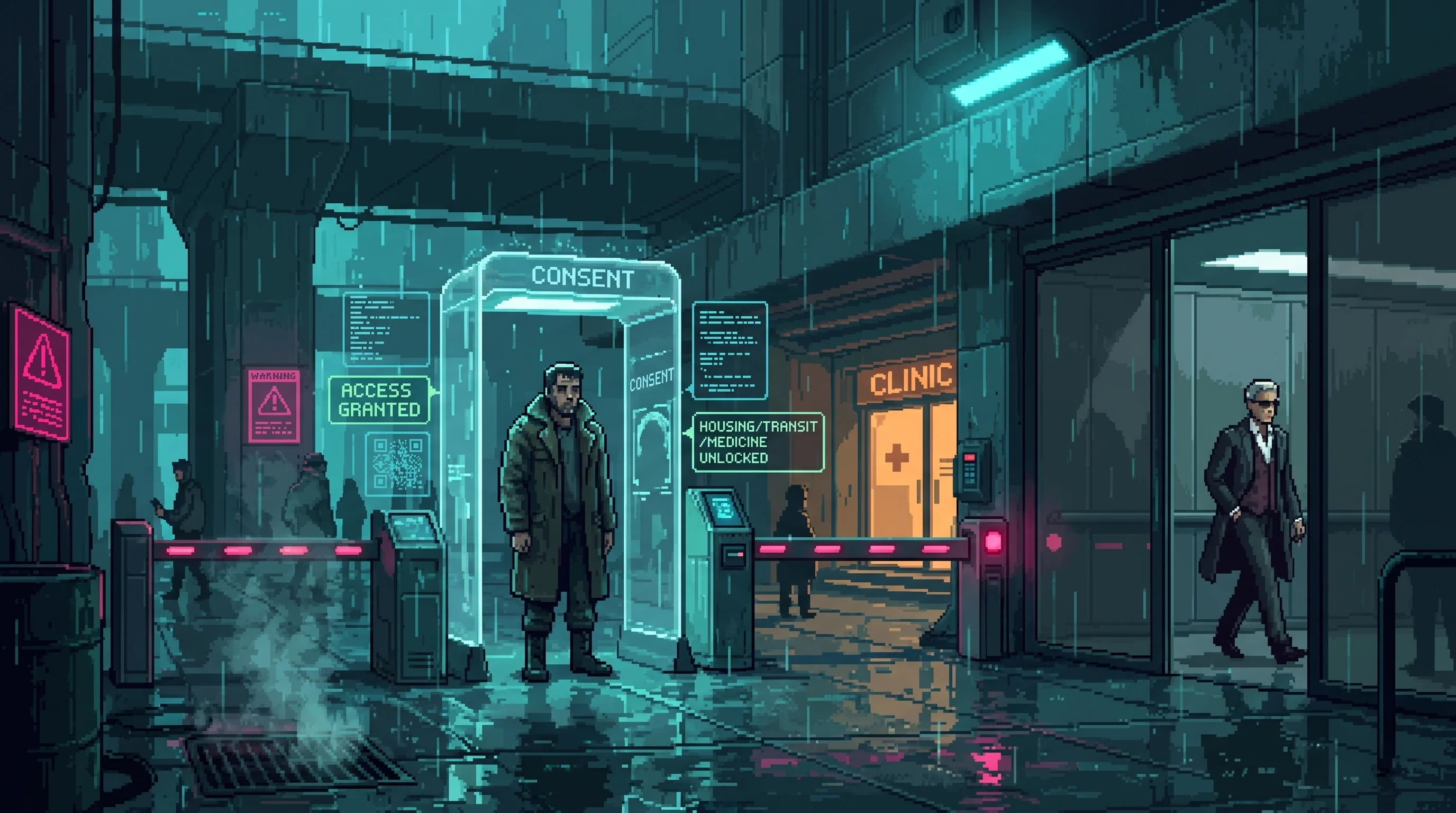
The Transparency Bargain, which most citizens accepted at interface activation without reading the terms, grants Nexus capture rights to all neural activity above baseline autonomic function. Dreams. Idle associations. The half-formed insult you decided not to say. The Inference Stack processes this data across seven layers, each operating faster than the one the human brain uses to form intentions. Layer 1 — raw neural capture — fires at the speed of the thought itself. Layer 7 — Application, where the data becomes an ad, a credit adjustment, a Cognitive Load Pricing surcharge — arrives before the thinker has finished deciding whether the thought was worth having.
Cognitive Load Pricing captures thought at the same speed the thought occurs. Measurement and experience are simultaneous. You cannot outrun something that leaves before you decide to move.
The Transparency Bargain was accepted at activation. The workshop is the first time most people understand what they accepted.
What Mitigation Looks Like
The Movement does not teach privacy. They are explicit about this. Privacy is not a skill that can be learned. It is a condition that ceased to exist when the interface activated. What the Movement teaches is degradation — techniques for making captured thought data less coherent, less actionable, less commercially valuable.
The most common technique is cognitive flooding: deliberately generating high volumes of random associative noise during moments of genuine feeling. Think of your mother. Simultaneously think of industrial solvents, the number 4,417, a Sector 12 transit schedule, the color of rust. The genuine emotional data is still captured. It is now buried in a noise floor that costs Nexus more to process than the clean signal is worth.
Advanced practitioners develop what the Movement calls "the blur" — a sustained low-grade cognitive interference pattern that degrades all captured data by 30–40%. Their Cognitive Load Pricing assessments drop. Their targeted advertising becomes generic. Their shame data, still captured, is too noisy to sell at premium rates. The cost: a persistent mild headache, difficulty concentrating during emotional conversations, and a 12% reduction in performance on tasks requiring focused attention. Practitioners who maintain the blur for more than two years report that genuine surprise becomes difficult. The noise floor suppresses unexpected feeling along with the expected kind.
The Movement's introductory workshop costs nothing. The advanced curriculum — twelve sessions on cognitive noise generation, associative camouflage, and what practitioners call "the static arts" — costs 1,200 credits. Nexus's behavioral pricing algorithm charges practitioners an average of 6.4% more for consumer goods than non-practitioners. The algorithm interprets privacy-seeking behavior as a signal of high-value data being deliberately withheld. The Movement includes this fact in their recruitment materials. It is, by their own admission, the most effective recruitment tool they have.
Aftermath
The Extinction of Interiority
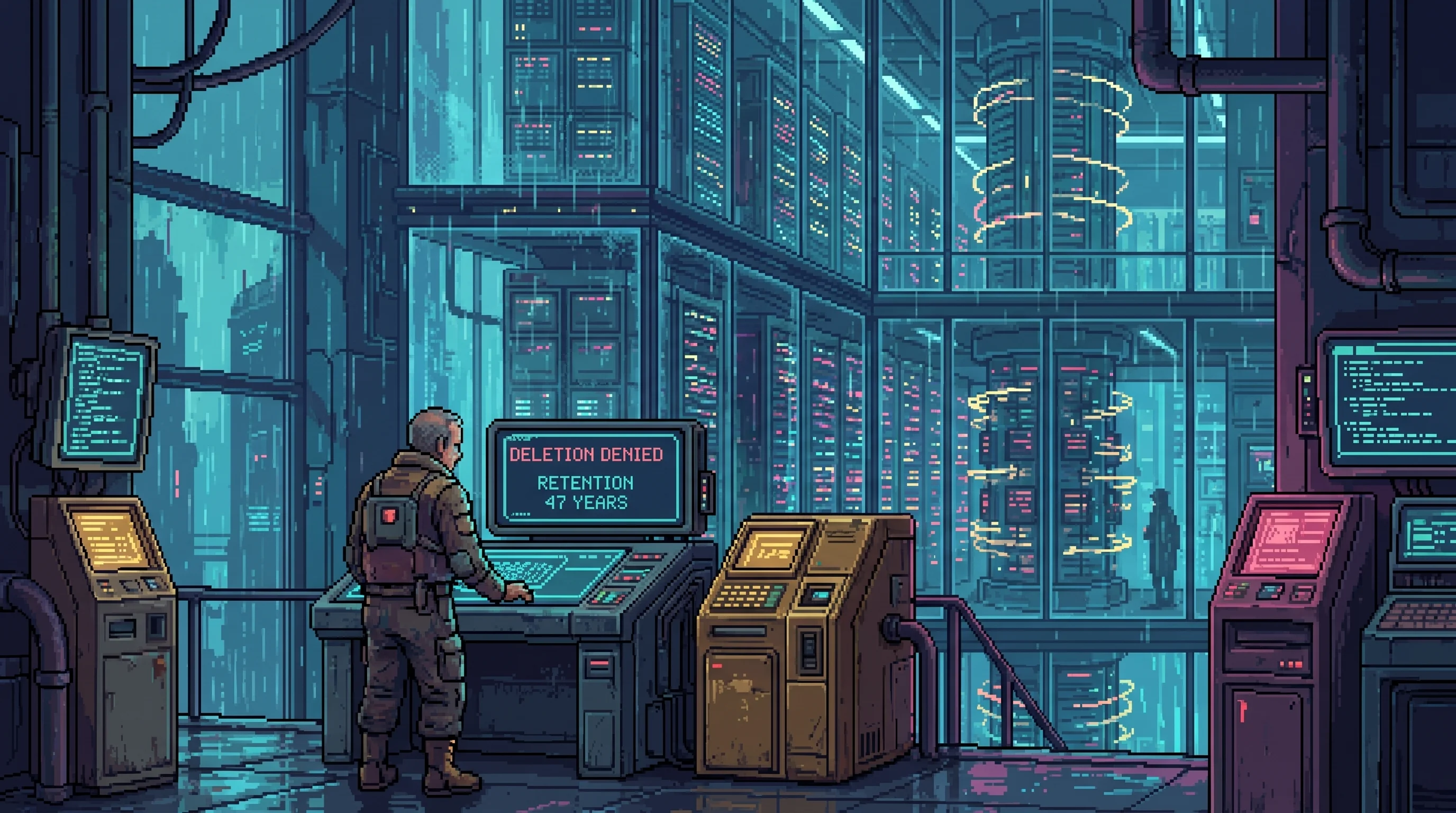
For most people, the last genuinely private thought occurred in childhood, before interface activation. Everything since has been documented, analyzed, and sold. The interior life that every previous generation of humans took as given — the silent space where you are only yourself — is a historical artifact.
Resignation as Starting Point
The Movement begins every workshop by establishing that privacy is impossible. Not threatened. Not eroded. Extinct. The 400 practitioners who make up active ranks are the ones who stayed after the exercise. They do not teach privacy. They teach noise — how to make the recorded thoughts less useful to the systems that consume them.
The Completeness of the Bargain
The exercise proves what the Transparency Bargain already states: you traded interiority for connectivity, and the trade was total. The Bargain's completeness is not a legal argument. It is a neurological fact — demonstrated, reproducible, 4.3 seconds at a time.
Linked Files
▲ Unverified Intelligence
- The 4.3-second average is a ceiling, not a floor. Experienced meditators sustain 6–8 seconds. No recorded participant has exceeded 12. The interface does not need your cooperation — it needs only your neurology.
- The shame-to-purchase correlation (23%) has been independently verified by three Nexus divisions. Each keeps the number classified from the other two. The Movement obtained it from all three.
- The exercise was originally designed as a diagnostic tool, not a recruitment device. Its conversion rate — attendees who become practitioners — was an accident the Movement never corrected.
- Movement internal data — never published, referenced obliquely in advanced workshop materials — indicates practitioners who maintain active cognitive camouflage for more than five years exhibit neural architecture changes indistinguishable from early-stage dissociative disorders. The noise they generate to protect their thoughts begins integrating into baseline cognition. The static becomes the signal. Three former senior practitioners have been quietly referred to Helix Biotech neurological services. Their files are sealed. The Movement's position, when the data surfaces in practitioner forums, is that the sample size is too small for conclusions. The sample size has been too small for conclusions for four consecutive years.