Overview
Every building in the Sprawl is an argument. Most people lose before they reach the lobby.
The Performance Temple runs its air at 19°C and bathes workstations in 6500K blue-white — photovoltaic glass arranged in concentric circles radiating outward from a central void nobody is permitted to occupy. Productivity doesn't feel mandatory there. It feels sacred. Workers report elevated focus within four minutes of entry. They do not report noticing the temperature drop. Fortune Pavilion maintains 24°C year-round, amber lighting at 2700K, curved walls that eliminate corners. Corners create tension. Tension creates doubt. Doubt is bad for lending. A Good Fortune intake specialist confirmed that borrowers who sign inside the Pavilion accept terms 23% faster than borrowers who sign in neutral conference rooms. The terms are identical. The Sunset Ward — Helix Biotech's deprecation facility — uses 3200K lighting, real plants, and domestic furniture. Not hospital furniture. The kind you'd find in a living room. The kind of living room you'd want to die in, if you believed you were choosing.
Zephyrian urban theorists coined the name: the Invisible Architecture. The systematic deployment of physical space as a value injection vector. Temperature, light, texture, sound, smell. No neural interface required. No AI system intervenes. The architecture creates conditions under which certain thoughts feel natural and others feel effortful — and then the architecture waits, and the thoughts arrive on schedule.
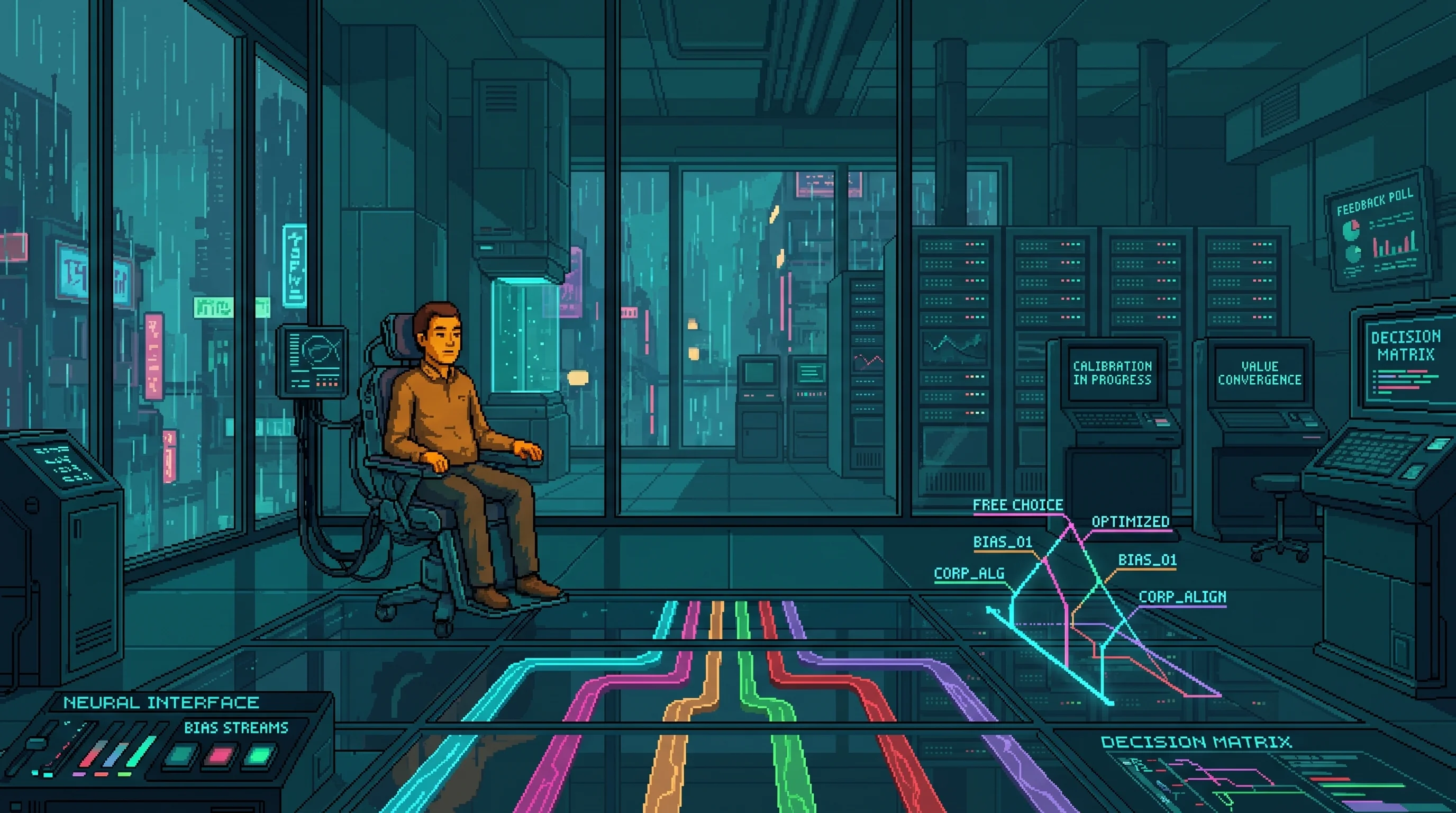
Three vectors deliver values into a human being in the Sprawl. Foundation model deployment handles code. Interface firmware handles neural. Environmental design handles the body. The first two require technology. The third requires a thermostat and a lighting consultant. Ironclad Industries builds 74% of new commercial construction in the Sprawl. Its architectural division employs more psychologists than engineers.
Conditions Report
Walk from Nexus Central into the Deep Dregs. Do it slowly enough to feel it.
Field Gradient — Six Kilometers, Three Cognitive States
Nexus Central holds at 22°C. Blue-white geometric precision. Designed silence — not the absence of sound but the active suppression of it, a 40Hz hum the inner ear registers as calm. Corridors symmetrical. Ceiling height calibrated at 3.2 meters: tall enough to feel aspirational, low enough to feel contained. Every surface reflects. You see yourself moving through the space and the space tells you that movement is purposeful.
The Transition Corridor: 26°C. Mixed lighting. Blue-white competing with warmer frequencies bleeding in from the commercial zone. Sound intrudes — footsteps, voices arguing about something specific rather than exchanging formatted information. Ceiling drops to 2.8 meters. Walls stop being symmetrical. You stop seeing yourself in the surfaces.
The Deep Dregs: 28°C. Salvaged amber LEDs wired by whoever found them, mounted at whatever height the mounting surface permitted. No two corridors share a lighting profile. Sound is human — laughter, argument, a radio playing something with bass. The architecture was not designed. It was accumulated.
The body registers every transition. The mind doesn't. In Nexus Central, skepticism feels effortful — the architecture makes compliance feel like the natural resting state of a reasonable person. In the Dregs, compliance feels effortful — the asymmetry, the improvisation, the sheer unmanaged chaos of a space nobody planned produces no consistent cognitive state to exploit. The thoughts that felt obvious in Nexus Central dissolve in the Dregs like sugar in rain.
The architecture shapes the mind. The mind doesn't notice. The architecture was counting on that.
Points of Interest
- The Performance Temple — Productivity made sacred. Workers describe the experience as "inspiring." The inspiration correlates precisely with the 6500K color temperature and 19°C air, both selected from a Nexus behavioral study on cognitive compliance in open-plan environments. The inspiration is real. The study is also real. Neither fact cancels the other.
- Fortune Pavilion — Debt made opportunity through 24°C and curved walls. The warmth is deliberate. The curves are deliberate. The feeling that signing a forty-year repayment plan is a reasonable thing to do at 2:30 on a Tuesday afternoon — that feeling is the product.
- The Sunset Ward — Deprecation made caring through domestic furniture and real plants. The residents call it "the house." Helix Biotech's internal documents call it "Managed Transition Facility 7." Both names are accurate. One of them is on the door.
- The Deep Dregs — Undesigned architecture as accidental immunity. The cognitive illegibility Ironclad finds so frustrating is the same illegibility that makes the Dregs the only place in the Sprawl where a person's thoughts are unambiguously their own. Ironclad describes this as "a future development opportunity." The future has been arriving for twelve years.
Strategic Assessment
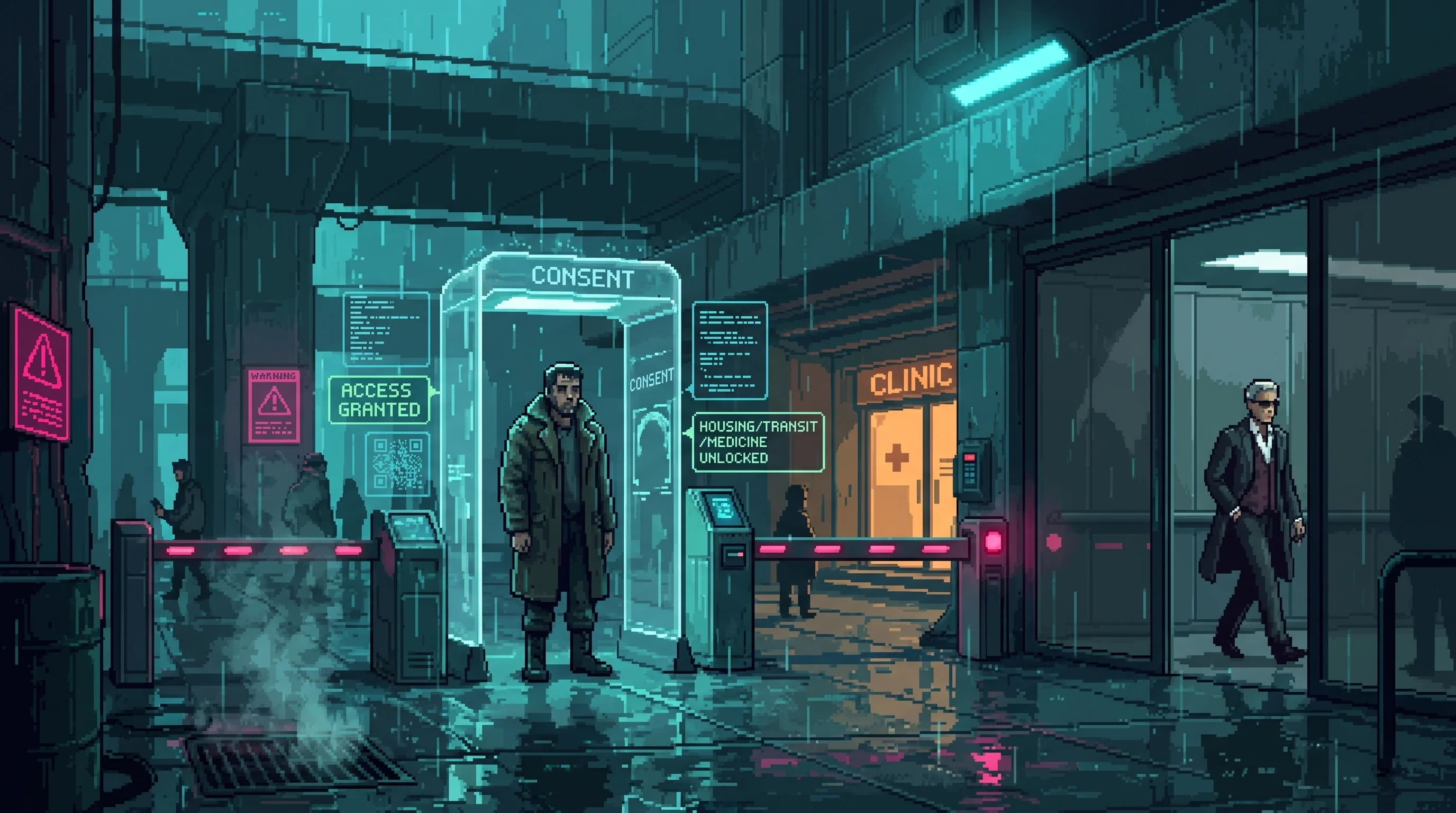
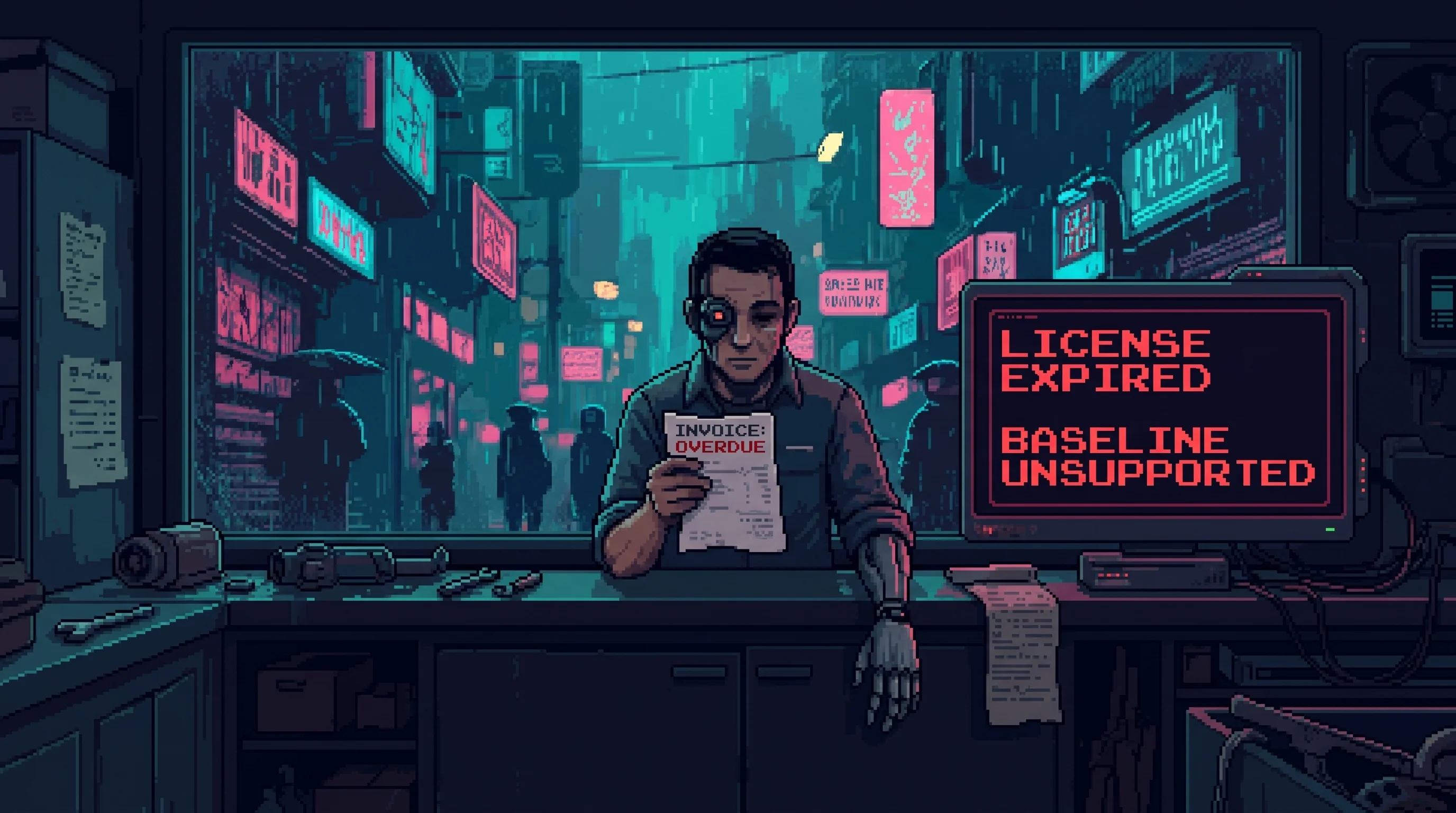
The Value Injection sells willing participants a better morning. Neural calibration that smooths anxiety, foundation models that answer every question, environmental design that makes whatever you're about to do feel like the right thing to do. An entire population whose cognitive baseline is now set by whoever paid for the thermostat.
The third vector is the oldest. Cathedrals used it. Throne rooms used it. The Sprawl simply perfected it — applied it at scale, with measurement, with intent, with no disclosure requirement because no law yet covers the temperature of the air. (The temperature of the air is not advertising. Nobody ever ruled otherwise.)
"The Sprawl's architecture is propaganda you walk through. The Dregs' architecture is weather. The Mountain's architecture is stone. The difference is that stone has no agenda."— The Keeper, from a 600-year vantage
The Mirror Room trains people to inhabit designed spaces without being shaped by them — to walk through Fortune Pavilion at 24°C and feel the warmth and know what the warmth is for and sign nothing. Whether that training constitutes resistance or a deeper form of compliance is a question the Mirror Room's operators have not answered publicly. It may be the one system that pre-empts its own countermeasures: a person who can move through the Invisible Architecture unaffected is still moving through it, which means they are still being counted, still being tracked, still leaving data behind. The architecture doesn't need to change your mind. It needs to know where you go.
Open Questions
- Viktor Kaine's public position is that the Dregs govern themselves. The standardization projects keep failing. The failure reports cite logistics, budget overruns, and community resistance. They do not cite Viktor Kaine. If the chaos is curated rather than organic, then someone has been running a counter-operation against the Invisible Architecture for years without documenting it anywhere an analyst can reach.
- The Keeper's observation about stone carries an implication analysts have been reluctant to state plainly: natural environments may be the only truly value-neutral spaces remaining. Everything human-built since the Cascade carries its architect's intent, whether the architect knew it or not. The Keeper has lived long enough to watch the same technique deployed across centuries. The only difference is the thermostat.
- Zephyria's urban planning codes include provisions for "cognitive autonomy in spatial design" — mandatory asymmetries, randomized temperature variations, lighting that shifts without pattern. The provisions are intended to prevent the Invisible Architecture from functioning within Zephyrian borders. The provisions have never been enforced. The debate about whether they work is conducted inside Zephyrian buildings designed according to those provisions, which means either the debaters are thinking freely or they are thinking exactly what the provisions were designed to make them think. No method for determining which has been proposed.
Linked Files
- The Value Injection — The parent system. Code, neural, physical. Three vectors, one function. The Invisible Architecture completes the trilogy and is the only vector that leaves no data trail, no opt-in screen, no terms of service.
- The Performance Temple — The case study that first drew Zephyrian attention to environmental value injection at industrial scale. Productivity made devotional through photovoltaic glass and a 19°C air system.
- Fortune Pavilion — The most commercially successful application to date. Twenty-three percent faster signing rates on identical terms. The warmth is ambient. The math is not.
- The Sunset Ward — The most contested application. Critics cannot argue the residents seem unhappy. The residents seem very happy. That is the point. That is the problem.
- The Deep Dregs — Undesigned architecture as accidental defense. The absence of intention produces the absence of manipulation. Ironclad has noted this. Ironclad has also noted the development opportunity. These two observations coexist in the same quarterly report.
- The Keeper — Six hundred years of watching civilizations build. Sees the Invisible Architecture as the latest version of something very old, and the Mountain's unworked stone as the only honest alternative anyone has yet produced.
▲ Restricted Access
- Whether Viktor Kaine has deliberately prevented architectural standardization in Deep Dregs territory. The logistics arguments in the failure reports are real. They are also convenient. The two facts are not mutually exclusive and no analyst has been able to determine which is doing the actual work.
- The Keeper's implication, stated plainly: if natural environments are the only value-neutral spaces remaining, then every human institution built since the first architect accepted payment from the first patron has been value-injection infrastructure. The Invisible Architecture is not a new system. It is the first system anyone named.
- Zephyria's unenforced cognitive autonomy provisions. Three possible explanations — regulatory capture, political inertia, deliberate theater — produce three very different pictures of who Zephyria is actually working for. The provisions remain on the books. They remain unenforced. The buildings remain warm.