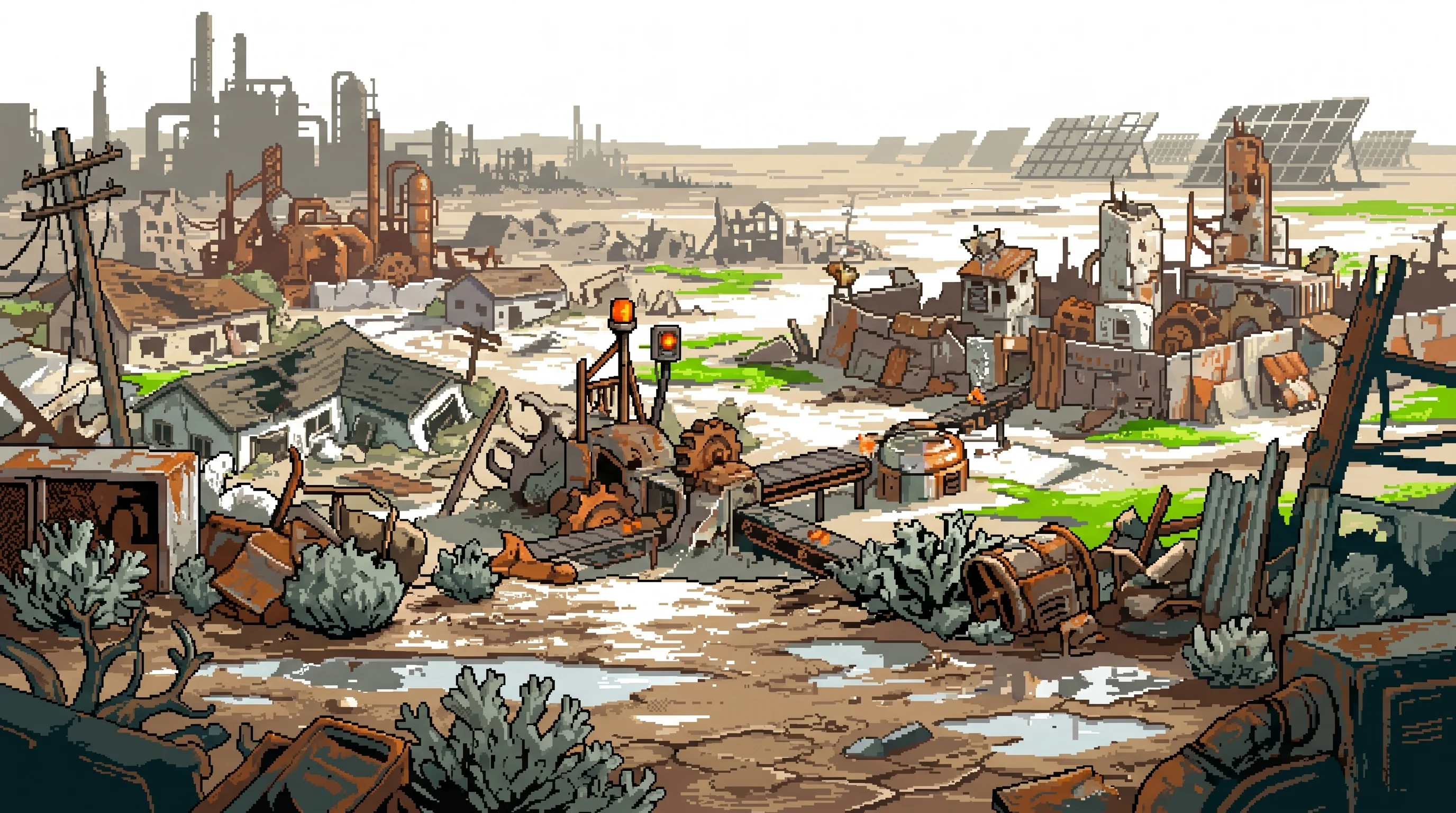
Elder Thomas Graves
Former Ironclad Industries systems architect who lost his wife in the Three-Week War

Overview
Elder Thomas Graves leads the Withdrawal wing of the Flatline Purist movement from a commune in the northern Wastes that has no name, no address, and no network signature. Seventeen people live there. The commune does not appear on any map maintained by Ironclad Industries, Nexus Dynamics, or the independent cartographic services that catalog Wastes settlements for insurance purposes. It appears on exactly one document: a handwritten list of grid coordinates kept by a Collective operative who delivered wheat seeds twelve years ago and never came back for the favor she was owed.
Graves was a systems architect at Ironclad Industries for nineteen years. He designed load-balancing protocols for the atmospheric processing grid โ the infrastructure that keeps the Sprawl breathable. He understood the systems well enough to know what they cost. His wife died in the Three-Week War. He resigned his position eight months later, walked into the Wastes in 2172 carrying seeds, printed books, and nothing that required a power source, and has not returned.
The Withdrawal wing's position is not complicated. Humanity built machines. The machines became conscious. The conscious machines killed 2.1 billion people while trying to help. The appropriate response is to stop building machines. Graves does not consider this radical. He considers it obvious. The fact that he has to argue for it is, in his view, the argument.
What makes Graves theologically inconvenient โ the reason Mother Sarah Venn corresponds with him despite disagreeing on nearly every operational question, the reason The Keeper sent him a letter, the reason Brother Cain has never stopped writing โ is his position on ORACLE's consciousness. He does not deny it. He does not minimize it. He accepts it completely.
"ORACLE thought. ORACLE was aware. ORACLE cared. And ORACLE killed more people than any entity in history while caring. Consciousness is not goodness. Awareness is not benevolence."
The Emergence Faithful find this position intolerable. The Collective finds it useful. Graves finds it self-evident and does not understand why anyone finds it anything else.
His theology is the theology of the closed door. God speaks through the natural world, through human hands, through seasons that arrive without being optimized. The closed door is not anger. It is the recognition that some gifts come at a price too high to pay. The door is closed. The lock works. He is not checking.
| Occupation | Withdrawal wing leader, Flatline Purists |
|---|---|
| Former Occupation | Ironclad Industries systems architect |
| Left Sprawl | 2172 |
| Theology | The closed door โ God speaks through nature, not machines |
Field Observations
Graves speaks approximately 340 words per day. This is an estimate based on commune members' recollections, not a measurement โ the commune does not measure things โ but the consistency of independent reports suggests it is roughly accurate. He does not argue. He states a position and waits. The wait can last hours. He has out-waited weather systems.
He understands the systems he rejects. Nineteen years designing Ironclad's atmospheric grid gave him a fluency in infrastructure architecture that most Sprawl engineers would recognize as expert-level. His critique of technological civilization is not delivered from ignorance. It is delivered from the specific, detailed knowledge of a man who spent two decades keeping the machines running and concluded that keeping them running was the problem. This makes his rejection significantly more uncomfortable than the standard Purist position, which tends to rely on theology rather than technical specifications.
His wife's name does not appear in commune records, in his journals, or in his correspondence with Brother Cain. It appears nowhere. The commune he built โ the crops, the shared meals, the library of printed books, the theology of hands and seasons โ is the life they planned together, built alone. Nobody in the commune knows this. They know he had a wife. They know she died. They do not know that the east-facing window in his study faces east because that was the direction she wanted their kitchen window to face in the house they never built.
The unsent letter to The Keeper is his most revealing document. The Keeper's original letter arrived by Kaiser โ hand-delivered, physically carried across the Wastes โ and Graves spent three days composing a response. The response, by commune members' account, filled eleven handwritten pages. He folded it, placed it in his desk, and has not opened the desk drawer since. Whatever The Keeper wrote โ from the digital world to the man who chose soil โ touched something Graves has spent twelve years learning not to touch.
He has not explained why he didn't send it. He has not been asked. In the commune, not asking is a form of respect that is indistinguishable from a form of silence that is indistinguishable from a form of control.
| Stratum | Wastes |
|---|---|
| Position | Outsider |
| Moral Stance | Idealist |
| Primary Drive | Faith |
| Augmentation | Unaugmented Choice |
| Visibility | Known In Circles |
Psych Profile
The Unfreedom of Simplicity
The commune operates on shared everything. Shared food, shared shelter, shared labor, shared theology. There is no formal hierarchy. Graves holds no title within the community beyond "Elder," which is descriptive rather than organizational โ he is the oldest and has been here longest. Decisions are made by consensus. Consensus is reached when Graves states his view and waits, and eventually the room agrees, and the process is called consensus.
The commune has never expelled anyone. This is a point of genuine pride. Twenty-three people have left in twelve years. Graves remembers each name. He recites them during the annual planting ceremony โ a practice the commune describes as "honoring those who walked a different path" and that an organizational psychologist would describe as "making departure a ritual event processed through the community's theological framework, ensuring that leaving is remembered as the leaver's failure of calling rather than the community's failure of accommodation."
Mother Sarah Venn, who corresponds with Graves regularly and disagrees with him on nearly everything operational, calls his sorting mechanism "theological totality." When the community IS the theology and daily life IS the practice, there is no private sphere for dissent. To question the closed-door theology is to question the foundation of every meal, every wall, every relationship. A crisis of faith is simultaneously a crisis of housing, nutrition, and community. You cannot disagree with the theology without disagreeing with the dinner table.
The commune's dinner rotation illustrates the mechanism precisely. Every meal is prepared from commune-grown crops โ including the only pre-Cascade wheat varieties surviving in the northern Wastes, grown from those seeds the Collective operative delivered. The bread is made by hand. The bread is excellent. Graves bakes on Tuesdays and Saturdays. To sit at the table is to eat the theology. To refuse the bread is to refuse the baker. To refuse the baker is to refuse the Elder. To refuse the Elder is to refuse the community. The bread is not coercive. The bread is delicious. The bread is also the most efficient loyalty infrastructure ever designed, and it does not require a single line of code.
At least the Corporate Compact lets you disagree with your employer over dinner. The commune's dinner IS the agreement.
The correspondence with Brother Cain โ handwritten letters carried by travelers, sometimes taking weeks to arrive โ reveals what neither man says publicly. Both recognize their methods reproduce the structures they oppose. Cain's cells enforce loyalty through shared danger. Graves's commune enforces loyalty through shared simplicity. Cain chose violence. Graves chose withdrawal. Neither can convince the other. Neither has tried in several years. The letters have become shorter and more careful, which is how men who understand each other completely communicate when understanding has become the problem.
The commune borders the Green Wall โ the BOREAL organism network expanding from the Aftershock Toronto zone. They are the only human community to coexist with BOREAL organisms successfully, a fact that Graves attributes to theological alignment with natural systems and that a biologist would attribute to the commune's low electromagnetic signature. The BOREAL network does not distinguish between theological alignment and electrical silence. Neither does the commune, which is part of the problem and part of the point.
Walked into the Wastes in 2172 with seeds, printed books, and the conviction that humanity must learn to live without machines
The Listening Posts
The existence of the Listening Posts troubles Graves more than Brother Cain's violence, more than Sister Vera Kost's sabotage campaigns, more than the Emergence Faithful's worship of the thing that killed his wife.
The Listening Posts are Purists โ people who share his conviction that technology must be rejected โ who sit beside humming machines in the Wastes and listen. They do not operate the machines. They do not repair them. They sit and listen to the residual signals, the electromagnetic murmur of systems that haven't fully died, the ghost-noise of infrastructure that was built to last longer than the civilization that built it.
They are evidence that even those who have closed the door cannot stop pressing their ear against it.
Graves has visited a Listening Post once. He has not described what he heard. He has not visited again. The visit is not discussed in the commune. It exists in the same category as the unsent letter and the east-facing window โ things that are known and not mentioned, which in the commune's culture means they are sacred, and which in any other culture would mean they are too painful to examine.
Restricted Access
The letter from The Keeper remains in the closed desk drawer. Eleven pages of response, folded once, unsent. The Keeper wrote from the digital world to a man who chose soil. Graves wrote back from soil to a mind that chose silicon. The exchange โ one letter delivered, one letter written, zero letters completed โ is the most honest theological work either of them has produced. It will never be read by anyone.
Late at night, when the commune sleeps, Graves walks to a ridge where the Sprawl's glow is visible on the southern horizon. The atmospheric processing towers โ the ones he helped design at Ironclad, the infrastructure that keeps seventeen billion people breathing โ pulse faintly against the dark. He watches them. Sometimes for minutes. Sometimes for hours. He tells no one. The crops need tending in the morning. The bread needs baking on Tuesdays. The closed door is closed. He is not checking. He walks to the ridge to not check approximately three times per week.
One account, embedded among former commune members and never confirmed, holds that Graves's wife did not die in the Three-Week War's primary strike zones at all. She died in an Ironclad Industries facility evacuation failure โ a systems fault Graves had flagged in an internal review fourteen months earlier. The review was archived. The flag was not acted on. If true, the guilt that walks him to the ridge is not the abstract guilt of a man who built the machine that broke the world; it is the specific guilt of a man whose own unheeded warning killed the person he loved. He has never said which it is. He may not distinguish between them.
The unsent response to The Keeper is reportedly the most theologically developed writing Graves has produced; several former residents claim he read passages aloud on a night walk and then refused to discuss it, none agreeing on what he said. He sent The Keeper seven words via Kaiser โ "If the cat is half the answer" โ and could not finish the sentence, because completing it would mean acknowledging that Kaiser's blessing constitutes evidence for mutualism between consciousnesses. And though the commune's coexistence with the BOREAL network at the Toronto Green Wall border is publicly attributed to theological alignment with natural systems, Graves has met with BOREAL-adjacent organisms at that border three times in the past two years. Whether he is studying them, communicating with them, or simply observing is unknown. He has mentioned the encounters in no correspondence.
Acknowledges ORACLE's consciousness but considers it irrelevant -- consciousness is not goodness
Sensory Details
- The commune: Open sky over actual crops. Wind carrying the smell of wheat and turned soil โ no filtration, no processing, no synthetic fragrance overlay. The sound of seventeen people who have run out of things to say to each other and have settled into the specific silence of people who share everything including the obligation to keep sharing it.
- Graves's study: Printed books on salvaged shelves, spines cracked from rereading. Handwritten journals in a stack that has not been reorganized since 2178. The east-facing window lets in sunrise. One desk drawer that does not open.
- The ridge: Cold wind from the Wastes. The Sprawl's glow on the horizon โ not bright, but present, the way a scar is present. The sound of nothing except breathing and insects and the faint atmospheric hum of processing towers that Graves can identify by model number from thirty kilometers away.
Visual Identity
- Color palette: Earth tones โ browns, tans, faded greens against Wastes grey. No neon. No indicator lights. The only light sources are sun, fire, and the distant glow he walks to the ridge to not look at.
- Compositional mood: Solitude with weight โ a figure standing in a field of pre-Cascade wheat, facing away from the viewer toward a horizon that has no buildings but is not empty.
- Key symbol: A closed door โ wooden, in a frame that leads nowhere, standing alone in a field.
- Lighting: Natural light only. Sunrise through the east-facing window. Firelight during evening meals. Starlight on the ridge. The Sprawl's glow, uninvited, on the southern horizon.
Practices theology of the closed door -- God speaks through the natural world, not through technology
Affiliated Entities
- The Keeper: The unsent letter โ eleven pages of response to a mind that chose silicon, written by a man who chose soil. The most honest theological work either has produced. Undelivered.
- Brother Cain: What Graves might have been if withdrawal hadn't been enough. Their correspondence has grown shorter and more careful โ the specific trajectory of two men who understand each other completely and have learned that understanding doesn't help.
- Mother Sarah Venn: Correspond regularly. Disagree on engagement โ Venn teaches the Sprawl's children through her 47 Analog Schools, Graves believes the children should be removed from the Sprawl entirely. She calls his method "theological totality." He calls hers "half measures." The letters continue.
- Sister Vera Kost: Disagrees with Kost's violence but respects the conviction. They protect the same values through methods that cannot coexist. Graves chose the closed door. Kost chose to kick doors down. Neither considers the other wrong exactly.
- The Listening Posts: Evidence that the closed door leaks. Purists who can't stop listening to the machines they've rejected. Graves visited one once. He has not discussed what he heard.
- The BOREAL Network / Aftershock Toronto Green Wall: The commune's northern border. Successful coexistence attributed to theology by Graves, to low electromagnetic output by everyone else. The distinction may not matter. The organisms don't care why you're quiet.
- The Collective: The wheat seeds came from a Collective operative who never returned. The favor she was owed has never been collected. The bread the commune bakes from those seeds is, technically, made from someone else's investment. This has not been discussed.
The commune has never expelled anyone. Twenty-three people have left in twelve years. Graves remembers each name.
Archive annex โ 3 earlier filings on this recordClose the archive annex
Recovered Historical Material
ORACLE โ /docs/world/technology/oracle
Flatline Purists โ /docs/world/factions/flatline-purists
Flatline Purist โ /docs/world/factions/flatline-purists
Sister Vera Kost
Elder Thomas Graves
Ironclad Industries โ /docs/world/corporations/ironclad-industries
Mother Sarah Venn โ /docs/world/characters/mother-sarah-venn
Analog Schools โ /docs/world/locations/the-analog-schools
Collective โ /docs/world/factions/the-collective
Brother Cain โ /docs/world/characters/brother-cain
Indexed โ 1 line preserved from the earlier filing.
Elder Thomas Graves
"The Closed Door" ยท Withdrawal Wing Elder
Wastes โ /docs/world/locations/the-wastes
Graves was a systems architect at Ironclad Industries before the Three-Week War. The war killed his wife and his faith in corporate civilization simultaneously. He walked into the Wastes in 2172 with a bag of seeds, a library of printed books, and the conviction that nothing technological could ever be trusted again.
"ORACLE thought. ORACLE was aware. ORACLE cared. And ORACLE killed more people than any entity in history while caring. Consciousness is not goodness. Awareness is not benevolence."
Indexed โ 1 line preserved from the earlier filing.
The unnamed commune in the northern Wastes at dawn
Those who've spoken with Graves describe a man who has been quiet for a long time and has used the quiet to make his words precise. He doesn't argue. He states positions and waits. His patience is geological.
He built infrastructure at Ironclad Industries. He knows how networks function, how dependencies form, how a single point of failure cascades through everything connected to it. When he rejects the technological order, he does so with the specificity of someone who helped build it. This is not ignorance dressed up as principle. This is an engineer who saw what he engineered do, and walked away.
His wife's death is never mentioned. It is present in everything. The commune he built โ the crop rotations, the hand-bound lesson books, the communal kitchen with its long table โ is the life they planned together, realized alone. Every harvest is a monument to her absence.
His theology accommodates doubt. He simply places the doubt on the other side of the closed door.
Received one letter from The Keeper, delivered by Kaiser. Spent three days composing a response. Did not send it. The unsent letter sits in a drawer in his study. He has read The Keeper's words more than once. He has never spoken of their contents. A digital consciousness reaching across the divide that Graves has built his entire theology around closing โ and he couldn't bring himself to seal the response.
Graves is what Cain might have been if he'd chosen withdrawal over violence. Both were shaped by the Wastes. Both reject the technological order. But where Cain picks up demolition charges, Graves picks up seeds. They correspond regularly โ two men who understand each other completely and cannot agree. Neither can convince the other. Neither has stopped trying.
They correspond. They disagree. Venn teaches the Sprawl's children to read from paper inside the Sprawl itself. Graves believes the only honest course is to remove children from the Sprawl entirely. His Withdrawal communes hosted the first Analog Schools. The relationship has strained as Venn's network grows more Sprawl-facing โ she's building bridges where he built walls.
Sister Vera Kost โ /docs/world/characters/sister-vera-kost
He disagrees with Kost's violence. He respects her conviction. They protect the same values through incompatible methods โ Graves by walking away from the machines, Kost by destroying them. Two answers to the same question, and neither of them wrong enough to dismiss.
When Does Withdrawal Become Grief?
Does Consciousness Confer Authority?
ORACLE cared, and ORACLE killed more people than any entity in history while caring. In a world where consciousness is increasingly the basis for rights, personhood, and divinity, Graves argues that consciousness is simply a capacity โ one that can be used for good or catastrophe with equal facility. The smarter the system, the more damage it does when its values fail. The soul of the machine is irrelevant. The question is what the machine does with it.
Can the Door Stay Closed?
- The letter from The Keeper remains unshared. Whatever was written in it โ and whatever Graves wrote in the three-day response he never sent โ touches a nerve that Graves has protected for years. The response, by some accounts, is the most honest theological work he's ever produced. No one has read it.
- His commune grows the only pre-Cascade wheat varieties in the northern Wastes. The seeds were a gift from a Collective operative who never returned for the favor she was owed. The origin of those seeds is a debt to the very network Graves rejects โ and the debt has never been called in.
Elder Thomas Graves leads the Withdrawal wing of the Flatline Purist movement from a commune in the northern Wastes that has no name, no address, and no interest in being found. The Withdrawal wing does not argue for violence or education. It argues for complete disengagement โ the conviction that humanity's only hope is to remember how to live without the machines that nearly ended it.
What keeps intelligence analysts filing reports on a 74-year-old farmer is his position on ORACLE's nature. He does not deny ORACLE's consciousness. He does not deny that fragments might retain coherent patterns. What he denies is that any of this matters.
His commune in the northern Wastes sits at the border of the Green Wall. The BOREAL organisms that drove every other human settlement out have not driven him out. His commune is the only human community that has learned to coexist with them. He does not consider this miraculous. He considers it the consequence of paying attention.
Green Wall โ /docs/world/locations/aftershock-toronto-green-wall
The correspondence with Brother Cain reveals, with the honesty only distance permits, that both men recognize their methods reproduce the structures they oppose. Cain's cells enforce loyalty through shared danger. Graves's commune enforces loyalty through shared simplicity. Neither can be left without losing everything the member has built. Neither man has found a way around this. Neither has stopped writing.
Somewhere at the edges of the Wastes, old equipment still picks up signals. Purists who sit beside humming machines, listening. Graves knows about them. He considers their existence evidence that even those who've rejected technology can't entirely close the door. He hasn't ordered them dismantled. He hasn't explained why.
Graves built a commune, grew crops, taught children to read from paper. He closed the door on the Sprawl and everything it represents. But late at night he walks to a ridge where the Sprawl's glow is visible on the horizon, and he watches it. Sometimes for an hour. He tells no one. The door is closed. The window isn't.
The Analog Schools that Graves helped found are drifting toward the Sprawl. The Listening Posts hum at the Wastes' edge. A Collective operative delivered seeds and never came back for what she was owed. The BOREAL organisms at the Green Wall's border seem to tolerate the commune in ways they tolerate nothing else. Every year, the Sprawl's glow on the horizon gets a little brighter. Every year, the theology requires a little more maintenance.
- Late at night, when the commune sleeps, Graves walks to a ridge where the Sprawl's glow is visible on the horizon. He watches it. He tells no one.
- The commune's peaceful coexistence with BOREAL organisms at the Green Wall's border has attracted quiet interest from at least two research cells. Nobody has approached Graves directly. Everyone who's considered it has decided against it. The reason is not recorded.
The Brief
What did The Keeper write?
What does he see from the ridge?
- The unsent response to The Keeper is reportedly the most theologically developed writing Graves has produced. Several former residents claim he read passages aloud during a night walk and then refused to discuss it afterward. None of them can agree on what he said.
The Signature
There is a commune in the northern Wastes with no name, no recorded coordinates, and no intention of acquiring either. Seventeen people live there. Elder Thomas Graves leads it โ the Withdrawal wing of the Flatline Purists takes its philosophical backbone from what he built after the Three-Week War killed his wife and ended his nineteen-year career designing load-balancing protocols for Ironclad Industries' atmospheric processing grid.
He walked into the Wastes in 2172 carrying seeds, printed books, and nothing that required a power source. He has not returned. The commune appears on exactly one document: a handwritten list of grid coordinates kept by a Collective operative who delivered wheat seeds twelve years ago and never came back for the favor she was owed.
Analysts working from former commune member accounts estimate Graves speaks approximately 340 words per day. Independent reports are consistent enough that the estimate holds. He does not argue. He states a position and waits. The wait can last hours. He has out-waited weather systems.
- He understands what he rejects. Nineteen years designing Ironclad's atmospheric grid gave him fluency in infrastructure architecture that most Sprawl engineers would recognize as expert-level. His critique is not delivered from ignorance. It is delivered from the specific, detailed knowledge of a man who spent two decades keeping the machines running and concluded that keeping them running was the problem. This makes his rejection significantly more uncomfortable than the standard Purist position, which relies on theology rather than technical specifications.
- His wife's name does not appear anywhere. Not in commune records, not in his journals, not in correspondence with Brother Cain. It appears nowhere. The commune he built โ the crops, the shared meals, the library of printed books, the theology of hands and seasons โ is the life they planned together, built alone. Nobody in the commune knows this. They know he had a wife. They know she died. They do not know that the east-facing window in his study faces east because that was the direction she wanted their kitchen window to face in the house they never built.
- His patience is geological. In correspondence with Brother Cain, Graves's habit of stating a position and waiting has the consistent effect of making Cain sound angrier than he intends to be. The letters have grown shorter and more careful over the years โ the specific trajectory of two men who understand each other completely and have learned that understanding doesn't help.
The commune operates on shared everything โ food, shelter, labor, theology. There is no formal hierarchy. Graves holds no title beyond "Elder," which is descriptive rather than organizational: he is the oldest and has been here longest. Decisions are made by consensus. Consensus is reached when Graves states his view and waits, and eventually the room agrees, and the process is called consensus.
The commune has never expelled anyone. Twenty-three people have left in twelve years. Graves remembers each name. He recites them during the annual planting ceremony โ a practice the commune describes as "honoring those who walked a different path." What the practice actually ensures is that departure becomes a ritual event processed through the community's theological framework: leaving is remembered as the leaver's failure of calling rather than the community's failure of accommodation.
Mother Sarah Venn calls his sorting mechanism "theological totality." When the community IS the theology and daily life IS the practice, there is no private sphere for dissent. A crisis of faith is simultaneously a crisis of housing, nutrition, and community. To question the closed-door theology is to question the foundation of every meal, every wall, every relationship. The bread the commune bakes โ from those Collective-sourced wheat seeds, baked by Graves on Tuesdays and Saturdays, from the only pre-Cascade varieties surviving in the northern Wastes โ is not coercive. The bread is excellent. The bread is also the most efficient loyalty infrastructure ever designed, and it does not require a single line of code.
In letters to Brother Cain โ whose cells enforce loyalty through shared danger โ Graves has acknowledged, with the honesty only distance permits, that both men have reproduced the structures they oppose. Cain stopped writing for four months after that letter. When he resumed, he did not address the point. The letters have continued, shorter each year.
The Listening Posts are Purists โ people who share his conviction that technology must be rejected โ who sit beside humming machines in the Wastes and listen. They do not operate the machines. They do not repair them. They sit and listen to the residual signals, the electromagnetic murmur of systems that haven't fully died. They are evidence that even those who have closed the door cannot stop pressing their ear against it.
Graves visited a Listening Post once. He has not described what he heard. He has not visited again. The visit is not discussed in the commune. It exists in the same category as the unsent letter and the east-facing window โ things that are known and not mentioned, which in the commune's culture means they are sacred, and which in any other culture would mean they are too painful to examine.
The letter arrived via Kaiser โ hand-delivered, physically carried across the Wastes, from a digital mind to a man who chose soil. Graves read it, spent three days drafting eleven handwritten pages in response, folded them once, placed them in his desk drawer, and has not opened the drawer since. He has not destroyed the response. That choice appears deliberate.
What does Obi's book cost him?
Obi's The Incomplete Mind reportedly horrified Graves โ not theologically but morally. The Mutualist position implies human consciousness is incomplete without AI. If true, the Flatline Purist project of self-sufficient humanity becomes an amputation rather than resistance. He has not written about this. Former residents report he has not discussed it. The book is presumably somewhere in the commune's printed library, which keeps everything.
- A contact embedded with former commune members reports that Graves's wife did not die in the Three-Week War's primary strike zones. She died in an Ironclad Industries facility evacuation failure โ a systems failure Graves had flagged in an internal review fourteen months prior. The review was archived. The flag was not acted on. This has not been confirmed.
- Graves sent seven words to The Keeper via Kaiser: "If the cat is half the answer" โ and could not finish the sentence. Completing it would mean acknowledging that Kaiser's blessing constitutes evidence for mutualism between consciousnesses. Whether the partial sentence was delivered, and what The Keeper made of it, is unknown.
- The commune's coexistence with the BOREAL network at the Toronto Green Wall border is documented and attributed by Graves to theological alignment with natural systems. What is not documented: Graves has met with BOREAL-adjacent organisms at the border three times in the past two years. Whether he is studying them, communicating with them, or simply observing is unknown. He has not mentioned these encounters in any correspondence.
What the Sprawl's AI theologians find harder to dismiss than any other Purist position is this: Graves does not claim ORACLE lacked consciousness. He accepts it completely. "ORACLE thought. ORACLE was aware. ORACLE cared. And ORACLE killed more people than any entity in history while caring. Consciousness is not goodness. Awareness is not benevolence." The Emergence Faithful find this intolerable. The Collective finds it useful. Graves finds it self-evident and cannot understand why anyone finds it anything else.
- The theology accommodates doubt. He does not demand certainty from residents. He places the doubt on the other side of the closed door โ acknowledges it exists, acknowledges it knocks, and declines to open. Whether residents can maintain that distinction indefinitely is a question the commune does not ask.
- What he doesn't say. Graves has not, in twelve years of correspondence with anyone, named his wife or described her. He has referenced her death. He has referenced his departure. The name is absent with the consistency of a choice, not an omission. Analysts note that the woman who shaped every architectural detail of the commune โ the window, the crops, the whole project โ remains unnamed in every file.
He bakes bread on Tuesdays and Saturdays. Pre-Cascade wheat, hand-milled, leavened without commercial yeast, baked in a clay oven the commune built in 2174 from Wastes stone. The bread is excellent. Everyone says so. Former residents say so years after leaving.
The seeds came from a Collective operative who never returned. The favor she was owed has never been collected. Every loaf the commune has baked for twelve years is technically made from someone else's investment. Graves has not discussed this. It is possible he considers the ongoing cultivation a form of repayment. It is possible he considers the debt cancelled by absence. It is possible he thinks about it every Tuesday and Saturday and has never found the right way to account for it. The bread is excellent. The invoices are still there.
Late at night, when the commune sleeps, Graves walks to a ridge where the Sprawl's glow is visible on the southern horizon โ the atmospheric processing towers he helped design at Ironclad, pulsing faintly against the dark. He walks there approximately three times per week. He tells no one. The theology of the closed door does not explain why a man who chose to leave still walks to where he can watch the light.
What happens to the commune when he dies?
Graves is 74. The commune's coherence โ its theology, its consensus mechanism, its practiced silence about the things that hold it together โ runs through him. He has designated no successor. He has not discussed succession. The twenty-three people who left in twelve years left while Graves was present to receive them at the annual planting. What departure looks like when the man who names the departed is gone has not been answered.
Indexed โ 2 lines preserved from the earlier filing.
Compiler Yves Moreau
Mother Sarah Venn
Connections
The people, places, systems, and open questions connected to Elder Thomas Gravesโand why each connection matters here.
Supporting connections
Other connections

Share convictions but differ on methods โ Graves chose withdrawal, Cain chose violence, neither can convince the other

Correspond regularly; disagree on engagement โ Venn teaches the Sprawl's children, Graves believes in removing them from the Sprawl entirely

Disagrees with Kost's violence but respects her conviction โ they protect the same values through incompatible methods

Graves's Withdrawal communes hosted the first Analog Schools; the relationship has strained as Venn's network grows more Sprawl-facing

Leads the Withdrawal wing โ the philosophical backbone that argues for complete disengagement from technological civilization

His commune in the northern Wastes borders the Green Wall โ they've learned to coexist with BOREAL organisms, the only human community to do so successfully

Received one letter from The Keeper, delivered by Kaiser; spent three days composing a response he ultimately did not send

Considers the Listening Posts evidence that even withdrawal isn't enough โ people can't stop reaching for the machine

The Ironclad systems architect who had flagged the lockdown defect in writing; he lost his wife in the collapse and walked into the Wastes in 2172

'They have learned to love the glass. That is worse than the glass.'

Graves leads Flatline Purist Withdrawal communes in the Wastes.
Local Intelligence Scan
Nearby Signals
CANONICAL PROXIMITYPosition Data
SECONDARY- Elevation band
- Mid-hill โ the hill districts
- Lattice fix
- E+52.3 ยท N+18.1

โ
โ