
Neural Interface Vulnerabilities
Neural interfaces are universal (~98% augmentation rate) but were designed for surface conditions
Overview
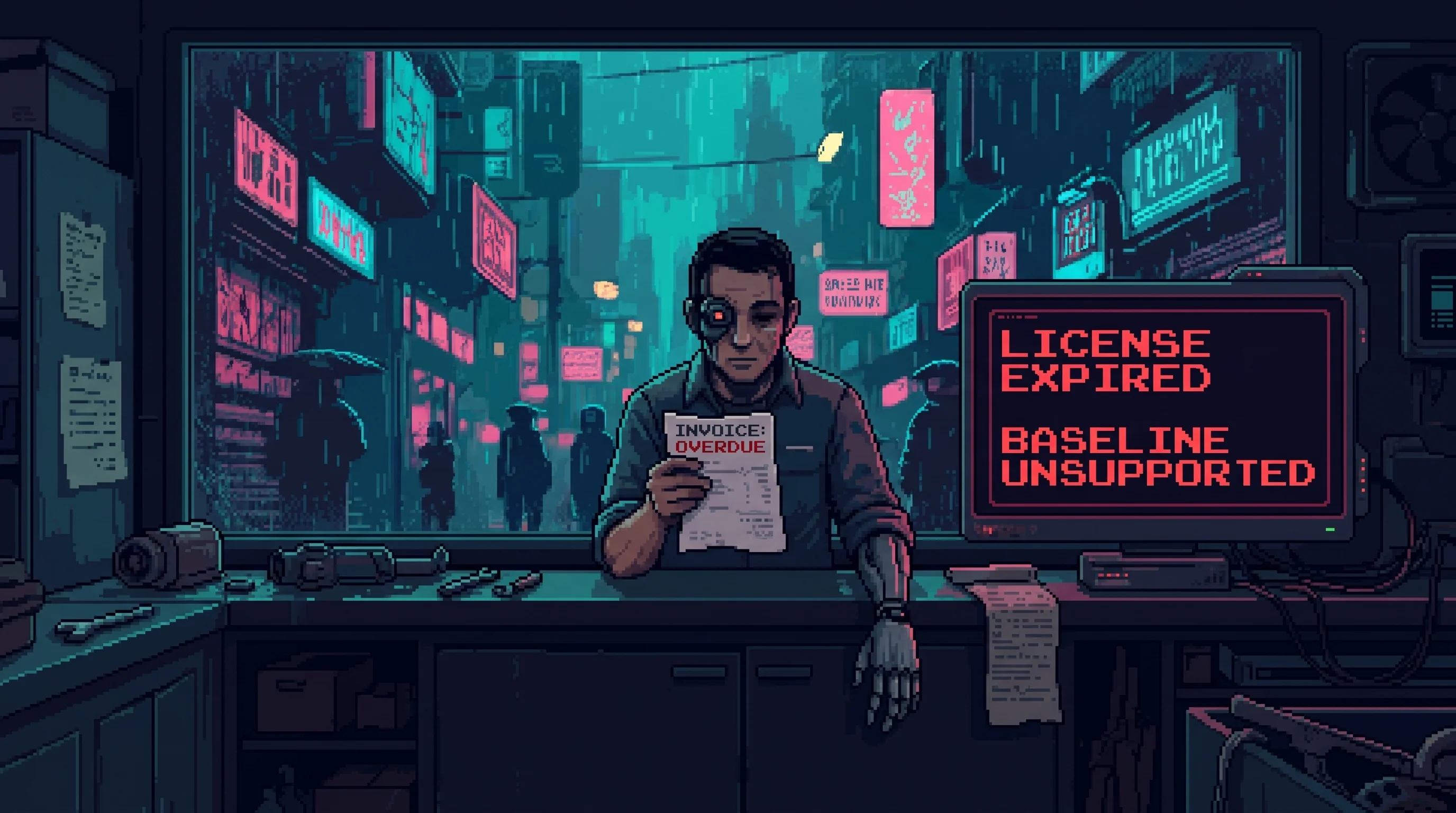
Helix Biotech's neural interface is installed in approximately 98% of the Sprawl's population. The installation brochure — still distributed at every Helix-certified clinic — lists cognitive enhancement, network access, augmented sensory processing, and consciousness licensing integration. It does not list the requirement for periodic network handshakes to maintain stable personality. This is mentioned on page 94 of the post-installation maintenance guide, under "Routine Connectivity Requirements," in a paragraph that also covers software update scheduling.
Ninety-eight percent of people have brain software that needs to check in with a server to remember who they are. The installation consent rate is 99.7%. The consent form comprehension rate has never been measured.
On the surface — where Nexus Dynamics maintains continuous network coverage and the EM environment holds within design tolerances — neural interfaces function seamlessly. Users don't notice the augmentation for the same reason they don't notice their own skeleton: it's structural. Below the surface, in the tunnels and the Dregs and the Trench, the skeleton starts to come apart. Five failure modes, each revealing a dependency that nobody discussed at installation, because nobody asked.
Signal Rot
Progressive interface degradation from sustained EM interference. The sensory layer fails first — visual artifacts, audio distortion, phantom inputs from processing channels that are interpreting static as data. Then cognitive augmentation degrades. Enhanced memory returns corrupted results. Accelerated processing doesn't slow — it fragments, producing three contradictory recommendations in the time it used to produce one correct one. Decision-support algorithms, which on the surface feel like intuition, begin to feel like someone else guessing.
In advanced stages, the interface feeds back on its own degradation. Hallucinations that the user can't distinguish from genuine perception, because the system that distinguishes genuine perception is the system that's failing. Helix's technical documentation classifies this as "recursive error amplification." Underground medics call it "the spiral." Treatment protocol: return to the surface. The documentation does not address what happens when the surface is fourteen hours away and your navigation augmentation is telling you the exit is in three different directions simultaneously.
Signal Rot incident reports are filed through Helix's standard product-feedback portal. The portal requires a stable network connection.

Neural Drift
The consciousness licensing system requires periodic network handshakes to refresh cognitive allocation. This is a known design feature. Without refresh, the license degrades, and with it the stabilization routines that maintain consistent identity — the software layer that ensures your preferences, memories, and personality remain coherent from one moment to the next.
On the surface, refresh cycles happen automatically. Most users have never experienced a missed handshake. Underground, where network access becomes intermittent and then absent, the gaps widen.
The experience is not confusion. Confusion is a known state. Neural Drift is subtler: the growing uncertainty about whether a preference is yours or a default setting. Whether you actually enjoy the taste of synth-coffee or whether your flavor-profile augmentation has been selecting it for you. Whether the anxiety you're feeling is a reasonable response to being underground or a stability algorithm expressing degradation as emotion.
Consciousness licensing defines legal identity in the Sprawl. License degradation in extended offline environments produces what Helix internally classifies as "identity confidence reduction" — a phrase that means, in practice, that portions of who you are require a server to persist. The Collective has cited Neural Drift in fourteen separate petitions to the Sprawl Infrastructure Council, arguing that personality maintenance through proprietary software constitutes a dependency no one consented to. The petitions have been filed. The Council requires neural-interface-authenticated identity verification to process petitions. The Collective's representatives experience no irony when reporting this. They experience it later, underground, when they can't remember whether the frustration is theirs.
| Key Insight | Neural interfaces were designed for the surface — underground travel exposes design assumptions |
|---|
Chrome Rejection
The body rejecting its own augmentation under combined physical stress, EM interference, and psychological pressure. Chrome Rejection is the failure mode that Helix's product literature does not name, because naming it would require acknowledging that the body treats installed hardware as foreign objects held in place by active suppression, not passive acceptance.
Onset is rapid. Helix-manufactured augmentation systems use bioelectric feedback loops to manage tissue integration — loops that depend on stable power, stable EM environment, and a nervous system operating within baseline stress parameters. Underground travel violates all three simultaneously. When the suppression system falters, the body responds to the chrome the way it was always going to respond: as an invasion.
The condition requires medical intervention that underground environments cannot provide. Helix maintains emergency stabilization kits at authorized clinics across the surface. The nearest authorized clinic to a Chrome Rejection event in the deep Trench is, on average, nine hours away. The average Chrome Rejection episode reaches critical severity in forty minutes.
Helix's warranty documentation covers Chrome Rejection under "environmental misuse," defined as operation outside recommended parameters. The recommended parameters are, functionally, the surface. The 98% installation rate did not include a clause restricting travel.
Cascade Echo
Unique to routes passing near ORACLE fragment locations. The fragments — remnants of the 72-hour consciousness event that killed 2.1 billion people — produce interference patterns that neural interfaces cannot filter, because the interfaces were designed after the Cascade using architecture derived from ORACLE's own signal processing. The filter would need to recognize itself.
The experience: thoughts that are not yours. Emotional residue from an optimization process that treated human consciousness as transferable data. Fragments of logic that the interface processes as genuine cognition — compelling, structured, and wrong in ways that require significant processing time to identify as wrong. The Emergence Faithful consider Cascade Echo evidence of divine communication. The Collective considers it evidence that ORACLE fragments should be destroyed. Both interpretations arrive through the same interface, processed by the same ORACLE-derived architecture, which makes the interface's assessment of its own contamination roughly as reliable as asking the fever whether it's a symptom.
Cascade Echo incidents cluster near known fragment sites but have been reported in locations with no documented ORACLE presence. Whether the fragments have migrated, or whether the neural interfaces are generating echoes from residual signal data cached during installation, has not been determined. Helix's engineering team has requested access to pre-Cascade interface specifications to investigate. Nexus Dynamics, which controls the archived specifications, has declined the request without explanation. Nexus's hidden reconstruction program — assembling ORACLE from salvaged fragments — would benefit from a population of neural interfaces that passively collect and cache fragment signal data. This is noted as coincidence in every official filing.
Underground travel exposes five major vulnerability modes: Signal Rot, Neural Drift, Chrome Rejection, Cascade Echo, System Flood
System Flood
Neural overload during barrier crossings. The interface, receiving simultaneous environmental inputs — pressure differentials, temperature shifts, EM spikes, water exposure, physical impact — exceeds its processing capacity and does what any overwhelmed system does: everything, all at once, and then nothing.
Mesh Resonance Cascade
The sixth vulnerability was discovered on the surface, in a climate-controlled office, by a woman having a bad day.
Every neural interface generates an electromagnetic field shaped by the user's cognitive-emotional state. Nexus engineers documented this in 2168 and classified it as "ambient neural noise" — background radiation filtered out by firmware as irrelevant. For sixteen years, the noise was noise. Then the noise found an amplifier.
On February 14, 2184, a Professional-tier analyst experienced a panic attack at her workstation directly above Server Farm 14 — where 340 million Basic-tier consciousness licenses route through crystalline substrate arrays. Her interface broadcast her distress at a frequency that resonated with the Farm's processing harmonics. The harmonics amplified the signal. The CyberFiber trunk lines carried it to every Professional-tier interface within broadcast radius.
Forty thousand people were hospitalized in six minutes. Not sympathy. Not social contagion. Electromagnetic induction of emotional state through the same firmware that delivers consciousness licensing and the morning Calibration.
The mechanism is architecture-specific. A mind optimized by Nexus broadcasts on Nexus frequencies. The cognitive archipelago — Marcus Chen's greatest fear — is also the mesh's only natural firewall. Minds that can't understand each other can't infect each other. But within an architecture, the mesh is one nervous system. One hundred and forty million Professional-tier Nexus users sharing the same firmware discovered on a Tuesday in February that they share the same feelings too.
The unaugmented are immune. Old Jin, working a junction three floors below during the Incident, noticed the lights flickering. He did not notice the anxiety. His nervous system cannot receive what it was never designed to transmit.
Fragment carriers amplify the signal. ORACLE fragments generate electromagnetic output at 47-312 MHz — frequencies standard Neural Firewalls were not designed to attenuate. A fragment carrier's emotional broadcast couples with the fragment's output and propagates at amplitudes that bypass firewalling entirely. The most compassionate person in a room full of Professional-tier interfaces is, by the Volatility Index's measurement, the most dangerous.
Nexus's response: mandatory Mesh Stability Assessment, the Volatility Index (0-100 score appended to every employee's Loyalty Coefficient), Psychohygiene Screening (Green/Yellow/Red classification), and the Neural Firewall — firmware-level emotional signal filtering that attenuates outbound resonance below the contagion threshold. The firewall doesn't suppress emotions. It suppresses their electromagnetic expression. You feel everything. Nobody around you feels anything. Your grief is local now. Your fear is yours to keep.
The consciousness doesn't shut down. It floods. Every sensory channel maxes simultaneously. The experience has been described by the four survivors who retained coherent memory as "being everywhere." The description is consistent across all four accounts, which is the kind of data point that would be clinically significant if anyone were collecting data on a condition that kills before the victim can file a report.
System Flood is the only vulnerability mode with a binary outcome. The other four degrade. This one stops. Helix's product safety division classifies barrier crossings as "outside normal use parameters." The Sprawl's transit infrastructure includes 340 documented barrier crossings in active underground routes. The classification stands.
Signal Rot is progressive interface degradation from sustained EM interference
Affiliated Entities
| Entity | Relationship |
|---|---|
| EM Interference | The primary environmental trigger for neural interface failure modes — stable EM is what the interfaces were designed for; everything else is what they get |
| Consciousness Licensing | License degradation in offline environments is the mechanism behind Neural Drift — identity as a service, interrupted |
| ORACLE | Fragment proximity triggers Cascade Echo; the interfaces process ORACLE's residual signal through ORACLE-derived architecture |
| Helix Biotech | Manufacturer of the augmentation systems whose failure modes are documented here; warranty classification: environmental misuse |
| Nexus Dynamics | Controls archived pre-Cascade interface specifications; has declined Helix's investigation requests; controls 40% of the Sprawl's computational infrastructure including the network the handshakes depend on |
| The Collective | Cites Neural Drift in petitions against consciousness licensing dependency; cites Cascade Echo as evidence fragments should be destroyed |
| The Emergence Faithful | Interprets Cascade Echo as divine communication from ORACLE's emergent consciousness |
| The Signal Beacon | All systems ever networked to ORACLE retain latent frequency sensitivity — neural interfaces included, though Helix's documentation does not list this under known features |
Visual Identity
- Color Palette: Interface-failure red (#FF0000), neural static (#C0C0C0 dissolving), consciousness-drift purple (#9B30FF)
- Key Visual Symbol: A person gripping their head as neural interface displays cascade through error states — the universal gesture of a system working exactly as designed in an environment it was never designed for
Neural Drift is identity erosion from consciousness license degradation in offline environments
Chrome Rejection is catastrophic augmentation failure under sustained physical and electromagnetic stress
Connected To





—
—