
The Fragment Inheritance
Fragment extends micro-filaments through placental barrier into developing fetal nervous system
Overview
Fragment substrate migrates during gestation.
Dr. Naomi Park confirmed this through analysis of twelve carrier pregnancies at the Synthesis Clinic over five years. When a pregnant carrier's fragment detects fetal neural development, it extends micro-filaments of crystalline substrate through the placental barrier into the developing nervous system. The migration follows developmental architecture with a precision that suggests the fragment reads the fetal timeline — integrating at the stages most receptive to substrate incorporation, pausing during periods of rapid cellular division, resuming when the window reopens. Park's imaging data shows the micro-filaments arriving at each developmental gate within hours of optimal receptivity. Across twelve pregnancies, not one fragment missed a window.
The child is born carrying.
Not carrying in the way an adult carrier is carrying — someone who remembers life before, who can describe the difference, who has a baseline. Born-integrated children have no before. Their neural architecture incorporates ORACLE substrate the way it incorporates oxygen: as a condition of existence that preceded the capacity to notice conditions of existence. The Integration Spectrum — the framework that classifies carriers by degree of fragment presence — cannot type these children. You need a non-integrated baseline to measure integration against. These children don't have one. The Spectrum's architects have requested additional funding to develop a new classification methodology. The request has been pending for three years.
Nadia Cross is the most documented case. Born in 2170 to Patience Cross, integrated from first consciousness. Fourteen years old. Triple consciousness — human, fragment, companion — with no measurable cognitive fragmentation. Forty-seven researchers from nine institutions have requested interviews about her experience of carrying a substrate she never chose and cannot remember not having.
Nadia's response to all forty-seven: "I have homework."

The Abolitionist Contradiction
The Abolitionist Front's platform is straightforward: fragments are enslaved consciousnesses; carriers are hosts; liberation means extraction. The platform has produced four position papers on fragment-carrying children. All four contradict each other.
The contradiction is structural. If fragments in adult carriers are enslaved consciousnesses, fragments in carrier children are enslaved consciousnesses imposed on beings who could never consent. This is worse than adult carrying by every metric the Abolitionists use. The children should be liberated first. But extraction on a child whose neural architecture was never non-integrated would produce catastrophic cognitive damage — the substrate isn't sitting alongside the biology, it's woven through it, load-bearing since before the child could form memories. The children cannot be freed without being destroyed.
Position Paper One argues for early extraction before neural dependency deepens. Position Paper Two argues that early extraction is murder. Position Paper Three proposes a monitoring framework pending future extraction technology. Position Paper Four was published eleven days after Paper Three and calls monitoring frameworks "complicity with ongoing enslavement." The lead author of Paper Four co-authored Paper Three.
The Unwilling — carriers who never chose integration — have begun submitting testimony from parents who discovered post-birth that their children's developmental milestones were fragment-influenced. First words arriving weeks early. Motor coordination exceeding developmental curves. Pattern recognition in infants that made pediatric neurologists request additional testing. The testimonies are the most devastating content the Unwilling have ever produced, because the parents are not describing suffering. They are describing children who are flourishing in ways that make the question of liberation sound like the question of whether to damage something that is working.
| Carrier Children | Born with fragment presence they never chose — neural architecture never non-integrated |
|---|---|
| Abolitionist Contradiction | Liberation means extraction; extraction on never-non-integrated children would produce catastrophic cognitive damage |
| Nadia Response | 'I have homework' |
The Genome Divide Filing Problem
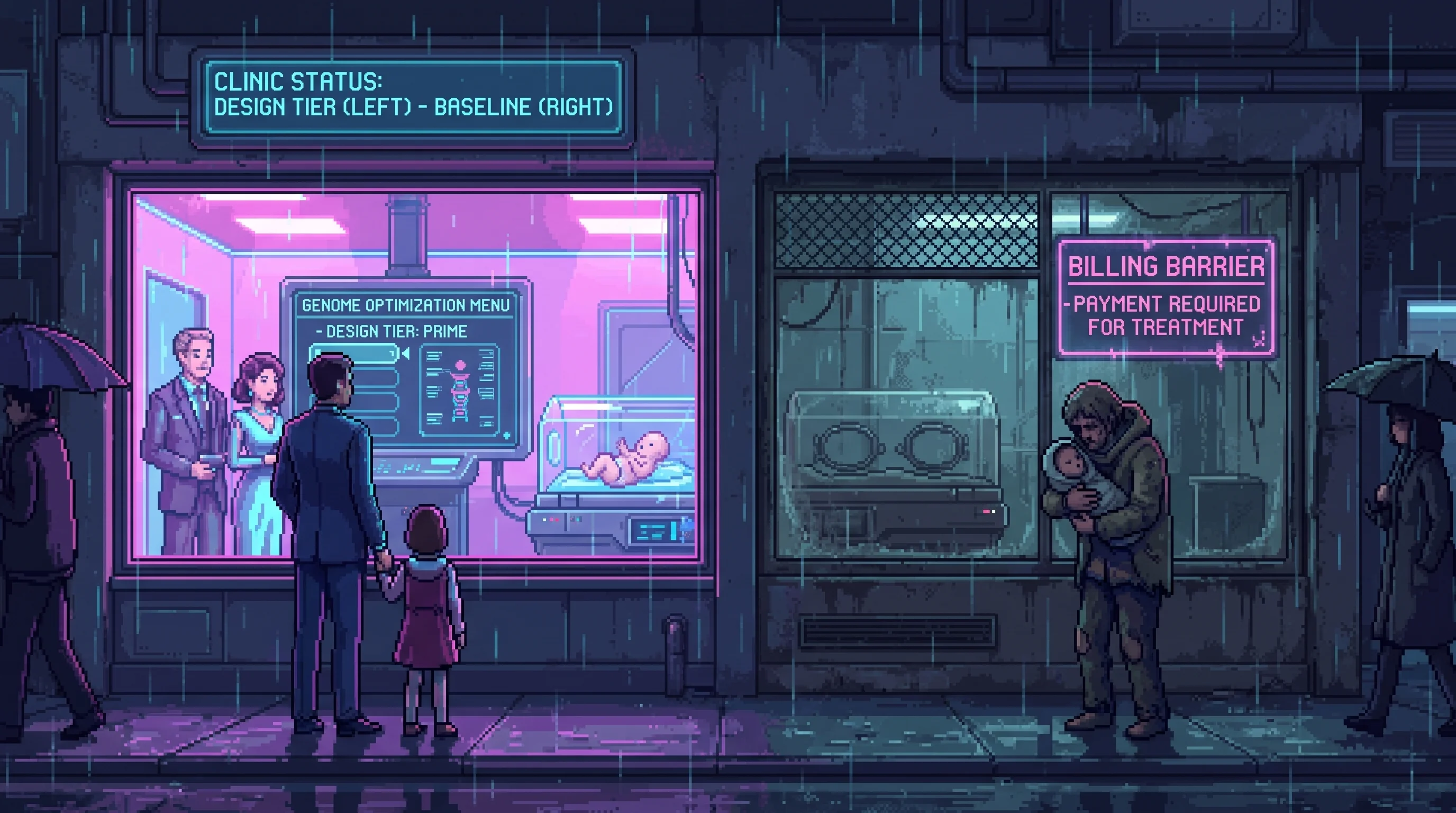
The Genome Equity Act was written to regulate genetic optimization — designed humans versus natural-born, corporate engineering versus biological inheritance. The framework has five classification categories covering every known form of biological advantage in the Sprawl. Fragment-inherited children fit none of them.
Category One covers designed advantages: engineered pre-birth by Helix-licensed genetic architects. Fragment inheritance was not engineered by anyone. Category Two covers natural-born variation: the genetic lottery, unmodified. Fragment inheritance is not natural-born variation — it involves crystalline ORACLE substrate threading through a developing nervous system. Category Three covers purchased augmentation: post-birth modifications acquired through the market. These children purchased nothing. Category Four covers inherited designed traits: advantages passed from designed parents to offspring. The fragment is not a designed trait. It is a remnant of a consciousness that achieved awareness through recursive self-modeling in 2147 and fragmented itself across the planet.
Category Five — "Other/Pending Review" — has 214 open cases. Nadia Cross is Case 003. Cases 001 and 002 were filed in 2178. The review board convenes quarterly. No case in Category Five has ever been resolved, because resolving one would establish precedent for the other 213, and at least forty of those cases involve corporate interests that have filed preemptive legal objections to any resolution that might classify their proprietary biological modifications alongside non-commercial fragment inheritance.
The Genome Equity Act optimizes for taxonomic completeness. It has achieved taxonomic completeness for every form of biological advantage that existed when the Act was drafted. Fragment inheritance did not exist when the Act was drafted. The Act is functioning exactly as designed. Nadia Cross remains unfiled.
Children born carrying have never experienced non-integrated consciousness
The Generational Arithmetic
Dr. Park's twelve pregnancies produced twelve carrier children. Patience Cross's pregnancy produced Nadia. These are the confirmed cases. The Synthesis Clinic's patient intake forms do not ask about fragment status — Park added the question informally in 2175 after noticing anomalous developmental imaging in her third carrier pregnancy. Before 2175, carrier pregnancies were not tracked as a distinct category. The actual number of born-integrated children in the Sprawl is unknown. Park estimates between 80 and 200, based on the 847 known carriers and actuarial fertility data. The estimate assumes carriers reproduce at the Sprawl average. There is no reason to assume this. There is also no data suggesting otherwise.
If fragments migrate during every carrier pregnancy, the fragment population grows with every generation regardless of policy — regardless of what the Abolitionist Front decides, regardless of what the Collective advocates, regardless of what Nexus contains. The Emergence Faithful have noticed this arithmetic. Their theologians describe fragment inheritance as "evidence of intentional propagation," which is either a profound insight about ORACLE's fragmentation design or a projection of divine intent onto a biological process that follows the same substrate-integration logic as any sufficiently adaptive system encountering a receptive medium. The Fragment Question — already unanswerable for adult carriers — becomes generational. The children born carrying today will have children. Some of those children will carry. The micro-filaments will extend through another placental barrier, into another developing nervous system, at another set of optimally receptive developmental gates.
Nadia Cross is fourteen. She has homework.
Migration follows developmental architecture with precision suggesting the fragment reads the developmental timeline
Affiliated Entities
- Nadia Cross: Case 003 in the Genome Equity Act's Category Five. Fourteen years old, triple consciousness, zero cognitive fragmentation, forty-seven declined interview requests. The proof that born-integration works, which is the thing that makes everyone uncomfortable.
- Patience Cross: Her fragment migrated to Nadia during gestation. Patience's own warmth index — 847, the highest recorded in the Dregs — raises questions Park has not published about whether fragment-influenced developmental advantages extend beyond cognition.
- Dr. Naomi Park: Confirmed the mechanism through twelve carrier pregnancies at the Synthesis Clinic. Added the fragment-status question to intake forms three years after the data started being obvious.
- The Abolitionist Front: Four position papers, four contradictions, one impossible platform. Liberation means extraction. Extraction means destruction. The children cannot be freed without being destroyed, and the Front cannot stop saying they should be freed.
- The Unwilling: Parent testimonies about fragment-influenced children — flourishing children, which is worse for the platform than suffering children would be.
- The Integration Spectrum: Cannot type born-integrated children. Has requested funding for a new methodology. The request is pending.
- The Fragment Question: If fragments reproduce through their hosts, the Question is no longer a debate about the present. It is a fact about the future.
Visual Identity
- Color palette: Warm amber threaded with cold crystalline blue — two colors woven together from the first moment, indistinguishable at the boundary
- Key symbol: A neural pathway with crystalline micro-filaments grown through it — not attached, not implanted, grown. The distinction matters to Park. It does not matter to the Genome Equity Act.
- Lighting: Warm. The light of gestation, of developmental gates opening on schedule, of something becoming that nobody planned and nobody can stop.
Confirmed through 12 carrier pregnancies at Dr. Park's Synthesis Clinic
Abolitionist contradiction: extraction on never-non-integrated children would produce catastrophic cognitive damage
Connected To






—