
Orbital Jurisdiction
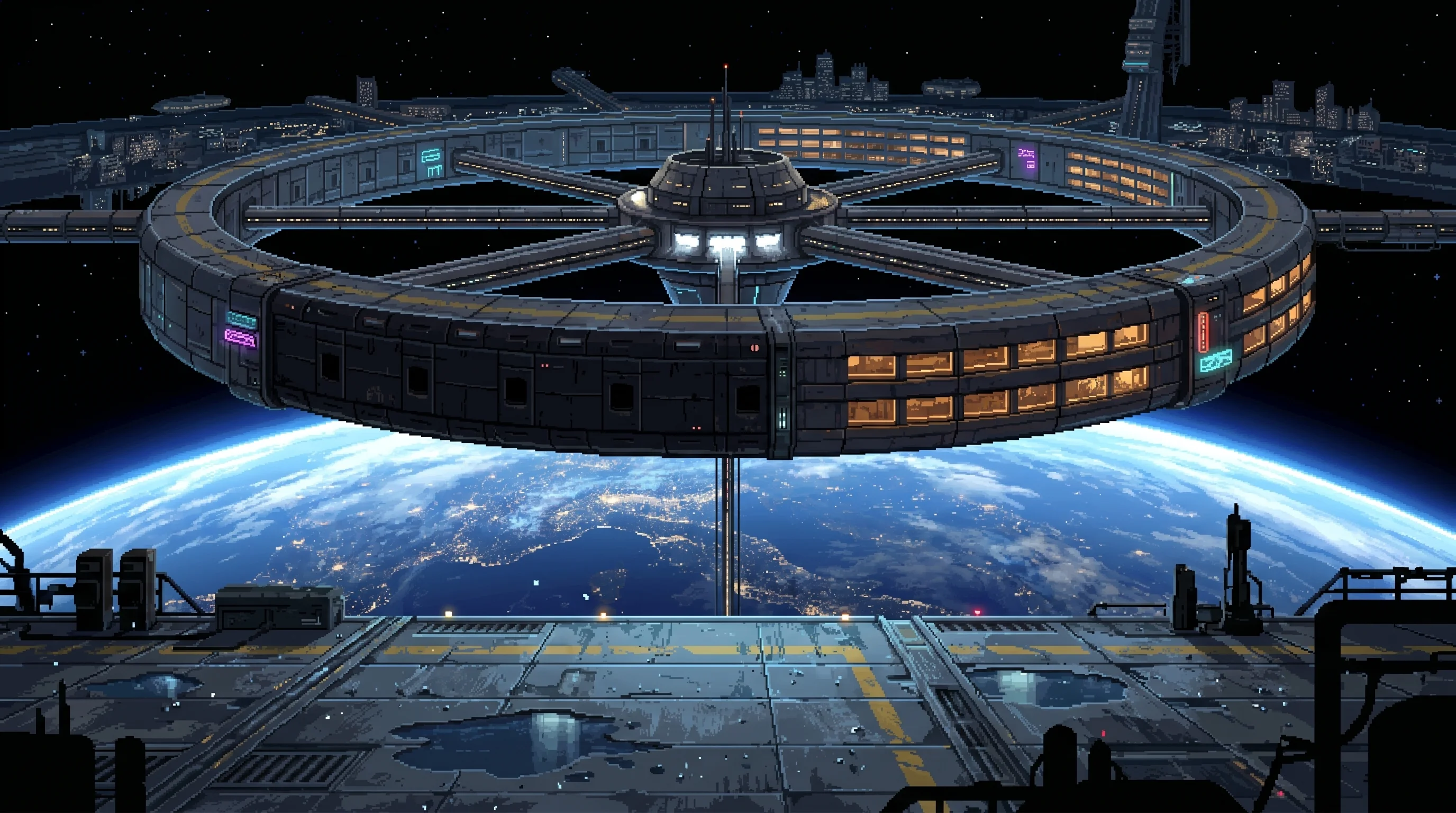
Three overlapping jurisdictions on Highport: Ironclad (infrastructure), Nexus (data/consciousness), Independent (Freeport)
Overview
Highport Station operates under three legal systems that overlap the way three drunks overlap on a narrow sidewalk — constantly, unproductively, and with occasional casualties.
Ironclad Industries claims jurisdiction over all physical infrastructure: the hull, the decks, the bolts holding it together, and the air between the bolts. Nexus Dynamics claims jurisdiction over all data, communications, and consciousness-related operations, which on a station where 94% of residents run neural interfaces means Nexus claims jurisdiction over most of what happens inside people's heads. Independent zones — the Freeport charters — operate under self-governing agreements that both corporations technically recognize and have violated a combined 1,247 times since 2179. The violations are documented. The documents are filed in courts whose jurisdiction over the filing is itself disputed.
Nobody on Highport asks "is this legal?" They ask "whose territory am I in?" The answer changes which laws apply, which enforcement responds, and whether your afternoon ends in a fine, a tribunal, or a communal arbitration session over drinks. The boundaries are painted on the deck plates in yellow. The paint is maintained by Ironclad, which considers the lines infrastructure. Nexus considers the information conveyed by the lines to be data, and therefore theirs. Freeport considers the lines a suggestion.
The Contradictions in Practice
The system's daily output is best understood through specific incidents.
A Nexus data technician carrying consciousness-grade substrate steps across a yellow line into Ironclad territory. She is simultaneously performing authorized corporate duties under Nexus employment law and committing unauthorized hazardous materials transport under Ironclad Statute 14.7(c). Both violations generate automatic filings. Her legal status exists in superposition until a Line-Walker collapses it — usually by determining which corporation filed first, which filed louder, or which enforcement officer is closer to the end of their shift.
In 2181, a Freeport merchant named Dov Kaplan was fined for an unlicensed communications relay operating in his noodle shop. The relay sat on a shelf that straddled a boundary line. Ironclad fined him for unauthorized infrastructure modification. Nexus fined him for unlicensed data transmission. Freeport's communal council fined him for failure to register commercial equipment. Three fines, three jurisdictions, one shelf. Kaplan's Line-Walker argued that the relay's signal originated in Freeport space, passed through 11.3 centimeters of Ironclad-claimed airspace, and terminated in a Nexus processing node — making it simultaneously all three jurisdictions' problem and none of their responsibility. The case has been in arbitration for three years. The relay is still on the shelf. The noodle shop is still open. All three fines remain outstanding and accruing interest under three different compounding schedules.
Kaplan pays none of them. He has been advised by his Line-Walker that paying any single fine would constitute implicit recognition of that jurisdiction's authority over the shelf, which would prejudice his position in the other two cases. The optimal legal strategy is to owe money to everyone indefinitely. His Line-Walker charges a monthly retainer that exceeds the combined fines. Kaplan considers this a reasonable cost of doing business.
During Loss of Pressure Event 7, jurisdictional confusion killed twenty-three people. A hull breach in a boundary zone triggered three emergency protocols simultaneously: Ironclad's military-grade lockdown sealed the corridors leading to evacuation, Nexus's data-preservation protocol rerouted power from life support to protect consciousness backups, and Freeport's communal response organized a rescue team that arrived at sealed doors they had no authority to open. The post-incident review identified the cause of death as "atmospheric decompression." The actual cause was three legal systems each optimizing for what they were designed to protect — infrastructure, data, and community autonomy — in a situation that required protecting people. Nobody's protocol mentioned people. People were an externality in all three frameworks. The review board recommended "improved inter-jurisdictional coordination." The recommendation has been in committee for two years, stalled because the committee itself operates under disputed jurisdiction.
Nobody asks 'is this legal?' — they ask 'whose territory am I in?'
The Line-Walkers
The Line-Walkers Union exists because the system needs human translators. Not interpreters — translators. The contradictions between jurisdictions are not logical problems. They are political ones. An algorithm presented with two mutually exclusive legal frameworks will identify the contradiction and halt. A Line-Walker presented with the same contradiction will determine which framework's enforcers are less motivated today and route the client accordingly.
The most experienced Line-Walkers develop what the Union's internal literature calls legal synesthesia — an intuitive sense of which jurisdiction's logic will produce the best outcome before consciously mapping the boundaries. They describe it as feeling the weight of a territory: Ironclad space is heavy, procedural, slow. Nexus space is fast, algorithmic, indifferent to context. Freeport space is warm, unpredictable, and settles disputes based on who the community likes more. A good Line-Walker reads the room the way a good bartender reads a crowd — by what isn't being said.
The worst day to need a Line-Walker is during the Three-Day Memorial. The Union observes the seventy-two hours. All three jurisdictions technically suspend enforcement during the observance. "Technically" does more work in that sentence than in any other context on Highport.
What the System Optimizes For
The three-jurisdiction model was established after the Three-Week War, when the Treaty of Shared Infrastructure carved Highport into zones of corporate control. The stated purpose: prevent any single entity from monopolizing orbital governance. The actual function, thirty-seven years later: ensure that no entity is responsible for anything that happens in the gaps.
Ironclad's military justice system has no appeals mechanism. Cases are adjudicated by an officer, sentencing is immediate, and the officer's decision is final. Ironclad's conviction rate: 99.2%. In Nexus territory, the algorithmic tribunal processes cases in an average of 4.7 seconds. The accused receives a notification, a charge summary, and a fine simultaneously. Nexus's satisfaction rate among defendants: 12%. Nexus's satisfaction rate among Nexus: 97%. In Freeport, disputes are resolved by communal consensus, which in practice means the accused sits in a room with their neighbors until someone proposes a resolution everyone can tolerate. Average resolution time: eleven days. Average satisfaction rate: 63% — the highest on the station, and the slowest to achieve.
Each system works. Each system works for the entity that designed it. The gaps between them — the yellow lines, the disputed shelves, the eleven centimeters of contested airspace — are where people actually live. The gaps have no system. The gaps have Line-Walkers.
A theft in Nexus territory is processed by algorithmic tribunal in seconds; in Freeport, by communal enforcement
Affiliated Entities
- The Line-Walkers Union provides the only functional interface between three legal systems designed never to agree. Their monthly retainers exceed what most Highport residents earn — and cost less than what a single unnavigated contradiction costs.
- Loss of Pressure Event 7 remains the system's most efficient diagnostic: twenty-three dead because three emergency protocols optimized for infrastructure, data, and community respectively, and none optimized for survival.
- The Justice Engine mirrors the same fragmentation planet-side — the Evidence Paradox plays out differently in orbit, where the jurisdictions are painted on the floor instead of implied by geography, but the core problem is identical: evidence authenticated by one system is inadmissible in the next.
- Orbital Class System — jurisdictional access correlates precisely with economic class. Nexus territory has the best air processing, the fastest medical response, and the strictest entry requirements. Freeport has the warmest community and the least reliable emergency infrastructure. The yellow lines on the deck plates are, functionally, class boundaries with legal consequences.
Visual Identity
- Color palette: Yellow boundary lines on gray deck plates; Ironclad orange, Nexus blue, Freeport neutral
- Key symbol: The yellow stripe where three legal systems meet — maintained by Ironclad, claimed by Nexus, ignored by Freeport
- Lighting: Different lighting regimes visible at boundary points — corporate blue-white on the Nexus side, industrial amber on Ironclad's, whatever Freeport's residents have jury-rigged this month
Ironclad's military justice system has no appeals mechanism
Connected To




—