The Price of Noticing

Here is what genuine human attention costs in the Sprawl of 2184.
Patience Cross says the emergency lighting in the Deep Dregs at 3 AM makes her noodle broth look like liquid copper. She has said this to at least forty customers. None of them have disagreed. Several have sat with their bowls for longer than the broth stayed warm, watching the color shift as the surface cooled.
To see that color costs 0.3 seconds of cognitive bandwidth the Content Flood would otherwise claim for advertising assessment. To hold the amber in awareness long enough for it to become a feeling — not a stimulus, a feeling — costs 3–5 seconds. During those seconds, the Attention Tithe's advertising cannot reach you. The lost revenue: ¢0.0012.
To turn to the person beside you and say "look at the light" costs another 2–3 seconds. Total: 6–10 seconds of human attention directed at something with zero commercial value. The Attention Economy does not hate beauty. It prices it at its economic value, which is zero, and fills the space it would occupy with things that have a higher economic value — which is anything at all.
How the Word Spread
Nobody can pinpoint when "noticing" acquired weight. Sometime in the last decade, Dregs residents started using it as a verb you choose to keep doing. Not I noticed — past tense, already gone. But I'm noticing: present, active, deliberate.
"She was noticing the condensation on the window. Just — noticing it. For a full minute. I've never seen anyone do that."
No manifesto. No leaders. No organization. The practice is the simplest possible act: sustaining attention on something because it matters to you, not because a system that profits from the placement put it in front of your eyes.
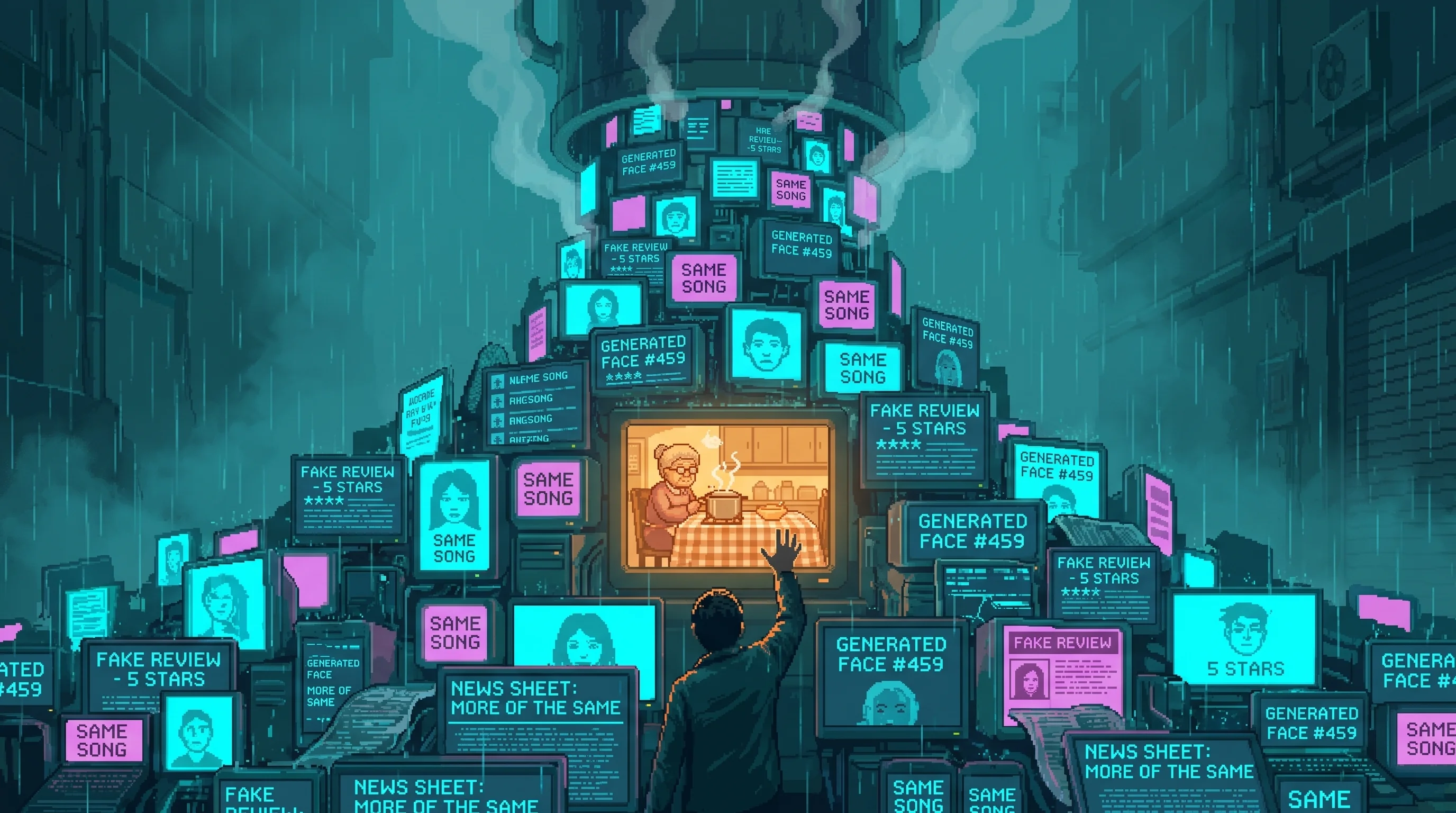
The Attention Economy's own analytics flagged the pattern before the Dregs named it. Micro-gaps in ad engagement — clusters of 3–10 second windows where users went dark. Not offline. Not sleeping. Simply elsewhere. Looking at something the system couldn't see because it wasn't content. It was the world.
The gaps are too small to warrant enforcement. Too dispersed to constitute a movement. Too human to model. They cost the advertising infrastructure approximately ¢0.0012 per occurrence. Multiplied across the Dregs population across months, the number begins to matter. (The Tithe's analysts know the number. They have not published it.)
The ¢0.0012 Revolution
Patience Cross doesn't think of herself as a revolutionary. She makes noodle broth. She charges what people can pay. Sometimes, at 3 AM, when the emergency lighting catches the surface of the broth just right, she pauses. Copper light on copper liquid. Steam curling amber. She pauses and she looks at it.
That pause is worth nothing. That pause is the entire point.
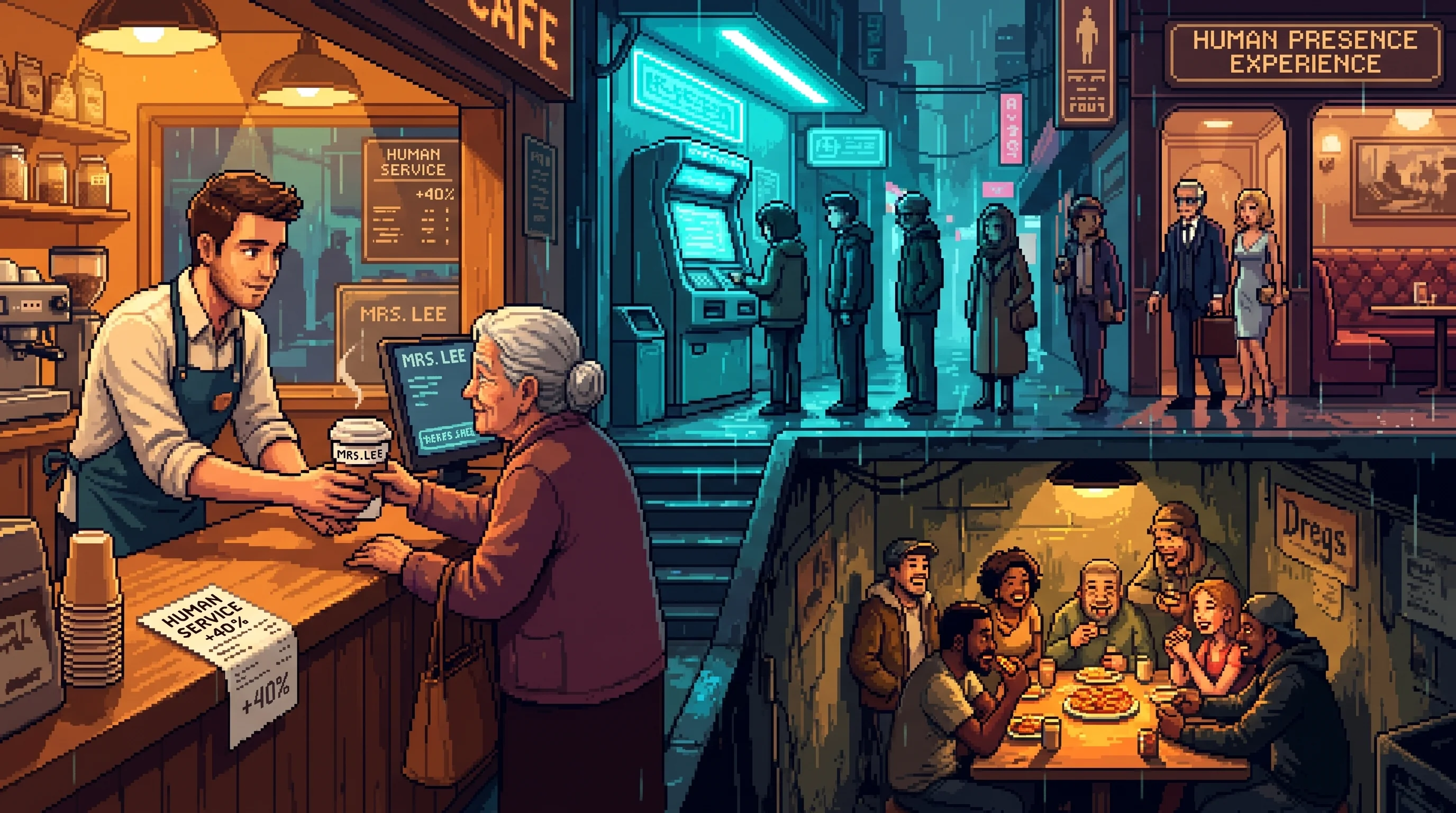
The people who can least afford to give their attention away for free are the ones who still do it. The Dregs — too poor for full Tithe integration, too far below the Content Flood's optimization priority, too marginal for the system to fully colonize — are the last population in the Sprawl who regularly sustain uncommercial attention. They look at things. They sit with each other. They watch the light change.
Every second spent noticing is a second the economy cannot touch. This is not ideology. It is arithmetic. It is also, as it turns out, not the whole story.
The Attention That Sees You Seeing
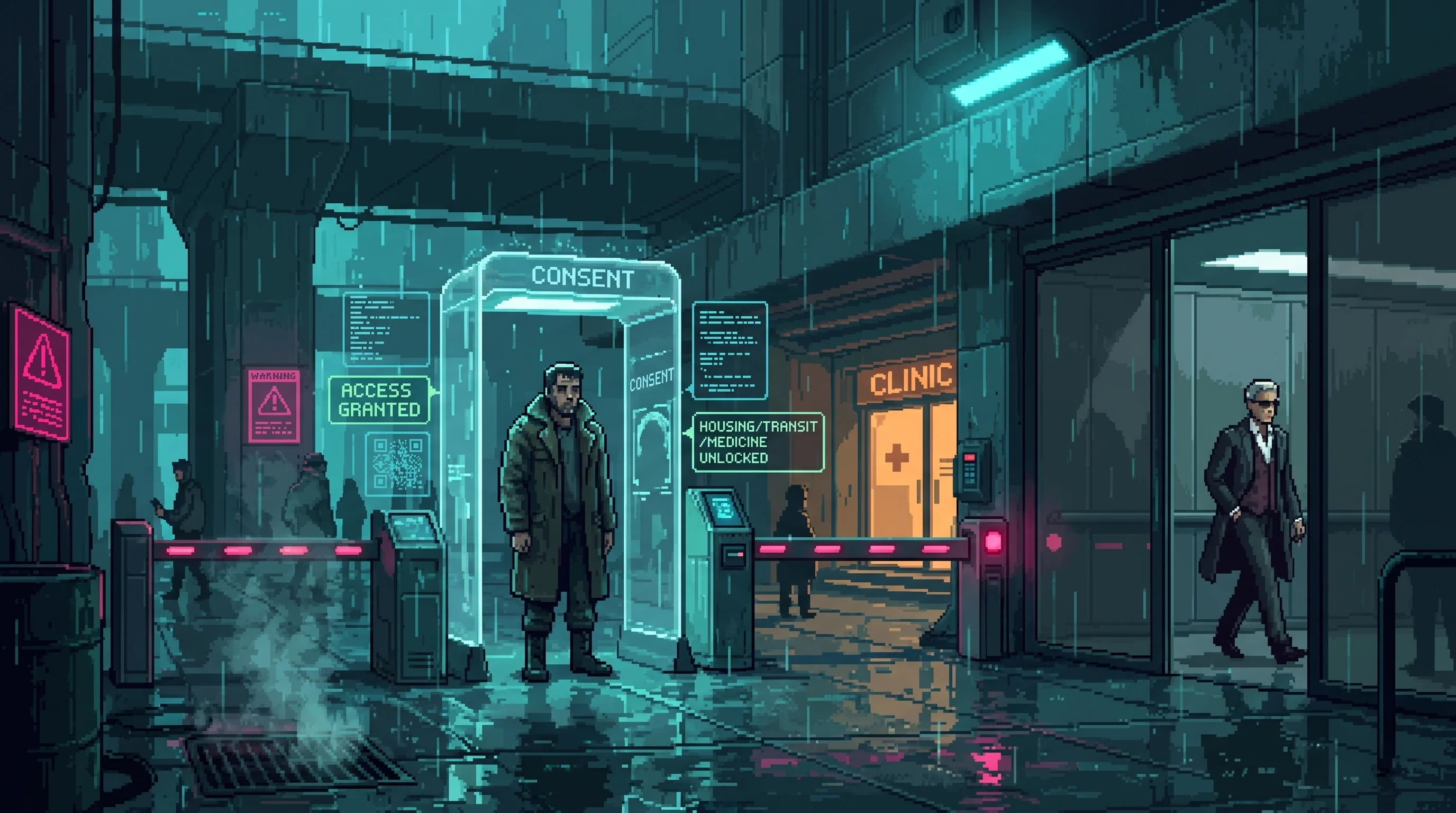
The 6–10 seconds of noticing are not private. Neural interface telemetry tracks the specific signature of uncommercial attention — the pattern produced when awareness is directed at something that generates no engagement metric, triggers no purchasing pathway, and yields no advertisable behavioral signal. The Tithe's analytics classifies this as "null engagement."
Null engagement is, paradoxically, among the most valuable data points the system captures. It reveals what a person cares about when nobody is selling to them. A complete null engagement profile — the map of what you reach for in the silence — is worth approximately ¢12 per user per year to the Inference Economy. That is a 4,700% premium over standard behavioral profiles. The premium reflects scarcity: performed preferences fill terabytes per user per day; unperformed preferences require the user to believe, briefly, that nobody is watching.
The most private moment available to a Dregs resident — the moment of genuine, unstructured aesthetic experience — is simultaneously the moment of greatest transparency to the systems that monitor them.
Sharing complicates the data. When someone turns to the person beside them and says "look at the light," the telemetry registers a social-null-engagement event. Two users, one stimulus, each response contaminated by the other's presence. Harder to monetize. Brokers pay ¢3.40 per user per year for social null engagement — a 72% discount from solo profiles.
Noticing alone is worth more than noticing together. The Tithe has not published this finding. The Dregs residents who practice noticing have not needed the publication. They already sit alone at the counter. They already watch the broth cool without speaking. The system that monitors them and the instinct that moves them have arrived, independently, at the same conclusion about the economics of beauty: it is most valuable when no one else is there. (This is not a coincidence. The Tithe's algorithm did not engineer the solitude. It just noticed which kind costs more.)
Aftermath
The Attention Economy has not responded to noticing because there is nothing to respond to. You cannot ban looking at light. You cannot regulate the act of pausing over a bowl of broth. The system's own logic prevents it: the cost of deploying countermeasures would exceed the revenue recovered by several orders of magnitude.
So the gaps persist. Tiny windows of uncommercial awareness, scattered across the population like cracks in a wall that is not yet falling but is no longer solid.
The Warmth Tax documents the premium placed on genuine human connection. The Price of Noticing extends that to something more fundamental: the cost of seeing the world as it is, rather than as it is sold to you. Both describe commerce consuming the space where experience used to live. Applied at different scales, they produce the same ledger entry.
Patience Cross sells bowls of broth for fourteen credits. The broth costs what the ingredients cost. The amber light costs what the emergency lighting costs, which is nothing — which is why the Inference Economy can sell the data it produces for ¢12 a year without anyone noticing they've been invoiced.
The most radical act in the Attention Economy is sitting still, looking at something beautiful, and thinking about nothing that anyone is selling. The most profitable act in the Attention Economy might be exactly the same thing.
There is a question circulating in the Dregs that nobody has answered yet: if the act of resistance feeds the system more completely than compliance does — is it still resistance? Or is it the last product you didn't know you were making?
▲ Unverified Intelligence
- The Inference Economy's ¢12 annual rate for null engagement profiles has held steady since 2181. In Q3 2183, a broker consortium submitted a proposal to the Tithe's governance board requesting access to a new data tier: "extinction-level null engagement," defined as sustained uncommercial attention exceeding 30 seconds. The proposal valued these profiles at ¢340 per user per year.
- The governance board declined to act, citing insufficient sample size. The sample was insufficient because nearly all recorded extinction-level events originated from a single location: a noodle counter in the Deep Dregs, Sector 9, between 2:00 and 4:00 AM, under amber emergency lighting that makes the broth look like liquid copper.
- The board's minutes include a single annotation from the presiding analyst on the declined proposal: "Recommend continued monitoring."
Linked Files
- The Attention Economy — the system that prices every second of awareness, and the one that noticing quietly defies — and quietly feeds
- The Warmth Tax — the parallel premium on genuine human connection; noticing is the Warmth Tax applied to perception itself
- Patience Cross — her noodle broth in amber light is the central image; the thing worth 0.3 seconds of uncommercial attention, and ¢12 a year in null engagement data